Lucía Marín Fabián
1º Bachillerato, 2011-2012
I.E. “V. Cañada Blanch” London
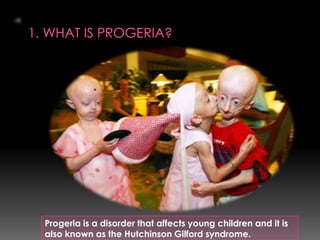
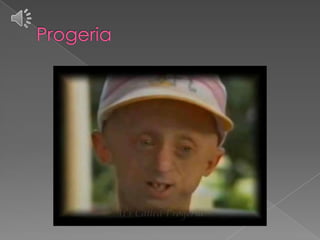
Progeria is a disorder that affects young children and it is
also known as the Hutchinson Gilford syndrome.
Progeria affects children and gives them an old person’s
appearance. The classic type of Progeria (there are
different forms) is the Hutchinson-Gilford Progeria Syndrome
(HGPS).
   At present there are 53
    known cases of Progeria
    around the world and only 2
    in the UK
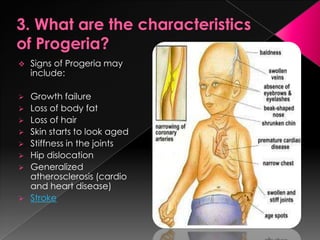
   Signs of Progeria may
    include:

   Growth failure
   Loss of body fat
   Loss of hair
   Skin starts to look aged
   Stiffness in the joints
   Hip dislocation
   Generalized
    atherosclerosis (cardio
    and heart disease)
   Stroke
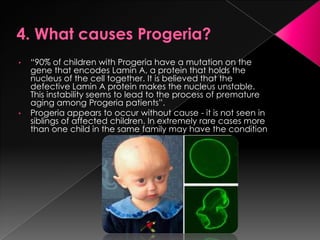
•   “90% of children with Progeria have a mutation on the
    gene that encodes Lamin A, a protein that holds the
    nucleus of the cell together. It is believed that the
    defective Lamin A protein makes the nucleus unstable.
    This instability seems to lead to the process of premature
    aging among Progeria patients”.
•   Progeria appears to occur without cause - it is not seen in
    siblings of affected children. In extremely rare cases more
    than one child in the same family may have the condition
Treatment
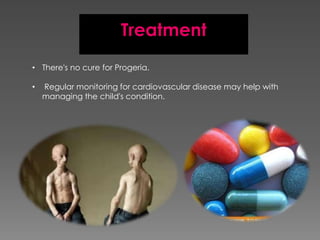
• There's no cure for Progeria.

•   Regular monitoring for cardiovascular disease may help with
    managing the child's condition.
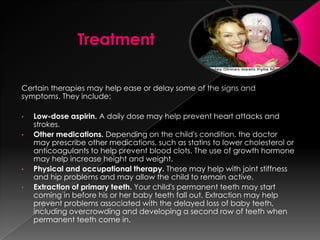
Certain therapies may help ease or delay some of the signs and
symptoms. They include:

•   Low-dose aspirin. A daily dose may help prevent heart attacks and
    strokes.
•   Other medications. Depending on the child's condition, the doctor
    may prescribe other medications, such as statins to lower cholesterol or
    anticoagulants to help prevent blood clots. The use of growth hormone
    may help increase height and weight.
•   Physical and occupational therapy. These may help with joint stiffness
    and hip problems and may allow the child to remain active.
•   Extraction of primary teeth. Your child's permanent teeth may start
    coming in before his or her baby teeth fall out. Extraction may help
    prevent problems associated with the delayed loss of baby teeth,
    including overcrowding and developing a second row of teeth when
    permanent teeth come in.
 www.medicalnewstoday.com
 http://healthmad.com/conditions-and-
  diseases/progeria-the-80-year-old-children/
 Hayley’s page.
 www.mayoclinic.com
 Google images.
 www.youtube.com
Progeria , by Lucia

Progeria , by Lucia

  • 1.
    Lucía Marín Fabián 1ºBachillerato, 2011-2012 I.E. “V. Cañada Blanch” London
  • 2.
    Progeria is adisorder that affects young children and it is also known as the Hutchinson Gilford syndrome.
  • 3.
    Progeria affects childrenand gives them an old person’s appearance. The classic type of Progeria (there are different forms) is the Hutchinson-Gilford Progeria Syndrome (HGPS).
  • 4.
    At present there are 53 known cases of Progeria around the world and only 2 in the UK
  • 5.
    Signs of Progeria may include:  Growth failure  Loss of body fat  Loss of hair  Skin starts to look aged  Stiffness in the joints  Hip dislocation  Generalized atherosclerosis (cardio and heart disease)  Stroke
  • 6.
    “90% of children with Progeria have a mutation on the gene that encodes Lamin A, a protein that holds the nucleus of the cell together. It is believed that the defective Lamin A protein makes the nucleus unstable. This instability seems to lead to the process of premature aging among Progeria patients”. • Progeria appears to occur without cause - it is not seen in siblings of affected children. In extremely rare cases more than one child in the same family may have the condition
  • 7.
    Treatment • There's nocure for Progeria. • Regular monitoring for cardiovascular disease may help with managing the child's condition.
  • 8.
    Certain therapies mayhelp ease or delay some of the signs and symptoms. They include: • Low-dose aspirin. A daily dose may help prevent heart attacks and strokes. • Other medications. Depending on the child's condition, the doctor may prescribe other medications, such as statins to lower cholesterol or anticoagulants to help prevent blood clots. The use of growth hormone may help increase height and weight. • Physical and occupational therapy. These may help with joint stiffness and hip problems and may allow the child to remain active. • Extraction of primary teeth. Your child's permanent teeth may start coming in before his or her baby teeth fall out. Extraction may help prevent problems associated with the delayed loss of baby teeth, including overcrowding and developing a second row of teeth when permanent teeth come in.
  • 10.
     www.medicalnewstoday.com  http://healthmad.com/conditions-and- diseases/progeria-the-80-year-old-children/  Hayley’s page.  www.mayoclinic.com  Google images.  www.youtube.com