PROGERIA SYNDROME
Prepared by: Halil Eryalçın
What is Progeria?
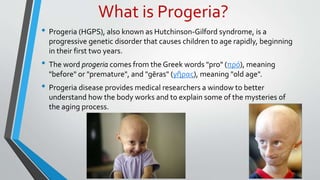
• Progeria (HGPS), also known as Hutchinson-Gilford syndrome, is a
progressive genetic disorder that causes children to age rapidly, beginning
in their first two years.
• The word progeria comes from the Greek words "pro" (πρό), meaning
"before" or "premature", and "gēras" (γῆρας), meaning "old age".
• Progeria disease provides medical researchers a window to better
understand how the body works and to explain some of the mysteries of
the aging process.
• Children with Progeria generally appear normal at birth. By 12 months, signs
and symptoms, such as slow growth and hair loss, begin to appear.
• The average life expectancy for a child with Progeria is about 13, but some
with the disease die younger and some live 20 years or longer.
Frequency
• Progeria is listed as a "rare disease" by the Office of Rare Diseases (ORD) of
the National Institutes of Health (NIH)(USA).
• HGPS prevalence is reported to be 1 in 8 million births.
• The true prevalence, however, has been suggested to be closer to 1 in 4
million births because many cases likely go undiagnosed or are
misdiagnosed.
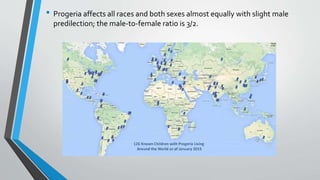
• Progeria affects all races and both sexes almost equally with slight male
predilection; the male-to-female ratio is 3/2.
What is the cause?
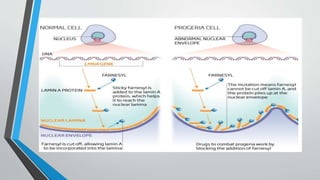
• HGPS is caused by a mutation in the gene called LMNA.
• The LMNA gene produces the lamin A protein which is the structural
scaffolding that holds the nucleus of a cell together.
• The abnormal lamin A protein that causes Progeria is called
progerin. Progerin makes the nucleus unstable. That cellular instability
leads to the process of premature aging and disease in Progeria.
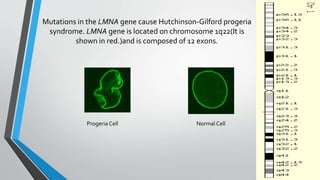
Mutations in the LMNA gene cause Hutchinson-Gilford progeria
syndrome. LMNA gene is located on chromosome 1q22(It is
shown in red.)and is composed of 12 exons.
Progeria Cell Normal Cell
What are the Symptoms?
• Although they are born looking healthy, children with Progeria begin to
display many characteristics of accelerated aging at around 18-24 months of
age.
• The children have a remarkably similar appearance, despite differing ethnic
backgrounds.
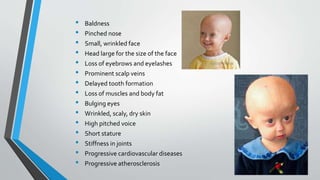
• Most of the following features are manifested after the age of three years in
children with Hutchinson-Gilford progeria syndrome:
• Baldness
• Pinched nose
• Small, wrinkled face
• Head large for the size of the face
• Loss of eyebrows and eyelashes
• Prominent scalp veins
• Delayed tooth formation
• Loss of muscles and body fat
• Bulging eyes
• Wrinkled, scaly, dry skin
• High pitched voice
• Short stature
• Stiffness in joints
• Progressive cardiovascular diseases
• Progressive atherosclerosis
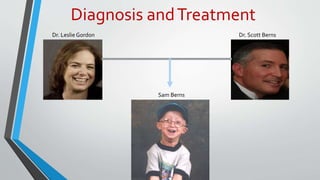
Diagnosis andTreatment
Dr. Scott BernsDr. Leslie Gordon
Sam Berns
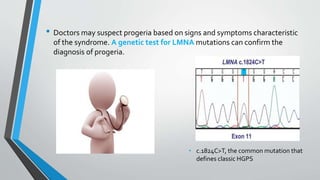
• Doctors may suspect progeria based on signs and symptoms characteristic
of the syndrome. A genetic test for LMNA mutations can confirm the
diagnosis of progeria.
• c.1824C>T, the common mutation that
defines classic HGPS
In September 2012 when the first-ever drug treatment was discovered. Every child in
the clinical trial involving Lonafarnib, a farnesyl transferase inhibitor, showed
improvement in one or more of four ways:
• gaining additional weight
• better hearing
• improved bone structure
• most importantly, increased flexibility of blood vessels
Unfortunately, the treatment
didn’t come soon enough for
Sam. He died on 23 october
2010.
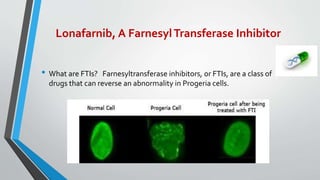
Lonafarnib, A FarnesylTransferase Inhibitor
• What are FTIs? Farnesyltransferase inhibitors, or FTIs, are a class of
drugs that can reverse an abnormality in Progeria cells.
Thanks For Listening!

Progeria Syndrome

  • 1.
  • 2.
    What is Progeria? •Progeria (HGPS), also known as Hutchinson-Gilford syndrome, is a progressive genetic disorder that causes children to age rapidly, beginning in their first two years. • The word progeria comes from the Greek words "pro" (πρό), meaning "before" or "premature", and "gēras" (γῆρας), meaning "old age". • Progeria disease provides medical researchers a window to better understand how the body works and to explain some of the mysteries of the aging process.
  • 3.
    • Children withProgeria generally appear normal at birth. By 12 months, signs and symptoms, such as slow growth and hair loss, begin to appear. • The average life expectancy for a child with Progeria is about 13, but some with the disease die younger and some live 20 years or longer.
  • 4.
    Frequency • Progeria islisted as a "rare disease" by the Office of Rare Diseases (ORD) of the National Institutes of Health (NIH)(USA). • HGPS prevalence is reported to be 1 in 8 million births. • The true prevalence, however, has been suggested to be closer to 1 in 4 million births because many cases likely go undiagnosed or are misdiagnosed.
  • 5.
    • Progeria affectsall races and both sexes almost equally with slight male predilection; the male-to-female ratio is 3/2.
  • 6.
    What is thecause? • HGPS is caused by a mutation in the gene called LMNA. • The LMNA gene produces the lamin A protein which is the structural scaffolding that holds the nucleus of a cell together. • The abnormal lamin A protein that causes Progeria is called progerin. Progerin makes the nucleus unstable. That cellular instability leads to the process of premature aging and disease in Progeria.
  • 8.
    Mutations in theLMNA gene cause Hutchinson-Gilford progeria syndrome. LMNA gene is located on chromosome 1q22(It is shown in red.)and is composed of 12 exons. Progeria Cell Normal Cell
  • 9.
    What are theSymptoms? • Although they are born looking healthy, children with Progeria begin to display many characteristics of accelerated aging at around 18-24 months of age. • The children have a remarkably similar appearance, despite differing ethnic backgrounds. • Most of the following features are manifested after the age of three years in children with Hutchinson-Gilford progeria syndrome:
  • 10.
    • Baldness • Pinchednose • Small, wrinkled face • Head large for the size of the face • Loss of eyebrows and eyelashes • Prominent scalp veins • Delayed tooth formation • Loss of muscles and body fat • Bulging eyes • Wrinkled, scaly, dry skin • High pitched voice • Short stature • Stiffness in joints • Progressive cardiovascular diseases • Progressive atherosclerosis
  • 11.
    Diagnosis andTreatment Dr. ScottBernsDr. Leslie Gordon Sam Berns
  • 13.
    • Doctors maysuspect progeria based on signs and symptoms characteristic of the syndrome. A genetic test for LMNA mutations can confirm the diagnosis of progeria. • c.1824C>T, the common mutation that defines classic HGPS
  • 14.
    In September 2012when the first-ever drug treatment was discovered. Every child in the clinical trial involving Lonafarnib, a farnesyl transferase inhibitor, showed improvement in one or more of four ways: • gaining additional weight • better hearing • improved bone structure • most importantly, increased flexibility of blood vessels Unfortunately, the treatment didn’t come soon enough for Sam. He died on 23 october 2010.
  • 15.
    Lonafarnib, A FarnesylTransferaseInhibitor • What are FTIs? Farnesyltransferase inhibitors, or FTIs, are a class of drugs that can reverse an abnormality in Progeria cells.
  • 16.