Progeria
Submitted to: Mrs.Kennedy&Miss O’neill
Submitted by: Morgan DeGruchy
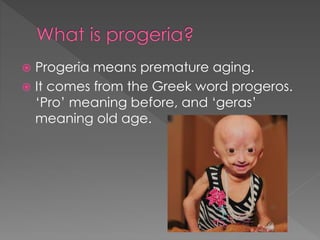
What is progeria?
 Progeria means premature aging.
 It comes from the Greek word progeros.
‘Pro’ meaning before, and ‘geras’
meaning old age.
Dominant or Recessive?
 The gene for progeria is unknown but
believed to be dominant.
 Children with progeria have a mutation
on the gene that encodes Lamin A, a
protein that holds the nucleus of the cell
together.
 It’s believed that the defective Lamin A
causes the nucleus of the cell to
become unstable.
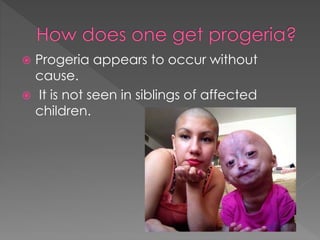
How does one get progeria?
 Progeria appears to occur without
cause.
 It is not seen in siblings of affected
children.
Diagnosis.
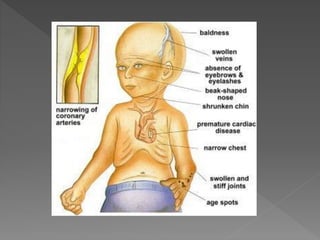
 Children with Progeria are born looking
healthy. When they are about 10 to 24 months
old, features of accelerated aging start to
appear. Signs of Progeria may include:
 Growth failure
 Loss of body fat
 Loss of hair
 Skin starts to look aged
 Stiffness in the joints
 Hip dislocation
 Heart problems
 Stroke
Heredity?
 Experts do not believe that Progera is
hereditary.
 It is due to a rare gene change which
happens purely by chance. So It’s hard
to say is heredity.
 In about 1 in every 100 cases is passed
down to the next generation within the
same family.
Is there a cure?
 There is no for sure cure but they have
found something to slow it down.
 They’re doing their best to find a way to
stop it completely but they’re yet to
figure it out for sure.
How prevalent is progeria?
 Progeria affects approximately 1 in 4 - 8
million newborns.
 There are an estimated 200-250 children
living with Progeria worldwide at any one
time.
 It affects both sexes equally and all
races.
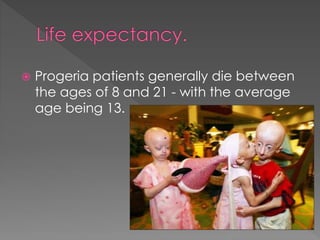
Life expectancy.
 Progeria patients generally die between
the ages of 8 and 21 - with the average
age being 13.
Karyotype?
 The most common cause of progeria will
not show up on a karyotype; it is a point
mutation of a gene on chromosome
one.
Everyday life
 People with progeria can do things just
like normal people, but for them their is a
down fall because where their bodies
are aging so much faster they mostly all
are getting arthritis in their joints, and
very stiff muscles which causes them
pain.
› http://www.youtube.com/watch?v=Cp_b2K
OrvuI

Progeria PPT 1………………………………………………………………..

  • 1.
    Progeria Submitted to: Mrs.Kennedy&MissO’neill Submitted by: Morgan DeGruchy
  • 2.
    What is progeria? Progeria means premature aging.  It comes from the Greek word progeros. ‘Pro’ meaning before, and ‘geras’ meaning old age.
  • 3.
    Dominant or Recessive? The gene for progeria is unknown but believed to be dominant.  Children with progeria have a mutation on the gene that encodes Lamin A, a protein that holds the nucleus of the cell together.  It’s believed that the defective Lamin A causes the nucleus of the cell to become unstable.
  • 4.
    How does oneget progeria?  Progeria appears to occur without cause.  It is not seen in siblings of affected children.
  • 5.
    Diagnosis.  Children withProgeria are born looking healthy. When they are about 10 to 24 months old, features of accelerated aging start to appear. Signs of Progeria may include:  Growth failure  Loss of body fat  Loss of hair  Skin starts to look aged  Stiffness in the joints  Hip dislocation  Heart problems  Stroke
  • 7.
    Heredity?  Experts donot believe that Progera is hereditary.  It is due to a rare gene change which happens purely by chance. So It’s hard to say is heredity.  In about 1 in every 100 cases is passed down to the next generation within the same family.
  • 8.
    Is there acure?  There is no for sure cure but they have found something to slow it down.  They’re doing their best to find a way to stop it completely but they’re yet to figure it out for sure.
  • 9.
    How prevalent isprogeria?  Progeria affects approximately 1 in 4 - 8 million newborns.  There are an estimated 200-250 children living with Progeria worldwide at any one time.  It affects both sexes equally and all races.
  • 10.
    Life expectancy.  Progeriapatients generally die between the ages of 8 and 21 - with the average age being 13.
  • 11.
    Karyotype?  The mostcommon cause of progeria will not show up on a karyotype; it is a point mutation of a gene on chromosome one.
  • 12.
    Everyday life  Peoplewith progeria can do things just like normal people, but for them their is a down fall because where their bodies are aging so much faster they mostly all are getting arthritis in their joints, and very stiff muscles which causes them pain.
  • 13.