Human Genetic Disorders
•The following is a presentation of several human
genetic disorders. Some of the pictures may be
disturbing. Please keep in mind that these
photographs are taken to assist the medical field in
correctly diagnosing genetic disorders.
• Photos are from Smith’s Recognizable Patterns of Human
Malformation, Chromosome Abnormalities, and Genetic
Counseling, Genetics In Medicine.
2.
Human Genetic Disorders
•Many of the disorders that will be discussed
during this presentation are in extremely
low frequency in the population. This
means that very few individuals in the
world suffer from these disorders.
3.
Human Genetics
• Heredity
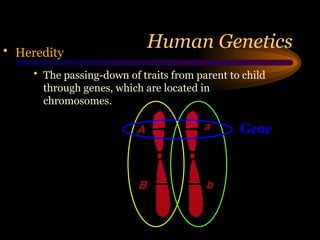
•The passing-down of traits from parent to child
through genes, which are located in
chromosomes.
Gene
4.
• Pedigree
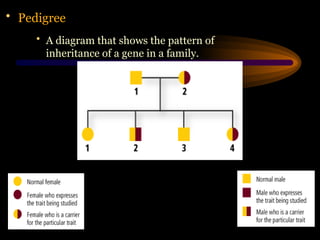
• Adiagram that shows the pattern of
inheritance of a gene in a family.
5.
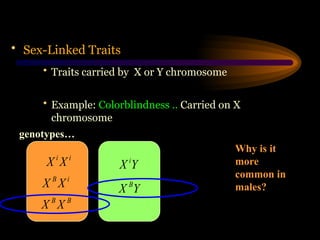
• Sex-Linked Traits
•Traits carried by X or Y chromosome
• Example: Colorblindness .. Carried on X
chromosome
genotypes…
i
B
X
X
i
i
X
X
B
B
X
X
Y
X i
Y
X B
Why is it
more
common in
males?
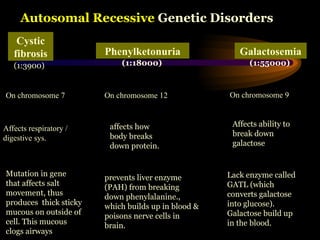
Autosomal Recessive GeneticDisorders
Cystic
fibrosis Galactosemia
Phenylketonuria
On chromosome 7
(1:3900)
Affects respiratory /
digestive sys.
Mutation in gene
that affects salt
movement, thus
produces thick sticky
mucous on outside of
cell. This mucous
clogs airways
On chromosome 12
affects how
body breaks
down protein.
(1:18000)
prevents liver enzyme
(PAH) from breaking
down phenylalanine.,
which builds up in blood &
poisons nerve cells in
brain.
(1:55000)
On chromosome 9
Affects ability to
break down
galactose
Lack enzyme called
GATL (which
converts galactose
into glucose).
Galactose build up
in the blood.
8.
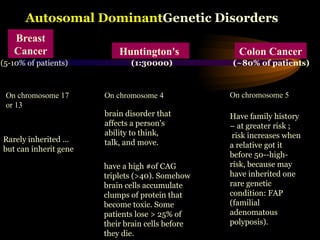
Autosomal DominantGenetic Disorders
Breast
CancerColon Cancer
Huntington's
On chromosome 17
or 13
(5-10% of patients)
Rarely inherited …
but can inherit gene
On chromosome 4
brain disorder that
affects a person's
ability to think,
talk, and move.
(1:30000)
have a high #of CAG
triplets (>40). Somehow
brain cells accumulate
clumps of protein that
become toxic. Some
patients lose > 25% of
their brain cells before
they die.
(~80% of patients)
On chromosome 5
Have family history
– at greater risk ;
risk increases when
a relative got it
before 50--high-
risk, because may
have inherited one
rare genetic
condition: FAP
(familial
adenomatous
polyposis).
9.
Aneuploidy
• Abnormal numberof chromosomes
• Trisomy disorders are considered major chromosomal
abnormalities that involve the addition of an extra
chromosome or part of a chromosome. Most individuals
will only have two copies of a single chromosome one that
was received from Mom and one received from Dad.
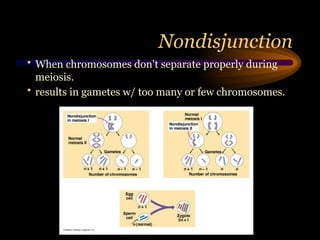
• These disorders are caused by a nondisjunction during the
process of meiosis and other factors.
• 1/5 of all conceptions and about 1/2 of all spontaneous
abortions have chromosome abnormalities
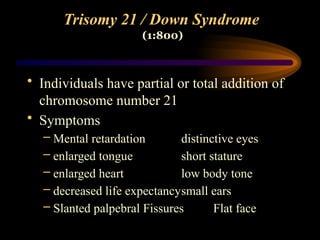
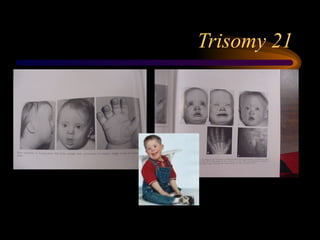
Trisomy 21 /Down Syndrome
• Individuals have partial or total addition of
chromosome number 21
• Symptoms
– Mental retardation distinctive eyes
– enlarged tongue short stature
– enlarged heart low body tone
– decreased life expectancysmall ears
– Slanted palpebral Fissures Flat face
(1:800)
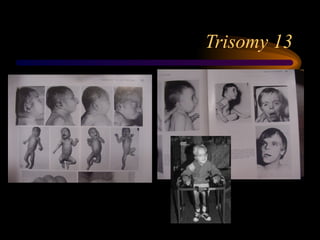
Trisomy 13 –Patau syndrome
• Symptoms
– defects of eye, nose, lip, and forebrain
– Polydactyly (more then 5 fingers or toes)
– hyperconvex fingernails (arches down)
• Only 18% survive the first year
• Survivors have severe mental defects
• seizures
(1:10000)
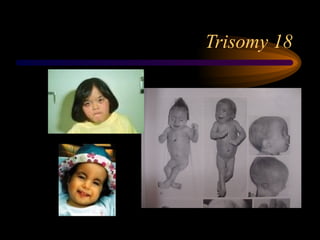
Trisomy 18- Edwardssyndrome
• Clenched hand
• Distinct patterns on the fingertip
• Low Arch Dermal - the crease on tip the 5th
finger is
missing.
• 80% die w/in first two months
• Only 10% survive the first year
• Usually feeble (weakness)
• Limited capacity for survival
• Resuscitation (artificial breathing) often performed at birth
• apneic episodes neonatally (stop breathing during sleep)
(1:3000)
Sex Chromosome Abnormalities
•A normal female has two X chromosomes
• A normal male has an X and a Y
chromosome
• There are several disorders where additional
sex chromosomes are present
22.
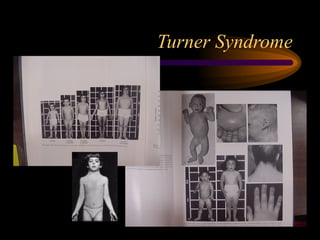
Turner Syndrome
• Femaleswith only one X sex chromosomes
• Physical Characteristics
– Short stature
– Web neck
– Infertile
– Normal intelligence
– Low posterior hairline
– broad chest with widely spaced nipples
– elevated frequency of renal (kidney) and cardiovascular
anomalies
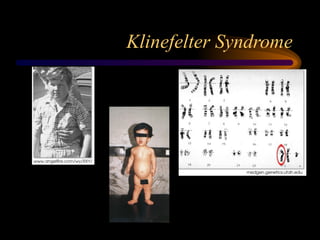
Klinefelter Syndrome
• XXY
•First sex chromosome abnormality to be reported
• Tall, thin relatively long legs
• appear normal until puberty
• Hypogonadism (sex hormones are not released)
• Infertile due to undeveloped sex orgnas
• significantly reduced IQ
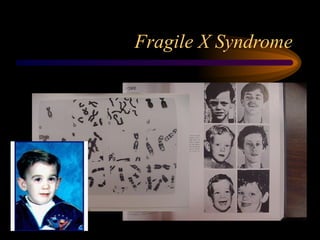
Fragile X Syndrome
•In males the lower portion of the X chromosome appears
constricted in a karyotype.
• Moderate mental retardation
• Fragile site - chromatin fails to condense during mitosis
• Females who carry the trait may also show
symptoms
• long face with a prominent jaw, large prominent ears,
high arched palate; flattened nasal bridge; Prominent
forehead
Fragile x syndromeis like Autism
• Developmental delay, speech delay, short attention span or
hyperactivity, mouthing of objects persisting at an age
beyond expected, difficulty in disciplining the child,
frequent temper tantrums, autistic-like behaviors such as
rocking, talking to oneself, spinning, unusual hand
movements, difficulty with transitions, preference for
being alone, echolalia, poor eye contact; poor motor
coordination; history of vomiting, spitting up or colic
during infancy; history of self-abusive behavior; hand
flapping; drooling persisting beyond expected; increase
fighting with others; hand/thumb sucking.
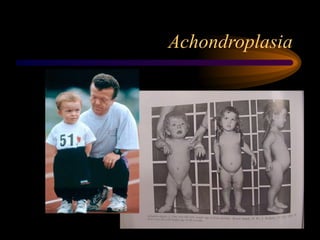
Achondroplasia
• Dwarfism- smallstature
• Large head
• Skeletal disorders
• Narrow nasal passages
• Respiratory problems
• 90% of cases are fresh mutations
• Older paternal age is a contributing factor to
mutation
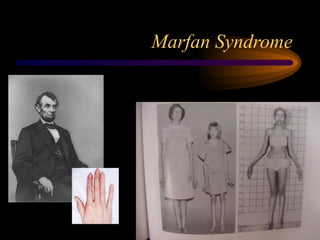
Marfan Syndrome
• Tallstature with long slim limbs
• Low tone muscles
• Little subcutaneous or skin fat
• 60% scoliosis
• Heart disorders (thought that Abraham
Lincoln had this disorder)
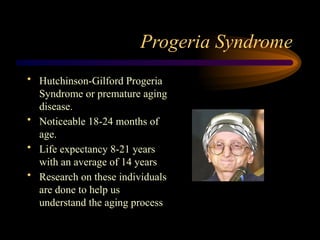
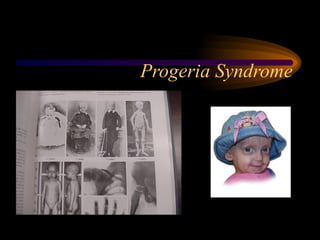
Progeria Syndrome
• Hutchinson-GilfordProgeria
Syndrome or premature aging
disease.
• Noticeable 18-24 months of
age.
• Life expectancy 8-21 years
with an average of 14 years
• Research on these individuals
are done to help us
understand the aging process
35.
Progeria Syndrome
• Agedlooking skin
• Growth failure
• Hip dislocation
• Arthritis, joint stiffness
• Cardiovascular atherosclerosis disease and stroke,
eventually leading to death.
• Enlarged heart and high blood pressure
• Not specific to sex or ethnicity
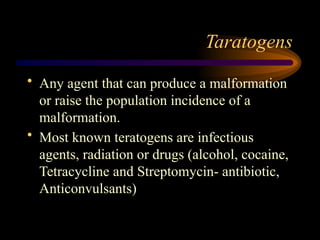
Taratogens
• Any agentthat can produce a malformation
or raise the population incidence of a
malformation.
• Most known teratogens are infectious
agents, radiation or drugs (alcohol, cocaine,
Tetracycline and Streptomycin- antibiotic,
Anticonvulsants)
38.
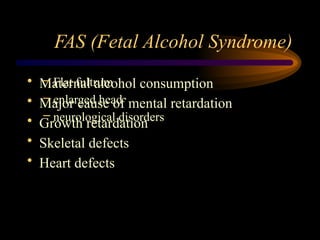
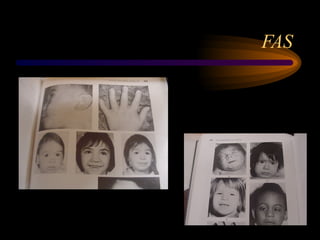
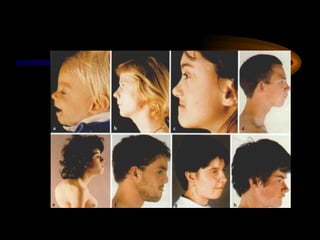
FAS (Fetal AlcoholSyndrome)
• Maternal alcohol consumption
• Major cause of mental retardation
• Growth retardation
• Skeletal defects
• Heart defects
– Flat fultrum
– enlarged head
– neurological disorders
Metabolic Disorders
• Thesedisorders are characteristic of a
breakdown of a biochemical pathway which
can cause minor problems or major
problems.
• Several of these disorders
42.
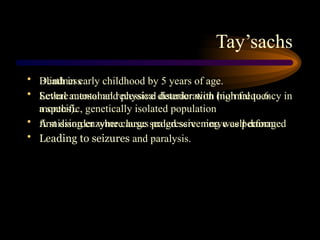
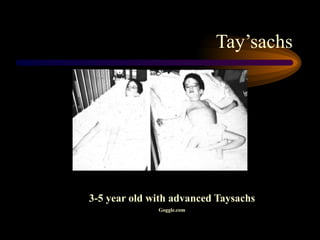
Tay’sachs
• Blindness
• Severemental and physical deterioration (normal to 6
months).
• A missing enzyme causes progressive nerve cell damage.
• Leading to seizures and paralysis.
• Death in early childhood by 5 years of age.
• Lethal autosomal recessive disorder with high frequency in
a specific, genetically isolated population
• first disorder where large scaled screening was performed
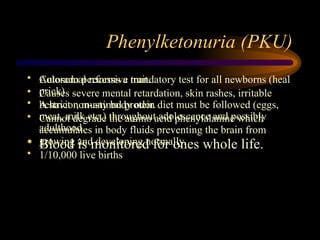
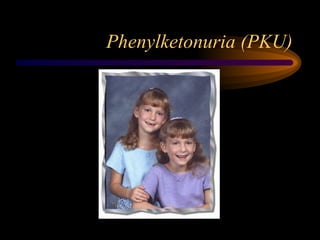
Phenylketonuria (PKU)
• Autosomalrecessive trait.
• Causes severe mental retardation, skin rashes, irritable
behavior, musty body odor.
• Cannot degrade the amino acid phenylalanine which
accumulates in body fluids preventing the brain from
growing and developing normally.
• 1/10,000 live births
• Colorado performs a mandatory test for all newborns (heal
prick)
• A strict non-animal protein diet must be followed (eggs,
meat, milk etc.) throughout adolescence and possibly
adulthood.
• Blood is monitored for ones whole life.
Genomic Imprinting
• Theexpression of the disease phenotype
depends on whether it has been inherited
from the father or from the mother.
• Prader-Willi Syndrome vs. Angelman’s
Syndrome
47.
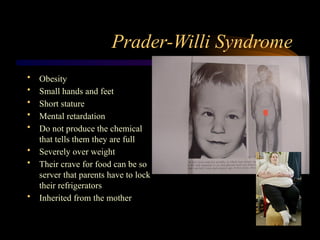
Prader-Willi Syndrome
• Obesity
•Small hands and feet
• Short stature
• Mental retardation
• Do not produce the chemical
that tells them they are full
• Severely over weight
• Their crave for food can be so
server that parents have to lock
their refrigerators
• Inherited from the mother
48.
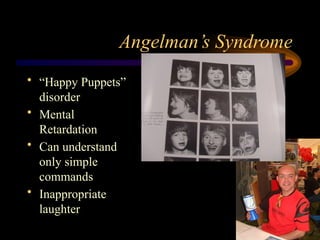
Angelman’s Syndrome
• “HappyPuppets”
disorder
• Mental
Retardation
• Can understand
only simple
commands
• Inappropriate
laughter
49.
This is theend….
Use your knowledge to be
compassionate and kind towards
others.




![ONFH[AVN HIP] -TRIPLE REGIME -A NOVAL SURGICAL CONCEPT .pptx](https://cdn.slidesharecdn.com/ss_thumbnails/onfhavnhip2026koaconcalicutdrgokuldevdrmashraf-260210064517-213ec005-thumbnail.jpg?width=640&height=640&fit=bounds)


