DisordersofAging
M a h i m a S h r i v a s t av a
G r o u p - 5 5 2 n d C o u r s e
Index
Introduction
Progerias
Werner’s And Bloom’s Syndromes
Alzheimer’s Disease
Other Common diseases
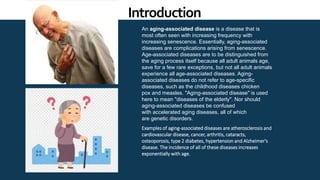
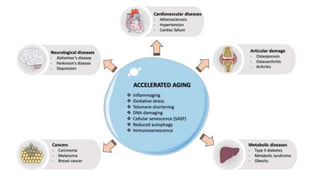
An aging-associated disease is a disease that is
most often seen with increasing frequency with
increasing senescence. Essentially, aging-associated
diseases are complications arising from senescence.
Age-associated diseases are to be distinguished from
the aging process itself because all adult animals age,
save for a few rare exceptions, but not all adult animals
experience all age-associated diseases. Aging-
associated diseases do not refer to age-specific
diseases, such as the childhood diseases chicken
pox and measles. "Aging-associated disease" is used
here to mean "diseases of the elderly". Nor should
aging-associated diseases be confused
with accelerated aging diseases, all of which
are genetic disorders.
Examples of aging-associated diseases are atherosclerosis and
cardiovascular disease, cancer, arthritis, cataracts,
osteoporosis, type 2 diabetes, hypertension and Alzheimer's
disease. The incidence of all of these diseases increases
exponentially with age.
Introduction
A single gene mutation is responsible
for progeria. The gene, known as lamin
A (LMNA), makes a protein necessary
for holding the center (nucleus) of a cell
together. When this gene has a defect
(mutation), an abnormal form of the
lamin A protein called progerin is
produced and makes cells unstable. This
appears to lead to progeria's aging
process.
Unlike many genetic mutations, progeria
is rarely passed down in families. The
gene mutation is a rare, chance
occurrence in the majority of cases.
Progerias
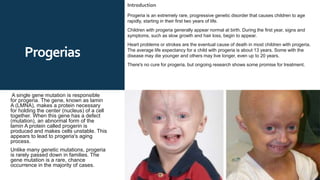
Progeria is an extremely rare, progressive genetic disorder that causes children to age
rapidly, starting in their first two years of life.
Children with progeria generally appear normal at birth. During the first year, signs and
symptoms, such as slow growth and hair loss, begin to appear.
Heart problems or strokes are the eventual cause of death in most children with progeria.
The average life expectancy for a child with progeria is about 13 years. Some with the
disease may die younger and others may live longer, even up to 20 years.
There's no cure for progeria, but ongoing research shows some promise for treatment.
Introduction
Werner’s&Bloom’s
Syndrome
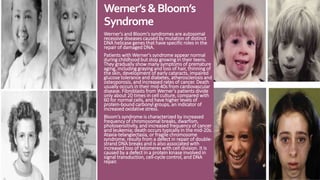
Werner's and Bloom's syndromes are autosomal
recessive diseases caused by mutation of distinct
DNA helicase genes that have specific roles in the
repair of damaged DNA.
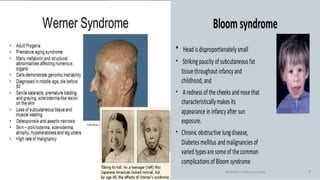
Patients with Werner's syndrome appear normal
during childhood but stop growing in their teens.
They gradually show many symptoms of premature
aging, including graying and loss of hair, thinning of
the skin, development of early cataracts, impaired
glucose tolerance and diabetes, atherosclerosis and
osteoporosis, and increased rates of cancer. Death
usually occurs in their mid-40s from cardiovascular
disease. Fibroblasts from Werner’s patients divide
only about 20 times in cell culture, compared with
60 for normal cells, and have higher levels of
protein-bound carbonyl groups, an indicator of
increased oxidative stress.
Bloom’s syndrome is characterized by increased
frequency of chromosomal breaks, dwarfism,
photosensitivity, and increased frequency of cancer
and leukemia; death occurs typically in the mid-20s.
Ataxia-telangiectasia, or fragile chromosome
syndrome, results from a defect in repair of double-
strand DNA breaks and is also associated with
increased loss of telomeres with cell division. It is
caused by a defect in a protein kinase involved in
signal transduction, cell-cycle control, and DNA
repair.
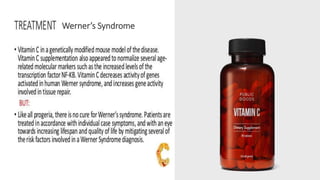
Werner’s Syndrome
Bloom Syndrome
ALZHEIMER’S DISEASE
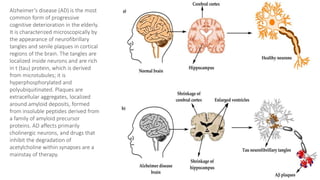
Alzheimer’s disease (AD) is the most
common form of progressive
cognitive deterioration in the elderly.
It is characterized microscopically by
the appearance of neurofibrillary
tangles and senile plaques in cortical
regions of the brain. The tangles are
localized inside neurons and are rich
in t (tau) protein, which is derived
from microtubules; it is
hyperphosphorylated and
polyubiquitinated. Plaques are
extracellular aggregates, localized
around amyloid deposits, formed
from insoluble peptides derived from
a family of amyloid precursor
proteins. AD affects primarily
cholinergic neurons, and drugs that
inhibit the degradation of
acetylcholine within synapses are a
mainstay of therapy.
OtherCommon Diseases
Age-Related
Macular
Degeneration
(AMD)
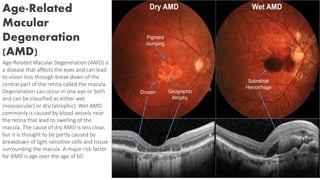
Age-Related Macular Degeneration (AMD) is
a disease that affects the eyes and can lead
to vision loss through break down of the
central part of the retina called the macula.
Degeneration can occur in one eye or both
and can be classified as either wet
(neovascular) or dry (atrophic). Wet AMD
commonly is caused by blood vessels near
the retina that lead to swelling of the
macula. The cause of dry AMD is less clear,
but it is thought to be partly caused by
breakdown of light-sensitive cells and tissue
surrounding the macula. A major risk factor
for AMD is age over the age of 60.
Atherosclerosis
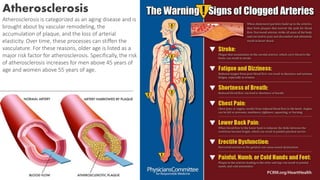
Atherosclerosis is categorized as an aging disease and is
brought about by vascular remodeling, the
accumulation of plaque, and the loss of arterial
elasticity. Over time, these processes can stiffen the
vasculature. For these reasons, older age is listed as a
major risk factor for atherosclerosis. Specifically, the risk
of atherosclerosis increases for men above 45 years of
age and women above 55 years of age.
Benign Prostatic Hyperplasia
(BPH)
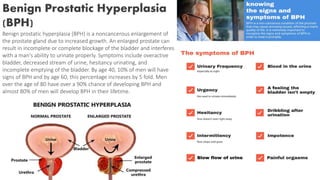
Benign prostatic hyperplasia (BPH) is a noncancerous enlargement of
the prostate gland due to increased growth. An enlarged prostate can
result in incomplete or complete blockage of the bladder and interferes
with a man's ability to urinate properly. Symptoms include overactive
bladder, decreased stream of urine, hesitancy urinating, and
incomplete emptying of the bladder. By age 40, 10% of men will have
signs of BPH and by age 60, this percentage increases by 5 fold. Men
over the age of 80 have over a 90% chance of developing BPH and
almost 80% of men will develop BPH in their lifetime.
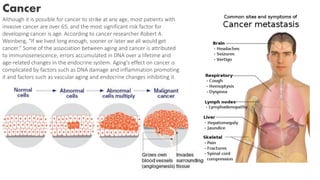
Cancer
Although it is possible for cancer to strike at any age, most patients with
invasive cancer are over 65, and the most significant risk factor for
developing cancer is age. According to cancer researcher Robert A.
Weinberg, "If we lived long enough, sooner or later we all would get
cancer." Some of the association between aging and cancer is attributed
to immunosenescence, errors accumulated in DNA over a lifetime and
age-related changes in the endocrine system. Aging's effect on cancer is
complicated by factors such as DNA damage and inflammation promoting
it and factors such as vascular aging and endocrine changes inhibiting it.
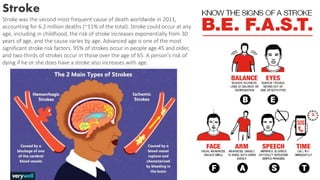
Stroke
Stroke was the second most frequent cause of death worldwide in 2011,
accounting for 6.2 million deaths (~11% of the total). Stroke could occur at any
age, including in childhood, the risk of stroke increases exponentially from 30
years of age, and the cause varies by age. Advanced age is one of the most
significant stroke risk factors. 95% of strokes occur in people age 45 and older,
and two-thirds of strokes occur in those over the age of 65. A person's risk of
dying if he or she does have a stroke also increases with age.
Disorders of aging

Disorders of aging

  • 1.
    DisordersofAging M a hi m a S h r i v a s t av a G r o u p - 5 5 2 n d C o u r s e
  • 2.
    Index Introduction Progerias Werner’s And Bloom’sSyndromes Alzheimer’s Disease Other Common diseases
  • 3.
    An aging-associated diseaseis a disease that is most often seen with increasing frequency with increasing senescence. Essentially, aging-associated diseases are complications arising from senescence. Age-associated diseases are to be distinguished from the aging process itself because all adult animals age, save for a few rare exceptions, but not all adult animals experience all age-associated diseases. Aging- associated diseases do not refer to age-specific diseases, such as the childhood diseases chicken pox and measles. "Aging-associated disease" is used here to mean "diseases of the elderly". Nor should aging-associated diseases be confused with accelerated aging diseases, all of which are genetic disorders. Examples of aging-associated diseases are atherosclerosis and cardiovascular disease, cancer, arthritis, cataracts, osteoporosis, type 2 diabetes, hypertension and Alzheimer's disease. The incidence of all of these diseases increases exponentially with age. Introduction
  • 4.
    A single genemutation is responsible for progeria. The gene, known as lamin A (LMNA), makes a protein necessary for holding the center (nucleus) of a cell together. When this gene has a defect (mutation), an abnormal form of the lamin A protein called progerin is produced and makes cells unstable. This appears to lead to progeria's aging process. Unlike many genetic mutations, progeria is rarely passed down in families. The gene mutation is a rare, chance occurrence in the majority of cases. Progerias Progeria is an extremely rare, progressive genetic disorder that causes children to age rapidly, starting in their first two years of life. Children with progeria generally appear normal at birth. During the first year, signs and symptoms, such as slow growth and hair loss, begin to appear. Heart problems or strokes are the eventual cause of death in most children with progeria. The average life expectancy for a child with progeria is about 13 years. Some with the disease may die younger and others may live longer, even up to 20 years. There's no cure for progeria, but ongoing research shows some promise for treatment. Introduction
  • 7.
    Werner’s&Bloom’s Syndrome Werner's and Bloom'ssyndromes are autosomal recessive diseases caused by mutation of distinct DNA helicase genes that have specific roles in the repair of damaged DNA. Patients with Werner's syndrome appear normal during childhood but stop growing in their teens. They gradually show many symptoms of premature aging, including graying and loss of hair, thinning of the skin, development of early cataracts, impaired glucose tolerance and diabetes, atherosclerosis and osteoporosis, and increased rates of cancer. Death usually occurs in their mid-40s from cardiovascular disease. Fibroblasts from Werner’s patients divide only about 20 times in cell culture, compared with 60 for normal cells, and have higher levels of protein-bound carbonyl groups, an indicator of increased oxidative stress. Bloom’s syndrome is characterized by increased frequency of chromosomal breaks, dwarfism, photosensitivity, and increased frequency of cancer and leukemia; death occurs typically in the mid-20s. Ataxia-telangiectasia, or fragile chromosome syndrome, results from a defect in repair of double- strand DNA breaks and is also associated with increased loss of telomeres with cell division. It is caused by a defect in a protein kinase involved in signal transduction, cell-cycle control, and DNA repair.
  • 9.
  • 10.
  • 11.
  • 12.
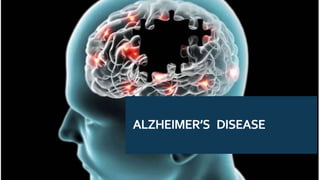
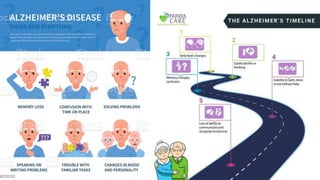
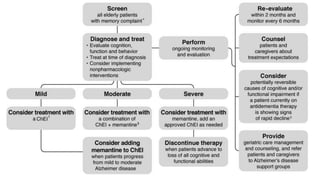
    Alzheimer’s disease (AD)is the most common form of progressive cognitive deterioration in the elderly. It is characterized microscopically by the appearance of neurofibrillary tangles and senile plaques in cortical regions of the brain. The tangles are localized inside neurons and are rich in t (tau) protein, which is derived from microtubules; it is hyperphosphorylated and polyubiquitinated. Plaques are extracellular aggregates, localized around amyloid deposits, formed from insoluble peptides derived from a family of amyloid precursor proteins. AD affects primarily cholinergic neurons, and drugs that inhibit the degradation of acetylcholine within synapses are a mainstay of therapy.
  • 15.
  • 17.
    Age-Related Macular Degeneration (AMD) Age-Related Macular Degeneration(AMD) is a disease that affects the eyes and can lead to vision loss through break down of the central part of the retina called the macula. Degeneration can occur in one eye or both and can be classified as either wet (neovascular) or dry (atrophic). Wet AMD commonly is caused by blood vessels near the retina that lead to swelling of the macula. The cause of dry AMD is less clear, but it is thought to be partly caused by breakdown of light-sensitive cells and tissue surrounding the macula. A major risk factor for AMD is age over the age of 60.
  • 19.
    Atherosclerosis Atherosclerosis is categorizedas an aging disease and is brought about by vascular remodeling, the accumulation of plaque, and the loss of arterial elasticity. Over time, these processes can stiffen the vasculature. For these reasons, older age is listed as a major risk factor for atherosclerosis. Specifically, the risk of atherosclerosis increases for men above 45 years of age and women above 55 years of age.
  • 20.
    Benign Prostatic Hyperplasia (BPH) Benignprostatic hyperplasia (BPH) is a noncancerous enlargement of the prostate gland due to increased growth. An enlarged prostate can result in incomplete or complete blockage of the bladder and interferes with a man's ability to urinate properly. Symptoms include overactive bladder, decreased stream of urine, hesitancy urinating, and incomplete emptying of the bladder. By age 40, 10% of men will have signs of BPH and by age 60, this percentage increases by 5 fold. Men over the age of 80 have over a 90% chance of developing BPH and almost 80% of men will develop BPH in their lifetime.
  • 21.
    Cancer Although it ispossible for cancer to strike at any age, most patients with invasive cancer are over 65, and the most significant risk factor for developing cancer is age. According to cancer researcher Robert A. Weinberg, "If we lived long enough, sooner or later we all would get cancer." Some of the association between aging and cancer is attributed to immunosenescence, errors accumulated in DNA over a lifetime and age-related changes in the endocrine system. Aging's effect on cancer is complicated by factors such as DNA damage and inflammation promoting it and factors such as vascular aging and endocrine changes inhibiting it.
  • 22.
    Stroke Stroke was thesecond most frequent cause of death worldwide in 2011, accounting for 6.2 million deaths (~11% of the total). Stroke could occur at any age, including in childhood, the risk of stroke increases exponentially from 30 years of age, and the cause varies by age. Advanced age is one of the most significant stroke risk factors. 95% of strokes occur in people age 45 and older, and two-thirds of strokes occur in those over the age of 65. A person's risk of dying if he or she does have a stroke also increases with age.