Brain and
         Nervous
          System
     Alicia Pliego
   2º Bachillerato, 2011-2012
I.E. “V. Cañada Blanch” London
CONTENTS

The most important parts of the brain are:
  Cerebrum
  Cerebellum
  Brain Stem
  Pituitary gland
  Hypothalamus
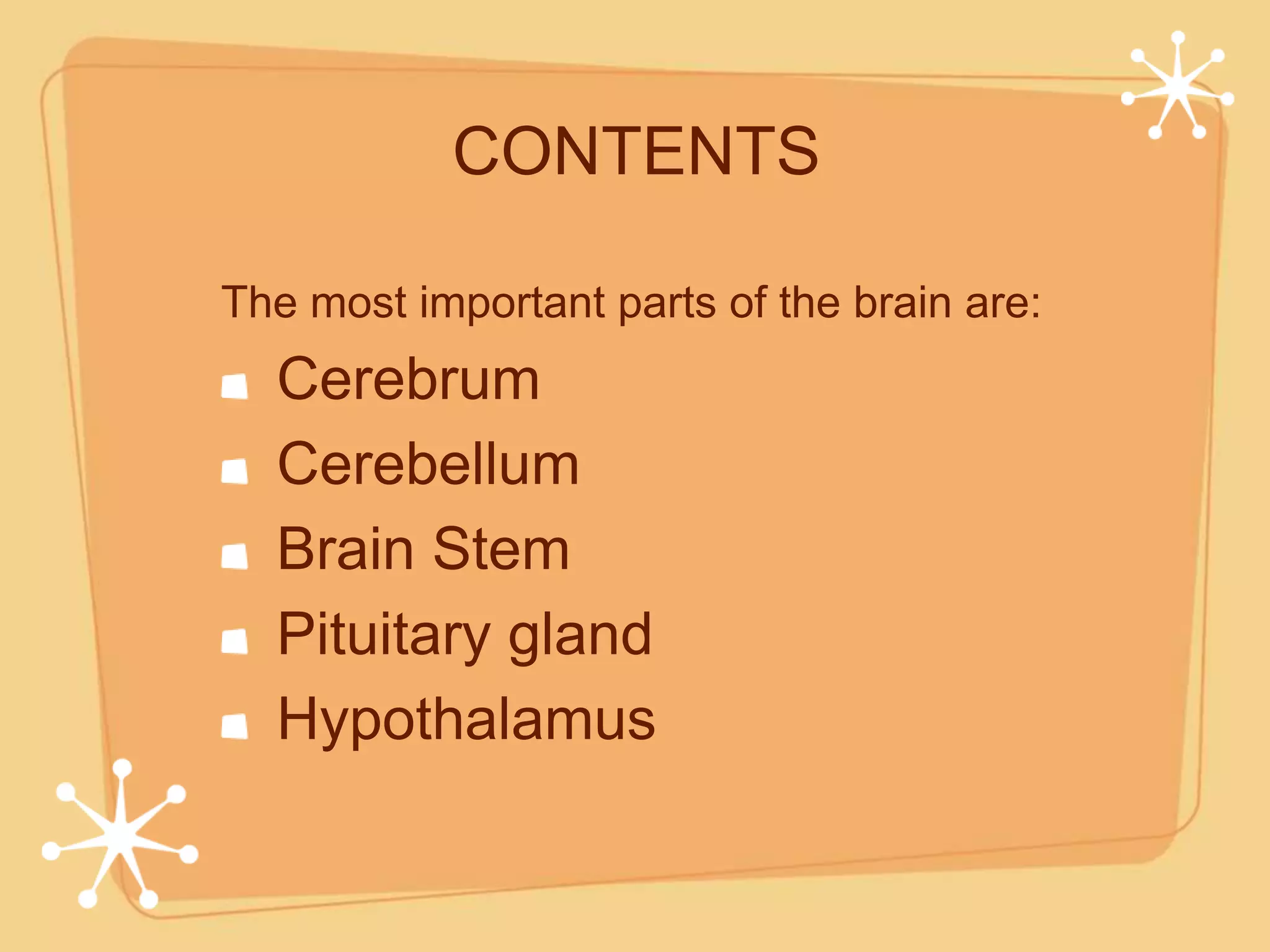
The biggest part: the Cerebrum
  It has two halves or hemispheres: the
  right hemisphere and the left
  hemisphere.
  It controls:
   ** voluntary movement
   ** speech
   ** intelligence
   ** memory
   ** emotion and
   **sensory processing.
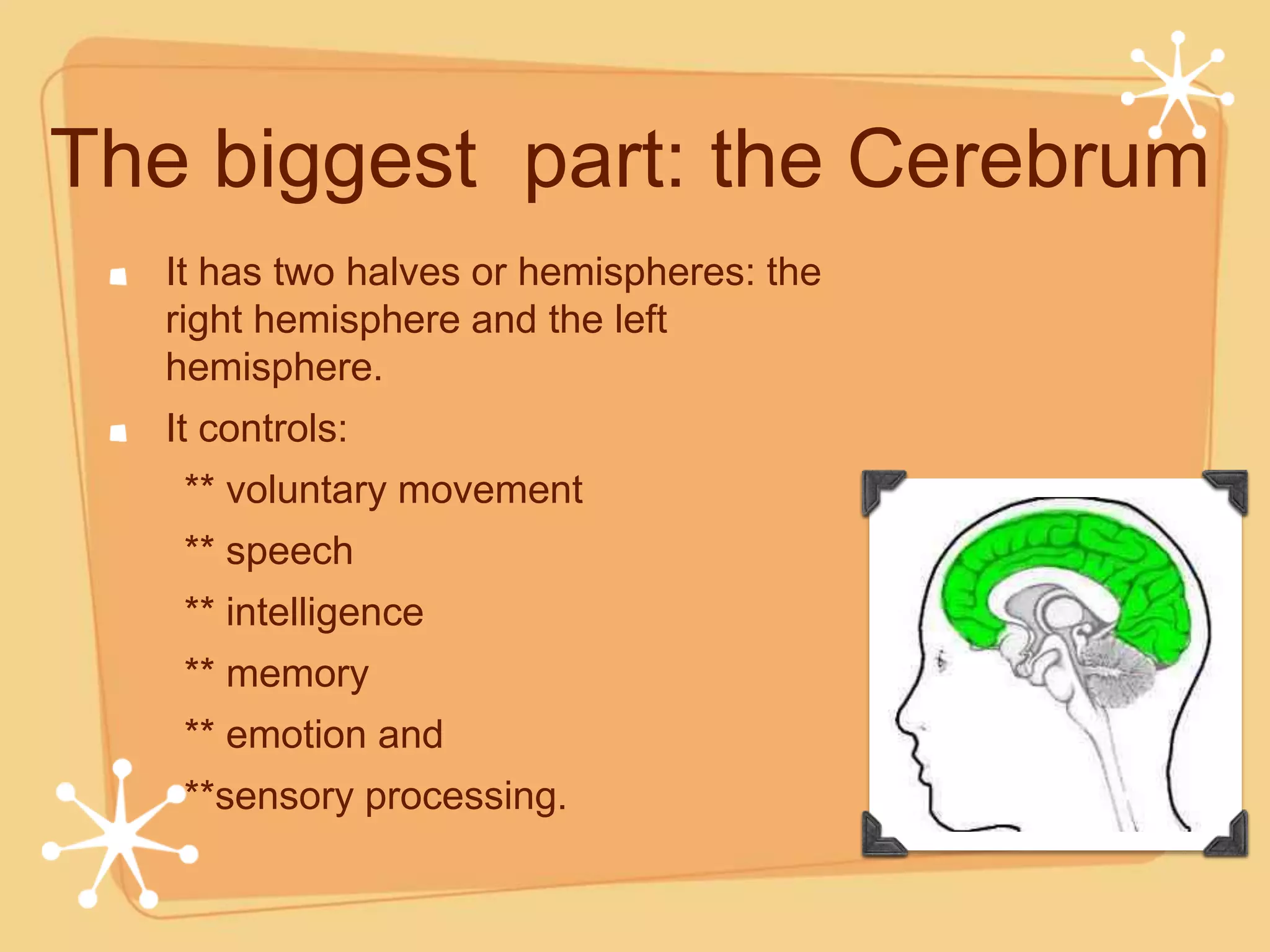
The two halves of the cerebrum:
  Each hemisphere is specialized in
  different functions. The left hemisphere
  is generally related to the right side of
  the body and vice versa.
• The left hemisphere controls -->
  language, maths and logic....
• The right hemisphere controls -->
  spatial orientation, face recognition,
  body image, ability to appreciate art
  and music...
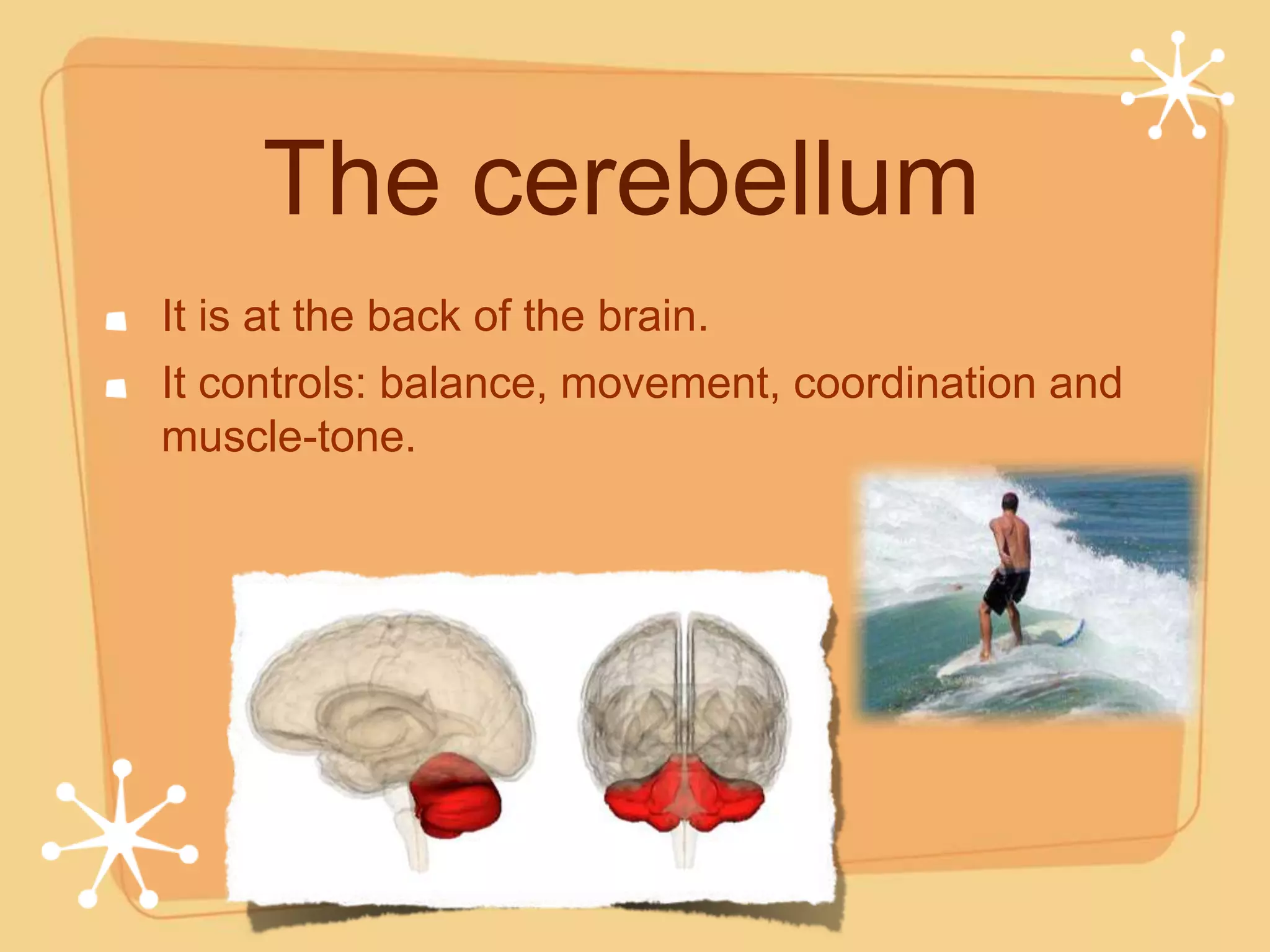
The cerebellum
It is at the back of the brain.
It controls: balance, movement, coordination and
muscle-tone.
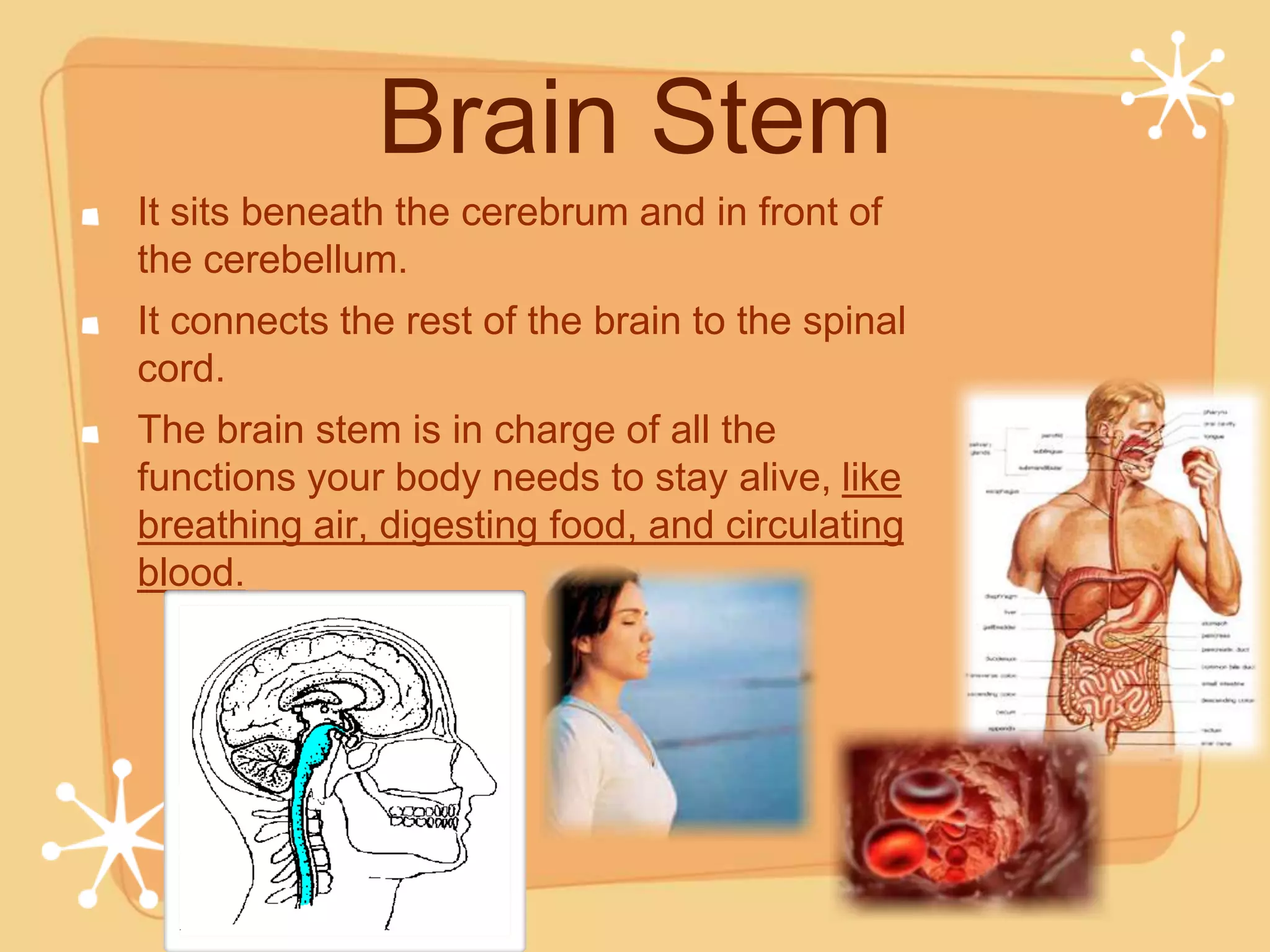
Brain Stem
It sits beneath the cerebrum and in front of
the cerebellum.
It connects the rest of the brain to the spinal
cord.
The brain stem is in charge of all the
functions your body needs to stay alive, like
breathing air, digesting food, and circulating
blood.
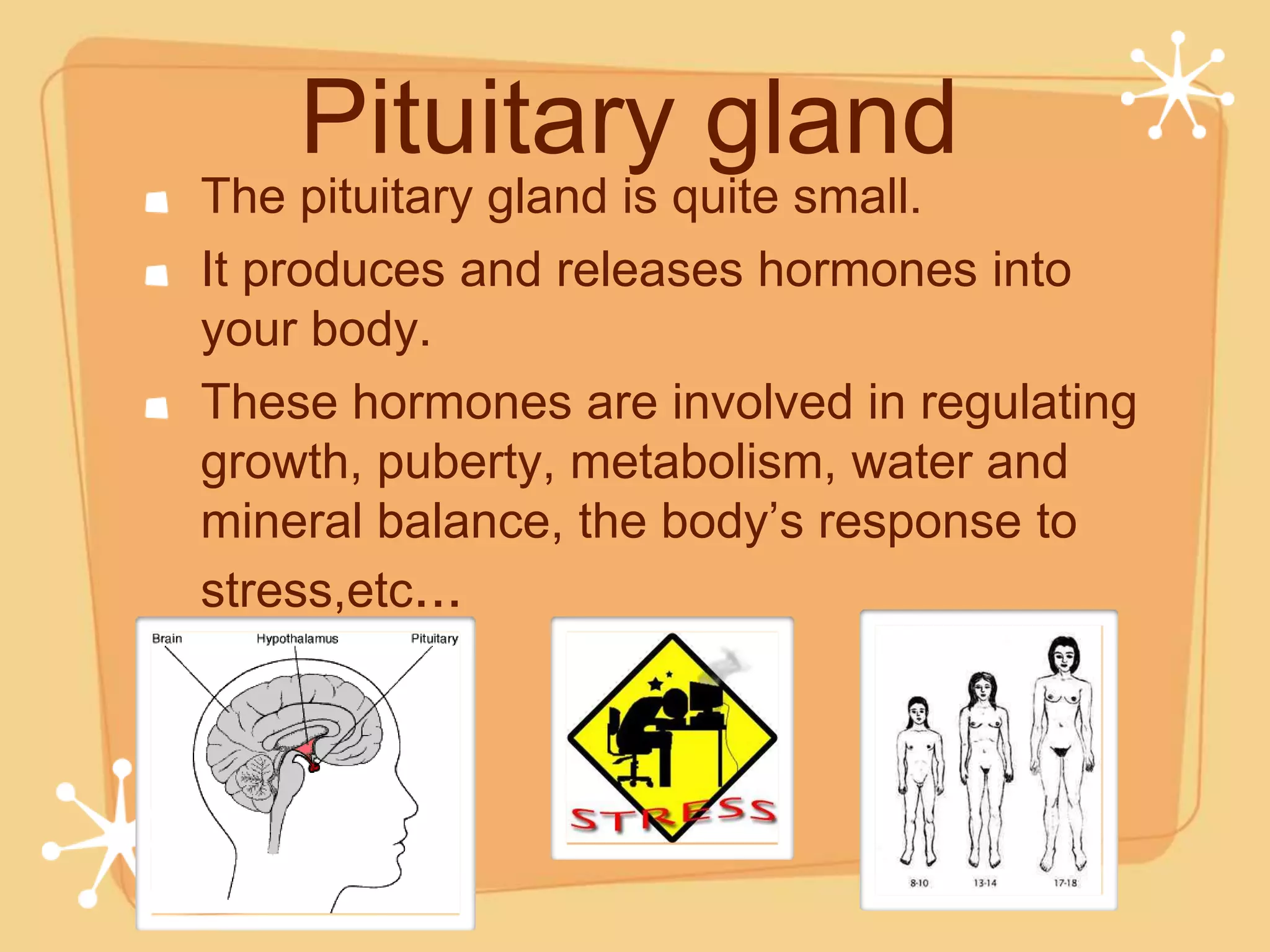
Pituitary gland
The pituitary gland is quite small.
It produces and releases hormones into
your body.
These hormones are involved in regulating
growth, puberty, metabolism, water and
mineral balance, the body’s response to
stress,etc...
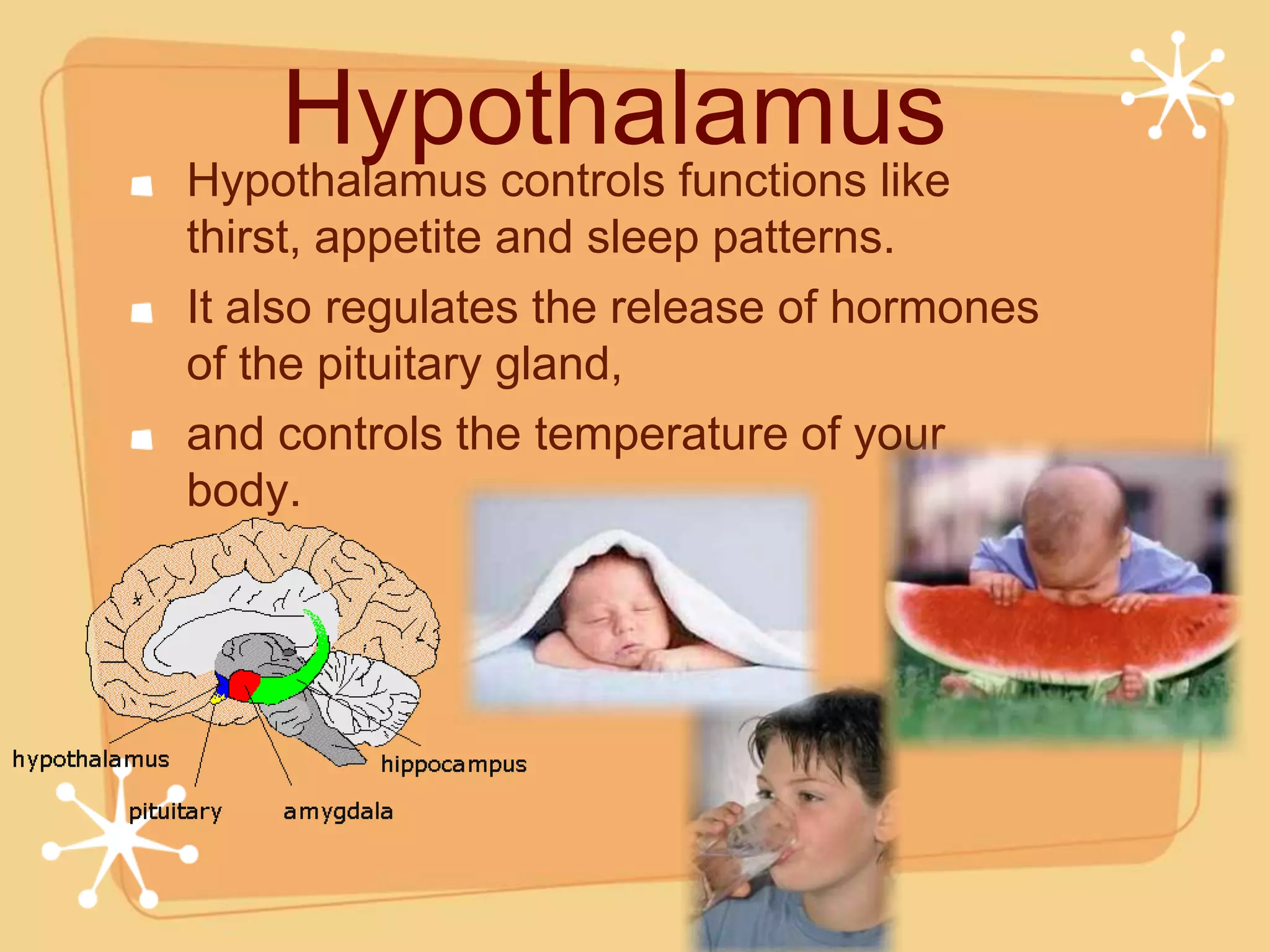
Hypothalamus
Hypothalamus controls functions like
thirst, appetite and sleep patterns.
It also regulates the release of hormones
of the pituitary gland,
and controls the temperature of your
body.
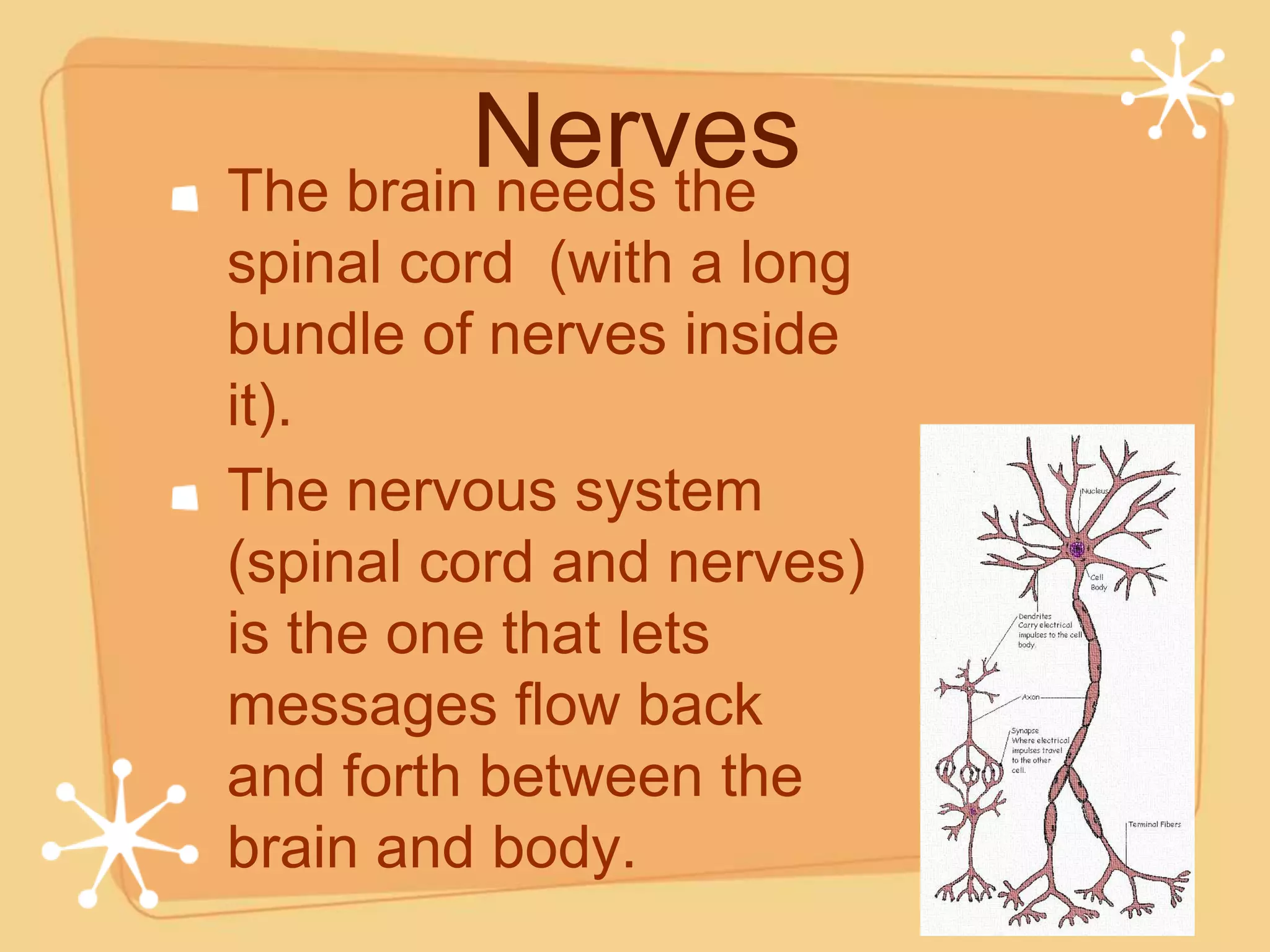
Nerves
The brain needs the
spinal cord (with a long
bundle of nerves inside
it).
The nervous system
(spinal cord and nerves)
is the one that lets
messages flow back
and forth between the
brain and body.
Sources:
http://webspace.ship.edu/cgboer/genpsycerebrum.html
http://kidshealth.org/kid/htbw/brain.html#cat20438
http://www.neuroskills.com/tbi/bcerebel.shtml
http://en.wikipedia.org/wiki/Cerebellum
http://www.neuroskills.com/tbi/bbstem.shtml
http://www.waiting.com/brainstem.html
http://www.umm.edu/endocrin/pitgland.htm
http://www.neurosurgery.pitt.edu/minc/skullbase/pituitary/ind
ex.html
http://en.wikipedia.org/wiki/Amygdala

Brain & Nervous System, by Alicia