
MHLANGA ZG
Unlike your classroom, your Personal Learning
Network (PLN) is available to you seven days a
week, 24 hours a day. It consists of all of the
educational sites that you join to have discussions
with other educators and find classroom resources.
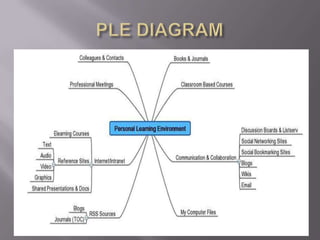
 Personal Learning Environments (PLE) are
systems that help learners take control of and
manage their own learning.
 This includes providing support for learners to
set their own learning goals, manage their
learning; managing both content and process
 communicate with others in the process of
learning
 and thereby achieve learning goals.
LearnTEC, Karlsruhe, Germany
A PLE is NOT:
 A specific software application
 A method for creating e-learning applications
A PLE is :
• A concept (based on Web 2.0 and social
network) rather than specific software
• A group of techniques and a variety of tools:
– to gather information
– explore/develop relationships between
pieces of information
– browser-based (potentially)
Source: Sabin-Corneliu Buraga
 An environment where you access learning
from a variety of sources.
 A place where you do your own work. It’s not
dependent on the university/school.
 A collection of tools and systems, not a single
monolithic system.
Source: Sabin-Corneliu Buraga
 View the subject as a landscape as
well as individual pieces of
information
 Create a personal repository of
materials and relationships clustered
around a unifying topic or concept
 Document, reflect, communicate, col
laborate
PLEs building laid the foundations of
some main ideas:
 learning is an on-going process and tools to
support this learning are needed
 the role of the individual in self-organizing
learning is important
 learning can take place in different contexts
and situations and cannot be provided by a
single learning provider.
Attwell Graham
 PLEs are systems that help learners take
control of and manage their own learning.
 This includes providing support for learners
to set their own learning goals, manage
their learning;
 managing both content and process;
 communicate with others in the process of
learning and thereby achieve learning goals.
Wikipedia
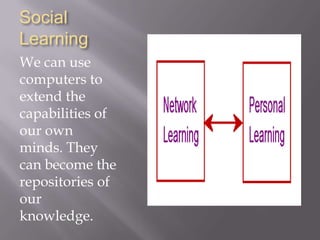
Social
Learning
We can use
computers to
extend the
capabilities of
our own
minds. They
can become the
repositories of
our
knowledge.
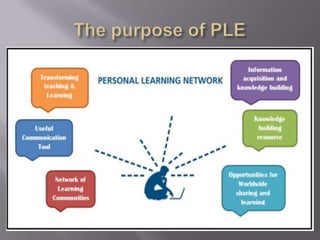
 The purpose of the Personal Learning
Network (PLN) was to create an
educational tool .
 that opens new paths of communication
with educators globally.
 also sharing evidence of my on-going
knowledge, passion and commitment to
teaching.
Picture by Helen Keegan
 Unlike your classroom, your (PLN) is
available to you seven days a week, 24
hours a day.
 It consists of all of the educational sites
that you join to have discussions with
other educators and find classroom
resources.
 You can participate in scheduled chats on
Twitter, write and comment on
educational blogs
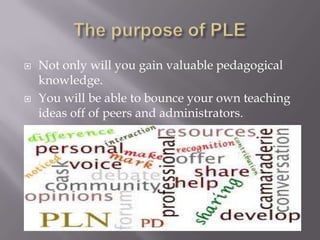
 Not only will you gain valuable pedagogical
knowledge.
 You will be able to bounce your own teaching
ideas off of peers and administrators.
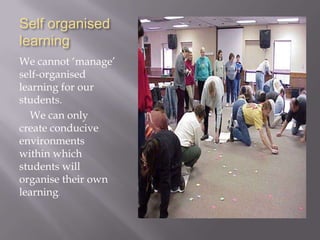
Self organised
learning
We cannot ‘manage’
self-organised
learning for our
students.
We can only
create conducive
environments
within which
students will
organise their own
learning.
 Rather than integrating different services into a
centralized system, the idea is to provide the
learner with a plethora of different services and
hand over control to her to select, use, and mash
up the services the way she deems fit.
 A PLE driven approach does not only provide
personal spaces, which belong to and are
controlled by the user, but also requires a social
context by offering means to connect with other
personal spaces for effective knowledge sharing
and collaborative knowledge creation.
Murphy, K etl.
 PLEs are not another substantiation of educational
technology but a new approach to learning.
 A response to pedagogic approaches which require that
learner’s e-learning systems need to be under the control of
the learners themselves.
 PLE are based on the idea that learning will take place in
different contexts and situations and will not be provided by
a single learning provider
 The idea of a Personal Learning Environment recognises
that learning is continuing and seeks to provide tools to
support that learning
Source: Graham Attwell
 The ‘pedagogy’ behind the PLE is that it offers
a portal to the world, through which learners
can explore and create, according to their own
interests and directions, interacting at all times
with their friends and community
 New forms of learning are based on trying
things and action, rather than on more abstract
knowledge.
Source: Graham Attwell
• By Alec Couros): Slideshare Networked Possibilities
• Article by Graham Attwell Personal Learning Environments - the future of eLearning?
• By Centro Internacional de Tecnologías Avanzadas. FGSR on Jul 08, 201: Slideshare personal learning
environment
• By Cindy Underhill. On July 24 2009: Slideshare. PLEs What Do Students Think?
• Murphy, K.,DePasquale, R., & McNamara, E. (2008). Meaningful Connections: Using Technology in Primary
Classrooms. Beyond the Journal: Young Children on the Web, 1-9.
• Connectivist Learning and the Personal Learning Environment (by Stephen Downes): Slideshare
• Colletion of PLE Diagrams: http://edtechpost.wikispaces.com/PLE+Diagrams
• History of Personal Learning Environments (Wikipedia)
• By Zaffar Ahmed Shaikh on Jul 19, 2011: Slideshare. Role of Teacher in Personal Learning Environments

Personal learning networks

  • 1.
  • 2.
    Unlike your classroom,your Personal Learning Network (PLN) is available to you seven days a week, 24 hours a day. It consists of all of the educational sites that you join to have discussions with other educators and find classroom resources.
  • 4.
     Personal LearningEnvironments (PLE) are systems that help learners take control of and manage their own learning.  This includes providing support for learners to set their own learning goals, manage their learning; managing both content and process  communicate with others in the process of learning  and thereby achieve learning goals. LearnTEC, Karlsruhe, Germany
  • 5.
    A PLE isNOT:  A specific software application  A method for creating e-learning applications
  • 6.
    A PLE is: • A concept (based on Web 2.0 and social network) rather than specific software • A group of techniques and a variety of tools: – to gather information – explore/develop relationships between pieces of information – browser-based (potentially) Source: Sabin-Corneliu Buraga
  • 8.
     An environmentwhere you access learning from a variety of sources.  A place where you do your own work. It’s not dependent on the university/school.  A collection of tools and systems, not a single monolithic system. Source: Sabin-Corneliu Buraga
  • 10.
     View thesubject as a landscape as well as individual pieces of information  Create a personal repository of materials and relationships clustered around a unifying topic or concept  Document, reflect, communicate, col laborate
  • 12.
    PLEs building laidthe foundations of some main ideas:  learning is an on-going process and tools to support this learning are needed  the role of the individual in self-organizing learning is important  learning can take place in different contexts and situations and cannot be provided by a single learning provider. Attwell Graham
  • 13.
     PLEs aresystems that help learners take control of and manage their own learning.  This includes providing support for learners to set their own learning goals, manage their learning;  managing both content and process;  communicate with others in the process of learning and thereby achieve learning goals. Wikipedia
  • 14.
    Social Learning We can use computersto extend the capabilities of our own minds. They can become the repositories of our knowledge.
  • 16.
     The purposeof the Personal Learning Network (PLN) was to create an educational tool .  that opens new paths of communication with educators globally.  also sharing evidence of my on-going knowledge, passion and commitment to teaching. Picture by Helen Keegan
  • 17.
     Unlike yourclassroom, your (PLN) is available to you seven days a week, 24 hours a day.  It consists of all of the educational sites that you join to have discussions with other educators and find classroom resources.  You can participate in scheduled chats on Twitter, write and comment on educational blogs
  • 18.
     Not onlywill you gain valuable pedagogical knowledge.  You will be able to bounce your own teaching ideas off of peers and administrators.
  • 19.
    Self organised learning We cannot‘manage’ self-organised learning for our students. We can only create conducive environments within which students will organise their own learning.
  • 21.
     Rather thanintegrating different services into a centralized system, the idea is to provide the learner with a plethora of different services and hand over control to her to select, use, and mash up the services the way she deems fit.  A PLE driven approach does not only provide personal spaces, which belong to and are controlled by the user, but also requires a social context by offering means to connect with other personal spaces for effective knowledge sharing and collaborative knowledge creation. Murphy, K etl.
  • 22.
     PLEs arenot another substantiation of educational technology but a new approach to learning.  A response to pedagogic approaches which require that learner’s e-learning systems need to be under the control of the learners themselves.  PLE are based on the idea that learning will take place in different contexts and situations and will not be provided by a single learning provider  The idea of a Personal Learning Environment recognises that learning is continuing and seeks to provide tools to support that learning Source: Graham Attwell
  • 23.
     The ‘pedagogy’behind the PLE is that it offers a portal to the world, through which learners can explore and create, according to their own interests and directions, interacting at all times with their friends and community  New forms of learning are based on trying things and action, rather than on more abstract knowledge. Source: Graham Attwell
  • 25.
    • By AlecCouros): Slideshare Networked Possibilities • Article by Graham Attwell Personal Learning Environments - the future of eLearning? • By Centro Internacional de Tecnologías Avanzadas. FGSR on Jul 08, 201: Slideshare personal learning environment • By Cindy Underhill. On July 24 2009: Slideshare. PLEs What Do Students Think? • Murphy, K.,DePasquale, R., & McNamara, E. (2008). Meaningful Connections: Using Technology in Primary Classrooms. Beyond the Journal: Young Children on the Web, 1-9. • Connectivist Learning and the Personal Learning Environment (by Stephen Downes): Slideshare • Colletion of PLE Diagrams: http://edtechpost.wikispaces.com/PLE+Diagrams • History of Personal Learning Environments (Wikipedia) • By Zaffar Ahmed Shaikh on Jul 19, 2011: Slideshare. Role of Teacher in Personal Learning Environments