Personal Learning Environments as
Enablers for Connectivist MOOCs
Denis Gillet
InformationTechnology Based Higher Education andTraining, ITHET 2013
14:30-14:50, Friday, October 11,Antalya,Turkey
Paper: http://infoscience.epfl.ch/record/188534?ln=en
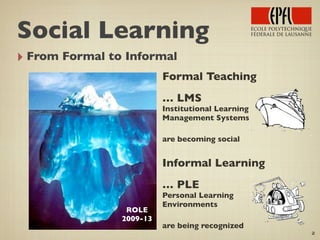
‣ From Formal to Informal
Formal Teaching
… LMS
Institutional Learning
Management Systems
are becoming social
Informal Learning
… PLE
Personal Learning
Environments
are being recognized
2
Social Learning
ROLE
2009-13
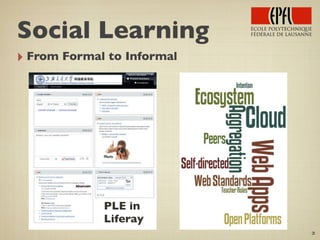
‣ From Formal to Informal
3
Social Learning
PLE in
Liferay
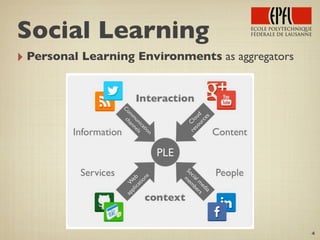
‣ Personal Learning Environments as aggregators
4
Social Learning
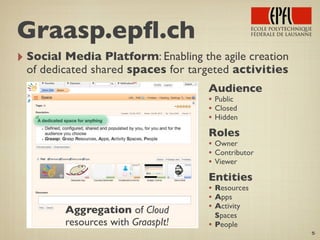
‣ Social Media Platform: Enabling the agile creation
of dedicated shared spaces for targeted activities
5
Aggregation of Cloud
resources with GraaspIt!
Audience
• Public
• Closed
• Hidden
Roles
• Owner
• Contributor
• Viewer
Entities
• Resources
• Apps
• Activity
Spaces
• People
Graasp.epfl.ch
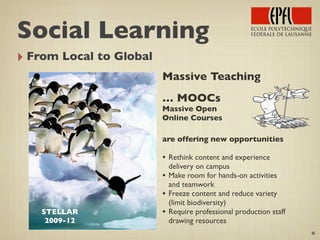
‣ From Local to Global
Massive Teaching
… MOOCs
Massive Open
Online Courses
are offering new opportunities
• Rethink content and experience
delivery on campus
• Make room for hands-on activities
and teamwork
• Freeze content and reduce variety
(limit biodiversity)
• Require professional production staff
drawing resources
6
STELLAR
2009-12
Social Learning
‣ From Local to Global
7
coursera
COURSES (444)
4,754,264
Social Learning
‣ From Local to Global
8
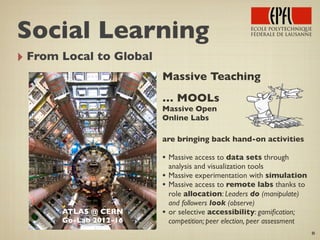
ATLAS @ CERN
Go-Lab 2012-16
Massive Teaching
… MOOLs
Massive Open
Online Labs
are bringing back hand-on activities
• Massive access to data sets through
analysis and visualization tools
• Massive experimentation with simulation
• Massive access to remote labs thanks to
role allocation: Leaders do (manipulate)
and followers look (observe)
• or selective accessibility: gamification;
competition; peer election, peer assessment
Social Learning
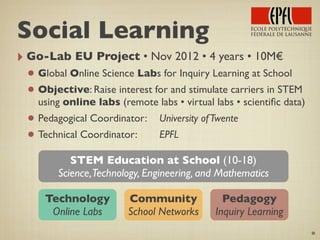
‣ Go-Lab EU Project • Nov 2012 • 4 years • 10M€
• Global Online Science Labs for Inquiry Learning at School
• Objective: Raise interest for and stimulate carriers in STEM
using online labs (remote labs • virtual labs • scientific data)
• Pedagogical Coordinator:	

 University ofTwente
• Technical Coordinator: 	


 EPFL
9
STEM Education at School (10-18)
Science,Technology, Engineering, and Mathematics
Technology
Online Labs
Pedagogy
Inquiry Learning
Community
School Networks
Social Learning
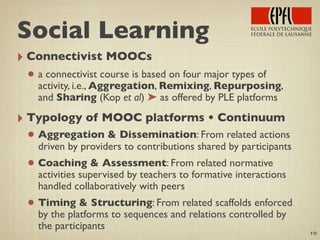
‣ Connectivist MOOCs
• a connectivist course is based on four major types of
activity, i.e., Aggregation, Remixing, Repurposing,
and Sharing (Kop et al) ➤ as offered by PLE platforms
‣ Typology of MOOC platforms • Continuum
• Aggregation & Dissemination: From related actions
driven by providers to contributions shared by participants
• Coaching & Assessment: From related normative
activities supervised by teachers to formative interactions
handled collaboratively with peers
• Timing & Structuring: From related scaffolds enforced
by the platforms to sequences and relations controlled by
the participants
10
Social Learning
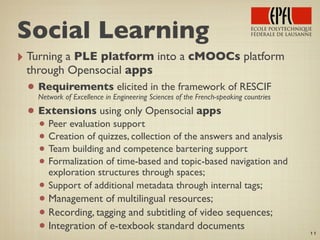
‣ Turning a PLE platform into a cMOOCs platform
through Opensocial apps
• Requirements elicited in the framework of RESCIF
Network of Excellence in Engineering Sciences of the French-speaking countries
• Extensions using only Opensocial apps
• Peer evaluation support
• Creation of quizzes, collection of the answers and analysis
• Team building and competence bartering support
• Formalization of time-based and topic-based navigation and
exploration structures through spaces;
• Support of additional metadata through internal tags;
• Management of multilingual resources;
• Recording, tagging and subtitling of video sequences;
• Integration of e-texbook standard documents
11
Social Learning
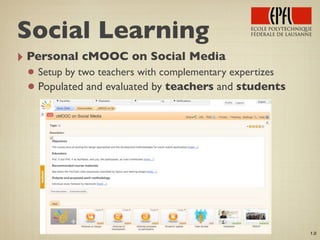
‣ Personal cMOOC on Social Media
• Setup by two teachers with complementary expertizes
•Populated and evaluated by teachers and students
12
Social Learning
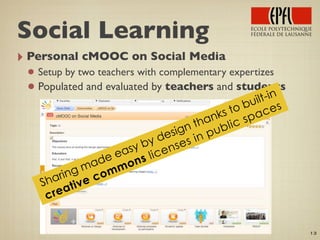
‣ Personal cMOOC on Social Media
• Setup by two teachers with complementary expertizes
•Populated and evaluated by teachers and students
13
Sharing made easy by design thanks to built-in
creative commons licenses in public spaces
Social Learning
14
Social Learning
http://www.emoocs2014.eu
• This work was partially funded by the European Union in
the context of the ROLE (Grant Agreement no. 231396)
and Go-Lab projects (Grant Agreement no. 317601) under
the Information and Communication Technologies (ICT)
theme of the 7th Framework Programme for R&D (FP7)
and by the Personal Learning Environment (Phase 3) project
of the Swiss AAA/SWITCH Program
15
Acknowledgment
16
Contact & Links
• denis.gillet@epfl.ch
• http://react.epfl.ch
• http://graasp.epfl.ch
• Tutorial: http://graasp.epfl.ch/
#item=asset_3627
• http://www.role-project.eu
http://www.role-widgetstore.eu
• FP7 • IST • European Union
http://www.go-lab-project.eu

Personal Learning Environments as Enablers for Connectivist MOOCs

  • 1.
    Personal Learning Environmentsas Enablers for Connectivist MOOCs Denis Gillet InformationTechnology Based Higher Education andTraining, ITHET 2013 14:30-14:50, Friday, October 11,Antalya,Turkey Paper: http://infoscience.epfl.ch/record/188534?ln=en
  • 2.
    ‣ From Formalto Informal Formal Teaching … LMS Institutional Learning Management Systems are becoming social Informal Learning … PLE Personal Learning Environments are being recognized 2 Social Learning ROLE 2009-13
  • 3.
    ‣ From Formalto Informal 3 Social Learning PLE in Liferay
  • 4.
    ‣ Personal LearningEnvironments as aggregators 4 Social Learning
  • 5.
    ‣ Social MediaPlatform: Enabling the agile creation of dedicated shared spaces for targeted activities 5 Aggregation of Cloud resources with GraaspIt! Audience • Public • Closed • Hidden Roles • Owner • Contributor • Viewer Entities • Resources • Apps • Activity Spaces • People Graasp.epfl.ch
  • 6.
    ‣ From Localto Global Massive Teaching … MOOCs Massive Open Online Courses are offering new opportunities • Rethink content and experience delivery on campus • Make room for hands-on activities and teamwork • Freeze content and reduce variety (limit biodiversity) • Require professional production staff drawing resources 6 STELLAR 2009-12 Social Learning
  • 7.
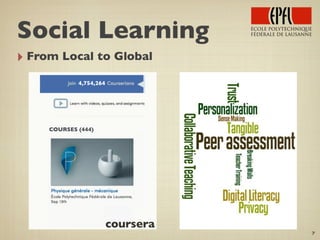
    ‣ From Localto Global 7 coursera COURSES (444) 4,754,264 Social Learning
  • 8.
    ‣ From Localto Global 8 ATLAS @ CERN Go-Lab 2012-16 Massive Teaching … MOOLs Massive Open Online Labs are bringing back hand-on activities • Massive access to data sets through analysis and visualization tools • Massive experimentation with simulation • Massive access to remote labs thanks to role allocation: Leaders do (manipulate) and followers look (observe) • or selective accessibility: gamification; competition; peer election, peer assessment Social Learning
  • 9.
    ‣ Go-Lab EUProject • Nov 2012 • 4 years • 10M€ • Global Online Science Labs for Inquiry Learning at School • Objective: Raise interest for and stimulate carriers in STEM using online labs (remote labs • virtual labs • scientific data) • Pedagogical Coordinator: University ofTwente • Technical Coordinator: EPFL 9 STEM Education at School (10-18) Science,Technology, Engineering, and Mathematics Technology Online Labs Pedagogy Inquiry Learning Community School Networks Social Learning
  • 10.
    ‣ Connectivist MOOCs •a connectivist course is based on four major types of activity, i.e., Aggregation, Remixing, Repurposing, and Sharing (Kop et al) ➤ as offered by PLE platforms ‣ Typology of MOOC platforms • Continuum • Aggregation & Dissemination: From related actions driven by providers to contributions shared by participants • Coaching & Assessment: From related normative activities supervised by teachers to formative interactions handled collaboratively with peers • Timing & Structuring: From related scaffolds enforced by the platforms to sequences and relations controlled by the participants 10 Social Learning
  • 11.
    ‣ Turning aPLE platform into a cMOOCs platform through Opensocial apps • Requirements elicited in the framework of RESCIF Network of Excellence in Engineering Sciences of the French-speaking countries • Extensions using only Opensocial apps • Peer evaluation support • Creation of quizzes, collection of the answers and analysis • Team building and competence bartering support • Formalization of time-based and topic-based navigation and exploration structures through spaces; • Support of additional metadata through internal tags; • Management of multilingual resources; • Recording, tagging and subtitling of video sequences; • Integration of e-texbook standard documents 11 Social Learning
  • 12.
    ‣ Personal cMOOCon Social Media • Setup by two teachers with complementary expertizes •Populated and evaluated by teachers and students 12 Social Learning
  • 13.
    ‣ Personal cMOOCon Social Media • Setup by two teachers with complementary expertizes •Populated and evaluated by teachers and students 13 Sharing made easy by design thanks to built-in creative commons licenses in public spaces Social Learning
  • 14.
  • 15.
    • This workwas partially funded by the European Union in the context of the ROLE (Grant Agreement no. 231396) and Go-Lab projects (Grant Agreement no. 317601) under the Information and Communication Technologies (ICT) theme of the 7th Framework Programme for R&D (FP7) and by the Personal Learning Environment (Phase 3) project of the Swiss AAA/SWITCH Program 15 Acknowledgment
  • 16.
    16 Contact & Links •denis.gillet@epfl.ch • http://react.epfl.ch • http://graasp.epfl.ch • Tutorial: http://graasp.epfl.ch/ #item=asset_3627 • http://www.role-project.eu http://www.role-widgetstore.eu • FP7 • IST • European Union http://www.go-lab-project.eu