Personal Learning Stephen Downes ~ March 11, 2008
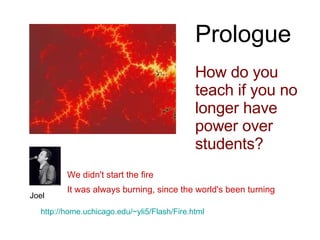
http://home.uchicago.edu/~yli5/Flash/Fire.html   We didn't start the fire It was always burning, since the world's been turning   Joel Prologue How do you teach if you no longer have power over students?
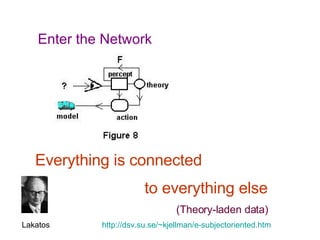
Enter the Network Everything is connected  to everything else (Theory-laden data) http://dsv.su.se/~kjellman/e-subjectoriented.htm   Lakatos
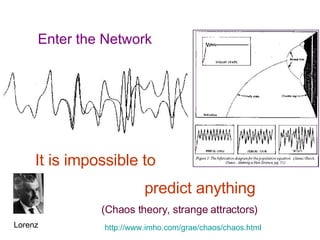
Enter the Network It is impossible to  predict anything (Chaos theory, strange attractors) Lorenz http://www.imho.com/grae/chaos/chaos.html
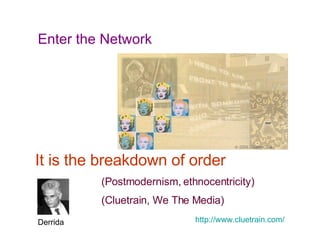
Enter the Network It is the breakdown of order (Postmodernism, ethnocentricity) (Cluetrain, We The Media) Derrida http://www.cluetrain.com/
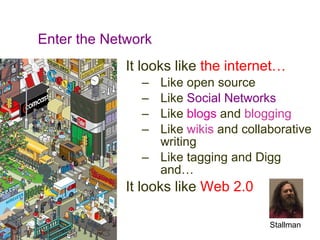
It looks like  the internet… Like open source Like  Social Networks Like  blogs  and  blogging Like  wikis  and collaborative writing Like tagging and Digg and… It looks like  Web 2.0 Stallman Enter the Network
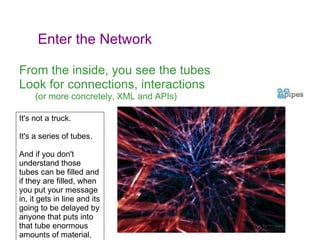
From the inside, you see the tubes Look for connections, interactions (or more concretely, XML and APIs) It's not a truck.  It's a series of tubes.  And if you don't understand those tubes can be filled and if they are filled, when you put your message in, it gets in line and its going to be delayed by anyone that puts into that tube enormous amounts of material, enormous amounts of material.  Enter the Network
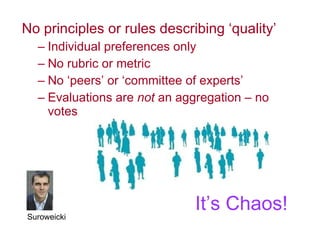
It’s Chaos! No principles or rules describing ‘quality’ Individual preferences only No rubric or metric No ‘peers’ or ‘committee of experts’ Evaluations are  not  an aggregation – no votes Suroweicki
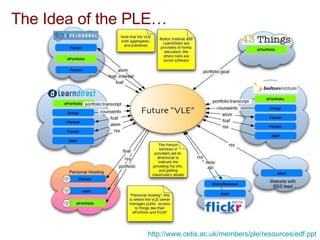
The Idea of the PLE… http://www.cetis.ac.uk/members/ple/resources/edf.ppt
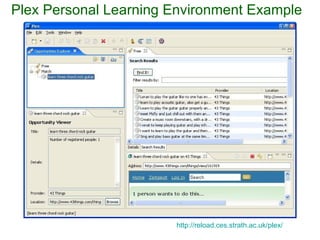
Plex Personal Learning Environment Example http://reload.ces.strath.ac.uk/plex/
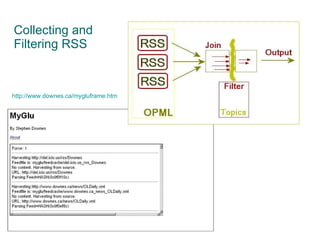
Collecting and Filtering RSS http://www.downes.ca/mygluframe.htm
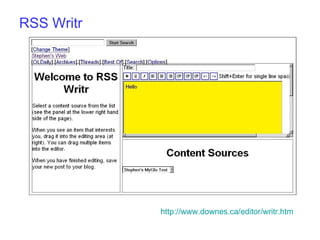
RSS Writr http://www.downes.ca/editor/writr.htm
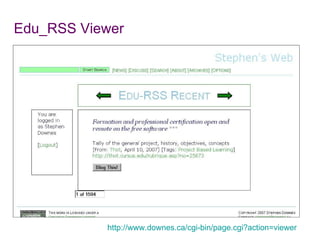
Edu_RSS Viewer http://www.downes.ca/cgi-bin/page.cgi?action=viewer
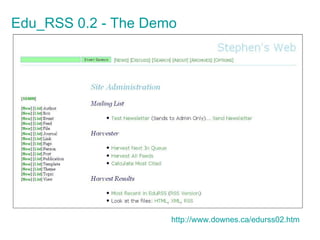
Edu_RSS 0.2 - The Demo http://www.downes.ca/edurss02.htm
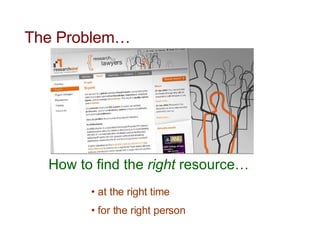
The Problem… How to find the  right  resource… at the right time for the right person
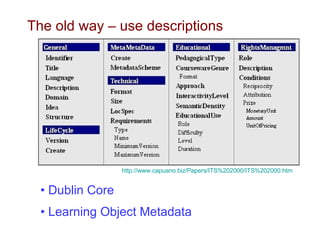
The old way – use descriptions Dublin Core Learning Object Metadata http://www.capuano.biz/Papers/ITS%202000/ITS%202000.htm
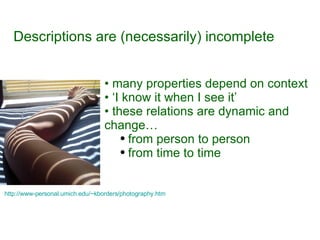
Descriptions are (necessarily) incomplete many properties depend on context ‘ I know it when I see it’ these relations are dynamic and change… from person to person from time to time http://www-personal.umich.edu/~kborders/photography.htm
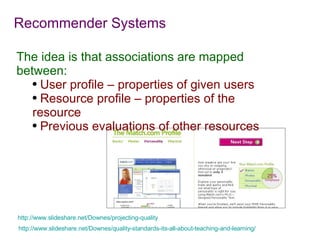
Recommender Systems The idea is that associations are mapped between: User profile – properties of given users Resource profile – properties of the resource Previous evaluations of other resources http://www.slideshare.net/Downes/projecting-quality   http://www.slideshare.net/Downes/quality-standards-its-all-about-teaching-and-learning/
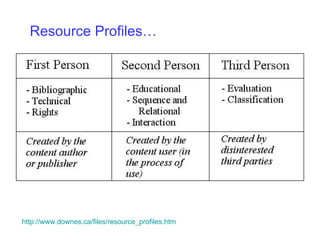
Resource Profiles… http://www.downes.ca/files/resource_profiles.htm
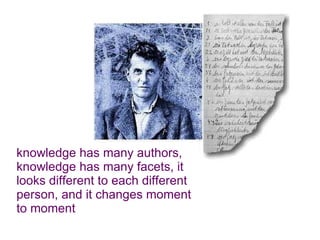
knowledge has many authors, knowledge has many facets, it looks different to each different person, and it changes moment to moment
The key insight… Two very distinct problems are in fact instances of the same problem. The problem of locating the right resource on the internet is basically  the same problem as the problem of getting the question right on the test.
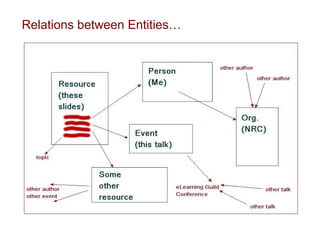
Relations between Entities…
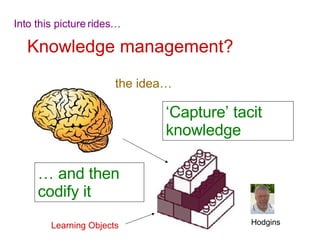
Knowledge management? Into this picture rides… the idea… ‘ Capture’ tacit knowledge …  and then codify it Hodgins Learning Objects
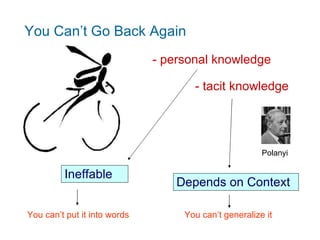
You Can’t Go Back Again personal knowledge Depends on Context Ineffable You can’t generalize it You can’t put it into words - tacit knowledge Polanyi
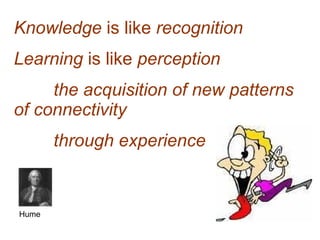
Knowledge  is like  recognition Learning  is like  perception the acquisition of new patterns of connectivity through experience Hume
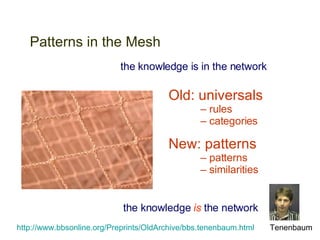
Patterns in the Mesh the knowledge is in the network the knowledge  is  the network Old: universals  –  rules  –  categories  New: patterns –  patterns  –  similarities   Tenenbaum http://www.bbsonline.org/Preprints/OldArchive/bbs.tenenbaum.html
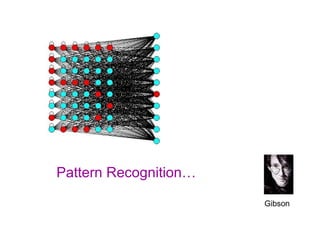
Pattern Recognition… Gibson
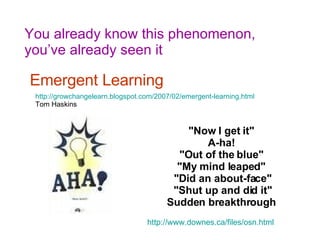
You already know this phenomenon, you’ve already seen it Emergent Learning http://growchangelearn.blogspot.com/2007/02/emergent-learning.html   Tom Haskins "Now I get it"   A-ha!   "Out of the blue"   "My mind leaped"   "Did an about-face" "Shut up and did it" Sudden breakthrough   http://www.downes.ca/files/osn.html
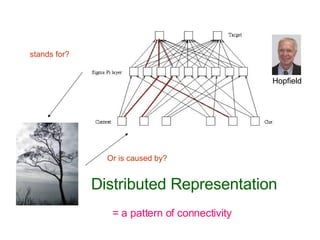
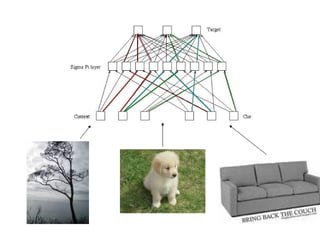
stands for? Or is caused by? Distributed Representation = a pattern of connectivity Hopfield
 
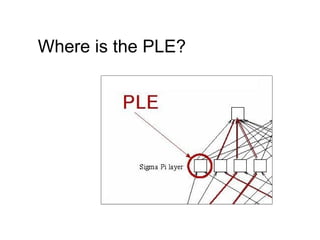
Where is the PLE?
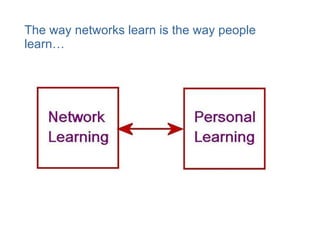
The way networks learn is the way people learn…
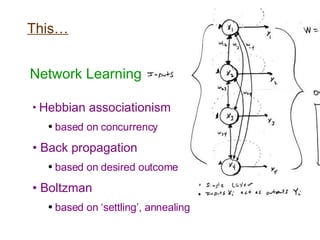
Network Learning… Hebbian associationism based on concurrency Back propagation based on desired outcome Boltzman based on ‘settling’, annealing This…
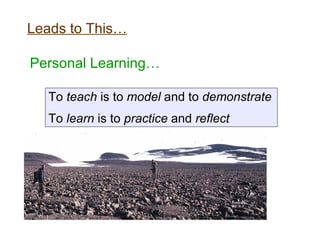
Leads to This… Personal Learning… To  teach  is to  model  and to  demonstrate To  learn  is to  practice  and  reflect
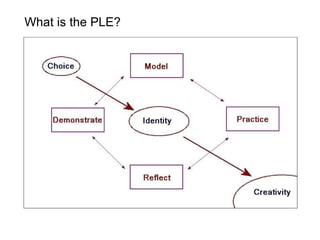
What is the PLE?
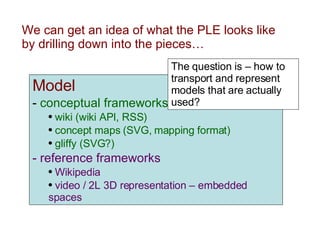
We can get an idea of what the PLE looks like by drilling down into the pieces… Model conceptual frameworks wiki (wiki API, RSS) concept maps (SVG, mapping format) gliffy (SVG?) reference frameworks Wikipedia video / 2L 3D representation – embedded spaces The question is – how to transport and represent models that are actually used?
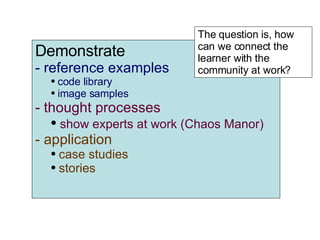
Demonstrate reference examples code library image samples thought processes show experts at work (Chaos Manor) application case studies stories The question is, how can we connect the learner with the community at work?
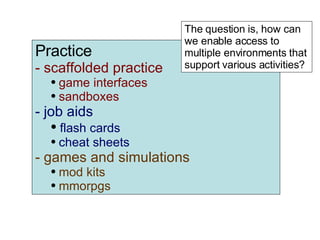
Practice scaffolded practice game interfaces sandboxes job aids flash cards cheat sheets games and simulations mod kits mmorpgs The question is, how can we enable access to multiple environments that support various activities?
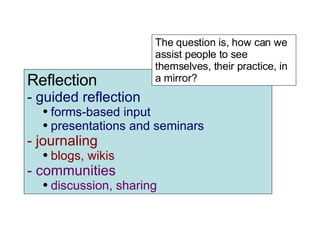
Reflection guided reflection forms-based input presentations and seminars journaling blogs, wikis communities discussion, sharing The question is, how can we assist people to see themselves, their practice, in a mirror?
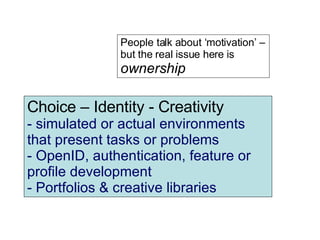
Choice – Identity - Creativity simulated or actual environments that present tasks or problems OpenID, authentication, feature or profile development Portfolios & creative libraries People talk about ‘motivation’ – but the real issue here is  ownership
http://www.downes.ca Downes

Stephen Downes on Personal Learning

  • 1.
    Personal Learning StephenDownes ~ March 11, 2008
  • 2.
    http://home.uchicago.edu/~yli5/Flash/Fire.html We didn't start the fire It was always burning, since the world's been turning Joel Prologue How do you teach if you no longer have power over students?
  • 3.
    Enter the NetworkEverything is connected to everything else (Theory-laden data) http://dsv.su.se/~kjellman/e-subjectoriented.htm Lakatos
  • 4.
    Enter the NetworkIt is impossible to predict anything (Chaos theory, strange attractors) Lorenz http://www.imho.com/grae/chaos/chaos.html
  • 5.
    Enter the NetworkIt is the breakdown of order (Postmodernism, ethnocentricity) (Cluetrain, We The Media) Derrida http://www.cluetrain.com/
  • 6.
    It looks like the internet… Like open source Like Social Networks Like blogs and blogging Like wikis and collaborative writing Like tagging and Digg and… It looks like Web 2.0 Stallman Enter the Network
  • 7.
    From the inside,you see the tubes Look for connections, interactions (or more concretely, XML and APIs) It's not a truck. It's a series of tubes. And if you don't understand those tubes can be filled and if they are filled, when you put your message in, it gets in line and its going to be delayed by anyone that puts into that tube enormous amounts of material, enormous amounts of material. Enter the Network
  • 8.
    It’s Chaos! Noprinciples or rules describing ‘quality’ Individual preferences only No rubric or metric No ‘peers’ or ‘committee of experts’ Evaluations are not an aggregation – no votes Suroweicki
  • 9.
    The Idea ofthe PLE… http://www.cetis.ac.uk/members/ple/resources/edf.ppt
  • 10.
    Plex Personal LearningEnvironment Example http://reload.ces.strath.ac.uk/plex/
  • 11.
    Collecting and FilteringRSS http://www.downes.ca/mygluframe.htm
  • 12.
  • 13.
  • 14.
    Edu_RSS 0.2 -The Demo http://www.downes.ca/edurss02.htm
  • 15.
    The Problem… Howto find the right resource… at the right time for the right person
  • 16.
    The old way– use descriptions Dublin Core Learning Object Metadata http://www.capuano.biz/Papers/ITS%202000/ITS%202000.htm
  • 17.
    Descriptions are (necessarily)incomplete many properties depend on context ‘ I know it when I see it’ these relations are dynamic and change… from person to person from time to time http://www-personal.umich.edu/~kborders/photography.htm
  • 18.
    Recommender Systems Theidea is that associations are mapped between: User profile – properties of given users Resource profile – properties of the resource Previous evaluations of other resources http://www.slideshare.net/Downes/projecting-quality http://www.slideshare.net/Downes/quality-standards-its-all-about-teaching-and-learning/
  • 19.
  • 20.
    knowledge has manyauthors, knowledge has many facets, it looks different to each different person, and it changes moment to moment
  • 21.
    The key insight…Two very distinct problems are in fact instances of the same problem. The problem of locating the right resource on the internet is basically the same problem as the problem of getting the question right on the test.
  • 22.
  • 23.
    Knowledge management? Intothis picture rides… the idea… ‘ Capture’ tacit knowledge … and then codify it Hodgins Learning Objects
  • 24.
    You Can’t GoBack Again personal knowledge Depends on Context Ineffable You can’t generalize it You can’t put it into words - tacit knowledge Polanyi
  • 25.
    Knowledge islike recognition Learning is like perception the acquisition of new patterns of connectivity through experience Hume
  • 26.
    Patterns in theMesh the knowledge is in the network the knowledge is the network Old: universals – rules – categories New: patterns – patterns – similarities Tenenbaum http://www.bbsonline.org/Preprints/OldArchive/bbs.tenenbaum.html
  • 27.
  • 28.
    You already knowthis phenomenon, you’ve already seen it Emergent Learning http://growchangelearn.blogspot.com/2007/02/emergent-learning.html Tom Haskins "Now I get it" A-ha! "Out of the blue" "My mind leaped" "Did an about-face" "Shut up and did it" Sudden breakthrough http://www.downes.ca/files/osn.html
  • 29.
    stands for? Oris caused by? Distributed Representation = a pattern of connectivity Hopfield
  • 30.
  • 31.
  • 32.
    The way networkslearn is the way people learn…
  • 33.
    Network Learning… Hebbianassociationism based on concurrency Back propagation based on desired outcome Boltzman based on ‘settling’, annealing This…
  • 34.
    Leads to This…Personal Learning… To teach is to model and to demonstrate To learn is to practice and reflect
  • 35.
  • 36.
    We can getan idea of what the PLE looks like by drilling down into the pieces… Model conceptual frameworks wiki (wiki API, RSS) concept maps (SVG, mapping format) gliffy (SVG?) reference frameworks Wikipedia video / 2L 3D representation – embedded spaces The question is – how to transport and represent models that are actually used?
  • 37.
    Demonstrate reference examplescode library image samples thought processes show experts at work (Chaos Manor) application case studies stories The question is, how can we connect the learner with the community at work?
  • 38.
    Practice scaffolded practicegame interfaces sandboxes job aids flash cards cheat sheets games and simulations mod kits mmorpgs The question is, how can we enable access to multiple environments that support various activities?
  • 39.
    Reflection guided reflectionforms-based input presentations and seminars journaling blogs, wikis communities discussion, sharing The question is, how can we assist people to see themselves, their practice, in a mirror?
  • 40.
    Choice – Identity- Creativity simulated or actual environments that present tasks or problems OpenID, authentication, feature or profile development Portfolios & creative libraries People talk about ‘motivation’ – but the real issue here is ownership
  • 41.