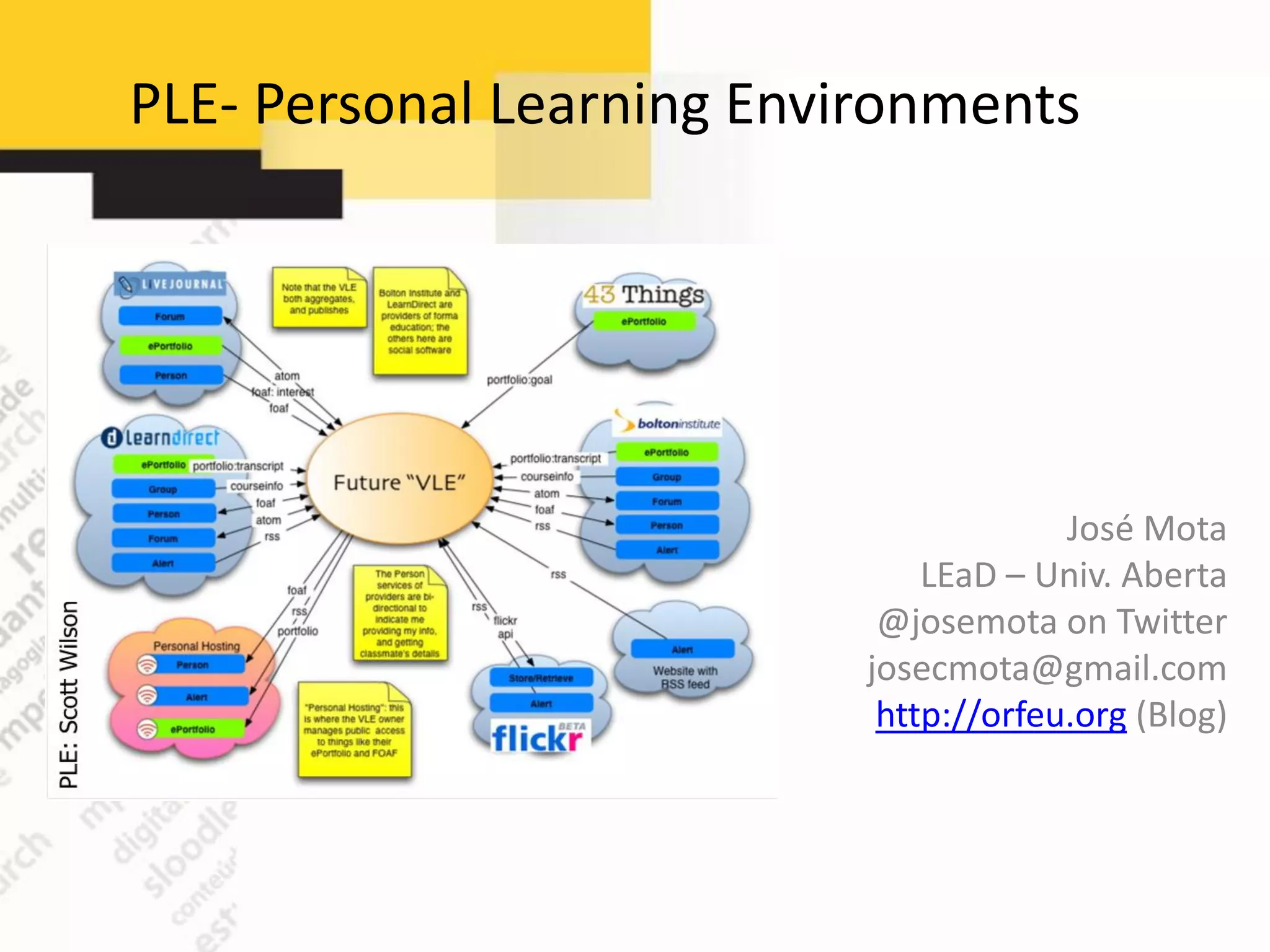
PLE- Personal Learning Environments


                                        José Mota
                               LEaD – Univ. Aberta
                            @josemota on Twitter
                           josecmota@gmail.com
                            http://orfeu.org (Blog)
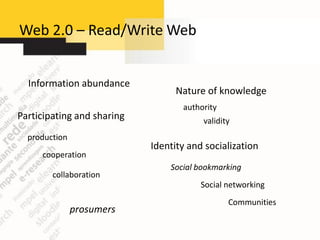
Web 2.0 – Read/Write Web


  Information abundance
                                  Nature of knowledge
                                   authority
Participating and sharing               validity
  production
                            Identity and socialization
     cooperation
                                Social bookmarking
        collaboration
                                        Social networking
                                               Communities
               prosumers
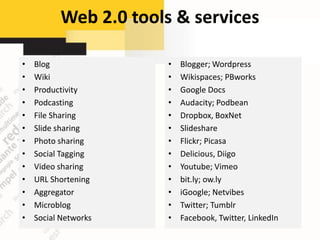
Web 2.0 tools & services

•   Blog               •   Blogger; Wordpress
•   Wiki               •   Wikispaces; PBworks
•   Productivity       •   Google Docs
•   Podcasting         •   Audacity; Podbean
•   File Sharing       •   Dropbox, BoxNet
•   Slide sharing      •   Slideshare
•   Photo sharing      •   Flickr; Picasa
•   Social Tagging     •   Delicious, Diigo
•   Video sharing      •   Youtube; Vimeo
•   URL Shortening     •   bit.ly; ow.ly
•   Aggregator         •   iGoogle; Netvibes
•   Microblog          •   Twitter; Tumblr
•   Social Networks    •   Facebook, Twitter, LinkedIn
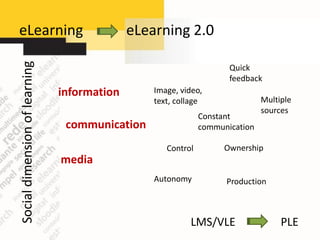
eLearning
Social dimension of learning                 eLearning 2.0

                                                                     Quick
                                                                     feedback
                               information       Image, video,
                                                 text, collage                Multiple
                                                                              sources
                                                              Constant
                                communication                 communication

                                                    Control         Ownership
                               media
                                                 Autonomy           Production


                                                          LMS/VLE                  PLE
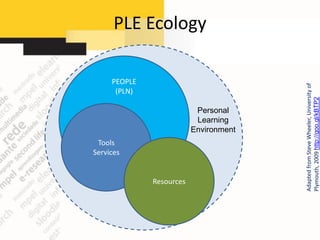
Tools
              Services
                                        (PLN)
                                       PEOPLE


  Resources
                                                PLE Ecology


                          Learning
                          Personal

                         Environment


Adapted from Steve Wheeler, University of
Plymouth, 2009 http://goo.gl/kBTP2
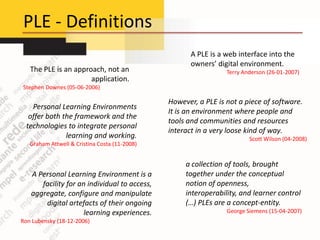
PLE - Definitions
                                                      A PLE is a web interface into the
                                                      owners’ digital environment.
   The PLE is an approach, not an                                Terry Anderson (26-01-2007)
                      application.
Stephen Downes (05-06-2006)

                                               However, a PLE is not a piece of software.
   Personal Learning Environments
                                               It is an environment where people and
  offer both the framework and the
                                               tools and communities and resources
 technologies to integrate personal
                                               interact in a very loose kind of way.
              learning and working.                                      Scott Wilson (04-2008)
   Graham Attwell & Cristina Costa (11-2008)


                                                    a collection of tools, brought
   A Personal Learning Environment is a             together under the conceptual
      facility for an individual to access,         notion of openness,
   aggregate, configure and manipulate              interoperability, and learner control
       digital artefacts of their ongoing           (…) PLEs are a concept-entity.
                     learning experiences.                       George Siemens (15-04-2007)
Ron Lubensky (18-12-2006)
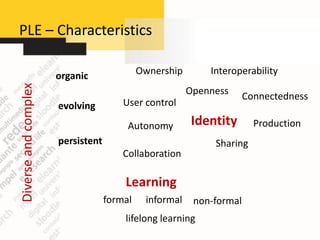
PLE – Characteristics

                      organic               Ownership       Interoperability
Diverse and complex


                                                        Openness
                                                                      Connectedness
                      evolving         User control

                                        Autonomy        Identity        Production
                      persistent                             Sharing
                                       Collaboration

                                       Learning
                                   formal    informal    non-formal
                                       lifelong learning
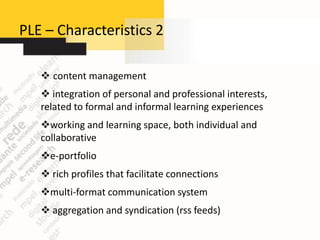
PLE – Characteristics 2

    content management
    integration of personal and professional interests,
   related to formal and informal learning experiences
   working and learning space, both individual and
   collaborative
   e-portfolio
    rich profiles that facilitate connections
   multi-format communication system
    aggregation and syndication (rss feeds)
PLE – Functions
Connect with others                                  Manage information                               Generate content

       Search for information                                 Aggregate information and
                                                              knowledge

       Share by supporting                                                           Analyse information to
       others in their learning                                                      develop knowledge


   Reflect, question, challenge, seek clarification,
   form and defend opinions
                                                                                           Manipulate, rearrange and
                     Network through a collaborative
                                                                                           repurpose knowledge artifacts
                     learning environment

Adapted from
Graham Attwell (2010) – Working, learning and playing through Personal Learning Environments [Presentation]
http://www.slideshare.net/GrahamAttwell/working-learning-and-playing-through-personal-learning-environments

Steve Wheeler (2010). It’s Personal: Learning Spaces, Learning Webs [Presentation]
http://www.slideshare.net/timbuckteeth/its-personal-learning-spaces-learning-webs
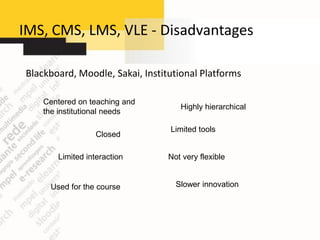
IMS, CMS, LMS, VLE - Disadvantages

Blackboard, Moodle, Sakai, Institutional Platforms

    Centered on teaching and
                                    Highly hierarchical
    the institutional needs

                                 Limited tools
                  Closed

       Limited interaction       Not very flexible


     Used for the course           Slower innovation
The end of VLE/LMS?


   Debate in the Association of Learning Technologists Conference 2009
   [ALT-C 2009]

   http://celtrecord.wordpress.com/2009/09/08/the-vle-is-dead-debate-at-
   alt-c-2009/
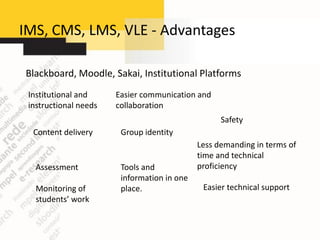
IMS, CMS, LMS, VLE - Advantages

Blackboard, Moodle, Sakai, Institutional Platforms
 Institutional and     Easier communication and
 instructional needs   collaboration
                                                   Safety
  Content delivery      Group identity
                                             Less demanding in terms of
                                             time and technical
   Assessment           Tools and            proficiency
                        information in one
   Monitoring of        place.                Easier technical support
   students’ work
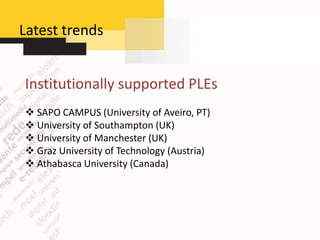
Latest trends


Institutionally supported PLEs
 SAPO CAMPUS (University of Aveiro, PT)
 University of Southampton (UK)
 University of Manchester (UK)
 Graz University of Technology (Austria)
 Athabasca University (Canada)
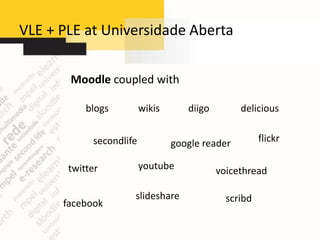
VLE + PLE at Universidade Aberta


       Moodle coupled with

           blogs         wikis      diigo        delicious


            secondlife           google reader         flickr

       twitter           youtube            voicethread

                     slideshare               scribd
      facebook
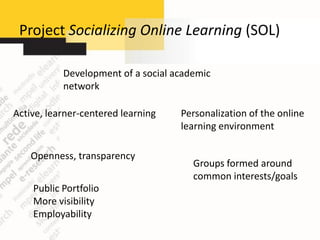
Project Socializing Online Learning (SOL)

           Development of a social academic
           network

Active, learner-centered learning   Personalization of the online
                                    learning environment

    Openness, transparency
                                       Groups formed around
                                       common interests/goals
    Public Portfolio
    More visibility
    Employability
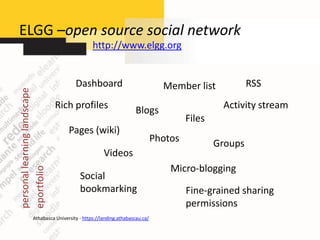
ELGG –open source social network
                                        http://www.elgg.org


                                   Dashboard                           Member list             RSS
personal learning landscape


                              Rich profiles                Blogs                       Activity stream
                                                                              Files
                                 Pages (wiki)
                                                                     Photos           Groups
                                             Videos
                                                                         Micro-blogging
eportfolio


                                    Social
                                    bookmarking                               Fine-grained sharing
                                                                              permissions
             Athabasca University - https://landing.athabascau.ca/
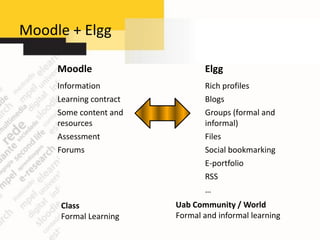
Moodle + Elgg

     Moodle                     Elgg
     Information                Rich profiles
     Learning contract          Blogs
     Some content and           Groups (formal and
     resources                  informal)
     Assessment                 Files
     Forums                     Social bookmarking
                                E-portfolio
                                RSS
                                …
     Class               Uab Community / World
     Formal Learning     Formal and informal learning
SOL – Some questions


 How to enable anf foster active participation in an
ecology of sharing and collaboration geared towards
knowledge creation, that contributes to reinforce the
identity of the academic community?
 What elements could be decisive to aggregate good
quality information, relevant for academic performance
and for social visibility/employability?
 How to develop good mechanisms that articulate
efficiently and productively formal and informal learning?
Thank you .


               e-mail: josecmota@gmail.com
               twitter: @josemota
               blog: http://orfeu.org

Personal Learning Environments

  • 1.
    PLE- Personal LearningEnvironments José Mota LEaD – Univ. Aberta @josemota on Twitter josecmota@gmail.com http://orfeu.org (Blog)
  • 2.
    Web 2.0 –Read/Write Web Information abundance Nature of knowledge authority Participating and sharing validity production Identity and socialization cooperation Social bookmarking collaboration Social networking Communities prosumers
  • 3.
    Web 2.0 tools& services • Blog • Blogger; Wordpress • Wiki • Wikispaces; PBworks • Productivity • Google Docs • Podcasting • Audacity; Podbean • File Sharing • Dropbox, BoxNet • Slide sharing • Slideshare • Photo sharing • Flickr; Picasa • Social Tagging • Delicious, Diigo • Video sharing • Youtube; Vimeo • URL Shortening • bit.ly; ow.ly • Aggregator • iGoogle; Netvibes • Microblog • Twitter; Tumblr • Social Networks • Facebook, Twitter, LinkedIn
  • 4.
    eLearning Social dimension oflearning eLearning 2.0 Quick feedback information Image, video, text, collage Multiple sources Constant communication communication Control Ownership media Autonomy Production LMS/VLE PLE
  • 5.
    Tools Services (PLN) PEOPLE Resources PLE Ecology Learning Personal Environment Adapted from Steve Wheeler, University of Plymouth, 2009 http://goo.gl/kBTP2
  • 6.
    PLE - Definitions A PLE is a web interface into the owners’ digital environment. The PLE is an approach, not an Terry Anderson (26-01-2007) application. Stephen Downes (05-06-2006) However, a PLE is not a piece of software. Personal Learning Environments It is an environment where people and offer both the framework and the tools and communities and resources technologies to integrate personal interact in a very loose kind of way. learning and working. Scott Wilson (04-2008) Graham Attwell & Cristina Costa (11-2008) a collection of tools, brought A Personal Learning Environment is a together under the conceptual facility for an individual to access, notion of openness, aggregate, configure and manipulate interoperability, and learner control digital artefacts of their ongoing (…) PLEs are a concept-entity. learning experiences. George Siemens (15-04-2007) Ron Lubensky (18-12-2006)
  • 7.
    PLE – Characteristics organic Ownership Interoperability Diverse and complex Openness Connectedness evolving User control Autonomy Identity Production persistent Sharing Collaboration Learning formal informal non-formal lifelong learning
  • 8.
    PLE – Characteristics2  content management  integration of personal and professional interests, related to formal and informal learning experiences working and learning space, both individual and collaborative e-portfolio  rich profiles that facilitate connections multi-format communication system  aggregation and syndication (rss feeds)
  • 9.
    PLE – Functions Connectwith others Manage information Generate content Search for information Aggregate information and knowledge Share by supporting Analyse information to others in their learning develop knowledge Reflect, question, challenge, seek clarification, form and defend opinions Manipulate, rearrange and Network through a collaborative repurpose knowledge artifacts learning environment Adapted from Graham Attwell (2010) – Working, learning and playing through Personal Learning Environments [Presentation] http://www.slideshare.net/GrahamAttwell/working-learning-and-playing-through-personal-learning-environments Steve Wheeler (2010). It’s Personal: Learning Spaces, Learning Webs [Presentation] http://www.slideshare.net/timbuckteeth/its-personal-learning-spaces-learning-webs
  • 10.
    IMS, CMS, LMS,VLE - Disadvantages Blackboard, Moodle, Sakai, Institutional Platforms Centered on teaching and Highly hierarchical the institutional needs Limited tools Closed Limited interaction Not very flexible Used for the course Slower innovation
  • 11.
    The end ofVLE/LMS? Debate in the Association of Learning Technologists Conference 2009 [ALT-C 2009] http://celtrecord.wordpress.com/2009/09/08/the-vle-is-dead-debate-at- alt-c-2009/
  • 12.
    IMS, CMS, LMS,VLE - Advantages Blackboard, Moodle, Sakai, Institutional Platforms Institutional and Easier communication and instructional needs collaboration Safety Content delivery Group identity Less demanding in terms of time and technical Assessment Tools and proficiency information in one Monitoring of place. Easier technical support students’ work
  • 13.
    Latest trends Institutionally supportedPLEs  SAPO CAMPUS (University of Aveiro, PT)  University of Southampton (UK)  University of Manchester (UK)  Graz University of Technology (Austria)  Athabasca University (Canada)
  • 14.
    VLE + PLEat Universidade Aberta Moodle coupled with blogs wikis diigo delicious secondlife google reader flickr twitter youtube voicethread slideshare scribd facebook
  • 15.
    Project Socializing OnlineLearning (SOL) Development of a social academic network Active, learner-centered learning Personalization of the online learning environment Openness, transparency Groups formed around common interests/goals Public Portfolio More visibility Employability
  • 16.
    ELGG –open sourcesocial network http://www.elgg.org Dashboard Member list RSS personal learning landscape Rich profiles Blogs Activity stream Files Pages (wiki) Photos Groups Videos Micro-blogging eportfolio Social bookmarking Fine-grained sharing permissions Athabasca University - https://landing.athabascau.ca/
  • 17.
    Moodle + Elgg Moodle Elgg Information Rich profiles Learning contract Blogs Some content and Groups (formal and resources informal) Assessment Files Forums Social bookmarking E-portfolio RSS … Class Uab Community / World Formal Learning Formal and informal learning
  • 18.
    SOL – Somequestions  How to enable anf foster active participation in an ecology of sharing and collaboration geared towards knowledge creation, that contributes to reinforce the identity of the academic community?  What elements could be decisive to aggregate good quality information, relevant for academic performance and for social visibility/employability?  How to develop good mechanisms that articulate efficiently and productively formal and informal learning?
  • 19.
    Thank you . e-mail: josecmota@gmail.com twitter: @josemota blog: http://orfeu.org