Towards an informational turn
in philosophy of science?
Federica Russo
Philosophy | Humanities | Amsterdam
russofederica.wordpress.com | @federicarusso
Overview
The pervasiveness of technology
Digital technologies and the philosophy of information
Philosophy of information and philosophy of science
Techno-scientific practices
An example: exposure science and biomarkers research
Ontological and epistemological questions
How to revisit classic philsci concepts with PI
2
THE PERVASIVENESS
OF TECHNOLOGY
3
4
5
Artefacts, instruments
From history of technology
Machines to help us domesticate nature,
Artefacts to boost / amplify our capacities
From history of science
The scientific revolution was also a technological revolution
The tradition of the workshop and the role of instruments in
scientific method
6
DIGITAL TECHNOLOGIES
7
The digital revolution
The place of human beings keeps changing:
We are not
at the center of the universe (Copernicus)
at the center of nature (Darwin)
transparent to ourselves (Freud)
the only intelligent being (Turing)
[Floridi, The 4th Revolution]
8
An information
revolution
A revolution in the information
process
From pre- to hyper-history
Pre-history: information is not
recorded
History: information is
recorded, processed
ICTs transform the whole
information process
The amount of transmitted
information
How information is transmitted
9
[Pics: Floridi, The 4th Revolution]
Basic vocabulary of PI
Information as:
Resource: we use it, e.g.: to make decisions; Product: we use it to
generate further information, and then used to modify it … i.e.:
information is a target
[Formal definition of information does not interest us here]
Inforgs: informational organisms
We, intelligent humans; intelligent engineered artefacts
Infosphere: informational environment
The whole space of possible information, including Nature.
Physis: nature, reality
Techne: practical science and creation of artefacts
10
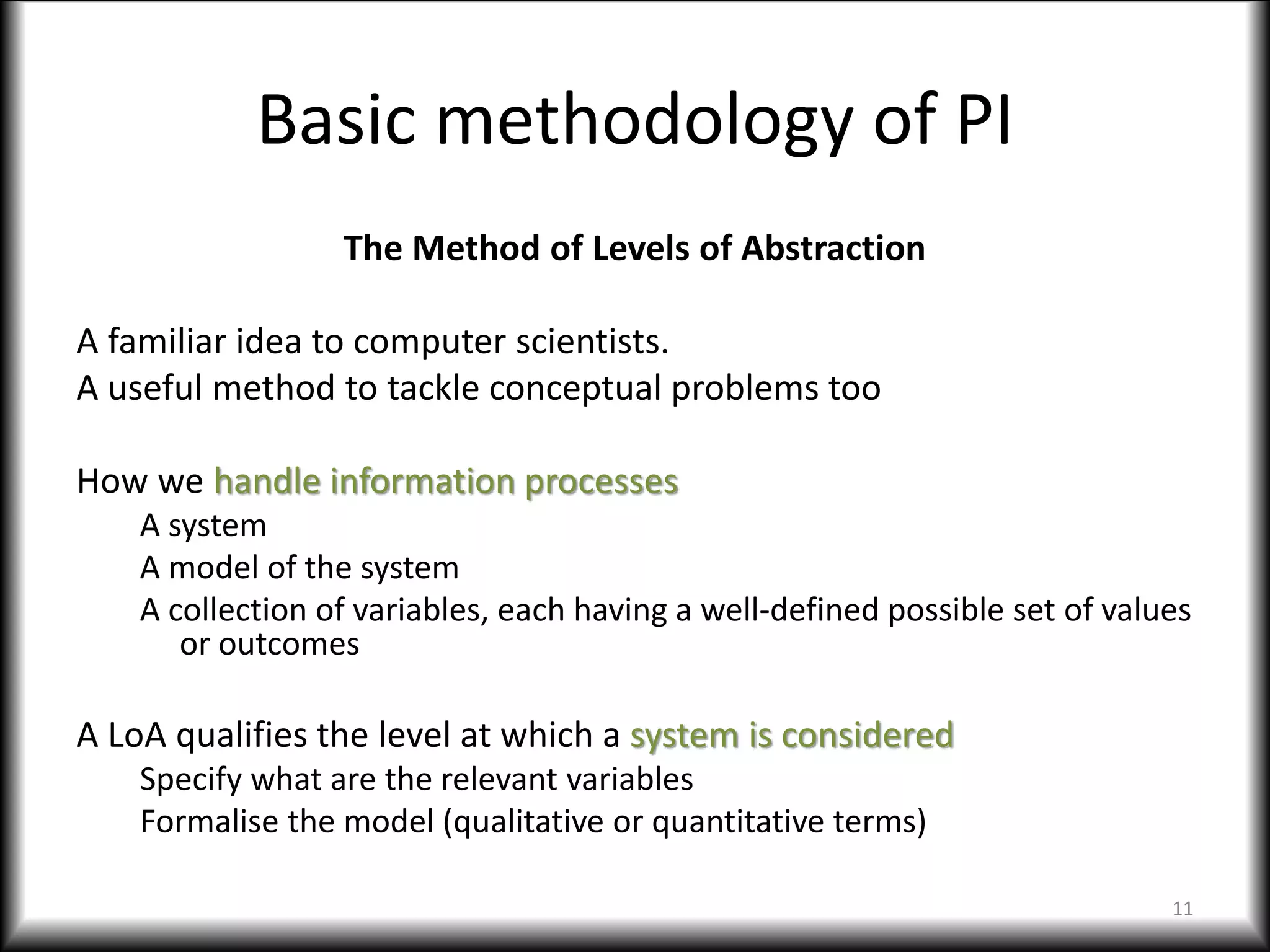
Basic methodology of PI
The Method of Levels of Abstraction
A familiar idea to computer scientists.
A useful method to tackle conceptual problems too
How we handle information processes
A system
A model of the system
A collection of variables, each having a well-defined possible set of values
or outcomes
A LoA qualifies the level at which a system is considered
Specify what are the relevant variables
Formalise the model (qualitative or quantitative terms)
11
Why going LoA in philosophy?
Clarify implicit assumptions
Facilitate comparison
Enhances rigour
Promotes resolution of possible conceptual
confusions
[Floridi, The ethics of information, ch.3]
12
TECHNO-SCIENTIFIC PRACTICES
13
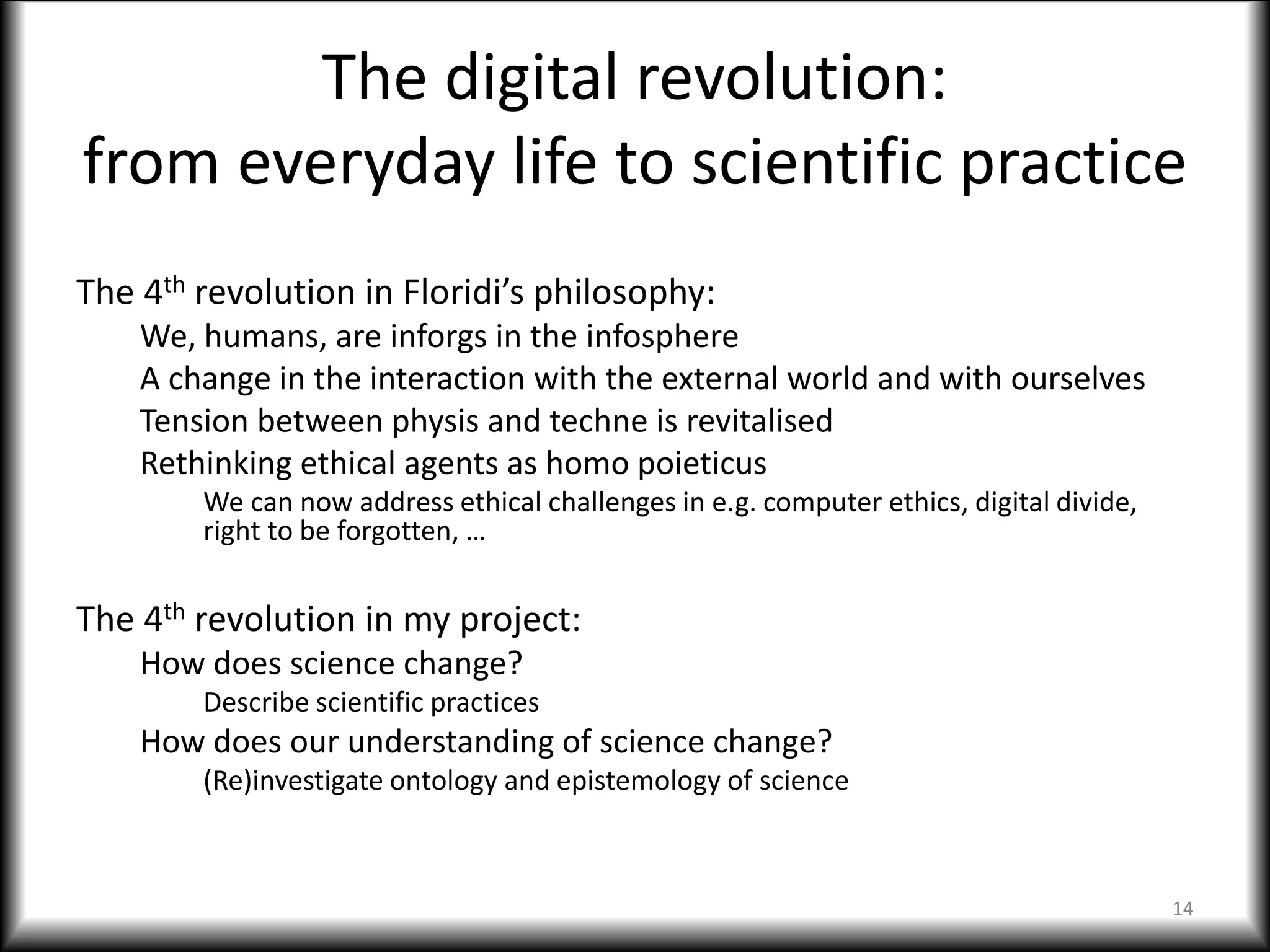
The digital revolution:
from everyday life to scientific practice
The 4th revolution in Floridi’s philosophy:
We, humans, are inforgs in the infosphere
A change in the interaction with the external world and with ourselves
Tension between physis and techne is revitalised
Rethinking ethical agents as homo poieticus
We can now address ethical challenges in e.g. computer ethics, digital divide,
right to be forgotten, …
The 4th revolution in my project:
How does science change?
Describe scientific practices
How does our understanding of science change?
(Re)investigate ontology and epistemology of science
14
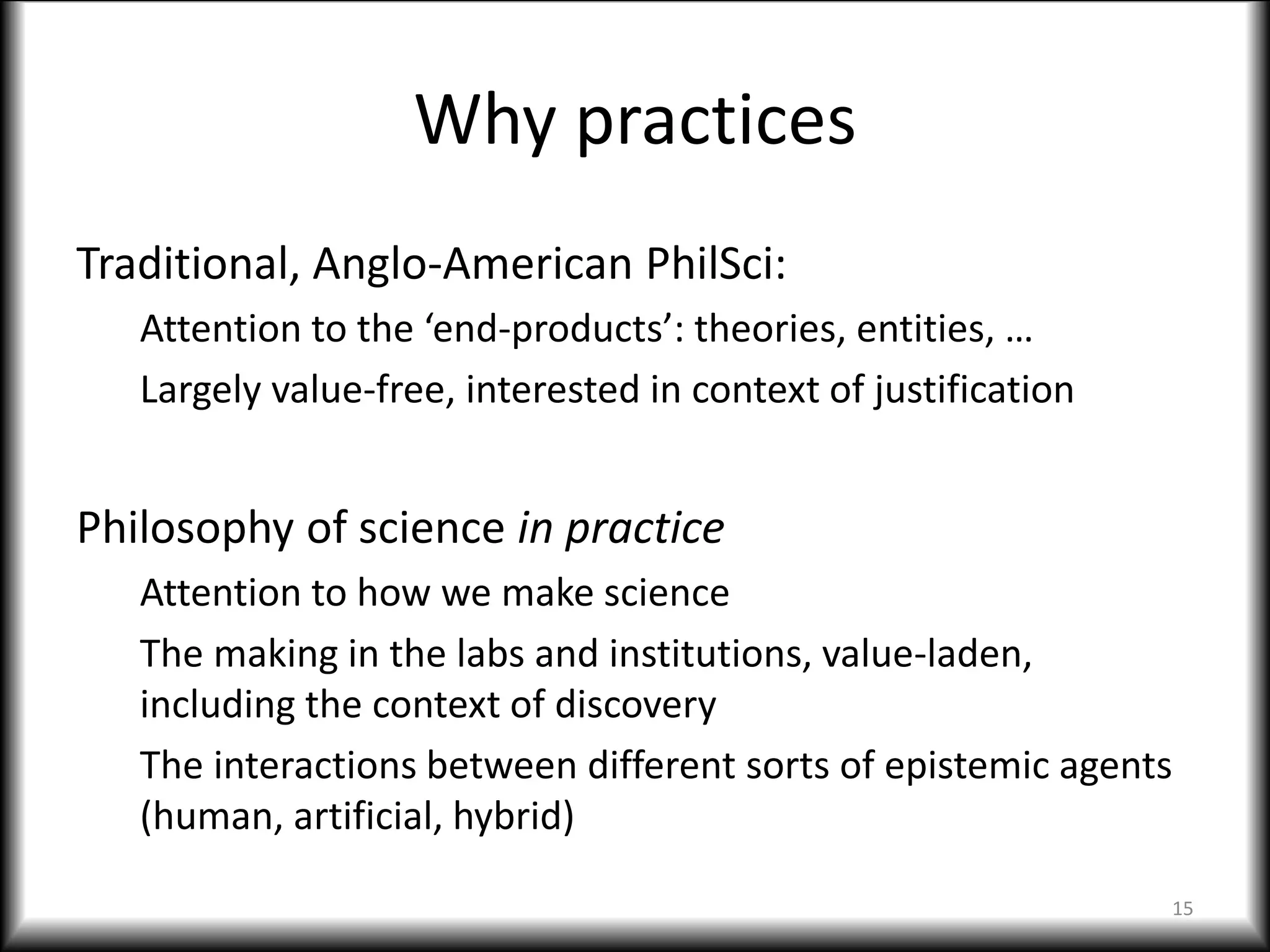
Why practices
Traditional, Anglo-American PhilSci:
Attention to the ‘end-products’: theories, entities, …
Largely value-free, interested in context of justification
Philosophy of science in practice
Attention to how we make science
The making in the labs and institutions, value-laden,
including the context of discovery
The interactions between different sorts of epistemic agents
(human, artificial, hybrid)
15
Why techno-scientific
The practice of science is highly technologised
The question is not who comes first
Technology first >< Science first
The interesting question is
How does our understanding of science changes? [Once the
technological component is appropriately examined]
16
Applying LoA
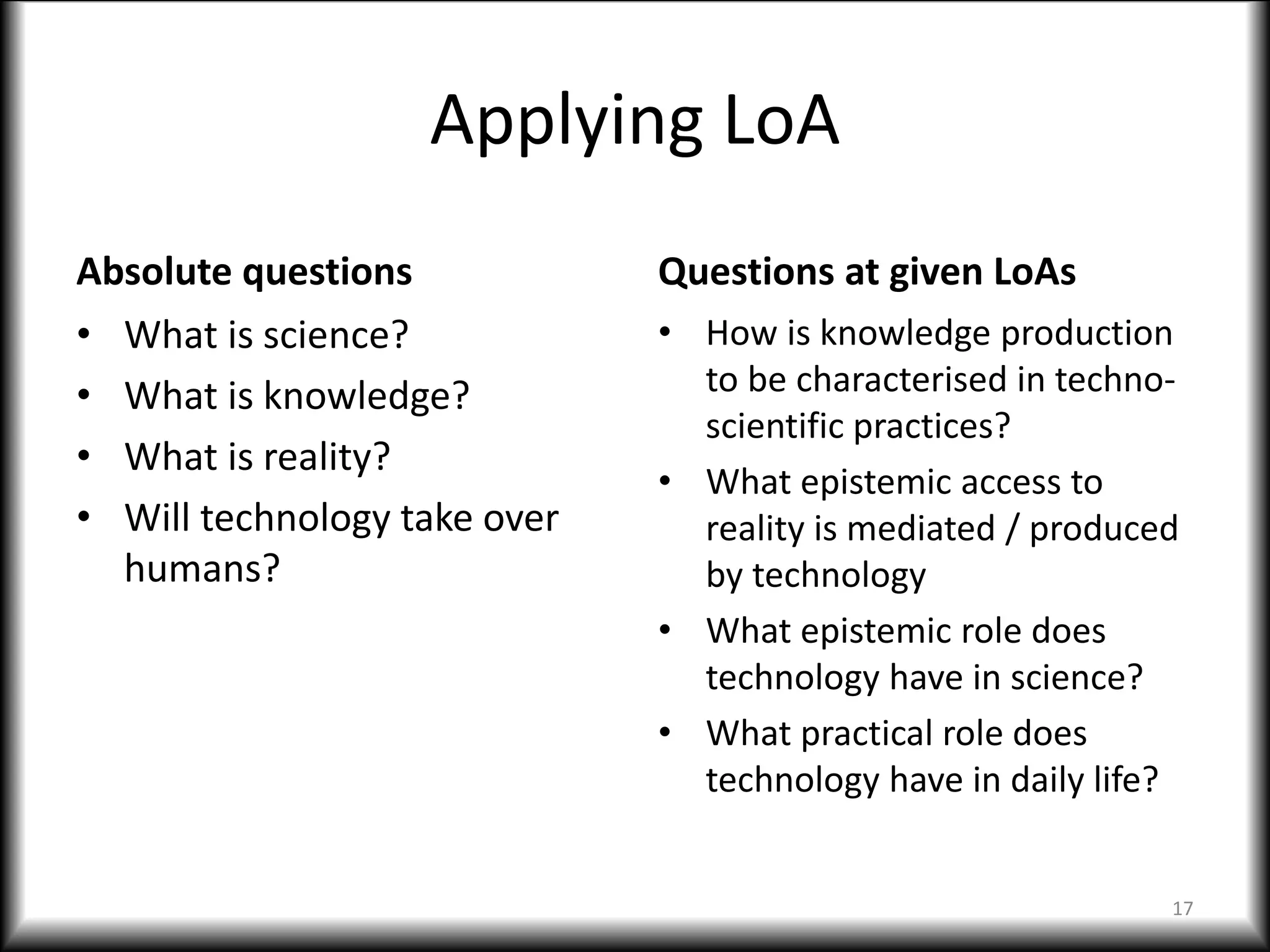
Absolute questions
• What is science?
• What is knowledge?
• What is reality?
• Will technology take over
humans?
Questions at given LoAs
• How is knowledge production
to be characterised in techno-
scientific practices?
• What epistemic access to
reality is mediated / produced
by technology
• What epistemic role does
technology have in science?
• What practical role does
technology have in daily life?
17
EXPOSURE SCIENCE AND
BIOMARKERS RESEARCH
An example
18
From epidemiology to
molecular epidemiology
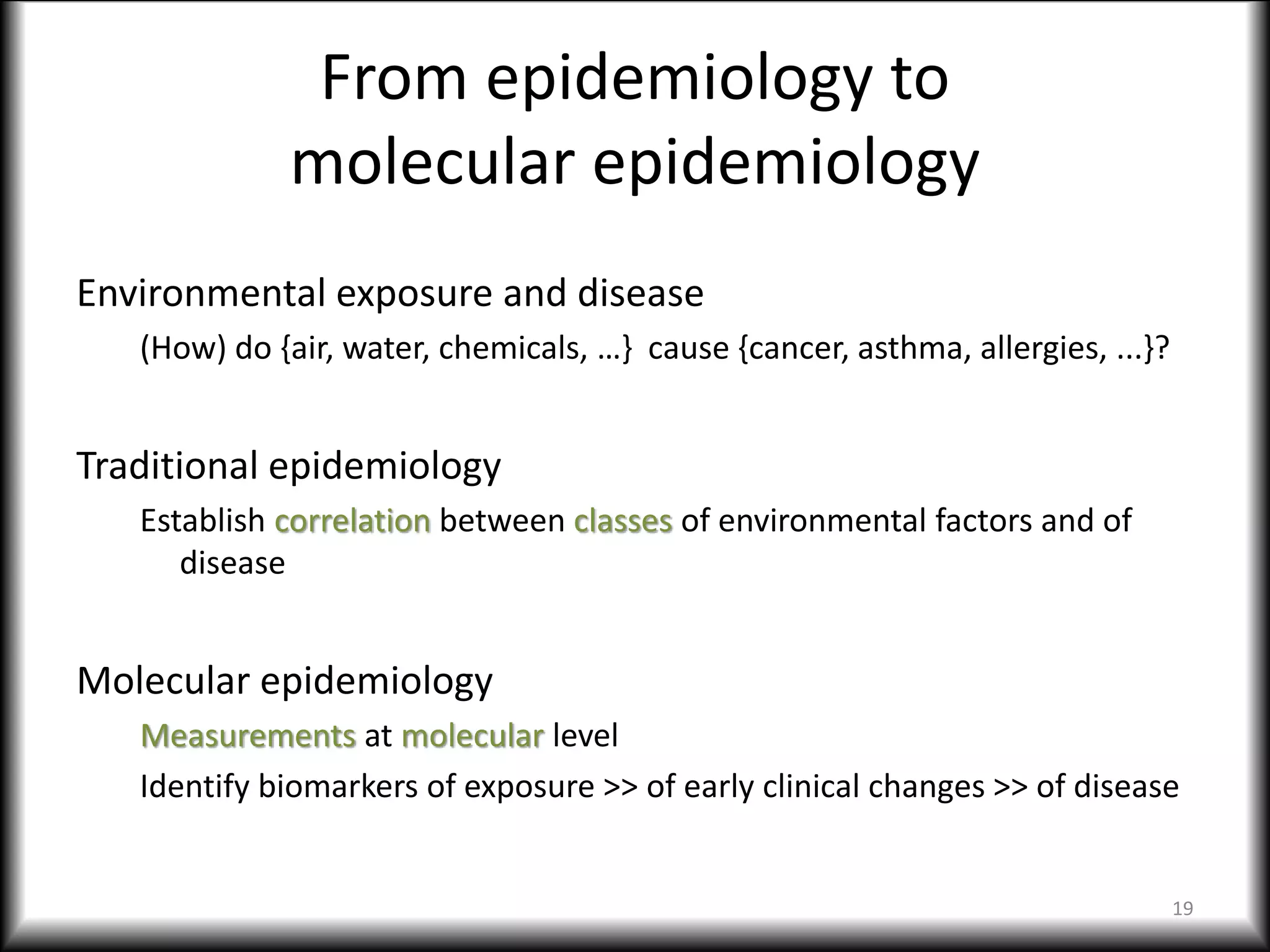
Environmental exposure and disease
(How) do {air, water, chemicals, …} cause {cancer, asthma, allergies, ...}?
Traditional epidemiology
Establish correlation between classes of environmental factors and of
disease
Molecular epidemiology
Measurements at molecular level
Identify biomarkers of exposure >> of early clinical changes >> of disease
19
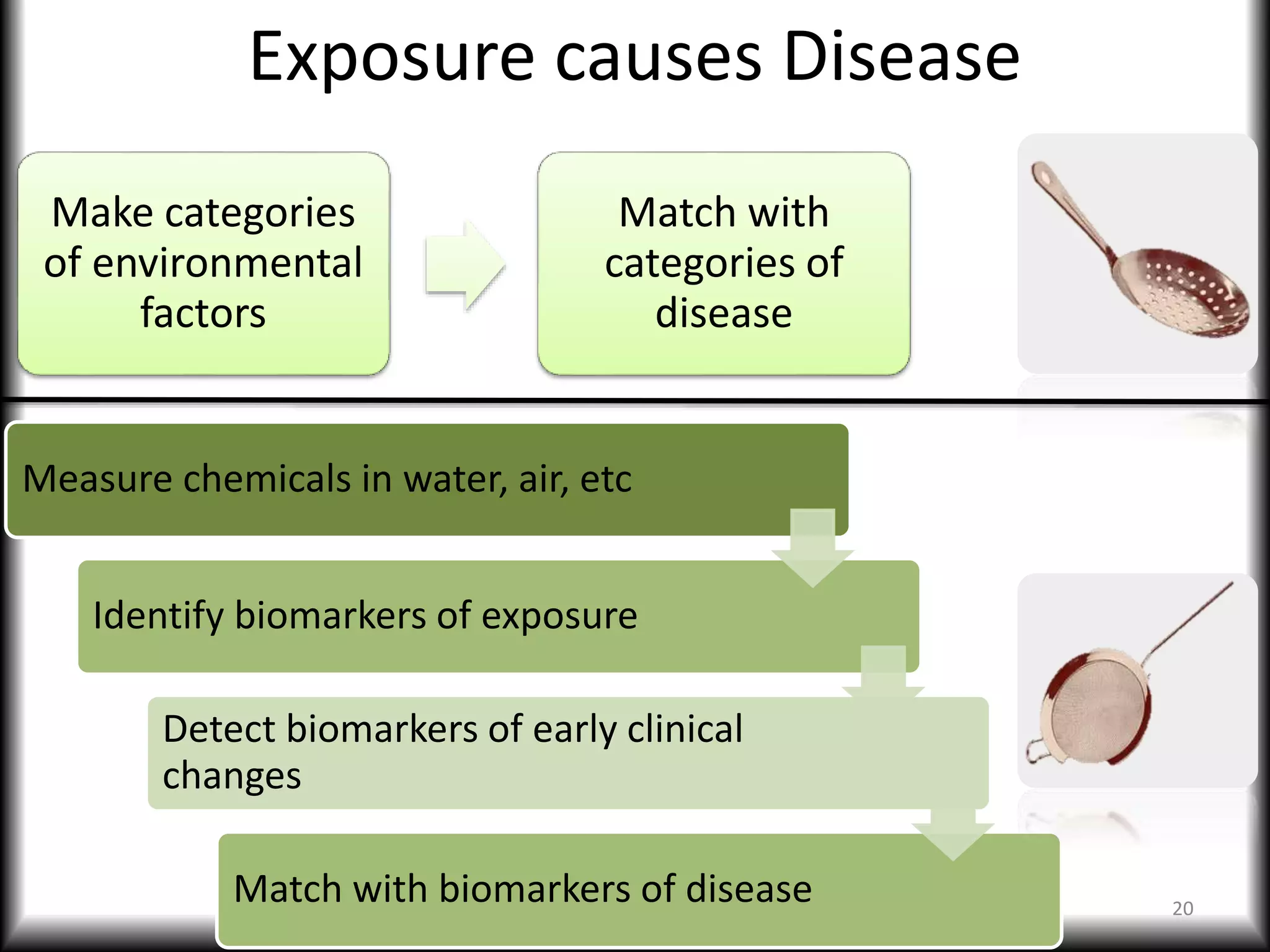
Exposure causes Disease
Measure chemicals in water, air, etc
Identify biomarkers of exposure
Detect biomarkers of early clinical
changes
Match with biomarkers of disease 20
Make categories
of environmental
factors
Match with
categories of
disease
Data- and technology-driven
Big data helps with the generation of evidence of
correlation (statistical analyses) and of mechanisms
(omics analyses)
Specifically, technology is central to: generating,
processing, storing / archiving, curating, analysing
data
21
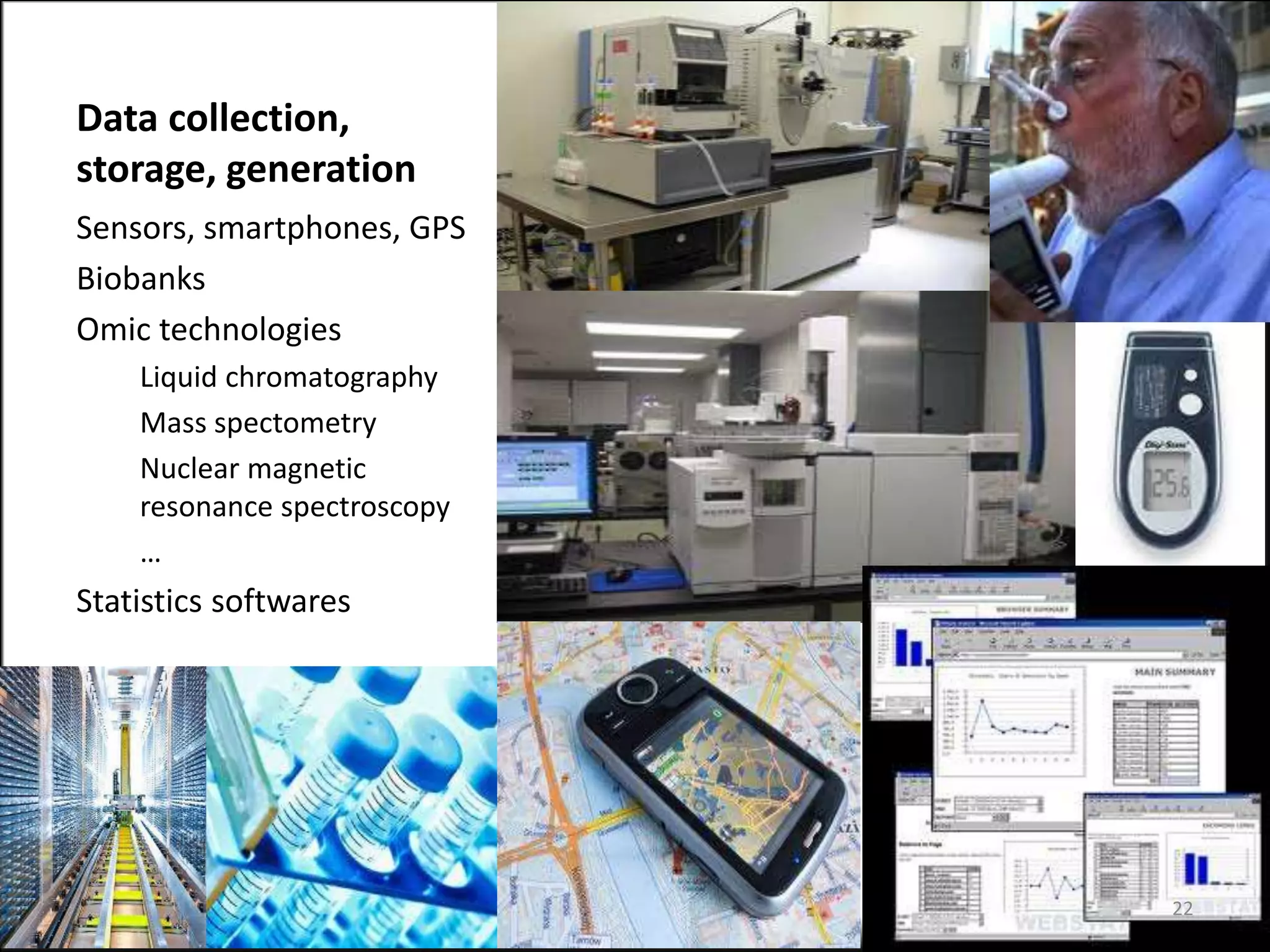
Data collection,
storage, generation
Sensors, smartphones, GPS
Biobanks
Omic technologies
Liquid chromatography
Mass spectometry
Nuclear magnetic
resonance spectroscopy
…
Statistics softwares
22
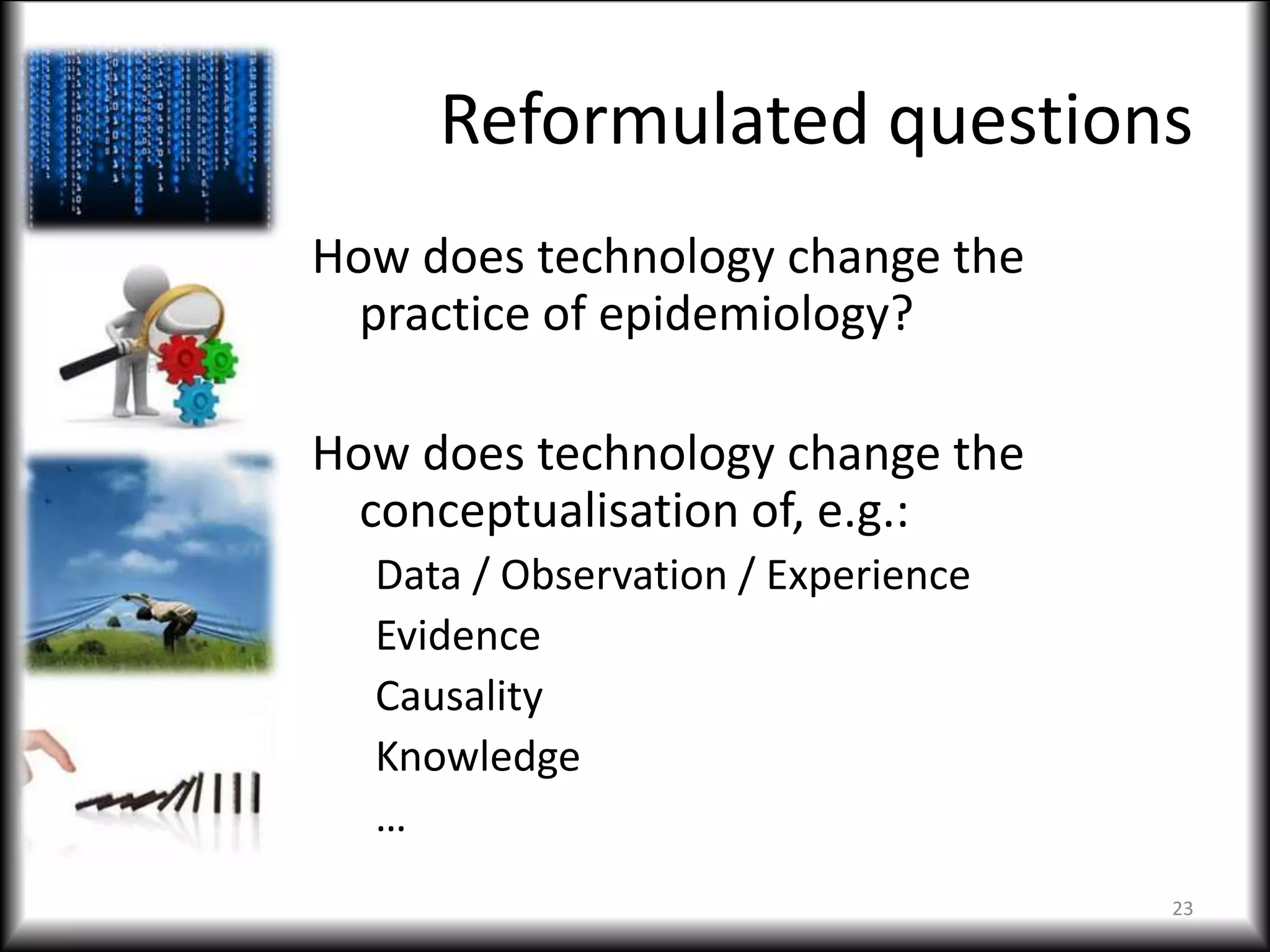
Reformulated questions
How does technology change the
practice of epidemiology?
How does technology change the
conceptualisation of, e.g.:
Data / Observation / Experience
Evidence
Causality
Knowledge
…
23
An example ad hoc?
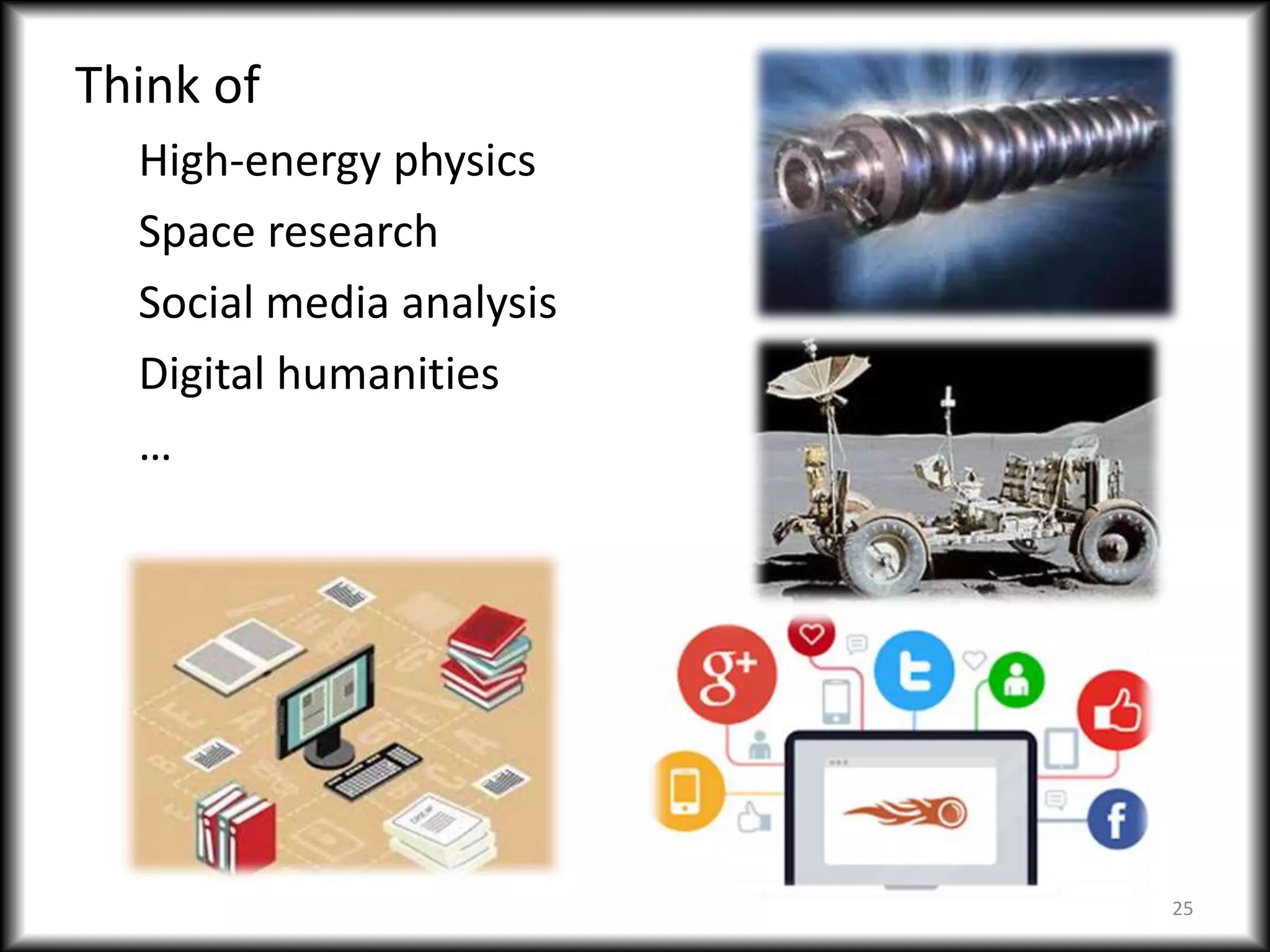
Think of
High-energy physics
Space research
Social media analysis
Digital humanities
…
25
ONTOLOGICAL QUESTIONS
26
Ontology, but not armchair
What there is:
not an abstract, absolute question
Here:
Do ICTs bear any changes to ‘what there is’?
27
Re-ontologising the real: a PI perspective
ICTs create new ontological spaces
Compare:
Dishwashers vs smartphones
Mimeograph vs smartprinting
Onlife presence vs locality
In a techno-scientific context
New understanding of old concepts
What is an entity?
Do entities really exist??
It depends on the LoA
28
Again on biomarkers research
Are biomarkers tiny tiny entities?
30
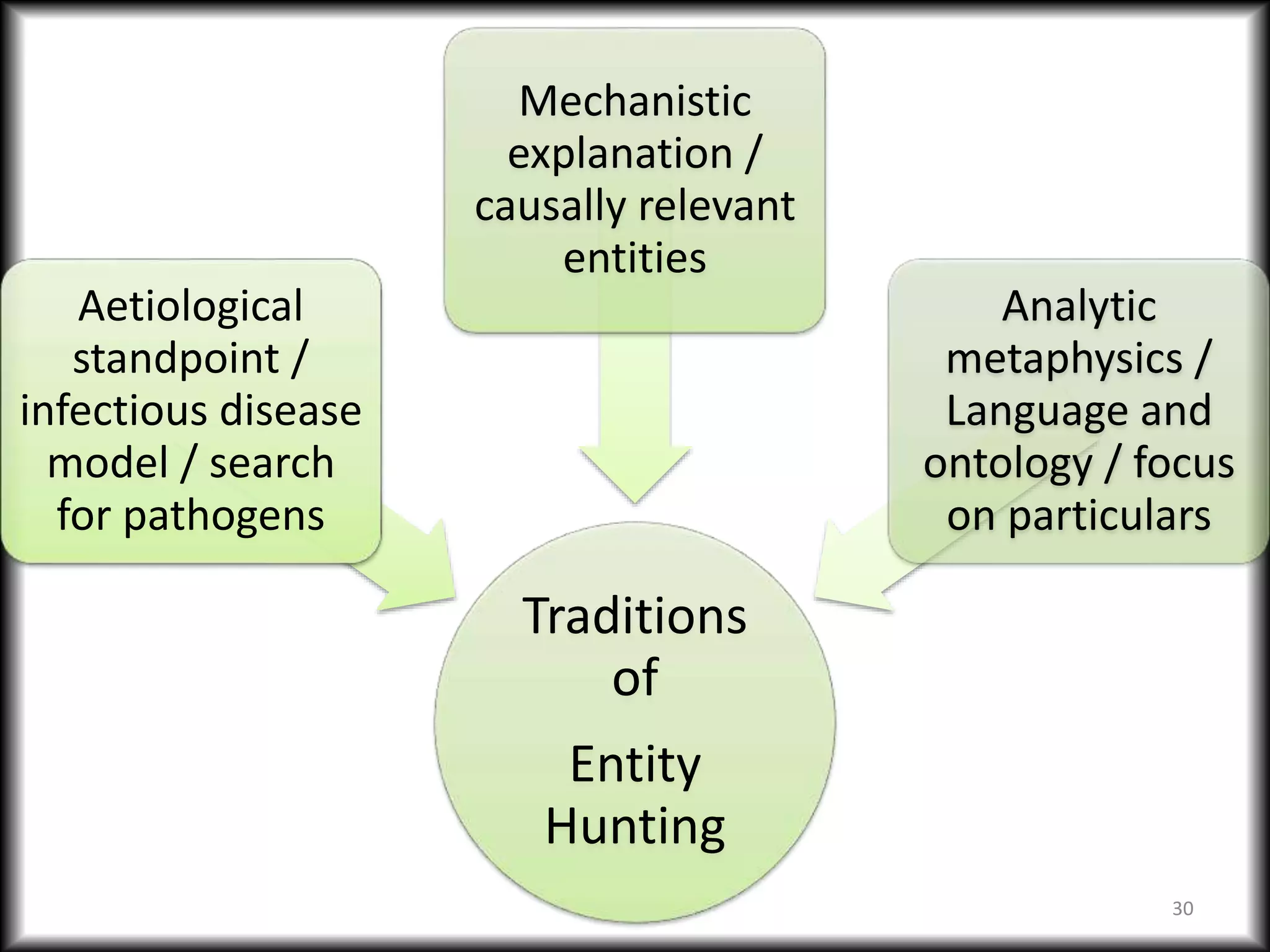
Traditions
of
Entity
Hunting
Aetiological
standpoint /
infectious disease
model / search
for pathogens
Mechanistic
explanation /
causally relevant
entities
Analytic
metaphysics /
Language and
ontology / focus
on particulars
Picking up entities?
While classical statistical models to analyzing -omics data serve the
purpose of identifying signals and separating them
from noise, little has been done in chronic diseases to model
time into the exposure-biomarker-disease continuum.
[Vineis and Chadeau-Hyam 2011]
From these two parallel analyses [statistical analyses], we obtained
lists of putative markers of (i) the disease outcome, and (ii)
exposure. These were compared in a second step in order to
identify possible intersecting signals, therefore defining
potential intermediate biomarkers.
[Chadeau-Hyam et al 2011]
31
We pick up signal!
Early theorisations of biomarkers
A must read
Molecular epidemiologist Paul Schulte (1993)
Biomarkers
Biological markers: ‘’technologically powerful measures of
biological variables’’
Indicate events in the continuum [E----D] at different levels
32
What do biomarkers stand for?
It is vital to understand the nature of the relationship between the
mark and the event
“Does the marker represent an event, is it an event itself, is it a
correlate of the event, or is it a predictor of the event?
The answers to these questions may affect who is sampled, how
and when they are sampled, and what confounders or effect
modifiers are considered. […] Thus, a biologic marker often
refers to the use made of a piece of biologic
information rather than to a specific type of
information.”
Schulte, 1993, p.14-15.
33
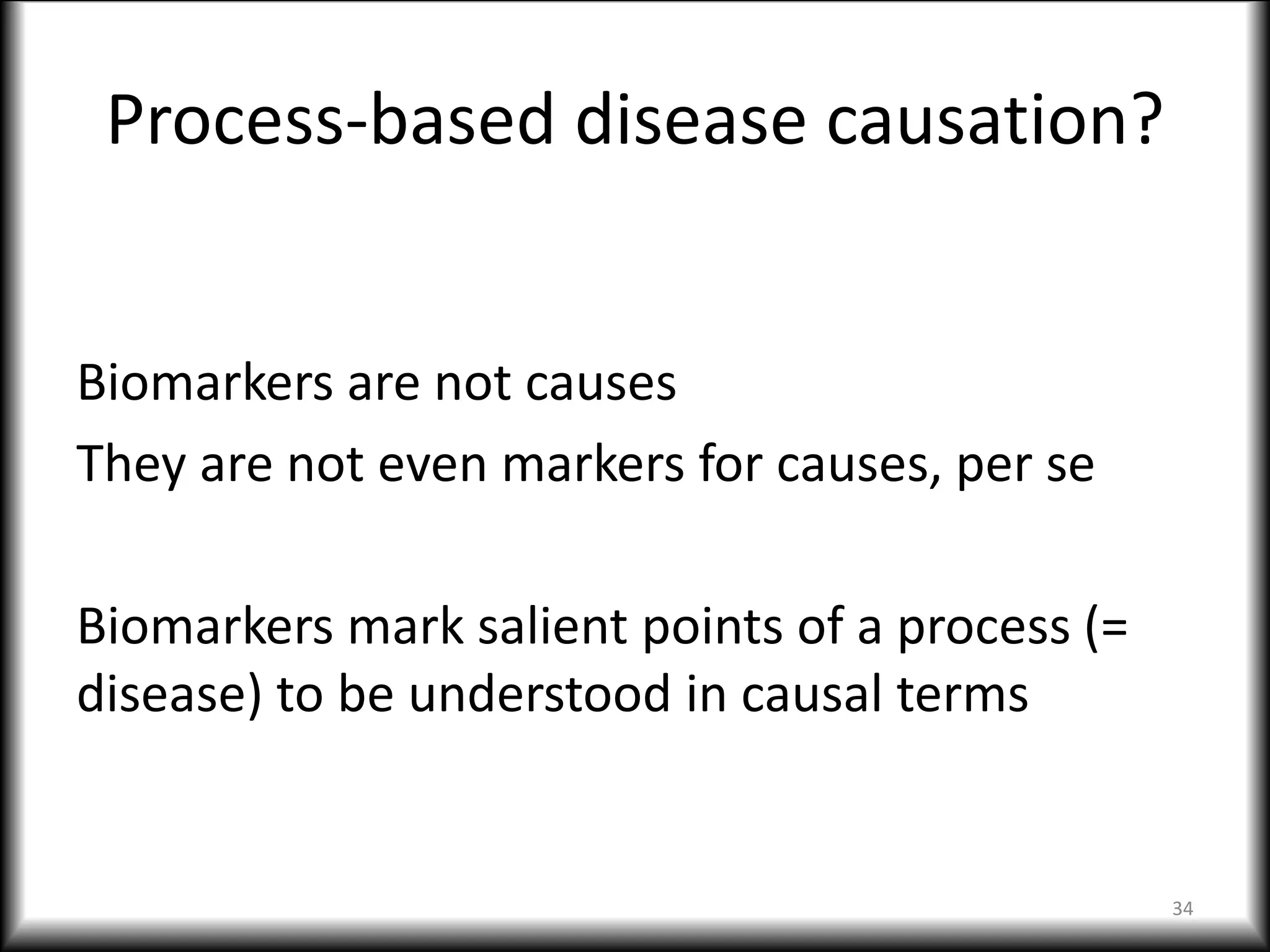
Process-based disease causation?
Biomarkers are not causes
They are not even markers for causes, per se
Biomarkers mark salient points of a process (=
disease) to be understood in causal terms
34
Process ontologies
Latest insights from phil biology
To say what an individual is we must look at processes,
rather than entities
Dupré, Pradeau (and Guay), Seibt, …
We can conceive as disease as a (causal) process
Sharp distinction between normal and pathological
collapses
[Yes, we may also create new ‘normal’ with biomarkers
of health …]
35
Undecided after ontological
arguments?
Look at the epistemology
EPISTEMOLOGICAL QUESTIONS
37
Epistemology, from science in practice
Again, start from the practice of science, then
raise epistemological questions.
Here: How do we know? How do we produce
knowledge?
38
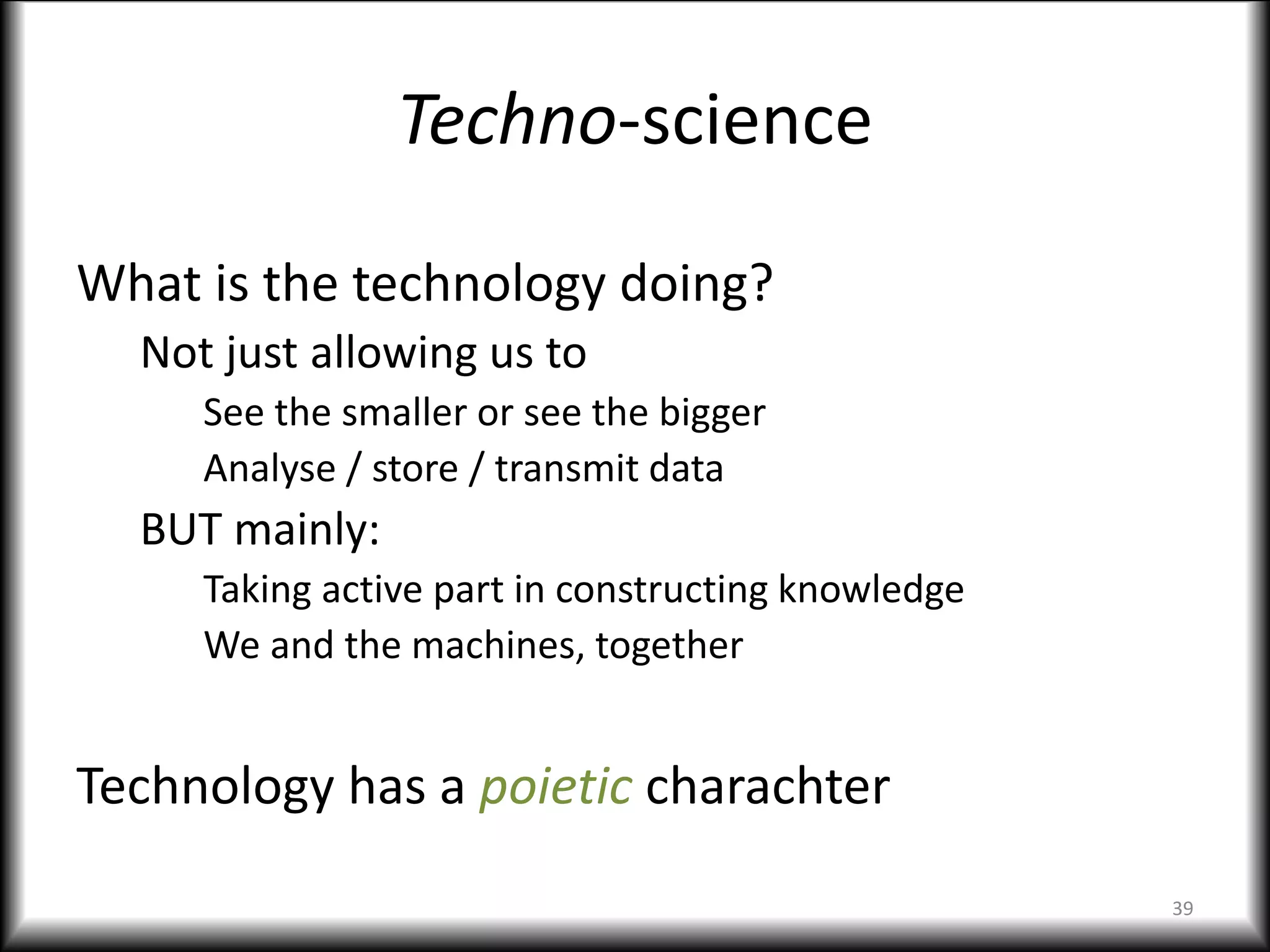
Techno-science
What is the technology doing?
Not just allowing us to
See the smaller or see the bigger
Analyse / store / transmit data
BUT mainly:
Taking active part in constructing knowledge
We and the machines, together
Technology has a poietic charachter
39
Why poiesis?
Knowledge is not just representational
Mimesis: we re-produce what there is
[Admittedly, we also express it in natural language, but it is not to be
reduced to it]
Knowledge is produced
Who/What produces knowledge?
Epistemic Agents: human and artificial
Knowledge becomes embodied, distributed, connected, …
Both human and artificial epistemic agents
have poietic characther
40
TO SUM UP AND CONCLUDE
41
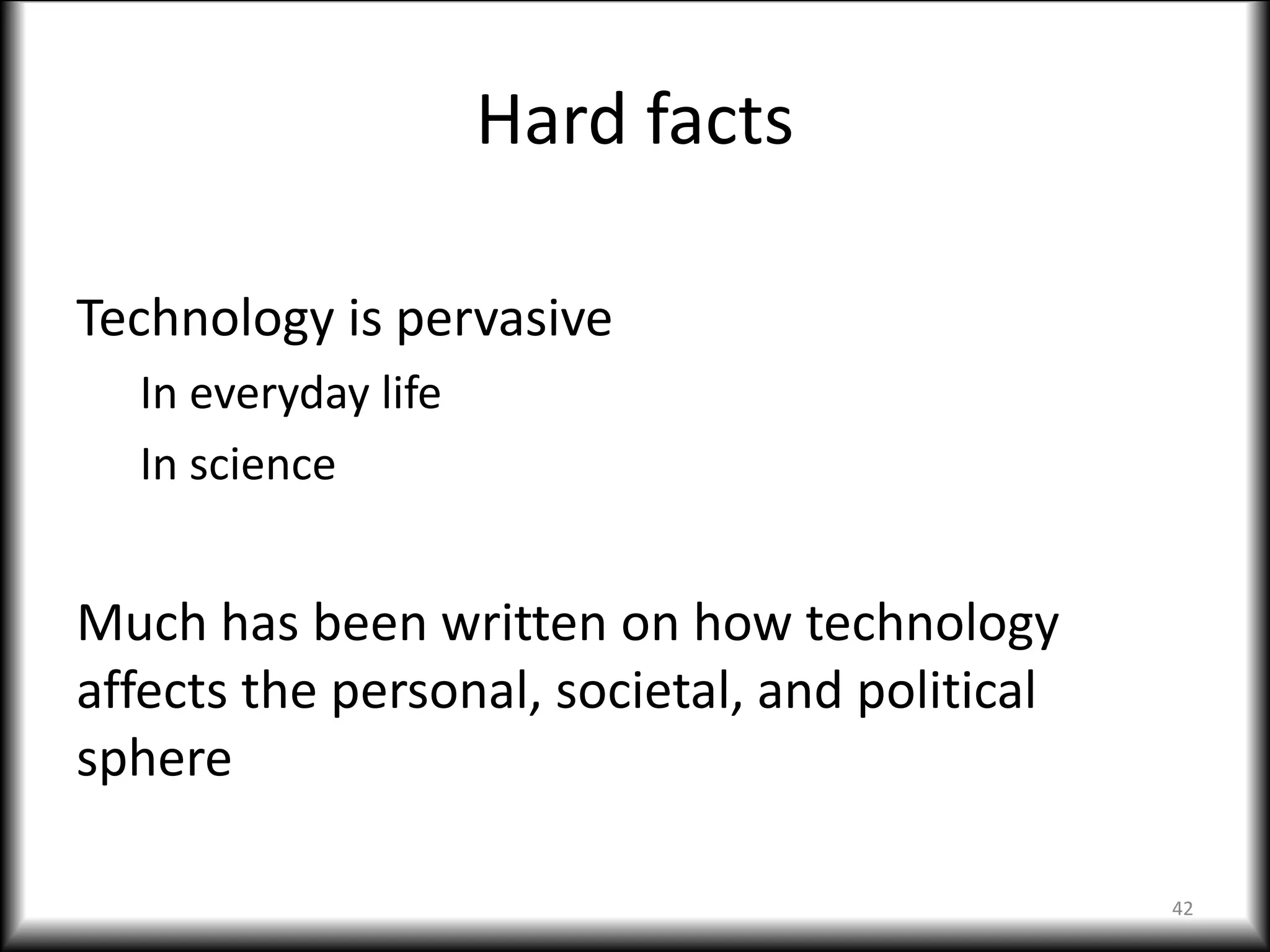
Hard facts
Technology is pervasive
In everyday life
In science
Much has been written on how technology
affects the personal, societal, and political
sphere
42
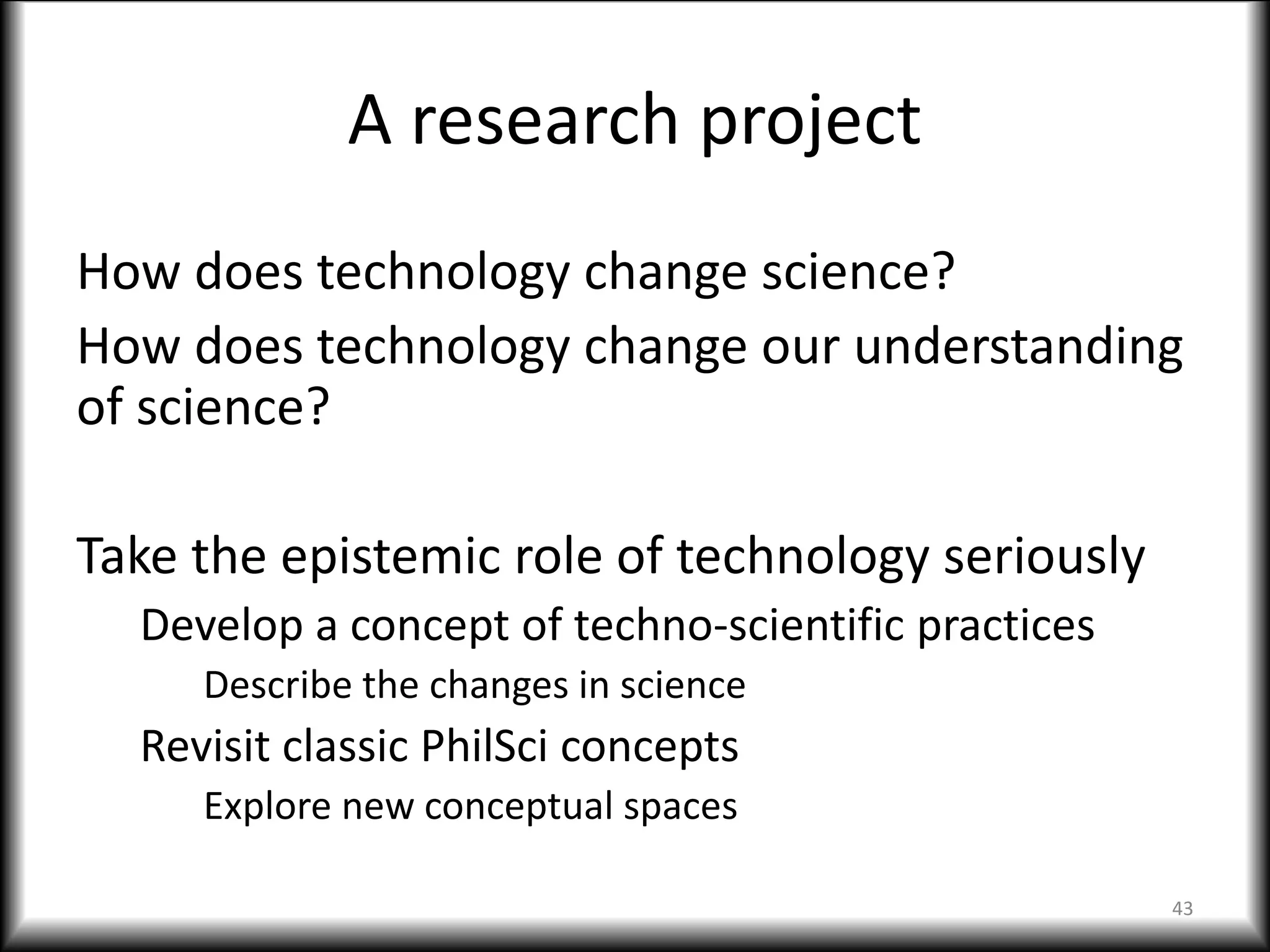
A research project
How does technology change science?
How does technology change our understanding
of science?
Take the epistemic role of technology seriously
Develop a concept of techno-scientific practices
Describe the changes in science
Revisit classic PhilSci concepts
Explore new conceptual spaces
43
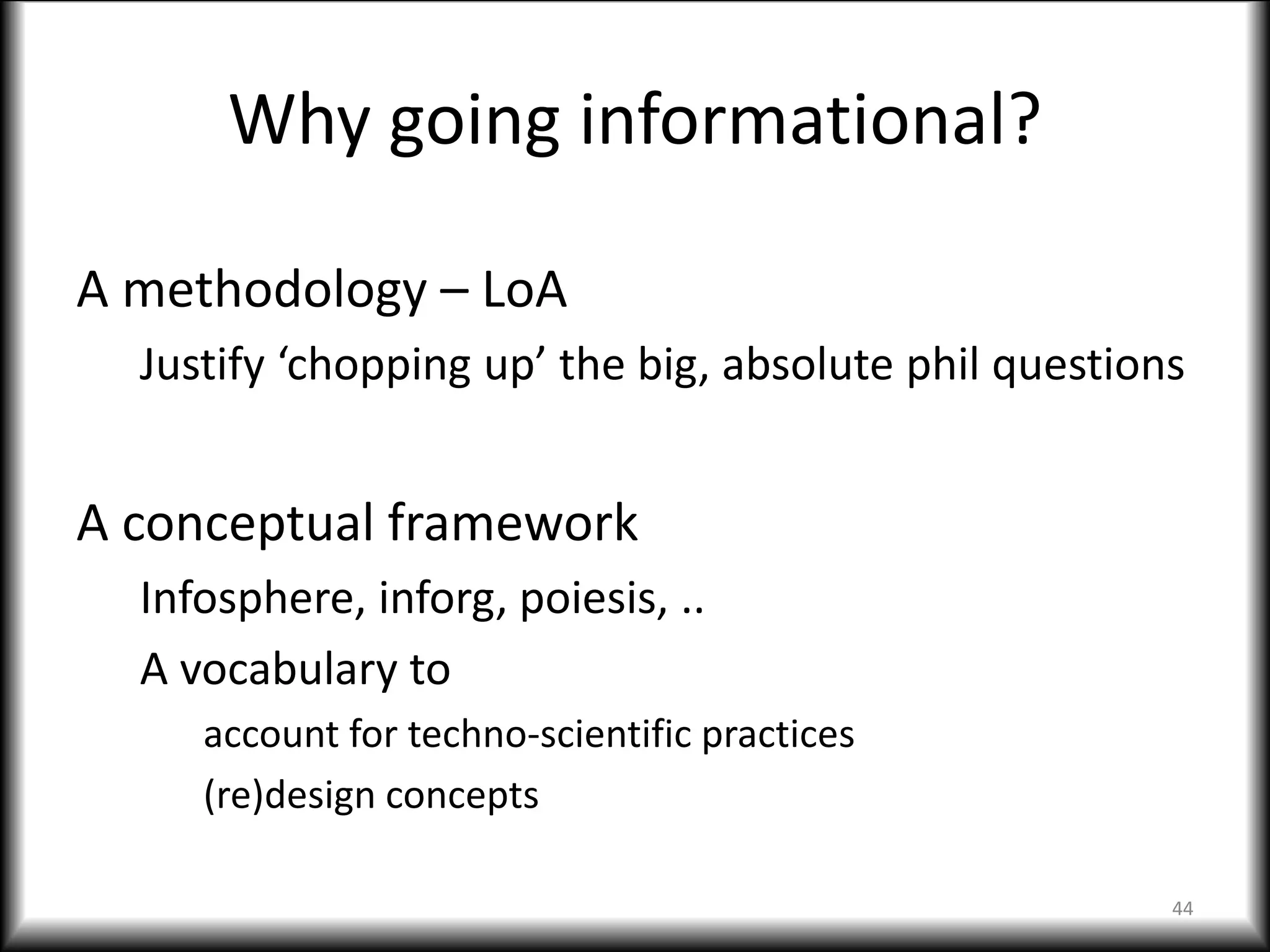
Why going informational?
A methodology – LoA
Justify ‘chopping up’ the big, absolute phil questions
A conceptual framework
Infosphere, inforg, poiesis, ..
A vocabulary to
account for techno-scientific practices
(re)design concepts
44
Will I succeed? Watch my space!
http://russofederica.wordpress.com | @federicarusso
Techno-Scientific Practices:
An Informational Approach
Under contract with Rowman & Littlefield

Towards an informational turn in philosophy of science?

  • 1.
    Towards an informationalturn in philosophy of science? Federica Russo Philosophy | Humanities | Amsterdam russofederica.wordpress.com | @federicarusso
  • 2.
    Overview The pervasiveness oftechnology Digital technologies and the philosophy of information Philosophy of information and philosophy of science Techno-scientific practices An example: exposure science and biomarkers research Ontological and epistemological questions How to revisit classic philsci concepts with PI 2
  • 3.
  • 4.
  • 5.
  • 6.
    Artefacts, instruments From historyof technology Machines to help us domesticate nature, Artefacts to boost / amplify our capacities From history of science The scientific revolution was also a technological revolution The tradition of the workshop and the role of instruments in scientific method 6
  • 7.
  • 8.
    The digital revolution Theplace of human beings keeps changing: We are not at the center of the universe (Copernicus) at the center of nature (Darwin) transparent to ourselves (Freud) the only intelligent being (Turing) [Floridi, The 4th Revolution] 8
  • 9.
    An information revolution A revolutionin the information process From pre- to hyper-history Pre-history: information is not recorded History: information is recorded, processed ICTs transform the whole information process The amount of transmitted information How information is transmitted 9 [Pics: Floridi, The 4th Revolution]
  • 10.
    Basic vocabulary ofPI Information as: Resource: we use it, e.g.: to make decisions; Product: we use it to generate further information, and then used to modify it … i.e.: information is a target [Formal definition of information does not interest us here] Inforgs: informational organisms We, intelligent humans; intelligent engineered artefacts Infosphere: informational environment The whole space of possible information, including Nature. Physis: nature, reality Techne: practical science and creation of artefacts 10
  • 11.
    Basic methodology ofPI The Method of Levels of Abstraction A familiar idea to computer scientists. A useful method to tackle conceptual problems too How we handle information processes A system A model of the system A collection of variables, each having a well-defined possible set of values or outcomes A LoA qualifies the level at which a system is considered Specify what are the relevant variables Formalise the model (qualitative or quantitative terms) 11
  • 12.
    Why going LoAin philosophy? Clarify implicit assumptions Facilitate comparison Enhances rigour Promotes resolution of possible conceptual confusions [Floridi, The ethics of information, ch.3] 12
  • 13.
  • 14.
    The digital revolution: fromeveryday life to scientific practice The 4th revolution in Floridi’s philosophy: We, humans, are inforgs in the infosphere A change in the interaction with the external world and with ourselves Tension between physis and techne is revitalised Rethinking ethical agents as homo poieticus We can now address ethical challenges in e.g. computer ethics, digital divide, right to be forgotten, … The 4th revolution in my project: How does science change? Describe scientific practices How does our understanding of science change? (Re)investigate ontology and epistemology of science 14
  • 15.
    Why practices Traditional, Anglo-AmericanPhilSci: Attention to the ‘end-products’: theories, entities, … Largely value-free, interested in context of justification Philosophy of science in practice Attention to how we make science The making in the labs and institutions, value-laden, including the context of discovery The interactions between different sorts of epistemic agents (human, artificial, hybrid) 15
  • 16.
    Why techno-scientific The practiceof science is highly technologised The question is not who comes first Technology first >< Science first The interesting question is How does our understanding of science changes? [Once the technological component is appropriately examined] 16
  • 17.
    Applying LoA Absolute questions •What is science? • What is knowledge? • What is reality? • Will technology take over humans? Questions at given LoAs • How is knowledge production to be characterised in techno- scientific practices? • What epistemic access to reality is mediated / produced by technology • What epistemic role does technology have in science? • What practical role does technology have in daily life? 17
  • 18.
    EXPOSURE SCIENCE AND BIOMARKERSRESEARCH An example 18
  • 19.
    From epidemiology to molecularepidemiology Environmental exposure and disease (How) do {air, water, chemicals, …} cause {cancer, asthma, allergies, ...}? Traditional epidemiology Establish correlation between classes of environmental factors and of disease Molecular epidemiology Measurements at molecular level Identify biomarkers of exposure >> of early clinical changes >> of disease 19
  • 20.
    Exposure causes Disease Measurechemicals in water, air, etc Identify biomarkers of exposure Detect biomarkers of early clinical changes Match with biomarkers of disease 20 Make categories of environmental factors Match with categories of disease
  • 21.
    Data- and technology-driven Bigdata helps with the generation of evidence of correlation (statistical analyses) and of mechanisms (omics analyses) Specifically, technology is central to: generating, processing, storing / archiving, curating, analysing data 21
  • 22.
    Data collection, storage, generation Sensors,smartphones, GPS Biobanks Omic technologies Liquid chromatography Mass spectometry Nuclear magnetic resonance spectroscopy … Statistics softwares 22
  • 23.
    Reformulated questions How doestechnology change the practice of epidemiology? How does technology change the conceptualisation of, e.g.: Data / Observation / Experience Evidence Causality Knowledge … 23
  • 24.
  • 25.
    Think of High-energy physics Spaceresearch Social media analysis Digital humanities … 25
  • 26.
  • 27.
    Ontology, but notarmchair What there is: not an abstract, absolute question Here: Do ICTs bear any changes to ‘what there is’? 27
  • 28.
    Re-ontologising the real:a PI perspective ICTs create new ontological spaces Compare: Dishwashers vs smartphones Mimeograph vs smartprinting Onlife presence vs locality In a techno-scientific context New understanding of old concepts What is an entity? Do entities really exist?? It depends on the LoA 28
  • 29.
    Again on biomarkersresearch Are biomarkers tiny tiny entities?
  • 30.
    30 Traditions of Entity Hunting Aetiological standpoint / infectious disease model/ search for pathogens Mechanistic explanation / causally relevant entities Analytic metaphysics / Language and ontology / focus on particulars
  • 31.
    Picking up entities? Whileclassical statistical models to analyzing -omics data serve the purpose of identifying signals and separating them from noise, little has been done in chronic diseases to model time into the exposure-biomarker-disease continuum. [Vineis and Chadeau-Hyam 2011] From these two parallel analyses [statistical analyses], we obtained lists of putative markers of (i) the disease outcome, and (ii) exposure. These were compared in a second step in order to identify possible intersecting signals, therefore defining potential intermediate biomarkers. [Chadeau-Hyam et al 2011] 31 We pick up signal!
  • 32.
    Early theorisations ofbiomarkers A must read Molecular epidemiologist Paul Schulte (1993) Biomarkers Biological markers: ‘’technologically powerful measures of biological variables’’ Indicate events in the continuum [E----D] at different levels 32
  • 33.
    What do biomarkersstand for? It is vital to understand the nature of the relationship between the mark and the event “Does the marker represent an event, is it an event itself, is it a correlate of the event, or is it a predictor of the event? The answers to these questions may affect who is sampled, how and when they are sampled, and what confounders or effect modifiers are considered. […] Thus, a biologic marker often refers to the use made of a piece of biologic information rather than to a specific type of information.” Schulte, 1993, p.14-15. 33
  • 34.
    Process-based disease causation? Biomarkersare not causes They are not even markers for causes, per se Biomarkers mark salient points of a process (= disease) to be understood in causal terms 34
  • 35.
    Process ontologies Latest insightsfrom phil biology To say what an individual is we must look at processes, rather than entities Dupré, Pradeau (and Guay), Seibt, … We can conceive as disease as a (causal) process Sharp distinction between normal and pathological collapses [Yes, we may also create new ‘normal’ with biomarkers of health …] 35
  • 36.
  • 37.
  • 38.
    Epistemology, from sciencein practice Again, start from the practice of science, then raise epistemological questions. Here: How do we know? How do we produce knowledge? 38
  • 39.
    Techno-science What is thetechnology doing? Not just allowing us to See the smaller or see the bigger Analyse / store / transmit data BUT mainly: Taking active part in constructing knowledge We and the machines, together Technology has a poietic charachter 39
  • 40.
    Why poiesis? Knowledge isnot just representational Mimesis: we re-produce what there is [Admittedly, we also express it in natural language, but it is not to be reduced to it] Knowledge is produced Who/What produces knowledge? Epistemic Agents: human and artificial Knowledge becomes embodied, distributed, connected, … Both human and artificial epistemic agents have poietic characther 40
  • 41.
    TO SUM UPAND CONCLUDE 41
  • 42.
    Hard facts Technology ispervasive In everyday life In science Much has been written on how technology affects the personal, societal, and political sphere 42
  • 43.
    A research project Howdoes technology change science? How does technology change our understanding of science? Take the epistemic role of technology seriously Develop a concept of techno-scientific practices Describe the changes in science Revisit classic PhilSci concepts Explore new conceptual spaces 43
  • 44.
    Why going informational? Amethodology – LoA Justify ‘chopping up’ the big, absolute phil questions A conceptual framework Infosphere, inforg, poiesis, .. A vocabulary to account for techno-scientific practices (re)design concepts 44
  • 45.
    Will I succeed?Watch my space! http://russofederica.wordpress.com | @federicarusso Techno-Scientific Practices: An Informational Approach Under contract with Rowman & Littlefield

Editor's Notes

  • #2 Towards an informational turn in philosophy of science?  Technology is pervasive in science and in everyday life. To be sure, it has always been. And yet, a special class of technologies – namely digital technologies – are making this pervasiveness also radical. Radical in the way we understand the world, ourselves, and the relation between the two. This, in a nutshell, reconstructs one of the goals of the philosophy of information (PI). In this talk, I spell out the stance PI takes towards digital technologies and explore its possible extension to ‘philsci’ questions. I sketch an account of techno-scientific practices and investigate two ideas: (i) the prospects of a process-based (rather than entity-based) ontology, and (ii) the poietic role of technologies in the construction of knowledge.
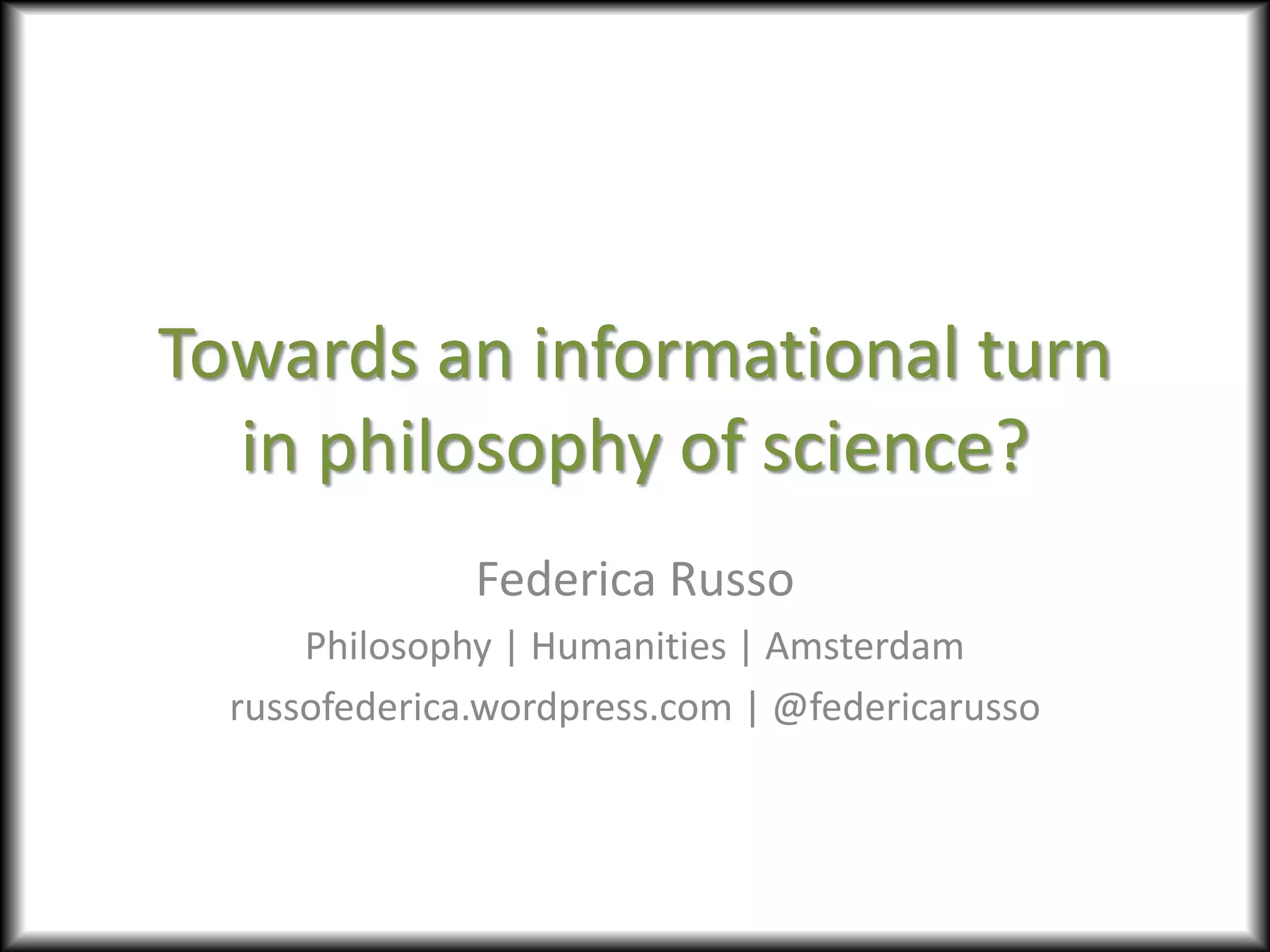
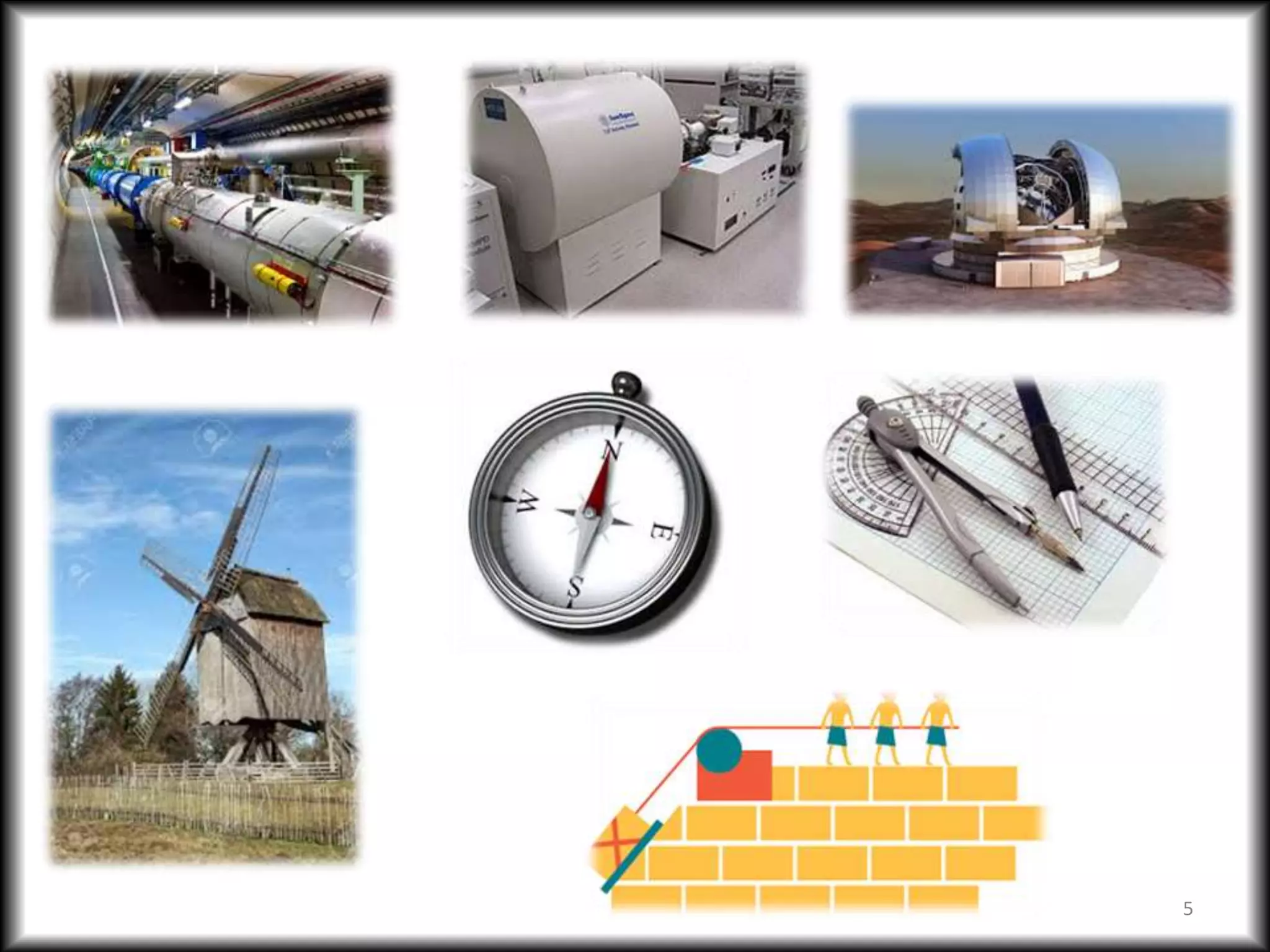
  • #5 Every day life. Tend to think of computers and smartphones as changing our lives. But technology is present in our lives every day
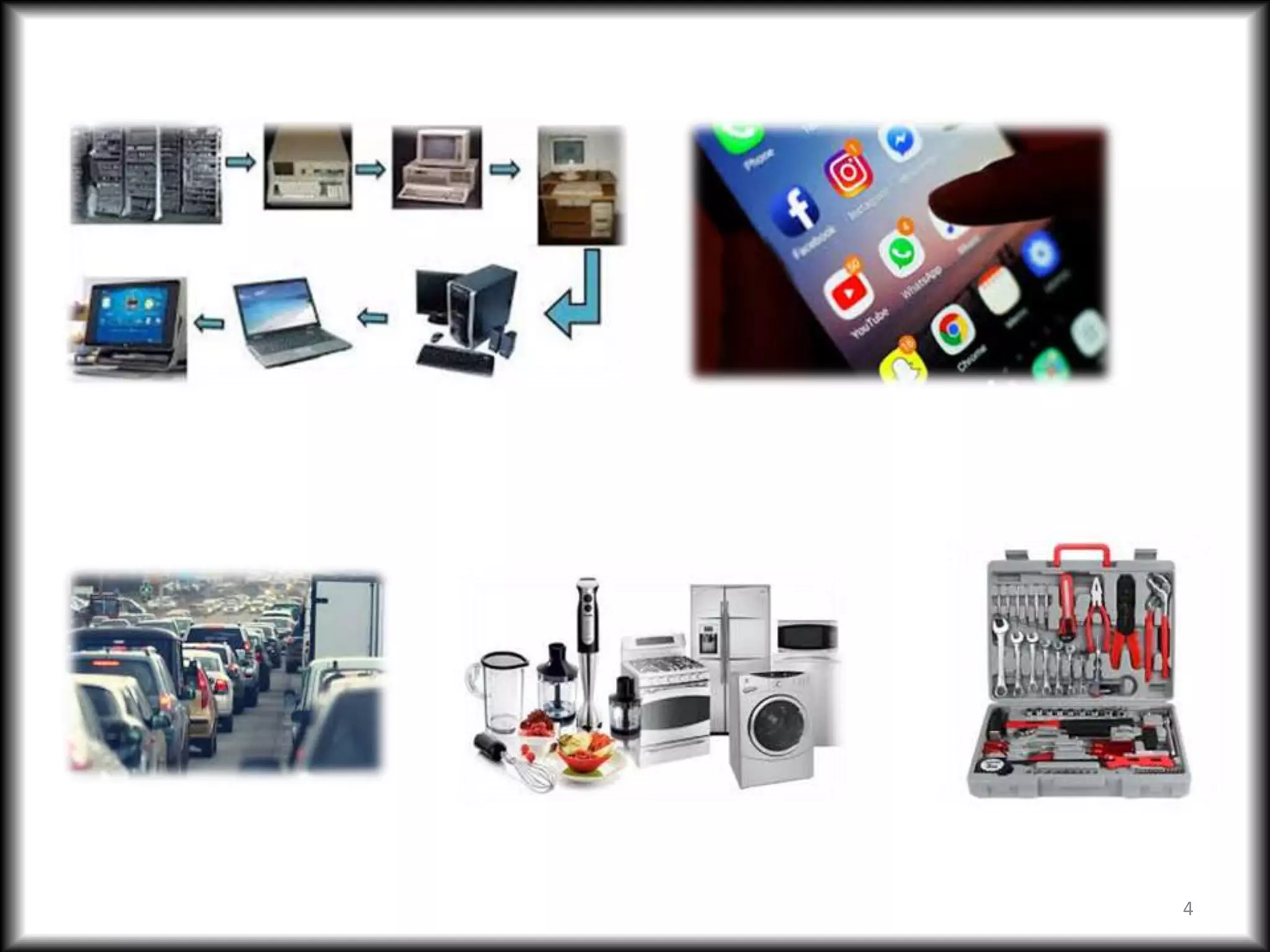
  • #6 Instruments in science. We tend to think of big instruments, e.g. LHD, mass spectometers, big optical telescopes … But instruments have been used since much earlier, some we still use today …
  • #7 Scientific revolution also a technological revolution: to understand nature is to reproduce the phenomena, and here instruments play a role. Also, workshop tradition. So science is very much associated with making, the making of the workshops. Also think of Bacon, New Atlantis, who develops a utopian view of science (and technology) at the service of society.
  • #8 Point so far: technology is pervasive. Didn’t make a distinction whether it ‘old’ analogue or ‘new’ digital technology. Hist/Phil Tech reflected extensively on how technology brings profound changes in life > personal, existential sphere > societal, political sphere In fact, these topics are often discussed from normative point of view, within ethics / political philosophy HERE: my angle is PhilSc, will get to it. Making a rather long intro to motivate why we should look closely at the role of instruments in science. I don’t think digital technologies are per se special, but they are insofar as they prompted a new philosophical approach – PI – which I want to adopt to address phil sci problems. HENCE: start with digital tech
  • #9 !! Before talking about machines – digital machines – we have to understand what the revolution is really about
  • #10 Think of literature in critical data studies 3V: volume, variety, velocity (also 5 V: volume, variety, velocity, value, veracity)
  • #18 For each of these questions one may distinguish - descriptive / normative levels - Epistemological / methodological / metaphysical / ethico-political level
  • #21 There is also an important change in the conceptualisation of disease E  D >> well identified causal relata E ------D >> continuum from E to D, no neat causal relata
  • #23 Emphasise that this is important because biomarkers are not there for us to find, as cherries on a tree or strawberries in a bush Remember passage in Hacking Repr & Inter, where he also says that it would be miracoulous if sci phenomena were out there to be picked as cherries on a tree
  • #36  Is exposure science ad hoc? Is there a thing like the Higgs boson? What it means to ‘find’ the Higgs boson Intercepting ‘salient’ events in the correlations from tons of data [See work of Koray Karaca on LHC!]