Z O H A I B UL H A S S A N
CITRUS
INTRODUCTION
• Origin: South East Asia
• Family: Rutaceae
• A prized fruit of Pakistan
• Ranks 1st among all fruits
• Shares 34% in total fruit production
• Shares one-third of total value of fruit’s exports
• Pakistan stands at the 9th position in mandarin production and
11th in orange production in the world.
( FAO, 2008)
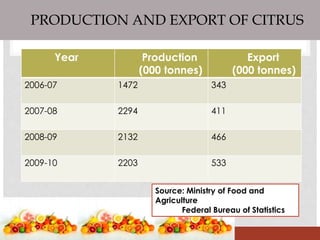
PRODUCTION AND EXPORT OF CITRUS
Year Production
(000 tonnes)
Export
(000 tonnes)
2006-07 1472 343
2007-08 2294 411
2008-09 2132 466
2009-10 2203 533
Source: Ministry of Food and
Agriculture
Federal Bureau of Statistics
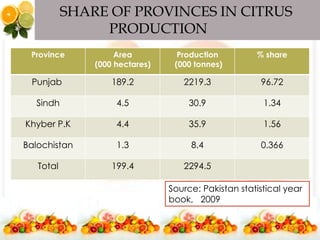
SHARE OF PROVINCES IN CITRUS
PRODUCTION
Province Area
(000 hectares)
Production
(000 tonnes)
% share
Punjab 189.2 2219.3 96.72
Sindh 4.5 30.9 1.34
Khyber P.K 4.4 35.9 1.56
Balochistan 1.3 8.4 0.366
Total 199.4 2294.5
Source: Pakistan statistical year
book, 2009
SOIL
• Deep sandy loam, loam and clay loam
• pH: 5.5-8.5
• Subsoil should be free from hard pan, sticky clay and water
logged conditions
• Poor soils with high pH are not suitable
• Soil requirements depend upon the type of rootstock used for
various species and varieties.
• Rough lemon is a good rootstock for dry, sandy loam soils of
Punjab, whereas sour orange performs better on the moist and
heavy soil of KPK.
TEMPERATURE
• Seed Germination:
15-30°C
• Vegetative Growth:
Optimum shoot growth: 25-31°C
Optimum root growth: 25-26 °C
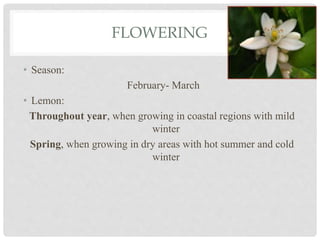
FLOWERING
• Season:
February- March
• Lemon:
Throughout year, when growing in coastal regions with mild
winter
Spring, when growing in dry areas with hot summer and cold
winter
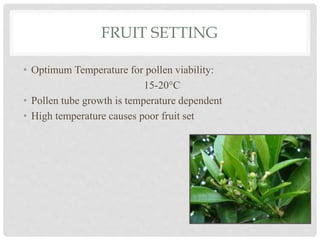
FRUIT SETTING
• Optimum Temperature for pollen viability:
15-20°C
• Pollen tube growth is temperature dependent
• High temperature causes poor fruit set
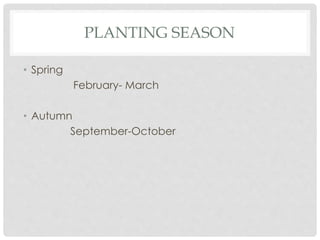
PLANTING SEASON
• Spring
February- March
• Autumn
September-October
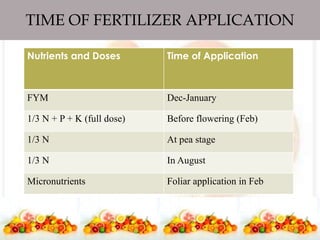
TIME OF FERTILIZER APPLICATION
Nutrients and Doses Time of Application
FYM Dec-January
1/3 N + P + K (full dose) Before flowering (Feb)
1/3 N At pea stage
1/3 N In August
Micronutrients Foliar application in Feb
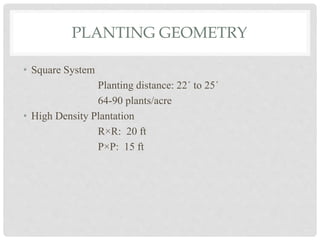
PLANTING GEOMETRY
• Square System
Planting distance: 22´ to 25´
64-90 plants/acre
• High Density Plantation
R×R: 20 ft
P×P: 15 ft
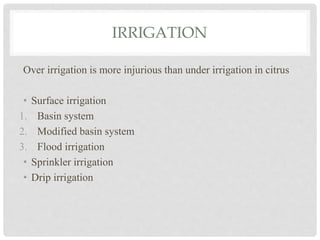
IRRIGATION
Over irrigation is more injurious than under irrigation in citrus
• Surface irrigation
1. Basin system
2. Modified basin system
3. Flood irrigation
• Sprinkler irrigation
• Drip irrigation
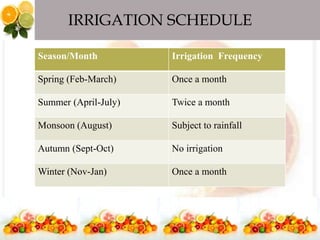
IRRIGATION SCHEDULE
Season/Month Irrigation Frequency
Spring (Feb-March) Once a month
Summer (April-July) Twice a month
Monsoon (August) Subject to rainfall
Autumn (Sept-Oct) No irrigation
Winter (Nov-Jan) Once a month
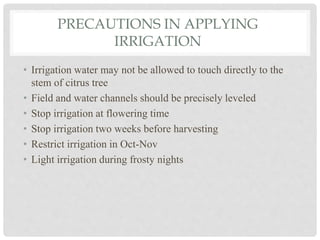
PRECAUTIONS IN APPLYING
IRRIGATION
• Irrigation water may not be allowed to touch directly to the
stem of citrus tree
• Field and water channels should be precisely leveled
• Stop irrigation at flowering time
• Stop irrigation two weeks before harvesting
• Restrict irrigation in Oct-Nov
• Light irrigation during frosty nights
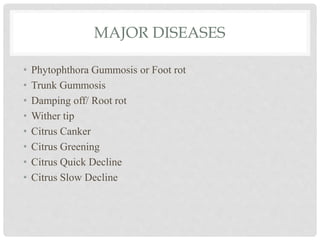
MAJOR DISEASES
• Phytophthora Gummosis or Foot rot
• Trunk Gummosis
• Damping off/ Root rot
• Wither tip
• Citrus Canker
• Citrus Greening
• Citrus Quick Decline
• Citrus Slow Decline
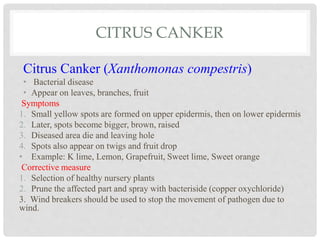
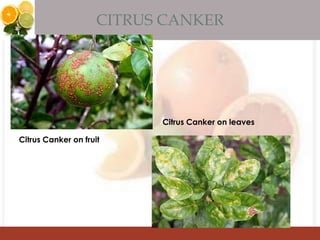
CITRUS CANKER
Citrus Canker (Xanthomonas compestris)
• Bacterial disease
• Appear on leaves, branches, fruit
Symptoms
1. Small yellow spots are formed on upper epidermis, then on lower epidermis
2. Later, spots become bigger, brown, raised
3. Diseased area die and leaving hole
4. Spots also appear on twigs and fruit drop
• Example: K lime, Lemon, Grapefruit, Sweet lime, Sweet orange
Corrective measure
1. Selection of healthy nursery plants
2. Prune the affected part and spray with bacteriside (copper oxychloride)
3. Wind breakers should be used to stop the movement of pathogen due to
wind.
CITRUS CANKER
Citrus Canker on fruit
Citrus Canker on leaves
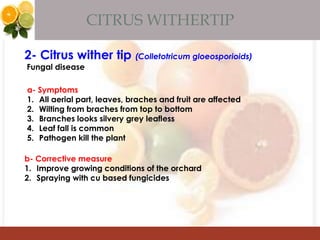
CITRUS WITHERTIP
2- Citrus wither tip (Colletotricum gloeosporioids)
Fungal disease
a- Symptoms
1. All aerial part, leaves, braches and fruit are affected
2. Wilting from braches from top to bottom
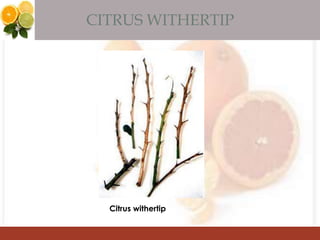
3. Branches looks silvery grey leafless
4. Leaf fall is common
5. Pathogen kill the plant
b- Corrective measure
1. Improve growing conditions of the orchard
2. Spraying with cu based fungicides
CITRUS WITHERTIP
Citrus withertip
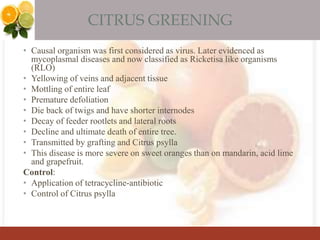
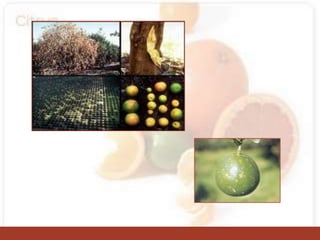
CITRUS GREENING
• Causal organism was first considered as virus. Later evidenced as
mycoplasmal diseases and now classified as Ricketisa like organisms
(RLO)
• Yellowing of veins and adjacent tissue
• Mottling of entire leaf
• Premature defoliation
• Die back of twigs and have shorter internodes
• Decay of feeder rootlets and lateral roots
• Decline and ultimate death of entire tree.
• Transmitted by grafting and Citrus psylla
• This disease is more severe on sweet oranges than on mandarin, acid lime
and grapefruit.
Control:
• Application of tetracycline-antibiotic
• Control of Citrus psylla
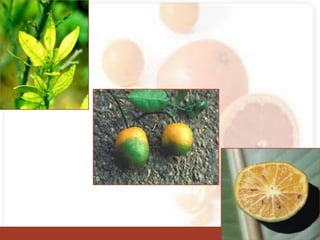
CITRUS TRISTEZA VIRUS
• Vein clearing in lime
• Bronzing of leaves
• Stem pitting
• Twig and root die back
• Leaf drop
• Foliage wilt
• Sudden death
• Tree debilitation
• Reduced fruit size
• Necrosis of cambial tissue
CITRUS TRISTEZA VIRUS
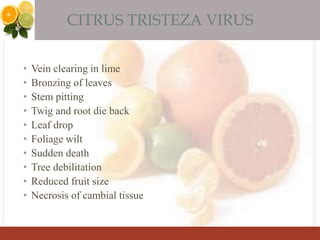
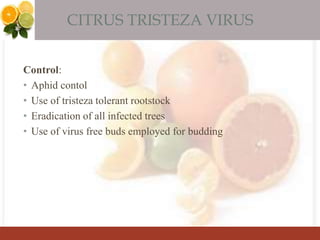
Control:
• Aphid contol
• Use of tristeza tolerant rootstock
• Eradication of all infected trees
• Use of virus free buds employed for budding
CAUSES OF LOW CITRUS PRODUCTION
• High pH
• Low organic matter
• Saline soils
• Uncertain weather conditions during flowering (fog, frost, rains)
• Use of unfit tube well water
• Faulty intercropping
• Inadequate and imbalance fertilizer application
• Poor plant protection measures
• Non judicious irrigation
• Low grade nursery plants
• Mechanical injury to the plants during hoeing and ploughing
SUGGESTIONS
• Legislation in nursery industry should be made
• Govt. and private sector should be involved for raising the
certified plants on commercial level
• To make the disease free true to type progeny plants, testing
training should be extended from government institutions
• Only certified plants should be recommended for plantation
and restrictions should be done for such nurseries those do not
follow it
• Quarantine measures should be observed strictly
• Enhancement and conservation of existed Germplasm on more
scientific basis

Citrus (Production Technology and diseases)

  • 1.
    Z O HA I B UL H A S S A N CITRUS
  • 2.
    INTRODUCTION • Origin: SouthEast Asia • Family: Rutaceae • A prized fruit of Pakistan • Ranks 1st among all fruits • Shares 34% in total fruit production • Shares one-third of total value of fruit’s exports • Pakistan stands at the 9th position in mandarin production and 11th in orange production in the world. ( FAO, 2008)
  • 3.
    PRODUCTION AND EXPORTOF CITRUS Year Production (000 tonnes) Export (000 tonnes) 2006-07 1472 343 2007-08 2294 411 2008-09 2132 466 2009-10 2203 533 Source: Ministry of Food and Agriculture Federal Bureau of Statistics
  • 4.
    SHARE OF PROVINCESIN CITRUS PRODUCTION Province Area (000 hectares) Production (000 tonnes) % share Punjab 189.2 2219.3 96.72 Sindh 4.5 30.9 1.34 Khyber P.K 4.4 35.9 1.56 Balochistan 1.3 8.4 0.366 Total 199.4 2294.5 Source: Pakistan statistical year book, 2009
  • 5.
    SOIL • Deep sandyloam, loam and clay loam • pH: 5.5-8.5 • Subsoil should be free from hard pan, sticky clay and water logged conditions • Poor soils with high pH are not suitable • Soil requirements depend upon the type of rootstock used for various species and varieties. • Rough lemon is a good rootstock for dry, sandy loam soils of Punjab, whereas sour orange performs better on the moist and heavy soil of KPK.
  • 6.
    TEMPERATURE • Seed Germination: 15-30°C •Vegetative Growth: Optimum shoot growth: 25-31°C Optimum root growth: 25-26 °C
  • 7.
    FLOWERING • Season: February- March •Lemon: Throughout year, when growing in coastal regions with mild winter Spring, when growing in dry areas with hot summer and cold winter
  • 8.
    FRUIT SETTING • OptimumTemperature for pollen viability: 15-20°C • Pollen tube growth is temperature dependent • High temperature causes poor fruit set
  • 9.
    PLANTING SEASON • Spring February-March • Autumn September-October
  • 10.
    TIME OF FERTILIZERAPPLICATION Nutrients and Doses Time of Application FYM Dec-January 1/3 N + P + K (full dose) Before flowering (Feb) 1/3 N At pea stage 1/3 N In August Micronutrients Foliar application in Feb
  • 11.
    PLANTING GEOMETRY • SquareSystem Planting distance: 22´ to 25´ 64-90 plants/acre • High Density Plantation R×R: 20 ft P×P: 15 ft
  • 12.
    IRRIGATION Over irrigation ismore injurious than under irrigation in citrus • Surface irrigation 1. Basin system 2. Modified basin system 3. Flood irrigation • Sprinkler irrigation • Drip irrigation
  • 13.
    IRRIGATION SCHEDULE Season/Month IrrigationFrequency Spring (Feb-March) Once a month Summer (April-July) Twice a month Monsoon (August) Subject to rainfall Autumn (Sept-Oct) No irrigation Winter (Nov-Jan) Once a month
  • 14.
    PRECAUTIONS IN APPLYING IRRIGATION •Irrigation water may not be allowed to touch directly to the stem of citrus tree • Field and water channels should be precisely leveled • Stop irrigation at flowering time • Stop irrigation two weeks before harvesting • Restrict irrigation in Oct-Nov • Light irrigation during frosty nights
  • 15.
    MAJOR DISEASES • PhytophthoraGummosis or Foot rot • Trunk Gummosis • Damping off/ Root rot • Wither tip • Citrus Canker • Citrus Greening • Citrus Quick Decline • Citrus Slow Decline
  • 16.
    CITRUS CANKER Citrus Canker(Xanthomonas compestris) • Bacterial disease • Appear on leaves, branches, fruit Symptoms 1. Small yellow spots are formed on upper epidermis, then on lower epidermis 2. Later, spots become bigger, brown, raised 3. Diseased area die and leaving hole 4. Spots also appear on twigs and fruit drop • Example: K lime, Lemon, Grapefruit, Sweet lime, Sweet orange Corrective measure 1. Selection of healthy nursery plants 2. Prune the affected part and spray with bacteriside (copper oxychloride) 3. Wind breakers should be used to stop the movement of pathogen due to wind.
  • 17.
    CITRUS CANKER Citrus Cankeron fruit Citrus Canker on leaves
  • 18.
    CITRUS WITHERTIP 2- Citruswither tip (Colletotricum gloeosporioids) Fungal disease a- Symptoms 1. All aerial part, leaves, braches and fruit are affected 2. Wilting from braches from top to bottom 3. Branches looks silvery grey leafless 4. Leaf fall is common 5. Pathogen kill the plant b- Corrective measure 1. Improve growing conditions of the orchard 2. Spraying with cu based fungicides
  • 19.
  • 20.
    CITRUS GREENING • Causalorganism was first considered as virus. Later evidenced as mycoplasmal diseases and now classified as Ricketisa like organisms (RLO) • Yellowing of veins and adjacent tissue • Mottling of entire leaf • Premature defoliation • Die back of twigs and have shorter internodes • Decay of feeder rootlets and lateral roots • Decline and ultimate death of entire tree. • Transmitted by grafting and Citrus psylla • This disease is more severe on sweet oranges than on mandarin, acid lime and grapefruit. Control: • Application of tetracycline-antibiotic • Control of Citrus psylla
  • 22.
    CITRUS TRISTEZA VIRUS •Vein clearing in lime • Bronzing of leaves • Stem pitting • Twig and root die back • Leaf drop • Foliage wilt • Sudden death • Tree debilitation • Reduced fruit size • Necrosis of cambial tissue
  • 23.
    CITRUS TRISTEZA VIRUS Control: •Aphid contol • Use of tristeza tolerant rootstock • Eradication of all infected trees • Use of virus free buds employed for budding
  • 25.
    CAUSES OF LOWCITRUS PRODUCTION • High pH • Low organic matter • Saline soils • Uncertain weather conditions during flowering (fog, frost, rains) • Use of unfit tube well water • Faulty intercropping • Inadequate and imbalance fertilizer application • Poor plant protection measures • Non judicious irrigation • Low grade nursery plants • Mechanical injury to the plants during hoeing and ploughing
  • 26.
    SUGGESTIONS • Legislation innursery industry should be made • Govt. and private sector should be involved for raising the certified plants on commercial level • To make the disease free true to type progeny plants, testing training should be extended from government institutions • Only certified plants should be recommended for plantation and restrictions should be done for such nurseries those do not follow it • Quarantine measures should be observed strictly • Enhancement and conservation of existed Germplasm on more scientific basis