1 1

 2002 South-Western/Thomson Learning
2002 South-Western/Thomson Learning TM
TM
Slides prepared
Slides prepared
by John Loucks
by John Loucks
2
Chapter 1
Chapter 1
Introduction to Operations Management
3
Overview
Overview

Introduction
Introduction

Historical Milestones in OM

Factors Affecting OM Today

Different Ways of Studying OM

Wrap-Up: What World-Class Producers Do
4
Introduction
Introduction

Operations management
Operations management is the management of an
is the management of an
organization’s productive resources or its production
system.
system.

A
A production system
production system takes inputs and converts
takes inputs and converts
them into outputs.
them into outputs.

The
The conversion process
conversion process is the predominant activity
is the predominant activity
of a production system.

The primary concern of an
The primary concern of an operations manager
operations manager is the
is the
activities of the conversion process.
5
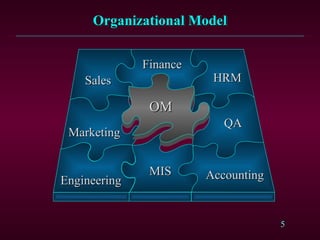
Organizational Model
Marketing
Marketing
MIS
MIS
Engineering
Engineering
HRM
HRM
QA
QA
Accounting
Accounting
Sales
Sales
Finance
Finance
OM
OM
6
Entry-Level Jobs in OM

Purchasing planner/buyer

Production (or operations) supervisor

Production (or operations) scheduler/controller

Production (or operations) analyst

Inventory analyst
Inventory analyst

Quality specialist
Quality specialist
7
Historical Milestones in OM

The Industrial Revolution

Post-Civil War Period

Scientific Management

Human Relations and Behaviorism

Operations Research
Operations Research

The Service Revolution
8
The Industrial Revolution

The
The industrial revolution
industrial revolution developed in England in the
developed in England in the
1700s.
1700s.

The steam engine, invented by James Watt in 1764,
largely replaced human and water power for factories.

Adam Smith’s
Adam Smith’s The Wealth of Nations
The Wealth of Nations in 1776 touted
in 1776 touted
the economic benefits of the
the economic benefits of the specialization of labor
specialization of labor.
.

Thus the late-1700s factories had not only machine
power but also ways of planning and controlling the
tasks of workers.
tasks of workers.
9
The Industrial Revolution

The industrial revolution spread from England to
other European countries and to the United Sates.

In 1790 an American, Eli Whitney, developed the
concept of
concept of interchangeable parts
interchangeable parts.
.

The first great industry in the US was the textile
industry.
industry.

In the 1800s the development of the gasoline engine
and electricity further advanced the revolution.

By the mid-1800s, the old
By the mid-1800s, the old cottage system
cottage system of
of
production had been replaced by the
production had been replaced by the factory system
factory system.
.

. . . more
. . . more
10
Post-Civil War Period

During the post-Civil War period great expansion of
production capacity occurred.

By post-Civil War the following developments set the
stage for the great production explosion of the 20th
century:
century:

increased capital and production capacity

the expanded urban workforce

new Western US markets

an effective national transportation system
11
Scientific Management

Frederick Taylor is known as the father of
Frederick Taylor is known as the father of scientific
scientific
management
management. His
. His shop system
shop system employed these steps:
employed these steps:

Each worker’s skill, strength, and learning ability
were determined.
were determined.

Stopwatch studies were conducted to precisely set
standard output per worker on each task.

Material specifications, work methods, and routing
sequences were used to organize the shop.

Supervisors were carefully selected and trained.

Incentive pay systems were initiated.
12
Scientific Management

In the 1920s, Ford Motor Company’s operation
embodied the key elements of scientific management:

standardized product designs

mass production
mass production

low manufacturing costs

mechanized assembly lines

specialization of labor

interchangeable parts
13
Human Relations and Behavioralism

In the 1927-1932 period, researchers in the
Hawthorne Studies realized that human factors were
affecting production.

Researchers and managers alike were recognizing
that psychological and sociological factors affected
production.
production.

From the work of
From the work of behavioralists
behavioralists came a gradual
came a gradual
change in the way managers thought about and
treated workers.
treated workers.
14
Operations Research
Operations Research

During World War II, enormous quantities of
resources (personnel, supplies, equipment, …) had to
be deployed.
be deployed.

Military
Military operations research
operations research (OR) teams were formed
(OR) teams were formed
to deal with the complexity of the deployment.

After the war, operations researchers found their way
back to universities, industry, government, and
consulting firms.
consulting firms.

OR helps operations managers make decisions when
problems are complex and wrong decisions are
costly.
costly.
15
The Service Revolution

The creation of services organizations accelerated
sharply after World War II.

Today, more than two-thirds of the US workforce is
employed in services.

About two-thirds of the US GDP is from services.

There is a huge trade surplus in services.

Investment per office worker now exceeds the
investment per factory worker.

Thus there is a growing need for service operations
management.
management.
16
The Computer Revolution

Explosive growth of computer and communication
technologies
technologies

Easy access to information and the availability of
more information
more information

Advances in software applications such as Enterprise
Resource Planning (ERP) software

Widespread use of email

More and more firms becoming involved in E-
Business using the Internet

Result:
Result: faster, better decisions over greater distances
faster, better decisions over greater distances
17
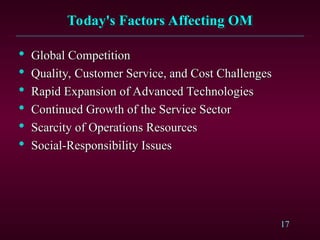
Today's Factors Affecting OM

Global Competition
Global Competition

Quality, Customer Service, and Cost Challenges

Rapid Expansion of Advanced Technologies

Continued Growth of the Service Sector

Scarcity of Operations Resources

Social-Responsibility Issues
18
Studying Operations Management

Operations as a System

Decision Making in OM
19
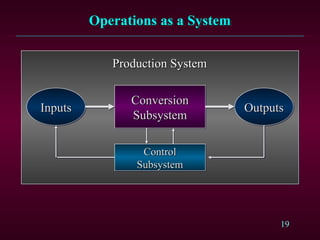
Operations as a System
Inputs
Inputs Outputs
Outputs
Conversion
Conversion
Subsystem
Subsystem
Production System
Production System
Control
Control
Subsystem
Subsystem
20
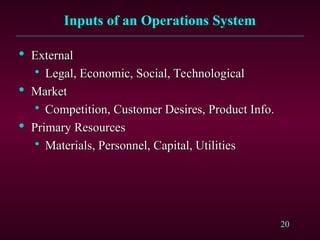
Inputs of an Operations System

External
External

Legal, Economic, Social, Technological

Market
Market

Competition, Customer Desires, Product Info.

Primary Resources
Primary Resources

Materials, Personnel, Capital, Utilities
21
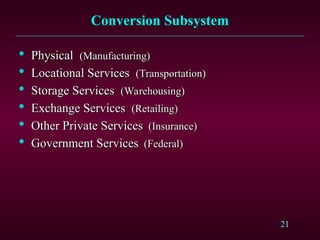
Conversion Subsystem

Physical
Physical (Manufacturing)
(Manufacturing)

Locational Services
Locational Services (Transportation)
(Transportation)

Storage Services
Storage Services (Warehousing)
(Warehousing)

Exchange Services
Exchange Services (Retailing)
(Retailing)

Other Private Services
Other Private Services (Insurance)
(Insurance)

Government Services
Government Services (Federal)
(Federal)
22
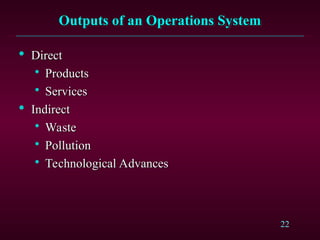
Outputs of an Operations System

Direct
Direct

Products
Products

Services
Services

Indirect
Indirect

Waste
Waste

Pollution
Pollution

Technological Advances
23
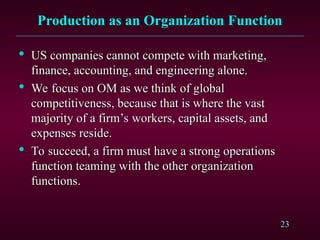
Production as an Organization Function

US companies cannot compete with marketing,
finance, accounting, and engineering alone.

We focus on OM as we think of global
competitiveness, because that is where the vast
majority of a firm’s workers, capital assets, and
expenses reside.
expenses reside.

To succeed, a firm must have a strong operations
function teaming with the other organization
functions.
functions.
24
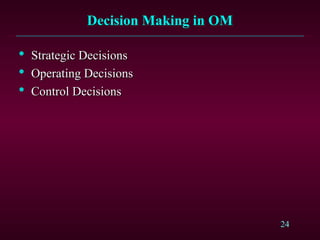
Decision Making in OM

Strategic Decisions
Strategic Decisions

Operating Decisions
Operating Decisions

Control Decisions
Control Decisions
25
Strategic Decisions
Strategic Decisions

These decisions are of strategic importance and have
long-term significance for the organization.

Examples include deciding:

the design for a new product’s production process

where to locate a new factory

whether to launch a new-product development plan
26
Operating Decisions
Operating Decisions

These decisions are necessary if the ongoing
production of goods and services is to satisfy market
demands and provide profits.

Examples include deciding:

how much finished-goods inventory to carry

the amount of overtime to use next week

the details for purchasing raw material next month
27
Control Decisions
Control Decisions

These decisions concern the day-to-day activities of
workers, quality of products and services, production
and overhead costs, and machine maintenance.

Examples include deciding:

labor cost standards for a new product

frequency of preventive maintenance

new quality control acceptance criteria
28
What Controls the Operations System?

Information about the outputs, the conversions, and
the inputs is fed back to management.

This information is matched with management’s
expectations
expectations

When there is a difference, management must take
corrective action to maintain control of the system
29
Wrap-Up: World Class Practice

OM important in
OM important in any
any organization
organization

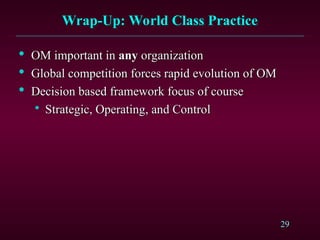
Global competition forces rapid evolution of OM

Decision based framework focus of course

Strategic, Operating, and Control
30
Chapter 1 HW Assignment

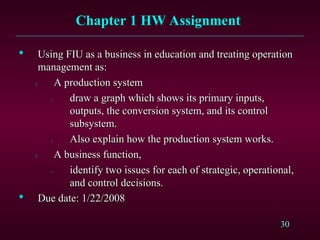
Using FIU as a business in education and treating operation
management as:
management as:
1.
1. A production system
A production system
1.
1. draw a graph which shows its primary inputs,
draw a graph which shows its primary inputs,
outputs, the conversion system, and its control
subsystem.
subsystem.
2.
2. Also explain how the production system works.
Also explain how the production system works.
2.
2. A business function,
A business function,
1.
1. identify two issues for each of strategic, operational,
identify two issues for each of strategic, operational,
and control decisions.

Due date: 1/22/2008
Due date: 1/22/2008
31
End of Chapter 1
End of Chapter 1

operation management and its significance

  • 1.
    1 1   2002South-Western/Thomson Learning 2002 South-Western/Thomson Learning TM TM Slides prepared Slides prepared by John Loucks by John Loucks
  • 2.
    2 Chapter 1 Chapter 1 Introductionto Operations Management Introduction to Operations Management
  • 3.
    3 Overview Overview  Introduction Introduction  Historical Milestones inOM Historical Milestones in OM  Factors Affecting OM Today Factors Affecting OM Today  Different Ways of Studying OM Different Ways of Studying OM  Wrap-Up: What World-Class Producers Do Wrap-Up: What World-Class Producers Do
  • 4.
    4 Introduction Introduction  Operations management Operations managementis the management of an is the management of an organization’s productive resources or its production organization’s productive resources or its production system. system.  A A production system production system takes inputs and converts takes inputs and converts them into outputs. them into outputs.  The The conversion process conversion process is the predominant activity is the predominant activity of a production system. of a production system.  The primary concern of an The primary concern of an operations manager operations manager is the is the activities of the conversion process. activities of the conversion process.
  • 5.
  • 6.
    6 Entry-Level Jobs inOM Entry-Level Jobs in OM  Purchasing planner/buyer Purchasing planner/buyer  Production (or operations) supervisor Production (or operations) supervisor  Production (or operations) scheduler/controller Production (or operations) scheduler/controller  Production (or operations) analyst Production (or operations) analyst  Inventory analyst Inventory analyst  Quality specialist Quality specialist
  • 7.
    7 Historical Milestones inOM Historical Milestones in OM  The Industrial Revolution The Industrial Revolution  Post-Civil War Period Post-Civil War Period  Scientific Management Scientific Management  Human Relations and Behaviorism Human Relations and Behaviorism  Operations Research Operations Research  The Service Revolution The Service Revolution
  • 8.
    8 The Industrial Revolution TheIndustrial Revolution  The The industrial revolution industrial revolution developed in England in the developed in England in the 1700s. 1700s.  The steam engine, invented by James Watt in 1764, The steam engine, invented by James Watt in 1764, largely replaced human and water power for factories. largely replaced human and water power for factories.  Adam Smith’s Adam Smith’s The Wealth of Nations The Wealth of Nations in 1776 touted in 1776 touted the economic benefits of the the economic benefits of the specialization of labor specialization of labor. .  Thus the late-1700s factories had not only machine Thus the late-1700s factories had not only machine power but also ways of planning and controlling the power but also ways of planning and controlling the tasks of workers. tasks of workers.
  • 9.
    9 The Industrial Revolution TheIndustrial Revolution  The industrial revolution spread from England to The industrial revolution spread from England to other European countries and to the United Sates. other European countries and to the United Sates.  In 1790 an American, Eli Whitney, developed the In 1790 an American, Eli Whitney, developed the concept of concept of interchangeable parts interchangeable parts. .  The first great industry in the US was the textile The first great industry in the US was the textile industry. industry.  In the 1800s the development of the gasoline engine In the 1800s the development of the gasoline engine and electricity further advanced the revolution. and electricity further advanced the revolution.  By the mid-1800s, the old By the mid-1800s, the old cottage system cottage system of of production had been replaced by the production had been replaced by the factory system factory system. .  . . . more . . . more
  • 10.
    10 Post-Civil War Period Post-CivilWar Period  During the post-Civil War period great expansion of During the post-Civil War period great expansion of production capacity occurred. production capacity occurred.  By post-Civil War the following developments set the By post-Civil War the following developments set the stage for the great production explosion of the 20th stage for the great production explosion of the 20th century: century:  increased capital and production capacity increased capital and production capacity  the expanded urban workforce the expanded urban workforce  new Western US markets new Western US markets  an effective national transportation system an effective national transportation system
  • 11.
    11 Scientific Management Scientific Management  FrederickTaylor is known as the father of Frederick Taylor is known as the father of scientific scientific management management. His . His shop system shop system employed these steps: employed these steps:  Each worker’s skill, strength, and learning ability Each worker’s skill, strength, and learning ability were determined. were determined.  Stopwatch studies were conducted to precisely set Stopwatch studies were conducted to precisely set standard output per worker on each task. standard output per worker on each task.  Material specifications, work methods, and routing Material specifications, work methods, and routing sequences were used to organize the shop. sequences were used to organize the shop.  Supervisors were carefully selected and trained. Supervisors were carefully selected and trained.  Incentive pay systems were initiated. Incentive pay systems were initiated.
  • 12.
    12 Scientific Management Scientific Management  Inthe 1920s, Ford Motor Company’s operation In the 1920s, Ford Motor Company’s operation embodied the key elements of scientific management: embodied the key elements of scientific management:  standardized product designs standardized product designs  mass production mass production  low manufacturing costs low manufacturing costs  mechanized assembly lines mechanized assembly lines  specialization of labor specialization of labor  interchangeable parts interchangeable parts
  • 13.
    13 Human Relations andBehavioralism Human Relations and Behavioralism  In the 1927-1932 period, researchers in the In the 1927-1932 period, researchers in the Hawthorne Studies realized that human factors were Hawthorne Studies realized that human factors were affecting production. affecting production.  Researchers and managers alike were recognizing Researchers and managers alike were recognizing that psychological and sociological factors affected that psychological and sociological factors affected production. production.  From the work of From the work of behavioralists behavioralists came a gradual came a gradual change in the way managers thought about and change in the way managers thought about and treated workers. treated workers.
  • 14.
    14 Operations Research Operations Research  DuringWorld War II, enormous quantities of During World War II, enormous quantities of resources (personnel, supplies, equipment, …) had to resources (personnel, supplies, equipment, …) had to be deployed. be deployed.  Military Military operations research operations research (OR) teams were formed (OR) teams were formed to deal with the complexity of the deployment. to deal with the complexity of the deployment.  After the war, operations researchers found their way After the war, operations researchers found their way back to universities, industry, government, and back to universities, industry, government, and consulting firms. consulting firms.  OR helps operations managers make decisions when OR helps operations managers make decisions when problems are complex and wrong decisions are problems are complex and wrong decisions are costly. costly.
  • 15.
    15 The Service Revolution TheService Revolution  The creation of services organizations accelerated The creation of services organizations accelerated sharply after World War II. sharply after World War II.  Today, more than two-thirds of the US workforce is Today, more than two-thirds of the US workforce is employed in services. employed in services.  About two-thirds of the US GDP is from services. About two-thirds of the US GDP is from services.  There is a huge trade surplus in services. There is a huge trade surplus in services.  Investment per office worker now exceeds the Investment per office worker now exceeds the investment per factory worker. investment per factory worker.  Thus there is a growing need for service operations Thus there is a growing need for service operations management. management.
  • 16.
    16 The Computer Revolution TheComputer Revolution  Explosive growth of computer and communication Explosive growth of computer and communication technologies technologies  Easy access to information and the availability of Easy access to information and the availability of more information more information  Advances in software applications such as Enterprise Advances in software applications such as Enterprise Resource Planning (ERP) software Resource Planning (ERP) software  Widespread use of email Widespread use of email  More and more firms becoming involved in E- More and more firms becoming involved in E- Business using the Internet Business using the Internet  Result: Result: faster, better decisions over greater distances faster, better decisions over greater distances
  • 17.
    17 Today's Factors AffectingOM Today's Factors Affecting OM  Global Competition Global Competition  Quality, Customer Service, and Cost Challenges Quality, Customer Service, and Cost Challenges  Rapid Expansion of Advanced Technologies Rapid Expansion of Advanced Technologies  Continued Growth of the Service Sector Continued Growth of the Service Sector  Scarcity of Operations Resources Scarcity of Operations Resources  Social-Responsibility Issues Social-Responsibility Issues
  • 18.
    18 Studying Operations Management StudyingOperations Management  Operations as a System Operations as a System  Decision Making in OM Decision Making in OM
  • 19.
    19 Operations as aSystem Operations as a System Inputs Inputs Outputs Outputs Conversion Conversion Subsystem Subsystem Production System Production System Control Control Subsystem Subsystem
  • 20.
    20 Inputs of anOperations System Inputs of an Operations System  External External  Legal, Economic, Social, Technological Legal, Economic, Social, Technological  Market Market  Competition, Customer Desires, Product Info. Competition, Customer Desires, Product Info.  Primary Resources Primary Resources  Materials, Personnel, Capital, Utilities Materials, Personnel, Capital, Utilities
  • 21.
    21 Conversion Subsystem Conversion Subsystem  Physical Physical(Manufacturing) (Manufacturing)  Locational Services Locational Services (Transportation) (Transportation)  Storage Services Storage Services (Warehousing) (Warehousing)  Exchange Services Exchange Services (Retailing) (Retailing)  Other Private Services Other Private Services (Insurance) (Insurance)  Government Services Government Services (Federal) (Federal)
  • 22.
    22 Outputs of anOperations System Outputs of an Operations System  Direct Direct  Products Products  Services Services  Indirect Indirect  Waste Waste  Pollution Pollution  Technological Advances Technological Advances
  • 23.
    23 Production as anOrganization Function Production as an Organization Function  US companies cannot compete with marketing, US companies cannot compete with marketing, finance, accounting, and engineering alone. finance, accounting, and engineering alone.  We focus on OM as we think of global We focus on OM as we think of global competitiveness, because that is where the vast competitiveness, because that is where the vast majority of a firm’s workers, capital assets, and majority of a firm’s workers, capital assets, and expenses reside. expenses reside.  To succeed, a firm must have a strong operations To succeed, a firm must have a strong operations function teaming with the other organization function teaming with the other organization functions. functions.
  • 24.
    24 Decision Making inOM Decision Making in OM  Strategic Decisions Strategic Decisions  Operating Decisions Operating Decisions  Control Decisions Control Decisions
  • 25.
    25 Strategic Decisions Strategic Decisions  Thesedecisions are of strategic importance and have These decisions are of strategic importance and have long-term significance for the organization. long-term significance for the organization.  Examples include deciding: Examples include deciding:  the design for a new product’s production process the design for a new product’s production process  where to locate a new factory where to locate a new factory  whether to launch a new-product development plan whether to launch a new-product development plan
  • 26.
    26 Operating Decisions Operating Decisions  Thesedecisions are necessary if the ongoing These decisions are necessary if the ongoing production of goods and services is to satisfy market production of goods and services is to satisfy market demands and provide profits. demands and provide profits.  Examples include deciding: Examples include deciding:  how much finished-goods inventory to carry how much finished-goods inventory to carry  the amount of overtime to use next week the amount of overtime to use next week  the details for purchasing raw material next month the details for purchasing raw material next month
  • 27.
    27 Control Decisions Control Decisions  Thesedecisions concern the day-to-day activities of These decisions concern the day-to-day activities of workers, quality of products and services, production workers, quality of products and services, production and overhead costs, and machine maintenance. and overhead costs, and machine maintenance.  Examples include deciding: Examples include deciding:  labor cost standards for a new product labor cost standards for a new product  frequency of preventive maintenance frequency of preventive maintenance  new quality control acceptance criteria new quality control acceptance criteria
  • 28.
    28 What Controls theOperations System? What Controls the Operations System?  Information about the outputs, the conversions, and Information about the outputs, the conversions, and the inputs is fed back to management. the inputs is fed back to management.  This information is matched with management’s This information is matched with management’s expectations expectations  When there is a difference, management must take When there is a difference, management must take corrective action to maintain control of the system corrective action to maintain control of the system
  • 29.
    29 Wrap-Up: World ClassPractice Wrap-Up: World Class Practice  OM important in OM important in any any organization organization  Global competition forces rapid evolution of OM Global competition forces rapid evolution of OM  Decision based framework focus of course Decision based framework focus of course  Strategic, Operating, and Control Strategic, Operating, and Control
  • 30.
    30 Chapter 1 HWAssignment Chapter 1 HW Assignment  Using FIU as a business in education and treating operation Using FIU as a business in education and treating operation management as: management as: 1. 1. A production system A production system 1. 1. draw a graph which shows its primary inputs, draw a graph which shows its primary inputs, outputs, the conversion system, and its control outputs, the conversion system, and its control subsystem. subsystem. 2. 2. Also explain how the production system works. Also explain how the production system works. 2. 2. A business function, A business function, 1. 1. identify two issues for each of strategic, operational, identify two issues for each of strategic, operational, and control decisions. and control decisions.  Due date: 1/22/2008 Due date: 1/22/2008
  • 31.
    31 End of Chapter1 End of Chapter 1

Editor's Notes

  • #7  1700’s Cottage Industry.... Machine power for human power.... factory system which resulted in greater productivity. 1790 Eli Whitney invented concept of interchangeable parts. Forced consistent production of parts. Variation evil. 1865 -1900 Joint stock companies formed changing capital structure of companies. Expansion into West created demand for products, development of rail lines provided quick, cheap transportation of goods. Also influx of labor from farm to urban centers. Early 1900’s Frederick Taylor developed the concept of Shop System. Henry Ford put concepts into practice with assembly lines that utilized modern scientific management concepts..... Standardized product design, mass production for low mfg. costs, mechanized the lines, specialization of labor, & interchangeable parts. 1927 -32 Hawtorne studies at Western Electric plant demonstrated human factors also impacted production. World War II required enormous qty’s of supplies, people, etc. Operations Research teams formed to develop models to manage the complex logistics. Linear programming, PERT/CPM, forecasting developed/refined. Accelerated after WWII, 2/3’s workforce in service and 2/3’s GNP generated by service industry.
  • #18  Table 1.5 discusses the concepts, Figure 1.2 shows the model of inputs, conversion, and outputs, and Table 1.6 shows the diversity of production systems. Table 1.7 shows various jobs available in OM. Highly paid, active market right now. More companies recognize strategic importance of OM. E.G.. Assets management..... inventory. Millions of $ tied up that could be applied to NPI, process improvement, R&D. Strategic ... what kind of product, process, and facility... location.. LONG-TERM Operating .... Planning production to meet demand Control .... Day-to-day activity of workers, product, process