INTRODUCTION TO OPERATIONS MANAGEMENT
© 2011 PEARSON EDUCATION
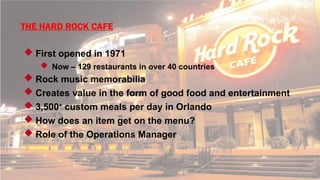
THE HARD ROCK CAFE
 First opened in 1971
 Now – 129 restaurants in over 40 countries
 Rock music memorabilia
 Creates value in the form of good food and entertainment
 3,500+
custom meals per day in Orlando
 How does an item get on the menu?
 Role of the Operations Manager
WHAT IS OPERATIONS MANAGEMENT?
PRODUCTION IS THE CREATION OF GOODS AND SERVICES
Operations management (OM) is the set of activities
that create value in the form of goods and services
by transforming inputs into outputs
WHY STUDY OM?
 OM is one of three major functions (marketing, finance, and
operations) of any organization
 We want (and need) to know how goods and services
are produced
 We want to understand what operations managers do
 OM is such a costly part of an organization
1–4
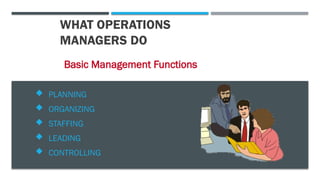
WHAT OPERATIONS
MANAGERS DO
 PLANNING
 ORGANIZING
 STAFFING
 LEADING
 CONTROLLING
Basic Management Functions
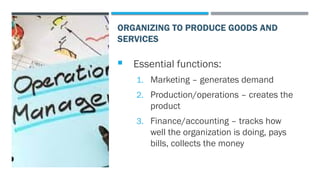
ORGANIZING TO PRODUCE GOODS AND
SERVICES
 Essential functions:
1. Marketing – generates demand
2. Production/operations – creates the
product
3. Finance/accounting – tracks how
well the organization is doing, pays
bills, collects the money
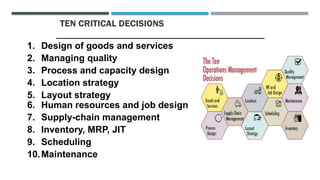
TEN CRITICAL DECISIONS
1. Design of goods and services
2. Managing quality
3. Process and capacity design
4. Location strategy
5. Layout strategy
6. Human resources and job design
7. Supply-chain management
8. Inventory, MRP, JIT
9. Scheduling
10.Maintenance
1 - 8
The Critical Decisions
1. Design of goods and services
 What good or service should we offer?
 How should we design these products and services?
2. Managing quality
 How do we define quality?
 Who is responsible for quality?
3. Process and capacity design
 What process and what capacity will these products require?
 What equipment and technology is necessary for these
processes?
1 - 9
The Critical Decisions
4. Location strategy
 Where should we put the facility?
 On what criteria should we base the location decision?
5. Layout strategy
 How should we arrange the facility?
 How large must the facility be to meet our plan?
6. Human resources and job design
 How do we provide a reasonable work environment?
 How much can we expect our employees to produce?
1 - 10
The Critical Decisions
7. Supply-chain management
 Should we make or buy this component?
 Who should be our suppliers and how can we integrate them into our strategy?
8. Inventory, material requirements planning, and JIT
 How much inventory of each item should we have?
 When do we re-order?
9. Intermediate and short–term scheduling
 Are we better off keeping people on the payroll during slowdowns?
 Which jobs do we perform next?
10. Maintenance
 How do we build reliability into our processes?
 Who is responsible for maintenance?
1 - 11
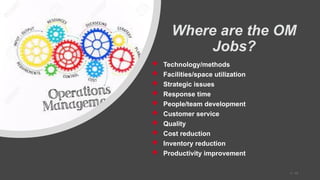
Where are the OM
Jobs?
 Technology/methods
 Facilities/space utilization
 Strategic issues
 Response time
 People/team development
 Customer service
 Quality
 Cost reduction
 Inventory reduction
 Productivity improvement
1 - 12
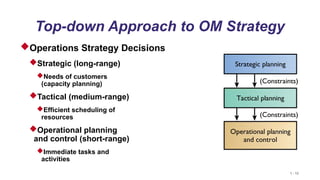
Top-down Approach to OM Strategy
Operations Strategy Decisions
Strategic (long-range)
Needs of customers
(capacity planning)
Tactical (medium-range)
Efficient scheduling of
resources
Operational planning
and control (short-range)
Immediate tasks and
activities
1 - 13
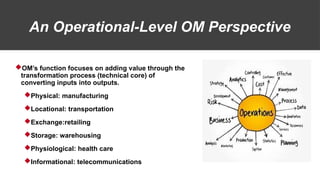
An Operational-Level OM Perspective
OM’s function focuses on adding value through the
transformation process (technical core) of
converting inputs into outputs.
Physical: manufacturing
Locational: transportation
Exchange:retailing
Storage: warehousing
Physiological: health care
Informational: telecommunications
1 - 14
OM’s Contributions to
Society
Higher Standard of Living
Ability to increase
productivity
Lower cost of goods and
services
Better Quality Goods and
Services
Competition increases
quality
Concern for the Environment
Recycling and concern for
air and water quality
Improved Working Conditions
Better job design and
employee participation
1 - 15
The Emergence of OM
Operations management has been gaining
increased recognition in recent years for several
reasons, including
a) the application of OM concepts in service operations,
b) an expanded definition of quality,
c) the introduction of OM concepts to other functional
areas such as marketing and human resources, and
d) the realization that the OM function can add value to
the end product.
1 - 16
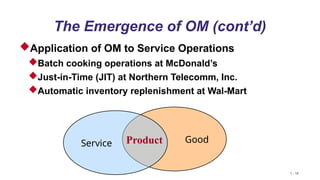
Good
The Emergence of OM (cont’d)
Application of OM to Service Operations
Batch cooking operations at McDonald’s
Just-in-Time (JIT) at Northern Telecomm, Inc.
Automatic inventory replenishment at Wal-Mart
Service Product
1 - 17
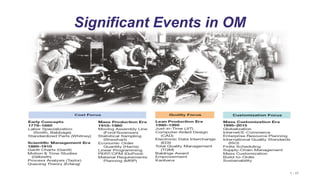
Significant Events in OM
1 - 18
The Heritage of OM
 Division of labor (Adam Smith 1776; Charles Babbage
1852)
 Standardized parts (Whitney 1800)
 Scientific Management (Taylor 1881)
 Coordinated assembly line (Ford/ Sorenson 1913)
 Gantt charts (Gantt 1916)
 Motion study (Frank and Lillian Gilbreth 1922)
 Quality control (Shewhart 1924; Deming 1950)
1 - 19
The Heritage of OM
 Computer (Atanasoff 1938)
 CPM/PERT (DuPont 1957, Navy 1958)
 Material requirements planning (Orlicky 1960)
 Computer aided design (CAD 1970)
 Flexible manufacturing system (FMS 1975)
 Baldrige Quality Awards (1980)
 Computer integrated manufacturing (1990)
 Globalization (1992)
 Internet (1995)
1 - 20
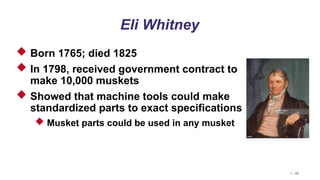
Eli Whitney
 Born 1765; died 1825
 In 1798, received government contract to
make 10,000 muskets
 Showed that machine tools could make
standardized parts to exact specifications
 Musket parts could be used in any musket
1 - 21
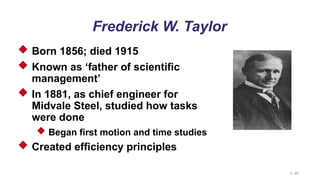
Frederick W. Taylor
 Born 1856; died 1915
 Known as ‘father of scientific
management’
 In 1881, as chief engineer for
Midvale Steel, studied how tasks
were done
 Began first motion and time studies
 Created efficiency principles
1 - 22
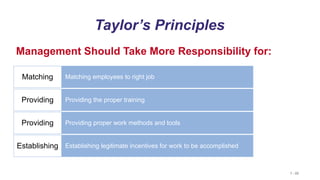
Taylor’s Principles
Management Should Take More Responsibility for:
Matching employees to right job
Matching
Providing the proper training
Providing
Providing proper work methods and tools
Providing
Establishing legitimate incentives for work to be accomplished
Establishing
1 - 23
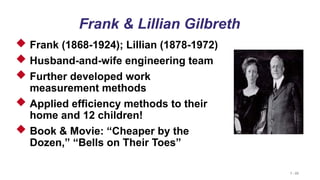
Frank & Lillian Gilbreth
 Frank (1868-1924); Lillian (1878-1972)
 Husband-and-wife engineering team
 Further developed work
measurement methods
 Applied efficiency methods to their
home and 12 children!
 Book & Movie: “Cheaper by the
Dozen,” “Bells on Their Toes”
1 - 24
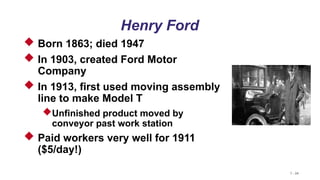
 Born 1863; died 1947
 In 1903, created Ford Motor
Company
 In 1913, first used moving assembly
line to make Model T
Unfinished product moved by
conveyor past work station
 Paid workers very well for 1911
($5/day!)
Henry Ford
1 - 25
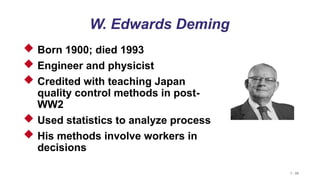
W. Edwards Deming
 Born 1900; died 1993
 Engineer and physicist
 Credited with teaching Japan
quality control methods in post-
WW2
 Used statistics to analyze process
 His methods involve workers in
decisions
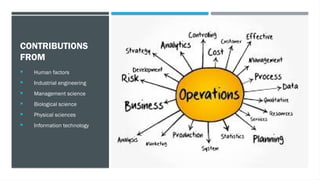
CONTRIBUTIONS
FROM
 Human factors
 Industrial engineering
 Management science
 Biological science
 Physical sciences
 Information technology
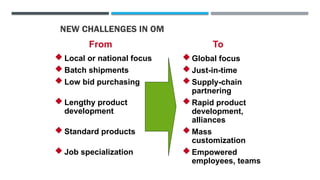
NEW CHALLENGES IN OM
 Global focus
 Just-in-time
 Supply-chain
partnering
 Rapid product
development,
alliances
 Mass
customization
 Empowered
employees, teams
To
From
 Local or national focus
 Batch shipments
 Low bid purchasing
 Lengthy product
development
 Standard products
 Job specialization
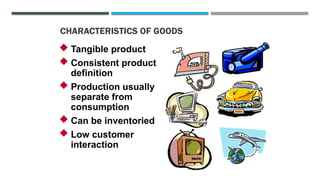
CHARACTERISTICS OF GOODS
 Tangible product
 Consistent product
definition
 Production usually
separate from
consumption
 Can be inventoried
 Low customer
interaction
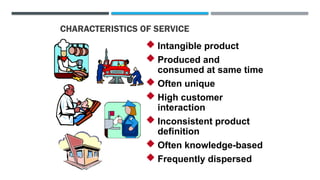
CHARACTERISTICS OF SERVICE
 Intangible product
 Produced and
consumed at same time
 Often unique
 High customer
interaction
 Inconsistent product
definition
 Often knowledge-based
 Frequently dispersed
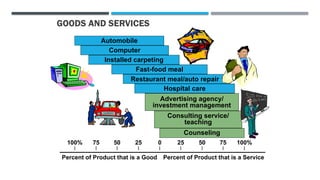
GOODS AND SERVICES
Automobile
Computer
Installed carpeting
Fast-food meal
Restaurant meal/auto repair
Hospital care
Advertising agency/
investment management
Consulting service/
teaching
Counseling
Percent of Product that is a Good Percent of Product that is a Service
100% 75 50 25 0 25 50 75 100%
| | | | | | | | |
AN EXPANDED DEFINITION OF QUALITY
Quality is important in all functional areas of an organization.
Quality is now much more than the technical requirements for
manufactured goods.
Service quality (customer relationships)
is equally important.
Quality
1–31
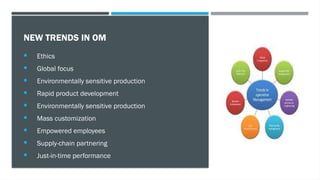
NEW TRENDS IN OM
 Ethics
 Global focus
 Environmentally sensitive production
 Rapid product development
 Environmentally sensitive production
 Mass customization
 Empowered employees
 Supply-chain partnering
 Just-in-time performance
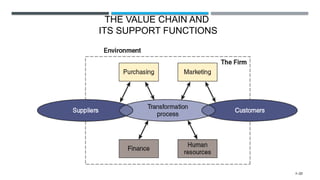
THE VALUE CHAIN AND
ITS SUPPORT FUNCTIONS
1–33
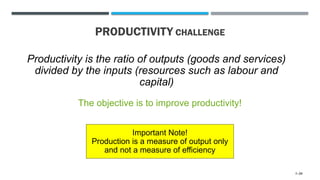
PRODUCTIVITY CHALLENGE
Productivity is the ratio of outputs (goods and services)
divided by the inputs (resources such as labour and
capital)
The objective is to improve productivity!
Important Note!
Production is a measure of output only
and not a measure of efficiency
1–34
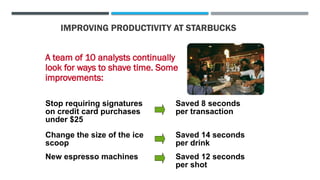
IMPROVING PRODUCTIVITY AT STARBUCKS
A team of 10 analysts continually
look for ways to shave time. Some
improvements:
Stop requiring signatures
on credit card purchases
under $25
Saved 8 seconds
per transaction
Change the size of the ice
scoop
Saved 14 seconds
per drink
New espresso machines Saved 12 seconds
per shot
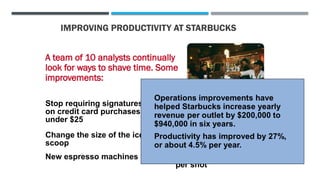
IMPROVING PRODUCTIVITY AT STARBUCKS
A team of 10 analysts continually
look for ways to shave time. Some
improvements:
Stop requiring signatures
on credit card purchases
under $25
Saved 8 seconds
per transaction
Change the size of the ice
scoop
Saved 14 seconds
per drink
New espresso machines Saved 12 seconds
per shot
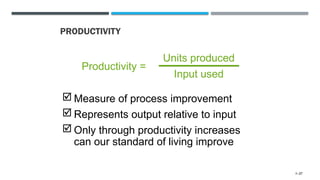
 Measure of process improvement
 Represents output relative to input
 Only through productivity increases
can our standard of living improve
PRODUCTIVITY
Productivity =
Units produced
Input used
1–37
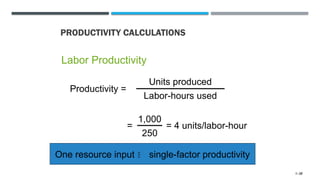
PRODUCTIVITY CALCULATIONS
Productivity =
Units produced
Labor-hours used
= = 4 units/labor-hour
1,000
250
Labor Productivity
One resource input  single-factor productivity
1–38
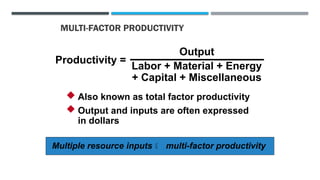
MULTI-FACTOR PRODUCTIVITY
Output
Labor + Material + Energy
+ Capital + Miscellaneous
Productivity =
 Also known as total factor productivity
 Output and inputs are often expressed
in dollars
Multiple resource inputs  multi-factor productivity
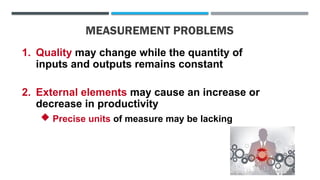
MEASUREMENT PROBLEMS
1. Quality may change while the quantity of
inputs and outputs remains constant
2. External elements may cause an increase or
decrease in productivity
 Precise units of measure may be lacking
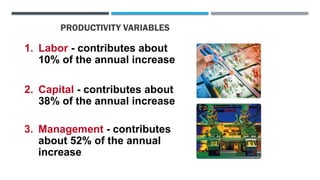
PRODUCTIVITY VARIABLES
1. Labor - contributes about
10% of the annual increase
2. Capital - contributes about
38% of the annual increase
3. Management - contributes
about 52% of the annual
increase
KEY VARIABLES FOR IMPROVED LABOR
PRODUCTIVITY
1. Basic education appropriate for the labor force
2. Diet of the labor force
3. Social overhead that makes labor available
Challenge is in maintaining and
enhancing skills in the midst of
rapidly changing technology and
knowledge
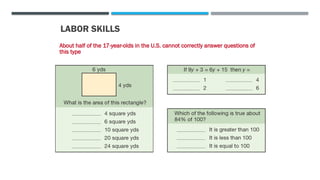
LABOR SKILLS
About half of the 17-year-olds in the U.S. cannot correctly answer questions of
this type
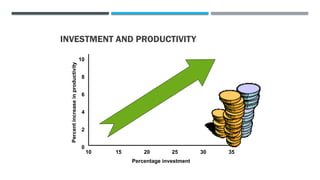
INVESTMENT AND PRODUCTIVITY
10
8
6
4
2
0
Percent
increase
in
productivity
Percentage investment
10 15 20 25 30 35
SERVICE PRODUCTIVITY
1. Typically labor intensive
2. Frequently focused on unique
individual attributes or desires
3. Often an intellectual task performed by
professionals
4. Often difficult to mechanize
5. Often difficult to evaluate for quality
ETHICS AND
SOCIAL RESPONSIBILITY
Challenges facing operations managers:
 Developing and producing safe, quality products
 Maintaining a clean environment
 Providing a safe workplace
 Honoring stakeholder commitments

Introduction to Operations Management.pptx

  • 1.
  • 2.
    © 2011 PEARSONEDUCATION THE HARD ROCK CAFE  First opened in 1971  Now – 129 restaurants in over 40 countries  Rock music memorabilia  Creates value in the form of good food and entertainment  3,500+ custom meals per day in Orlando  How does an item get on the menu?  Role of the Operations Manager
  • 3.
    WHAT IS OPERATIONSMANAGEMENT? PRODUCTION IS THE CREATION OF GOODS AND SERVICES Operations management (OM) is the set of activities that create value in the form of goods and services by transforming inputs into outputs
  • 4.
    WHY STUDY OM? OM is one of three major functions (marketing, finance, and operations) of any organization  We want (and need) to know how goods and services are produced  We want to understand what operations managers do  OM is such a costly part of an organization 1–4
  • 5.
    WHAT OPERATIONS MANAGERS DO PLANNING  ORGANIZING  STAFFING  LEADING  CONTROLLING Basic Management Functions
  • 6.
    ORGANIZING TO PRODUCEGOODS AND SERVICES  Essential functions: 1. Marketing – generates demand 2. Production/operations – creates the product 3. Finance/accounting – tracks how well the organization is doing, pays bills, collects the money
  • 7.
    TEN CRITICAL DECISIONS 1.Design of goods and services 2. Managing quality 3. Process and capacity design 4. Location strategy 5. Layout strategy 6. Human resources and job design 7. Supply-chain management 8. Inventory, MRP, JIT 9. Scheduling 10.Maintenance
  • 8.
    1 - 8 TheCritical Decisions 1. Design of goods and services  What good or service should we offer?  How should we design these products and services? 2. Managing quality  How do we define quality?  Who is responsible for quality? 3. Process and capacity design  What process and what capacity will these products require?  What equipment and technology is necessary for these processes?
  • 9.
    1 - 9 TheCritical Decisions 4. Location strategy  Where should we put the facility?  On what criteria should we base the location decision? 5. Layout strategy  How should we arrange the facility?  How large must the facility be to meet our plan? 6. Human resources and job design  How do we provide a reasonable work environment?  How much can we expect our employees to produce?
  • 10.
    1 - 10 TheCritical Decisions 7. Supply-chain management  Should we make or buy this component?  Who should be our suppliers and how can we integrate them into our strategy? 8. Inventory, material requirements planning, and JIT  How much inventory of each item should we have?  When do we re-order? 9. Intermediate and short–term scheduling  Are we better off keeping people on the payroll during slowdowns?  Which jobs do we perform next? 10. Maintenance  How do we build reliability into our processes?  Who is responsible for maintenance?
  • 11.
    1 - 11 Whereare the OM Jobs?  Technology/methods  Facilities/space utilization  Strategic issues  Response time  People/team development  Customer service  Quality  Cost reduction  Inventory reduction  Productivity improvement
  • 12.
    1 - 12 Top-downApproach to OM Strategy Operations Strategy Decisions Strategic (long-range) Needs of customers (capacity planning) Tactical (medium-range) Efficient scheduling of resources Operational planning and control (short-range) Immediate tasks and activities
  • 13.
    1 - 13 AnOperational-Level OM Perspective OM’s function focuses on adding value through the transformation process (technical core) of converting inputs into outputs. Physical: manufacturing Locational: transportation Exchange:retailing Storage: warehousing Physiological: health care Informational: telecommunications
  • 14.
    1 - 14 OM’sContributions to Society Higher Standard of Living Ability to increase productivity Lower cost of goods and services Better Quality Goods and Services Competition increases quality Concern for the Environment Recycling and concern for air and water quality Improved Working Conditions Better job design and employee participation
  • 15.
    1 - 15 TheEmergence of OM Operations management has been gaining increased recognition in recent years for several reasons, including a) the application of OM concepts in service operations, b) an expanded definition of quality, c) the introduction of OM concepts to other functional areas such as marketing and human resources, and d) the realization that the OM function can add value to the end product.
  • 16.
    1 - 16 Good TheEmergence of OM (cont’d) Application of OM to Service Operations Batch cooking operations at McDonald’s Just-in-Time (JIT) at Northern Telecomm, Inc. Automatic inventory replenishment at Wal-Mart Service Product
  • 17.
    1 - 17 SignificantEvents in OM
  • 18.
    1 - 18 TheHeritage of OM  Division of labor (Adam Smith 1776; Charles Babbage 1852)  Standardized parts (Whitney 1800)  Scientific Management (Taylor 1881)  Coordinated assembly line (Ford/ Sorenson 1913)  Gantt charts (Gantt 1916)  Motion study (Frank and Lillian Gilbreth 1922)  Quality control (Shewhart 1924; Deming 1950)
  • 19.
    1 - 19 TheHeritage of OM  Computer (Atanasoff 1938)  CPM/PERT (DuPont 1957, Navy 1958)  Material requirements planning (Orlicky 1960)  Computer aided design (CAD 1970)  Flexible manufacturing system (FMS 1975)  Baldrige Quality Awards (1980)  Computer integrated manufacturing (1990)  Globalization (1992)  Internet (1995)
  • 20.
    1 - 20 EliWhitney  Born 1765; died 1825  In 1798, received government contract to make 10,000 muskets  Showed that machine tools could make standardized parts to exact specifications  Musket parts could be used in any musket
  • 21.
    1 - 21 FrederickW. Taylor  Born 1856; died 1915  Known as ‘father of scientific management’  In 1881, as chief engineer for Midvale Steel, studied how tasks were done  Began first motion and time studies  Created efficiency principles
  • 22.
    1 - 22 Taylor’sPrinciples Management Should Take More Responsibility for: Matching employees to right job Matching Providing the proper training Providing Providing proper work methods and tools Providing Establishing legitimate incentives for work to be accomplished Establishing
  • 23.
    1 - 23 Frank& Lillian Gilbreth  Frank (1868-1924); Lillian (1878-1972)  Husband-and-wife engineering team  Further developed work measurement methods  Applied efficiency methods to their home and 12 children!  Book & Movie: “Cheaper by the Dozen,” “Bells on Their Toes”
  • 24.
    1 - 24 Born 1863; died 1947  In 1903, created Ford Motor Company  In 1913, first used moving assembly line to make Model T Unfinished product moved by conveyor past work station  Paid workers very well for 1911 ($5/day!) Henry Ford
  • 25.
    1 - 25 W.Edwards Deming  Born 1900; died 1993  Engineer and physicist  Credited with teaching Japan quality control methods in post- WW2  Used statistics to analyze process  His methods involve workers in decisions
  • 26.
    CONTRIBUTIONS FROM  Human factors Industrial engineering  Management science  Biological science  Physical sciences  Information technology
  • 27.
    NEW CHALLENGES INOM  Global focus  Just-in-time  Supply-chain partnering  Rapid product development, alliances  Mass customization  Empowered employees, teams To From  Local or national focus  Batch shipments  Low bid purchasing  Lengthy product development  Standard products  Job specialization
  • 28.
    CHARACTERISTICS OF GOODS Tangible product  Consistent product definition  Production usually separate from consumption  Can be inventoried  Low customer interaction
  • 29.
    CHARACTERISTICS OF SERVICE Intangible product  Produced and consumed at same time  Often unique  High customer interaction  Inconsistent product definition  Often knowledge-based  Frequently dispersed
  • 30.
    GOODS AND SERVICES Automobile Computer Installedcarpeting Fast-food meal Restaurant meal/auto repair Hospital care Advertising agency/ investment management Consulting service/ teaching Counseling Percent of Product that is a Good Percent of Product that is a Service 100% 75 50 25 0 25 50 75 100% | | | | | | | | |
  • 31.
    AN EXPANDED DEFINITIONOF QUALITY Quality is important in all functional areas of an organization. Quality is now much more than the technical requirements for manufactured goods. Service quality (customer relationships) is equally important. Quality 1–31
  • 32.
    NEW TRENDS INOM  Ethics  Global focus  Environmentally sensitive production  Rapid product development  Environmentally sensitive production  Mass customization  Empowered employees  Supply-chain partnering  Just-in-time performance
  • 33.
    THE VALUE CHAINAND ITS SUPPORT FUNCTIONS 1–33
  • 34.
    PRODUCTIVITY CHALLENGE Productivity isthe ratio of outputs (goods and services) divided by the inputs (resources such as labour and capital) The objective is to improve productivity! Important Note! Production is a measure of output only and not a measure of efficiency 1–34
  • 35.
    IMPROVING PRODUCTIVITY ATSTARBUCKS A team of 10 analysts continually look for ways to shave time. Some improvements: Stop requiring signatures on credit card purchases under $25 Saved 8 seconds per transaction Change the size of the ice scoop Saved 14 seconds per drink New espresso machines Saved 12 seconds per shot
  • 36.
    IMPROVING PRODUCTIVITY ATSTARBUCKS A team of 10 analysts continually look for ways to shave time. Some improvements: Stop requiring signatures on credit card purchases under $25 Saved 8 seconds per transaction Change the size of the ice scoop Saved 14 seconds per drink New espresso machines Saved 12 seconds per shot
  • 37.
     Measure ofprocess improvement  Represents output relative to input  Only through productivity increases can our standard of living improve PRODUCTIVITY Productivity = Units produced Input used 1–37
  • 38.
    PRODUCTIVITY CALCULATIONS Productivity = Unitsproduced Labor-hours used = = 4 units/labor-hour 1,000 250 Labor Productivity One resource input  single-factor productivity 1–38
  • 39.
    MULTI-FACTOR PRODUCTIVITY Output Labor +Material + Energy + Capital + Miscellaneous Productivity =  Also known as total factor productivity  Output and inputs are often expressed in dollars Multiple resource inputs  multi-factor productivity
  • 40.
    MEASUREMENT PROBLEMS 1. Qualitymay change while the quantity of inputs and outputs remains constant 2. External elements may cause an increase or decrease in productivity  Precise units of measure may be lacking
  • 41.
    PRODUCTIVITY VARIABLES 1. Labor- contributes about 10% of the annual increase 2. Capital - contributes about 38% of the annual increase 3. Management - contributes about 52% of the annual increase
  • 42.
    KEY VARIABLES FORIMPROVED LABOR PRODUCTIVITY 1. Basic education appropriate for the labor force 2. Diet of the labor force 3. Social overhead that makes labor available Challenge is in maintaining and enhancing skills in the midst of rapidly changing technology and knowledge
  • 43.
    LABOR SKILLS About halfof the 17-year-olds in the U.S. cannot correctly answer questions of this type
  • 44.
  • 45.
    SERVICE PRODUCTIVITY 1. Typicallylabor intensive 2. Frequently focused on unique individual attributes or desires 3. Often an intellectual task performed by professionals 4. Often difficult to mechanize 5. Often difficult to evaluate for quality
  • 46.
    ETHICS AND SOCIAL RESPONSIBILITY Challengesfacing operations managers:  Developing and producing safe, quality products  Maintaining a clean environment  Providing a safe workplace  Honoring stakeholder commitments