Accounting Information Systems, 6th edition
                                  James A. Hall


COPYRIGHT © 2009 South-Western, a division of Cengage Learning. Cengage Learning and South-Western
                              are trademarks used herein under license
Objectives for Chapter 7
Elements and procedures of a traditional production 
process
Data flows and procedures in a traditional cost accounting 
system
Accounting controls in a traditional environment
Principles, operating features, and technologies of lean 
manufacturing
Shortcomings of traditional accounting methods in the 
world‐class environment
Key features of activity based costing and value stream 
accounting
Information systems of lean manufacturing and world‐
class companies
The Conversion Cycle
Transforms input resources, raw materials, 
labor, and overhead into finished products 
or services for sale
Consists of two subsystems:
  Physical activities – the production system 
  Information activities – the cost accounting 
  system
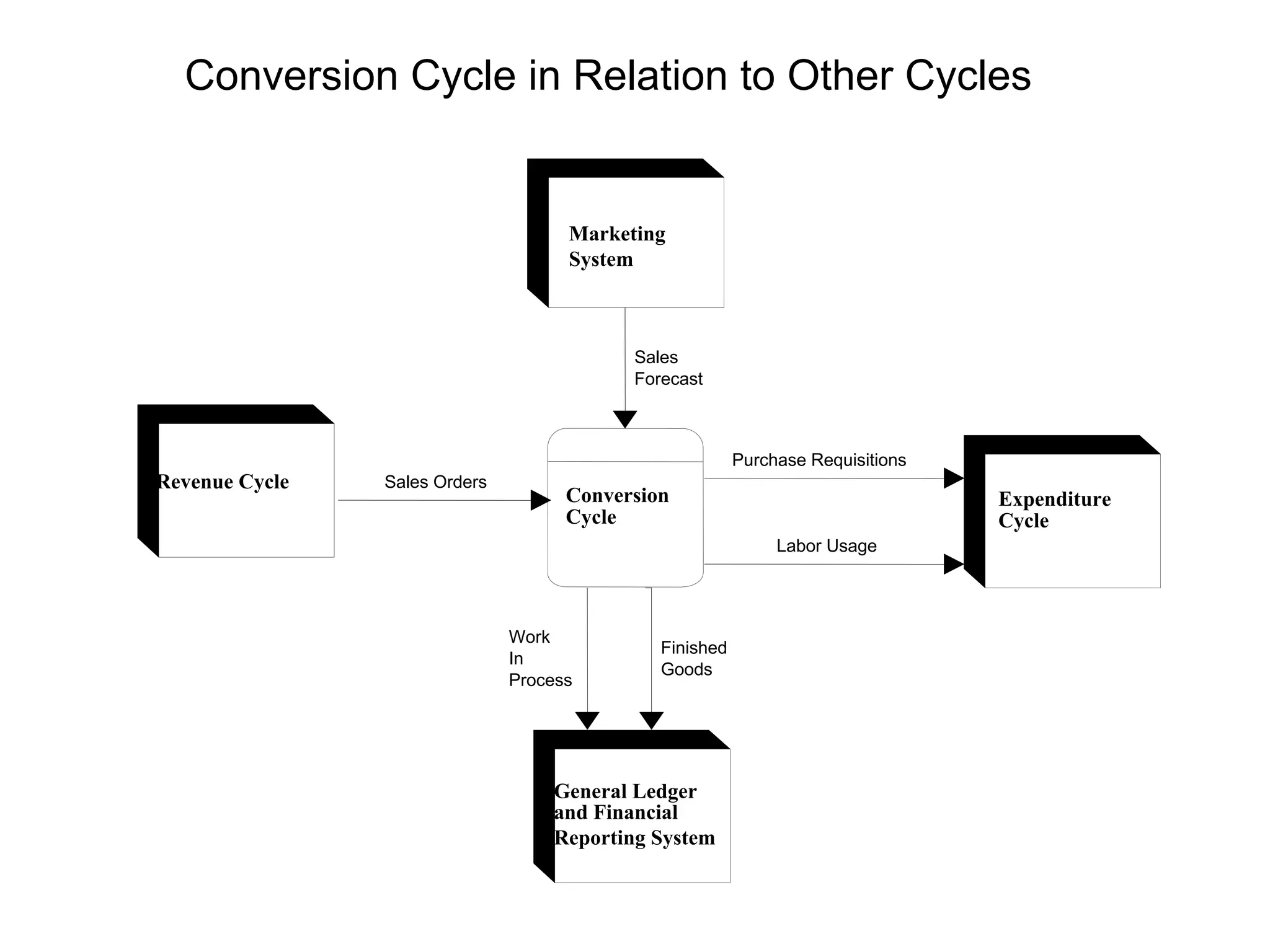
Conversion Cycle in Relation to Other Cycles


                                     Marketing
                                     System


                                           Sales
                                           Forecast


                                                         Purchase Requisitions
Revenue Cycle   Sales Orders
                                     Conversion                                  Expenditure
                                     Cycle                                       Cycle
                                                              Labor Usage


                               Work
                                              Finished
                               In
                                              Goods
                               Process


                                   General Ledger
                                   and Financial
                                   Reporting System
Production System
Involves the planning, scheduling, and control of 
the physical product through the manufacturing 
process
  determining raw materials requirements
  authorizing the release of raw materials into 
  production
  authorizing work to be conducted in the 
  production process
  directing the movement of work through the 
  various stages of production
Production Methods
Continuous Processing creates a homogeneous 
product through a continuous series of standard 
procedures.
Batch Processing produces discrete groups 
(batches) of products. 
Make‐to‐Order Processing involves the fabrication 
of discrete products in accordance with customer 
specifications.
Overview: Traditional Batch 
Production Model…
 consists of four basic processes:
  plan and control production 
  perform production operations 
  maintain inventory control 
  perform cost accounting
Batch Production System 
Production Planning and Control
  Materials and operations requirements 
  Production scheduling
Materials and Operations Requirements 
  Materials requirement – the difference between what is 
  needed and what is available in inventory
  Operations requirements – the assembly and/or 
  manufacturing activities to be applied to the product
Batch Production System 
Production Scheduling
  Coordinates the production of multiple batches 
  Influenced by time constraints, batch size, and 
  other specifications
Work Centers and Storekeeping
  Production operations begin when work centers 
  obtain raw materials from storekeeping.
  It ends with the completed product being sent to 
  the finished goods (FG) warehouse .
Batch Production System 
 Inventory Control
   Objective: minimize total inventory cost while 
   ensuring that adequate inventories exist of 
   production demand
   Provides production planning and control with 
   status of finished goods and raw materials inventory 
   Continually updates the raw material inventory 
   during production process 
   Upon completion of production, updates finished 
   goods inventory
EOQ Inventory Model
 Very simple too use, but assumptions are not always 
 valid
    demand is known and constant
    ordering lead time is known and constant
    total cost per year of placing orders decreases as the 
    order quantities increase
    carrying costs of inventory increases as quantity of 
    orders increases
    no quantity discounts
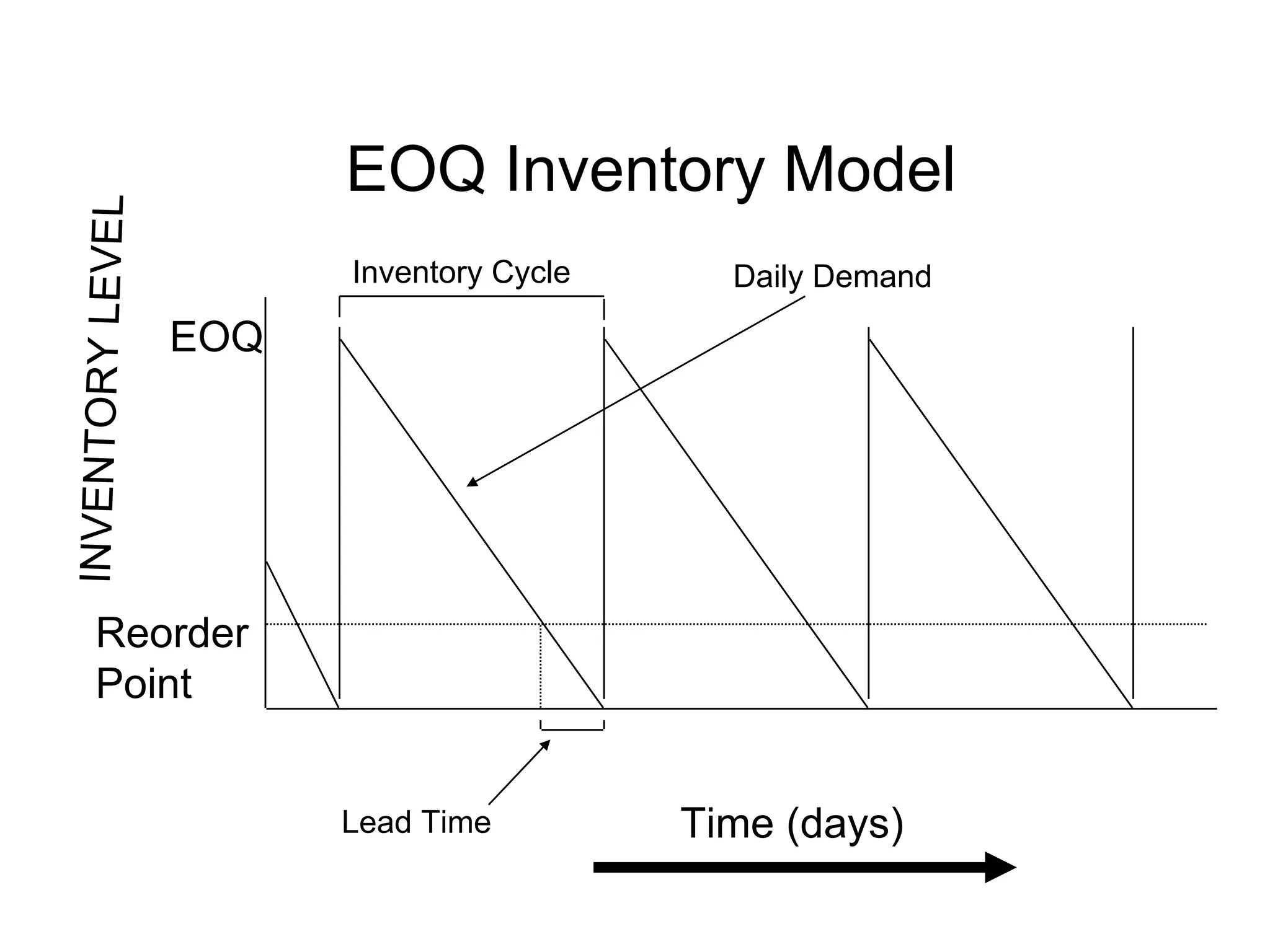
EOQ Inventory Model
INVENTORY LEVEL


                        Inventory Cycle     Daily Demand

                  EOQ


    Reorder
    Point


                        Lead Time         Time (days)
Information: Documents in 
the Batch Production System 
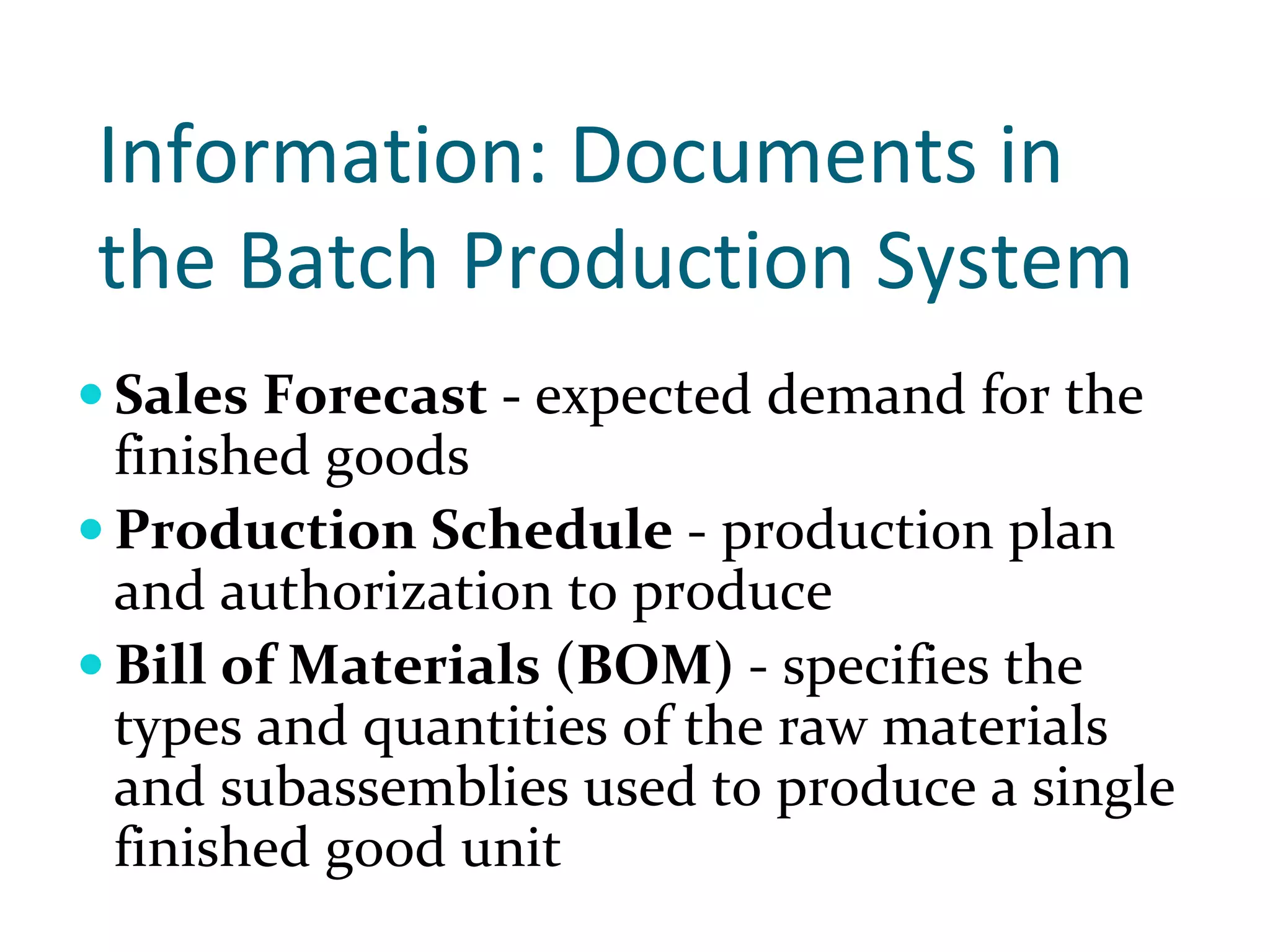
Sales Forecast ‐ expected demand for the 
finished goods
Production Schedule ‐ production plan 
and authorization to produce
Bill of Materials (BOM) ‐ specifies the 
types and quantities of the raw materials 
and subassemblies used to produce a single 
finished good unit
Information: Documents in 
the Batch Production System 
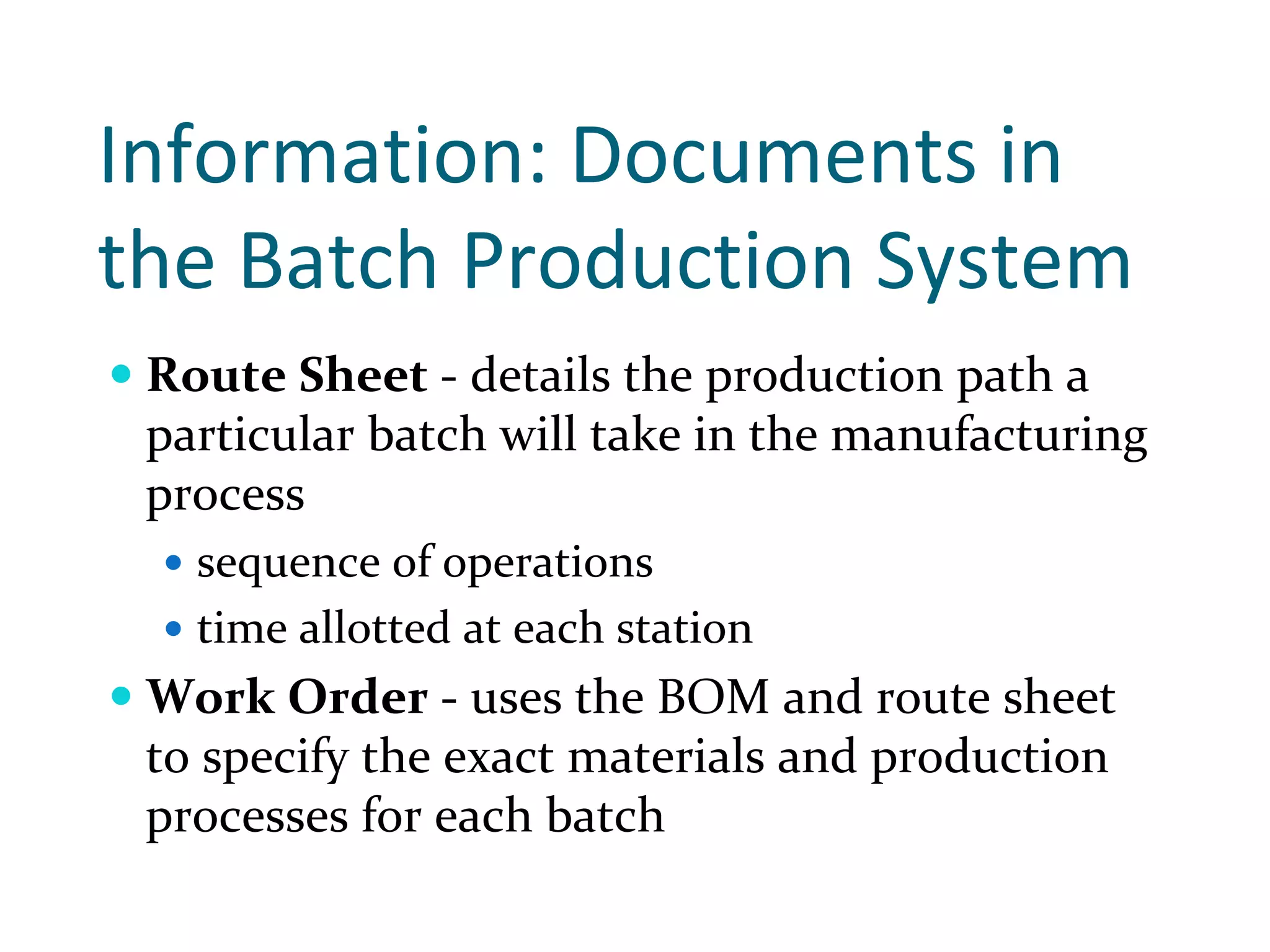
 Route Sheet ‐ details the production path a 
 particular batch will take in the manufacturing 
 process
   sequence of operations
   time allotted at each station
 Work Order ‐ uses the BOM and route sheet 
 to specify the exact materials and production 
 processes for each batch
Information: Documents in 
the Batch Production System 
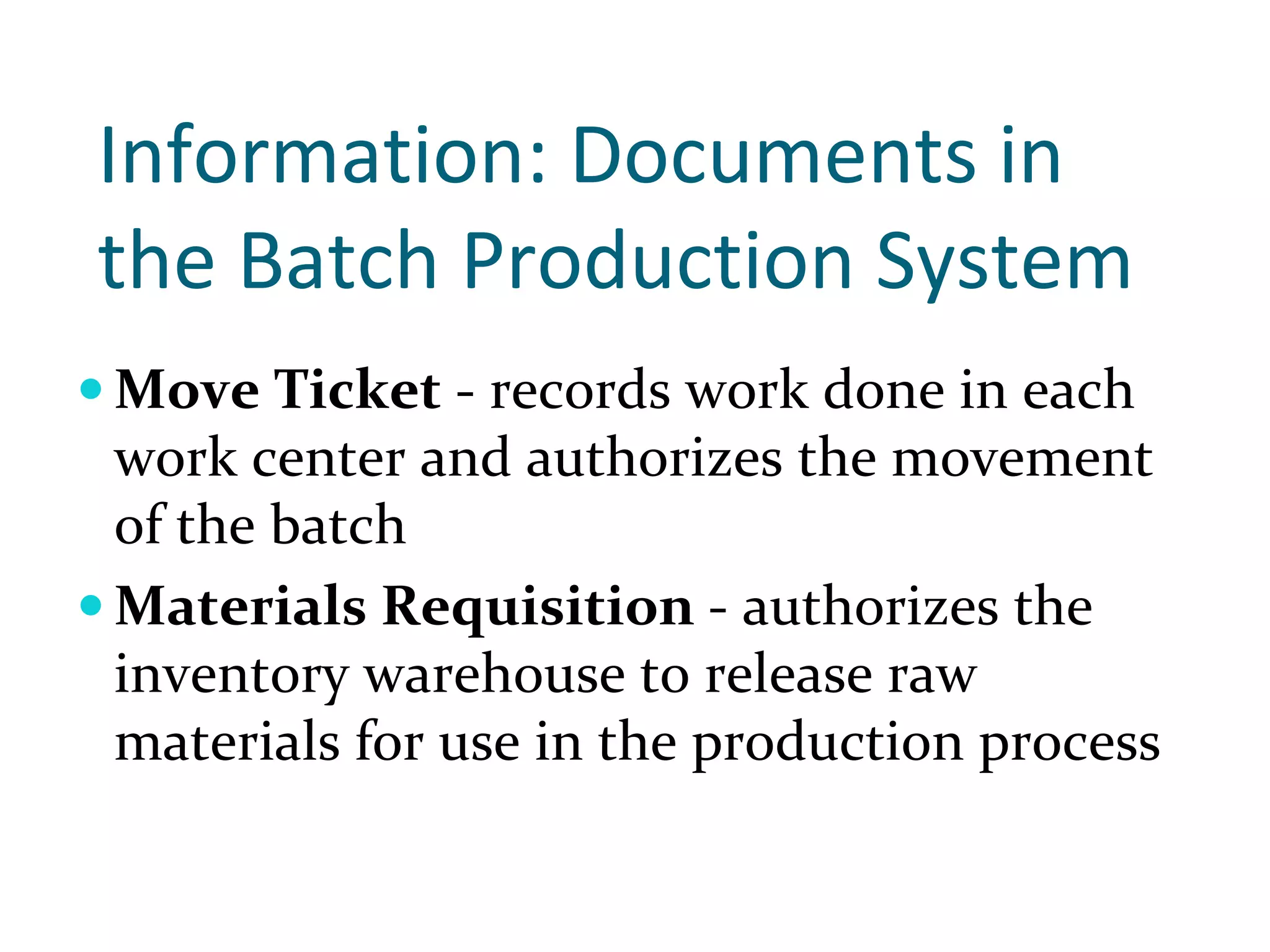
Move Ticket ‐ records work done in each 
work center and authorizes the movement 
of the batch
Materials Requisition ‐ authorizes the 
inventory warehouse to release raw 
materials for use in the production process
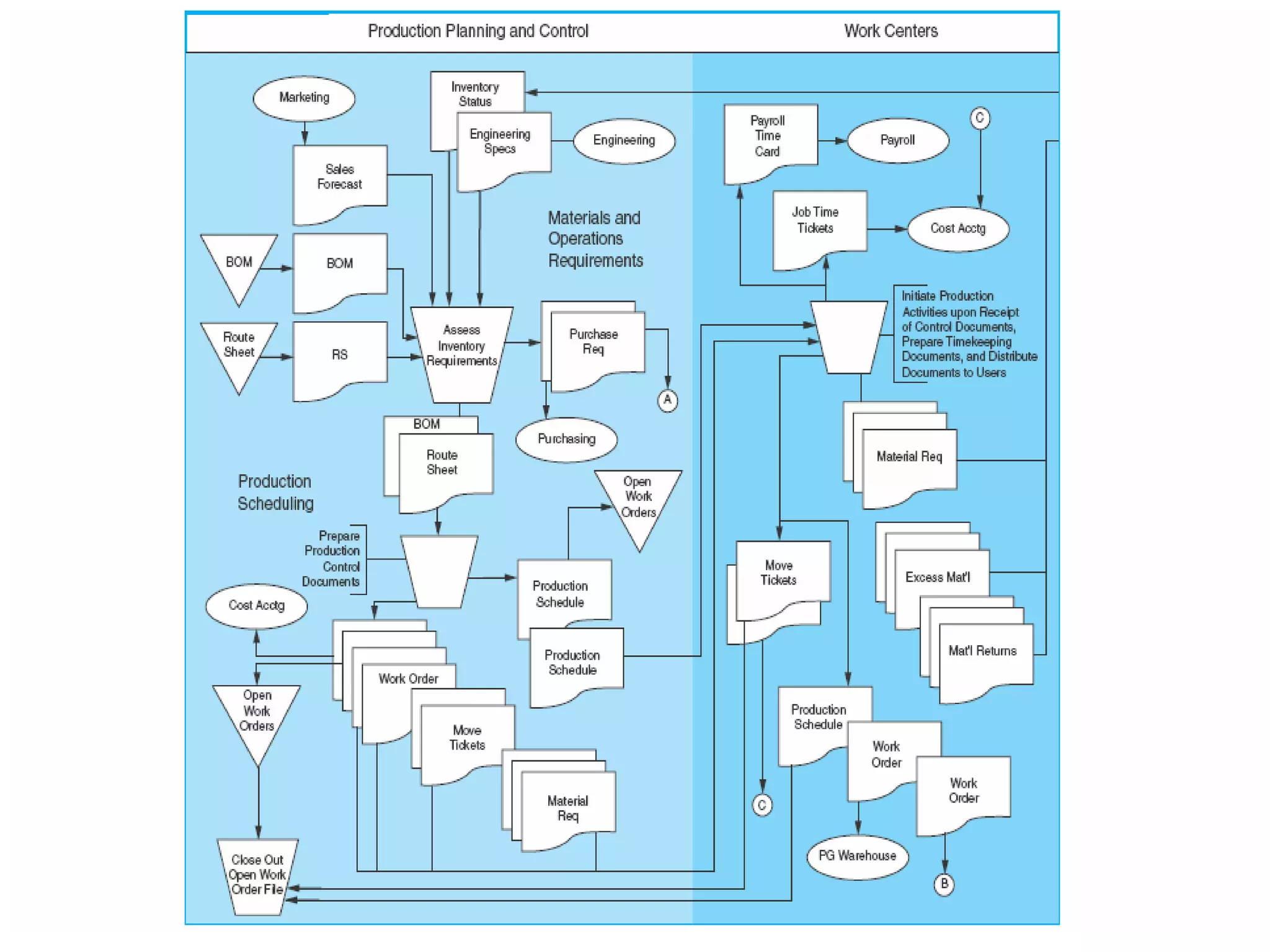
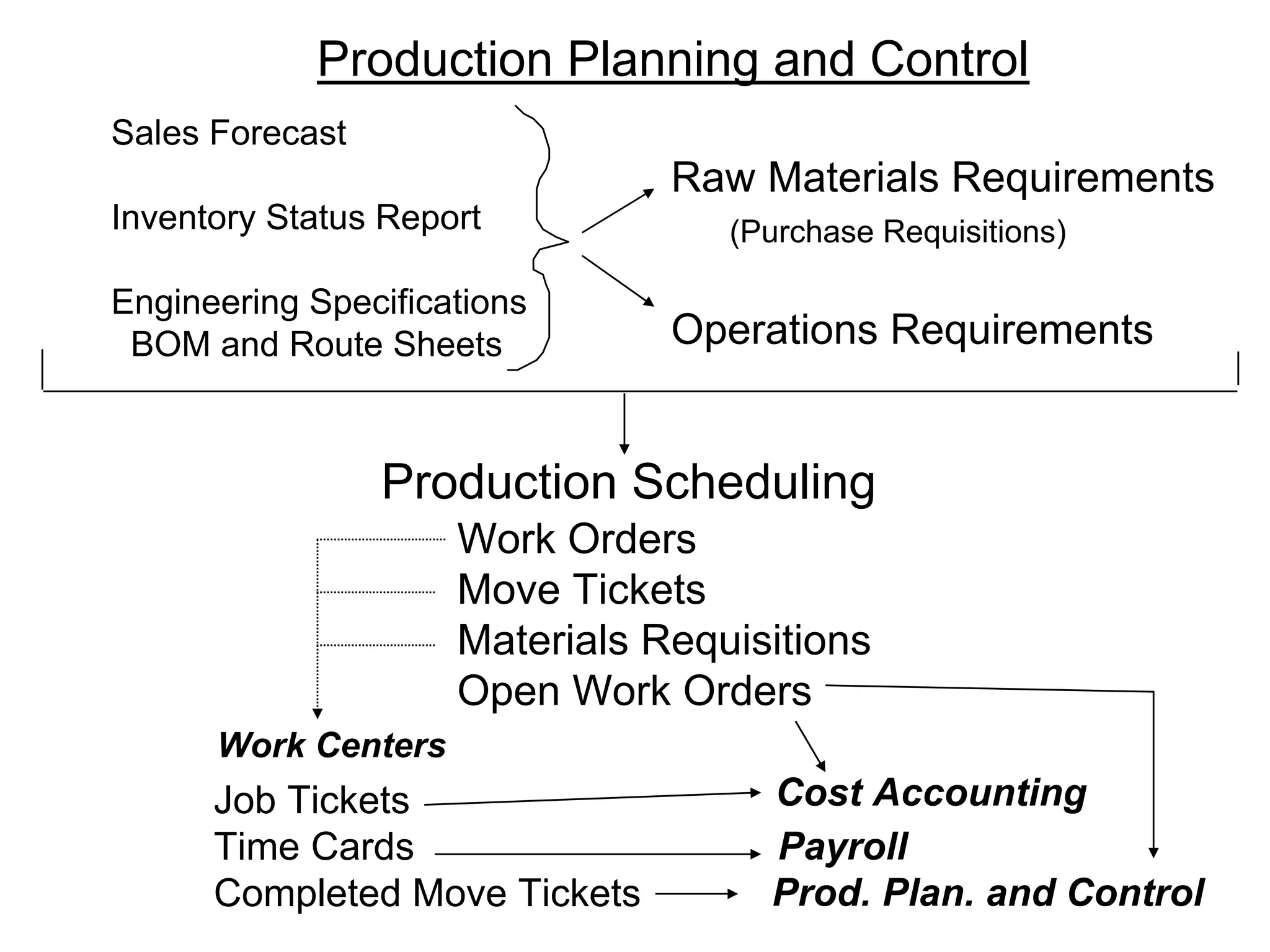
Production Planning and Control
Sales Forecast
                                Raw Materials Requirements
Inventory Status Report            (Purchase Requisitions)

Engineering Specifications
 BOM and Route Sheets           Operations Requirements


                 Production Scheduling
                     Work Orders
                     Move Tickets
                     Materials Requisitions
                     Open Work Orders
      Work Centers
      Job Tickets                    Cost Accounting
      Time Cards                     Payroll
      Completed Move Tickets         Prod. Plan. and Control
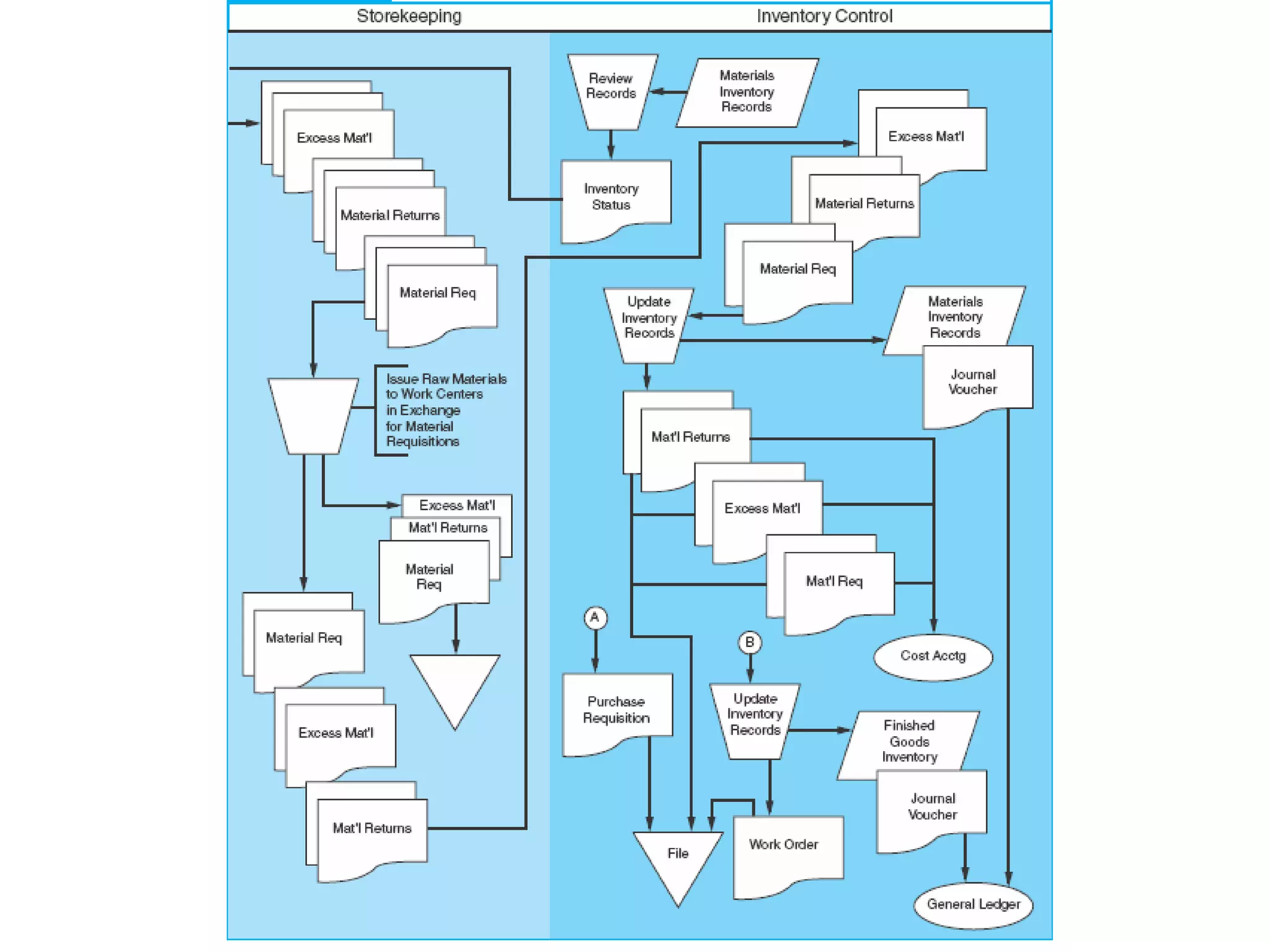
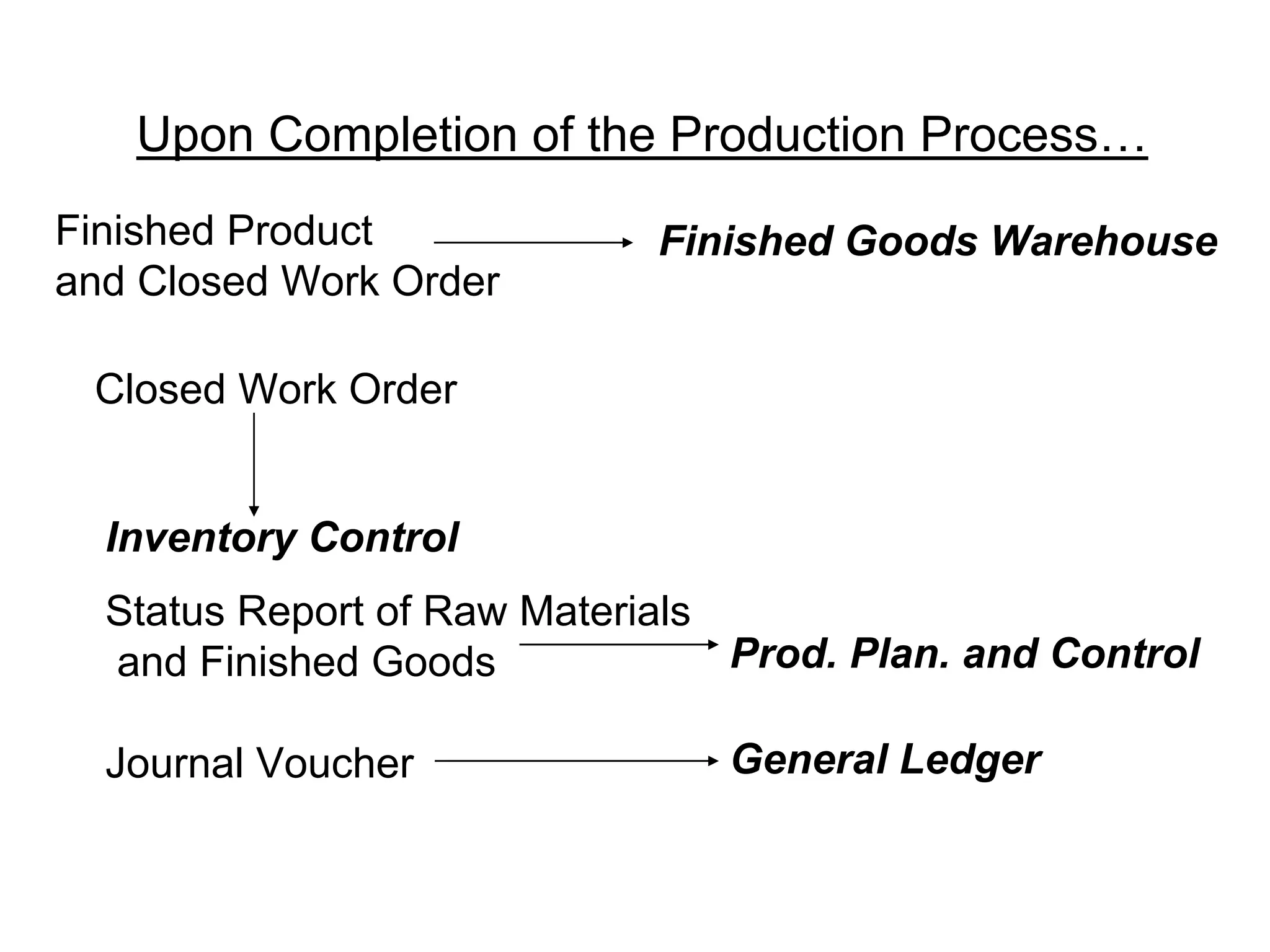
Upon Completion of the Production Process…
Finished Product             Finished Goods Warehouse
and Closed Work Order

 Closed Work Order


  Inventory Control
  Status Report of Raw Materials
  and Finished Goods             Prod. Plan. and Control

  Journal Voucher               General Ledger
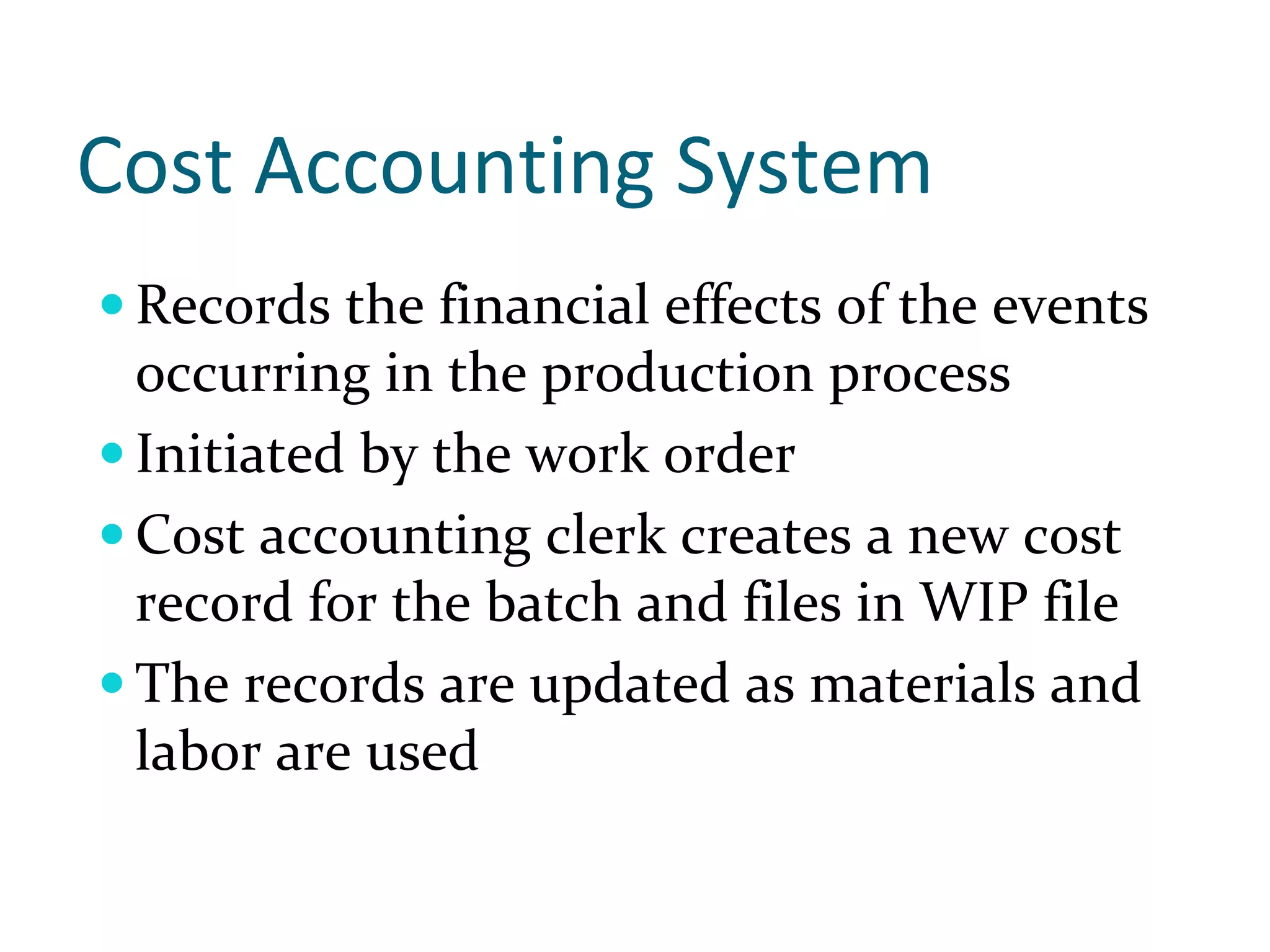
Cost Accounting System
 Records the financial effects of the events 
 occurring in the production process
 Initiated by the work order
 Cost accounting clerk creates a new cost 
 record for the batch and files in WIP file
 The records are updated as materials and 
 labor are used
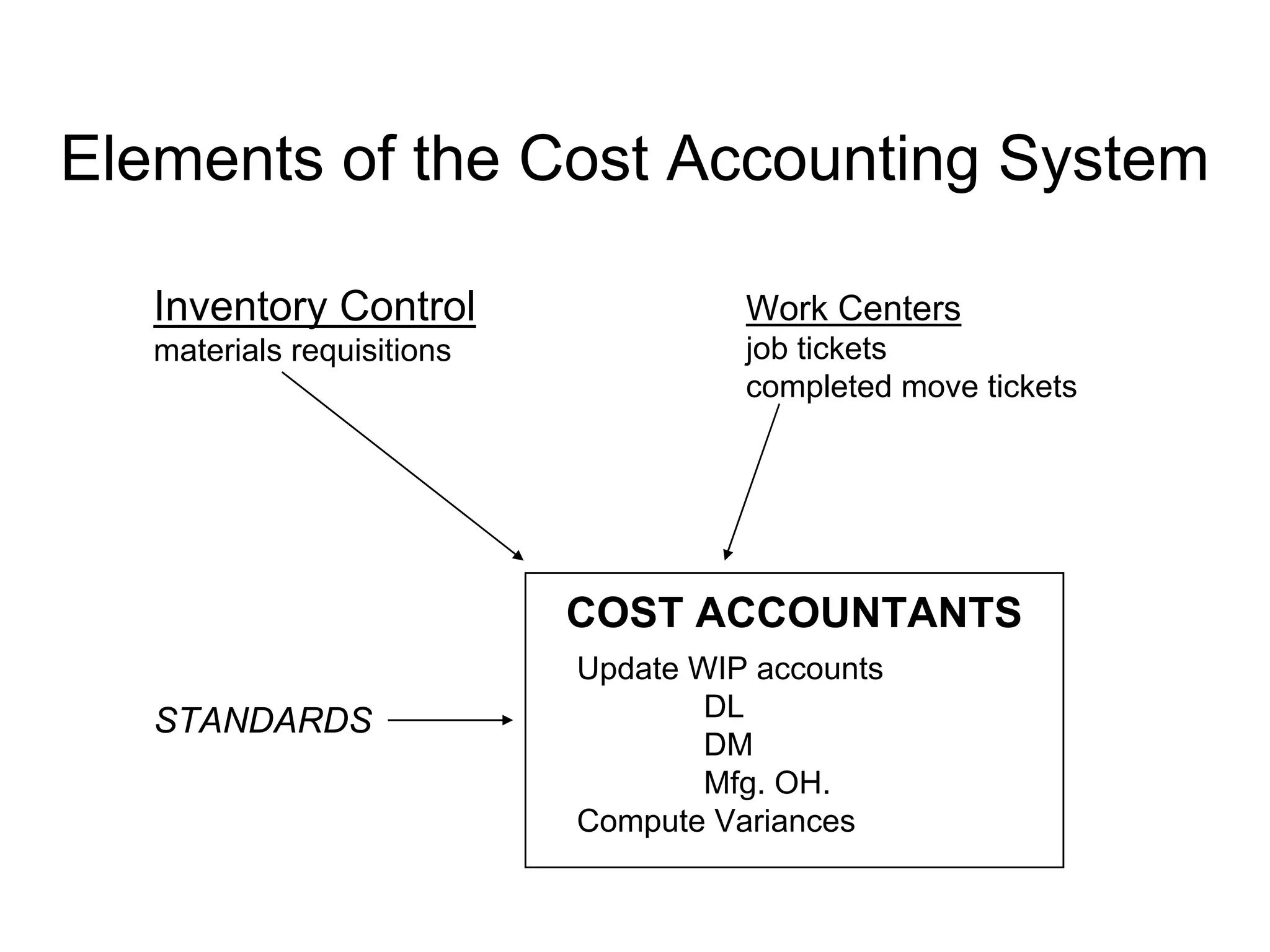
Elements of the Cost Accounting System

   Inventory Control                  Work Centers
   materials requisitions             job tickets
                                      completed move tickets


                            COST ACCOUNTANTS
                            Update WIP accounts
   STANDARDS                        DL
                                    DM
                                    Mfg. OH.
                            Compute Variances
Cost Accounting System
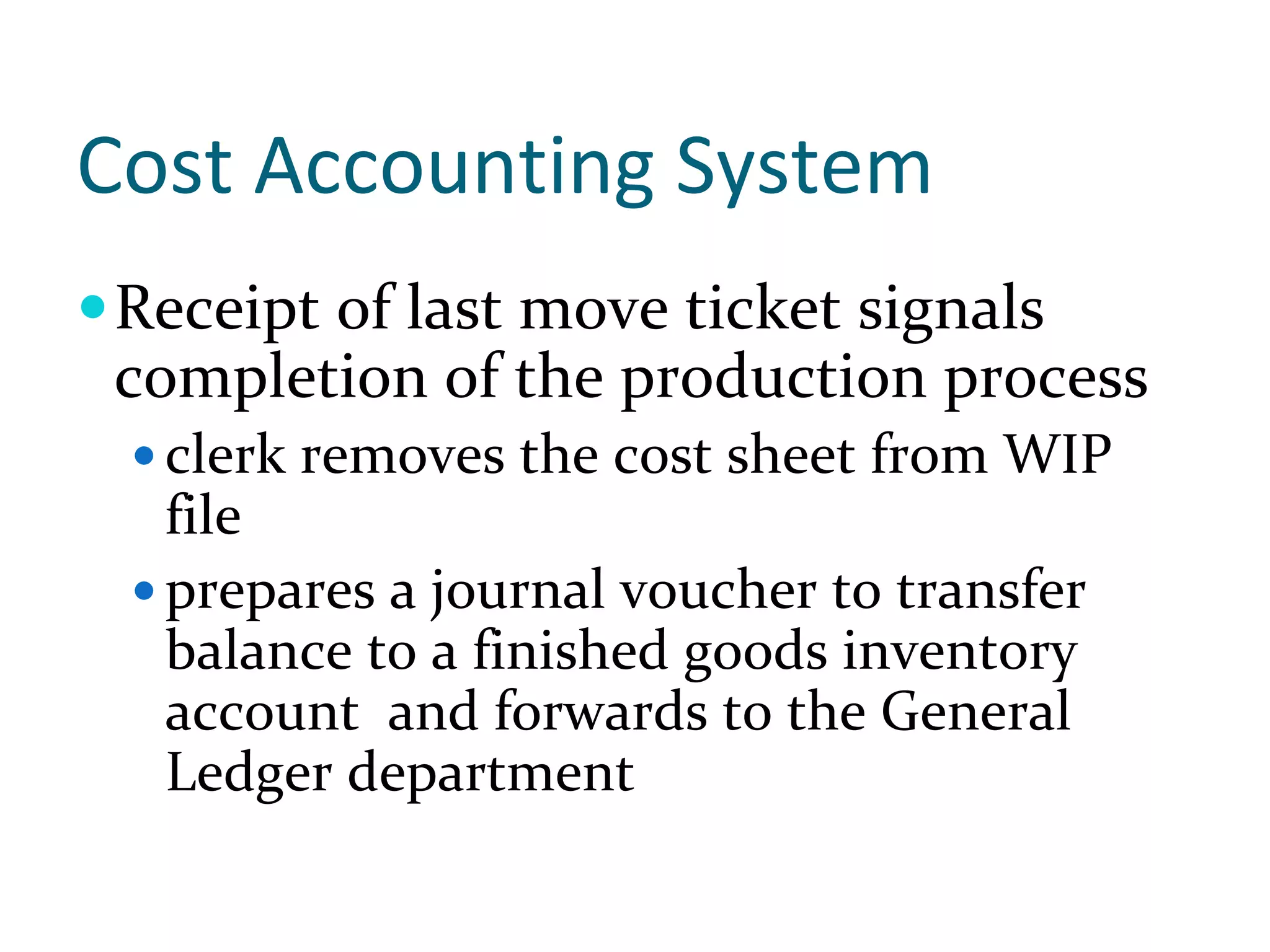
Receipt of last move ticket signals 
completion of the production process
  clerk removes the cost sheet from WIP 
  file
  prepares a journal voucher to transfer 
  balance to a finished goods inventory 
  account  and forwards to the General 
  Ledger department
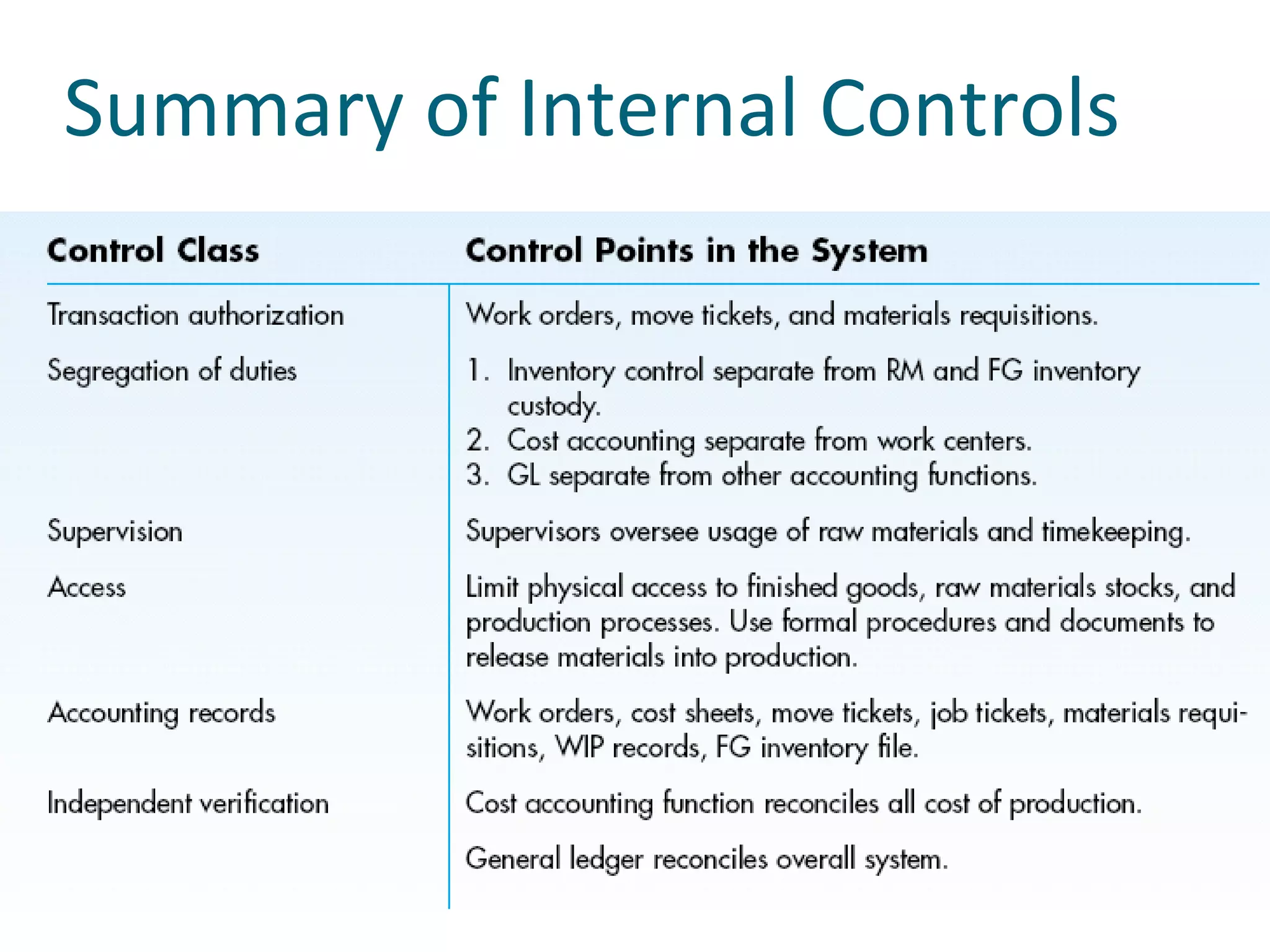
Summary of Internal Controls
Internal Controls
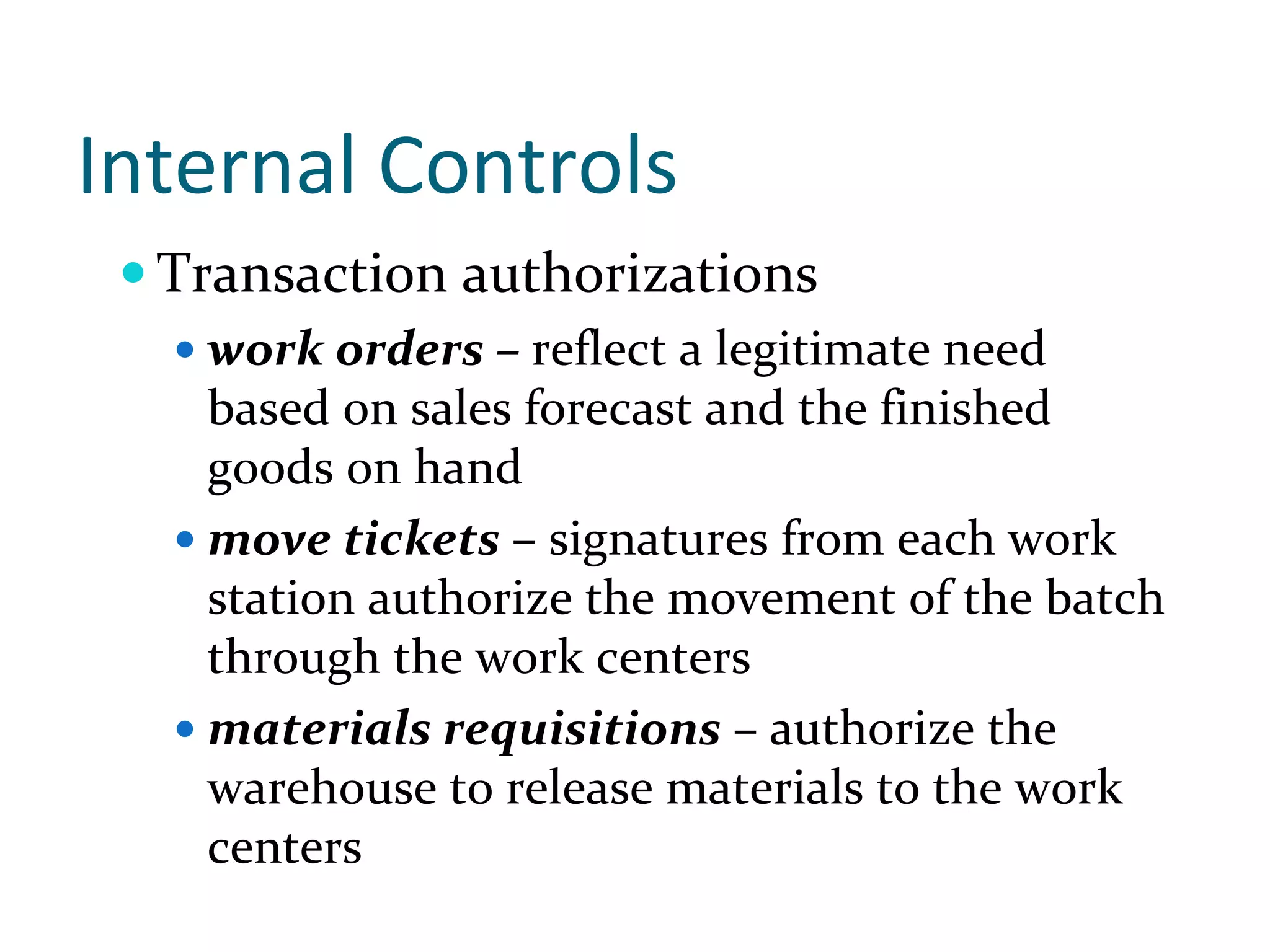
  Transaction authorizations
   work orders – reflect a legitimate need 
   based on sales forecast and the finished 
   goods on hand
   move tickets – signatures from each work 
   station authorize the movement of the batch 
   through the work centers
   materials requisitions – authorize the 
   warehouse to release materials to the work 
   centers
Internal Controls 
  Segregation of duties
    production planning and control 
    department is separate from the work 
    centers
    inventory control is separate from materials 
    storeroom and finished goods warehouse
    cost accounting function accounts for WIP 
    and should be separate from the work 
    centers in the production process
Internal Controls 
  Supervision
   work center supervisors oversee the usage of 
   raw materials to ensure that all released 
   materials are used in production and waste 
   is minimized
   employee time cards and job tickets are 
   checked for accuracy
Internal Controls
 Access control
   direct access to assets
    controlled access to storerooms, production 
    work centers, and finished goods warehouses 
    quantities in excess of standard amounts 
    require approval
   indirect access to assets
    controlled use of materials requisitions, excess 
    materials requisitions, and employee time 
    cards
Internal Controls
   Accounting records 
    pre‐numbered documents
    work orders
    cost sheets 
    move tickets
    job tickets
    material requisitions
    WIP and finished goods files
Internal Controls
Independent verification
  cost accounting reconciles material usage (material 
  requisitions) and labor usage (job tickets) with 
  standards 
    variances are investigated
  GL dept. verifies movement from WIP to FG by 
  reconciling journal vouchers from cost accounting and 
  inventory subsidiary ledgers from inventory control 
  internal and external auditors periodically verify the 
  raw materials and FGs inventories through a physical 
  count
World‐Class Companies…
continuously pursue improvements in all 
aspects of their operations, including 
manufacturing procedures
are highly customer oriented
have undergone fundamental changes from 
the traditional production model
often adopt a lean manufacturing model
Principles of Lean Manufacturing
 Pull Processing – products are pulled from the 
 consumer end (demand), not pushed from the 
 production end (supply)
 Perfect Quality –pull processing requires zero defects 
 in raw material, WIP, and FG inventories
 Waste Minimization – activities that do not add value 
 or maximize the use of scarce resources are 
 eliminated
 Inventory Reduction – hallmark of lean manufacturing
   Inventories cost money
   Inventories can mask production problems
   Inventories can precipitate overproduction
Principles of Lean Manufacturing
 Production Flexibility – reduce setup time to a 
 minimum, allowing for a greater diversity of products, 
 without sacrificing efficiency
 Established Supplier Relations – late deliveries, 
 defective raw materials, or incorrect orders will shut 
 down production since there are  no inventory 
 reserves
 Team Attitude – each employee must be vigilant of 
 problems that threaten the continuous flow of the 
 production line
Lean Manufacturing Model
 Achieve production flexibility by means of:
   Changes in the physical organization of 
   production facilities
   Employment of automated technologies
     CIM, AS/RS, robotics, CAD, and CAM
   Use of alternative accounting models 
    ABC and value stream accounting
   Use of advanced information systems
    MRP, MRPII, ERP, and EDI
Physical Reorganization of the 
Production Facilities
Inefficiencies in traditional plant layouts increase 
handling costs, conversion time, and excess 
inventories.  
Employees tend to feel ownership over their stations, 
contrary to the team concept.
Reorganization is based on flows through cells which 
shorten the physical distance between activities.
  This reduces setup and processing time, handling costs, 
  and inventories.
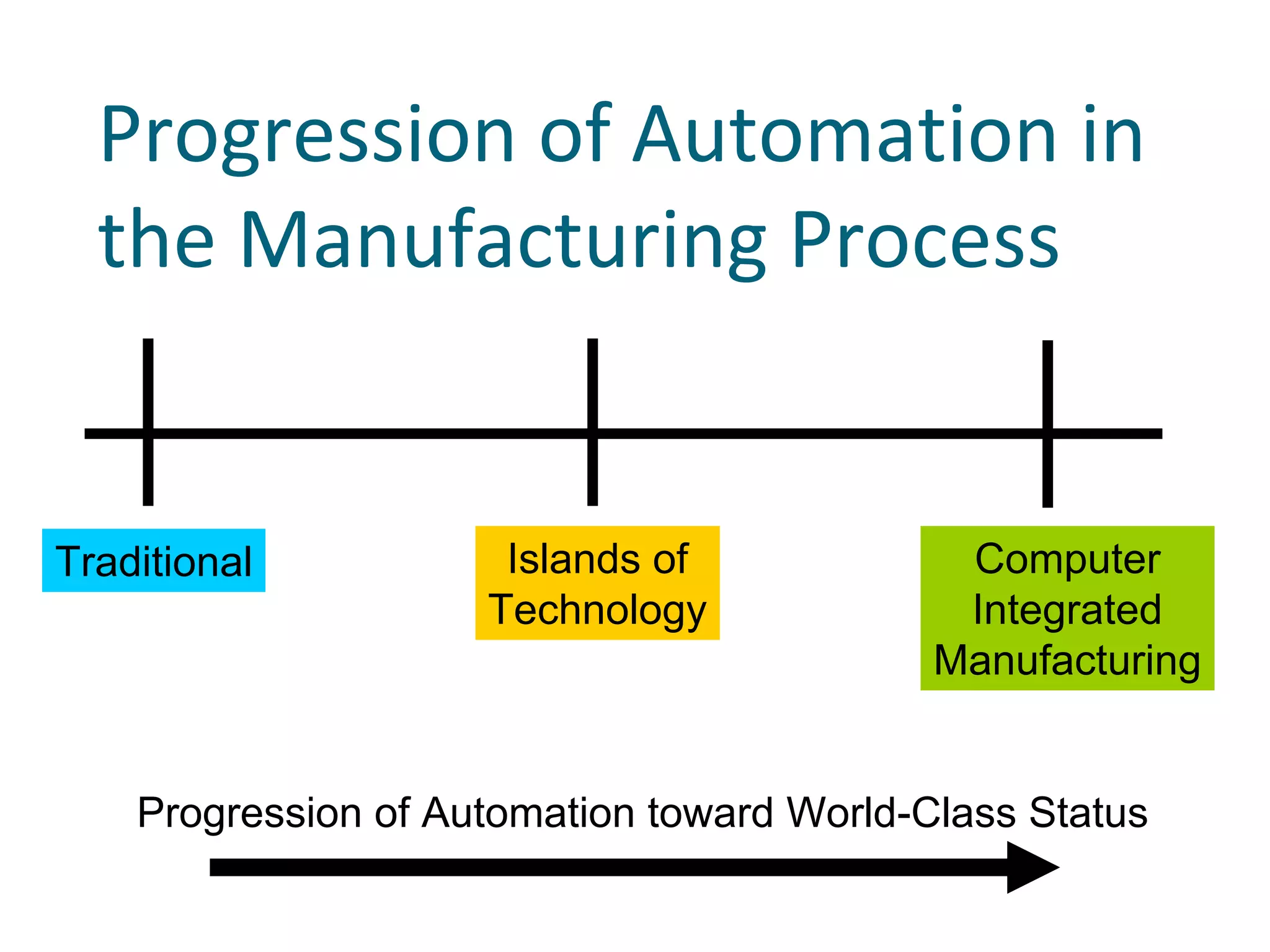
Progression of Automation in 
  the Manufacturing Process


Traditional           Islands of             Computer
                     Technology              Integrated
                                            Manufacturing


    Progression of Automation toward World-Class Status
Automating Manufacturing
 Traditional Approach to Automation
   Consists of many different types of 
   machines which require a lot of setup time
   Machines and operators are organized in 
   functional departments
   WIP follows a circuitous route through the 
   different operations
Automating Manufacturing
Islands of Technology
  Stand alone islands which employ computer numerical 
  controlled (CNC) machines that can perform multiple 
  operations with less human involvement
Computer Numerical Controlled (CNC ) Machines
  Reduce the complexity of the physical layout
  Arranged in groups and  in cells to produce an entire part 
  from start to finish
  Need less set‐up time
Automating Manufacturing
 Computer Integrated Manufacturing (CIM)
   A completely automated environment which 
   employs automated storage and retrieval systems 
   (AS/RS) and robotics
 Automated Storage and Retrieval Systems 
 (AS/RS)
   Replaces traditional forklifts and their human 
   operators with computer‐controlled conveyor 
   systems 
   Reduce errors, improved inventory control, and 
   lower storage costs
Computer‐Integrated 
Manufacturing (CIM) System
Automating Manufacturing
Robotics
  Use special CNC machines that are useful in 
  performing hazardous, difficult, and monotonous 
  tasks
Computer‐Aided Design (CAD)
  Increases engineers’ productivity
  Improves accuracy
  Allows firms to be more responsive to market 
  demands
  Interfaces with CAM and MRPII systems
Automating Manufacturing
 Computer Aided Manufacturing 
 (CAM)
  Uses computers to control the physical 
  manufacturing process
  Provides greater precision, speed, and 
  control than human production processes
Achieving World‐Class Status
 The world‐class firm needs new accounting 
 methods and new information systems that:
   show what matters to its customers
   identify profitable products
   identify profitable customers
   identify opportunities for improving operations and 
   products
   encourage the adoption of value‐added activities and 
   processes and identify those that do not add value
   efficiently support multiple users with both financial 
   and nonfinancial information
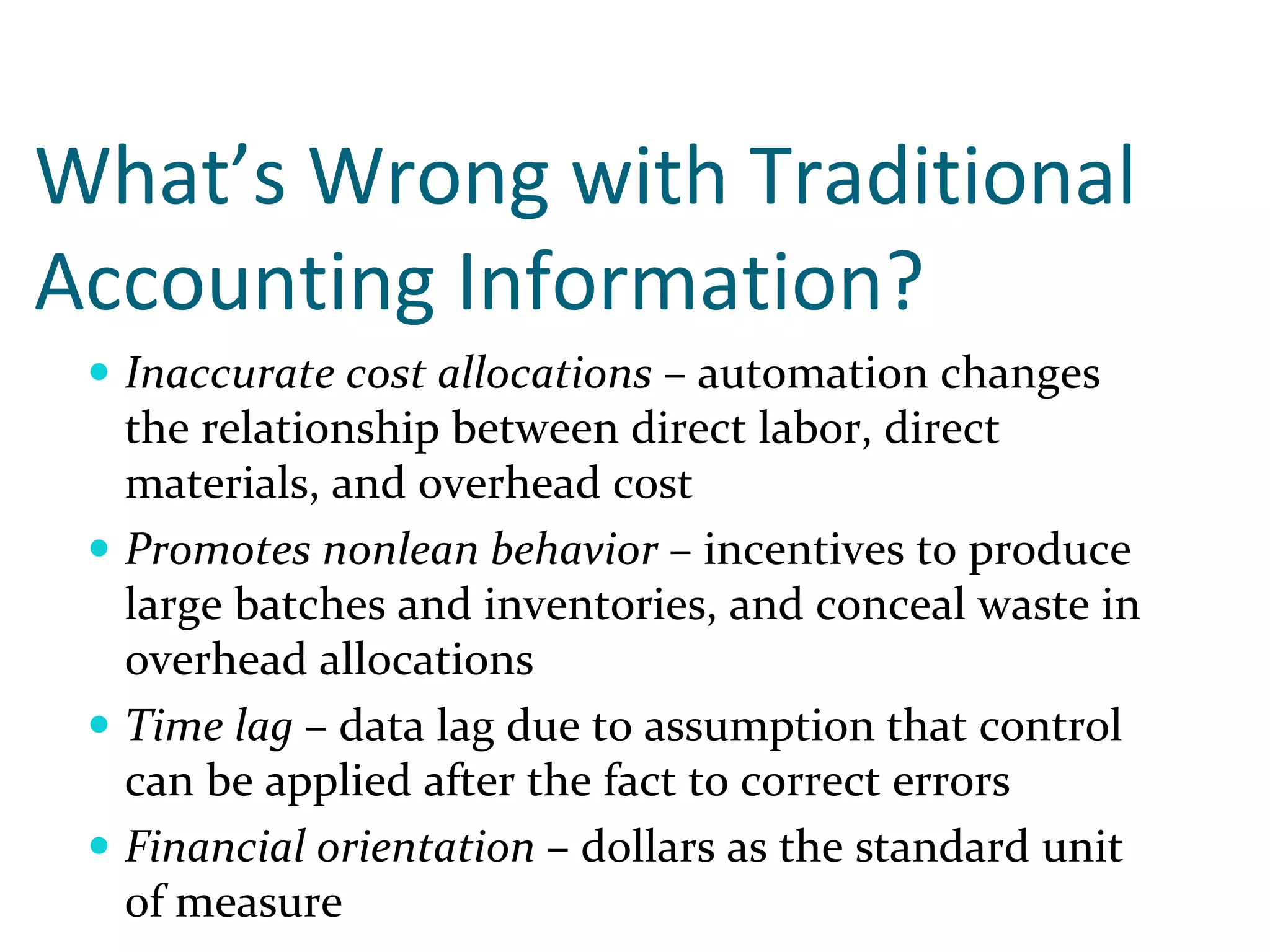
What’s Wrong with Traditional 
Accounting Information?
  Inaccurate cost allocations – automation changes 
  the relationship between direct labor, direct 
  materials, and overhead cost
  Promotes nonlean behavior – incentives to produce 
  large batches and inventories, and conceal waste in 
  overhead allocations
  Time lag – data lag due to assumption that control 
  can be applied after the fact to correct errors
  Financial orientation – dollars as the standard unit 
  of measure
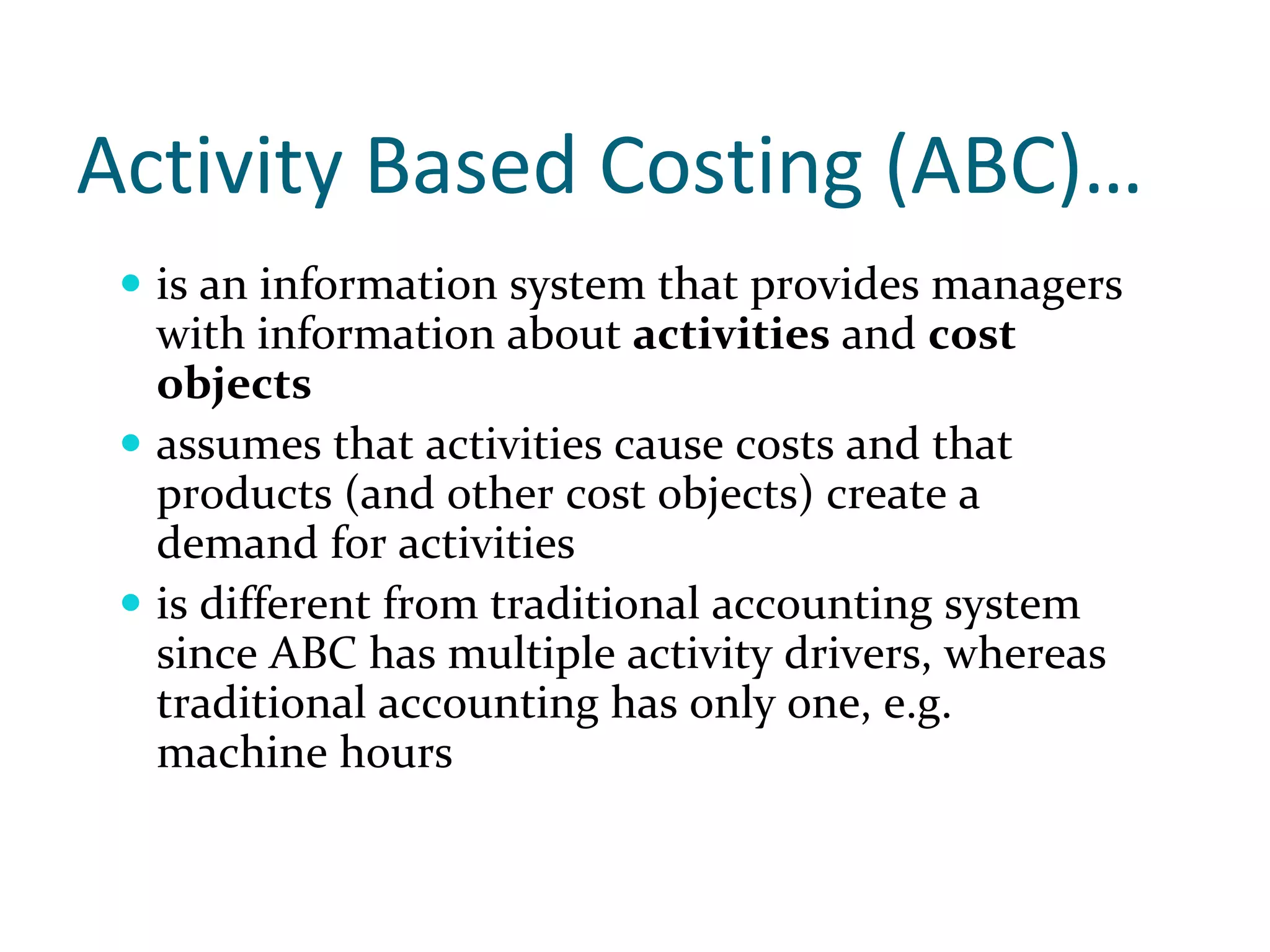
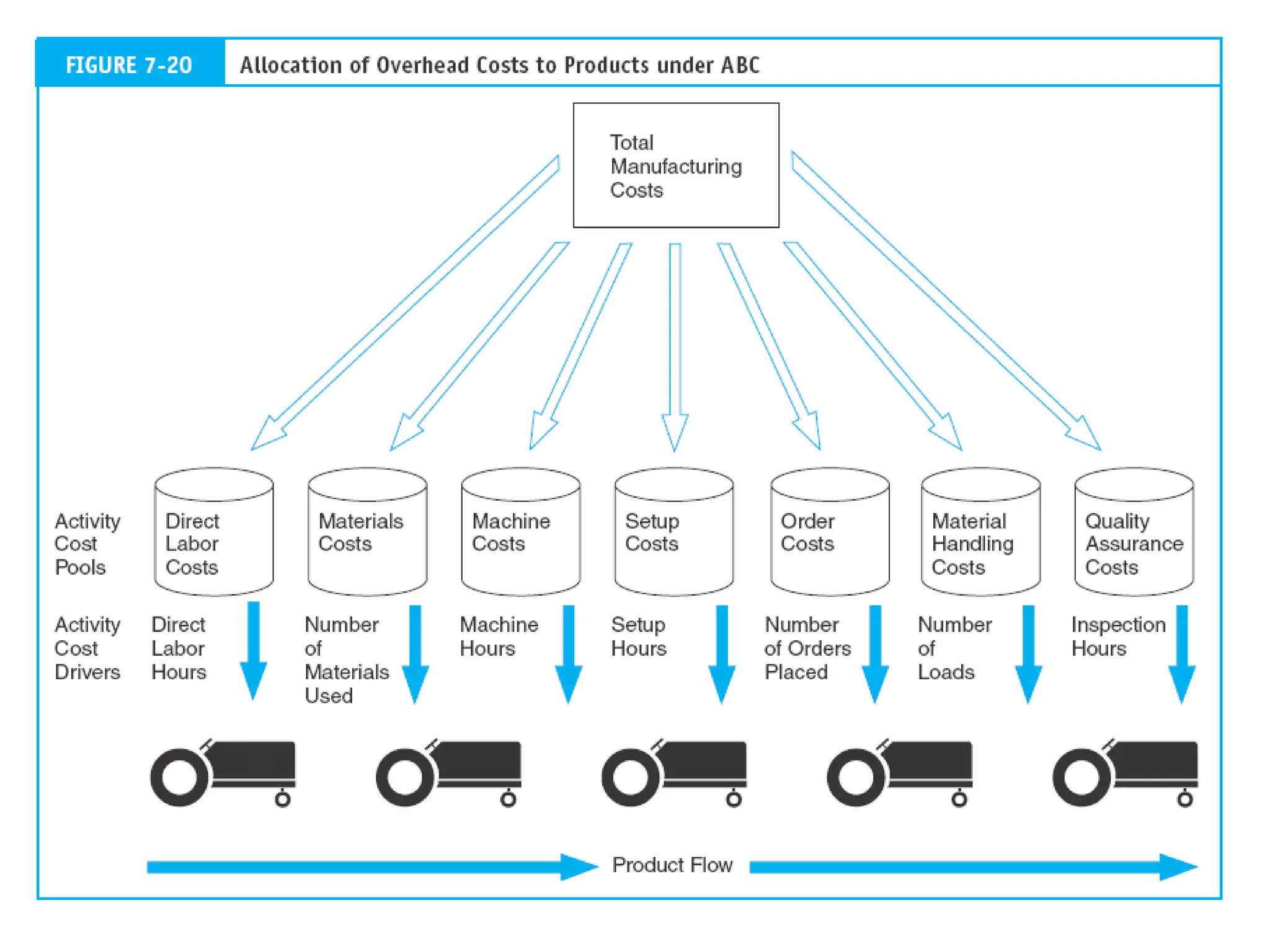
Activity Based Costing (ABC)…
  is an information system that provides managers 
  with information about activities and cost 
  objects
  assumes that activities cause costs and that 
  products (and other cost objects) create a 
  demand for activities
  is different from traditional accounting system 
  since ABC has multiple activity drivers, whereas 
  traditional accounting has only one, e.g. 
  machine hours
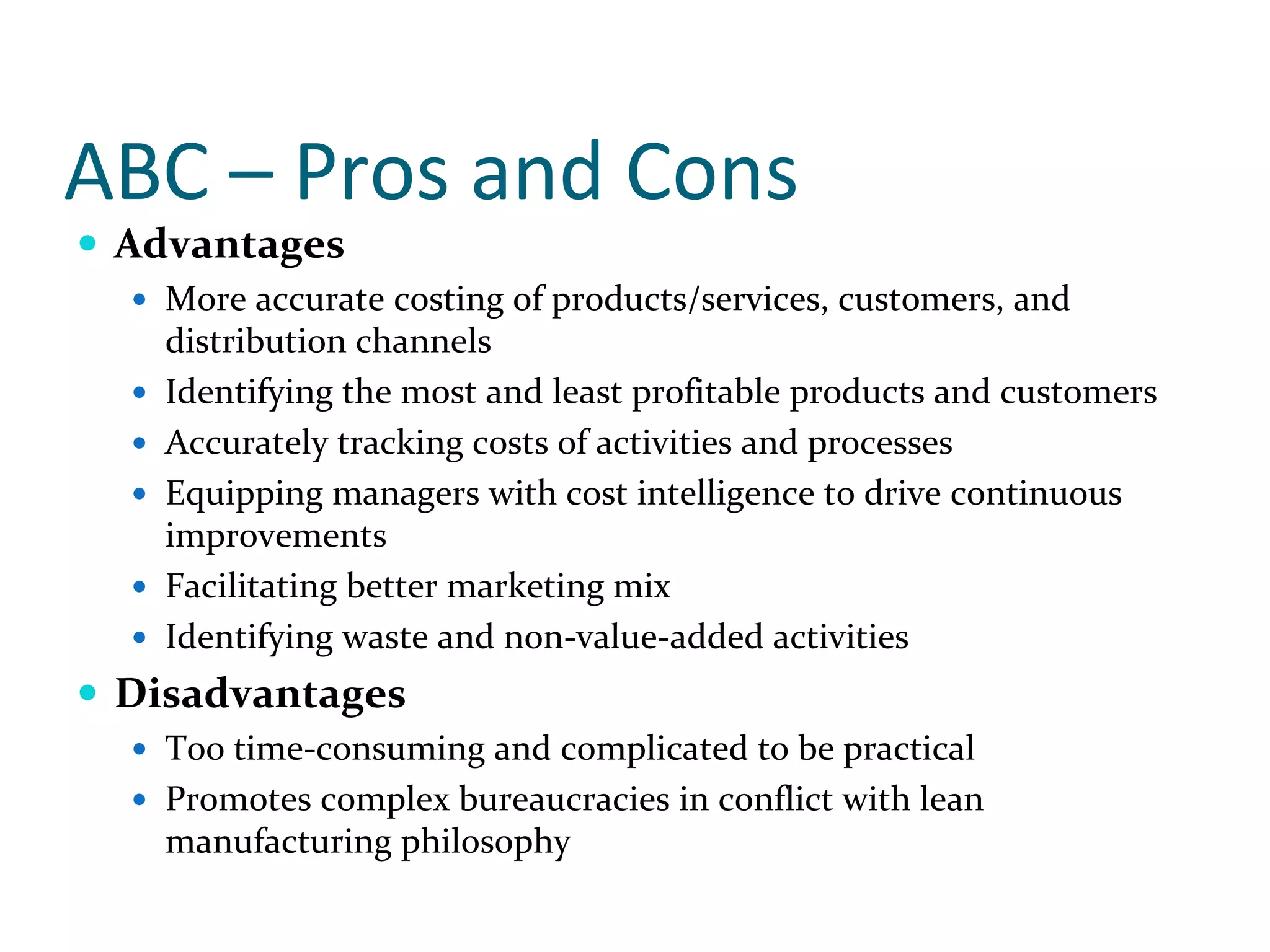
ABC – Pros and Cons
 Advantages
   More accurate costing of products/services, customers, and 
   distribution channels
   Identifying the most and least profitable products and customers
   Accurately tracking costs of activities and processes
   Equipping managers with cost intelligence to drive continuous 
   improvements
   Facilitating better marketing mix
   Identifying waste and non‐value‐added activities
 Disadvantages
   Too time‐consuming and complicated to be practical
   Promotes complex bureaucracies in conflict with lean 
   manufacturing philosophy
Value Stream Accounting
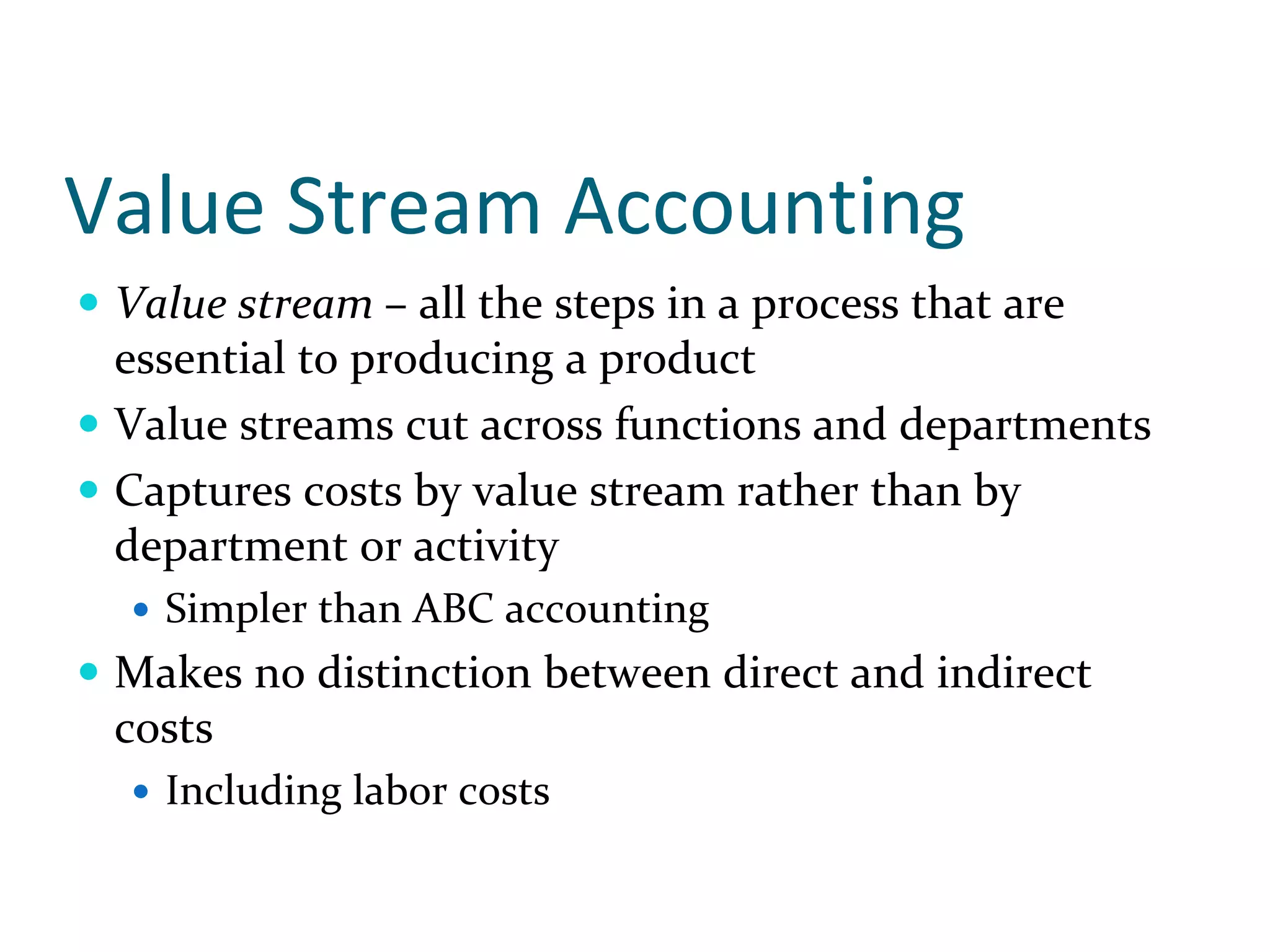
 Value stream – all the steps in a process that are 
 essential to producing a product
 Value streams cut across functions and departments
 Captures costs by value stream rather than by 
 department or activity
   Simpler than ABC accounting
 Makes no distinction between direct and indirect 
 costs
   Including labor costs
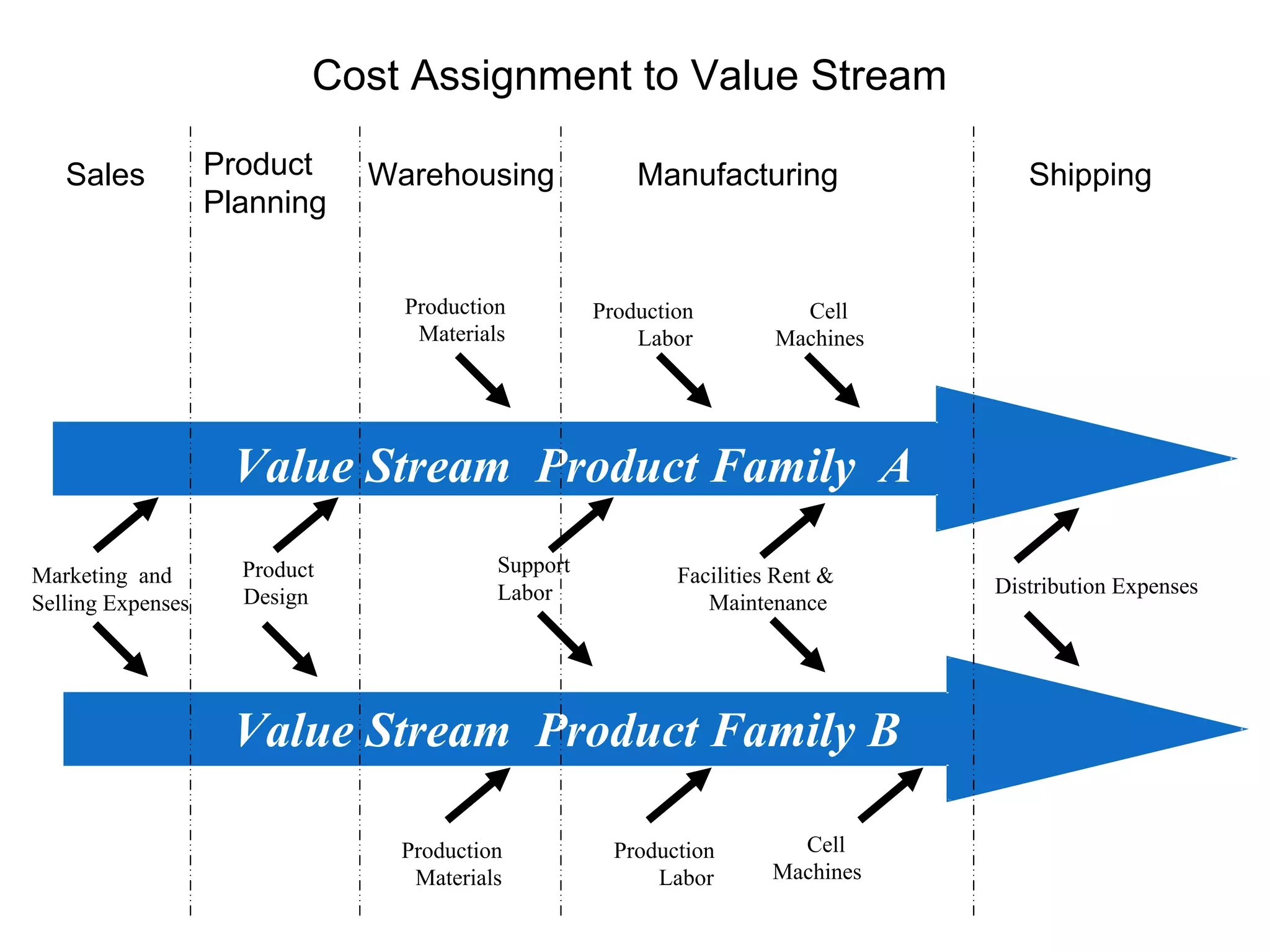
Cost Assignment to Value Stream

   Sales           Product     Warehousing              Manufacturing               Shipping
                   Planning


                                 Production         Production          Cell
                                  Materials             Labor         Machines


                    Value Stream Product Family A

Marketing and        Product              Support           Facilities Rent &
                     Design               Labor                                  Distribution Expenses
Selling Expenses                                               Maintenance


                    Value Stream Product Family B

                                Production            Production        Cell
                                 Materials                Labor       Machines
Information Systems that Support 
Lean Manufacturing
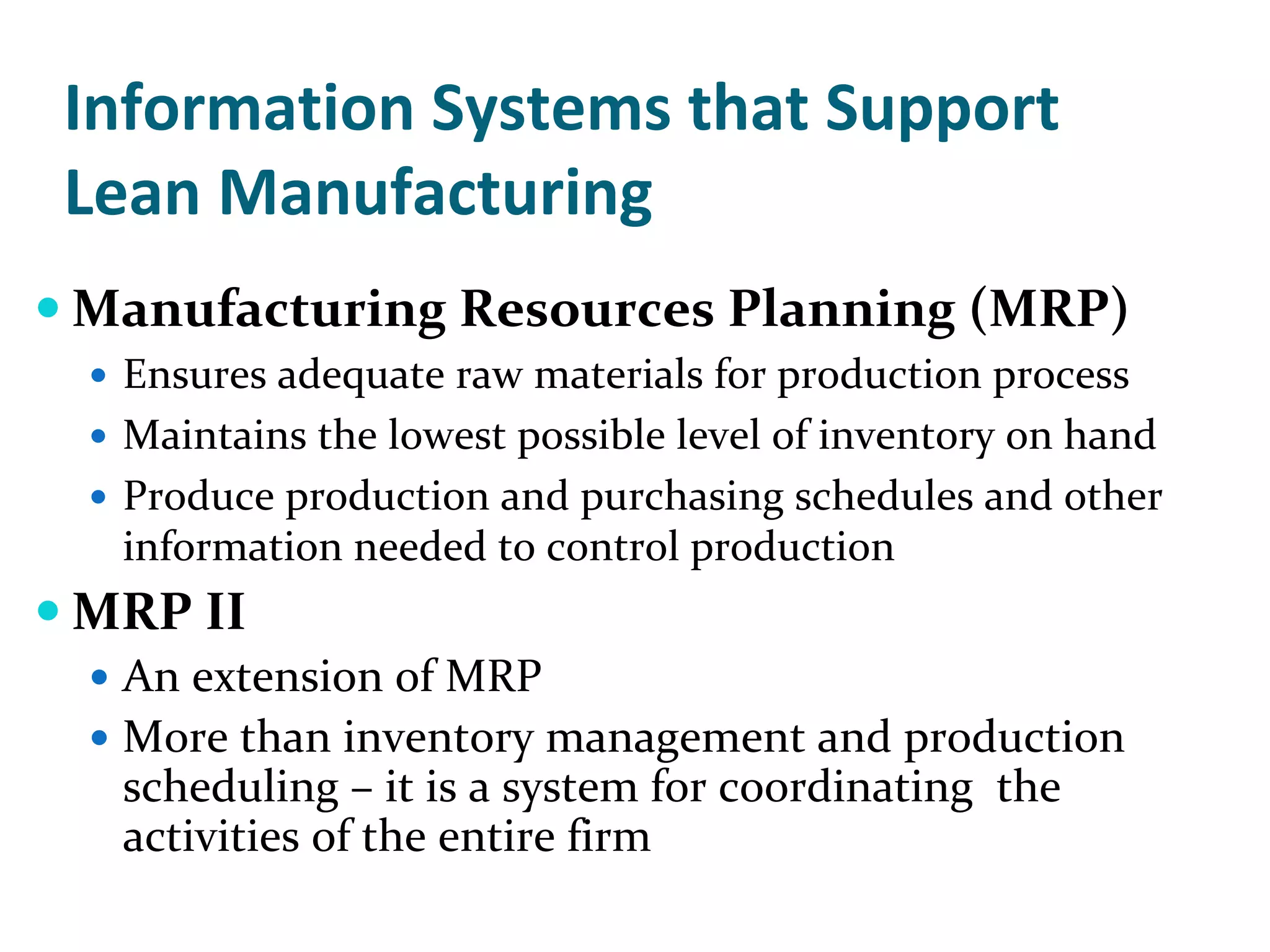
Manufacturing Resources Planning (MRP)
 Ensures adequate raw materials for production process
 Maintains the lowest possible level of inventory on hand
 Produce production and purchasing schedules and other 
 information needed to control production
MRP II
 An extension of MRP
 More than inventory management and production 
 scheduling – it is a system for coordinating  the 
 activities of the entire firm
Information Systems that 
Support Lean Manufacturing
 Enterprise Resource Planning (ERP) Systems
   Huge commercial software packages that support the 
   information needs of the entire organization, not just 
   the manufacturing functions
   Automates all business functions along with full 
   financial and managerial reporting capability
 Electronic Data Interchange (EDI)
   External communications with its customers and 
   suppliers via Internet or direct connection

Plugin ch07