Submitted to : Sir Aamir
Submitted by : M.Arsalan Qureshi
Roll No :
Cost Accumulation
 The use of an accounting system to collect
and maintain a database of the expenses
incurred by a business in the course of its
operation.
The two main forms of cost accumulation are:
 A job Order System
 A Process Costing System
 In process costing, materials, labor, and factory
overhead costs are accumulated in the usual accounts,
using normal cost accounting procedures. Costs are
then analyzed by departments or processes and
charged to departments by appropriate journal
entries. The details involved in process costing are
usually fewer than those in the job order costing,
where accumulation of costs for many orders can
become unwieldy.
 Materials, Labor, and Factory Overhead Costs
Accumulations
Procedures for Manufacture Cost Accumulation
 The procedure for cost accumulation in job order
costing.
 Materials costs: In job order costing, materials
requisitions are used and changes are made to order.
 Labor costs: Time tickets sheet are used in job order
costing to accumulate costs by jobs.
 Factory overhead: Job cost requires the use of
predetermined rates for charging overhead to orders.
 Summarizing costs: Job order costs sheet is used to
accumulate the cost of an order in job order costing.
Procedures for Manufacture Cost Accumulation
 A job order system where direct materials ,
staffing and over heads are collected under
assigned job number.
 Job costing involves the calculation of cost
involved in construction “job”or the
manufacturing of goods done in discrete
batches .These costs are recorded in ledger
accounts throughout the life of the job or batch
and are then summarized in the final trial
balance before the preparing of the job cost or
batch manufacturing statement.
Job Order System
Job order costing
Useful for
 Managing the costs of current jobs
 Determining inventory costs
 Providing data to predict future costs
 Identifying likely profitable or unprofitable jobs
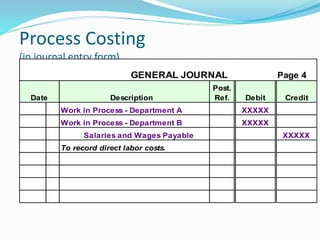
Process Costing
(in journal entry form)
GENERAL JOURNAL Page 4
Date Description
Post.
Ref. Debit Credit
Work in Process - Department A XXXXX
Work in Process - Department B XXXXX
Salaries and Wages Payable XXXXX
To record direct labor costs.
 Process costing is an accounting methodology that
traces and accumulates direct costs, and
allocates indirect costs of a manufacturing process.
Costs are assigned to products, usually in a large batch,
which might include an entire month's production.
Eventually, costs have to be allocated to individual
units of product.
 It assigns average costs to each unit, and is the
opposite extreme of Job costing which attempts to
measure individual costs of production of each unit.
Process Costing
8-10
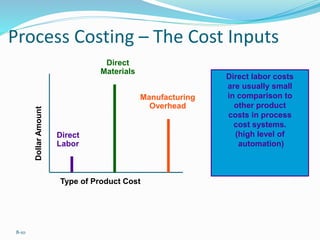
Direct
Materials
Type of Product Cost
DollarAmount
Direct
Labor
Manufacturing
Overhead
Direct labor costs
are usually small
in comparison to
other product
costs in process
cost systems.
(high level of
automation)
Process Costing – The Cost Inputs
8-11
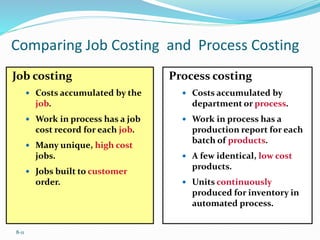
Job costing
 Costs accumulated by the
job.
 Work in process has a job
cost record for each job.
 Many unique, high cost
jobs.
 Jobs built to customer
order.
Process costing
 Costs accumulated by
department or process.
 Work in process has a
production report for each
batch of products.
 A few identical, low cost
products.
 Units continuously
produced for inventory in
automated process.
Comparing Job Costing and Process Costing
8-12
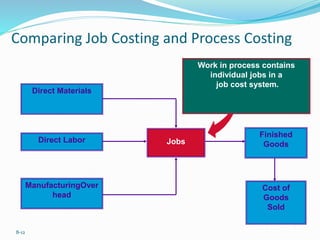
Work in process contains
individual jobs in a
job cost system.
Direct Materials
Finished
Goods
Cost of
Goods
Sold
Direct Labor
ManufacturingOver
head
Jobs
Comparing Job Costing and Process Costing
8-13
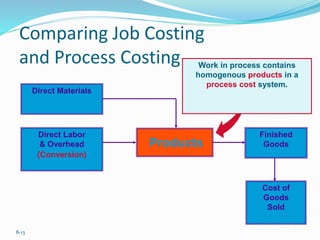
Finished
Goods
Cost of
Goods
Sold
Products
Work in process contains
homogenous products in a
process cost system.
Direct Labor
& Overhead
(Conversion)
Direct Materials
Comparing Job Costing
and Process Costing
8-14
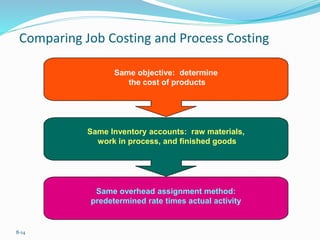
Same objective: determine
the cost of products
Same Inventory accounts: raw materials,
work in process, and finished goods
Same overhead assignment method:
predetermined rate times actual activity
Same objective: determine
the cost of products
Same Inventory accounts: raw materials,
work in process, and finished goods
Same overhead assignment method:
predetermined rate times actual activity
Comparing Job Costing and Process Costing
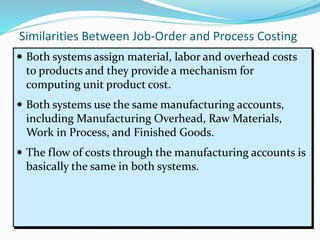
Similarities Between Job-Order and Process Costing
 Both systems assign material, labor and overhead costs
to products and they provide a mechanism for
computing unit product cost.
 Both systems use the same manufacturing accounts,
including Manufacturing Overhead, Raw Materials,
Work in Process, and Finished Goods.
 The flow of costs through the manufacturing accounts is
basically the same in both systems.
Case Study Organization
Procter & Gamble
Vision
Mission
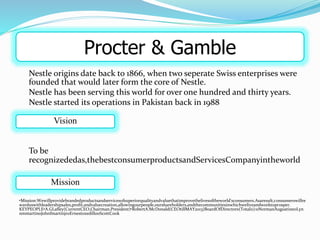
Nestle origins date back to 1866, when two seperate Swiss enterprises were
founded that would later form the core of Nestle.
Nestle has been serving this world for over one hundred and thirty years.
Nestle started its operations in Pakistan back in 1988
To be
recognizededas,thebestconsumerproductsandServicesCompanyintheworld
•Mission:Wewillprovidebrandedproductsandservicesofsuperiorqualityandvaluethatimprovethelivesoftheworld'sconsumers.Asaresult,consumerswillre
warduswithleadershipsales,profit,andvaluecreation,allowingourpeople,ourshareholders,andthecommunitiesinwhichweliveandworktoprosper.
KEYPEOPLE•A.GLafley(CurrentCEO,Chairman,President)•RobertA.McDonald(CEOtillMAY2013)BoardOfDirectors(Total11):oNormanAugustineoLyn
nmmartinoJohnfmartinjroErnestozedillooScottCook
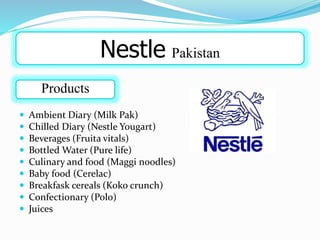
 Ambient Diary (Milk Pak)
 Chilled Diary (Nestle Yougart)
 Beverages (Fruita vitals)
 Bottled Water (Pure life)
 Culinary and food (Maggi noodles)
 Baby food (Cerelac)
 Breakfask cereals (Koko crunch)
 Confectionary (Polo)
 Juices
Nestle Pakistan
Products
Products
Competitors
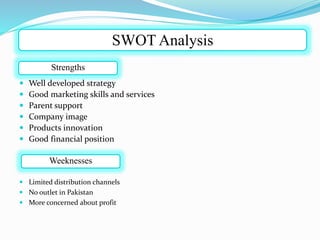
SWOT Analysis
Strengths
 Well developed strategy
 Good marketing skills and services
 Parent support
 Company image
 Products innovation
 Good financial position
Weeknesses
 Limited distribution channels
 No outlet in Pakistan
 More concerned about profit
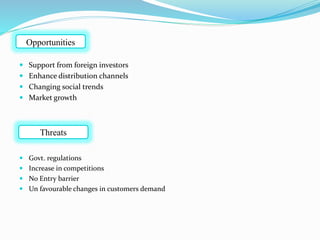
 Support from foreign investors
 Enhance distribution channels
 Changing social trends
 Market growth
Opportunities
Threats
 Govt. regulations
 Increase in competitions
 No Entry barrier
 Un favourable changes in customers demand
By analyzing the cash flow chart , for three years of
Nestle Pakistan , we come to conclusion that although
the organization is improving in terms of increase in
sales , but there are also some grey areas which need
to be tackaled by method and proper strategy to boost
up the sales
Analysis
 Overall profit margin showed a slight increase but a slight decline in
gross profit margin was witnessed, this was mainly due to cost pressure
on some products.
 Nestle can be made more profitable by making it more proactive
 It is recommended that they should icrease their outlets in Pakistan
Suggestions & Recommendations
Complete Cost Accumulation Procedures in Manufacturing Organizations

Complete Cost Accumulation Procedures in Manufacturing Organizations

  • 2.
    Submitted to :Sir Aamir Submitted by : M.Arsalan Qureshi Roll No :
  • 3.
    Cost Accumulation  Theuse of an accounting system to collect and maintain a database of the expenses incurred by a business in the course of its operation. The two main forms of cost accumulation are:  A job Order System  A Process Costing System
  • 4.
     In processcosting, materials, labor, and factory overhead costs are accumulated in the usual accounts, using normal cost accounting procedures. Costs are then analyzed by departments or processes and charged to departments by appropriate journal entries. The details involved in process costing are usually fewer than those in the job order costing, where accumulation of costs for many orders can become unwieldy.  Materials, Labor, and Factory Overhead Costs Accumulations Procedures for Manufacture Cost Accumulation
  • 5.
     The procedurefor cost accumulation in job order costing.  Materials costs: In job order costing, materials requisitions are used and changes are made to order.  Labor costs: Time tickets sheet are used in job order costing to accumulate costs by jobs.  Factory overhead: Job cost requires the use of predetermined rates for charging overhead to orders.  Summarizing costs: Job order costs sheet is used to accumulate the cost of an order in job order costing. Procedures for Manufacture Cost Accumulation
  • 6.
     A joborder system where direct materials , staffing and over heads are collected under assigned job number.  Job costing involves the calculation of cost involved in construction “job”or the manufacturing of goods done in discrete batches .These costs are recorded in ledger accounts throughout the life of the job or batch and are then summarized in the final trial balance before the preparing of the job cost or batch manufacturing statement. Job Order System
  • 7.
    Job order costing Usefulfor  Managing the costs of current jobs  Determining inventory costs  Providing data to predict future costs  Identifying likely profitable or unprofitable jobs
  • 8.
    Process Costing (in journalentry form) GENERAL JOURNAL Page 4 Date Description Post. Ref. Debit Credit Work in Process - Department A XXXXX Work in Process - Department B XXXXX Salaries and Wages Payable XXXXX To record direct labor costs.
  • 9.
     Process costingis an accounting methodology that traces and accumulates direct costs, and allocates indirect costs of a manufacturing process. Costs are assigned to products, usually in a large batch, which might include an entire month's production. Eventually, costs have to be allocated to individual units of product.  It assigns average costs to each unit, and is the opposite extreme of Job costing which attempts to measure individual costs of production of each unit. Process Costing
  • 10.
    8-10 Direct Materials Type of ProductCost DollarAmount Direct Labor Manufacturing Overhead Direct labor costs are usually small in comparison to other product costs in process cost systems. (high level of automation) Process Costing – The Cost Inputs
  • 11.
    8-11 Job costing  Costsaccumulated by the job.  Work in process has a job cost record for each job.  Many unique, high cost jobs.  Jobs built to customer order. Process costing  Costs accumulated by department or process.  Work in process has a production report for each batch of products.  A few identical, low cost products.  Units continuously produced for inventory in automated process. Comparing Job Costing and Process Costing
  • 12.
    8-12 Work in processcontains individual jobs in a job cost system. Direct Materials Finished Goods Cost of Goods Sold Direct Labor ManufacturingOver head Jobs Comparing Job Costing and Process Costing
  • 13.
    8-13 Finished Goods Cost of Goods Sold Products Work inprocess contains homogenous products in a process cost system. Direct Labor & Overhead (Conversion) Direct Materials Comparing Job Costing and Process Costing
  • 14.
    8-14 Same objective: determine thecost of products Same Inventory accounts: raw materials, work in process, and finished goods Same overhead assignment method: predetermined rate times actual activity Same objective: determine the cost of products Same Inventory accounts: raw materials, work in process, and finished goods Same overhead assignment method: predetermined rate times actual activity Comparing Job Costing and Process Costing
  • 15.
    Similarities Between Job-Orderand Process Costing  Both systems assign material, labor and overhead costs to products and they provide a mechanism for computing unit product cost.  Both systems use the same manufacturing accounts, including Manufacturing Overhead, Raw Materials, Work in Process, and Finished Goods.  The flow of costs through the manufacturing accounts is basically the same in both systems.
  • 16.
  • 17.
    Procter & Gamble Vision Mission Nestleorigins date back to 1866, when two seperate Swiss enterprises were founded that would later form the core of Nestle. Nestle has been serving this world for over one hundred and thirty years. Nestle started its operations in Pakistan back in 1988 To be recognizededas,thebestconsumerproductsandServicesCompanyintheworld •Mission:Wewillprovidebrandedproductsandservicesofsuperiorqualityandvaluethatimprovethelivesoftheworld'sconsumers.Asaresult,consumerswillre warduswithleadershipsales,profit,andvaluecreation,allowingourpeople,ourshareholders,andthecommunitiesinwhichweliveandworktoprosper. KEYPEOPLE•A.GLafley(CurrentCEO,Chairman,President)•RobertA.McDonald(CEOtillMAY2013)BoardOfDirectors(Total11):oNormanAugustineoLyn nmmartinoJohnfmartinjroErnestozedillooScottCook
  • 18.
     Ambient Diary(Milk Pak)  Chilled Diary (Nestle Yougart)  Beverages (Fruita vitals)  Bottled Water (Pure life)  Culinary and food (Maggi noodles)  Baby food (Cerelac)  Breakfask cereals (Koko crunch)  Confectionary (Polo)  Juices Nestle Pakistan Products
  • 19.
  • 20.
  • 21.
    SWOT Analysis Strengths  Welldeveloped strategy  Good marketing skills and services  Parent support  Company image  Products innovation  Good financial position Weeknesses  Limited distribution channels  No outlet in Pakistan  More concerned about profit
  • 22.
     Support fromforeign investors  Enhance distribution channels  Changing social trends  Market growth Opportunities Threats  Govt. regulations  Increase in competitions  No Entry barrier  Un favourable changes in customers demand
  • 23.
    By analyzing thecash flow chart , for three years of Nestle Pakistan , we come to conclusion that although the organization is improving in terms of increase in sales , but there are also some grey areas which need to be tackaled by method and proper strategy to boost up the sales Analysis
  • 24.
     Overall profitmargin showed a slight increase but a slight decline in gross profit margin was witnessed, this was mainly due to cost pressure on some products.  Nestle can be made more profitable by making it more proactive  It is recommended that they should icrease their outlets in Pakistan Suggestions & Recommendations