Inventory Models
Ankit Rai
INVENTORY MODEL
 Inventory model is a mathematical model that helps business
in determining the optimum level of inventories that should
be maintained in a production process, managing frequency
of ordering, deciding on quantity of goods or raw materials to
be stored, tracking flow of supply of raw materials and goods
to provide uninterrupted service to customers without any
delay in delivery.
Ankit Rai
There are two types of Inventory model widely used in
business.
 Fixed Reorder Quantity System
 Fixed Reorder Period System.
Ankit Rai
Fixed Recorder Quantity System
 Fixed Reorder Quantity System is an Inventory Model,
where an alarm is raised immediately when the
inventory level drops below a fixed quantity and new
orders are raised to replenish the inventory to an
optimum level based on the demand.
 The point at which the inventory is ordered for
replenishment is termed as Reorder Point.
 The inventory quantity at Reorder Point is termed
as Reorder Level and the quantity of new inventory
ordered is referred as Order Quantity.
Ankit Rai
 Average Demand (DAv): It is the average number of
order requests made per day.
 Average Lead Time (TL): The time required to
manufacture goods or product.
 Average Lead Time Demand (DL): Average number of
orders requested during the Lead Time.
Average Lead Time Demand (DL)
= Average Demand (DAv) x Average Lead Time (TL)
Ankit Rai
Safety Stock (S): It is the extra stock that is always maintained
to mitigate any future risks arising due to stock-outs because of
shortfall of raw materials or supply, breakdown in machine or
plant, accidents, natural calamity or disaster, labour strike or
any other crisis that may stall the production process.
The quantity of safety stock is often derived by analysing
historical data and is set to an optimized level by evaluating
carefully the current cost of inventory and losses that may be
incurred due to future risk.
Ankit Rai
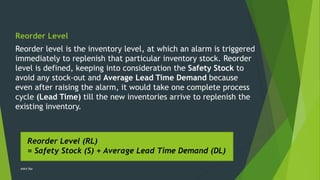
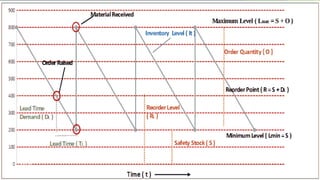
Reorder Level
Reorder level is the inventory level, at which an alarm is triggered
immediately to replenish that particular inventory stock. Reorder
level is defined, keeping into consideration the Safety Stock to
avoid any stock-out and Average Lead Time Demand because
even after raising the alarm, it would take one complete process
cycle (Lead Time) till the new inventories arrive to replenish the
existing inventory.
Reorder Level (RL)
= Safety Stock (S) + Average Lead Time Demand (DL)
Ankit Rai
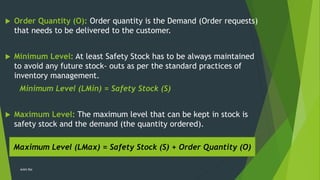
Maximum Level (LMax) = Safety Stock (S) + Order Quantity (O)
 Order Quantity (O): Order quantity is the Demand (Order requests)
that needs to be delivered to the customer.
 Minimum Level: At least Safety Stock has to be always maintained
to avoid any future stock- outs as per the standard practices of
inventory management.
Minimum Level (LMin) = Safety Stock (S)
 Maximum Level: The maximum level that can be kept in stock is
safety stock and the demand (the quantity ordered).
Ankit Rai
Ankit Rai
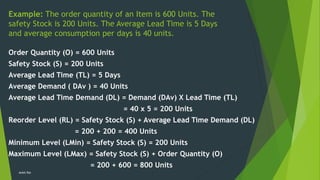
Example: The order quantity of an Item is 600 Units. The
safety Stock is 200 Units. The Average Lead Time is 5 Days
and average consumption per days is 40 units.
Order Quantity (O) = 600 Units
Safety Stock (S) = 200 Units
Average Lead Time (TL) = 5 Days
Average Demand ( DAv ) = 40 Units
Average Lead Time Demand (DL) = Demand (DAv) X Lead Time (TL)
= 40 x 5 = 200 Units
Reorder Level (RL) = Safety Stock (S) + Average Lead Time Demand (DL)
= 200 + 200 = 400 Units
Minimum Level (LMin) = Safety Stock (S) = 200 Units
Maximum Level (LMax) = Safety Stock (S) + Order Quantity (O)
= 200 + 600 = 800 Units
Ankit Rai
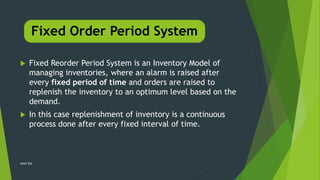
Fixed Order Period System
 Fixed Reorder Period System is an Inventory Model of
managing inventories, where an alarm is raised after
every fixed period of time and orders are raised to
replenish the inventory to an optimum level based on the
demand.
 In this case replenishment of inventory is a continuous
process done after every fixed interval of time.
Ankit Rai
 Regular Intervals (R): Regular Interval is the fixed time
interval at the end of which the inventories would be
reviewed and orders would be raised to replenish the
inventory
 Inventory on Hand (It): Inventory on hand is the Inventory
level measured at any given point of time.
 Maximum Level (M): It is the maximum level of inventory
allowed as per the production guidelines. The maximum
level is derived by analysing historical data.
Ankit Rai
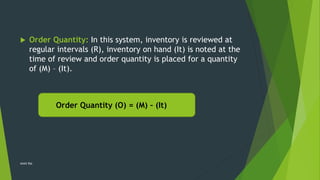
 Order Quantity: In this system, inventory is reviewed at
regular intervals (R), inventory on hand (It) is noted at the
time of review and order quantity is placed for a quantity
of (M) – (It).
Order Quantity (O) = (M) – (It)
Ankit Rai
Ankit Rai
Example: Inventory is replenished at every regular interval of 5
days. The maximum allowable inventory is 800 Units. The
inventory reviewed on Day-5, Day-10, Day -15 and Day -20 were
387 Units, 201 Units, 498 Units and 127 Units respectively.
 Regular Intervals (R) = 5 Days
 Maximum Level (M) = 800 Units
 Inventory on Hand: I5 = 387 Units, I10 = 201 Units, I15 = 498
Units and I20 = 127 Units
 Order Quantity (O) = (M) – (It).
 Order Quantity (O5) = 800 – 387 = 413 Units
 Order Quantity (O10) = 800 – 201 = 599 Units
 Order Quantity (O15) = 800 – 498 = 302 Units
 Order Quantity (O20) = 800 – 127 = 673 Units
Ankit Rai
Source & Credit : http://www.whatissixsigma.net

Inventory models

  • 1.
  • 2.
    INVENTORY MODEL  Inventorymodel is a mathematical model that helps business in determining the optimum level of inventories that should be maintained in a production process, managing frequency of ordering, deciding on quantity of goods or raw materials to be stored, tracking flow of supply of raw materials and goods to provide uninterrupted service to customers without any delay in delivery. Ankit Rai
  • 3.
    There are twotypes of Inventory model widely used in business.  Fixed Reorder Quantity System  Fixed Reorder Period System. Ankit Rai
  • 4.
    Fixed Recorder QuantitySystem  Fixed Reorder Quantity System is an Inventory Model, where an alarm is raised immediately when the inventory level drops below a fixed quantity and new orders are raised to replenish the inventory to an optimum level based on the demand.  The point at which the inventory is ordered for replenishment is termed as Reorder Point.  The inventory quantity at Reorder Point is termed as Reorder Level and the quantity of new inventory ordered is referred as Order Quantity. Ankit Rai
  • 5.
     Average Demand(DAv): It is the average number of order requests made per day.  Average Lead Time (TL): The time required to manufacture goods or product.  Average Lead Time Demand (DL): Average number of orders requested during the Lead Time. Average Lead Time Demand (DL) = Average Demand (DAv) x Average Lead Time (TL) Ankit Rai
  • 6.
    Safety Stock (S):It is the extra stock that is always maintained to mitigate any future risks arising due to stock-outs because of shortfall of raw materials or supply, breakdown in machine or plant, accidents, natural calamity or disaster, labour strike or any other crisis that may stall the production process. The quantity of safety stock is often derived by analysing historical data and is set to an optimized level by evaluating carefully the current cost of inventory and losses that may be incurred due to future risk. Ankit Rai
  • 7.
    Reorder Level Reorder levelis the inventory level, at which an alarm is triggered immediately to replenish that particular inventory stock. Reorder level is defined, keeping into consideration the Safety Stock to avoid any stock-out and Average Lead Time Demand because even after raising the alarm, it would take one complete process cycle (Lead Time) till the new inventories arrive to replenish the existing inventory. Reorder Level (RL) = Safety Stock (S) + Average Lead Time Demand (DL) Ankit Rai
  • 8.
    Maximum Level (LMax)= Safety Stock (S) + Order Quantity (O)  Order Quantity (O): Order quantity is the Demand (Order requests) that needs to be delivered to the customer.  Minimum Level: At least Safety Stock has to be always maintained to avoid any future stock- outs as per the standard practices of inventory management. Minimum Level (LMin) = Safety Stock (S)  Maximum Level: The maximum level that can be kept in stock is safety stock and the demand (the quantity ordered). Ankit Rai
  • 9.
  • 10.
    Example: The orderquantity of an Item is 600 Units. The safety Stock is 200 Units. The Average Lead Time is 5 Days and average consumption per days is 40 units. Order Quantity (O) = 600 Units Safety Stock (S) = 200 Units Average Lead Time (TL) = 5 Days Average Demand ( DAv ) = 40 Units Average Lead Time Demand (DL) = Demand (DAv) X Lead Time (TL) = 40 x 5 = 200 Units Reorder Level (RL) = Safety Stock (S) + Average Lead Time Demand (DL) = 200 + 200 = 400 Units Minimum Level (LMin) = Safety Stock (S) = 200 Units Maximum Level (LMax) = Safety Stock (S) + Order Quantity (O) = 200 + 600 = 800 Units Ankit Rai
  • 11.
    Fixed Order PeriodSystem  Fixed Reorder Period System is an Inventory Model of managing inventories, where an alarm is raised after every fixed period of time and orders are raised to replenish the inventory to an optimum level based on the demand.  In this case replenishment of inventory is a continuous process done after every fixed interval of time. Ankit Rai
  • 12.
     Regular Intervals(R): Regular Interval is the fixed time interval at the end of which the inventories would be reviewed and orders would be raised to replenish the inventory  Inventory on Hand (It): Inventory on hand is the Inventory level measured at any given point of time.  Maximum Level (M): It is the maximum level of inventory allowed as per the production guidelines. The maximum level is derived by analysing historical data. Ankit Rai
  • 13.
     Order Quantity:In this system, inventory is reviewed at regular intervals (R), inventory on hand (It) is noted at the time of review and order quantity is placed for a quantity of (M) – (It). Order Quantity (O) = (M) – (It) Ankit Rai
  • 14.
  • 15.
    Example: Inventory isreplenished at every regular interval of 5 days. The maximum allowable inventory is 800 Units. The inventory reviewed on Day-5, Day-10, Day -15 and Day -20 were 387 Units, 201 Units, 498 Units and 127 Units respectively.  Regular Intervals (R) = 5 Days  Maximum Level (M) = 800 Units  Inventory on Hand: I5 = 387 Units, I10 = 201 Units, I15 = 498 Units and I20 = 127 Units  Order Quantity (O) = (M) – (It).  Order Quantity (O5) = 800 – 387 = 413 Units  Order Quantity (O10) = 800 – 201 = 599 Units  Order Quantity (O15) = 800 – 498 = 302 Units  Order Quantity (O20) = 800 – 127 = 673 Units Ankit Rai
  • 16.
    Source & Credit: http://www.whatissixsigma.net