The Conversion Cycle
• Elements and procedures of a traditional production
process
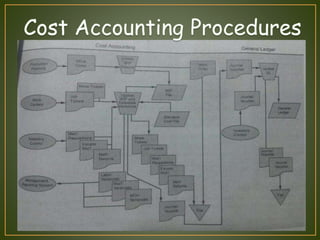
• Data flows and procedures in a traditional cost accounting
system
• Accounting controls in a traditional environment
• Principles, operating features, and technologies of lean
manufacturing
• Shortcomings of traditional accounting methods in the
world-class environment
• Key features of activity based costing and value stream
accounting
• Information systems of lean manufacturing and world-
class companies
• Transforms input resources, raw materials,
labor, and overhead into finished products
or services for sale
• Consists of two subsystems:
• Physical activities – the production system
• Information activities – the cost accounting
system
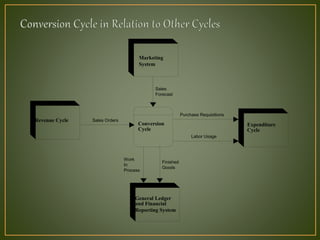
Revenue Cycle
Expenditure
Cycle
Purchase Requisitions
Marketing
System
Conversion
Cycle
Sales
Forecast
Sales Orders
Labor Usage
General Ledger
and Financial
Reporting System
Work
In
Process
Finished
Goods
• Continuous Processing creates a
homogeneous product through a
continuous series of standard procedures.
• Batch Processing produces discrete
groups (batches) of products.
• Make-to-Order Processing involves the
fabrication of discrete products in
accordance with customer specifications.
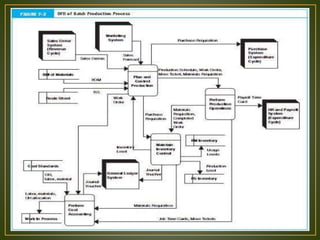
• consists of four basic processes:
•plan and control production
•perform production operations
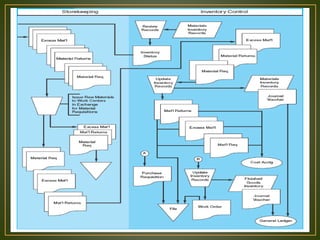
•maintain inventory control
•perform cost accounting
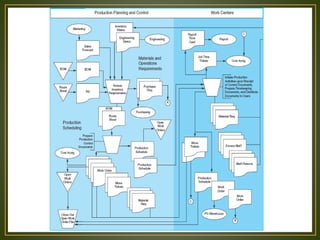
• Production Schedule
 is the formal plan and
authorization to begin production.
• Bill of Materials (BOM)
 specifies the types and
quantities of the raw materials and
subassemblies used to produce a
single finished good unit.
• Route Sheet
 - details the production path a
particular batch will take in the
manufacturing process
• sequence of operations
• time allotted at each station
• Move Ticket
 records work done in each
work center and authorizes the
movement of the batch.
• Materials Requisition
 authorizes the inventory
warehouse to release raw materials
for use in the production process.
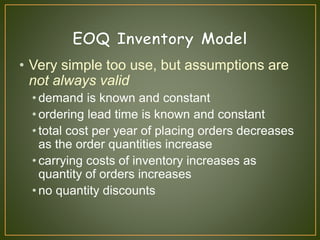
• Very simple too use, but assumptions are
not always valid
• demand is known and constant
• ordering lead time is known and constant
• total cost per year of placing orders decreases
as the order quantities increase
• carrying costs of inventory increases as
quantity of orders increases
• no quantity discounts
Report AIS chapter 7- Conversion Cycle

Report AIS chapter 7- Conversion Cycle

  • 1.
  • 2.
    • Elements andprocedures of a traditional production process • Data flows and procedures in a traditional cost accounting system • Accounting controls in a traditional environment • Principles, operating features, and technologies of lean manufacturing • Shortcomings of traditional accounting methods in the world-class environment • Key features of activity based costing and value stream accounting • Information systems of lean manufacturing and world- class companies
  • 3.
    • Transforms inputresources, raw materials, labor, and overhead into finished products or services for sale • Consists of two subsystems: • Physical activities – the production system • Information activities – the cost accounting system
  • 4.
    Revenue Cycle Expenditure Cycle Purchase Requisitions Marketing System Conversion Cycle Sales Forecast SalesOrders Labor Usage General Ledger and Financial Reporting System Work In Process Finished Goods
  • 5.
    • Continuous Processingcreates a homogeneous product through a continuous series of standard procedures. • Batch Processing produces discrete groups (batches) of products. • Make-to-Order Processing involves the fabrication of discrete products in accordance with customer specifications.
  • 6.
    • consists offour basic processes: •plan and control production •perform production operations •maintain inventory control •perform cost accounting
  • 8.
    • Production Schedule is the formal plan and authorization to begin production. • Bill of Materials (BOM)  specifies the types and quantities of the raw materials and subassemblies used to produce a single finished good unit. • Route Sheet  - details the production path a particular batch will take in the manufacturing process • sequence of operations • time allotted at each station • Move Ticket  records work done in each work center and authorizes the movement of the batch. • Materials Requisition  authorizes the inventory warehouse to release raw materials for use in the production process.
  • 11.
    • Very simpletoo use, but assumptions are not always valid • demand is known and constant • ordering lead time is known and constant • total cost per year of placing orders decreases as the order quantities increase • carrying costs of inventory increases as quantity of orders increases • no quantity discounts