Cost Accounting
Foundations and Evolutions
     Kinney, Prather, Raiborn


    Chapter 4
Job Order Costing
Learning Objectives (1 of 3)
• Contrast the job order and process costing
  systems and their valuation methods
• Define what the term ‘job’ means
• Explain the purpose of the documents used
  in a job order costing system
Learning Objectives (2 of 3)
• List the journal entries used to accumulate
  costs in a job order costing system
• Identify how technology impacts the
  gathering and use of information in job
  order costing systems
Learning Objectives (3of 3)
• Explain how standard costs are used in a
  job order costing system
• Describe how job order costing information
  supports management decision making
• Explain how losses are treated in a job
  order costing system
Job Order or Process Costing
        Job Order
•   Small quantities
•   Batches of
    identifiable,
    tailor-made
    products
•   User-specific
    services
•   Tracks costs by
    job
Job Order or Process Costing
        Job Order            Process
•   Small quantities   • Large quantities
•   Batches of         • Homogeneous
    identifiable,        goods
    tailor-made
    products           • Tracks costs by
•   User-specific        batch of goods by
    services             department
•   Tracks costs by
    job
Job Order Costing
• A job is a single unit or group of units
  identifiable as being produced to distinct
  customer specifications
• A job can be a
  –   Client
  –   Engagement
  –   Project
  –   Contract
Costing Systems

Job order costing   Process costing


                          COLA
Product Costing
• Cost identification
• Cost measurement
• Product cost assignment
Methods of Product Costing
• Cost Accumulation System defines
  – cost object
  – method of assigning costs to production
• Valuation Method specifies
  – how product costs will be measured
Six Possibilities
V           COSTING SYSTEM
A
L   M   Job Order        Process
U   E   • Actual         • Actual
A   T   • Normal         • Normal
T   H   • Standard       • Standard
I   O
O   D
N
Valuation Methods
• Actual                     • Standard
  – Actual direct material     – Standard direct material
  – Actual direct labor        – Standard direct labor
  – Actual overhead            – Standard overhead
• Normal
  – Actual direct material
  – Actual direct labor
                                             The
  – Predetermined overhead                Difference
Job Order Costing System
• Each job is a cost object
• Costs are accumulated for each job
• A job can consist of one or more units of
  output
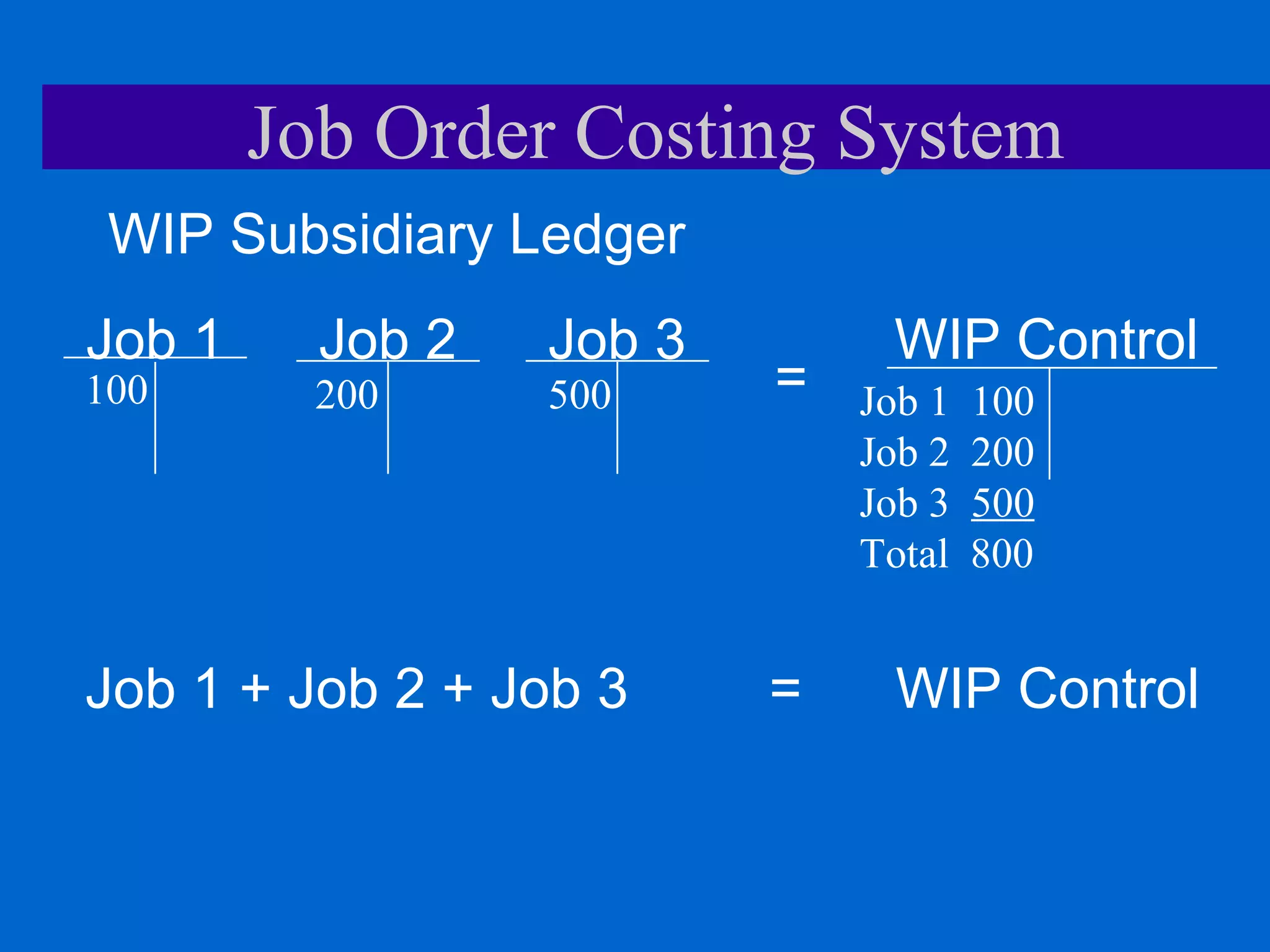
• There is a subsidiary ledger for each job
Job Order Costing System
 WIP Subsidiary Ledger
Job 1     Job 2   Job 3        WIP Control
100       200     500     =   Job 1   100
                              Job 2   200
                              Job 3   500
                              Total   800


Job 1 + Job 2 + Job 3     =     WIP Control
Material Requisition Form
• Tracks who is responsible for materials
• Verifies flow of materials from warehouse
  to department to job
Material Requisition Form
• Tracks who is responsible for materials
• Verifies flow of materials from warehouse to
  department to job
• Journal entry
   Work in Process Inventory (direct material)
   Manufacturing Overhead (indirect material)
       Raw Material Inventory
Materials Requisition Form
Date ___________________                        No. ###
Job No. _________________ Department _______________
Authorized by ___________ Issued by _________________
Received by _____________ Inspected by _______________
Item Part        Unit of Quantity Quantity Unit Total
No. No. Descrip. Measure Required Issued Cost Cost
Job Order Cost Sheet
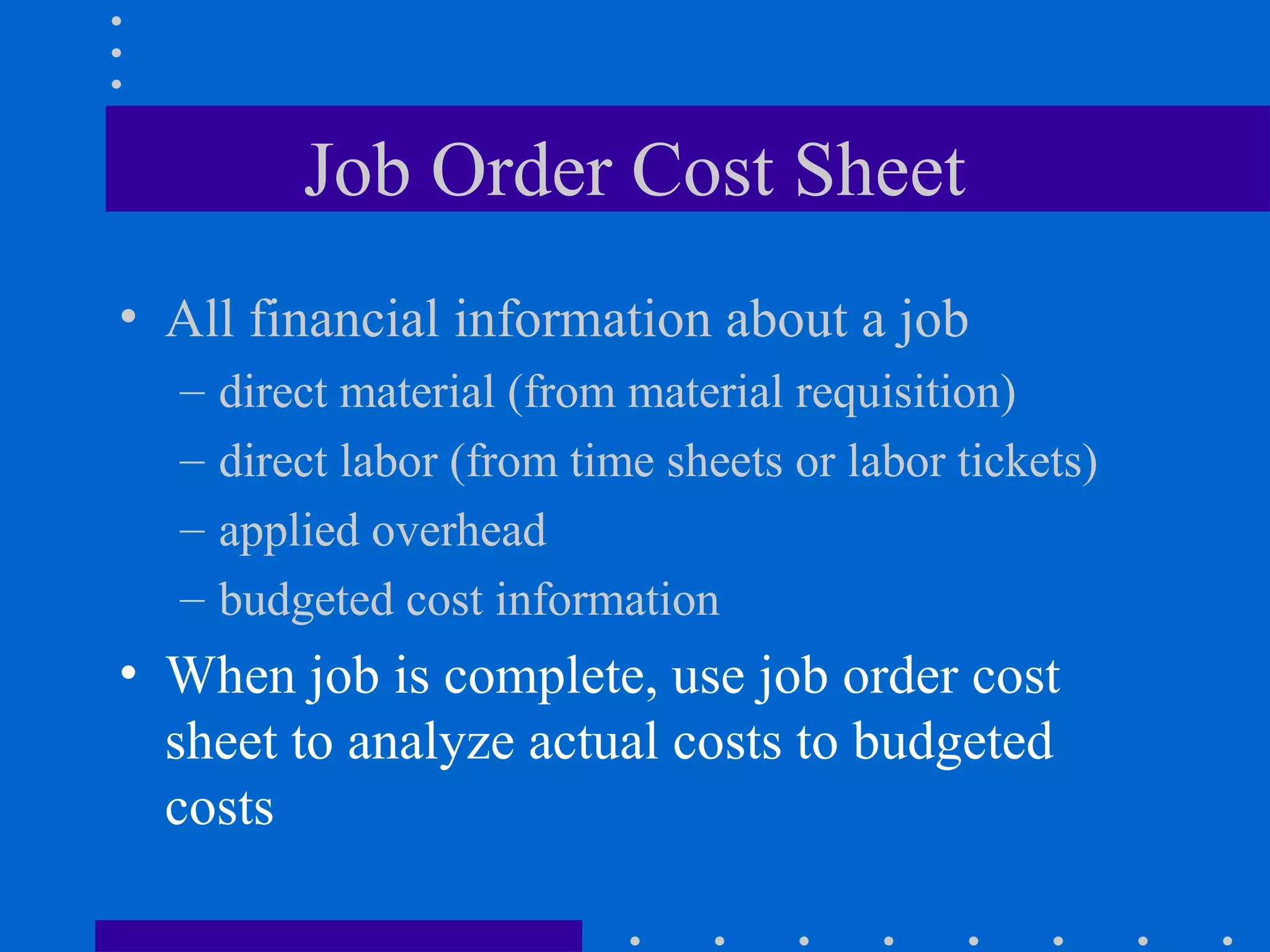
• All financial information about a job
  –   direct material (from material requisition)
  –   direct labor (from time sheets or labor tickets)
  –   applied overhead
  –   budgeted cost information
Job Order Cost Sheet
• All financial information about a job
  –   direct material (from material requisition)
  –   direct labor (from time sheets or labor tickets)
  –   applied overhead
  –   budgeted cost information
• When job is complete, use job order cost
  sheet to analyze actual costs to budgeted
  costs
Job Order Cost Sheet
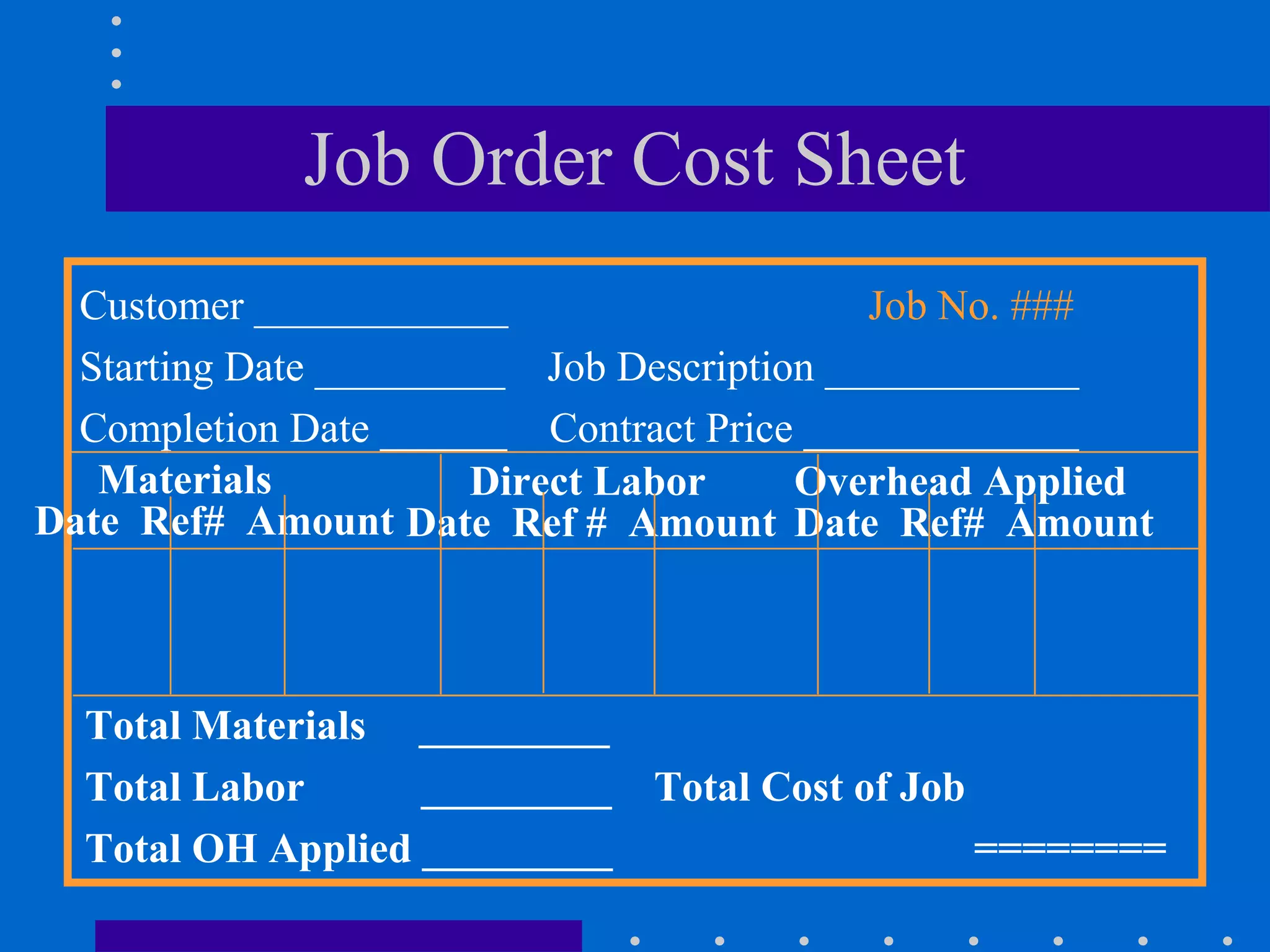
  Customer ____________                     Job No. ###
  Starting Date _________ Job Description ____________
  Completion Date ______ Contract Price _____________
   Materials           Direct Labor     Overhead Applied
Date Ref# Amount Date Ref # Amount Date Ref# Amount


  Total Materials _________
  Total Labor      _________ Total Cost of Job
  Total OH Applied _________                   ========
Employee Time Sheet
• Time worked on each job
Employee Time Sheet
• Time worked on each job
• Journal entry
  Work in Process Inventory (direct labor)
  Manufacturing Overhead (indirect labor)
    Salaries and Wages Payable
Employee Time Sheet
 Employee Name _______________
 Employee No. _______________        For week ending
 Department    _______________               _______
                         Start    Stop         Total
Type of Work   Job No.   Time     Time   Day   Hours


Employee Signature               Supervisor’s Signature
Manufacturing Overhead
          Overhead Account
    Actual Overhead   Applied Overhead


• Journal Entry
     Work in Process Inventory
          Manufacturing Overhead (applied)
Completion of a Job
• Move job cost sheet from WIP
  subsidiary to Finished Goods subsidiary
Completion of a Job
• Move job cost sheet from WIP
  subsidiary to Finished Goods subsidiary
• Journal entry
   Finished Goods Inventory
       Work in Process Inventory
Standard Cost System
• Actual cost
• Normal cost
• Standard cost
  – Predetermined norms (or standards) for
    materials, labor, and overhead
  – Compare actual costs to standard costs -
    difference is a variance
Management Use of
        Job Order Costing Systems
•   Estimate future job costs
•   Establish realistic bids and selling prices
•   Develop budgets and standards
•   Compare actual costs to estimated costs
•   Determine which jobs are profitable
•   Manage inventory
Product and Material Losses
• Shrinkage
  – Evaporation
  – Leakage
  – Oxidation
• Production errors
  – Defects can be economically reworked
  – Spoilage cannot be economically reworked
Product and Material Losses
• Normal Loss – expected during production
• Abnormal Loss – exceeds that expected
  during production
Normal Loss
• Anticipated on all jobs
  – Include cost when calculating predetermined
    overhead application rate
  – Include cost less the estimated disposal value
• Specific to a job
  – Applied to the specific job
  – Include cost less the estimated disposal value
Abnormal Spoilage
• Period cost – includes cost of abnormal loss
  less any disposal value
Product and Material Losses
                    Normal        Abnormal
                     Loss           Loss

  Loss for
  most jobs       In overhead    Period cost
                      rate

Loss identified    Charge to
   with a                        Period cost
                  specific job
 specific job
Questions
• What is the difference between job order
  and process costing systems?
• How do actual, normal, and standard
  costing valuation methods differ?
• How is the job order cost sheet used?

Job order costing

  • 1.
    Cost Accounting Foundations andEvolutions Kinney, Prather, Raiborn Chapter 4 Job Order Costing
  • 2.
    Learning Objectives (1of 3) • Contrast the job order and process costing systems and their valuation methods • Define what the term ‘job’ means • Explain the purpose of the documents used in a job order costing system
  • 3.
    Learning Objectives (2of 3) • List the journal entries used to accumulate costs in a job order costing system • Identify how technology impacts the gathering and use of information in job order costing systems
  • 4.
    Learning Objectives (3of3) • Explain how standard costs are used in a job order costing system • Describe how job order costing information supports management decision making • Explain how losses are treated in a job order costing system
  • 5.
    Job Order orProcess Costing Job Order • Small quantities • Batches of identifiable, tailor-made products • User-specific services • Tracks costs by job
  • 6.
    Job Order orProcess Costing Job Order Process • Small quantities • Large quantities • Batches of • Homogeneous identifiable, goods tailor-made products • Tracks costs by • User-specific batch of goods by services department • Tracks costs by job
  • 7.
    Job Order Costing •A job is a single unit or group of units identifiable as being produced to distinct customer specifications • A job can be a – Client – Engagement – Project – Contract
  • 8.
    Costing Systems Job ordercosting Process costing COLA
  • 9.
    Product Costing • Costidentification • Cost measurement • Product cost assignment
  • 10.
    Methods of ProductCosting • Cost Accumulation System defines – cost object – method of assigning costs to production • Valuation Method specifies – how product costs will be measured
  • 11.
    Six Possibilities V COSTING SYSTEM A L M Job Order Process U E • Actual • Actual A T • Normal • Normal T H • Standard • Standard I O O D N
  • 12.
    Valuation Methods • Actual • Standard – Actual direct material – Standard direct material – Actual direct labor – Standard direct labor – Actual overhead – Standard overhead • Normal – Actual direct material – Actual direct labor The – Predetermined overhead Difference
  • 14.
    Job Order CostingSystem • Each job is a cost object • Costs are accumulated for each job • A job can consist of one or more units of output • There is a subsidiary ledger for each job
  • 15.
    Job Order CostingSystem WIP Subsidiary Ledger Job 1 Job 2 Job 3 WIP Control 100 200 500 = Job 1 100 Job 2 200 Job 3 500 Total 800 Job 1 + Job 2 + Job 3 = WIP Control
  • 16.
    Material Requisition Form •Tracks who is responsible for materials • Verifies flow of materials from warehouse to department to job
  • 17.
    Material Requisition Form •Tracks who is responsible for materials • Verifies flow of materials from warehouse to department to job • Journal entry Work in Process Inventory (direct material) Manufacturing Overhead (indirect material) Raw Material Inventory
  • 18.
    Materials Requisition Form Date___________________ No. ### Job No. _________________ Department _______________ Authorized by ___________ Issued by _________________ Received by _____________ Inspected by _______________ Item Part Unit of Quantity Quantity Unit Total No. No. Descrip. Measure Required Issued Cost Cost
  • 19.
    Job Order CostSheet • All financial information about a job – direct material (from material requisition) – direct labor (from time sheets or labor tickets) – applied overhead – budgeted cost information
  • 20.
    Job Order CostSheet • All financial information about a job – direct material (from material requisition) – direct labor (from time sheets or labor tickets) – applied overhead – budgeted cost information • When job is complete, use job order cost sheet to analyze actual costs to budgeted costs
  • 21.
    Job Order CostSheet Customer ____________ Job No. ### Starting Date _________ Job Description ____________ Completion Date ______ Contract Price _____________ Materials Direct Labor Overhead Applied Date Ref# Amount Date Ref # Amount Date Ref# Amount Total Materials _________ Total Labor _________ Total Cost of Job Total OH Applied _________ ========
  • 22.
    Employee Time Sheet •Time worked on each job
  • 23.
    Employee Time Sheet •Time worked on each job • Journal entry Work in Process Inventory (direct labor) Manufacturing Overhead (indirect labor) Salaries and Wages Payable
  • 24.
    Employee Time Sheet Employee Name _______________ Employee No. _______________ For week ending Department _______________ _______ Start Stop Total Type of Work Job No. Time Time Day Hours Employee Signature Supervisor’s Signature
  • 25.
    Manufacturing Overhead Overhead Account Actual Overhead Applied Overhead • Journal Entry Work in Process Inventory Manufacturing Overhead (applied)
  • 26.
    Completion of aJob • Move job cost sheet from WIP subsidiary to Finished Goods subsidiary
  • 27.
    Completion of aJob • Move job cost sheet from WIP subsidiary to Finished Goods subsidiary • Journal entry Finished Goods Inventory Work in Process Inventory
  • 28.
    Standard Cost System •Actual cost • Normal cost • Standard cost – Predetermined norms (or standards) for materials, labor, and overhead – Compare actual costs to standard costs - difference is a variance
  • 29.
    Management Use of Job Order Costing Systems • Estimate future job costs • Establish realistic bids and selling prices • Develop budgets and standards • Compare actual costs to estimated costs • Determine which jobs are profitable • Manage inventory
  • 30.
    Product and MaterialLosses • Shrinkage – Evaporation – Leakage – Oxidation • Production errors – Defects can be economically reworked – Spoilage cannot be economically reworked
  • 31.
    Product and MaterialLosses • Normal Loss – expected during production • Abnormal Loss – exceeds that expected during production
  • 32.
    Normal Loss • Anticipatedon all jobs – Include cost when calculating predetermined overhead application rate – Include cost less the estimated disposal value • Specific to a job – Applied to the specific job – Include cost less the estimated disposal value
  • 33.
    Abnormal Spoilage • Periodcost – includes cost of abnormal loss less any disposal value
  • 34.
    Product and MaterialLosses Normal Abnormal Loss Loss Loss for most jobs In overhead Period cost rate Loss identified Charge to with a Period cost specific job specific job
  • 35.
    Questions • What isthe difference between job order and process costing systems? • How do actual, normal, and standard costing valuation methods differ? • How is the job order cost sheet used?