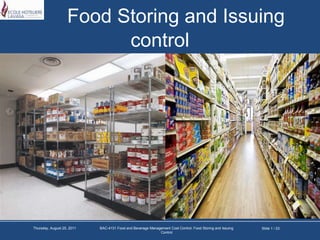
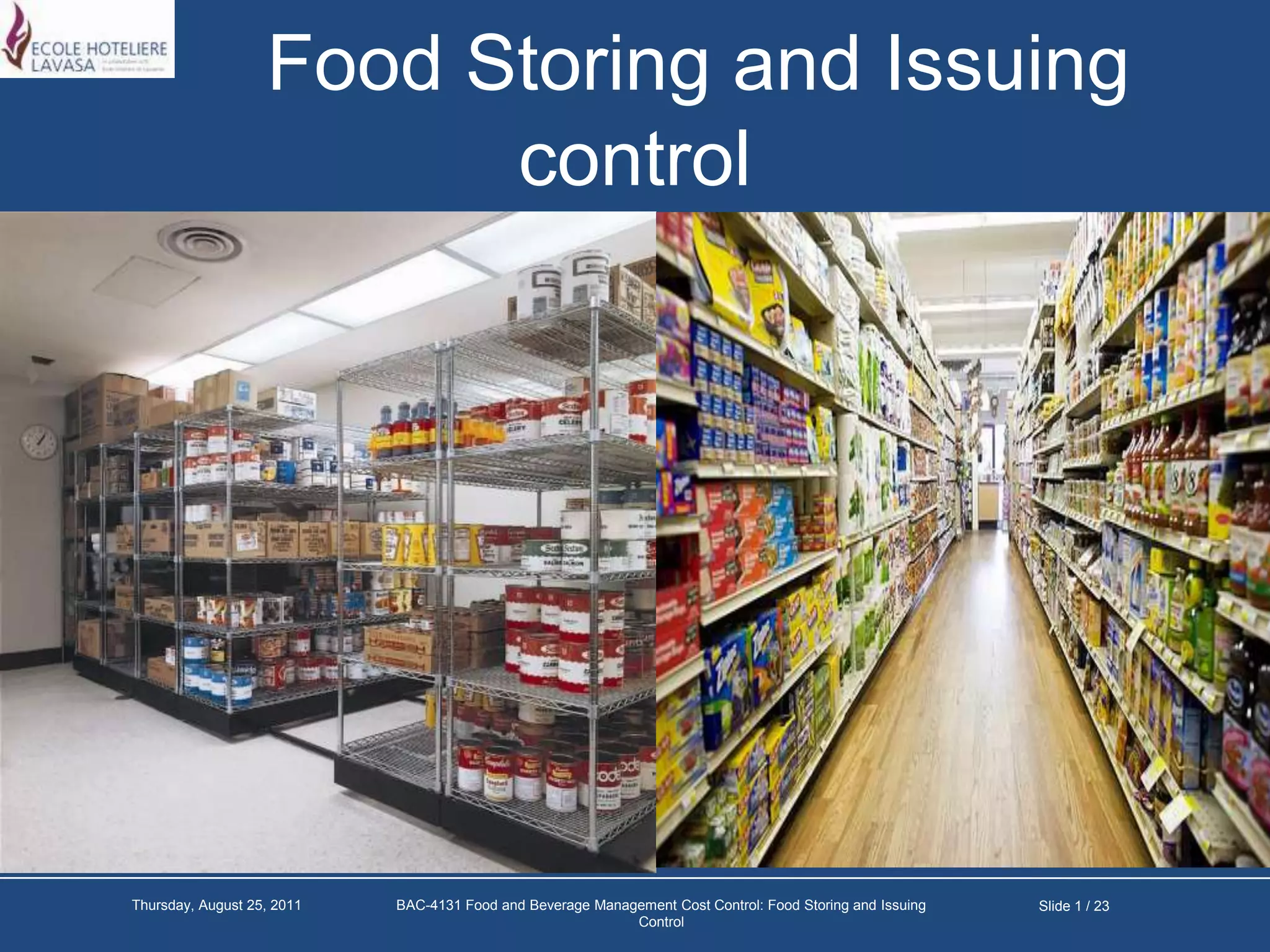
Food Storing and Issuing controlSlide 1 / 23Tuesday, March 22, 2011BAC-4131 Food and Beverage Management Cost Control: Food Storing and Issuing Control
Recap of the previous sessionList in sequence the procedure for receiving food.Set differences between directs and stores.List characteristics of an Invoice.Explain features of receiving clerks daily report.Slide 2 / 23Tuesday, March 22, 2011BAC-4131 Food and Beverage Management Cost Control: Food Storing and Issuing Control
Learning objectives KCMThree causes of unplanned costs that can develop while food is in storage.Explain the importance of establishing standards for each of the following: storage temperatures.Explain the difference between inter-unit and intra-unit transfers, and give two examples of each. Explain the significance of transfers in determining accurate food costs Slide 3 / 23Tuesday, March 22, 2011BAC-4131 Food and Beverage Management Cost Control: Food Storing and Issuing Control
Scope Storing control: Establishing standards.Record keeping in the stores.Computerized procedure.Dating and pricing of stored foods.Transfer document.Sample ProblemSlide 4 / 23Tuesday, March 22, 2011BAC-4131 Food and Beverage Management Cost Control: Food Storing and Issuing Control
Storing control: Establishing standardsIn general, the standards established for storing food should address five principal concerns.Condition of facilities and equipment.Arrangement of foodsLocation of facilitiesSecurity of storage areasDating and pricing of stored foodsSlide 5 / 23Tuesday, March 22, 2011BAC-4131 Food and Beverage Management Cost Control: Food Storing and Issuing Control
Condition of facilities and equipmentMaintaining proper temperature.Proper storage containers.Shelving.Cleanliness.Slide 6 / 23Tuesday, March 22, 2011BAC-4131 Food and Beverage Management Cost Control: Food Storing and Issuing Control
Arrangement of foodsKeeping the most used items readily available.Fixing definite location.Rotation of stock.Slide 7 / 23Tuesday, March 22, 2011BAC-4131 Food and Beverage Management Cost Control: Food Storing and Issuing Control
Location of facilitiesWhenever possible, the storage facilities for both perishable and nonperishable foods should be located between receiving areas and preparation areas, preferably close to both.Speeding the storing and issuing of food.Maximizing security.Reducing labor requirements.Minimizing infestation of rodents and other unwanted creatures.Slide 8 / 23Tuesday, March 22, 2011BAC-4131 Food and Beverage Management Cost Control: Food Storing and Issuing Control
Security of storage areasFood should never be stored in a manner that permits pilferage.A storeroom for staple food products should never be left open and unattended.Employees should not be permitted to remove items at will.When the storeroom is closed, it should be locked, and the single key should be in the storeroom clerk ’ s possession.Slide 9 / 23Tuesday, March 22, 2011BAC-4131 Food and Beverage Management Cost Control: Food Storing and Issuing Control
	Dating and pricing of stored foodsDating traditionally used to be done by using a marker on the cling film laced on the product.Its an indication of the processed food age.It allows the kitchen staff to use the older processed item first.Pricing has become important in storage of non processed items.Slide 10 / 23Tuesday, March 22, 2011BAC-4131 Food and Beverage Management Cost Control: Food Storing and Issuing Control
Record keeping in the storesThe Requisition. A requisition, is a form filledin by a member of the kitchen staff. It lists the items and quantities of stores that the kitchen staff needs for the current day ’ s production.Each requisition should be reviewed by the chef, who should check to see that all required items are listed and that the quantity listed for each is accurate.Slide 11 / 23Tuesday, March 22, 2011BAC-4131 Food and Beverage Management Cost Control: Food Storing and Issuing Control
Sample requisitionSlide 12 / 23Tuesday, March 22, 2011BAC-4131 Food and Beverage Management Cost Control: Food Storing and Issuing Control
Advantages of stores issue requisitionsA documented way of issues.Creates usage awareness within employees.Makes two individuals responsible for their acts.Makes both individuals accountable for the material used.Slide 13 / 23Tuesday, March 22, 2011BAC-4131 Food and Beverage Management Cost Control: Food Storing and Issuing Control
Pricing the requisition(Manual operation)Slide 14 / 23Tuesday, March 22, 2011BAC-4131 Food and Beverage Management Cost Control: Food Storing and Issuing Control
Computerized procedure The unit cost of each item is marked on each container as it is stored, making it readily available to the storeroom clerk.A book or card file is maintained for all staple items, one page or one card per item. As prices change, the most recent purchase price is entered.Slide 15 / 23Tuesday, March 22, 2011BAC-4131 Food and Beverage Management Cost Control: Food Storing and Issuing Control
Computerized procedure The most recent purchase price for each item is listed on a perpetual inventory card or in the computer.The storeroom clerk keeps a mental record of the orders placed and usually remembers Slide 16 / 23Tuesday, March 22, 2011BAC-4131 Food and Beverage Management Cost Control: Food Storing and Issuing Control
Food and Beverage TransfersIntra-unit TransfersIntra-unit transfers are food and beverage transfers between departments of a food and beverage operation. Between Bar and Kitchen.Between Kitchen and Kitchen.Inter-unit Transfers.Slide 17 / 23Tuesday, March 22, 2011BAC-4131 Food and Beverage Management Cost Control: Food Storing and Issuing Control
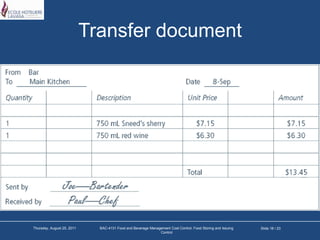
Transfer documentSlide 18 / 23Tuesday, March 22, 2011BAC-4131 Food and Beverage Management Cost Control: Food Storing and Issuing Control
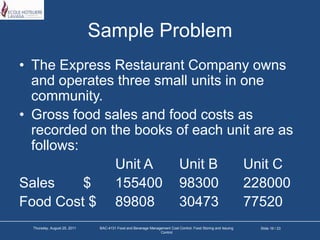
Sample ProblemThe Express Restaurant Company owns and operates three small units in one community.Gross food sales and food costs as recorded on the books of each unit are as follows:				Unit A	Unit B	Unit CSales	$	155400	98300	228000Food Cost $	89808	30473	77520Slide 19 / 23Tuesday, March 22, 2011BAC-4131 Food and Beverage Management Cost Control: Food Storing and Issuing Control
Sample ProblemThe above figures do not include the values of the food transferred from Units A to the other two units. These are all baked goods used in the chain which are produced in one bake shop located in Units A. During the period transfers from Unit A to the other units totaled $ 20000 of which $ 8000 was sent to Unit B and the remainder to Unit C.Slide 20 / 23Tuesday, March 22, 2011BAC-4131 Food and Beverage Management Cost Control: Food Storing and Issuing Control
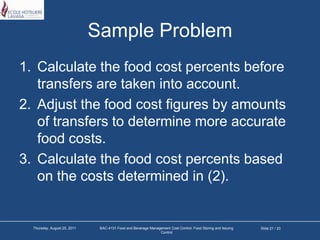
Sample ProblemCalculate the food cost percents before transfers are taken into account.Adjust the food cost figures by amounts of transfers to determine more accurate food costs.Calculate the food cost percents based on the costs determined in (2).Slide 21 / 23Tuesday, March 22, 2011BAC-4131 Food and Beverage Management Cost Control: Food Storing and Issuing Control
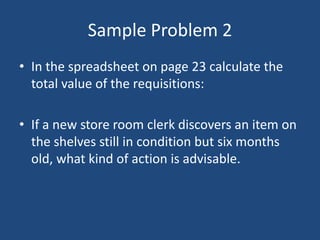
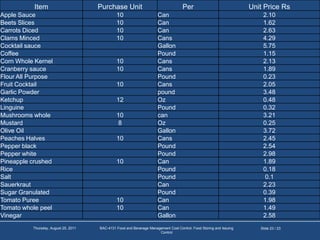
Sample Problem 2In the spreadsheet on page 23 calculate the total value of the requisitions:If a new store room clerk discovers an item on the shelves still in condition but six months old, what kind of action is advisable.
Slide 23 / 23Tuesday, March 22, 2011BAC-4131 Food and Beverage Management Cost Control: Food Storing and Issuing Control
		Questions 				CommentsSlide 24 / 23Tuesday, March 22, 2011BAC-4131 Food and Beverage Management Cost Control: Food Storing and Issuing Control

Food storing and issuing control

  • 1.
    Food Storing andIssuing controlSlide 1 / 23Tuesday, March 22, 2011BAC-4131 Food and Beverage Management Cost Control: Food Storing and Issuing Control
  • 2.
    Recap of theprevious sessionList in sequence the procedure for receiving food.Set differences between directs and stores.List characteristics of an Invoice.Explain features of receiving clerks daily report.Slide 2 / 23Tuesday, March 22, 2011BAC-4131 Food and Beverage Management Cost Control: Food Storing and Issuing Control
  • 3.
    Learning objectives KCMThreecauses of unplanned costs that can develop while food is in storage.Explain the importance of establishing standards for each of the following: storage temperatures.Explain the difference between inter-unit and intra-unit transfers, and give two examples of each. Explain the significance of transfers in determining accurate food costs Slide 3 / 23Tuesday, March 22, 2011BAC-4131 Food and Beverage Management Cost Control: Food Storing and Issuing Control
  • 4.
    Scope Storing control:Establishing standards.Record keeping in the stores.Computerized procedure.Dating and pricing of stored foods.Transfer document.Sample ProblemSlide 4 / 23Tuesday, March 22, 2011BAC-4131 Food and Beverage Management Cost Control: Food Storing and Issuing Control
  • 5.
    Storing control: EstablishingstandardsIn general, the standards established for storing food should address five principal concerns.Condition of facilities and equipment.Arrangement of foodsLocation of facilitiesSecurity of storage areasDating and pricing of stored foodsSlide 5 / 23Tuesday, March 22, 2011BAC-4131 Food and Beverage Management Cost Control: Food Storing and Issuing Control
  • 6.
    Condition of facilitiesand equipmentMaintaining proper temperature.Proper storage containers.Shelving.Cleanliness.Slide 6 / 23Tuesday, March 22, 2011BAC-4131 Food and Beverage Management Cost Control: Food Storing and Issuing Control
  • 7.
    Arrangement of foodsKeepingthe most used items readily available.Fixing definite location.Rotation of stock.Slide 7 / 23Tuesday, March 22, 2011BAC-4131 Food and Beverage Management Cost Control: Food Storing and Issuing Control
  • 8.
    Location of facilitiesWheneverpossible, the storage facilities for both perishable and nonperishable foods should be located between receiving areas and preparation areas, preferably close to both.Speeding the storing and issuing of food.Maximizing security.Reducing labor requirements.Minimizing infestation of rodents and other unwanted creatures.Slide 8 / 23Tuesday, March 22, 2011BAC-4131 Food and Beverage Management Cost Control: Food Storing and Issuing Control
  • 9.
    Security of storageareasFood should never be stored in a manner that permits pilferage.A storeroom for staple food products should never be left open and unattended.Employees should not be permitted to remove items at will.When the storeroom is closed, it should be locked, and the single key should be in the storeroom clerk ’ s possession.Slide 9 / 23Tuesday, March 22, 2011BAC-4131 Food and Beverage Management Cost Control: Food Storing and Issuing Control
  • 10.
    Dating and pricingof stored foodsDating traditionally used to be done by using a marker on the cling film laced on the product.Its an indication of the processed food age.It allows the kitchen staff to use the older processed item first.Pricing has become important in storage of non processed items.Slide 10 / 23Tuesday, March 22, 2011BAC-4131 Food and Beverage Management Cost Control: Food Storing and Issuing Control
  • 11.
    Record keeping inthe storesThe Requisition. A requisition, is a form filledin by a member of the kitchen staff. It lists the items and quantities of stores that the kitchen staff needs for the current day ’ s production.Each requisition should be reviewed by the chef, who should check to see that all required items are listed and that the quantity listed for each is accurate.Slide 11 / 23Tuesday, March 22, 2011BAC-4131 Food and Beverage Management Cost Control: Food Storing and Issuing Control
  • 12.
    Sample requisitionSlide 12/ 23Tuesday, March 22, 2011BAC-4131 Food and Beverage Management Cost Control: Food Storing and Issuing Control
  • 13.
    Advantages of storesissue requisitionsA documented way of issues.Creates usage awareness within employees.Makes two individuals responsible for their acts.Makes both individuals accountable for the material used.Slide 13 / 23Tuesday, March 22, 2011BAC-4131 Food and Beverage Management Cost Control: Food Storing and Issuing Control
  • 14.
    Pricing the requisition(Manualoperation)Slide 14 / 23Tuesday, March 22, 2011BAC-4131 Food and Beverage Management Cost Control: Food Storing and Issuing Control
  • 15.
    Computerized procedure Theunit cost of each item is marked on each container as it is stored, making it readily available to the storeroom clerk.A book or card file is maintained for all staple items, one page or one card per item. As prices change, the most recent purchase price is entered.Slide 15 / 23Tuesday, March 22, 2011BAC-4131 Food and Beverage Management Cost Control: Food Storing and Issuing Control
  • 16.
    Computerized procedure Themost recent purchase price for each item is listed on a perpetual inventory card or in the computer.The storeroom clerk keeps a mental record of the orders placed and usually remembers Slide 16 / 23Tuesday, March 22, 2011BAC-4131 Food and Beverage Management Cost Control: Food Storing and Issuing Control
  • 17.
    Food and BeverageTransfersIntra-unit TransfersIntra-unit transfers are food and beverage transfers between departments of a food and beverage operation. Between Bar and Kitchen.Between Kitchen and Kitchen.Inter-unit Transfers.Slide 17 / 23Tuesday, March 22, 2011BAC-4131 Food and Beverage Management Cost Control: Food Storing and Issuing Control
  • 18.
    Transfer documentSlide 18/ 23Tuesday, March 22, 2011BAC-4131 Food and Beverage Management Cost Control: Food Storing and Issuing Control
  • 19.
    Sample ProblemThe ExpressRestaurant Company owns and operates three small units in one community.Gross food sales and food costs as recorded on the books of each unit are as follows: Unit A Unit B Unit CSales $ 155400 98300 228000Food Cost $ 89808 30473 77520Slide 19 / 23Tuesday, March 22, 2011BAC-4131 Food and Beverage Management Cost Control: Food Storing and Issuing Control
  • 20.
    Sample ProblemThe abovefigures do not include the values of the food transferred from Units A to the other two units. These are all baked goods used in the chain which are produced in one bake shop located in Units A. During the period transfers from Unit A to the other units totaled $ 20000 of which $ 8000 was sent to Unit B and the remainder to Unit C.Slide 20 / 23Tuesday, March 22, 2011BAC-4131 Food and Beverage Management Cost Control: Food Storing and Issuing Control
  • 21.
    Sample ProblemCalculate thefood cost percents before transfers are taken into account.Adjust the food cost figures by amounts of transfers to determine more accurate food costs.Calculate the food cost percents based on the costs determined in (2).Slide 21 / 23Tuesday, March 22, 2011BAC-4131 Food and Beverage Management Cost Control: Food Storing and Issuing Control
  • 22.
    Sample Problem 2Inthe spreadsheet on page 23 calculate the total value of the requisitions:If a new store room clerk discovers an item on the shelves still in condition but six months old, what kind of action is advisable.
  • 23.
    Slide 23 /23Tuesday, March 22, 2011BAC-4131 Food and Beverage Management Cost Control: Food Storing and Issuing Control
  • 24.
    Questions CommentsSlide 24/ 23Tuesday, March 22, 2011BAC-4131 Food and Beverage Management Cost Control: Food Storing and Issuing Control