© 2015 INTERNATIONAL CULINARY CENTER 1
CULINARY MATH:
FOOD COSTING & COST CONTROL
© 2015 INTERNATIONAL CULINARY CENTER 2
CULINARY MATH:
BAKER’S PERCENTAGE
RECIPE SCALING & YIELDS
FOOD COSTING & COST CONTROL
© 2015 INTERNATIONAL CULINARY CENTER 3
LEARNING OBJECTIVES
• To identify and explain key concepts in food costing & cost control
• To perform and explain how to perform basic food costing
calculations, finding usable yield percentage, and differentiating as-
purchased and edible portions
• To estimate selling price based on basic food costing calculations
© 2015 INTERNATIONAL CULINARY CENTER 4
Why Is Food Costing Important?
• A critical part of a chef’s job is to manage kitchen expenditures.
• Food costing impacts the financial health of a food business.
− It affects purchasing decisions and relationships with vendors.
− It affects menu pricing.
© 2015 INTERNATIONAL CULINARY CENTER 5
Keys to Managing Food Cost
• Recipe standardization
 Consistent product
 Ensures all cooks can produce the same dish in the same manner
• Tracking costs of product
 Costs of purchases
 After-fabrication costs
• Determining appropriate menu prices
© 2015 INTERNATIONAL CULINARY CENTER 6
REVIEW
6
What is a standardized recipe?
• A recipe that has been developed, tested, and proven to:
− Produce a consistent product using the same
ingredients
− Yield a given amount or number of portions from a
single preparation
© 2015 INTERNATIONAL CULINARY CENTER 7
REVIEW
• Key Features of Standardized Recipes
Standard Units of Measure
 Ingredients are listed in the order they are used
 Recipe Procedures is thorough and clearly stated
 Recipe includes portion size and/or total recipe yield
© 2015 INTERNATIONAL CULINARY CENTER 8
ANALYZING FOOD COST
© 2015 INTERNATIONAL CULINARY CENTER 9
Recipe Costing: Terms to Know
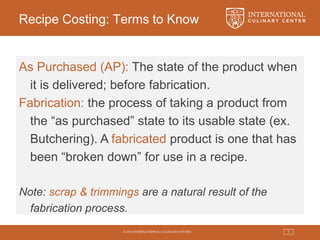
As Purchased (AP): The state of the product when
it is delivered; before fabrication.
Fabrication: the process of taking a product from
the “as purchased” state to its usable state (ex.
Butchering). A fabricated product is one that has
been “broken down” for use in a recipe.
Note: scrap & trimmings are a natural result of the
fabrication process.
© 2015 INTERNATIONAL CULINARY CENTER 10
The Yield Test
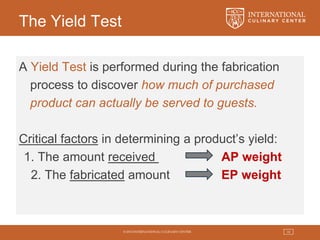
A Yield Test is performed during the fabrication
process to discover how much of purchased
product can actually be served to guests.
Critical factors in determining a product’s yield:
1. The amount received AP weight
2. The fabricated amount EP weight
© 2015 INTERNATIONAL CULINARY CENTER 11
Usable Yield Percentage
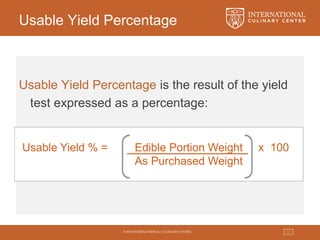
Usable Yield Percentage is the result of the yield
test expressed as a percentage:
Usable Yield % = Edible Portion Weight x 100
As Purchased Weight
© 2015 INTERNATIONAL CULINARY CENTER 12
Case Study #2:
Calculating Usable Yield Percentage
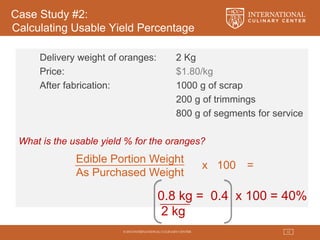
Delivery weight of oranges: 2 Kg
Price: $1.80/kg
After fabrication: 1000 g of scrap
200 g of trimmings
800 g of segments for service
What is the usable yield % for the oranges?
Edible Portion Weight
As Purchased Weight
x 100 =
0.8 kg = 0.4 x 100 = 40%
2 kg
© 2015 INTERNATIONAL CULINARY CENTER 13
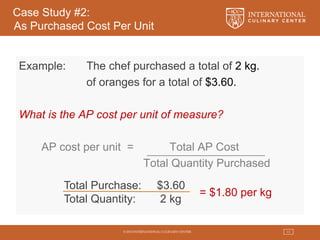
Case Study #2:
As Purchased Cost Per Unit
Example: The chef purchased a total of 2 kg.
of oranges for a total of $3.60.
What is the AP cost per unit of measure?
AP cost per unit = Total AP Cost
Total Quantity Purchased
Total Purchase: $3.60
Total Quantity: 2 kg
= $1.80 per kg
© 2015 INTERNATIONAL CULINARY CENTER 14
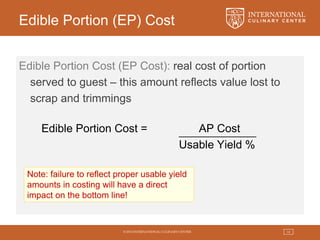
Edible Portion (EP) Cost
Edible Portion Cost (EP Cost): real cost of portion
served to guest – this amount reflects value lost to
scrap and trimmings
Edible Portion Cost = AP Cost
Usable Yield %
Note: failure to reflect proper usable yield
amounts in costing will have a direct
impact on the bottom line!
© 2015 INTERNATIONAL CULINARY CENTER 15
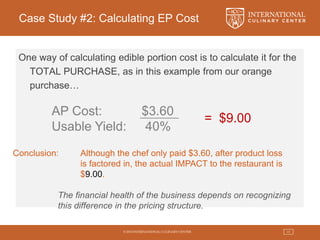
Case Study #2: Calculating EP Cost
One way of calculating edible portion cost is to calculate it for the
TOTAL PURCHASE, as in this example from our orange
purchase…
AP Cost: $3.60
Usable Yield: 40%
= $9.00
Conclusion: Although the chef only paid $3.60, after product loss
is factored in, the actual IMPACT to the restaurant is
$9.00.
The financial health of the business depends on recognizing
this difference in the pricing structure.
© 2015 INTERNATIONAL CULINARY CENTER 16
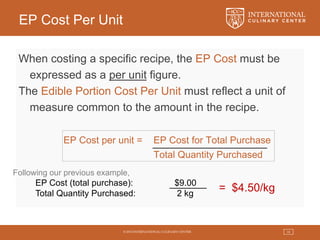
EP Cost Per Unit
When costing a specific recipe, the EP Cost must be
expressed as a per unit figure.
The Edible Portion Cost Per Unit must reflect a unit of
measure common to the amount in the recipe.
EP Cost per unit = EP Cost for Total Purchase
Total Quantity Purchased
Following our previous example,
EP Cost (total purchase): $9.00
Total Quantity Purchased: 2 kg
= $4.50/kg
© 2015 INTERNATIONAL CULINARY CENTER 17
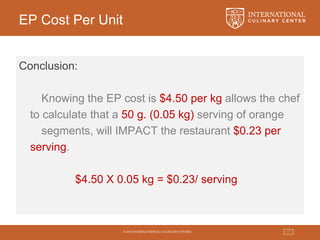
EP Cost Per Unit
Conclusion:
Knowing the EP cost is $4.50 per kg allows the chef
to calculate that a 50 g. (0.05 kg) serving of orange
segments, will IMPACT the restaurant $0.23 per
serving.
$4.50 X 0.05 kg = $0.23/ serving
© 2015 INTERNATIONAL CULINARY CENTER 18
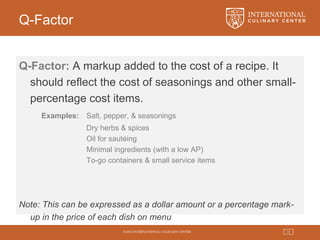
Q-Factor
Q-Factor: A markup added to the cost of a recipe. It
should reflect the cost of seasonings and other small-
percentage cost items.
Examples: Salt, pepper, & seasonings
Dry herbs & spices
Oil for sautéing
Minimal ingredients (with a low AP)
To-go containers & small service items
Note: This can be expressed as a dollar amount or a percentage mark-
up in the price of each dish on menu
© 2015 INTERNATIONAL CULINARY CENTER 19
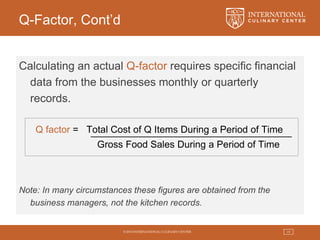
Q-Factor, Cont’d
Calculating an actual Q-factor requires specific financial
data from the businesses monthly or quarterly
records.
Q factor = Total Cost of Q Items During a Period of Time
Gross Food Sales During a Period of Time
Note: In many circumstances these figures are obtained from the
business managers, not the kitchen records.
© 2015 INTERNATIONAL CULINARY CENTER 20
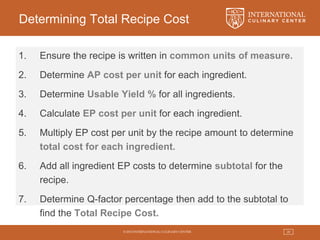
Determining Total Recipe Cost
1. Ensure the recipe is written in common units of measure.
2. Determine AP cost per unit for each ingredient.
3. Determine Usable Yield % for all ingredients.
4. Calculate EP cost per unit for each ingredient.
5. Multiply EP cost per unit by the recipe amount to determine
total cost for each ingredient.
6. Add all ingredient EP costs to determine subtotal for the
recipe.
7. Determine Q-factor percentage then add to the subtotal to
find the Total Recipe Cost.
© 2015 INTERNATIONAL CULINARY CENTER 21
Determining Total Recipe Cost
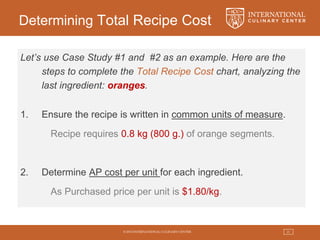
Let’s use Case Study #1 and #2 as an example. Here are the
steps to complete the Total Recipe Cost chart, analyzing the
last ingredient: oranges.
1. Ensure the recipe is written in common units of measure.
Recipe requires 0.8 kg (800 g.) of orange segments.
2. Determine AP cost per unit for each ingredient.
As Purchased price per unit is $1.80/kg.
© 2015 INTERNATIONAL CULINARY CENTER 22
Determining Total Recipe Cost
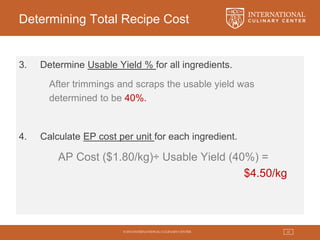
3. Determine Usable Yield % for all ingredients.
After trimmings and scraps the usable yield was
determined to be 40%.
4. Calculate EP cost per unit for each ingredient.
AP Cost ($1.80/kg)÷ Usable Yield (40%) =
$4.50/kg
© 2015 INTERNATIONAL CULINARY CENTER 23
Determining Total Recipe Cost
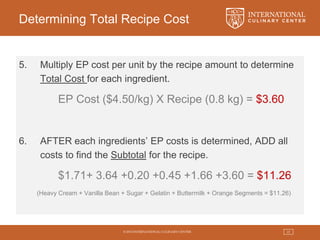
5. Multiply EP cost per unit by the recipe amount to determine
Total Cost for each ingredient.
EP Cost ($4.50/kg) X Recipe (0.8 kg) = $3.60
6. AFTER each ingredients’ EP costs is determined, ADD all
costs to find the Subtotal for the recipe.
$1.71+ 3.64 +0.20 +0.45 +1.66 +3.60 = $11.26
(Heavy Cream + Vanilla Bean + Sugar + Gelatin + Buttermilk + Orange Segments = $11.26)
© 2015 INTERNATIONAL CULINARY CENTER 24
Determining Total Recipe Cost
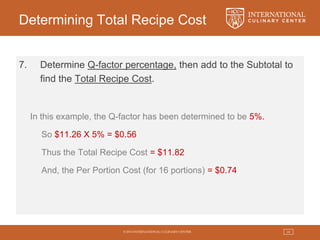
7. Determine Q-factor percentage, then add to the Subtotal to
find the Total Recipe Cost.
In this example, the Q-factor has been determined to be 5%.
So $11.26 X 5% = $0.56
Thus the Total Recipe Cost = $11.82
And, the Per Portion Cost (for 16 portions) = $0.74
© 2015 INTERNATIONAL CULINARY CENTER 25
Food Cost Percentage
WHAT: A figure which is usually determined by management
during budget periods (quarterly or annually)
WHY: It provides a guideline for making purchasing decisions
and setting menu prices
Typically, food cost can range from 25% to 35%
(depending on the type of business, dish, etc.)
© 2015 INTERNATIONAL CULINARY CENTER 26
Determining the Selling Price of a Dish
This price is used as the minimum base selling price. Actual
selling price is based on other considerations such as…
– Product mix of menu (variety of other dishes)
– Restaurant overhead
– Market tolerance (what diners will pay for a meal of similar
quality)
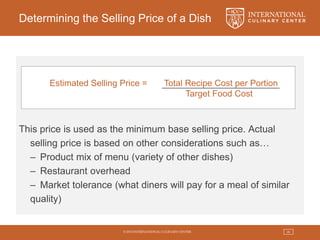
Estimated Selling Price = Total Recipe Cost per Portion
Target Food Cost
© 2015 INTERNATIONAL CULINARY CENTER 27
Determining the Selling Price of a Dish
Example: If the Total Recipe Cost per Portion of the panna cotta
and orange dessert on our menu is $0.74 and our target food
cost is 25%, the estimated selling price would be…
© 2015 INTERNATIONAL CULINARY CENTER 28
Determining the Selling Price of a Dish
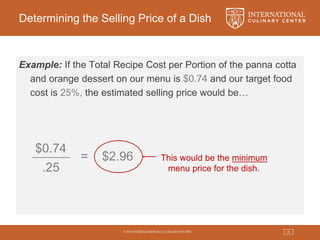
Example: If the Total Recipe Cost per Portion of the panna cotta
and orange dessert on our menu is $0.74 and our target food
cost is 25%, the estimated selling price would be…
$0.74
.25
= $2.96 This would be the minimum
menu price for the dish.
© 2015 INTERNATIONAL CULINARY CENTER 29
REVIEW
Let’s review….
− Recipe Yield
− Portion Yield
− As Purchased (AP)
− Conversion Factor (CF)
− Scraps and Trimmings
− Yield Test
− Usable Yield
− Edible Portion (EP)
− Q-Factor
− Total Recipe Cost
© 2015 INTERNATIONAL CULINARY CENTER 30
PROFESSIONAL PASTRY ARTS
© 2015 INTERNATIONAL CULINARY CENTER.
All rights reserved. Unless otherwise indicated, the materials herein are
the copyrighted property of the International Culinary Center. These materials
are for the private non-commercial use of the student only. Any other use without
the express written permission of the International Culinary Center is
strictly prohibited.
This is a study aid. Information is subject to change. Student is responsible for
keeping notes of all information presented in class.
RECIPE SCALING & YIELDS

Food Costing

  • 1.
    © 2015 INTERNATIONALCULINARY CENTER 1 CULINARY MATH: FOOD COSTING & COST CONTROL
  • 2.
    © 2015 INTERNATIONALCULINARY CENTER 2 CULINARY MATH: BAKER’S PERCENTAGE RECIPE SCALING & YIELDS FOOD COSTING & COST CONTROL
  • 3.
    © 2015 INTERNATIONALCULINARY CENTER 3 LEARNING OBJECTIVES • To identify and explain key concepts in food costing & cost control • To perform and explain how to perform basic food costing calculations, finding usable yield percentage, and differentiating as- purchased and edible portions • To estimate selling price based on basic food costing calculations
  • 4.
    © 2015 INTERNATIONALCULINARY CENTER 4 Why Is Food Costing Important? • A critical part of a chef’s job is to manage kitchen expenditures. • Food costing impacts the financial health of a food business. − It affects purchasing decisions and relationships with vendors. − It affects menu pricing.
  • 5.
    © 2015 INTERNATIONALCULINARY CENTER 5 Keys to Managing Food Cost • Recipe standardization  Consistent product  Ensures all cooks can produce the same dish in the same manner • Tracking costs of product  Costs of purchases  After-fabrication costs • Determining appropriate menu prices
  • 6.
    © 2015 INTERNATIONALCULINARY CENTER 6 REVIEW 6 What is a standardized recipe? • A recipe that has been developed, tested, and proven to: − Produce a consistent product using the same ingredients − Yield a given amount or number of portions from a single preparation
  • 7.
    © 2015 INTERNATIONALCULINARY CENTER 7 REVIEW • Key Features of Standardized Recipes Standard Units of Measure  Ingredients are listed in the order they are used  Recipe Procedures is thorough and clearly stated  Recipe includes portion size and/or total recipe yield
  • 8.
    © 2015 INTERNATIONALCULINARY CENTER 8 ANALYZING FOOD COST
  • 9.
    © 2015 INTERNATIONALCULINARY CENTER 9 Recipe Costing: Terms to Know As Purchased (AP): The state of the product when it is delivered; before fabrication. Fabrication: the process of taking a product from the “as purchased” state to its usable state (ex. Butchering). A fabricated product is one that has been “broken down” for use in a recipe. Note: scrap & trimmings are a natural result of the fabrication process.
  • 10.
    © 2015 INTERNATIONALCULINARY CENTER 10 The Yield Test A Yield Test is performed during the fabrication process to discover how much of purchased product can actually be served to guests. Critical factors in determining a product’s yield: 1. The amount received AP weight 2. The fabricated amount EP weight
  • 11.
    © 2015 INTERNATIONALCULINARY CENTER 11 Usable Yield Percentage Usable Yield Percentage is the result of the yield test expressed as a percentage: Usable Yield % = Edible Portion Weight x 100 As Purchased Weight
  • 12.
    © 2015 INTERNATIONALCULINARY CENTER 12 Case Study #2: Calculating Usable Yield Percentage Delivery weight of oranges: 2 Kg Price: $1.80/kg After fabrication: 1000 g of scrap 200 g of trimmings 800 g of segments for service What is the usable yield % for the oranges? Edible Portion Weight As Purchased Weight x 100 = 0.8 kg = 0.4 x 100 = 40% 2 kg
  • 13.
    © 2015 INTERNATIONALCULINARY CENTER 13 Case Study #2: As Purchased Cost Per Unit Example: The chef purchased a total of 2 kg. of oranges for a total of $3.60. What is the AP cost per unit of measure? AP cost per unit = Total AP Cost Total Quantity Purchased Total Purchase: $3.60 Total Quantity: 2 kg = $1.80 per kg
  • 14.
    © 2015 INTERNATIONALCULINARY CENTER 14 Edible Portion (EP) Cost Edible Portion Cost (EP Cost): real cost of portion served to guest – this amount reflects value lost to scrap and trimmings Edible Portion Cost = AP Cost Usable Yield % Note: failure to reflect proper usable yield amounts in costing will have a direct impact on the bottom line!
  • 15.
    © 2015 INTERNATIONALCULINARY CENTER 15 Case Study #2: Calculating EP Cost One way of calculating edible portion cost is to calculate it for the TOTAL PURCHASE, as in this example from our orange purchase… AP Cost: $3.60 Usable Yield: 40% = $9.00 Conclusion: Although the chef only paid $3.60, after product loss is factored in, the actual IMPACT to the restaurant is $9.00. The financial health of the business depends on recognizing this difference in the pricing structure.
  • 16.
    © 2015 INTERNATIONALCULINARY CENTER 16 EP Cost Per Unit When costing a specific recipe, the EP Cost must be expressed as a per unit figure. The Edible Portion Cost Per Unit must reflect a unit of measure common to the amount in the recipe. EP Cost per unit = EP Cost for Total Purchase Total Quantity Purchased Following our previous example, EP Cost (total purchase): $9.00 Total Quantity Purchased: 2 kg = $4.50/kg
  • 17.
    © 2015 INTERNATIONALCULINARY CENTER 17 EP Cost Per Unit Conclusion: Knowing the EP cost is $4.50 per kg allows the chef to calculate that a 50 g. (0.05 kg) serving of orange segments, will IMPACT the restaurant $0.23 per serving. $4.50 X 0.05 kg = $0.23/ serving
  • 18.
    © 2015 INTERNATIONALCULINARY CENTER 18 Q-Factor Q-Factor: A markup added to the cost of a recipe. It should reflect the cost of seasonings and other small- percentage cost items. Examples: Salt, pepper, & seasonings Dry herbs & spices Oil for sautéing Minimal ingredients (with a low AP) To-go containers & small service items Note: This can be expressed as a dollar amount or a percentage mark- up in the price of each dish on menu
  • 19.
    © 2015 INTERNATIONALCULINARY CENTER 19 Q-Factor, Cont’d Calculating an actual Q-factor requires specific financial data from the businesses monthly or quarterly records. Q factor = Total Cost of Q Items During a Period of Time Gross Food Sales During a Period of Time Note: In many circumstances these figures are obtained from the business managers, not the kitchen records.
  • 20.
    © 2015 INTERNATIONALCULINARY CENTER 20 Determining Total Recipe Cost 1. Ensure the recipe is written in common units of measure. 2. Determine AP cost per unit for each ingredient. 3. Determine Usable Yield % for all ingredients. 4. Calculate EP cost per unit for each ingredient. 5. Multiply EP cost per unit by the recipe amount to determine total cost for each ingredient. 6. Add all ingredient EP costs to determine subtotal for the recipe. 7. Determine Q-factor percentage then add to the subtotal to find the Total Recipe Cost.
  • 21.
    © 2015 INTERNATIONALCULINARY CENTER 21 Determining Total Recipe Cost Let’s use Case Study #1 and #2 as an example. Here are the steps to complete the Total Recipe Cost chart, analyzing the last ingredient: oranges. 1. Ensure the recipe is written in common units of measure. Recipe requires 0.8 kg (800 g.) of orange segments. 2. Determine AP cost per unit for each ingredient. As Purchased price per unit is $1.80/kg.
  • 22.
    © 2015 INTERNATIONALCULINARY CENTER 22 Determining Total Recipe Cost 3. Determine Usable Yield % for all ingredients. After trimmings and scraps the usable yield was determined to be 40%. 4. Calculate EP cost per unit for each ingredient. AP Cost ($1.80/kg)÷ Usable Yield (40%) = $4.50/kg
  • 23.
    © 2015 INTERNATIONALCULINARY CENTER 23 Determining Total Recipe Cost 5. Multiply EP cost per unit by the recipe amount to determine Total Cost for each ingredient. EP Cost ($4.50/kg) X Recipe (0.8 kg) = $3.60 6. AFTER each ingredients’ EP costs is determined, ADD all costs to find the Subtotal for the recipe. $1.71+ 3.64 +0.20 +0.45 +1.66 +3.60 = $11.26 (Heavy Cream + Vanilla Bean + Sugar + Gelatin + Buttermilk + Orange Segments = $11.26)
  • 24.
    © 2015 INTERNATIONALCULINARY CENTER 24 Determining Total Recipe Cost 7. Determine Q-factor percentage, then add to the Subtotal to find the Total Recipe Cost. In this example, the Q-factor has been determined to be 5%. So $11.26 X 5% = $0.56 Thus the Total Recipe Cost = $11.82 And, the Per Portion Cost (for 16 portions) = $0.74
  • 25.
    © 2015 INTERNATIONALCULINARY CENTER 25 Food Cost Percentage WHAT: A figure which is usually determined by management during budget periods (quarterly or annually) WHY: It provides a guideline for making purchasing decisions and setting menu prices Typically, food cost can range from 25% to 35% (depending on the type of business, dish, etc.)
  • 26.
    © 2015 INTERNATIONALCULINARY CENTER 26 Determining the Selling Price of a Dish This price is used as the minimum base selling price. Actual selling price is based on other considerations such as… – Product mix of menu (variety of other dishes) – Restaurant overhead – Market tolerance (what diners will pay for a meal of similar quality) Estimated Selling Price = Total Recipe Cost per Portion Target Food Cost
  • 27.
    © 2015 INTERNATIONALCULINARY CENTER 27 Determining the Selling Price of a Dish Example: If the Total Recipe Cost per Portion of the panna cotta and orange dessert on our menu is $0.74 and our target food cost is 25%, the estimated selling price would be…
  • 28.
    © 2015 INTERNATIONALCULINARY CENTER 28 Determining the Selling Price of a Dish Example: If the Total Recipe Cost per Portion of the panna cotta and orange dessert on our menu is $0.74 and our target food cost is 25%, the estimated selling price would be… $0.74 .25 = $2.96 This would be the minimum menu price for the dish.
  • 29.
    © 2015 INTERNATIONALCULINARY CENTER 29 REVIEW Let’s review…. − Recipe Yield − Portion Yield − As Purchased (AP) − Conversion Factor (CF) − Scraps and Trimmings − Yield Test − Usable Yield − Edible Portion (EP) − Q-Factor − Total Recipe Cost
  • 30.
    © 2015 INTERNATIONALCULINARY CENTER 30 PROFESSIONAL PASTRY ARTS © 2015 INTERNATIONAL CULINARY CENTER. All rights reserved. Unless otherwise indicated, the materials herein are the copyrighted property of the International Culinary Center. These materials are for the private non-commercial use of the student only. Any other use without the express written permission of the International Culinary Center is strictly prohibited. This is a study aid. Information is subject to change. Student is responsible for keeping notes of all information presented in class. RECIPE SCALING & YIELDS