PRODUCTION PLANNING AND
CONTROL
PRODUCTION PLANNING
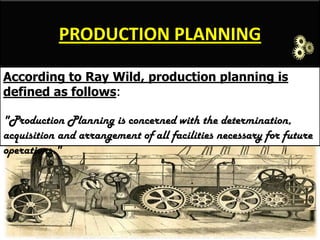
According to Ray Wild, production planning is
defined as follows:
"Production Planning is concerned with the determination,
acquisition and arrangement of all facilities necessary for future
operations."
NEED FOR
PRODUCTION PLANNING AND
CONTROL
Addresses decisions on
Acquisition
Utilization
Allocation of limited
production resources
Resources include the production
facilities, labor and materials.
Constraints include the availability of resources,
delivery times for the products and management
policies.
• It should be based on accurate data
• It should be flexible
• It must satisfy one of the pre defined objective
• It must be simple and straight forward
• It must have a reporting system
• No weak links
REQUIREMENTS OF
PRODUCTION PLANNING
PRODUCTION PLANNING
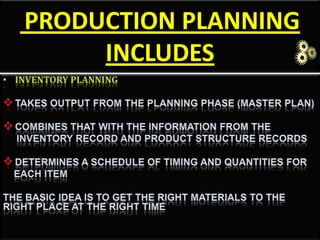
INCLUDES
Scheduling arranges the different manufacturing
operations in order of priority, fixing the time & date for the
commencement & completion of each operation.
• Types of scheduling
Forward scheduling
Backward scheduling
PRODUCTION PLANNING
INCLUDES
• The pattern of scheduling differs from one job to
another
PRODUCTION PLANNING
INCLUDES
production planning and controlPRODUCTION PLANNING
INCLUDES
PRODUCTION PLANNING
INCLUDES
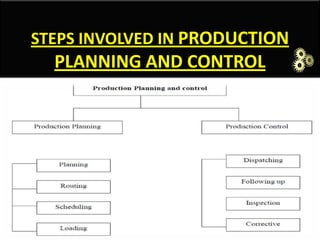
STEPS INVOLVED IN PRODUCTION
PLANNING AND CONTROL
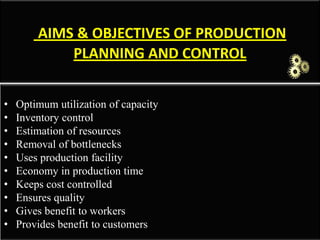
• Optimum utilization of capacity
• Inventory control
• Estimation of resources
• Removal of bottlenecks
• Uses production facility
• Economy in production time
• Keeps cost controlled
• Ensures quality
• Gives benefit to workers
• Provides benefit to customers
AIMS & OBJECTIVES OF PRODUCTION
PLANNING AND CONTROL
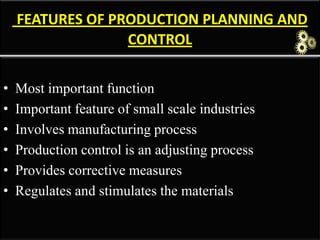
• Most important function
• Important feature of small scale industries
• Involves manufacturing process
• Production control is an adjusting process
• Provides corrective measures
• Regulates and stimulates the materials
FEATURES OF PRODUCTION PLANNING AND
CONTROL
• Steady production flow
• Maintain delivery schedules
• Resource estimation
• Ensures optimum inventory
• Minimization of wastages
• Improvement in labour productivity
• Low cost of operation
• Better work environment
• Team work
• Facilitates quality improvement
ADVANTAGES OF PRODUCTION PLANNING
AND CONTROL
• JIT is the technique for reducing inventories and
elimination of waste in the production system.
• Objectives
To eliminate waste
To improve quality
To minimize lead time
To reduce costs
To improve productivity
PRODUCTION CONTROL USING JIT
• Pull production and kanban
JIT is associated with pull systems.
Toyota was the first developer of kanban system.
• Examples
McDonalds'
Office Xerox Paper
PRODUCTION CONTROL USING JIT
CONCLUSION
Production planning and control

Production planning and control

  • 1.
  • 2.
    PRODUCTION PLANNING According toRay Wild, production planning is defined as follows: "Production Planning is concerned with the determination, acquisition and arrangement of all facilities necessary for future operations."
  • 3.
    NEED FOR PRODUCTION PLANNINGAND CONTROL Addresses decisions on Acquisition Utilization Allocation of limited production resources Resources include the production facilities, labor and materials. Constraints include the availability of resources, delivery times for the products and management policies.
  • 4.
    • It shouldbe based on accurate data • It should be flexible • It must satisfy one of the pre defined objective • It must be simple and straight forward • It must have a reporting system • No weak links REQUIREMENTS OF PRODUCTION PLANNING
  • 5.
  • 6.
    Scheduling arranges thedifferent manufacturing operations in order of priority, fixing the time & date for the commencement & completion of each operation. • Types of scheduling Forward scheduling Backward scheduling PRODUCTION PLANNING INCLUDES
  • 7.
    • The patternof scheduling differs from one job to another PRODUCTION PLANNING INCLUDES
  • 8.
    production planning andcontrolPRODUCTION PLANNING INCLUDES
  • 9.
  • 10.
    STEPS INVOLVED INPRODUCTION PLANNING AND CONTROL
  • 11.
    • Optimum utilizationof capacity • Inventory control • Estimation of resources • Removal of bottlenecks • Uses production facility • Economy in production time • Keeps cost controlled • Ensures quality • Gives benefit to workers • Provides benefit to customers AIMS & OBJECTIVES OF PRODUCTION PLANNING AND CONTROL
  • 12.
    • Most importantfunction • Important feature of small scale industries • Involves manufacturing process • Production control is an adjusting process • Provides corrective measures • Regulates and stimulates the materials FEATURES OF PRODUCTION PLANNING AND CONTROL
  • 13.
    • Steady productionflow • Maintain delivery schedules • Resource estimation • Ensures optimum inventory • Minimization of wastages • Improvement in labour productivity • Low cost of operation • Better work environment • Team work • Facilitates quality improvement ADVANTAGES OF PRODUCTION PLANNING AND CONTROL
  • 14.
    • JIT isthe technique for reducing inventories and elimination of waste in the production system. • Objectives To eliminate waste To improve quality To minimize lead time To reduce costs To improve productivity PRODUCTION CONTROL USING JIT
  • 15.
    • Pull productionand kanban JIT is associated with pull systems. Toyota was the first developer of kanban system. • Examples McDonalds' Office Xerox Paper PRODUCTION CONTROL USING JIT
  • 16.