PLAN AND
MANAGE MENU-
BASED CATERING
DEDY WIJAYANTO
Plan and manage menu based
catering
MENU PLANING
Write menus for enterprise operations
 Café - all day menu
 A la carte - fine dining
 Set menu
 Function menu
DEDY WIJAYANTO
Manager
Dossen tetap di
Sekolah Tinggi
Pariwisata Trisakti
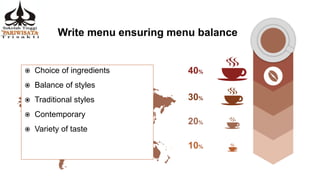
Write menu ensuring menu balance
40%
30%
20%
10%
 Choice of ingredients
 Balance of styles
 Traditional styles
 Contemporary
 Variety of taste
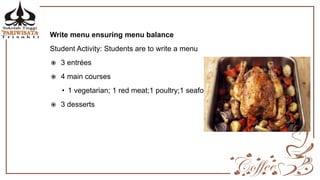
Write menu ensuring menu balance
Student Activity: Students are to write a menu
 3 entrées
 4 main courses
• 1 vegetarian; 1 red meat;1 poultry;1 seafood
 3 desserts
D A Y
B E G I N S
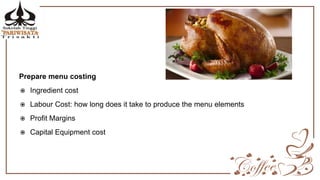
Prepare menu costing
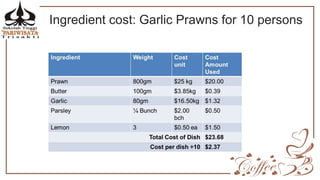
 Ingredient cost
 Labour Cost: how long does it take to produce the menu elements
 Profit Margins
 Capital Equipment cost
Ingredient cost: Garlic Prawns for 10 persons
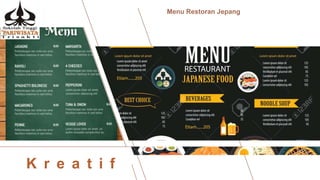
K r e a t i f
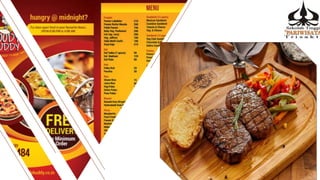
Menu Restoran Jepang
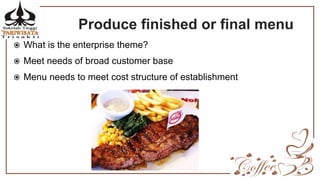
Produce finished or final menu
 What is the enterprise theme?
 Meet needs of broad customer base
 Menu needs to meet cost structure of establishment
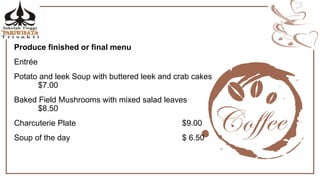
Produce finished or final menu
Entrée
Potato and leek Soup with buttered leek and crab cakes
$7.00
Baked Field Mushrooms with mixed salad leaves
$8.50
Charcuterie Plate $9.00
Soup of the day $ 6.50
Produce finished or final menu
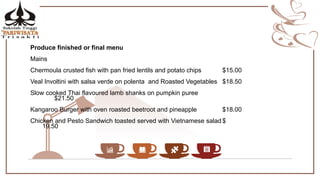
Mains
Chermoula crusted fish with pan fried lentils and potato chips $15.00
Veal Involtini with salsa verde on polenta and Roasted Vegetables $18.50
Slow cooked Thai flavoured lamb shanks on pumpkin puree
$21.50
Kangaroo Burger with oven roasted beetroot and pineapple $18.00
Chicken and Pesto Sandwich toasted served with Vietnamese salad $
19.50
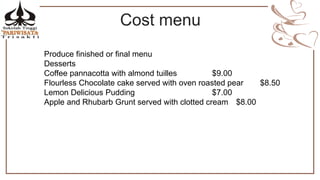
Cost menu
Produce finished or final menu
Desserts
Coffee pannacotta with almond tuilles $9.00
Flourless Chocolate cake served with oven roasted pear $8.50
Lemon Delicious Pudding $7.00
Apple and Rhubarb Grunt served with clotted cream $8.00
t i m e i s
m y t i m e
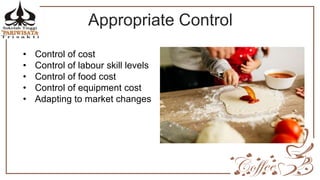
Appropriate Control
• Control of cost
• Control of labour skill levels
• Control of food cost
• Control of equipment cost
• Adapting to market changes
Select and use appropriate catering
control
Food ordering system
• Handwritten documents
• Computerised system
Easy to keep track of incoming stock
Easier to keep costs under control
Element 2: Manage menu based catering
 Select and use appropriate catering control
 Control labour costs
 Optimise product usage
 Apply stock control measures
 Plan production schedules
Select and use appropriate catering control
Skill level of staff
Training
Versatility of staff
Auditing of skill levels
Continual improvement of skill levels
Element 2: Manage menu based catering
 Select and use appropriate catering control
 Control labour costs
 Optimise product usage
 Apply stock control measures
 Plan production schedules
Select and use appropriate catering control
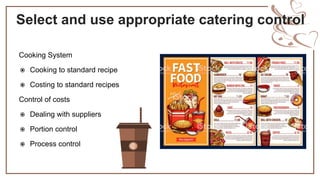
Cooking System
 Cooking to standard recipe
 Costing to standard recipes
Control of costs
 Dealing with suppliers
 Portion control
 Process control
• Control labour costs
• How many staff are required to produce
required menu items?
• How much are they paid per hour?
• What other benefits do they have?
• Are they productive all the time?
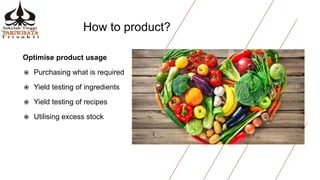
How to product?
Optimise product usage
 Purchasing what is required
 Yield testing of ingredients
 Yield testing of recipes
 Utilising excess stock
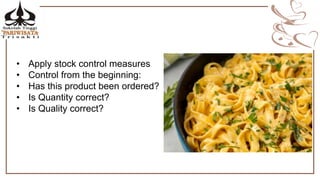
• Apply stock control measures
• Control from the beginning:
• Has this product been ordered?
• Is Quantity correct?
• Is Quality correct?
• Apply stock control measures
• Who is taking stock from store room?
• To where is it being taken?
• Does that stock arrive at the correct
destination?
• Implement usage of documentation for stock
control
We Create Professional
menu design
• Apply stock control measures
• Amount of stock received
• Number of serving of each menu
item sold
• Amount of waste from each section
• Old stock
• Breakages and accidents
• Plan production schedules
• How much needs to be produced?
• Production capabilities of the
equipment
• Skill level of the staff
• Storage facilities of the kitchen
• How many staff will be required to
meet demand?
Menu based plan
Menu based plan

Menu based plan

  • 1.
    PLAN AND MANAGE MENU- BASEDCATERING DEDY WIJAYANTO
  • 2.
    Plan and managemenu based catering
  • 3.
  • 4.
    Write menus forenterprise operations  Café - all day menu  A la carte - fine dining  Set menu  Function menu
  • 5.
    DEDY WIJAYANTO Manager Dossen tetapdi Sekolah Tinggi Pariwisata Trisakti
  • 6.
    Write menu ensuringmenu balance 40% 30% 20% 10%  Choice of ingredients  Balance of styles  Traditional styles  Contemporary  Variety of taste
  • 7.
    Write menu ensuringmenu balance Student Activity: Students are to write a menu  3 entrées  4 main courses • 1 vegetarian; 1 red meat;1 poultry;1 seafood  3 desserts
  • 8.
    D A Y BE G I N S
  • 9.
    Prepare menu costing Ingredient cost  Labour Cost: how long does it take to produce the menu elements  Profit Margins  Capital Equipment cost
  • 10.
    Ingredient cost: GarlicPrawns for 10 persons
  • 11.
    K r ea t i f Menu Restoran Jepang
  • 12.
    Produce finished orfinal menu  What is the enterprise theme?  Meet needs of broad customer base  Menu needs to meet cost structure of establishment
  • 13.
    Produce finished orfinal menu Entrée Potato and leek Soup with buttered leek and crab cakes $7.00 Baked Field Mushrooms with mixed salad leaves $8.50 Charcuterie Plate $9.00 Soup of the day $ 6.50
  • 15.
    Produce finished orfinal menu Mains Chermoula crusted fish with pan fried lentils and potato chips $15.00 Veal Involtini with salsa verde on polenta and Roasted Vegetables $18.50 Slow cooked Thai flavoured lamb shanks on pumpkin puree $21.50 Kangaroo Burger with oven roasted beetroot and pineapple $18.00 Chicken and Pesto Sandwich toasted served with Vietnamese salad $ 19.50
  • 16.
    Cost menu Produce finishedor final menu Desserts Coffee pannacotta with almond tuilles $9.00 Flourless Chocolate cake served with oven roasted pear $8.50 Lemon Delicious Pudding $7.00 Apple and Rhubarb Grunt served with clotted cream $8.00
  • 17.
    t i me i s m y t i m e
  • 18.
    Appropriate Control • Controlof cost • Control of labour skill levels • Control of food cost • Control of equipment cost • Adapting to market changes
  • 19.
    Select and useappropriate catering control Food ordering system • Handwritten documents • Computerised system Easy to keep track of incoming stock Easier to keep costs under control
  • 20.
    Element 2: Managemenu based catering  Select and use appropriate catering control  Control labour costs  Optimise product usage  Apply stock control measures  Plan production schedules
  • 21.
    Select and useappropriate catering control Skill level of staff Training Versatility of staff Auditing of skill levels Continual improvement of skill levels
  • 22.
    Element 2: Managemenu based catering  Select and use appropriate catering control  Control labour costs  Optimise product usage  Apply stock control measures  Plan production schedules
  • 24.
    Select and useappropriate catering control Cooking System  Cooking to standard recipe  Costing to standard recipes Control of costs  Dealing with suppliers  Portion control  Process control
  • 25.
    • Control labourcosts • How many staff are required to produce required menu items? • How much are they paid per hour? • What other benefits do they have? • Are they productive all the time?
  • 26.
    How to product? Optimiseproduct usage  Purchasing what is required  Yield testing of ingredients  Yield testing of recipes  Utilising excess stock
  • 27.
    • Apply stockcontrol measures • Control from the beginning: • Has this product been ordered? • Is Quantity correct? • Is Quality correct?
  • 28.
    • Apply stockcontrol measures • Who is taking stock from store room? • To where is it being taken? • Does that stock arrive at the correct destination? • Implement usage of documentation for stock control
  • 29.
  • 30.
    • Apply stockcontrol measures • Amount of stock received • Number of serving of each menu item sold • Amount of waste from each section • Old stock • Breakages and accidents
  • 31.
    • Plan productionschedules • How much needs to be produced? • Production capabilities of the equipment • Skill level of the staff • Storage facilities of the kitchen • How many staff will be required to meet demand?