Production and Operations Management
Production – conversion of raw materials to end product
by using processes, machines, men etc
Production Management – management of an
organisation’s productive resources or its production
system which converts input into output
6M’s – men, money, machines, materials, methods and
markets – to satisfy the wants of the people
‘Production Management is the process of effective
planning and regulating the operations of that section of
an enterprise which is responsible for the actual
transformation of materials into finished products.’
Production and Operations Management
Operations – include both manufacturing as well as
service – adding value.
The process of changing inputs into outputs, thereby
adding value.
- Alteration
- Transportation
- Store
- Inspection
Why PRODUCTION and OPERATION
Operations – includes both manufacturing as well as
service organisation
Operations – process of changing inputs to outputs
thereby adding value to some entity
Till 1930 – Manufacturing Management
1930 – 50 – Production Management
1970 Onwards – Operations Management
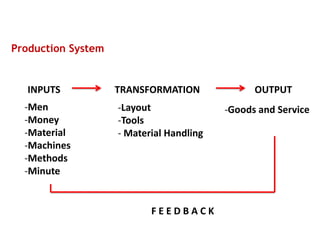
INPUTS TRANSFORMATION OUTPUT
-Men
-Money
-Material
-Machines
-Methods
-Minute
Production System
-Layout
-Tools
- Material Handling
-Goods and Service
F E E D B A C K
Production and Operations Management
Production as the creation of Utilities
value, or usefulness, that a purchaser receives in return for
exchanging his money for a company's goods or services.
Form Utility- changing the shape, form, colour etc –
transformation into finished goods
Place Utility – change of place of a thing which increases
its capacity to satisfy human wants
Time Utility – created by the preservation or storage of a
thing in a season and to consume the same in another
season when in scarcity
Possession Utility – sale and purchase of commodity
Service Utility – rendering of service
Knowledge Utility – imparting knowledge to a person
Difference between Production and
Operations Management
Output: Production management deals with manufacturing
of products like (computer, car, etc) while operations
management cover both products and services.
Usage of Output: Products like computer/car are utilized
over a period of time whereas services need to be
consumed immediately
Classification of work: To produce products like
computer/car more of capital equipment and less labour
are required while services require more labour and lesser
capital equipment.
Customer Contact: There is no participation of customer
during production whereas for services a constant contact
with customer is required.
Scope of Production and Operations
Management
1. Location of Facilities
- selection of location
- based on the company’s expansion plan and policy
- find the optimal location
2. Plant Layout and Material Handling
- Plant layout – physical arrangement of facilities
- meet the output quality and quantity most
economically.
- Material handling – moving of materials during the
manufacturing.
Scope of Production and Operations
Management
3. Product Design
- design, develop and introduce new products
- includes Product Development, Manufacturing
- Specification and design
4. Process Design
- decision –making of an overall process route for
converting the raw material into finished goods.
- Choice of technology.
- work flow of converting raw material into
finished product.
Scope of Production and Operations
Management
5. Production Planning and Control
- Planning the production in advance.
- Setting the exact route of each item
- fixing the starting and finishing dates for each item.
- Planning
- Routing – selection of path
- Scheduling –fixation of time and date
- Dispatching – starting the processes
- Follow-up – reporting daily the progress of work
Scope of Production and Operations
Management
6. Quality Control
- system used to maintain a desired level of quality in a
product or service.
- product of uniform acceptable quality is manufactured.
- Optimum quality products at minimum cost.
7. Materials Management
- Acquisition, control and use of materials needed.
- Standardization
- Source of supply
- Inventory control
8. Maintenance Management
- maintaining Plant and machinery in good conditions
Importance of Production and Operation
Management
1. Accomplishment of firm’s objectives
2. Reputation, Goodwill and Image – through products
produced
3. Helps to introduce new products – R&D
4. Support other functional areas
5. Help to face competition – satisfying customer
6. Optimum utilisation of resources – men & machine
7. Minimizes cost of production – maximise output and
minimise cost
Importance of Production Management
8. Expansion of the firm – through revenue
9. Higher standard of living – better varieties of products
10. Generates employment
11. Improves quality and reduces cost
12. Spread effect – survival of other industries
13. Creates utility – Form utility
14. Boosts economy
Function of Production and Operations
Management
1. Creation of goods or services – physical assembly of goods,
data based goods-websites, order processing services.
2. Customer Services – Support functions – Includes all
service functions after the purchase of goods and
services.
3. Profit – create profit and revenue for the company
4. Evaluation – monitoring the quality, quantity and cost of
goods produced.
5. Tasks – forecasting, scheduling, purchasing, design,
maintenance, people management, flow analysis,
reporting, assembly and testing
6. Fulfillment – timely delivery of the output from
production to customers.
7. Analysis – Critical path analysis, stock control analysis,
capacity analysis, just-in-time analysis
Objectives of Production and Operations
Management
1. To attain maximum output with given set of resources
2. To produce maximum with lowest cost
3. To control pollution and waste
4. To ensure optimum capacity utilization
5. To exercise inventory control
6. To control and reduce cost of operations
7. To ensure optimum utilization of resources
8. To ensure timely delivery of output
9. To ensure quality of products
10.To suggest changes in machinery and equipment.
Need for Production and Operations
Management
1. Produce right quality of product: based on customer
needs – considering cost of the product and technical
characteristics.
2. Right Quantity: based on the demand
3. Right Time: Timeliness of delivery
4. Right Manufacturing Cost: produce the products at
pre-established cost – reduce the variation between
actual and the standard cost
Computer Aided Design (CAD)
Computer-aided design (CAD) is the use of computer
systems to aid in the creation, modification, analysis, or
optimization of a design.
CAD software is used to increase the productivity of the
designer, improve the quality of design, improve
communications through documentation, and to create
a database for manufacturing.
CAD output is often in the form of electronic files for print,
machining, or other manufacturing operations.
Computer Aided Manufacturing (CAM)
Computer-aided manufacturing (CAM) refers to the use
of computers in the functions of production planning
and control
- Use of robots and other automated systems for the
manufacturing products.
Supply Chain Management
Supply chain management (SCM) - the management of
the flow of goods and services - involves the movement
and storage of raw materials, of work-in-process
inventory, and of finished goods from point of origin to
point of consumption.
Recent Trends in Production and Operations
Management
1. Global Market Place: Operations in many countries –
competition among manufacturing firms throughout
the world.
2. Production/Operations Strategy: for the overall
success of the business.
3. Total Quality Management: continuous improving the
quality of goods and services
4. Flexibility: adapt quick changes in manufacturing
according to the demand.
5. Time Reduction: Reduction of manufacturing cycle.
6. Technology: Automation, computerisation,
information and communication technologies.
7. Worker Involvement: responsibility for decision
making and problem solving to the lower level in the
organisation
PLANT LOCATION
Plant location means the establishment of a particular
industrial unit at a particular place
The situation of any industrial unit at any definite place
or area due to the availability of specific facility or
facilities is called localisation or concentration or
location
PLANT LOCATION - Need
1. When a new plant is to be established
2. Expansion, Diversification and Decentralisation of
Manufacturing Activities
3. Non-renewal of lease of Land
4. Doing away with Undesirable location
5. Meeting Socio-economic Needs
6. Ever Expanding Market for Products
Importance of Ideal Plant Location
Ideal Plant location – permits lowest unit cost in the
production and distribution of product and service
Ideal location means a place or a spot for locating a
factory that makes possible to enjoy maximum factors
Ideal plant location is one that makes possible lowest
input and marketing costs at their minimum
Factors affecting Plant Location
Primary Factors
1. Availability of Raw Material
- nature of raw material
- Transportation Cost
2. Nearness of Market for the finished product
- Transportation cost
3. Availability of Fuel and Power
4. Transport facilities
- for raw material and finished goods
- roads, rail, water or air
- Cost of transport must be kept at a minimum
5. Availability of Labour
- Adequate number of labour at a reasonable labour
wages
6. Availability of water
Factors affecting Plant Location
Secondary Factors
1. Soil and Climate – Agricultural Products
2. Availability and Cost of the land – accommodate the
production facilities, sufficient for future expansion
3. Safety requirement
4. Industrial Atmosphere
5. Financial and other aids – support of banks and other
institutions
6. Availability of facilities like housing, schools and
hospitals
7. Momentum of an early start
8. Special advantages of the place – facilities offered by the
state
9. Personal factors – promoters personal interest
10. Political Stability
Steps in choosing a Location for the Plant
Step 1: Deciding on domestic or international location
- Political stability
- Export and import quotas
- Exchange rates
- Cultural and economic considerations
- Availability of natural resources, climate, cost of
labour etc
- Friendliness with the country under consideration
Steps in choosing a Location for the Plant
Step 2: Selection of the region or state
- Availability of raw materials
- Availability of Market
- Power
- Transport facilities
- Nearness to suppliers
Identifying a place where the product can be produced in
a most economical way
Government policy and competition between states are
also considered
Steps in choosing a Location for the Plant
Step 3: Selection of appropriate place within the region
find a suitable place within the state
Availability of skilled labour, water, other amenities
Consideration of local taxes
Steps in choosing a Location for the Plant
Step 4: Selection of various sites within the selected place
decide on various sites and work out the costs
- Availability of cheap land to build and to expand the
plant
- Construction cost
- Facilities for transportation of goods and materials
- facilities for housing of the workers and their
transportation to the work-site
- disposing of factory waste………………..
Steps in choosing a Location for the Plant
Step 5: Decide optimum site
Work out the costs for different sites and finally select the
optimum site where he would get the maximum benefit
Latest Developments in Plant Location
1. Plants are getting located outside cities
2. Industrial Estates have come up
3. Competition among the states to develop their
industries
4. Trend towards decentralization
5. More stress given on pollution control as a mark of
social responsibility
6. Balanced regional industrial development
Latest Developments in Plant Location
1. Plants are getting located outside cities
Plants are getting located in sub-urban areas and rural
areas
Latest Developments in Plant Location
Merits of Sub-urban areas
- Suppliers contact for Raw materials
- Availability of labour Supply
- Existence of Service-facilities
- Land is cheaper
- Availability of Municipal Services
- Easy means of Transportation and Communication
- Benefits of Allied Industries
Demerits of Sub-urban areas
- Long-run Costs are high
- Problems of labour turnover and Absenteeism
- No guaranteed security
Latest Developments in Plant Location
Merits of Rural areas
- Availability of more land
- Cheap labour
- Environment friendly atmosphere
- State support through incentives and concessions
- Water supply
Demerits of Rural areas
- Lack of proper transport facilitiies
- Power supply
- Absence of Civic Amenities
- Difficulty in reaching the market
Latest Developments in Plant Location
2. Industrial Estates have come up
Group of factors constructed on a economic scale in suitable sites with
facilities of electricity, transport, roads, water, bank, canteen and
drainage systems and provided with special arrangements for
technical guidance and common service facilities
- Acquisition of suitable land and its development
- Construction of factory sheds
- Provision for infrastructure facilities like water, electricity, transport,
banks, canteens, roads etc
INDUSTRIAL ESTATES - Objectives
- Provide accomadation for plant and machinery and requisite office
- Ensure infrastructure and facilities like roads, power supply, water
and drainage
- Arrange common business facilities like banks, post office, canteen,
transport etc
- Development of small and medium scale enterprises in the country
- Dispersal of industries to rural and backward areas
- Safeguard towns and cities from various types of pollution due to
industries by shifting to the industrial estates which are normally
away from the living areas
Latest Developments in Plant Location
3. Inter-state Competition for Development of
Industries
-Through Packages and Incentives – Electricity rebate,
Loan facilities, State tax rebate, etc
4. Increased trend towards Decentalization
- Spreading out of a particular industry in different new
localities
Latest Developments in Plant Location
5. Pollution Control as a Social Responsibility
Water, Air, Noise and Solid waste
6. Move towards balanced Regional Development
- Even development
- Social Objectives
7. Growth of Transnational
Factories set up in different countries and different
parts
Plant Layout
Arrangement and location of different departments and
of the machinery within a department so that an
optimum utilisation of space available can be made
with a view to enabling the plant function in an
effective manner
The overall operating costs are minimised
A good plant layout is one which allows materials rapidly
and directly for processing.
Features of a good Plant Layout
1. Smooth flow of production
2. Maximum utilisation of available space
3. Facilities in the movement of men, materials and
machines
4. Involves minimum handling
5. Provides better working conditions
6. Flexibility
7. Location of stores
8. Facilitates supervision and control
9. Provision of safety
10.Co-ordination and integration
Objectives of Plant Layout
Maximise the production at the minimum cost
1. Economy in Material handling
2. Optimum utilisation of Resources
3. Good work flow
4. Efficient Control
5. Avoidance of frequent changes
6. Safety
7. Flexibility
8. Reduced damage and wastage of materials
9. Minimising delay and bottlenecks in production system
10. Providing employee comforts and satisfaction
Factors influencing Layout
Layout of a plant is influenced by the relationship among
materials, machinery and men
1. Materials – to provide for the storage and movement of
raw materials in a plant until they are converted into
finished products
2. Product – designed with the ultimate purpose of
producing a product
3. Worker – Type, position and requirements of
employees – Employee safety
4. Machinery – For each process or for moving of
materials
Factors influencing Layout
5. Type of Industry
a) Assembly Industry – Involves production of a product
by the use of various elements. Eg. Automobiles
b) Analytical Industry – breaks the raw materials into
various elements
c) Conditioning Industry – involves a change in form or
physical properties
d) Extractive Industry – concerned with the physical
extraction of metals and minerals from the Earth
Factors influencing Layout
6. Location factors – topography of the site which the
plant is located
7. Managerial Policies – volume of production, Future
expansion, extent of Automation, Making or buying,
purchasing policy etc.
Principles and Criteria of Plant layout
1. Maximum Flexibility – can be modified to meet the
changing circumstances
2. Maximum Co-ordination – co-ordinating all operations
3. Maximum use of volume – Space should be used to the
maximum
4. Maximum Visibility - No difficulty in supervision,
coordination and control
5. Maximum Accessibility - Servicing and maintenance
points should be readily accessible without causing
breakdown to production process
Principles and Criteria of Plant layout
6. Minimum Movement – least movement of goods and
workers
7. Minimum Discomfort – Poor lighting, excessive
sunlight, heat, noise, vibration and bad odour should
be avoided or minimised
8. Minimum Handling – The best handling is no handling.
Use of lifts, conveyors, trucks etc
9. Safety Aspects - free from causing any danger to
machine operators working on the machines
10. Efficient process flow - Material flows in one direction
only
Types of Layouts
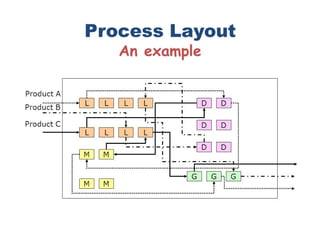
1. Process layout
Machines or equipment of the same functional types are
grouped together in a particular department
Separate departments are established for each production
operation
Raw materials have to travel from department to
department
Also called Functional layout
Process Layout - Advantages
1. Flexibility in production
2. Better and more efficient supervision is possible
through specialization
3. Greater scope of expansion – capacities can be easily
increased
4. Better utilisation of men and machines
5. Easier to handle breakdown of equipment by
transferring work to another machine
6. Full utilization of equipment
Process Layout - Disadvantages
1. Difficulty in the movement of materials
2. Require more floor space
3. Work-in-progress is more
4. High Handling charges
Process Layout - Suitability
1. Many types or kinds of products, or emphasis on
special orders
2. Relatively low volume of production of Individual
items
3. Many inspections required during a sequence of
operations
4. Materials or products too bulky to permit bulk or
continuous handling by mechanical means
Types of Layouts
2. Product layout (Straight line layout)
Involves the arrangement of machines in one line,
depending upon the sequence of operations
Materials are worked out into finished components
through a series of integrated operations
Raw Materials are fed into the first machine and the final
product comes out of the last machines
Product Layout - Advantages
1. Smooth Flow of Production
2. Mechanization of Material Handling
3. Economy in Manufacturing time
4. Lesser work-in-progress
5. Easy inspection
6. Maximum utilization of available space
7. Effective utilization of available resources – Minimum
possible movement, lesser wastage of materials etc)
Product Layout - Disadvantages
1. Inflexibility
2. Expensive – duplication of materials
3. Stoppage of work through Breakdown
4. Difficulty in Expansion
Product Layout - Suitability
1. One or few standard products
2. Large volume of production of each items over a
considerable period of time
3. Minimum inspection required during the sequence of
operations
Product and Process Layout - Difference
1. Arrangement of Production Facilities
Product – Machines and equipment are arranged one
after another on the same floor making it possible to
put one end raw-materials and to get final product on
the other
Process – Machines and equipments performing similar
functions are grouped in a separate departments of
the factory floor – All machines in a single department
are identical machines performing similar range of
activities
Product and Process Layout - Difference
2. Suitability
Product – suited where there is mass and standardised
production moving straight from raw-material stage to
another end to final product – Production is in
anticipation of demand
Process – suited for small lot and non-standardised
production – Production starts only after getting the
order
Product and Process Layout - Difference
3. Economy
Product – Costlier as there is duplication of machines
and equipments and the machines are not used to the
full extent or capacity though there is mass production
Process – the cost are comparatively much lower as
there is uninterrupted fuller use of machines and
equipment or production facilities
Product and Process Layout - Difference
4. Expansion Possibilities
Product – Not possible to increase the production
capacity of a plant beyond a particular limit
Process – possible to add to the existing capacity.
5. Flow of Work
Product – the work should move on faster provided
there is no machine break down in the chain
Process – Materials and semifinished goods move
slowly as they move from one department to another
waiting on the way
Product and Process Layout - Difference
6. Material Handling Expenses
Product – lower as it moves from one machine to
another though mechanical devices
Process – higher as there is more materials moving to
and from one department to another and waiting in
queue.
7. Flexibility
Product – rigid as it is difficult and costly to change the
existing arrangement of machines and other facilities
once set
Process – More flexible and adaptable as changes in
the existing set up can be brought easily
Product and Process Layout - Difference
8. Time Span of Production Cycle
Product – Fast movement of work
Process – Overall time taken is more
9. Cost and Effectiveness of Supervision
Product – Supervision work is easier and economical
Process – Each department has a supervisor who is to
supervise only a part of entire job
Product and Process Layout - Difference
10.Production Planning and Control (Routing, scheduling,
despatching and following up)
Product – PPC poses much less problems and pressures
on foreman and supervisory staff
Process – more task – sequence may not be pre-
determined
Combined Layout
A combination of Product and Process layout
Applicable for those factories or works which are engaged
in repetitive processes of manufacturing highly
standardised products
Fixed Position Layout
Involves the movement of men and machines to the
product which remains stationary
The material or major components remain in a fixed
location, and tools, machinery and men as well as
other pieces of material are brought to this location
Advantages
1. Same people and machines can be used on producing
different product
2. Layout investment is economical
3. Simple portable machines are used to perform
4. High cost and difficulty in transporting heavy product
is avoided
Fixed Position Layout
Disadvantages
1. Costly
2. Requirement of skilled labour
3. Time consuming
Service Facility Layout
Bring together customers and services
Hospitals
Education Institute
Hotels
Service Facility Layout
The focus of the designer should be the customer
satisfaction and employee morale
- Nearness of the facility
- Good parking place
- Well maintained entrance
- Good reception
- Working environment
- Signages at proper places
- Easily accessible facilities
Techniques and Tools of Plant Layout
Techniques
1. Templates – patterns resembling the plan of the
machines made of a thin plate of wood or from a
cardboard or from metal
- Representation of a physical object like machine, an
equipment, a work men or materials
Techniques and Tools of Plant Layout
Techniques
2. Model Equipment
3. Layout Drawings – replica of a factory floor plan showing
very clearly the space management
4. Plot Plan – entire factory building shown as a part of the
plant site giving details of production and service
departments and other production facilities that are
essential and desirably provided
- used for future expansion of production activiities
Techniques and Tools of Plant Layout
Tools
1. Process Charts
Also know as Outline process chart
Graphic representation of events and information pertaining
there to, occurring during a series of actions or
operations
Techniques and Tools of Plant Layout
Tools
Need of Process Charts
1. Presenting the birds eye view of the entire process
2. Selecting key operations for critical examination
3. Determining the requirements for detailed recording
4. Establishing logical sequence of activities
Techniques and Tools of Plant Layout
Tools
Types of Process Charts
a) Operation Chart – graphic representation of the points
at which materials are introduced into the process and
the sequence of inspection and all operations except
those involved in material handling.
- Indicates the overall picture of the process involved in a
factory
- Helps in improving the existing processes and the
location
Techniques and Tools of Plant Layout
Tools
Types of Process Charts
b) Flow Process Chart – graphic representation of the
sequence of all operations, transport, inspection, delays
and storages occurring during a process or procedure and
includes information considered for the analysis such as
time required and the distance moved
Three Types
- Flow process charts for men
- Flow Process charts for equipments
- Flow Process charts for materials
Techniques and Tools of Plant Layout
Tools
2. Machine Data Card
Provides the necessary information for placement or a
layout of a machine or equipment
Illustration of the machine or equipment
Production capacity of a given machine in terms of output
and space required
Layout Procedure
How to go in for a proper layout.
1. Data Accumulation – Collection of data of the layout
- Information about the operation involved and tools
required
- Information about the volume of production
- Method involved in Production
- Flow process charts and standard time to complete
each operation
Layout Procedure
2. Data Analysis and Co-ordination
- Analysis of the Data collected
- Preparation of Operation Process Charts
- Understanding the sequence of operation
- Understanding the overall picture of the flow pattern
and all the necessary production operations
Layout Procedure
3. Machine and Equipment Decision
- Type of machines and equipment needed
- Selecting the right type of machines and equipments
which will serve for a longer period of time
4. Design and decide the material Handling Plan
- Equipment for the movement of raw-materials and
finished product
- Depends on the material to be moved, distance of
movement, speed etc.
-
Layout Procedure
5. Plan the Building Layout
- To have machines and other production facilities
- Building should have all the facilities to
accommodate
6. Plan the General Flow Pattern
- Flow of materials throughout the plant
- Help in reducing manufacturing cycle time
- Product layout or Process Layout or combined
Layout Procedure
7. Design Individual Work Stations
- A work station is the floor area occupied by the
worker and the machine or group of workers and
machines
- Space Allocation
8. Combine Individual Layout of Work Stations
- Consolidation of all Work Stations in accordance with
the general flow pattern of work and the building
facilities
Layout Procedure
9. Calculation of Storage Space Needed
- Storing of Raw Materials and Finished goods
- Protection of materials
10.Making Work Station Flow diagrams and Incorporate in
the Plot Plan
- Clear understanding of flow of work and to find out
whether work is held up in any Work station
Layout Procedure
11.Locate Service Departments
- To support and strengthen the working of production
department
- includes rest and lunch rooms, dispensary,
maintenance, etc
12.Design the Master Layout Plan
- Master plan – which is designed with the help of
drawings, diagrams, templates giving a model of the
entire factory
Layout Procedure
13.Check and Recheck the Final Layout
- Asking opinions and suggestions of experts
14.Get the Official Approval
- From the Officials in the organisation and from
outside authorities if required
15.Install the Approved Final Layout Plan
After modification if any, implement the plan step by
step which involves actual installation of machinery
and other equipments needed for production
Space Requirement for the Machines
Ample space should be provided around the machines for
complicated and dangerous machines to avoid
accidents as well as for servicing
Man’s safety and comforts should be given priority
Different types of Facilities
1. Factory Building
2. Factory Lighting
3. Ventilation and Air-conditioning
4. Industrial Sanitation
5. Industrial Noise Control
6. Industrial Safety
1. Factory Building
Place where production is carried on and into which all
other production tools and mechanisms must fit.
Building should ensure functional smoothness of
operations
Building should be strong enough to withstand damages
Factors in Designing an Ideal Factory Building
1. Flexibility or Adaptability – to meet the present and
future needs and requirements
2. Expandability – sufficient space for any additions and
extensions
3. Product and Equipment – type of products –
Machineries used
4. Employee facilities and service areas – employee
comfort – canteen, lunch rooms, medical rooms etc
5. Material Handing – Fixing and installation of Material
Handling equipment
6. Lighting, ventilation and air-conditioning – good
lighting, fresh air, free from pollution
7. Fire protection and other protections of property and
people – protect form natural calamities
Types of Factory Building
Single Storey Building
- Whenever the land is available in plenty and at
cheaper rate
- Mostly in rural areas
Multi Storey Building
- Cost of land is high
- No scope for horizontal expansion
- Mostly in Urban and Semi Urban areas
Types of Factory Building
High Bay and Monitor Types
Single storey structures by giving more space which can
be used to operate crane and other facilities
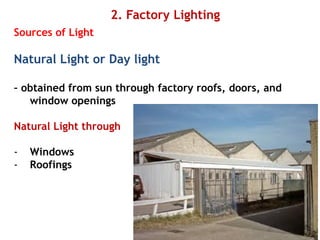
2. Factory Lighting
Sources of Light
Natural Light or Day light
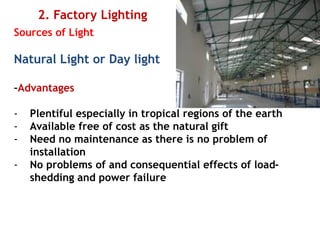
– obtained from sun through factory roofs, doors, and
window openings
Natural Light through
- Windows
- Roofings
2. Factory Lighting
Sources of Light
Natural Light or Day light
–Advantages
- Plentiful especially in tropical regions of the earth
- Available free of cost as the natural gift
- Need no maintenance as there is no problem of
installation
- No problems of and consequential effects of load-
shedding and power failure
2. Factory Lighting
Sources of Light
Natural Light or Day light
Disadvantages
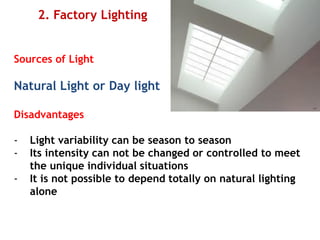
- Light variability can be season to season
- Its intensity can not be changed or controlled to meet
the unique individual situations
- It is not possible to depend totally on natural lighting
alone
2. Factory Lighting
Sources of Light
Artificial Light
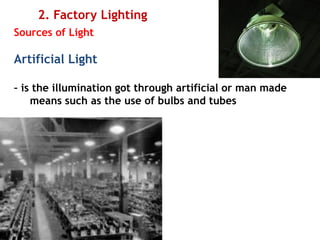
– is the illumination got through artificial or man made
means such as the use of bulbs and tubes
2. Factory Lighting
Sources of Light
Artificial Light
Advantages
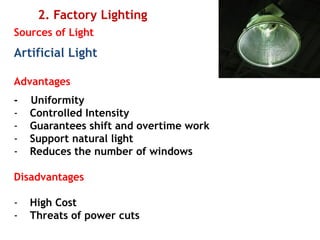
- Uniformity
- Controlled Intensity
- Guarantees shift and overtime work
- Support natural light
- Reduces the number of windows
Disadvantages
- High Cost
- Threats of power cuts
3. Ventilation and Air-conditioning
Ventilation – removal of stale air and letting in fresh air in
the factory building
Process of removing or supplying air by natural or
mechanical or combined means to and from factory
building
Importance
- Provides adequate supply of fresh air
- Protects the health of Workers
- Reduces odour and Impurities
- Removes Dust
- Prevents excessive heat generation
3. Ventilation and Air-conditioning
Air-conditioning
Importance
- Employee Confort
- Employee Health
- Desirable Conditions of Temperature
- Preservation and Improvement of Product Quality
- Protection of Manufacturing Equipments
4. Industrial Sanitation
- Maintenance of cleanliness
- Control of the spread of infections and other insults to
employee health
Elements
- Adequate and clean water supply
- Waste disposal
- Provision for personal service rooms
- Supply of Hygienic Food
- Good Plant House-Keeping
5. Industrial Noise Control
Noise – unwanted sound
Sound that does not have an agreeable quality
Vibration is that kind of shaking that causes rapid
deterioration of machines, buildings and resulting in
high maintenance costs
5. Industrial Noise
Importance of Noise Control
- To protect physical and mental health of Employees
- To make oral communication more effective
- To improve employee efficiency and productivity
6. Industrial Safety
All those measures to safe-guard and protect the property
and personnel of a factory against possible theft,
damage
Protection of the workers from the danger of industrial
accidents
Importance
- Increased Productivity
- Fulfills legal Requirements
Production Planning and Control
PPC – defined as the direction and coordination of the firm’s
material and physical facilities towards the attainment
of pre-specific production goals in the most efficient
available way
- Organisation of the supply and movement of materials and
labour, machine utilisation and related activities in order
to bring about the desired manufacturing results in terms
of quality, time and price
Production Planning and Control - Objectives
1. Quality of output – safe and economical manufacture of
desired products in required quantity and quality
2. Plant Utilization – productivity of highest degree
3. Process Efficiency – maximum process efficiency by
proper coordination
4. Delivery of goods – deliver the products to the customers
whenever they are needed
5. Maintenance of inventories – maintain adequate supply
of finished goods and having sufficient work-in-process –
to ensure that deliveries are made to the customers in
time
6. Effectiveness of work – right man for the right job, at the
right place, at the right time on right wages and salaries
Production Planning and Control - Objectives
7. Absenteeism – minimise and regulate absenteeism
8. Team spirit – feeling of brotherhood among workers
9. Ideas for new methods – giving encouragement to the
workers for new ideas and new methods
10.Reduced supervision – reduce supervision by creating
interest in work amongst workforce
11.Reduced waiting time – reduces waiting time arising due
to want of material, tools, equipment etc
Production Planning and Control - Functions
1. Materials – making the materials available in the
required quantities and at required time to enusre
correct beginnning and end for each operation resulting
in uninterrupted production
2. Methods – Analysis of alternatives and selection of the
best method with due consideration to constraints
imposed – determination of sequence of operations
3. Machines and Equipment – detailed analysis of available
production facilities, equipment down time,
maintenance policy, procedure and schedule
4. Manpower – availability of appropriate man power on
appropriate machines at the right time
5. Process planning (Routing) – selection of path route
which the raw material should follow to get transferred
into finished product
Production Planning and Control - Functions
6. Estimating – Operations time – Fixing of standard time
for operation
7. Loading and Scheduling – Loading the machines as per
capacity – Scheduling is concerned with preparation of
machine loads and fixation of starting and completion
date for each of the operations
8. Despatching – process of setting production activities in
motion through release of orders and instructions
9. Expediting – close observation on the progress of the
work – also called as follow-up
10.Inspection – becoming aware of the limitations with
respect to methods, processes etc
11.Evaluation –tharough analysis of all the factors of
production – identify the weak spots and taking
corrective actions
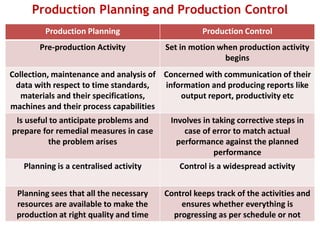
Production Planning and Production Control
Production Planning Production Control
Pre-production Activity Set in motion when production activity
begins
Collection, maintenance and analysis of
data with respect to time standards,
materials and their specifications,
machines and their process capabilities
Concerned with communication of their
information and producing reports like
output report, productivity etc
Is useful to anticipate problems and
prepare for remedial measures in case
the problem arises
Involves in taking corrective steps in
case of error to match actual
performance against the planned
performance
Planning is a centralised activity Control is a widespread activity
Planning sees that all the necessary
resources are available to make the
production at right quality and time
Control keeps track of the activities and
ensures whether everything is
progressing as per schedule or not
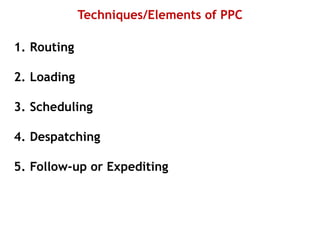
Techniques/Elements of PPC
1. Routing
2. Loading
3. Scheduling
4. Despatching
5. Follow-up or Expediting
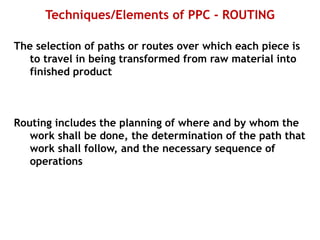
Techniques/Elements of PPC - ROUTING
The selection of paths or routes over which each piece is
to travel in being transformed from raw material into
finished product
Routing includes the planning of where and by whom the
work shall be done, the determination of the path that
work shall follow, and the necessary sequence of
operations
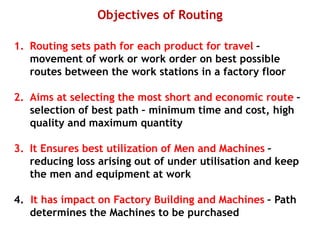
Objectives of Routing
1. Routing sets path for each product for travel –
movement of work or work order on best possible
routes between the work stations in a factory floor
2. Aims at selecting the most short and economic route –
selection of best path – minimum time and cost, high
quality and maximum quantity
3. It Ensures best utilization of Men and Machines –
reducing loss arising out of under utilisation and keep
the men and equipment at work
4. It has impact on Factory Building and Machines – Path
determines the Machines to be purchased
Advantages of Routing
1. Efficient use of available resources
2. Reduction in manufacturing costs
3. Improvement in quality and quantity of output
4. Provides a basis for scheduling and loading
Routing Procedure / Steps in Routing
1. Decision as to Make or buy – deciding about which
components can be produced in the plant and which
parts are to be purchased from outside
2. Determining the Material required – Quality standard
materials – materials match the product quality
standards
3. Determining the manufacturing operations and their
sequence – production process of transforming inputs
into output is outlined in the form of drawing on a
route sheet using symbols
Routing Procedure / Steps in Routing
4. Duration and the nature of equipment and machine
required for each operation – time taken to complete
each process in each machines is determined
5. Ascertaining Lot Sizes – economic lot size of
production order quantity is calculated
6. Cost Analysis of the product – Direct Material and
labout costs – supporting Accounting department in
providing information
7. Organising Production Control Forms – various types of
Performa is prepared to record the details of
production process at different stages
Route Sheets
It is the map or the blueprint of the manufacturing process in a
production unit.
A route sheet determines the sequence or order of arrangement
of various departments in a facility.
Route sheet is a document which has information and data inputs
and a step wise listing of all the processes or transactions
performed.
Route Sheets
Route Sheet contains
- Identification and sequence of work arrangement.
- Symbol or sign of a component of the product
- Computing the number of units to be produced.
- Machines and tools used in the operation, their run time,
efficiency and capacity.
- Evaluation of the entire production process
Techniques/Elements of PPC - LOADING
Loading can be defined as the study of the relationship
between load and capacity at the place where work is
done.
Loading provides a complete and correct information
about the number of machines available and their
speed, capacity etc
The information is used to calculate the difference
between work load and actual capacity
Objectives
1. To plan new work orders on the basis of capacity
available
2. To balance the work load in a plant
3. To maintain the delivery promises
Techniques/Elements of PPC - SCHEDULING
Detailed planning of material, labour and machines time
so that materials and parts will be at the right place,
at the right time so that a job can be completed within
the time planned and in accordance with the
requirements
Objectives
1. Ensure maximum utilisation of the plant at minimum
cost
2. Ensure that requirements of manpower is optimum
and is evenly distributed
3. Possess up to date information regarding availability of
materials, expected date of delivery, materials
rejection, shortages etc
Techniques/Elements of PPC - SCHEDULING
Objectives
4. Determining Machine servicing and overhauling
schedules and replacement schedules
5. Complete information on performance standards and
their revisions, method improvement, change in
materials and machines etc
6. Obtain quick feedback from machine shops regarding
delays and interruptions which may hold up
production activity
Techniques/Elements of PPC - SCHEDULING
Types of Schedules
1. Operation Schedule – determines the total time
required to do a piece of work with a given machine or
process
2. Master Schedule – list showing how many of each item
to make in each period of time in future
3. Sequential Schedule – Defining a sequence for a multi
product plant – processing through number of
department
Techniques/Elements of PPC - DESPATCHING
Is the routine of setting productive activities in motion
through the release of orders and instructions, in
accordance with previously planned time and
sequences as per the route sheets and schedule charts
Functions
1. To check the immediate availability of materials
2. Ensuring that all production and inspection aids are
available for use
3. Assign the work to definite machine, work place and
men
4. To issue necessary materials, tools etc to correct point
for use
Techniques/Elements of PPC - DESPATCHING
Functions
5. To issue production order note stating the start time
and finish time
6. Instruction to start the production
7. To maintain all production records – time taken for
production and the cause for delay, critical incidence
etc
Techniques/Elements of PPC – FOLLOW UP
Production control procedure which regulates the
progress of materials and parts through production
process
- Regulator of materials when they are travelling on the
path of performance as laid down by routing sheets
and schedule charts
Objectives
1. To correct the irregularities in Production process
2. To find out whether the activities was according to the
plan
3. To eliminate unnecessary actions
4. To make the production process more effective
CAPACITY
• Capacity may be defined as the maximum quantity of
output that can be produced from an existing plant
in a given period of time.
• Capacity information enables managers to make
decisions concerning inputs and outputs required.
TYPES OF CAPACITY
1. Licensed Capacity – denotes the capacity licensed
by the Govt authorities concerned.
2. Potential Capacity – The decision on potential
capacity is taken mostly by a senior most executive
of the organisation
3. Immediate Capacity – is that which can be made
available within the current budget period
4. Design or installed Capacity – maximum output
that can be achieved in a given time period from a
particular plant.
5. Practical Capacity – It is the maximum capacity
minus the capacity lost due to efficiency and scarp
factors.
6. Actual or Utilised Capacity – This is the actual
output achieved during a particular time period
7. Normal Capacity – It is the capacity estimated by a
qualified authority as to the amount of production
that should be usually secured.
CAPACITY PLANNING
Capacity Planning refers to determining what kind of
labour and equipment capacities are required and
when they are required.
Four Major considerations in Capacity Planning
1. Level of Demand
2. Cost of Production
3. Availability of Fund
4. Management Policy
IMPORTANCE OF CAPACITY PLANNING
1. Capacity limits the rate of output
2. Capacity influences the operating Costs
3. Capacity decisions have direct impact on the
amount of investment made
4. Capacity decisions results in long term
commitment of funds
PROCEDURE FOR CAPACITY PLANNING
1. Assessment of Existing Capacity
2. Forecasting Future Capacity needs
3. Identifying Alternative ways of Modifying
Capacities
4. Evaluation of Alternatives
5. Choice of suitable course of Action
QUALITY CONTROL &
MANAGEMENT
• Quality control includes techniques and
systems for the achievement of the required
quality in the articles produced & for the
elimination of sub-standard goods.
Objects of quality control
• Establishing quality standards
• Ensure smooth production
• Find out deviations in production process
• Find out causes for low productivity
• Segregation of defective products
Principles or essentials of quality
control system
• Set standard
• Quality control must be responsibility of a
competent personnel
• Measuring quality standards at every step
• Unanimity among workers to maintain quality
• Maintaining records of quality
Steps to exercise effective quality
control
• Setting the Standards of quality
• Control over raw materials
• Control over production operation
• Inspection of machinery & equipment's
• Promptness in inspecting quality
• Quality consciousness
• Application of statistical methods of quality
control - sampling, - standard deviation, -
probability
Factors affecting the quality of
goods
• Cost of production
• Requirements of customers
• Equipment's & tools used
• Utility of products
• Attitude of workers
• Scale of operations
Functions of quality control
• Determining requirements of the factory
• Keeping records of quality standards
• Determining sampling limits
• Better quality devices developed
Advantages of quality control
• Consumer satisfaction
• Quality consciousness
• Better utilization of resources
• Increased sales
• Uniform products
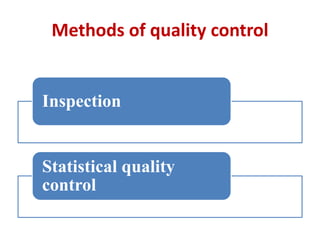
Methods of quality control
Inspection
Statistical quality
control
Inspection
• Inspection is the process of measuring the
qualities of a product or service in terms of
established standards
- W. R. Spriegel
Objectives of inspection
• Segregate products which do not conform to
the standards
• Finding out reasons for low quality or
rejection of goods
• Maintaining reports
Forms of inspection
• Inspection of raw materials
• Inspection of work in progress
• Process control – temperature, humidity
• Running tests
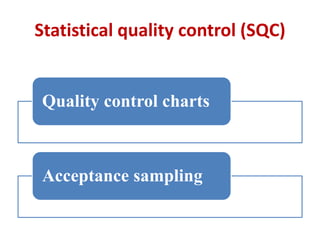
Statistical quality control (SQC)
Quality control charts
Acceptance sampling
Quality control charts
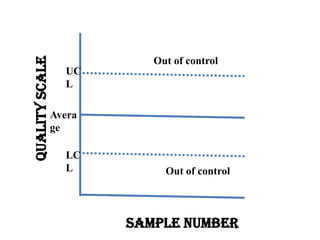
• A control chart is the graphic presentation of
expected variations in quality
• Two lines on each graph indicate tolerance
limits within which the variations of quality
will be permitted
• Upper control limit (UCL)
• Lower control limit (LCL)
• Sample is rejected if it falls outside the
tolerance limits
Out of control
Out of control
QUALITY
SCALE
SAMPLE NUMBER
UC
L
LC
L
Avera
ge
Acceptance sampling
• A sample is taken from the manufactured
products and quality of these products is
inspected.
• If the quality of the sample conforms to the
pre-determined standards then it is presumed
that the quality of the whole lot is good.
Advantages of statistical quality
control
• Inspecting a sample instead of the whole lot
• Increases profits
• Simplifying quality control
• Creating quality consciousness among
employees
• Improves the goodwill of the products among
consumers
TOTAL QUALITY MANAGEMENT
(TQM)
TQM is a corporate business management
philosophy which recognizes that customer needs
and business goals are inseparable.
- British Quality Association
Elements of TQM
• Commitment to quality
• Customer satisfaction
• Measurement of quality
• Prevention rather than detection
• Proper training
• Continuous improvement
• benchmarking
Quality system standards
International Organization for Standardization
(ISO)
- Worldwide federation of national standards
bodies located in Geneva, Switzerland
- To promote the development of
standardisation and related activities in the
world with a view to facilitating international
exchange of goods and services
- To developing cooperation in the spheres of
intellectual, scientific, technological and
economic activity
Quality Circles (QC)
• Quality circle is a small group of people who
voluntarily perform quality improvement
activities at the work place
Objectives of quality circles
• To aid self & mutual development
• To increase quality & cost awareness
• To utilize the creativity of the work force
• To develop managerial ability & leadership
• To improve productivity
Benefits of QCS
• Improves human relations
• Develops participative culture
• Workers take interest in solving problems
• Reduces defects of products/ services
• Helps in improving productivity
• Helps in leadership development
Maintenance Management
Maintenance Management – Introduction
Types of Maintenance
- Breakdown
- Preventive
- Scheduled
- Predictive
Modern scientific maintenance methods
Maintenance
Maintenance is the set of activities performed to keep an
equipment in the specified condition or it is a remedial
action to restore the equipment to its specified
condition
Day to day activity of keeping the physical plant in good
operating condition
Set of activities which help in keeping plant, machinery and
other facilities in good condition
Maintenance Management
Maintenance Management is concerned with planning and
controlling routine, planned and preventive maintenance
activities of an organization
Maintenance Management is concerned with the direction
and organisation of resources in order to control the
availability and performance of the industrial plants to
some specified level
Objectives of Maintenance
1. To keep the factory-plants, equipment, machine tools
etc in an optimum working condition
2. To keep equipment safe and prevent the development of
safety hazards
3. To ensure specified accuracy to products and time
schedule of delivery to customers
4. To keep the down time of machines to the minimum thus
to have control over the production programme
5. To keep the production cycle within the stipulated range
6. To modify the machine tools to meet the augmented
needs for production
7. To improve productivity of existing machine tools and to
avoid sinking of additional capital
8. To reduce the maintenance costs as far as possible
thereby leading to a reduction in factory overheads
Objectives of Maintenance
9. To prolong the useful life of the factory plant and
machinery
10. To help management in taking decisions on replacement
or new investment
11. Help in implementation of suitable procedure for
procurement, storage and consumption of spares, tools
etc
12. Standardisation of spares and parts in conformity with
plant, national and international standards
13. Help in training and development of skilled workmen
and executives
Functional Elements of Maintenance Programme
1. Inspection or Check-ups – checking whether equipment is
as per the standards
2. Lubrication – application of right type of lubricant at the
right time, at right place and in right quantity
3. Planning and Scheduling – based on the analysis done on
the past records
4. Records and Analysis – Keeping of registers
5. Training of Maintenance Personnel - technicians and
supervisors are trained to carry out maintenance,
inspection and repairs
6. Storage of Spare Parts - Keep stock of spare parts so as
to avoid loss of production
Importance of Maintenance
1. Maintaining Operating Efficiency
2. Prevention of Loss of Production
3. Maintaining Productivity level
4. Helps solving the problems of Break-downs
5. High Employee Morale
Advantages of Maintenance Management
1. Reduction in production down time
2. Less overtime pay for maintenance personnel
3. Lesser number of stand-by equipment needed
4. Less expenditure on repairs
5. Due to planned spare parts replacement, lesser spare
parts inventory in stores
6. Greater safety to employees because of reduced
breakdowns
Cost of Maintenance
1. Down-time Costs – cost incurred due to breakdown of
machine
2. Idle Wages – wages paid to the employees for just
spending the time in the factory and not for any
productive work.
3. Cost of Repairs – Break-downs which are unexpected
4. Failure to meet delivery schedule – consumer loyalty is
lost
5. Lowered Employee Morale – negative attitude and
negative results
6. Cost of Stand-by Equipment
Types of Maintenance
1. Corrective or Breakdown Maintenance
2. Preventive Maintenance
3. Predictive Maintenenace
Corrective Maintenance
- also called as breakdown maintenance
- Repairs are made only after the equipment is out of
order
- Refers to the repair work taken after the failure of
machine or equipment
- Suitable for equipments whose down-time and repair
costs are less
Causes for Equipment Breakdown
1. Failure to replace the worn out parts
2. Lack of inadequate lubrication
3. Neglected cooling system
4. External factors such as too low or too high voltage,
wrong fuel etc
Objectives/Advantages of Breakdown
Maintenance
1. To get equipment back into operation as quick as
possible in order to minimise interruption to production –
production capacity, production costs, product quality
and consumer satisfaction
2. To control the cost of repair, including regular time and
overtime labour costs
3. To control the cost of the operation of repair shops
4. To control the investment in replacement spare parts
that are used when machines are reparied
Disadvantages of Breakdown Maintenance
1. Work Stoppage at any time
2. Reduced Output
3. Increased Accidents and Lesser Safety to Employees
4. More lower quality output
Suitability
- Where the plant capacity exceeds market demand
- Stand-by equipment is available
- Machine outdated and more modern equipment is under
consideration
Preventive Maintenance
- Consists of routine action taken in a planned manner to
prevent breakdowns
- Lubrication and inspection are the two important aspect
of preventive maintenance
- Lubrication ensures long and safe working of the
equipment without mishap
- Inspection facilitates detection of faults in an equipment
so that repairs and replacements may be undertaken
before it leads to breakdown
Forms of Preventive Maintenance
1. Time based Preventive Maintenance – refers to
conducting maintenance at regular intervals
2. Work-based Preventive Maintenance – Maintenance
performed after a set number of operating hours of
volume of work produced
3. Opportunity-based preventive maintenance – Repair or
replacement takes place when the equipment or system
is devoid (free) of work
4. Condition-based Preventive Maintenance – relies on
planned inspection to reveal when maintenance is
convenient
Objectives of Preventive Maintenance
1. To minimise the possibility of unanticipated production
interruptions
2. To make plant equipment and machines always available
and ready for use
3. To maintain the value of the equipment and machinery
by conducting periodic inspection, repairs, overhauling
etc
4. To reduce the work content of maintenance job
5. To ensure safety of life of the workmen
Advantages of Preventive Maintenance
1. Life of Machine and equipment become longer
2. Production planning become easier due to fewer
breakdowns
3. Higher productivity due to less down-time
4. Production system becomes more reliable due to less
repetitive repairs
5. Safety of plant and employees is enhanced
6. Shutdowns and startups can be scheduled in advance
7. Lesser no. of stand-by equipment are needed
8. Minimum Inventory, less rejects and better quality
control
Disadvantages of Preventive Maintenance
Page 214 S K Podder
Predictive Maintenance
Using human senses or other instruments like vibration
analysers, pressure, temperative detector etc to predict
a problem before the equipment fails
- Unusual sounds coming out of a rotating equipment
predict a coming trouble
- Advantages and Disadvantages – 215 S K Poddar
Scheduled Maintenance
Scheduled maintenance is a ‘stitch in time’ procedure
aimed at avoiding break-downs
- Includes inspection, lubrication, repair and overhaul of
certain equipments which, if neglected, can result in
break-down
Plant Maintenance Scheduling
Determining the calander inspection dates
Clear, precise and easy to operate
Finalised in consultation with production department
Procedure
1. Preparation of ‘master’ maintenance schedule – indicates
the nature and the amount of each repair and
construction task segment of maintenance for a specified
time span
2. Preparation of ‘detailed’ weekly or daily schedule –
provides information related each activity to be carried
on
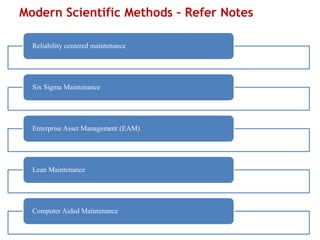
Modern Scientific Methods – Refer Notes
Reliability centered maintenance
Six Sigma Maintenance
Enterprise Asset Management (EAM)
Lean Maintenance
Computer Aided Maintenance
Waste Management
Waste – that portion of raw-material lost in processing
having no recovery value
Visible waste – physically present – Ash, saw-dust etc
Invisible waste – disappearance of basic raw-material in the
form of evaporation, smoke etc
Waste management is the collection, transport, processing,
recycling or disposal, and monitoring of waste materials
179
Kinds of Wastes
Solid wastes: domestic, commercial and industrial wastes
especially common as co-disposal of wastes
Examples: plastics, bottles,
cans, papers, scrap iron, and other scrap
Liquid Wastes: wastes in liquid form
Examples: domestic washings, chemicals, oils, waste
water from manufacturing industries
Why Waste
➢ Bad planning and incorrect policies, systems and procedures
➢ Faulty work method
➢ Wrong specifications, standards, raw materials etc
➢ Lack of proper inventory control, handling of material etc
➢ Failures of maintenance
➢ Poor working conditions
How waste can be reduced ?
Step 1 - Recognise the total waste found in the whole system
Step 2 – Identify the stages from which waste is generated
Step 3 – Identify the substages in which above waste can be put
Step 4 – Plan for corrective action and to eliminate the causes at
each stage of the Waste reduction program
Waste Management
Effective management does everything possible to keep waste at a
minimum
Cooperation with production and engineering to prevent waste
should be one of the purchasing department’s major value
analysis objectives
Waste Management
Large Scale Organisation have Waste Management Department
Three Sources of Waste:
- Obsolete Items
- Surplus
- Scrap
Waste Management
Disposal of Obsolete Items
Need proper scrutiny and expert advice before deciding to consider
it so and disposing
Waste Management department should try to locate the obsolete
items as early as possible and get declared so. Then, the
department should prepare a list and take action to dispose the
items off
Waste Management
Disposal of Obsolete Items
1. Invite quotations or circulate the list of these items
2. Give detailed ads in newspapers and periodicals to that effect
3. Declare the auction in public
Waste Management
Disposal of Surplus Items
When there is surplus anywhere in the organisation, it is the duty
of the concerned unit to inform the waste management
department to take appropriate timely action for disposal of
surplus items
Surpluses are disposed at purchase price to avoid loss
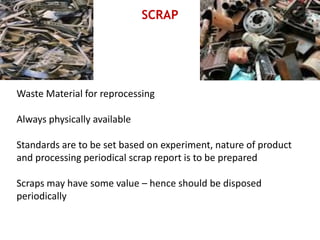
SCRAP
Waste Material for reprocessing
Always physically available
Standards are to be set based on experiment, nature of product
and processing periodical scrap report is to be prepared
Scraps may have some value – hence should be disposed
periodically
SCRAP
➢ Spoiled raw materials
➢ Rejected components
➢ Defective parts
➢ Obsolete equipment
➢ Wastes from production departments
➢ Packing cases
SPOILAGE
- Outcome of materials being damaged in manufacturing
operations in such a way that they can not be rectified and
brought back to normal specifications
- Spoilage occurs due to some defect in materials or
manufacturing operations which could have avoided
Control of Spoilage
- Normal spoilage is determined in advance and compared with
actual spoilage in spoilage Report
- Causes of abnormal spoilage should be investigated and
remedial measures should be taken immediately
DEFECTIVES
Defective Work is that portion of production which is below
standard specification or quality and can be rectified by
incurring additional expenditure on material labour and works
overheads known as rectification cost
Spoilage – cannot be rectified
Defectives - can be rectified by incurring additional costs and
brought back to the level of standard product
SALVAGED ITEMS
Salvage items are those which can not be put to use for their
original purpose for which they where procured
Parts of the salvaged items may be collected and may be used in
repairs, replacements and so on
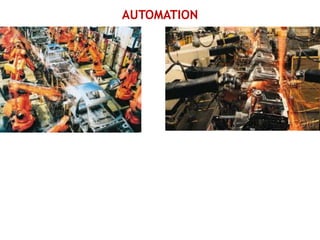
AUTOMATION
AUTOMATION - Meaning
Automation is a technology concerned with the application
of mechanical, electronic and computer-based systems
to operate and control production
Reducing human intervention to the minimum
Human Contribution – physical and mental
Physical is taken over by machines
Mental is taken by computers
Forms of AUTOMATION
1. Integration – processes in which the finished product is
moved automatically, untouched by human hands, from
one stage to another
2. Feedback Control – Electronic process by which any error
or diversion of the machine from a planned performance
is automatically corrected
3. Computer Technology – Electronically operated machines
capable of recording and classifying information, and
when required drawing conclusions from this information
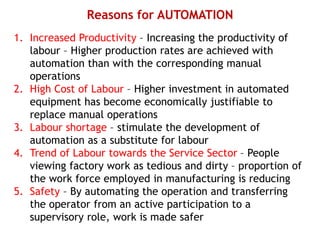
Reasons for AUTOMATION
1. Increased Productivity – Increasing the productivity of
labour – Higher production rates are achieved with
automation than with the corresponding manual
operations
2. High Cost of Labour – Higher investment in automated
equipment has become economically justifiable to
replace manual operations
3. Labour shortage – stimulate the development of
automation as a substitute for labour
4. Trend of Labour towards the Service Sector – People
viewing factory work as tedious and dirty – proportion of
the work force employed in manufacturing is reducing
5. Safety – By automating the operation and transferring
the operator from an active participation to a
supervisory role, work is made safer
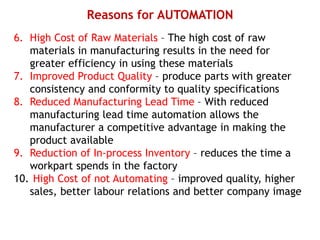
Reasons for AUTOMATION
6. High Cost of Raw Materials – The high cost of raw
materials in manufacturing results in the need for
greater efficiency in using these materials
7. Improved Product Quality – produce parts with greater
consistency and conformity to quality specifications
8. Reduced Manufacturing Lead Time – With reduced
manufacturing lead time automation allows the
manufacturer a competitive advantage in making the
product available
9. Reduction of In-process Inventory – reduces the time a
workpart spends in the factory
10. High Cost of not Automating – improved quality, higher
sales, better labour relations and better company image
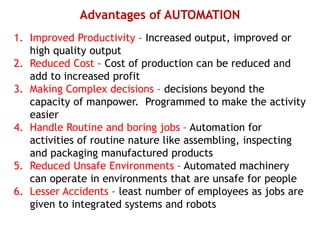
Advantages of AUTOMATION
1. Improved Productivity – Increased output, improved or
high quality output
2. Reduced Cost – Cost of production can be reduced and
add to increased profit
3. Making Complex decisions – decisions beyond the
capacity of manpower. Programmed to make the activity
easier
4. Handle Routine and boring jobs – Automation for
activities of routine nature like assembling, inspecting
and packaging manufactured products
5. Reduced Unsafe Environments – Automated machinery
can operate in environments that are unsafe for people
6. Lesser Accidents – least number of employees as jobs are
given to integrated systems and robots
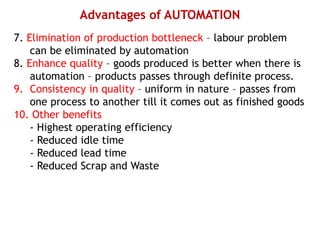
Advantages of AUTOMATION
7. Elimination of production bottleneck – labour problem
can be eliminated by automation
8. Enhance quality – goods produced is better when there is
automation – products passes through definite process.
9. Consistency in quality – uniform in nature – passes from
one process to another till it comes out as finished goods
10. Other benefits
- Highest operating efficiency
- Reduced idle time
- Reduced lead time
- Reduced Scrap and Waste
Disdvantages of AUTOMATION
1. High capital investment – initial investment is high –
installation costs, maintenance cost, power
consumption, depreciation and other operating cost
2. High cost of depreciation – More machines used – tend to
depreciate every year.
3. Not suitable to small firms – due to heavy investment –
costly machines and not able to afford.
4. Displacement of Labour – Unemployment
5. Higher specifications may be needed – particular
sequence and process to be followed
6. Lack of ready market – Automation increases production
– demand of the product in the market may not be there
7. Unemployment Problem – Machines are used instead of
labour force. Reduces employabilty

Pom ppts

  • 1.
    Production and OperationsManagement Production – conversion of raw materials to end product by using processes, machines, men etc Production Management – management of an organisation’s productive resources or its production system which converts input into output 6M’s – men, money, machines, materials, methods and markets – to satisfy the wants of the people ‘Production Management is the process of effective planning and regulating the operations of that section of an enterprise which is responsible for the actual transformation of materials into finished products.’
  • 2.
    Production and OperationsManagement Operations – include both manufacturing as well as service – adding value. The process of changing inputs into outputs, thereby adding value. - Alteration - Transportation - Store - Inspection
  • 3.
    Why PRODUCTION andOPERATION Operations – includes both manufacturing as well as service organisation Operations – process of changing inputs to outputs thereby adding value to some entity Till 1930 – Manufacturing Management 1930 – 50 – Production Management 1970 Onwards – Operations Management
  • 4.
    INPUTS TRANSFORMATION OUTPUT -Men -Money -Material -Machines -Methods -Minute ProductionSystem -Layout -Tools - Material Handling -Goods and Service F E E D B A C K
  • 5.
    Production and OperationsManagement Production as the creation of Utilities value, or usefulness, that a purchaser receives in return for exchanging his money for a company's goods or services. Form Utility- changing the shape, form, colour etc – transformation into finished goods Place Utility – change of place of a thing which increases its capacity to satisfy human wants Time Utility – created by the preservation or storage of a thing in a season and to consume the same in another season when in scarcity Possession Utility – sale and purchase of commodity Service Utility – rendering of service Knowledge Utility – imparting knowledge to a person
  • 6.
    Difference between Productionand Operations Management Output: Production management deals with manufacturing of products like (computer, car, etc) while operations management cover both products and services. Usage of Output: Products like computer/car are utilized over a period of time whereas services need to be consumed immediately Classification of work: To produce products like computer/car more of capital equipment and less labour are required while services require more labour and lesser capital equipment. Customer Contact: There is no participation of customer during production whereas for services a constant contact with customer is required.
  • 7.
    Scope of Productionand Operations Management 1. Location of Facilities - selection of location - based on the company’s expansion plan and policy - find the optimal location 2. Plant Layout and Material Handling - Plant layout – physical arrangement of facilities - meet the output quality and quantity most economically. - Material handling – moving of materials during the manufacturing.
  • 8.
    Scope of Productionand Operations Management 3. Product Design - design, develop and introduce new products - includes Product Development, Manufacturing - Specification and design 4. Process Design - decision –making of an overall process route for converting the raw material into finished goods. - Choice of technology. - work flow of converting raw material into finished product.
  • 9.
    Scope of Productionand Operations Management 5. Production Planning and Control - Planning the production in advance. - Setting the exact route of each item - fixing the starting and finishing dates for each item. - Planning - Routing – selection of path - Scheduling –fixation of time and date - Dispatching – starting the processes - Follow-up – reporting daily the progress of work
  • 10.
    Scope of Productionand Operations Management 6. Quality Control - system used to maintain a desired level of quality in a product or service. - product of uniform acceptable quality is manufactured. - Optimum quality products at minimum cost. 7. Materials Management - Acquisition, control and use of materials needed. - Standardization - Source of supply - Inventory control 8. Maintenance Management - maintaining Plant and machinery in good conditions
  • 11.
    Importance of Productionand Operation Management 1. Accomplishment of firm’s objectives 2. Reputation, Goodwill and Image – through products produced 3. Helps to introduce new products – R&D 4. Support other functional areas 5. Help to face competition – satisfying customer 6. Optimum utilisation of resources – men & machine 7. Minimizes cost of production – maximise output and minimise cost
  • 12.
    Importance of ProductionManagement 8. Expansion of the firm – through revenue 9. Higher standard of living – better varieties of products 10. Generates employment 11. Improves quality and reduces cost 12. Spread effect – survival of other industries 13. Creates utility – Form utility 14. Boosts economy
  • 13.
    Function of Productionand Operations Management 1. Creation of goods or services – physical assembly of goods, data based goods-websites, order processing services. 2. Customer Services – Support functions – Includes all service functions after the purchase of goods and services. 3. Profit – create profit and revenue for the company 4. Evaluation – monitoring the quality, quantity and cost of goods produced. 5. Tasks – forecasting, scheduling, purchasing, design, maintenance, people management, flow analysis, reporting, assembly and testing 6. Fulfillment – timely delivery of the output from production to customers. 7. Analysis – Critical path analysis, stock control analysis, capacity analysis, just-in-time analysis
  • 14.
    Objectives of Productionand Operations Management 1. To attain maximum output with given set of resources 2. To produce maximum with lowest cost 3. To control pollution and waste 4. To ensure optimum capacity utilization 5. To exercise inventory control 6. To control and reduce cost of operations 7. To ensure optimum utilization of resources 8. To ensure timely delivery of output 9. To ensure quality of products 10.To suggest changes in machinery and equipment.
  • 15.
    Need for Productionand Operations Management 1. Produce right quality of product: based on customer needs – considering cost of the product and technical characteristics. 2. Right Quantity: based on the demand 3. Right Time: Timeliness of delivery 4. Right Manufacturing Cost: produce the products at pre-established cost – reduce the variation between actual and the standard cost
  • 16.
    Computer Aided Design(CAD) Computer-aided design (CAD) is the use of computer systems to aid in the creation, modification, analysis, or optimization of a design. CAD software is used to increase the productivity of the designer, improve the quality of design, improve communications through documentation, and to create a database for manufacturing. CAD output is often in the form of electronic files for print, machining, or other manufacturing operations.
  • 17.
    Computer Aided Manufacturing(CAM) Computer-aided manufacturing (CAM) refers to the use of computers in the functions of production planning and control - Use of robots and other automated systems for the manufacturing products.
  • 18.
    Supply Chain Management Supplychain management (SCM) - the management of the flow of goods and services - involves the movement and storage of raw materials, of work-in-process inventory, and of finished goods from point of origin to point of consumption.
  • 19.
    Recent Trends inProduction and Operations Management 1. Global Market Place: Operations in many countries – competition among manufacturing firms throughout the world. 2. Production/Operations Strategy: for the overall success of the business. 3. Total Quality Management: continuous improving the quality of goods and services 4. Flexibility: adapt quick changes in manufacturing according to the demand. 5. Time Reduction: Reduction of manufacturing cycle. 6. Technology: Automation, computerisation, information and communication technologies. 7. Worker Involvement: responsibility for decision making and problem solving to the lower level in the organisation
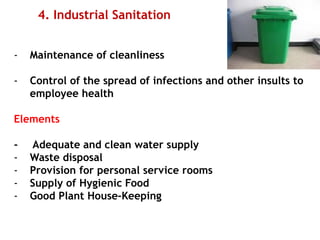
  • 20.
    PLANT LOCATION Plant locationmeans the establishment of a particular industrial unit at a particular place The situation of any industrial unit at any definite place or area due to the availability of specific facility or facilities is called localisation or concentration or location
  • 21.
    PLANT LOCATION -Need 1. When a new plant is to be established 2. Expansion, Diversification and Decentralisation of Manufacturing Activities 3. Non-renewal of lease of Land 4. Doing away with Undesirable location 5. Meeting Socio-economic Needs 6. Ever Expanding Market for Products
  • 22.
    Importance of IdealPlant Location Ideal Plant location – permits lowest unit cost in the production and distribution of product and service Ideal location means a place or a spot for locating a factory that makes possible to enjoy maximum factors Ideal plant location is one that makes possible lowest input and marketing costs at their minimum
  • 23.
    Factors affecting PlantLocation Primary Factors 1. Availability of Raw Material - nature of raw material - Transportation Cost 2. Nearness of Market for the finished product - Transportation cost 3. Availability of Fuel and Power 4. Transport facilities - for raw material and finished goods - roads, rail, water or air - Cost of transport must be kept at a minimum 5. Availability of Labour - Adequate number of labour at a reasonable labour wages 6. Availability of water
  • 24.
    Factors affecting PlantLocation Secondary Factors 1. Soil and Climate – Agricultural Products 2. Availability and Cost of the land – accommodate the production facilities, sufficient for future expansion 3. Safety requirement 4. Industrial Atmosphere 5. Financial and other aids – support of banks and other institutions 6. Availability of facilities like housing, schools and hospitals 7. Momentum of an early start 8. Special advantages of the place – facilities offered by the state 9. Personal factors – promoters personal interest 10. Political Stability
  • 25.
    Steps in choosinga Location for the Plant Step 1: Deciding on domestic or international location - Political stability - Export and import quotas - Exchange rates - Cultural and economic considerations - Availability of natural resources, climate, cost of labour etc - Friendliness with the country under consideration
  • 26.
    Steps in choosinga Location for the Plant Step 2: Selection of the region or state - Availability of raw materials - Availability of Market - Power - Transport facilities - Nearness to suppliers Identifying a place where the product can be produced in a most economical way Government policy and competition between states are also considered
  • 27.
    Steps in choosinga Location for the Plant Step 3: Selection of appropriate place within the region find a suitable place within the state Availability of skilled labour, water, other amenities Consideration of local taxes
  • 28.
    Steps in choosinga Location for the Plant Step 4: Selection of various sites within the selected place decide on various sites and work out the costs - Availability of cheap land to build and to expand the plant - Construction cost - Facilities for transportation of goods and materials - facilities for housing of the workers and their transportation to the work-site - disposing of factory waste………………..
  • 29.
    Steps in choosinga Location for the Plant Step 5: Decide optimum site Work out the costs for different sites and finally select the optimum site where he would get the maximum benefit
  • 30.
    Latest Developments inPlant Location 1. Plants are getting located outside cities 2. Industrial Estates have come up 3. Competition among the states to develop their industries 4. Trend towards decentralization 5. More stress given on pollution control as a mark of social responsibility 6. Balanced regional industrial development
  • 31.
    Latest Developments inPlant Location 1. Plants are getting located outside cities Plants are getting located in sub-urban areas and rural areas
  • 32.
    Latest Developments inPlant Location Merits of Sub-urban areas - Suppliers contact for Raw materials - Availability of labour Supply - Existence of Service-facilities - Land is cheaper - Availability of Municipal Services - Easy means of Transportation and Communication - Benefits of Allied Industries Demerits of Sub-urban areas - Long-run Costs are high - Problems of labour turnover and Absenteeism - No guaranteed security
  • 33.
    Latest Developments inPlant Location Merits of Rural areas - Availability of more land - Cheap labour - Environment friendly atmosphere - State support through incentives and concessions - Water supply Demerits of Rural areas - Lack of proper transport facilitiies - Power supply - Absence of Civic Amenities - Difficulty in reaching the market
  • 34.
    Latest Developments inPlant Location 2. Industrial Estates have come up Group of factors constructed on a economic scale in suitable sites with facilities of electricity, transport, roads, water, bank, canteen and drainage systems and provided with special arrangements for technical guidance and common service facilities - Acquisition of suitable land and its development - Construction of factory sheds - Provision for infrastructure facilities like water, electricity, transport, banks, canteens, roads etc
  • 35.
    INDUSTRIAL ESTATES -Objectives - Provide accomadation for plant and machinery and requisite office - Ensure infrastructure and facilities like roads, power supply, water and drainage - Arrange common business facilities like banks, post office, canteen, transport etc - Development of small and medium scale enterprises in the country - Dispersal of industries to rural and backward areas - Safeguard towns and cities from various types of pollution due to industries by shifting to the industrial estates which are normally away from the living areas
  • 36.
    Latest Developments inPlant Location 3. Inter-state Competition for Development of Industries -Through Packages and Incentives – Electricity rebate, Loan facilities, State tax rebate, etc 4. Increased trend towards Decentalization - Spreading out of a particular industry in different new localities
  • 37.
    Latest Developments inPlant Location 5. Pollution Control as a Social Responsibility Water, Air, Noise and Solid waste 6. Move towards balanced Regional Development - Even development - Social Objectives 7. Growth of Transnational Factories set up in different countries and different parts
  • 38.
    Plant Layout Arrangement andlocation of different departments and of the machinery within a department so that an optimum utilisation of space available can be made with a view to enabling the plant function in an effective manner The overall operating costs are minimised A good plant layout is one which allows materials rapidly and directly for processing.
  • 39.
    Features of agood Plant Layout 1. Smooth flow of production 2. Maximum utilisation of available space 3. Facilities in the movement of men, materials and machines 4. Involves minimum handling 5. Provides better working conditions 6. Flexibility 7. Location of stores 8. Facilitates supervision and control 9. Provision of safety 10.Co-ordination and integration
  • 40.
    Objectives of PlantLayout Maximise the production at the minimum cost 1. Economy in Material handling 2. Optimum utilisation of Resources 3. Good work flow 4. Efficient Control 5. Avoidance of frequent changes 6. Safety 7. Flexibility 8. Reduced damage and wastage of materials 9. Minimising delay and bottlenecks in production system 10. Providing employee comforts and satisfaction
  • 41.
    Factors influencing Layout Layoutof a plant is influenced by the relationship among materials, machinery and men 1. Materials – to provide for the storage and movement of raw materials in a plant until they are converted into finished products 2. Product – designed with the ultimate purpose of producing a product 3. Worker – Type, position and requirements of employees – Employee safety 4. Machinery – For each process or for moving of materials
  • 42.
    Factors influencing Layout 5.Type of Industry a) Assembly Industry – Involves production of a product by the use of various elements. Eg. Automobiles b) Analytical Industry – breaks the raw materials into various elements c) Conditioning Industry – involves a change in form or physical properties d) Extractive Industry – concerned with the physical extraction of metals and minerals from the Earth
  • 43.
    Factors influencing Layout 6.Location factors – topography of the site which the plant is located 7. Managerial Policies – volume of production, Future expansion, extent of Automation, Making or buying, purchasing policy etc.
  • 44.
    Principles and Criteriaof Plant layout 1. Maximum Flexibility – can be modified to meet the changing circumstances 2. Maximum Co-ordination – co-ordinating all operations 3. Maximum use of volume – Space should be used to the maximum 4. Maximum Visibility - No difficulty in supervision, coordination and control 5. Maximum Accessibility - Servicing and maintenance points should be readily accessible without causing breakdown to production process
  • 45.
    Principles and Criteriaof Plant layout 6. Minimum Movement – least movement of goods and workers 7. Minimum Discomfort – Poor lighting, excessive sunlight, heat, noise, vibration and bad odour should be avoided or minimised 8. Minimum Handling – The best handling is no handling. Use of lifts, conveyors, trucks etc 9. Safety Aspects - free from causing any danger to machine operators working on the machines 10. Efficient process flow - Material flows in one direction only
  • 46.
    Types of Layouts 1.Process layout Machines or equipment of the same functional types are grouped together in a particular department Separate departments are established for each production operation Raw materials have to travel from department to department Also called Functional layout
  • 48.
    Process Layout -Advantages 1. Flexibility in production 2. Better and more efficient supervision is possible through specialization 3. Greater scope of expansion – capacities can be easily increased 4. Better utilisation of men and machines 5. Easier to handle breakdown of equipment by transferring work to another machine 6. Full utilization of equipment
  • 49.
    Process Layout -Disadvantages 1. Difficulty in the movement of materials 2. Require more floor space 3. Work-in-progress is more 4. High Handling charges
  • 50.
    Process Layout -Suitability 1. Many types or kinds of products, or emphasis on special orders 2. Relatively low volume of production of Individual items 3. Many inspections required during a sequence of operations 4. Materials or products too bulky to permit bulk or continuous handling by mechanical means
  • 51.
    Types of Layouts 2.Product layout (Straight line layout) Involves the arrangement of machines in one line, depending upon the sequence of operations Materials are worked out into finished components through a series of integrated operations Raw Materials are fed into the first machine and the final product comes out of the last machines
  • 52.
    Product Layout -Advantages 1. Smooth Flow of Production 2. Mechanization of Material Handling 3. Economy in Manufacturing time 4. Lesser work-in-progress 5. Easy inspection 6. Maximum utilization of available space 7. Effective utilization of available resources – Minimum possible movement, lesser wastage of materials etc)
  • 53.
    Product Layout -Disadvantages 1. Inflexibility 2. Expensive – duplication of materials 3. Stoppage of work through Breakdown 4. Difficulty in Expansion
  • 54.
    Product Layout -Suitability 1. One or few standard products 2. Large volume of production of each items over a considerable period of time 3. Minimum inspection required during the sequence of operations
  • 55.
    Product and ProcessLayout - Difference 1. Arrangement of Production Facilities Product – Machines and equipment are arranged one after another on the same floor making it possible to put one end raw-materials and to get final product on the other Process – Machines and equipments performing similar functions are grouped in a separate departments of the factory floor – All machines in a single department are identical machines performing similar range of activities
  • 56.
    Product and ProcessLayout - Difference 2. Suitability Product – suited where there is mass and standardised production moving straight from raw-material stage to another end to final product – Production is in anticipation of demand Process – suited for small lot and non-standardised production – Production starts only after getting the order
  • 57.
    Product and ProcessLayout - Difference 3. Economy Product – Costlier as there is duplication of machines and equipments and the machines are not used to the full extent or capacity though there is mass production Process – the cost are comparatively much lower as there is uninterrupted fuller use of machines and equipment or production facilities
  • 58.
    Product and ProcessLayout - Difference 4. Expansion Possibilities Product – Not possible to increase the production capacity of a plant beyond a particular limit Process – possible to add to the existing capacity. 5. Flow of Work Product – the work should move on faster provided there is no machine break down in the chain Process – Materials and semifinished goods move slowly as they move from one department to another waiting on the way
  • 59.
    Product and ProcessLayout - Difference 6. Material Handling Expenses Product – lower as it moves from one machine to another though mechanical devices Process – higher as there is more materials moving to and from one department to another and waiting in queue. 7. Flexibility Product – rigid as it is difficult and costly to change the existing arrangement of machines and other facilities once set Process – More flexible and adaptable as changes in the existing set up can be brought easily
  • 60.
    Product and ProcessLayout - Difference 8. Time Span of Production Cycle Product – Fast movement of work Process – Overall time taken is more 9. Cost and Effectiveness of Supervision Product – Supervision work is easier and economical Process – Each department has a supervisor who is to supervise only a part of entire job
  • 61.
    Product and ProcessLayout - Difference 10.Production Planning and Control (Routing, scheduling, despatching and following up) Product – PPC poses much less problems and pressures on foreman and supervisory staff Process – more task – sequence may not be pre- determined
  • 62.
    Combined Layout A combinationof Product and Process layout Applicable for those factories or works which are engaged in repetitive processes of manufacturing highly standardised products
  • 63.
    Fixed Position Layout Involvesthe movement of men and machines to the product which remains stationary The material or major components remain in a fixed location, and tools, machinery and men as well as other pieces of material are brought to this location Advantages 1. Same people and machines can be used on producing different product 2. Layout investment is economical 3. Simple portable machines are used to perform 4. High cost and difficulty in transporting heavy product is avoided
  • 64.
    Fixed Position Layout Disadvantages 1.Costly 2. Requirement of skilled labour 3. Time consuming
  • 65.
    Service Facility Layout Bringtogether customers and services Hospitals Education Institute Hotels
  • 66.
    Service Facility Layout Thefocus of the designer should be the customer satisfaction and employee morale - Nearness of the facility - Good parking place - Well maintained entrance - Good reception - Working environment - Signages at proper places - Easily accessible facilities
  • 67.
    Techniques and Toolsof Plant Layout Techniques 1. Templates – patterns resembling the plan of the machines made of a thin plate of wood or from a cardboard or from metal - Representation of a physical object like machine, an equipment, a work men or materials
  • 68.
    Techniques and Toolsof Plant Layout Techniques 2. Model Equipment 3. Layout Drawings – replica of a factory floor plan showing very clearly the space management 4. Plot Plan – entire factory building shown as a part of the plant site giving details of production and service departments and other production facilities that are essential and desirably provided - used for future expansion of production activiities
  • 69.
    Techniques and Toolsof Plant Layout Tools 1. Process Charts Also know as Outline process chart Graphic representation of events and information pertaining there to, occurring during a series of actions or operations
  • 70.
    Techniques and Toolsof Plant Layout Tools Need of Process Charts 1. Presenting the birds eye view of the entire process 2. Selecting key operations for critical examination 3. Determining the requirements for detailed recording 4. Establishing logical sequence of activities
  • 71.
    Techniques and Toolsof Plant Layout Tools Types of Process Charts a) Operation Chart – graphic representation of the points at which materials are introduced into the process and the sequence of inspection and all operations except those involved in material handling. - Indicates the overall picture of the process involved in a factory - Helps in improving the existing processes and the location
  • 72.
    Techniques and Toolsof Plant Layout Tools Types of Process Charts b) Flow Process Chart – graphic representation of the sequence of all operations, transport, inspection, delays and storages occurring during a process or procedure and includes information considered for the analysis such as time required and the distance moved Three Types - Flow process charts for men - Flow Process charts for equipments - Flow Process charts for materials
  • 73.
    Techniques and Toolsof Plant Layout Tools 2. Machine Data Card Provides the necessary information for placement or a layout of a machine or equipment Illustration of the machine or equipment Production capacity of a given machine in terms of output and space required
  • 74.
    Layout Procedure How togo in for a proper layout. 1. Data Accumulation – Collection of data of the layout - Information about the operation involved and tools required - Information about the volume of production - Method involved in Production - Flow process charts and standard time to complete each operation
  • 75.
    Layout Procedure 2. DataAnalysis and Co-ordination - Analysis of the Data collected - Preparation of Operation Process Charts - Understanding the sequence of operation - Understanding the overall picture of the flow pattern and all the necessary production operations
  • 76.
    Layout Procedure 3. Machineand Equipment Decision - Type of machines and equipment needed - Selecting the right type of machines and equipments which will serve for a longer period of time 4. Design and decide the material Handling Plan - Equipment for the movement of raw-materials and finished product - Depends on the material to be moved, distance of movement, speed etc. -
  • 77.
    Layout Procedure 5. Planthe Building Layout - To have machines and other production facilities - Building should have all the facilities to accommodate 6. Plan the General Flow Pattern - Flow of materials throughout the plant - Help in reducing manufacturing cycle time - Product layout or Process Layout or combined
  • 78.
    Layout Procedure 7. DesignIndividual Work Stations - A work station is the floor area occupied by the worker and the machine or group of workers and machines - Space Allocation 8. Combine Individual Layout of Work Stations - Consolidation of all Work Stations in accordance with the general flow pattern of work and the building facilities
  • 79.
    Layout Procedure 9. Calculationof Storage Space Needed - Storing of Raw Materials and Finished goods - Protection of materials 10.Making Work Station Flow diagrams and Incorporate in the Plot Plan - Clear understanding of flow of work and to find out whether work is held up in any Work station
  • 80.
    Layout Procedure 11.Locate ServiceDepartments - To support and strengthen the working of production department - includes rest and lunch rooms, dispensary, maintenance, etc 12.Design the Master Layout Plan - Master plan – which is designed with the help of drawings, diagrams, templates giving a model of the entire factory
  • 81.
    Layout Procedure 13.Check andRecheck the Final Layout - Asking opinions and suggestions of experts 14.Get the Official Approval - From the Officials in the organisation and from outside authorities if required 15.Install the Approved Final Layout Plan After modification if any, implement the plan step by step which involves actual installation of machinery and other equipments needed for production
  • 82.
    Space Requirement forthe Machines Ample space should be provided around the machines for complicated and dangerous machines to avoid accidents as well as for servicing Man’s safety and comforts should be given priority
  • 83.
    Different types ofFacilities 1. Factory Building 2. Factory Lighting 3. Ventilation and Air-conditioning 4. Industrial Sanitation 5. Industrial Noise Control 6. Industrial Safety
  • 84.
    1. Factory Building Placewhere production is carried on and into which all other production tools and mechanisms must fit. Building should ensure functional smoothness of operations Building should be strong enough to withstand damages
  • 85.
    Factors in Designingan Ideal Factory Building 1. Flexibility or Adaptability – to meet the present and future needs and requirements 2. Expandability – sufficient space for any additions and extensions 3. Product and Equipment – type of products – Machineries used 4. Employee facilities and service areas – employee comfort – canteen, lunch rooms, medical rooms etc 5. Material Handing – Fixing and installation of Material Handling equipment 6. Lighting, ventilation and air-conditioning – good lighting, fresh air, free from pollution 7. Fire protection and other protections of property and people – protect form natural calamities
  • 86.
    Types of FactoryBuilding Single Storey Building - Whenever the land is available in plenty and at cheaper rate - Mostly in rural areas Multi Storey Building - Cost of land is high - No scope for horizontal expansion - Mostly in Urban and Semi Urban areas
  • 87.
    Types of FactoryBuilding High Bay and Monitor Types Single storey structures by giving more space which can be used to operate crane and other facilities
  • 88.
    2. Factory Lighting Sourcesof Light Natural Light or Day light – obtained from sun through factory roofs, doors, and window openings Natural Light through - Windows - Roofings
  • 89.
    2. Factory Lighting Sourcesof Light Natural Light or Day light –Advantages - Plentiful especially in tropical regions of the earth - Available free of cost as the natural gift - Need no maintenance as there is no problem of installation - No problems of and consequential effects of load- shedding and power failure
  • 90.
    2. Factory Lighting Sourcesof Light Natural Light or Day light Disadvantages - Light variability can be season to season - Its intensity can not be changed or controlled to meet the unique individual situations - It is not possible to depend totally on natural lighting alone
  • 91.
    2. Factory Lighting Sourcesof Light Artificial Light – is the illumination got through artificial or man made means such as the use of bulbs and tubes
  • 92.
    2. Factory Lighting Sourcesof Light Artificial Light Advantages - Uniformity - Controlled Intensity - Guarantees shift and overtime work - Support natural light - Reduces the number of windows Disadvantages - High Cost - Threats of power cuts
  • 93.
    3. Ventilation andAir-conditioning Ventilation – removal of stale air and letting in fresh air in the factory building Process of removing or supplying air by natural or mechanical or combined means to and from factory building Importance - Provides adequate supply of fresh air - Protects the health of Workers - Reduces odour and Impurities - Removes Dust - Prevents excessive heat generation
  • 94.
    3. Ventilation andAir-conditioning Air-conditioning Importance - Employee Confort - Employee Health - Desirable Conditions of Temperature - Preservation and Improvement of Product Quality - Protection of Manufacturing Equipments
  • 95.
    4. Industrial Sanitation -Maintenance of cleanliness - Control of the spread of infections and other insults to employee health Elements - Adequate and clean water supply - Waste disposal - Provision for personal service rooms - Supply of Hygienic Food - Good Plant House-Keeping
  • 96.
    5. Industrial NoiseControl Noise – unwanted sound Sound that does not have an agreeable quality Vibration is that kind of shaking that causes rapid deterioration of machines, buildings and resulting in high maintenance costs
  • 97.
    5. Industrial Noise Importanceof Noise Control - To protect physical and mental health of Employees - To make oral communication more effective - To improve employee efficiency and productivity
  • 98.
    6. Industrial Safety Allthose measures to safe-guard and protect the property and personnel of a factory against possible theft, damage Protection of the workers from the danger of industrial accidents Importance - Increased Productivity - Fulfills legal Requirements
  • 99.
    Production Planning andControl PPC – defined as the direction and coordination of the firm’s material and physical facilities towards the attainment of pre-specific production goals in the most efficient available way - Organisation of the supply and movement of materials and labour, machine utilisation and related activities in order to bring about the desired manufacturing results in terms of quality, time and price
  • 100.
    Production Planning andControl - Objectives 1. Quality of output – safe and economical manufacture of desired products in required quantity and quality 2. Plant Utilization – productivity of highest degree 3. Process Efficiency – maximum process efficiency by proper coordination 4. Delivery of goods – deliver the products to the customers whenever they are needed 5. Maintenance of inventories – maintain adequate supply of finished goods and having sufficient work-in-process – to ensure that deliveries are made to the customers in time 6. Effectiveness of work – right man for the right job, at the right place, at the right time on right wages and salaries
  • 101.
    Production Planning andControl - Objectives 7. Absenteeism – minimise and regulate absenteeism 8. Team spirit – feeling of brotherhood among workers 9. Ideas for new methods – giving encouragement to the workers for new ideas and new methods 10.Reduced supervision – reduce supervision by creating interest in work amongst workforce 11.Reduced waiting time – reduces waiting time arising due to want of material, tools, equipment etc
  • 102.
    Production Planning andControl - Functions 1. Materials – making the materials available in the required quantities and at required time to enusre correct beginnning and end for each operation resulting in uninterrupted production 2. Methods – Analysis of alternatives and selection of the best method with due consideration to constraints imposed – determination of sequence of operations 3. Machines and Equipment – detailed analysis of available production facilities, equipment down time, maintenance policy, procedure and schedule 4. Manpower – availability of appropriate man power on appropriate machines at the right time 5. Process planning (Routing) – selection of path route which the raw material should follow to get transferred into finished product
  • 103.
    Production Planning andControl - Functions 6. Estimating – Operations time – Fixing of standard time for operation 7. Loading and Scheduling – Loading the machines as per capacity – Scheduling is concerned with preparation of machine loads and fixation of starting and completion date for each of the operations 8. Despatching – process of setting production activities in motion through release of orders and instructions 9. Expediting – close observation on the progress of the work – also called as follow-up 10.Inspection – becoming aware of the limitations with respect to methods, processes etc 11.Evaluation –tharough analysis of all the factors of production – identify the weak spots and taking corrective actions
  • 104.
    Production Planning andProduction Control Production Planning Production Control Pre-production Activity Set in motion when production activity begins Collection, maintenance and analysis of data with respect to time standards, materials and their specifications, machines and their process capabilities Concerned with communication of their information and producing reports like output report, productivity etc Is useful to anticipate problems and prepare for remedial measures in case the problem arises Involves in taking corrective steps in case of error to match actual performance against the planned performance Planning is a centralised activity Control is a widespread activity Planning sees that all the necessary resources are available to make the production at right quality and time Control keeps track of the activities and ensures whether everything is progressing as per schedule or not
  • 105.
    Techniques/Elements of PPC 1.Routing 2. Loading 3. Scheduling 4. Despatching 5. Follow-up or Expediting
  • 106.
    Techniques/Elements of PPC- ROUTING The selection of paths or routes over which each piece is to travel in being transformed from raw material into finished product Routing includes the planning of where and by whom the work shall be done, the determination of the path that work shall follow, and the necessary sequence of operations
  • 107.
    Objectives of Routing 1.Routing sets path for each product for travel – movement of work or work order on best possible routes between the work stations in a factory floor 2. Aims at selecting the most short and economic route – selection of best path – minimum time and cost, high quality and maximum quantity 3. It Ensures best utilization of Men and Machines – reducing loss arising out of under utilisation and keep the men and equipment at work 4. It has impact on Factory Building and Machines – Path determines the Machines to be purchased
  • 108.
    Advantages of Routing 1.Efficient use of available resources 2. Reduction in manufacturing costs 3. Improvement in quality and quantity of output 4. Provides a basis for scheduling and loading
  • 109.
    Routing Procedure /Steps in Routing 1. Decision as to Make or buy – deciding about which components can be produced in the plant and which parts are to be purchased from outside 2. Determining the Material required – Quality standard materials – materials match the product quality standards 3. Determining the manufacturing operations and their sequence – production process of transforming inputs into output is outlined in the form of drawing on a route sheet using symbols
  • 110.
    Routing Procedure /Steps in Routing 4. Duration and the nature of equipment and machine required for each operation – time taken to complete each process in each machines is determined 5. Ascertaining Lot Sizes – economic lot size of production order quantity is calculated 6. Cost Analysis of the product – Direct Material and labout costs – supporting Accounting department in providing information 7. Organising Production Control Forms – various types of Performa is prepared to record the details of production process at different stages
  • 111.
    Route Sheets It isthe map or the blueprint of the manufacturing process in a production unit. A route sheet determines the sequence or order of arrangement of various departments in a facility. Route sheet is a document which has information and data inputs and a step wise listing of all the processes or transactions performed.
  • 112.
    Route Sheets Route Sheetcontains - Identification and sequence of work arrangement. - Symbol or sign of a component of the product - Computing the number of units to be produced. - Machines and tools used in the operation, their run time, efficiency and capacity. - Evaluation of the entire production process
  • 113.
    Techniques/Elements of PPC- LOADING Loading can be defined as the study of the relationship between load and capacity at the place where work is done. Loading provides a complete and correct information about the number of machines available and their speed, capacity etc The information is used to calculate the difference between work load and actual capacity Objectives 1. To plan new work orders on the basis of capacity available 2. To balance the work load in a plant 3. To maintain the delivery promises
  • 114.
    Techniques/Elements of PPC- SCHEDULING Detailed planning of material, labour and machines time so that materials and parts will be at the right place, at the right time so that a job can be completed within the time planned and in accordance with the requirements Objectives 1. Ensure maximum utilisation of the plant at minimum cost 2. Ensure that requirements of manpower is optimum and is evenly distributed 3. Possess up to date information regarding availability of materials, expected date of delivery, materials rejection, shortages etc
  • 115.
    Techniques/Elements of PPC- SCHEDULING Objectives 4. Determining Machine servicing and overhauling schedules and replacement schedules 5. Complete information on performance standards and their revisions, method improvement, change in materials and machines etc 6. Obtain quick feedback from machine shops regarding delays and interruptions which may hold up production activity
  • 116.
    Techniques/Elements of PPC- SCHEDULING Types of Schedules 1. Operation Schedule – determines the total time required to do a piece of work with a given machine or process 2. Master Schedule – list showing how many of each item to make in each period of time in future 3. Sequential Schedule – Defining a sequence for a multi product plant – processing through number of department
  • 117.
    Techniques/Elements of PPC- DESPATCHING Is the routine of setting productive activities in motion through the release of orders and instructions, in accordance with previously planned time and sequences as per the route sheets and schedule charts Functions 1. To check the immediate availability of materials 2. Ensuring that all production and inspection aids are available for use 3. Assign the work to definite machine, work place and men 4. To issue necessary materials, tools etc to correct point for use
  • 118.
    Techniques/Elements of PPC- DESPATCHING Functions 5. To issue production order note stating the start time and finish time 6. Instruction to start the production 7. To maintain all production records – time taken for production and the cause for delay, critical incidence etc
  • 119.
    Techniques/Elements of PPC– FOLLOW UP Production control procedure which regulates the progress of materials and parts through production process - Regulator of materials when they are travelling on the path of performance as laid down by routing sheets and schedule charts Objectives 1. To correct the irregularities in Production process 2. To find out whether the activities was according to the plan 3. To eliminate unnecessary actions 4. To make the production process more effective
  • 120.
    CAPACITY • Capacity maybe defined as the maximum quantity of output that can be produced from an existing plant in a given period of time. • Capacity information enables managers to make decisions concerning inputs and outputs required.
  • 121.
    TYPES OF CAPACITY 1.Licensed Capacity – denotes the capacity licensed by the Govt authorities concerned. 2. Potential Capacity – The decision on potential capacity is taken mostly by a senior most executive of the organisation 3. Immediate Capacity – is that which can be made available within the current budget period
  • 122.
    4. Design orinstalled Capacity – maximum output that can be achieved in a given time period from a particular plant. 5. Practical Capacity – It is the maximum capacity minus the capacity lost due to efficiency and scarp factors. 6. Actual or Utilised Capacity – This is the actual output achieved during a particular time period 7. Normal Capacity – It is the capacity estimated by a qualified authority as to the amount of production that should be usually secured.
  • 123.
    CAPACITY PLANNING Capacity Planningrefers to determining what kind of labour and equipment capacities are required and when they are required. Four Major considerations in Capacity Planning 1. Level of Demand 2. Cost of Production 3. Availability of Fund 4. Management Policy
  • 124.
    IMPORTANCE OF CAPACITYPLANNING 1. Capacity limits the rate of output 2. Capacity influences the operating Costs 3. Capacity decisions have direct impact on the amount of investment made 4. Capacity decisions results in long term commitment of funds
  • 125.
    PROCEDURE FOR CAPACITYPLANNING 1. Assessment of Existing Capacity 2. Forecasting Future Capacity needs 3. Identifying Alternative ways of Modifying Capacities 4. Evaluation of Alternatives 5. Choice of suitable course of Action
  • 126.
  • 127.
    • Quality controlincludes techniques and systems for the achievement of the required quality in the articles produced & for the elimination of sub-standard goods.
  • 128.
    Objects of qualitycontrol • Establishing quality standards • Ensure smooth production • Find out deviations in production process • Find out causes for low productivity • Segregation of defective products
  • 129.
    Principles or essentialsof quality control system • Set standard • Quality control must be responsibility of a competent personnel • Measuring quality standards at every step • Unanimity among workers to maintain quality • Maintaining records of quality
  • 130.
    Steps to exerciseeffective quality control • Setting the Standards of quality • Control over raw materials • Control over production operation • Inspection of machinery & equipment's • Promptness in inspecting quality • Quality consciousness • Application of statistical methods of quality control - sampling, - standard deviation, - probability
  • 131.
    Factors affecting thequality of goods • Cost of production • Requirements of customers • Equipment's & tools used • Utility of products • Attitude of workers • Scale of operations
  • 132.
    Functions of qualitycontrol • Determining requirements of the factory • Keeping records of quality standards • Determining sampling limits • Better quality devices developed
  • 133.
    Advantages of qualitycontrol • Consumer satisfaction • Quality consciousness • Better utilization of resources • Increased sales • Uniform products
  • 134.
    Methods of qualitycontrol Inspection Statistical quality control
  • 135.
    Inspection • Inspection isthe process of measuring the qualities of a product or service in terms of established standards - W. R. Spriegel
  • 136.
    Objectives of inspection •Segregate products which do not conform to the standards • Finding out reasons for low quality or rejection of goods • Maintaining reports
  • 137.
    Forms of inspection •Inspection of raw materials • Inspection of work in progress • Process control – temperature, humidity • Running tests
  • 138.
    Statistical quality control(SQC) Quality control charts Acceptance sampling
  • 139.
    Quality control charts •A control chart is the graphic presentation of expected variations in quality • Two lines on each graph indicate tolerance limits within which the variations of quality will be permitted
  • 140.
    • Upper controllimit (UCL) • Lower control limit (LCL) • Sample is rejected if it falls outside the tolerance limits
  • 141.
    Out of control Outof control QUALITY SCALE SAMPLE NUMBER UC L LC L Avera ge
  • 142.
    Acceptance sampling • Asample is taken from the manufactured products and quality of these products is inspected. • If the quality of the sample conforms to the pre-determined standards then it is presumed that the quality of the whole lot is good.
  • 143.
    Advantages of statisticalquality control • Inspecting a sample instead of the whole lot • Increases profits • Simplifying quality control • Creating quality consciousness among employees • Improves the goodwill of the products among consumers
  • 144.
    TOTAL QUALITY MANAGEMENT (TQM) TQMis a corporate business management philosophy which recognizes that customer needs and business goals are inseparable. - British Quality Association
  • 145.
    Elements of TQM •Commitment to quality • Customer satisfaction • Measurement of quality • Prevention rather than detection • Proper training • Continuous improvement • benchmarking
  • 146.
    Quality system standards InternationalOrganization for Standardization (ISO) - Worldwide federation of national standards bodies located in Geneva, Switzerland - To promote the development of standardisation and related activities in the world with a view to facilitating international exchange of goods and services - To developing cooperation in the spheres of intellectual, scientific, technological and economic activity
  • 147.
    Quality Circles (QC) •Quality circle is a small group of people who voluntarily perform quality improvement activities at the work place
  • 148.
    Objectives of qualitycircles • To aid self & mutual development • To increase quality & cost awareness • To utilize the creativity of the work force • To develop managerial ability & leadership • To improve productivity
  • 149.
    Benefits of QCS •Improves human relations • Develops participative culture • Workers take interest in solving problems • Reduces defects of products/ services • Helps in improving productivity • Helps in leadership development
  • 150.
    Maintenance Management Maintenance Management– Introduction Types of Maintenance - Breakdown - Preventive - Scheduled - Predictive Modern scientific maintenance methods
  • 151.
    Maintenance Maintenance is theset of activities performed to keep an equipment in the specified condition or it is a remedial action to restore the equipment to its specified condition Day to day activity of keeping the physical plant in good operating condition Set of activities which help in keeping plant, machinery and other facilities in good condition
  • 152.
    Maintenance Management Maintenance Managementis concerned with planning and controlling routine, planned and preventive maintenance activities of an organization Maintenance Management is concerned with the direction and organisation of resources in order to control the availability and performance of the industrial plants to some specified level
  • 153.
    Objectives of Maintenance 1.To keep the factory-plants, equipment, machine tools etc in an optimum working condition 2. To keep equipment safe and prevent the development of safety hazards 3. To ensure specified accuracy to products and time schedule of delivery to customers 4. To keep the down time of machines to the minimum thus to have control over the production programme 5. To keep the production cycle within the stipulated range 6. To modify the machine tools to meet the augmented needs for production 7. To improve productivity of existing machine tools and to avoid sinking of additional capital 8. To reduce the maintenance costs as far as possible thereby leading to a reduction in factory overheads
  • 154.
    Objectives of Maintenance 9.To prolong the useful life of the factory plant and machinery 10. To help management in taking decisions on replacement or new investment 11. Help in implementation of suitable procedure for procurement, storage and consumption of spares, tools etc 12. Standardisation of spares and parts in conformity with plant, national and international standards 13. Help in training and development of skilled workmen and executives
  • 155.
    Functional Elements ofMaintenance Programme 1. Inspection or Check-ups – checking whether equipment is as per the standards 2. Lubrication – application of right type of lubricant at the right time, at right place and in right quantity 3. Planning and Scheduling – based on the analysis done on the past records 4. Records and Analysis – Keeping of registers 5. Training of Maintenance Personnel - technicians and supervisors are trained to carry out maintenance, inspection and repairs 6. Storage of Spare Parts - Keep stock of spare parts so as to avoid loss of production
  • 156.
    Importance of Maintenance 1.Maintaining Operating Efficiency 2. Prevention of Loss of Production 3. Maintaining Productivity level 4. Helps solving the problems of Break-downs 5. High Employee Morale
  • 157.
    Advantages of MaintenanceManagement 1. Reduction in production down time 2. Less overtime pay for maintenance personnel 3. Lesser number of stand-by equipment needed 4. Less expenditure on repairs 5. Due to planned spare parts replacement, lesser spare parts inventory in stores 6. Greater safety to employees because of reduced breakdowns
  • 158.
    Cost of Maintenance 1.Down-time Costs – cost incurred due to breakdown of machine 2. Idle Wages – wages paid to the employees for just spending the time in the factory and not for any productive work. 3. Cost of Repairs – Break-downs which are unexpected 4. Failure to meet delivery schedule – consumer loyalty is lost 5. Lowered Employee Morale – negative attitude and negative results 6. Cost of Stand-by Equipment
  • 159.
    Types of Maintenance 1.Corrective or Breakdown Maintenance 2. Preventive Maintenance 3. Predictive Maintenenace
  • 160.
    Corrective Maintenance - alsocalled as breakdown maintenance - Repairs are made only after the equipment is out of order - Refers to the repair work taken after the failure of machine or equipment - Suitable for equipments whose down-time and repair costs are less
  • 161.
    Causes for EquipmentBreakdown 1. Failure to replace the worn out parts 2. Lack of inadequate lubrication 3. Neglected cooling system 4. External factors such as too low or too high voltage, wrong fuel etc
  • 162.
    Objectives/Advantages of Breakdown Maintenance 1.To get equipment back into operation as quick as possible in order to minimise interruption to production – production capacity, production costs, product quality and consumer satisfaction 2. To control the cost of repair, including regular time and overtime labour costs 3. To control the cost of the operation of repair shops 4. To control the investment in replacement spare parts that are used when machines are reparied
  • 163.
    Disadvantages of BreakdownMaintenance 1. Work Stoppage at any time 2. Reduced Output 3. Increased Accidents and Lesser Safety to Employees 4. More lower quality output Suitability - Where the plant capacity exceeds market demand - Stand-by equipment is available - Machine outdated and more modern equipment is under consideration
  • 164.
    Preventive Maintenance - Consistsof routine action taken in a planned manner to prevent breakdowns - Lubrication and inspection are the two important aspect of preventive maintenance - Lubrication ensures long and safe working of the equipment without mishap - Inspection facilitates detection of faults in an equipment so that repairs and replacements may be undertaken before it leads to breakdown
  • 165.
    Forms of PreventiveMaintenance 1. Time based Preventive Maintenance – refers to conducting maintenance at regular intervals 2. Work-based Preventive Maintenance – Maintenance performed after a set number of operating hours of volume of work produced 3. Opportunity-based preventive maintenance – Repair or replacement takes place when the equipment or system is devoid (free) of work 4. Condition-based Preventive Maintenance – relies on planned inspection to reveal when maintenance is convenient
  • 166.
    Objectives of PreventiveMaintenance 1. To minimise the possibility of unanticipated production interruptions 2. To make plant equipment and machines always available and ready for use 3. To maintain the value of the equipment and machinery by conducting periodic inspection, repairs, overhauling etc 4. To reduce the work content of maintenance job 5. To ensure safety of life of the workmen
  • 167.
    Advantages of PreventiveMaintenance 1. Life of Machine and equipment become longer 2. Production planning become easier due to fewer breakdowns 3. Higher productivity due to less down-time 4. Production system becomes more reliable due to less repetitive repairs 5. Safety of plant and employees is enhanced 6. Shutdowns and startups can be scheduled in advance 7. Lesser no. of stand-by equipment are needed 8. Minimum Inventory, less rejects and better quality control
  • 168.
    Disadvantages of PreventiveMaintenance Page 214 S K Podder
  • 169.
    Predictive Maintenance Using humansenses or other instruments like vibration analysers, pressure, temperative detector etc to predict a problem before the equipment fails - Unusual sounds coming out of a rotating equipment predict a coming trouble - Advantages and Disadvantages – 215 S K Poddar
  • 170.
    Scheduled Maintenance Scheduled maintenanceis a ‘stitch in time’ procedure aimed at avoiding break-downs - Includes inspection, lubrication, repair and overhaul of certain equipments which, if neglected, can result in break-down
  • 171.
    Plant Maintenance Scheduling Determiningthe calander inspection dates Clear, precise and easy to operate Finalised in consultation with production department Procedure 1. Preparation of ‘master’ maintenance schedule – indicates the nature and the amount of each repair and construction task segment of maintenance for a specified time span 2. Preparation of ‘detailed’ weekly or daily schedule – provides information related each activity to be carried on
  • 172.
    Modern Scientific Methods– Refer Notes Reliability centered maintenance Six Sigma Maintenance Enterprise Asset Management (EAM) Lean Maintenance Computer Aided Maintenance
  • 175.
    Waste Management Waste –that portion of raw-material lost in processing having no recovery value Visible waste – physically present – Ash, saw-dust etc Invisible waste – disappearance of basic raw-material in the form of evaporation, smoke etc Waste management is the collection, transport, processing, recycling or disposal, and monitoring of waste materials
  • 176.
    179 Kinds of Wastes Solidwastes: domestic, commercial and industrial wastes especially common as co-disposal of wastes Examples: plastics, bottles, cans, papers, scrap iron, and other scrap Liquid Wastes: wastes in liquid form Examples: domestic washings, chemicals, oils, waste water from manufacturing industries
  • 177.
    Why Waste ➢ Badplanning and incorrect policies, systems and procedures ➢ Faulty work method ➢ Wrong specifications, standards, raw materials etc ➢ Lack of proper inventory control, handling of material etc ➢ Failures of maintenance ➢ Poor working conditions
  • 178.
    How waste canbe reduced ? Step 1 - Recognise the total waste found in the whole system Step 2 – Identify the stages from which waste is generated Step 3 – Identify the substages in which above waste can be put Step 4 – Plan for corrective action and to eliminate the causes at each stage of the Waste reduction program
  • 179.
    Waste Management Effective managementdoes everything possible to keep waste at a minimum Cooperation with production and engineering to prevent waste should be one of the purchasing department’s major value analysis objectives
  • 180.
    Waste Management Large ScaleOrganisation have Waste Management Department Three Sources of Waste: - Obsolete Items - Surplus - Scrap
  • 181.
    Waste Management Disposal ofObsolete Items Need proper scrutiny and expert advice before deciding to consider it so and disposing Waste Management department should try to locate the obsolete items as early as possible and get declared so. Then, the department should prepare a list and take action to dispose the items off
  • 182.
    Waste Management Disposal ofObsolete Items 1. Invite quotations or circulate the list of these items 2. Give detailed ads in newspapers and periodicals to that effect 3. Declare the auction in public
  • 183.
    Waste Management Disposal ofSurplus Items When there is surplus anywhere in the organisation, it is the duty of the concerned unit to inform the waste management department to take appropriate timely action for disposal of surplus items Surpluses are disposed at purchase price to avoid loss
  • 184.
    SCRAP Waste Material forreprocessing Always physically available Standards are to be set based on experiment, nature of product and processing periodical scrap report is to be prepared Scraps may have some value – hence should be disposed periodically
  • 185.
    SCRAP ➢ Spoiled rawmaterials ➢ Rejected components ➢ Defective parts ➢ Obsolete equipment ➢ Wastes from production departments ➢ Packing cases
  • 186.
    SPOILAGE - Outcome ofmaterials being damaged in manufacturing operations in such a way that they can not be rectified and brought back to normal specifications - Spoilage occurs due to some defect in materials or manufacturing operations which could have avoided
  • 187.
    Control of Spoilage -Normal spoilage is determined in advance and compared with actual spoilage in spoilage Report - Causes of abnormal spoilage should be investigated and remedial measures should be taken immediately
  • 188.
    DEFECTIVES Defective Work isthat portion of production which is below standard specification or quality and can be rectified by incurring additional expenditure on material labour and works overheads known as rectification cost Spoilage – cannot be rectified Defectives - can be rectified by incurring additional costs and brought back to the level of standard product
  • 189.
    SALVAGED ITEMS Salvage itemsare those which can not be put to use for their original purpose for which they where procured Parts of the salvaged items may be collected and may be used in repairs, replacements and so on
  • 190.
  • 191.
    AUTOMATION - Meaning Automationis a technology concerned with the application of mechanical, electronic and computer-based systems to operate and control production Reducing human intervention to the minimum Human Contribution – physical and mental Physical is taken over by machines Mental is taken by computers
  • 192.
    Forms of AUTOMATION 1.Integration – processes in which the finished product is moved automatically, untouched by human hands, from one stage to another 2. Feedback Control – Electronic process by which any error or diversion of the machine from a planned performance is automatically corrected 3. Computer Technology – Electronically operated machines capable of recording and classifying information, and when required drawing conclusions from this information
  • 193.
    Reasons for AUTOMATION 1.Increased Productivity – Increasing the productivity of labour – Higher production rates are achieved with automation than with the corresponding manual operations 2. High Cost of Labour – Higher investment in automated equipment has become economically justifiable to replace manual operations 3. Labour shortage – stimulate the development of automation as a substitute for labour 4. Trend of Labour towards the Service Sector – People viewing factory work as tedious and dirty – proportion of the work force employed in manufacturing is reducing 5. Safety – By automating the operation and transferring the operator from an active participation to a supervisory role, work is made safer
  • 194.
    Reasons for AUTOMATION 6.High Cost of Raw Materials – The high cost of raw materials in manufacturing results in the need for greater efficiency in using these materials 7. Improved Product Quality – produce parts with greater consistency and conformity to quality specifications 8. Reduced Manufacturing Lead Time – With reduced manufacturing lead time automation allows the manufacturer a competitive advantage in making the product available 9. Reduction of In-process Inventory – reduces the time a workpart spends in the factory 10. High Cost of not Automating – improved quality, higher sales, better labour relations and better company image
  • 195.
    Advantages of AUTOMATION 1.Improved Productivity – Increased output, improved or high quality output 2. Reduced Cost – Cost of production can be reduced and add to increased profit 3. Making Complex decisions – decisions beyond the capacity of manpower. Programmed to make the activity easier 4. Handle Routine and boring jobs – Automation for activities of routine nature like assembling, inspecting and packaging manufactured products 5. Reduced Unsafe Environments – Automated machinery can operate in environments that are unsafe for people 6. Lesser Accidents – least number of employees as jobs are given to integrated systems and robots
  • 196.
    Advantages of AUTOMATION 7.Elimination of production bottleneck – labour problem can be eliminated by automation 8. Enhance quality – goods produced is better when there is automation – products passes through definite process. 9. Consistency in quality – uniform in nature – passes from one process to another till it comes out as finished goods 10. Other benefits - Highest operating efficiency - Reduced idle time - Reduced lead time - Reduced Scrap and Waste
  • 197.
    Disdvantages of AUTOMATION 1.High capital investment – initial investment is high – installation costs, maintenance cost, power consumption, depreciation and other operating cost 2. High cost of depreciation – More machines used – tend to depreciate every year. 3. Not suitable to small firms – due to heavy investment – costly machines and not able to afford. 4. Displacement of Labour – Unemployment 5. Higher specifications may be needed – particular sequence and process to be followed 6. Lack of ready market – Automation increases production – demand of the product in the market may not be there 7. Unemployment Problem – Machines are used instead of labour force. Reduces employabilty