Operations Management
Prof Padmanav Acharya
Faculty Cabin – 504, ALB
pacharya@nitie.ac.in
Course Objective(s)
The objective of the course is to develop
familiarity with the concepts of production
systems their constraints, and their linkages with
the overall business strategy; planning and
control of operations; optimal utilization of
resources and interfaces of operations
management with other managerial areas.
Course Content
• Introduction to Operations and Supply
Management
• Demand Management and Forecasting
• Aggregate Sales and Operational Planning
• Material Requirements Planning
• Inventory Control
• Scheduling and Sequencing
Reference Books
• Operations & Supply Management, (Latest Edition),
Chase, R. B. Aquilano, N. J. Jacobs, F. R. Boston,
McGraw-Hill.
• Operations Management: Processes and Supply
Chains, (latest Edition), Krajewski, L.J., Ritzman, L.
P. and Malhorta, M.J., Pearson.
• Operations Management, (Latest Edition), Heizer,
Jay; Render, Barry, Upper Saddle River, N.J.:
Prentice-Hall.
• Operations Management, (Latest Edition), William J.
Stevenson, Tata McGraw Hill education Private Ltd.
Production management to
Operations Management
• Till 1960s, global economy was predominantly
manufacturing based
• Gradually there was shift towards service
centric economy
• So, Production Management (science of
managing Manufacturing set ups) led to
Operations Management (science of
managing both manufacturing and service set
ups)
Manufacturing vs Production vs
Operations
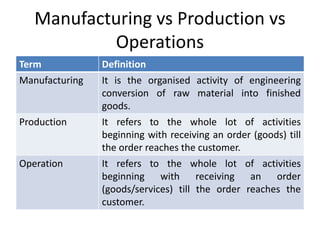
Term Definition
Manufacturing It is the organised activity of engineering
conversion of raw material into finished
goods.
Production It refers to the whole lot of activities
beginning with receiving an order (goods) till
the order reaches the customer.
Operation It refers to the whole lot of activities
beginning with receiving an order
(goods/services) till the order reaches the
customer.
Operations Management
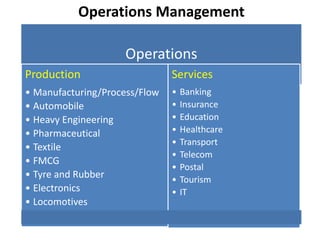
Operations
Production
• Manufacturing/Process/Flow
• Automobile
• Heavy Engineering
• Pharmaceutical
• Textile
• FMCG
• Tyre and Rubber
• Electronics
• Locomotives
Services
• Banking
• Insurance
• Education
• Healthcare
• Transport
• Telecom
• Postal
• Tourism
• IT
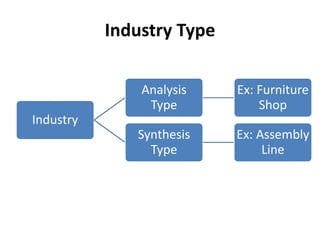
Industry Type
Industry
Analysis
Type
Ex: Furniture
Shop
Synthesis
Type
Ex: Assembly
Line
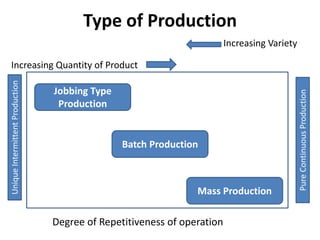
Type of Production
Increasing Variety
Increasing Quantity of Product
Degree of Repetitiveness of operation
Jobbing Type
Jobbing Type
Jobbing Type
Jobbing Type
Production
Batch Production
Mass Production
Pure
Continuous
Production
Unique
Intermittent
Production
Job Production
• High degree of flexibility in production
ensures that—
– Wide variety of products
– High degree of customization
– Volume of production in each variety is low
– Firms usually follow make to order process
– Each product is considered as a ‘single separate
Job’
Batch Production
• Volume/quantity, Variety lies in between Job
production and Mass Production
• There could be small batch or large batch
depending on the order.
• There is need of change of set up after one
batch is over and new batch is to be produced.
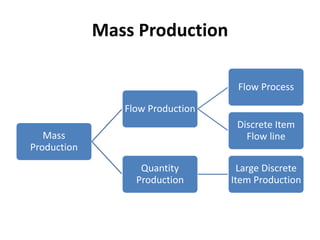
Mass Production
Mass
Production
Flow Production
Flow Process
Discrete Item
Flow line
Quantity
Production
Large Discrete
Item Production
Flow Production
• Flow Production: Continuous movement of
products through the production process
– Flow process (manufacturing process for
petroleum products, soft drinks, rubber, steel,
aluminum, and other metallurgical processes)
– Discrete item flow line (Also know as Assembly
line, where products are dished out in discrete
manner one after the other, such as bottling units,
automobiles, tyres, electronic goods etc.
Quantity Production
• Large discrete item production
• Production cycle time is very small
• Large quantity of production of small items
takes place within a reasonably small time.
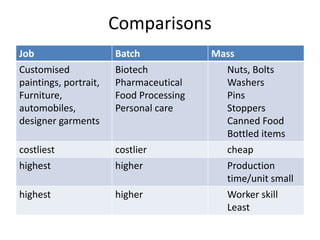
Comparisons
Job Batch Mass
Customised
paintings, portrait,
Furniture,
automobiles,
designer garments
Biotech
Pharmaceutical
Food Processing
Personal care
Nuts, Bolts
Washers
Pins
Stoppers
Canned Food
Bottled items
costliest costlier cheap
highest higher Production
time/unit small
highest higher Worker skill
Least
Production Strategies
• Design to Order
• Make to Order
• Assemble to Order
• Make to Stock
Design to order
• Design to order is a manufacturing strategy, that
involves designing a product that does not currently
exist
• And then the individual parts of the product are
manufactured and assembled as per the design
based on a specific/unique customer order.
Make to Order
• A strategy that makes products of low volume as per
customer specifications.
• It is a business production strategy whereby
manufacturers build products only once a confirmed
order has been received.
Assemble to Order
• A strategy where a large variety of products can be
sold as per customer requirements out of relatively
fewer component parts and subassemblies.
• Products are quickly produced from component
parts once the order is confirmed.
Make to Stock
• This Strategy involves holding items in stock for
immediate delivery when order is received.
• It minimizes the delivery lead time.
• It matches inventory with anticipated customer
demand.

Production Concept operations management .pdf

  • 1.
    Operations Management Prof PadmanavAcharya Faculty Cabin – 504, ALB pacharya@nitie.ac.in
  • 2.
    Course Objective(s) The objectiveof the course is to develop familiarity with the concepts of production systems their constraints, and their linkages with the overall business strategy; planning and control of operations; optimal utilization of resources and interfaces of operations management with other managerial areas.
  • 3.
    Course Content • Introductionto Operations and Supply Management • Demand Management and Forecasting • Aggregate Sales and Operational Planning • Material Requirements Planning • Inventory Control • Scheduling and Sequencing
  • 4.
    Reference Books • Operations& Supply Management, (Latest Edition), Chase, R. B. Aquilano, N. J. Jacobs, F. R. Boston, McGraw-Hill. • Operations Management: Processes and Supply Chains, (latest Edition), Krajewski, L.J., Ritzman, L. P. and Malhorta, M.J., Pearson. • Operations Management, (Latest Edition), Heizer, Jay; Render, Barry, Upper Saddle River, N.J.: Prentice-Hall. • Operations Management, (Latest Edition), William J. Stevenson, Tata McGraw Hill education Private Ltd.
  • 5.
    Production management to OperationsManagement • Till 1960s, global economy was predominantly manufacturing based • Gradually there was shift towards service centric economy • So, Production Management (science of managing Manufacturing set ups) led to Operations Management (science of managing both manufacturing and service set ups)
  • 6.
    Manufacturing vs Productionvs Operations Term Definition Manufacturing It is the organised activity of engineering conversion of raw material into finished goods. Production It refers to the whole lot of activities beginning with receiving an order (goods) till the order reaches the customer. Operation It refers to the whole lot of activities beginning with receiving an order (goods/services) till the order reaches the customer.
  • 7.
    Operations Management Operations Production • Manufacturing/Process/Flow •Automobile • Heavy Engineering • Pharmaceutical • Textile • FMCG • Tyre and Rubber • Electronics • Locomotives Services • Banking • Insurance • Education • Healthcare • Transport • Telecom • Postal • Tourism • IT
  • 8.
  • 9.
    Type of Production IncreasingVariety Increasing Quantity of Product Degree of Repetitiveness of operation Jobbing Type Jobbing Type Jobbing Type Jobbing Type Production Batch Production Mass Production Pure Continuous Production Unique Intermittent Production
  • 10.
    Job Production • Highdegree of flexibility in production ensures that— – Wide variety of products – High degree of customization – Volume of production in each variety is low – Firms usually follow make to order process – Each product is considered as a ‘single separate Job’
  • 11.
    Batch Production • Volume/quantity,Variety lies in between Job production and Mass Production • There could be small batch or large batch depending on the order. • There is need of change of set up after one batch is over and new batch is to be produced.
  • 12.
    Mass Production Mass Production Flow Production FlowProcess Discrete Item Flow line Quantity Production Large Discrete Item Production
  • 13.
    Flow Production • FlowProduction: Continuous movement of products through the production process – Flow process (manufacturing process for petroleum products, soft drinks, rubber, steel, aluminum, and other metallurgical processes) – Discrete item flow line (Also know as Assembly line, where products are dished out in discrete manner one after the other, such as bottling units, automobiles, tyres, electronic goods etc.
  • 14.
    Quantity Production • Largediscrete item production • Production cycle time is very small • Large quantity of production of small items takes place within a reasonably small time.
  • 15.
    Comparisons Job Batch Mass Customised paintings,portrait, Furniture, automobiles, designer garments Biotech Pharmaceutical Food Processing Personal care Nuts, Bolts Washers Pins Stoppers Canned Food Bottled items costliest costlier cheap highest higher Production time/unit small highest higher Worker skill Least
  • 16.
    Production Strategies • Designto Order • Make to Order • Assemble to Order • Make to Stock
  • 17.
    Design to order •Design to order is a manufacturing strategy, that involves designing a product that does not currently exist • And then the individual parts of the product are manufactured and assembled as per the design based on a specific/unique customer order.
  • 18.
    Make to Order •A strategy that makes products of low volume as per customer specifications. • It is a business production strategy whereby manufacturers build products only once a confirmed order has been received.
  • 19.
    Assemble to Order •A strategy where a large variety of products can be sold as per customer requirements out of relatively fewer component parts and subassemblies. • Products are quickly produced from component parts once the order is confirmed.
  • 20.
    Make to Stock •This Strategy involves holding items in stock for immediate delivery when order is received. • It minimizes the delivery lead time. • It matches inventory with anticipated customer demand.