Marketing Quality Circle
4
LEARNING OBJECTIVES
After reading this chapter, students should:
1. Know what constitutes good marketing
research
2. Know what are good metrics for measuring
marketing productivity
3. Know how marketers can assess their
returns on investment of marketing
expenditures
4. Know how companies can more accurately
measure and forecast demand
What is Marketing Research?
Marketing research is the systematic design,
collection, analysis, and reporting of data and
findings relevant to a specific marketing situation
facing the company.
Types of Research
 Qualitative research
 Quantitative research
TheMarketingResearchProcess
Types of Marketing Research Firms
 Syndicated service
 Custom
 Specialty-line
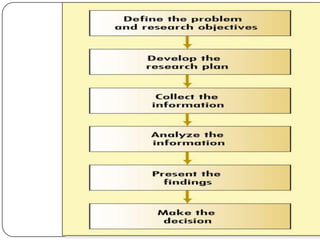
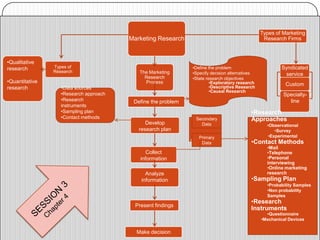
The Marketing Research Process
 Define the problem
 Develop research plan
 Collect information
 Analyze information
 Present findings
 Make decision
Step 1: Define the Problem
 Define the problem
 Specify decision alternatives
 State research objectives
Step 1: Define the Problem
 Marketing managers and researchers must
work closely together to define the problem
and agree on research objectives.
 After the problem had been defined carefully,
the manager and researcher must sat the
research objectives.
 A marketing research project might have one of
three types of objectives:
1.Exploratory research
2.Descriptive Research
3.Causal Research
Step 2: Develop the Research Plan
 Data sources
 Research approach
 Research instruments
 Sampling plan
 Contact methods
Step 2: Develop the Research Plan
 To meet the manager’s information needs, the
research plan can call for gathering secondary
data, primary data or both.
 Secondary data—Information that already exists
somewhere , having been collected for another
purpose.
 Primary data—Information collected for the
specific purpose at hand.
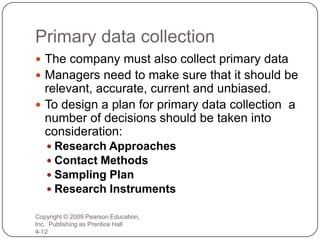
Primary data collection
Copyright © 2009 Pearson Education,
Inc. Publishing as Prentice Hall
4-12
 The company must also collect primary data
 Managers need to make sure that it should be
relevant, accurate, current and unbiased.
 To design a plan for primary data collection a
number of decisions should be taken into
consideration:
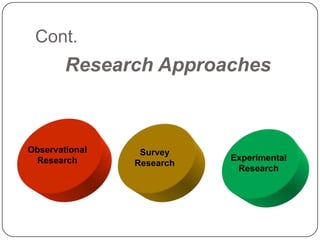
 Research Approaches
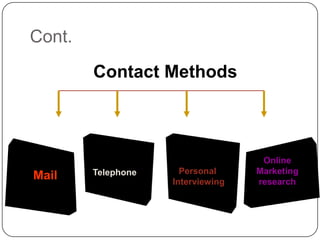
 Contact Methods
 Sampling Plan
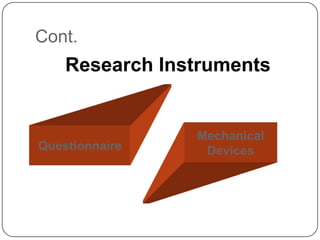
 Research Instruments
Cont.
Research Approaches
Observational
Research
Survey
Research
Experimental
Research
Cont.
Contact Methods
Mail Personal
Interviewing
Telephone
Online
Marketing
research
Cont.
Research Instruments
Questionnaire
Mechanical
Devices
Technological Devices
 Galvanometers
 Audiometers
 Eye cameras
Sampling Plan
Three decisions
 Sampling unit: Who is to be surveyed?
 Sample size: How many people should be surveyed?
 Sampling procedure: How should the respondents be
chosen?
Marketing Research
The Marketing
Research
Process
Define the problem
Organizational
Culture
Types of
Research
•Qualitative
research
•Quantitative
research
Types of Marketing
Research Firms
Spirituality &
Organizational
Culture
Syndicated
service
Custom
Specialty-
line
Develop
research plan
Collect
information
Analyze
information
Present findings
Make decision
•Define the problem
•Specify decision alternatives
•State research objectives
•Exploratory research
•Descriptive Research
•Causal Research
•Data sources
•Research approach
•Research
instruments
•Sampling plan
•Contact methods Secondary
Data
Primary
Data
•Research
Approaches
•Observational
•Survey
•Experimental
•Contact Methods
•Mail
•Telephone
•Personal
interviewing
•Online marketing
research
•Sampling Plan
•Probability Samples
•Non probability
Samples
•Research
Instruments
•Questionnaire
•Mechanical Devices

Conducting Marketing Research and Forecasting Demand

  • 1.
  • 2.
    LEARNING OBJECTIVES After readingthis chapter, students should: 1. Know what constitutes good marketing research 2. Know what are good metrics for measuring marketing productivity 3. Know how marketers can assess their returns on investment of marketing expenditures 4. Know how companies can more accurately measure and forecast demand
  • 3.
    What is MarketingResearch? Marketing research is the systematic design, collection, analysis, and reporting of data and findings relevant to a specific marketing situation facing the company.
  • 4.
    Types of Research Qualitative research  Quantitative research
  • 5.
  • 6.
    Types of MarketingResearch Firms  Syndicated service  Custom  Specialty-line
  • 7.
    The Marketing ResearchProcess  Define the problem  Develop research plan  Collect information  Analyze information  Present findings  Make decision
  • 8.
    Step 1: Definethe Problem  Define the problem  Specify decision alternatives  State research objectives
  • 9.
    Step 1: Definethe Problem  Marketing managers and researchers must work closely together to define the problem and agree on research objectives.  After the problem had been defined carefully, the manager and researcher must sat the research objectives.  A marketing research project might have one of three types of objectives: 1.Exploratory research 2.Descriptive Research 3.Causal Research
  • 10.
    Step 2: Developthe Research Plan  Data sources  Research approach  Research instruments  Sampling plan  Contact methods
  • 11.
    Step 2: Developthe Research Plan  To meet the manager’s information needs, the research plan can call for gathering secondary data, primary data or both.  Secondary data—Information that already exists somewhere , having been collected for another purpose.  Primary data—Information collected for the specific purpose at hand.
  • 12.
    Primary data collection Copyright© 2009 Pearson Education, Inc. Publishing as Prentice Hall 4-12  The company must also collect primary data  Managers need to make sure that it should be relevant, accurate, current and unbiased.  To design a plan for primary data collection a number of decisions should be taken into consideration:  Research Approaches  Contact Methods  Sampling Plan  Research Instruments
  • 13.
  • 14.
  • 15.
  • 16.
  • 17.
    Sampling Plan Three decisions Sampling unit: Who is to be surveyed?  Sample size: How many people should be surveyed?  Sampling procedure: How should the respondents be chosen?
  • 18.
    Marketing Research The Marketing Research Process Definethe problem Organizational Culture Types of Research •Qualitative research •Quantitative research Types of Marketing Research Firms Spirituality & Organizational Culture Syndicated service Custom Specialty- line Develop research plan Collect information Analyze information Present findings Make decision •Define the problem •Specify decision alternatives •State research objectives •Exploratory research •Descriptive Research •Causal Research •Data sources •Research approach •Research instruments •Sampling plan •Contact methods Secondary Data Primary Data •Research Approaches •Observational •Survey •Experimental •Contact Methods •Mail •Telephone •Personal interviewing •Online marketing research •Sampling Plan •Probability Samples •Non probability Samples •Research Instruments •Questionnaire •Mechanical Devices