New Product develoPmeNt 
Presented By: Shubham Goswami
Definition 
 New product development (NPD) is the 
complete process of bringing a new product to 
the market till its consumption & feedback 
from the end user of the business chain 
through the systematic procedure & 
parameter. 
 It may be a Consumable product, service or 
idea.
Definition 
 New product development (NPD) is the 
complete process of bringing a new product or 
service to market. 
 New product development may be done to 
develop an item to compete with a particular 
product or may be done to improve an already 
established product.
Examples 
 This type of development is considered the 
preliminary step in product or service 
development and involves a number of steps 
that must be completed before the product can 
be introduced to the market. 
 Fair & lovely. 
 Bajaj Pulsar. 
 Samsung Mobile
Agenda 
 Market Research/Opportunity Scan 
 Concept Testing 
 Prototype Development 
 Market Testing 
 Product Launch
Why New Products? 
 New product development is essential to any 
business that must keep up with market trends 
and changes. 
 Approximately one-third of the revenue a 
business generates is coming from products 
they did not sell five years ago 
 Changing environment creates new demands 
and needs
Product Development 
 Must be alert to quickly develop opportunities 
 Focus on markets or product categories 
consistent with organization’s objectives, 
resources, capabilities and strengths 
 Securing a competitive advantage
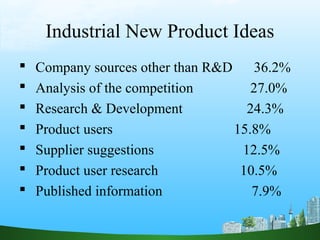
Industrial New Product Ideas 
 Company sources other than R&D 36.2% 
 Analysis of the competition 27.0% 
 Research & Development 24.3% 
 Product users 15.8% 
 Supplier suggestions 12.5% 
 Product user research 10.5% 
 Published information 7.9%
New Products necessity 
 A way of getting new and keeping old 
customers 
 Effective way of obtaining a competitive 
advantage 
 Source of growth and excitement
New Product Categories 
 New to the world products 
 New product lines 
 Product line extensions 
 Improvements and revisions to existing 
products 
 Repositionings
Product Development Process 
Market research 
and 
Opportunity scan 
Concept 
Testing 
Prototype 
Development 
Test 
Marketing 
Product 
Launch
Marketing 
 Very important to product development success 
 Key to successful marketing is imaginative, 
effective, creative communication 
 Find a need and fill it. 
 Mutually beneficial exchange relationships
Marketing Strategies 
 Increase the number of customers 
 Increase the average transaction 
 Increase the frequency of repurchase
Marketing Concepts 
 Consumer orientation 
 Customer service orientation 
 Profit orientation 
 Society Benefit.
Market Research 
 Who is my target audience? 
 Are there enough members of this target group to 
make the business worthwhile? 
 How large is the potential market and how much of 
that potential market can I capture? 
 Who is my competition and what would make 
someone choose my product over their current?
Market Opportunity and Threats 
Economic Realities 
•GNP 
•Disposable Income 
•Discretionary Income 
Legal & Regulatory 
Condition 
•Laws 
•Regulations 
Societal Focus 
•Population Shifts 
•Values 
•Attitudes 
•Competition 
•Trends 
Technological 
Development 
•Advance in 
technology 
•Market receptiveness 
to technology
Market Placement 
1)Identify target markets 
 Size and growth potential 
 Ability and ease of reaching segment 
 Good fit with organizational objectives 
 Greatest revenue generation with least investment
Market Placement 
2)Determine opportunity 
 Segment size 
 Annual usage potential 
 Anticipated annual growth rate 
 Margin 
 Value in use 
3)Evaluate competition 
 Strengths/Limitations 
 Implications
Pricing Strategies 
 Goal is to achieve a target profit 
 Can you hold a product’s manufacturing costs 
down to less than 25% of its perceived value? 
 Estimating manufacturing costs 
 Obtain price quotes from several suppliers
Concept Testing 
Concept testing is the process of using 
quantitative methods and qualitative methods 
to evaluate consumer response to a product 
idea prior to the introduction of a product to 
the market.
Concept Testing 
Determine 
 Critical success factors 
 Financial objectives 
 Marketing mix strategies 
 Product, Pricing, Promotion, Placement 
 Marketing plan initiatives 
 Activity, Budget, Timing
Prototype Development 
 Prototype development is the process of 
preparing a device, technique or system that 
demonstrates the feasibility of a solution to a 
problem. For- 
 1) Experimentation and learning in the 
product development process 
 2) Testing and proofing product concepts 
 3)Communicating concepts to the product 
development team members, management and 
customers.
Test Marketing 
 Test marketing is an experiment conducted in 
a field laboratory ( test market) comprising of 
actual stores and real-life buying situations, 
without the buyers knowing they are 
participating in an evaluation exercise. 
 Test marketing may last from few weeks to 
several months.
Prototype and Test Marketing 
 Do you prefer this product over your current 
product? 
 Does this product meet the need you thought it 
would? 
 Does the way the product works provide an 
important benefit?
Promotion and Product Launch 
 Publicity 
 Trade journals 
 Conferences 
 Personal selling 
 Word of mouth
Reasons For New Product Failures 
 Poor marketing research 
 Technical problems 
 Insufficient marketing effort 
 Bad timing 
 The wrong group was targeted. 
 Unrealistic forecast. 
 Insufficient level of awareness.
Summary 
 New product development drives growth. 
 Market research is critical to the success of a 
new product launch. 
 Market research is a continuous process as 
customer needs, your business and the 
environment changes.

New product development

  • 1.
    New Product develoPmeNt Presented By: Shubham Goswami
  • 2.
    Definition  Newproduct development (NPD) is the complete process of bringing a new product to the market till its consumption & feedback from the end user of the business chain through the systematic procedure & parameter.  It may be a Consumable product, service or idea.
  • 3.
    Definition  Newproduct development (NPD) is the complete process of bringing a new product or service to market.  New product development may be done to develop an item to compete with a particular product or may be done to improve an already established product.
  • 4.
    Examples  Thistype of development is considered the preliminary step in product or service development and involves a number of steps that must be completed before the product can be introduced to the market.  Fair & lovely.  Bajaj Pulsar.  Samsung Mobile
  • 5.
    Agenda  MarketResearch/Opportunity Scan  Concept Testing  Prototype Development  Market Testing  Product Launch
  • 6.
    Why New Products?  New product development is essential to any business that must keep up with market trends and changes.  Approximately one-third of the revenue a business generates is coming from products they did not sell five years ago  Changing environment creates new demands and needs
  • 7.
    Product Development Must be alert to quickly develop opportunities  Focus on markets or product categories consistent with organization’s objectives, resources, capabilities and strengths  Securing a competitive advantage
  • 8.
    Industrial New ProductIdeas  Company sources other than R&D 36.2%  Analysis of the competition 27.0%  Research & Development 24.3%  Product users 15.8%  Supplier suggestions 12.5%  Product user research 10.5%  Published information 7.9%
  • 9.
    New Products necessity  A way of getting new and keeping old customers  Effective way of obtaining a competitive advantage  Source of growth and excitement
  • 10.
    New Product Categories  New to the world products  New product lines  Product line extensions  Improvements and revisions to existing products  Repositionings
  • 11.
    Product Development Process Market research and Opportunity scan Concept Testing Prototype Development Test Marketing Product Launch
  • 12.
    Marketing  Veryimportant to product development success  Key to successful marketing is imaginative, effective, creative communication  Find a need and fill it.  Mutually beneficial exchange relationships
  • 13.
    Marketing Strategies Increase the number of customers  Increase the average transaction  Increase the frequency of repurchase
  • 14.
    Marketing Concepts Consumer orientation  Customer service orientation  Profit orientation  Society Benefit.
  • 15.
    Market Research Who is my target audience?  Are there enough members of this target group to make the business worthwhile?  How large is the potential market and how much of that potential market can I capture?  Who is my competition and what would make someone choose my product over their current?
  • 16.
    Market Opportunity andThreats Economic Realities •GNP •Disposable Income •Discretionary Income Legal & Regulatory Condition •Laws •Regulations Societal Focus •Population Shifts •Values •Attitudes •Competition •Trends Technological Development •Advance in technology •Market receptiveness to technology
  • 17.
    Market Placement 1)Identifytarget markets  Size and growth potential  Ability and ease of reaching segment  Good fit with organizational objectives  Greatest revenue generation with least investment
  • 18.
    Market Placement 2)Determineopportunity  Segment size  Annual usage potential  Anticipated annual growth rate  Margin  Value in use 3)Evaluate competition  Strengths/Limitations  Implications
  • 19.
    Pricing Strategies Goal is to achieve a target profit  Can you hold a product’s manufacturing costs down to less than 25% of its perceived value?  Estimating manufacturing costs  Obtain price quotes from several suppliers
  • 20.
    Concept Testing Concepttesting is the process of using quantitative methods and qualitative methods to evaluate consumer response to a product idea prior to the introduction of a product to the market.
  • 21.
    Concept Testing Determine  Critical success factors  Financial objectives  Marketing mix strategies  Product, Pricing, Promotion, Placement  Marketing plan initiatives  Activity, Budget, Timing
  • 22.
    Prototype Development Prototype development is the process of preparing a device, technique or system that demonstrates the feasibility of a solution to a problem. For-  1) Experimentation and learning in the product development process  2) Testing and proofing product concepts  3)Communicating concepts to the product development team members, management and customers.
  • 23.
    Test Marketing Test marketing is an experiment conducted in a field laboratory ( test market) comprising of actual stores and real-life buying situations, without the buyers knowing they are participating in an evaluation exercise.  Test marketing may last from few weeks to several months.
  • 24.
    Prototype and TestMarketing  Do you prefer this product over your current product?  Does this product meet the need you thought it would?  Does the way the product works provide an important benefit?
  • 25.
    Promotion and ProductLaunch  Publicity  Trade journals  Conferences  Personal selling  Word of mouth
  • 26.
    Reasons For NewProduct Failures  Poor marketing research  Technical problems  Insufficient marketing effort  Bad timing  The wrong group was targeted.  Unrealistic forecast.  Insufficient level of awareness.
  • 27.
    Summary  Newproduct development drives growth.  Market research is critical to the success of a new product launch.  Market research is a continuous process as customer needs, your business and the environment changes.