PRODUCT MANAGEMENT
PRODUCT & PRODUCT
RELATED DECISIONS
&
NEW PRODUCT
DEVELOPMENT & PRODUCT
LIFE CYCLE
What is a product?
 A product is a bundle of satisfaction that a
customer buys. It represents a solution to a
customer’s problem and satisfies his needs. It is
a combination of tangible and intangible
benefits.
 A product can be defined as a bundle of
attributes that satisfies a consumer.
 Anything made keeping in mind consumers can
be called as a product as it is formed with an
intension to satisfy consumers’ needs.
Essentials of a product:
 Product should have utility
 Need satisfying capacity
 With various features
 Selling point
 It is heart of the marketing mix
 It must have proper name and
identity
A product has its total product
personality which includes the
following component:
 The basic constituent ie. Physical aspect
 Associated features ie. Features, merit,
uses
 Brand name given to the product
 Package used
 Label attached to the product
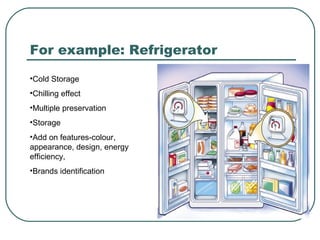
For example: Refrigerator
•Cold Storage
•Chilling effect
•Multiple preservation
•Storage
•Add on features-colour,
appearance, design, energy
efficiency,
•Brands identification
Definition Of product
• Philip Kotler: “A product is anything that can be
offered to a market for attention, acquisition, use
or consumption that might satisfy a want or need.
It includes physical objects, services, persons,
places, or organizations, and ideas.”
• William Stanton: “A product is a set of tangible
attributes including packaging, colour, price,
quality and brand plus the services and reputation
of the seller. A product may be a good, service,
place, person or idea.”
What constitutes of a product?
[Component/Levels of product]
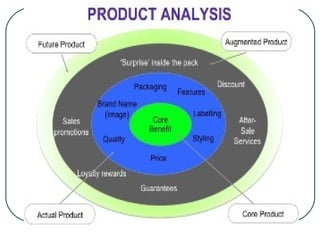
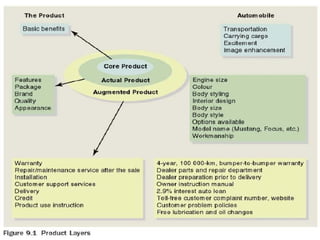
 A product planner should think about the
product at three levels:
 first needs- identify the core consumer
needs the product will satisfy.
 Then design the actual products
 And find ways and means to augment it
further to create bundle of satisfy
consumers.
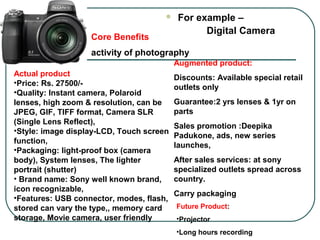
 For example –
Digital Camera
Core Benefits
activity of photography
Actual product
•Price: Rs. 27500/-
•Quality: Instant camera, Polaroid
lenses, high zoom & resolution, can be
JPEG, GIF, TIFF format, Camera SLR
(Single Lens Reflect),
•Style: image display-LCD, Touch screen
function,
•Packaging: light-proof box (camera
body), System lenses, The lighter
portrait (shutter)
• Brand name: Sony well known brand,
icon recognizable,
•Features: USB connector, modes, flash,
stored can vary the type,, memory card
storage, Movie camera, user friendly
Augmented product:
Discounts: Available special retail
outlets only
Guarantee:2 yrs lenses & 1yr on
parts
Sales promotion :Deepika
Padukone, ads, new series
launches,
After sales services: at sony
specialized outlets spread across
country.
Carry packaging
Future Product:
•Projector
•Long hours recording
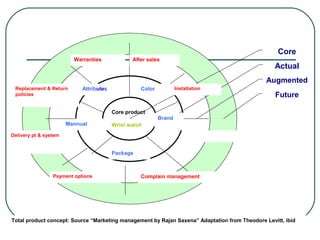
Future
Augmented
Actual
Core
Core product
Wrist watch
Package
Brand
ColorAttributes
Mannual
Warranties After sales
Installation
Complain managementPayment options
Replacement & Return
policies
Delivery pt & system
Total product concept: Source “Marketing management by Rajan Saxena” Adaptation from Theodore Levitt, ibid
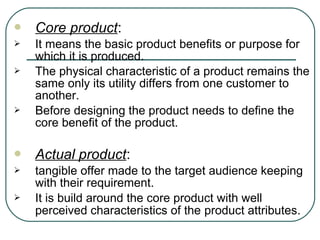
 Core product:
 It means the basic product benefits or purpose for
which it is produced.
 The physical characteristic of a product remains the
same only its utility differs from one customer to
another.
 Before designing the product needs to define the
core benefit of the product.
 Actual product:
 tangible offer made to the target audience keeping
with their requirement.
 It is build around the core product with well
perceived characteristics of the product attributes.
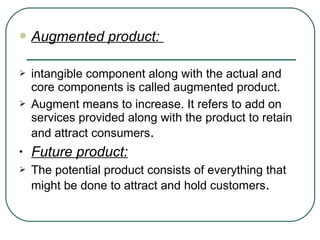
 Augmented product:
 intangible component along with the actual and
core components is called augmented product.
 Augment means to increase. It refers to add on
services provided along with the product to retain
and attract consumers.
• Future product:
 The potential product consists of everything that
might be done to attract and hold customers.
Product mix
 Product mix means the number of product
carried by a firm at a given point of time i.e.
composition of products offered for sale by a
firm.
 For example : Samsung-television, music
system, cellphones, microwave, refrigerators
 Bajaj Electrical-household name in India, has
almost 90 product ranging from low value
products like bulb to high price consumer
durables like mixer, bikes-scooters, etc.
 It consists of product line and product items.
 It has four dimensions: LCDW
 Length: Total number of items included.
 Consistency: Degree of similarity bwt product
line with respect to end use, technology,
production techniques, & distribution channel.
 Depth: Number of versions offered by the
firms (size, packaging, colour, etc)
 Width: Different product line ( different
models offered) firm carries.
Product line:
 Different products that are closely related to each
other by virtue of satisfying a particular class of
needs, being used together, distributed through same
channel or processing common physical or technical
characteristics.
 It a group of products offered by a single firm that
have similar uses. Example- shoes(BATA)
 Under this the firm adds product to the product line.
 The ideal product mix is an issue that varies
from firm to firm and may be hard to define.
 The following situations may suggest that
the firm has a sub-optimal product mix:
a. Excess capacity in a firm’s manufacturing,
warehousing, or transportation facilities
b. High proportion of profits from a small
percentage of product items
c. Insufficient use of sale force contacts & skill
d. Steadily declining sales/ profit
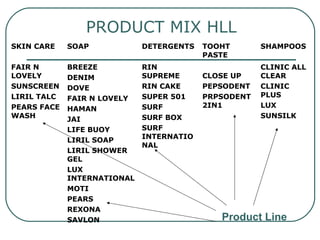
PRODUCT MIX HLL
SKIN CARE
FAIR N
LOVELY
SUNSCREEN
LIRIL TALC
PEARS FACE
WASH
SOAP
BREEZE
DENIM
DOVE
FAIR N LOVELY
HAMAN
JAI
LIFE BUOY
LIRIL SOAP
LIRIL SHOWER
GEL
LUX
INTERNATIONAL
MOTI
PEARS
REXONA
SAVLON
DETERGENTS
RIN
SUPREME
RIN CAKE
SUPER 501
SURF
SURF BOX
SURF
INTERNATIO
NAL
TOOHT
PASTE
CLOSE UP
PEPSODENT
PRPSODENT
2IN1
SHAMPOOS
CLINIC ALL
CLEAR
CLINIC
PLUS
LUX
SUNSILK
Product Line
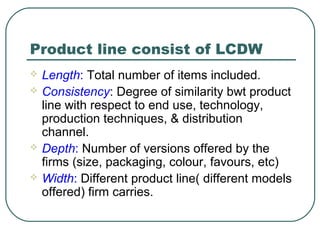
Product line consist of LCDW
 Length: Total number of items included.
 Consistency: Degree of similarity bwt product
line with respect to end use, technology,
production techniques, & distribution
channel.
 Depth: Number of versions offered by the
firms (size, packaging, colour, favours, etc)
 Width: Different product line( different models
offered) firm carries.
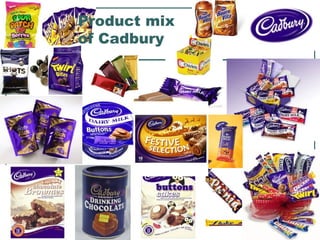
Product mix
of Cadbury
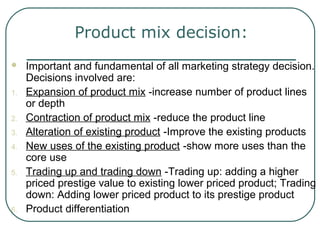
Product mix decision:
 Important and fundamental of all marketing strategy decision.
Decisions involved are:
1. Expansion of product mix -increase number of product lines
or depth
2. Contraction of product mix -reduce the product line
3. Alteration of existing product -Improve the existing products
4. New uses of the existing product -show more uses than the
core use
5. Trading up and trading down -Trading up: adding a higher
priced prestige value to existing lower priced product; Trading
down: Adding lower priced product to its prestige product
6. Product differentiation
Product life Cycle
 Movement through different stages
 A product is born grows lustily, attains a
dynamic maturity & then enters its declining
years.
 Understood through analysis of environ.
 PLC comparison to human life cycle
 Represented by sales & profit of a product over
a period of time.
 Philip Kotler “the product life cycle is an attempt
to recognize distinct stages in the sales history
of the product”
 PLC –heart of marketing strategy
 PLC lengthy & costly process
 Stages of PLC:
i. Introduction
ii. Growth
iii. Maturity
iv. Decline
v. Withdrawal
 Introductory Stages/market Pioneering stage:
1. Launch of the product
2. Preceded by product planning & Development
3. High operational cost
4. Lack market support
5. Consumer-trail basis approach
6. low / no awareness of the product
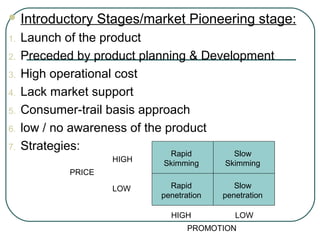
7. Strategies:
PRICE
PROMOTION
Rapid
Skimming
Slow
Skimming
Rapid
penetration
Slow
penetration
HIGH
LOW
LOWHIGH
 Growth Phase:
1. Cultivation of selective demand-focus on Covered
market
2. Increase in competition
3. Softening of pricing / competition oriented pricing
4. Operation on economical levels
5. Gaining market support
6. Strong service network & distribution
7. Product modification & improvement
8. Entry of substitutes
 Maturity stage:
1. Slow growth rate of sales & profit
2. Marked as the peak stage
3. Cutthroat competition
4. Enjoy economies of scale
5. Saturation stage
6. Pricing intensified
7. Increase in marketing cost
8. Product mix- product line altered
 Decline stage:
1. Sales gradually fall
2. Reduction demand
3. Consumer switch over to competitor
4. Expenditure brought down
5. Consumer attitude-old product
6. Vacuum
7. Reduce pricing to survive
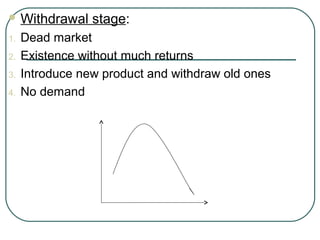
 Withdrawal stage:
1. Dead market
2. Existence without much returns
3. Introduce new product and withdraw old ones
4. No demand
New product development
 Introducing new product in the market
 Adding new product to existing product line
 Constant changing environment dynamics
 Enjoy benefits of initial demand
 Different from product modification or innovation
Why New product development
needed?
1. Meeting growing & changing needs
2. Pressure from environment change
3. Earning more profit
4. Extending product line
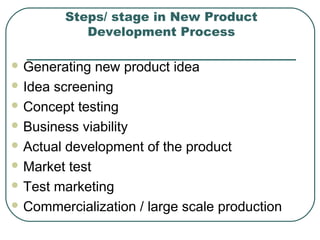
Steps/ stage in New Product
Development Process
 Generating new product idea
 Idea screening
 Concept testing
 Business viability
 Actual development of the product
 Market test
 Test marketing
 Commercialization / large scale production
Product management & PLC

Product management & PLC

  • 1.
    PRODUCT MANAGEMENT PRODUCT &PRODUCT RELATED DECISIONS & NEW PRODUCT DEVELOPMENT & PRODUCT LIFE CYCLE
  • 2.
    What is aproduct?  A product is a bundle of satisfaction that a customer buys. It represents a solution to a customer’s problem and satisfies his needs. It is a combination of tangible and intangible benefits.  A product can be defined as a bundle of attributes that satisfies a consumer.  Anything made keeping in mind consumers can be called as a product as it is formed with an intension to satisfy consumers’ needs.
  • 3.
    Essentials of aproduct:  Product should have utility  Need satisfying capacity  With various features  Selling point  It is heart of the marketing mix  It must have proper name and identity
  • 4.
    A product hasits total product personality which includes the following component:  The basic constituent ie. Physical aspect  Associated features ie. Features, merit, uses  Brand name given to the product  Package used  Label attached to the product
  • 5.
    For example: Refrigerator •ColdStorage •Chilling effect •Multiple preservation •Storage •Add on features-colour, appearance, design, energy efficiency, •Brands identification
  • 6.
    Definition Of product •Philip Kotler: “A product is anything that can be offered to a market for attention, acquisition, use or consumption that might satisfy a want or need. It includes physical objects, services, persons, places, or organizations, and ideas.” • William Stanton: “A product is a set of tangible attributes including packaging, colour, price, quality and brand plus the services and reputation of the seller. A product may be a good, service, place, person or idea.”
  • 7.
    What constitutes ofa product? [Component/Levels of product]  A product planner should think about the product at three levels:  first needs- identify the core consumer needs the product will satisfy.  Then design the actual products  And find ways and means to augment it further to create bundle of satisfy consumers.
  • 9.
     For example– Digital Camera Core Benefits activity of photography Actual product •Price: Rs. 27500/- •Quality: Instant camera, Polaroid lenses, high zoom & resolution, can be JPEG, GIF, TIFF format, Camera SLR (Single Lens Reflect), •Style: image display-LCD, Touch screen function, •Packaging: light-proof box (camera body), System lenses, The lighter portrait (shutter) • Brand name: Sony well known brand, icon recognizable, •Features: USB connector, modes, flash, stored can vary the type,, memory card storage, Movie camera, user friendly Augmented product: Discounts: Available special retail outlets only Guarantee:2 yrs lenses & 1yr on parts Sales promotion :Deepika Padukone, ads, new series launches, After sales services: at sony specialized outlets spread across country. Carry packaging Future Product: •Projector •Long hours recording
  • 10.
    Future Augmented Actual Core Core product Wrist watch Package Brand ColorAttributes Mannual WarrantiesAfter sales Installation Complain managementPayment options Replacement & Return policies Delivery pt & system Total product concept: Source “Marketing management by Rajan Saxena” Adaptation from Theodore Levitt, ibid
  • 12.
     Core product: It means the basic product benefits or purpose for which it is produced.  The physical characteristic of a product remains the same only its utility differs from one customer to another.  Before designing the product needs to define the core benefit of the product.  Actual product:  tangible offer made to the target audience keeping with their requirement.  It is build around the core product with well perceived characteristics of the product attributes.
  • 13.
     Augmented product: intangible component along with the actual and core components is called augmented product.  Augment means to increase. It refers to add on services provided along with the product to retain and attract consumers. • Future product:  The potential product consists of everything that might be done to attract and hold customers.
  • 14.
    Product mix  Productmix means the number of product carried by a firm at a given point of time i.e. composition of products offered for sale by a firm.  For example : Samsung-television, music system, cellphones, microwave, refrigerators  Bajaj Electrical-household name in India, has almost 90 product ranging from low value products like bulb to high price consumer durables like mixer, bikes-scooters, etc.
  • 15.
     It consistsof product line and product items.  It has four dimensions: LCDW  Length: Total number of items included.  Consistency: Degree of similarity bwt product line with respect to end use, technology, production techniques, & distribution channel.  Depth: Number of versions offered by the firms (size, packaging, colour, etc)  Width: Different product line ( different models offered) firm carries.
  • 16.
    Product line:  Differentproducts that are closely related to each other by virtue of satisfying a particular class of needs, being used together, distributed through same channel or processing common physical or technical characteristics.  It a group of products offered by a single firm that have similar uses. Example- shoes(BATA)  Under this the firm adds product to the product line.
  • 17.
     The idealproduct mix is an issue that varies from firm to firm and may be hard to define.  The following situations may suggest that the firm has a sub-optimal product mix: a. Excess capacity in a firm’s manufacturing, warehousing, or transportation facilities b. High proportion of profits from a small percentage of product items c. Insufficient use of sale force contacts & skill d. Steadily declining sales/ profit
  • 18.
    PRODUCT MIX HLL SKINCARE FAIR N LOVELY SUNSCREEN LIRIL TALC PEARS FACE WASH SOAP BREEZE DENIM DOVE FAIR N LOVELY HAMAN JAI LIFE BUOY LIRIL SOAP LIRIL SHOWER GEL LUX INTERNATIONAL MOTI PEARS REXONA SAVLON DETERGENTS RIN SUPREME RIN CAKE SUPER 501 SURF SURF BOX SURF INTERNATIO NAL TOOHT PASTE CLOSE UP PEPSODENT PRPSODENT 2IN1 SHAMPOOS CLINIC ALL CLEAR CLINIC PLUS LUX SUNSILK Product Line
  • 19.
    Product line consistof LCDW  Length: Total number of items included.  Consistency: Degree of similarity bwt product line with respect to end use, technology, production techniques, & distribution channel.  Depth: Number of versions offered by the firms (size, packaging, colour, favours, etc)  Width: Different product line( different models offered) firm carries.
  • 20.
  • 21.
    Product mix decision: Important and fundamental of all marketing strategy decision. Decisions involved are: 1. Expansion of product mix -increase number of product lines or depth 2. Contraction of product mix -reduce the product line 3. Alteration of existing product -Improve the existing products 4. New uses of the existing product -show more uses than the core use 5. Trading up and trading down -Trading up: adding a higher priced prestige value to existing lower priced product; Trading down: Adding lower priced product to its prestige product 6. Product differentiation
  • 22.
    Product life Cycle Movement through different stages  A product is born grows lustily, attains a dynamic maturity & then enters its declining years.  Understood through analysis of environ.  PLC comparison to human life cycle  Represented by sales & profit of a product over a period of time.  Philip Kotler “the product life cycle is an attempt to recognize distinct stages in the sales history of the product”
  • 23.
     PLC –heartof marketing strategy  PLC lengthy & costly process  Stages of PLC: i. Introduction ii. Growth iii. Maturity iv. Decline v. Withdrawal
  • 24.
     Introductory Stages/marketPioneering stage: 1. Launch of the product 2. Preceded by product planning & Development 3. High operational cost 4. Lack market support 5. Consumer-trail basis approach 6. low / no awareness of the product 7. Strategies: PRICE PROMOTION Rapid Skimming Slow Skimming Rapid penetration Slow penetration HIGH LOW LOWHIGH
  • 25.
     Growth Phase: 1.Cultivation of selective demand-focus on Covered market 2. Increase in competition 3. Softening of pricing / competition oriented pricing 4. Operation on economical levels 5. Gaining market support 6. Strong service network & distribution 7. Product modification & improvement 8. Entry of substitutes
  • 26.
     Maturity stage: 1.Slow growth rate of sales & profit 2. Marked as the peak stage 3. Cutthroat competition 4. Enjoy economies of scale 5. Saturation stage 6. Pricing intensified 7. Increase in marketing cost 8. Product mix- product line altered
  • 27.
     Decline stage: 1.Sales gradually fall 2. Reduction demand 3. Consumer switch over to competitor 4. Expenditure brought down 5. Consumer attitude-old product 6. Vacuum 7. Reduce pricing to survive
  • 28.
     Withdrawal stage: 1.Dead market 2. Existence without much returns 3. Introduce new product and withdraw old ones 4. No demand
  • 29.
    New product development Introducing new product in the market  Adding new product to existing product line  Constant changing environment dynamics  Enjoy benefits of initial demand  Different from product modification or innovation Why New product development needed? 1. Meeting growing & changing needs 2. Pressure from environment change 3. Earning more profit 4. Extending product line
  • 30.
    Steps/ stage inNew Product Development Process  Generating new product idea  Idea screening  Concept testing  Business viability  Actual development of the product  Market test  Test marketing  Commercialization / large scale production