
POLICY
REVIEW / EVALUATION
Republic of the Philippines
Region III – Central Luzon
TARLAC STATE UNIVERSITY
Tarlac City
EDUARDO A. PANTIG JR.
Ed. D. – IEM
Stages of Policy Process
Agenda Setting
Policy Formulation
Policy
Adoption/Legitimization
Policy Implementation
Policy
Review/Evaluation
What is Policy Review /
Evaluation?
 It is a means of determining the
effectiveness and efficiency of
government policies and identifying areas
needing change and improvement.
 is a purposeful, systematic, and careful
collection and analysis of information used
for the purpose of documenting the
effectiveness and impact of programs.
To determine whether a social
intervention has produced the
intended result.
Results are not always well
received.
Probably the most difficult type of
research to do well
Policy evaluation enables all
participants in the policy process,
including legislators, executives, agency
officials and others, to measure the
degree to which a program has
achieved its goals, assess the effects
and identify any needed changes to a
policy.
Policy Evaluation uses social
science research methods,
including qualitative and
quantitative techniques, to
examine the effects of
policies.
STANDARDS FOR CONDUCTING
POLICY EVALUATION
1.UTILITY
“Who wants the evaluation results and
for what purpose?”
2. FEASIBILITY
“Are the evaluation procedures
practical, given the time, resources,
and expertise available?”
STANDARDS FOR CONDUCTING
POLICY EVALUATION
3. PROPRIETY
“Is the evaluation being conducted in a
fair and ethical way?”
4. ACCURACY
“Are approaches at each step
accurate, given stakeholder needs and
evaluation purpose?”
TWO MAIN TYPES OF POLICY
EVALUATION
Formative Evaluation - examines the
operations of the program, usually
for the purpose of improving the
program and assessing its
implementation.
TWO MAIN TYPES OF POLICY
EVALUATION
Summative Evaluation - asks
whether the program achieved its
intended goals. It is conducted
for the purpose of documenting
the results of a policy.
STEPS IN POLICY EVALUATION
Step 1: Define Purpose and Scope
•Why are you doing the
evaluation?
 program outcomes?
 program improvement?
STEPS IN POLICY EVALUATION
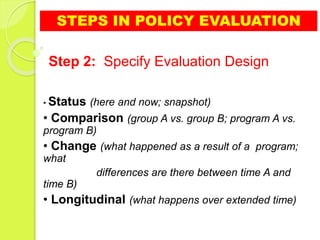
Step 2: Specify Evaluation Design
• Status (here and now; snapshot)
• Comparison (group A vs. group B; program A vs.
program B)
• Change (what happened as a result of a program;
what
differences are there between time A and
time B)
• Longitudinal (what happens over extended time)
STEPS IN POLICY EVALUATION
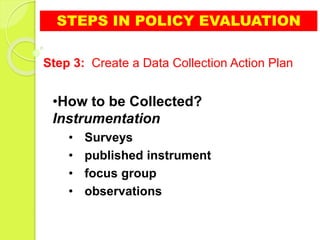
Step 3: Create a Data Collection Action Plan
•How to be Collected?
Instrumentation
• Surveys
• published instrument
• focus group
• observations
STEPS IN POLICY EVALUATION
Step 4: Collect Data
•How much data do you need?
– 100% of target audience is ideal; may
be too expensive and time consuming
STEPS IN POLICY EVALUATION
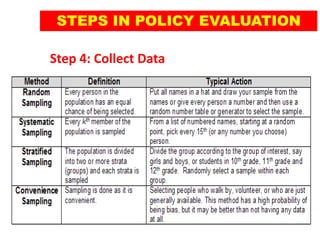
Step 4: Collect Data
STEPS IN POLICY EVALUATION
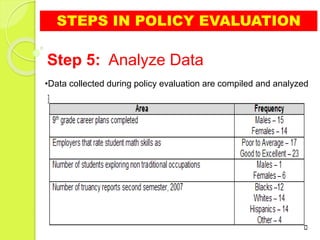
Step 5: Analyze Data
•Data collected during policy evaluation are compiled and analyzed
STEPS IN POLICY EVALUATION
Step 6: Drawing Conclusions and Documenting
Findings
• Examine results carefully and
objectively
• Draw conclusions based on your data
• What do the results signify about your
program?
STEPS IN POLICY EVALUATION
Step 7: Feedback to Program Improvement
•You can use evaluation findings to
make program improvements
– Consider adjustments
– Re-examine/revise program strategies
– Change programs or methodologies
– Increase time with the program
CONCLUSION
Evaluation helps you:
• determine the effects of the program on
recipients
• know if you have reached your
objectives
• improve your program
Thank
You!

Policy Review/Evaluation

  • 1.
    POLICY REVIEW / EVALUATION Republicof the Philippines Region III – Central Luzon TARLAC STATE UNIVERSITY Tarlac City EDUARDO A. PANTIG JR. Ed. D. – IEM
  • 2.
    Stages of PolicyProcess Agenda Setting Policy Formulation Policy Adoption/Legitimization Policy Implementation Policy Review/Evaluation
  • 3.
    What is PolicyReview / Evaluation?  It is a means of determining the effectiveness and efficiency of government policies and identifying areas needing change and improvement.  is a purposeful, systematic, and careful collection and analysis of information used for the purpose of documenting the effectiveness and impact of programs.
  • 4.
    To determine whethera social intervention has produced the intended result. Results are not always well received. Probably the most difficult type of research to do well
  • 5.
    Policy evaluation enablesall participants in the policy process, including legislators, executives, agency officials and others, to measure the degree to which a program has achieved its goals, assess the effects and identify any needed changes to a policy.
  • 6.
    Policy Evaluation usessocial science research methods, including qualitative and quantitative techniques, to examine the effects of policies.
  • 7.
    STANDARDS FOR CONDUCTING POLICYEVALUATION 1.UTILITY “Who wants the evaluation results and for what purpose?” 2. FEASIBILITY “Are the evaluation procedures practical, given the time, resources, and expertise available?”
  • 8.
    STANDARDS FOR CONDUCTING POLICYEVALUATION 3. PROPRIETY “Is the evaluation being conducted in a fair and ethical way?” 4. ACCURACY “Are approaches at each step accurate, given stakeholder needs and evaluation purpose?”
  • 9.
    TWO MAIN TYPESOF POLICY EVALUATION Formative Evaluation - examines the operations of the program, usually for the purpose of improving the program and assessing its implementation.
  • 10.
    TWO MAIN TYPESOF POLICY EVALUATION Summative Evaluation - asks whether the program achieved its intended goals. It is conducted for the purpose of documenting the results of a policy.
  • 11.
    STEPS IN POLICYEVALUATION Step 1: Define Purpose and Scope •Why are you doing the evaluation?  program outcomes?  program improvement?
  • 12.
    STEPS IN POLICYEVALUATION Step 2: Specify Evaluation Design • Status (here and now; snapshot) • Comparison (group A vs. group B; program A vs. program B) • Change (what happened as a result of a program; what differences are there between time A and time B) • Longitudinal (what happens over extended time)
  • 13.
    STEPS IN POLICYEVALUATION Step 3: Create a Data Collection Action Plan •How to be Collected? Instrumentation • Surveys • published instrument • focus group • observations
  • 14.
    STEPS IN POLICYEVALUATION Step 4: Collect Data •How much data do you need? – 100% of target audience is ideal; may be too expensive and time consuming
  • 15.
    STEPS IN POLICYEVALUATION Step 4: Collect Data
  • 16.
    STEPS IN POLICYEVALUATION Step 5: Analyze Data •Data collected during policy evaluation are compiled and analyzed
  • 17.
    STEPS IN POLICYEVALUATION Step 6: Drawing Conclusions and Documenting Findings • Examine results carefully and objectively • Draw conclusions based on your data • What do the results signify about your program?
  • 18.
    STEPS IN POLICYEVALUATION Step 7: Feedback to Program Improvement •You can use evaluation findings to make program improvements – Consider adjustments – Re-examine/revise program strategies – Change programs or methodologies – Increase time with the program
  • 19.
    CONCLUSION Evaluation helps you: •determine the effects of the program on recipients • know if you have reached your objectives • improve your program
  • 20.

Editor's Notes

  • #3 Agenda setting is the process wherein problems, issues and concerns of the health sector are identified and clearly defined Policy formulation is the process of transforming an agenda into policy. Policy adoption is the process by which the approving authority decides for the approval of the policy. Policy implementation is the process of carrying out or executing the policy. Policy evaluation and monitoring is the process by which policies are assessed using a set of parameters to determine whether it should be continued or terminated