Product Planning
Teaching materials to accompany:
Product Design and Development
Chapter 4
Product Design and Development
Karl T. Ulrich and Steven D. Eppinger
5th edition, Irwin McGraw-Hill, 2012.
Chapter Table of Contents:
1.Introduction
2.Development Processes and Organizations
3.Opportunity Identification
4.Product Planning
5.Identifying Customer Needs
6.Product Specifications
7.Concept Generation
8.Concept Selection
9.Concept Testing
10.Product Architecture
11.Industrial Design
12.Design for Environment
13.Design for Manufacturing
14.Prototyping
15.Robust Design
16.Patents and Intellectual Property
17.Product Development Economics
18.Managing Projects
Session Outline
 Product development opportunities  Sourcing ideas on a regular
basis
 Market competition  Planning products w.r.t competition
 Technology  The concept of technology S-curves
 Portfolio planning  The need for balanced portfolios; product-
process change map & aggregate product planning
 Mission statements  For each project
Objectives & Strategy
 Product development teams generally begin with a project mission
statement.
 This relates strongly to concepts of corporate strategy.
 A cross-functional planning process develops the product
development team's mission statement.
 Note: The multiple-product, multiple-project context of product
development in established firms.
 The ability to choose the right set of development projects and
to define the scope of these projects in such a way that they are
complementary
PlanningPlanning
Product Development
Process
Concept
Development
Concept
Development
System-Level
Design
System-Level
Design
Detail
Design
Detail
Design
Testing and
Refinement
Testing and
Refinement
Production
Ramp-Up
Production
Ramp-Up
Four Phases of Product Development
The product planning phase precedes the product development process.
(i.e., before substantial resources are applied)
It considers the portfolio of projects that an organization might pursue
Product Planning
 Ensures product development projects support the broader
business strategy of the company.
Addresses:
 What product development projects will be undertaken?
 What mix of fundamentally new products, platforms and derivative
products should be pursued?
 How do the various projects relate to each other as a portfolio?
 What will be the timing and sequence of projects?
Product Development Teams
 Work on selected projects and start with a mission.
 The mission statement answers:
 What market segments should be considered in designing the
product and developing its features?
 What new technologies (if any) should be incorporated into the new
products?
 What are the manufacturing and service goals and constraints?
 What are the financial targets for the project?
 What are the budget and the time frame for the project?
The Product Planning Process
The product plan identifies the portfolio of products to be developed by
the organization and the timing of their introduction to the market
through proper allocation of resources.
The planning process considers:
 Product dev. Opportunities identified from various sources
 Suggestions from marketing, research, customers, current product
development teams
 Benchmarking of competitors
Inefficiencies
Some inefficiencies in organizations that do not engage in product
planning:
 Inadequate coverage of target markets with competitive products.
 Poor timing of market introductions of products.
 Mismatches between aggregate development capacity and the number
of projects pursued.
 Poor distribution of resources, with some projects overstaffed and
others understaffed.
 Initiation and subsequent cancellation of ill-conceived projects.
 Frequent changes in the directions of the projects.
Xerox Lakes Project Example
Xerox Document Centre 265
Xerox’s Competitive
Strategy  Exploit
technological innovation
in a rapidly changing
market
DIGITAL COPIER
PLATFORM
(AS OPPOSED TO
EXISTING LIGHT
LENS )
TQ-1: How might a portfolio of development projects differ for product technologies
at position A or B?
Concept of S-Curves
Draw S-curves of your choice. What are the disruptive technologies here? What
dimensions of performance are affected?
The Product Plan
The product plans developed by keeping in mind:
 Company’s goals
 Capabilities
 Constraints
 Competitive environment
The product plan is regularly updated to reflect changes in:
 Competitive environment
 Technology
 Info on successes of existing products
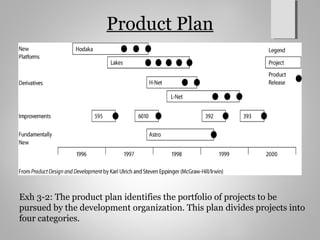
Product Plan
Exh 3-2: The product plan identifies the portfolio of projects to be
pursued by the development organization. This plan divides projects into
four categories.
The Product Planning Process
1. Identify opportunities.
2. Evaluate and prioritize projects.
3. Allocate resources and plan timing.
4. Complete pre-project planning.
5. Reflect on the results and the processes.
Note: Selecting a promising project is iterative in nature
Step 1: Identify opportunities
Sources of product development opportunities:
 Marketing/Sales
 Research/Technology Development (Xerox PARC)
 PD Teams
 Manufacturing
 Customers
 Third party: Suppliers, Inventors, and business partners
 Other business groups (Xerox Supplies Division)
Some proactive approaches:
 Document frustrations and complaints
 Study Competitors’ products (Competitive benchmarking)
 Track the status of emerging technologies
 More…see text
Xerox
Some opportunity statements proposed at Xerox:
 Create a document distribution system in which a networked
printing, device resides on each office worker’s desk and
automatically drives mail and other documents.
 Create document delivery software that allows the digital delivery
and storage of most intra-organizational documents via a worker’s
personal computer.
Opportunity statement: Lakes Project
 Develop a new black & white (B&W), digital, networkable, document
center platform for the office market, including scanning, storage,
fax, distribution, and printing capabilities
Step 2: Evaluate and Prioritize
Projects
Competitive strategies
 Technology leadership
 Cost leadership
 Customer focus
 Imitative
Market Segmentation
Technology Trajectories
Product Platform Planning
Evaluating Fundamentally New Product Opportunities
Balancing the portfolio
 Technology leadership  Basic R & D
 Cost leadership  Superior manufacturing methods; Design for
manufacturing to reduce costs
 Customer focus  Rapid development of derivatives through
carefully designed product platforms
 Imitative  Fast development process
Competitive Strategies
Market Segmentation: Market Segment Map
Exh 3.4: Product segment map showing Xerox B&W digital products and the competition in three
markets (Segmentation based on number of users sharing office equipment) . Key performance
dimensions  pages per minute & networking capability
Technology Trajectories
Q: How near or far is the ultimate performance limit?
Exh 3.5: This technology S-curve
illustrates that Xerox believed digital
copier technologies were just emerging
and will improve product performance
in coming years. Xerox believed that it
could develop a full-featured digital
copier in the near future with
performance exceeding that of light-
lens copiers.
Product Platform Planning: Platforms vs.
Derivatives
Ex 3.6: A platform development project creates the architecture of a family of products.
Derivative products may be included in the initial platform development effort (Platform
A) or derivative products may follow thereafter (Platform B)
Platform  Set of assets shared across a set of products (e.g. components & sub assys)
Derivatives  For different segments
Ex 3.7: This technology
roadmap shows the life cycles
of several digital
photocopying technologies &
identifies which technologies
would be used in each
product. For Lakes
platform Higher speeds
and color capabilities
required of its derivatives.
Product Platform Planning: Technology Roadmap
Note: decisions about
product platforms are
closely related to the
technology development
efforts of the firm
Some criteria for evaluating fundamentally new product opportunities:
 Market size (units/year * average price)
 Market growth rate (percent per year)
 Competitive intensity (#competitors & their strengths)
 Depth of the firm’s existing knowledge of the markets
 Depth of the firm’s existing knowledge of technology
 Fit with the firm’s other products
 Fit with the firm’s capabilities
 Potential for patents or other barriers to competition
 Existence of a product champion within the firm
Evaluating Fundamentally New Product Opportunities
 Ex 3.8: The product-process change matrix
 The extent to which the project involves changes in the product
line and/or the production processes
 Helps identify projects  breakthrough opportunities as well as
incremental improvements
 Firms typically benefit from a diverse set of projects
 Firm’s choice of competitive strategy influences product
development portfolio:
(FIRM STRATEGY) (PORTFOLIO)
 LOW COST STRATEGY  MORE OF PRODUCTION
PROCESS IMPROVEMENT PROJECTS
 HIGH PRODUCT VARIETY  DERIVATIVE PRODUCTS
UPON EXISTING PLATFORMS
 TECHNOLOGICAL SUPERIORITY  TECH DEV. &
BREAKTHROUGH PROJECTS
Balancing the portfolio
Product-Process Change Matrix
Extent of Production Process Changes
ExtentofProductChanges
New
Core
Process
Next
Generation
Process
Single
Department
Upgrade
Tuning and
Incremental
Changes
No
Process
Change
New
Core
Product
Next
Generation
Product
Addition
to Product
Family
Minor
Product
Enhancement
No
Product
Change
Lakes
Project
Research and
Technology
Development
Breakthrough
Development
Projects
Platform
Development
Projects
Derivative
Product
Development
Current
Product/Process
Support
Step 3:Allocate Resources & Plan
Timing
Resource Allocation
 Careful use of the limited development resources
 Avoid starting too many projects. May result in:
 Skilled engineers and managers stretching their capabilities
 Affects productivity, time-to-market, quality, and profitability
 Aggregate Product Planning (Ex 3.9):
 makes efficient use of resources within budgeted resources
Project Timing
 Timing of product introductions
 Technology readiness
 Market readiness
 Competition
The Product Plan (Exhibit: 3.2)
 Set of projects approved by the planning process and sequenced in time.
 Mix of: Fundamentally new product, platform and derivative projects.
 Updated periodically as a part of the strategic planning activity.
Aggregate Resource Planning
0%
20%
40%
60%
80%
1 0 0 %
120%
140%
Year 1 Year 2 Year 3
Capacity
Utilization
MechanicalDesign
ElectricalEngineering
ManufacturingEngineering
Software/Firmware
IndustrialDesign
MechanicalDesign
ElectricalEngineering
ManufacturingEngineering
Software/Firmware
IndustrialDesign
MechanicalDesign
ElectricalEngineering
ManufacturingEngineering
Software/Firmware
IndustrialDesign
Ex 3.9: Aggregate
Resource Planning
Product Plan
Exh 3-2: The product plan identifies the portfolio of projects to be pursued by the
development organization. This plan divides projects into four categories.
The Product Plan (Exhibit: 3.2)
•Set of projects approved by the planning process and sequenced in time.
•Mix of: Fundamentally new product, platform and derivative projects.
•Updated periodically as a part of the strategic planning activity.
Step 4: Complete Pre-Project
Planning
Product Vision Statement
Develop a networked, mid-range digital platform for imaging, marking, and
finishing
Mission Statements
 Brief (one sentence) description of the product
 Key business goals
 Target market(s) for the product
 Assumptions and constraints that guide the development effort
 Stakeholders
Assumptions and constraints
 Manufacturing
 Service
 Environment
Staffing and other pre-project planning activities
Lakes Project Mission Statement
Product Description
• Networkable, digital machine with copy, print, fax, and scan functions
Key Business Goals
• Support Xerox strategy of leadership in digital office equipment
• Serve as platform for all future B&W digital products and solutions
• Capture 50% of digital product sales in primary market
• Environmentally friendly
• First product introduction 4thQ 1997
Primary Market
• Office departments, mid-volume (40-65 ppm, above 42,000 avg. copies/mo.)
Secondary Markets
• Quick-print market
• Small ‘satellite’ operations
Assumptions and Constraints
• New product platform
• Digital imaging technology
• Compatible with Centre Ware software
• Input devices manufactured in Canada
• Output devices manufactured in Brazil
• Image processing engine manufactured in both USA and Europe
Stakeholders
• Purchasers and Users
• Manufacturing Operations
• Service Operations
• Distributors and Resellers
Product Description
• Networkable, digital machine with copy, print, fax, and scan functions
Key Business Goals
• Support Xerox strategy of leadership in digital office equipment
• Serve as platform for all future B&W digital products and solutions
• Capture 50% of digital product sales in primary market
• Environmentally friendly
• First product introduction 4thQ 1997
Primary Market
• Office departments, mid-volume (40-65 ppm, above 42,000 avg. copies/mo.)
Secondary Markets
• Quick-print market
• Small ‘satellite’ operations
Assumptions and Constraints
• New product platform
• Digital imaging technology
• Compatible with Centre Ware software
• Input devices manufactured in Canada
• Output devices manufactured in Brazil
• Image processing engine manufactured in both USA and Europe
Stakeholders
• Purchasers and Users
• Manufacturing Operations
• Service Operations
• Distributors and Resellers
Lakes Project Mission Statement
Assumptions & Constraints
Some may ask:
 Why manufacturing, Service and Environmental strategies should be
part of the mission statement for a new product?
Some may even hold:
 Decisions about these issues should arise from customer needs for new
products and should not be determined in advance.
Why then do we have Xerox mentioning these in the project
mission statement?
Assumptions & Constraints (contd..)
 For complex projects (as in this Xerox example), the design of the
manufacturing systems are equally complex.
 Thus manufacturing facilities involved in the product need to be
identified very early in the process.
 Some product requirements cannot be derived strictly from customer
needs.
 Environmentally responsible design (as a Corporate Responsibility
of Xerox
Mission statements must reflect such corporate objectives and
constraints.
Assumptions & Constraints (contd..)
For Lakes Project of Xerox
Manufacturing
 Capabilities, capacities, and constraints of existing manufacturing processes
 Which internal production facility to be used?
 What key suppliers to be involved and when?
 For Xerox: Input devises at Canada, Output devices in Brazil etc.
Service
 Note: Customer service and service revenue important in this business
 Strategic goals for improving service quality
 Designing components requiring few parts
 Designing for ease of serviceability (quick service)
Environment
 Design for environment
 Developing new products with environmental sustainability
 Xerox’s  “Zero to landfill” policy with an energy efficiency goal “most efficient machine in
its class”
 Remanufacture or recycle [no part should be disposed by the customer to end up in a
landfill]
Step 5: Reflect on the Results & the
Process
Some suggested questions:
 Is the opportunity funnel collecting an exciting and diverse set of product
opportunities?
 Does the product plan support the competitive strategy of the firm?
 Does the product plan address the most important current opportunities facing the
firm?
 Are the resources allocated product development adequate to pursue the firm’s
competitive strategy?
 Have creative ways of leveraging finite resources been considered…?
 Does the core team accept the challenges of the resulting mission statement
 Are the elements of the mission statement consistent?
 Are assumptions listed in the mission statement really necessary or is the project
over-constrained? Will the development team have the freedom to develop the best
possible design?
 How can the product planning process be improved?

Product design and development ch4

  • 1.
    Product Planning Teaching materialsto accompany: Product Design and Development Chapter 4
  • 2.
    Product Design andDevelopment Karl T. Ulrich and Steven D. Eppinger 5th edition, Irwin McGraw-Hill, 2012. Chapter Table of Contents: 1.Introduction 2.Development Processes and Organizations 3.Opportunity Identification 4.Product Planning 5.Identifying Customer Needs 6.Product Specifications 7.Concept Generation 8.Concept Selection 9.Concept Testing 10.Product Architecture 11.Industrial Design 12.Design for Environment 13.Design for Manufacturing 14.Prototyping 15.Robust Design 16.Patents and Intellectual Property 17.Product Development Economics 18.Managing Projects
  • 3.
    Session Outline  Productdevelopment opportunities  Sourcing ideas on a regular basis  Market competition  Planning products w.r.t competition  Technology  The concept of technology S-curves  Portfolio planning  The need for balanced portfolios; product- process change map & aggregate product planning  Mission statements  For each project
  • 4.
    Objectives & Strategy Product development teams generally begin with a project mission statement.  This relates strongly to concepts of corporate strategy.  A cross-functional planning process develops the product development team's mission statement.  Note: The multiple-product, multiple-project context of product development in established firms.  The ability to choose the right set of development projects and to define the scope of these projects in such a way that they are complementary
  • 5.
    PlanningPlanning Product Development Process Concept Development Concept Development System-Level Design System-Level Design Detail Design Detail Design Testing and Refinement Testingand Refinement Production Ramp-Up Production Ramp-Up Four Phases of Product Development The product planning phase precedes the product development process. (i.e., before substantial resources are applied) It considers the portfolio of projects that an organization might pursue
  • 6.
    Product Planning  Ensuresproduct development projects support the broader business strategy of the company. Addresses:  What product development projects will be undertaken?  What mix of fundamentally new products, platforms and derivative products should be pursued?  How do the various projects relate to each other as a portfolio?  What will be the timing and sequence of projects?
  • 7.
    Product Development Teams Work on selected projects and start with a mission.  The mission statement answers:  What market segments should be considered in designing the product and developing its features?  What new technologies (if any) should be incorporated into the new products?  What are the manufacturing and service goals and constraints?  What are the financial targets for the project?  What are the budget and the time frame for the project?
  • 8.
    The Product PlanningProcess The product plan identifies the portfolio of products to be developed by the organization and the timing of their introduction to the market through proper allocation of resources. The planning process considers:  Product dev. Opportunities identified from various sources  Suggestions from marketing, research, customers, current product development teams  Benchmarking of competitors
  • 9.
    Inefficiencies Some inefficiencies inorganizations that do not engage in product planning:  Inadequate coverage of target markets with competitive products.  Poor timing of market introductions of products.  Mismatches between aggregate development capacity and the number of projects pursued.  Poor distribution of resources, with some projects overstaffed and others understaffed.  Initiation and subsequent cancellation of ill-conceived projects.  Frequent changes in the directions of the projects.
  • 10.
    Xerox Lakes ProjectExample Xerox Document Centre 265 Xerox’s Competitive Strategy  Exploit technological innovation in a rapidly changing market DIGITAL COPIER PLATFORM (AS OPPOSED TO EXISTING LIGHT LENS )
  • 11.
    TQ-1: How mighta portfolio of development projects differ for product technologies at position A or B? Concept of S-Curves Draw S-curves of your choice. What are the disruptive technologies here? What dimensions of performance are affected?
  • 12.
    The Product Plan Theproduct plans developed by keeping in mind:  Company’s goals  Capabilities  Constraints  Competitive environment The product plan is regularly updated to reflect changes in:  Competitive environment  Technology  Info on successes of existing products
  • 13.
    Product Plan Exh 3-2:The product plan identifies the portfolio of projects to be pursued by the development organization. This plan divides projects into four categories.
  • 14.
    The Product PlanningProcess 1. Identify opportunities. 2. Evaluate and prioritize projects. 3. Allocate resources and plan timing. 4. Complete pre-project planning. 5. Reflect on the results and the processes. Note: Selecting a promising project is iterative in nature
  • 15.
    Step 1: Identifyopportunities Sources of product development opportunities:  Marketing/Sales  Research/Technology Development (Xerox PARC)  PD Teams  Manufacturing  Customers  Third party: Suppliers, Inventors, and business partners  Other business groups (Xerox Supplies Division) Some proactive approaches:  Document frustrations and complaints  Study Competitors’ products (Competitive benchmarking)  Track the status of emerging technologies  More…see text
  • 16.
    Xerox Some opportunity statementsproposed at Xerox:  Create a document distribution system in which a networked printing, device resides on each office worker’s desk and automatically drives mail and other documents.  Create document delivery software that allows the digital delivery and storage of most intra-organizational documents via a worker’s personal computer. Opportunity statement: Lakes Project  Develop a new black & white (B&W), digital, networkable, document center platform for the office market, including scanning, storage, fax, distribution, and printing capabilities
  • 17.
    Step 2: Evaluateand Prioritize Projects Competitive strategies  Technology leadership  Cost leadership  Customer focus  Imitative Market Segmentation Technology Trajectories Product Platform Planning Evaluating Fundamentally New Product Opportunities Balancing the portfolio
  • 18.
     Technology leadership Basic R & D  Cost leadership  Superior manufacturing methods; Design for manufacturing to reduce costs  Customer focus  Rapid development of derivatives through carefully designed product platforms  Imitative  Fast development process Competitive Strategies
  • 19.
    Market Segmentation: MarketSegment Map Exh 3.4: Product segment map showing Xerox B&W digital products and the competition in three markets (Segmentation based on number of users sharing office equipment) . Key performance dimensions  pages per minute & networking capability
  • 20.
    Technology Trajectories Q: Hownear or far is the ultimate performance limit? Exh 3.5: This technology S-curve illustrates that Xerox believed digital copier technologies were just emerging and will improve product performance in coming years. Xerox believed that it could develop a full-featured digital copier in the near future with performance exceeding that of light- lens copiers.
  • 21.
    Product Platform Planning:Platforms vs. Derivatives Ex 3.6: A platform development project creates the architecture of a family of products. Derivative products may be included in the initial platform development effort (Platform A) or derivative products may follow thereafter (Platform B) Platform  Set of assets shared across a set of products (e.g. components & sub assys) Derivatives  For different segments
  • 22.
    Ex 3.7: Thistechnology roadmap shows the life cycles of several digital photocopying technologies & identifies which technologies would be used in each product. For Lakes platform Higher speeds and color capabilities required of its derivatives. Product Platform Planning: Technology Roadmap Note: decisions about product platforms are closely related to the technology development efforts of the firm
  • 23.
    Some criteria forevaluating fundamentally new product opportunities:  Market size (units/year * average price)  Market growth rate (percent per year)  Competitive intensity (#competitors & their strengths)  Depth of the firm’s existing knowledge of the markets  Depth of the firm’s existing knowledge of technology  Fit with the firm’s other products  Fit with the firm’s capabilities  Potential for patents or other barriers to competition  Existence of a product champion within the firm Evaluating Fundamentally New Product Opportunities
  • 24.
     Ex 3.8:The product-process change matrix  The extent to which the project involves changes in the product line and/or the production processes  Helps identify projects  breakthrough opportunities as well as incremental improvements  Firms typically benefit from a diverse set of projects  Firm’s choice of competitive strategy influences product development portfolio: (FIRM STRATEGY) (PORTFOLIO)  LOW COST STRATEGY  MORE OF PRODUCTION PROCESS IMPROVEMENT PROJECTS  HIGH PRODUCT VARIETY  DERIVATIVE PRODUCTS UPON EXISTING PLATFORMS  TECHNOLOGICAL SUPERIORITY  TECH DEV. & BREAKTHROUGH PROJECTS Balancing the portfolio
  • 25.
    Product-Process Change Matrix Extentof Production Process Changes ExtentofProductChanges New Core Process Next Generation Process Single Department Upgrade Tuning and Incremental Changes No Process Change New Core Product Next Generation Product Addition to Product Family Minor Product Enhancement No Product Change Lakes Project Research and Technology Development Breakthrough Development Projects Platform Development Projects Derivative Product Development Current Product/Process Support
  • 26.
    Step 3:Allocate Resources& Plan Timing Resource Allocation  Careful use of the limited development resources  Avoid starting too many projects. May result in:  Skilled engineers and managers stretching their capabilities  Affects productivity, time-to-market, quality, and profitability  Aggregate Product Planning (Ex 3.9):  makes efficient use of resources within budgeted resources Project Timing  Timing of product introductions  Technology readiness  Market readiness  Competition The Product Plan (Exhibit: 3.2)  Set of projects approved by the planning process and sequenced in time.  Mix of: Fundamentally new product, platform and derivative projects.  Updated periodically as a part of the strategic planning activity.
  • 27.
    Aggregate Resource Planning 0% 20% 40% 60% 80% 10 0 % 120% 140% Year 1 Year 2 Year 3 Capacity Utilization MechanicalDesign ElectricalEngineering ManufacturingEngineering Software/Firmware IndustrialDesign MechanicalDesign ElectricalEngineering ManufacturingEngineering Software/Firmware IndustrialDesign MechanicalDesign ElectricalEngineering ManufacturingEngineering Software/Firmware IndustrialDesign
  • 28.
  • 29.
    Product Plan Exh 3-2:The product plan identifies the portfolio of projects to be pursued by the development organization. This plan divides projects into four categories. The Product Plan (Exhibit: 3.2) •Set of projects approved by the planning process and sequenced in time. •Mix of: Fundamentally new product, platform and derivative projects. •Updated periodically as a part of the strategic planning activity.
  • 30.
    Step 4: CompletePre-Project Planning Product Vision Statement Develop a networked, mid-range digital platform for imaging, marking, and finishing Mission Statements  Brief (one sentence) description of the product  Key business goals  Target market(s) for the product  Assumptions and constraints that guide the development effort  Stakeholders Assumptions and constraints  Manufacturing  Service  Environment Staffing and other pre-project planning activities
  • 31.
    Lakes Project MissionStatement Product Description • Networkable, digital machine with copy, print, fax, and scan functions Key Business Goals • Support Xerox strategy of leadership in digital office equipment • Serve as platform for all future B&W digital products and solutions • Capture 50% of digital product sales in primary market • Environmentally friendly • First product introduction 4thQ 1997 Primary Market • Office departments, mid-volume (40-65 ppm, above 42,000 avg. copies/mo.) Secondary Markets • Quick-print market • Small ‘satellite’ operations Assumptions and Constraints • New product platform • Digital imaging technology • Compatible with Centre Ware software • Input devices manufactured in Canada • Output devices manufactured in Brazil • Image processing engine manufactured in both USA and Europe Stakeholders • Purchasers and Users • Manufacturing Operations • Service Operations • Distributors and Resellers
  • 32.
    Product Description • Networkable,digital machine with copy, print, fax, and scan functions Key Business Goals • Support Xerox strategy of leadership in digital office equipment • Serve as platform for all future B&W digital products and solutions • Capture 50% of digital product sales in primary market • Environmentally friendly • First product introduction 4thQ 1997 Primary Market • Office departments, mid-volume (40-65 ppm, above 42,000 avg. copies/mo.) Secondary Markets • Quick-print market • Small ‘satellite’ operations Assumptions and Constraints • New product platform • Digital imaging technology • Compatible with Centre Ware software • Input devices manufactured in Canada • Output devices manufactured in Brazil • Image processing engine manufactured in both USA and Europe Stakeholders • Purchasers and Users • Manufacturing Operations • Service Operations • Distributors and Resellers Lakes Project Mission Statement
  • 33.
    Assumptions & Constraints Somemay ask:  Why manufacturing, Service and Environmental strategies should be part of the mission statement for a new product? Some may even hold:  Decisions about these issues should arise from customer needs for new products and should not be determined in advance. Why then do we have Xerox mentioning these in the project mission statement?
  • 34.
    Assumptions & Constraints(contd..)  For complex projects (as in this Xerox example), the design of the manufacturing systems are equally complex.  Thus manufacturing facilities involved in the product need to be identified very early in the process.  Some product requirements cannot be derived strictly from customer needs.  Environmentally responsible design (as a Corporate Responsibility of Xerox Mission statements must reflect such corporate objectives and constraints.
  • 35.
    Assumptions & Constraints(contd..) For Lakes Project of Xerox Manufacturing  Capabilities, capacities, and constraints of existing manufacturing processes  Which internal production facility to be used?  What key suppliers to be involved and when?  For Xerox: Input devises at Canada, Output devices in Brazil etc. Service  Note: Customer service and service revenue important in this business  Strategic goals for improving service quality  Designing components requiring few parts  Designing for ease of serviceability (quick service) Environment  Design for environment  Developing new products with environmental sustainability  Xerox’s  “Zero to landfill” policy with an energy efficiency goal “most efficient machine in its class”  Remanufacture or recycle [no part should be disposed by the customer to end up in a landfill]
  • 36.
    Step 5: Reflecton the Results & the Process Some suggested questions:  Is the opportunity funnel collecting an exciting and diverse set of product opportunities?  Does the product plan support the competitive strategy of the firm?  Does the product plan address the most important current opportunities facing the firm?  Are the resources allocated product development adequate to pursue the firm’s competitive strategy?  Have creative ways of leveraging finite resources been considered…?  Does the core team accept the challenges of the resulting mission statement  Are the elements of the mission statement consistent?  Are assumptions listed in the mission statement really necessary or is the project over-constrained? Will the development team have the freedom to develop the best possible design?  How can the product planning process be improved?