Marketing Management
Setting product strategy
THE MEANING OF “PRODUCT”
 A product may be a good, service, place,
person, or idea.
 A product is a set of tangible and intangible
attributes, which include packaging, color,
price, quality, and brand, plus the services
and reputation of the seller.
Components of the
Market Offering
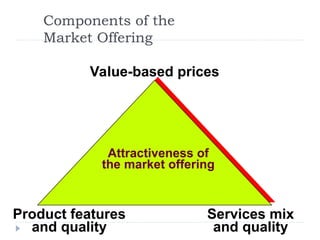
Value-based prices
Services mix
and quality
Product features
and quality
Attractiveness of
the market offering
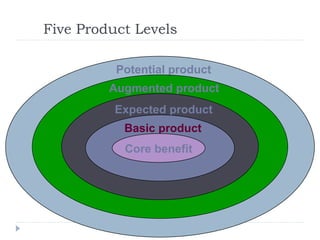
Five Product Levels
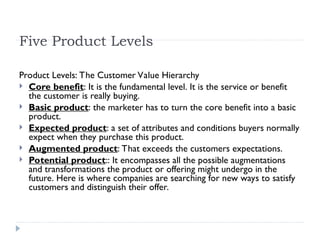
Product Levels: The Customer Value Hierarchy
 Core benefit: It is the fundamental level. It is the service or benefit
the customer is really buying.
 Basic product: the marketer has to turn the core benefit into a basic
product.
 Expected product: a set of attributes and conditions buyers normally
expect when they purchase this product.
 Augmented product: That exceeds the customers expectations.
 Potential product:: It encompasses all the possible augmentations
and transformations the product or offering might undergo in the
future. Here is where companies are searching for new ways to satisfy
customers and distinguish their offer.
Augmented Product
In developing countries brand positioning and competition
takes place at this level. Differentiation arises on the
basis of product augmentation also leads the marketer to
look at the users total consumption system (the way the
user perform the tasks of getting and using products and
related services)
Product Augmentation Strategy:
1. Each augmentation adds cost
2. Augmented benefits soon become expected benefits and
necessary point-of-parity, this means that competitors
will have to search for other features and benefits.
3. As companies raise the price of their augmented product
some competitors offer a “stripped-down” version at a
much lower price.
Five Product Levels
Potential product
Augmented product
Expected product
Basic product
Core benefit
Product Classification Schemes
 Durability
 Tangibility
 Use (consumer or industrial)
Durability and Tangibility
1. Nondurable goods: are tangible goods consumed in one or few
uses like coke and soap, because these goods are consumed
quickly and purchased frequently, the best strategy is to make
them available in many locations, charge only a small mark-up and
advertise heavily to induce trail and build preference.
2. Durable goods: they are tangible goods that normally survive
many uses: refrigerator, machine tools and clothing. Durable
goods normally require more personal selling and service,
command a high margin and require more seller guarantees.
3. Services: they are intangible, inseparable, variable and perishable
products. As a result they normally require more quality control,
supplier credibility and adaptability, like haircuts, legal advice and
appliance repairs.
Consumer Goods Classification
The vast array of goods consumers buy can be classified on the basis of shopping habits.
 Convenience goods: consumer usually purchases frequently, immediately and with a
minimum of effort like tobacco products, soap and newspapers. it can be further divided
into staple (goods consumer purchases on a regular basis) Impulse goods (are purchased
without any planning and search effort) Emergency goods (are purchased when the need
is urgent)
 Shopping goods: are goods that the consumer in the process of selection and
purchase characteristically compares on such bases as suitability, quality, price and style.
Further divided into Homogenous shopping goods (are similar in quality but different
enough in price to justify shopping comparisons) Heterogeneous shopping goods (differ
in product features and services that may be more important then price. The seller of
heterogeneous shopping goods carries a wide assortment to satisfy individual tastes and
must have well trained salespeople to inform and advise customers)
 Specialty: has unique characteristics or brand identification for which a sufficient
number of buyers are willing to make a special purchasing effort. Specialty goods do not
involve making comparisons; buyer invest time only to reach dealers carrying the
wanted product.
 Unsought goods: are those the consumer does not know about or normally think of
buying. Unsought goods require advertising and personal selling support.
Specialty Products
Specialty Products Unsought Products
Unsought Products
Shopping Products
Shopping Products
Buy less frequently
> Gather product information
> Fewer purchase locations
> Compare for:
• Suitability & Quality
• Price & Style
Convenience Products
Special purchase efforts
> Unique characteristics
> Brand identification
> Few purchase locations
New innovations
> Products consumers don’t
want to think about.
>Require much advertising &
personal selling
Buy frequently & immediately
> Low priced
> Many purchase locations
> Includes:
• Staple goods
• Impulse goods
• Emergency goods
Consumer-Goods Classification
Industrial Goods Classification
 Materials and parts: are goods that enter the
manufacturer’s product completely. They fall into two
parts raw materials and manufactured materials and
parts. Raw material can be of farm products and natural
products.
 Capital items: installations and equipments.
 Supplies/business services: operating suppliers,
maintenance and repair items, maintenance and repair
services and business advisory services.
Product Differentiation
 Product form: the size, shape or physical structure of a product.
 Features: they supplement its basic functions
 Performance Quality: is the level at which the products primary characteristics
operate. most products are established at one of our performance levels: low,
average, high or superior.
 Conformance Quality: buyers expect that the product to have a high conformance
quality which is the degree to which all the produced units are identical and meet
the promised specifications.
 Durability: a measure of the product’s expected operating life under natural or
stressful conditions, is a valued attribute to some products.
 Reliability: It is the measure of the probability that a product will not malfunction or
fail within a specific time period.
 Reparability: it is the measure of the ease of fixing a product when it malfunction or
fails.
 Style: Describes the product’s look and feel to the buyer.
 Design: it is the totality of features that affect how a product looks and functions in
terms of consumer requirements.
Services Differentiation
 Ordering ease: refers to how easy it is fot the customers to place an
order with the company.
 Delivery: refers to how well the product or service is delivered to the
customer.
 Installation: refers to the work done to make a product operational in
its planned location.
 Customer training: refers to training the customer’s employees to use
the vendor’s equipment properly and efficiently.
 Customer consulting: refers to data, information systems and advice
services that the seller offers to buyers.
 Maintenance and repair: describes the service program for helping
customers keep purchased products in good working order.
The Product Hierarchy
 Need family: the core need that underlies the existence of a product family.
example: security
 Product family: all the product classes that can satisfy a core need with
reasonable effectiveness. Example: savings and income
 Product class: a group of products within the product family recognized as
having a certain functional coherence. Also known as product category.
Example: financial instruments
 Product line: a group of products that are closely related because they perform
a similar function are sold to the same customer groups, are marketed through
the same outlets or channels or fall within given price ranges
 Product type: a group of items within a product line that share one of the
several possible forms of the product.
 Item: a distinct unit within a brand or product line distinguishable by size, price,
appearance or some other attribute
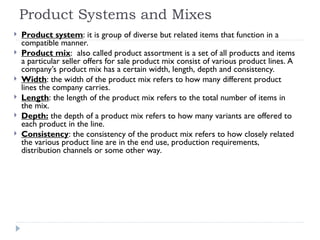
Product Systems and Mixes
 Product system: it is group of diverse but related items that function in a
compatible manner.
 Product mix: also called product assortment is a set of all products and items
a particular seller offers for sale product mix consist of various product lines. A
company’s product mix has a certain width, length, depth and consistency.
 Width: the width of the product mix refers to how many different product
lines the company carries.
 Length: the length of the product mix refers to the total number of items in
the mix.
 Depth: the depth of a product mix refers to how many variants are offered to
each product in the line.
 Consistency: the consistency of the product mix refers to how closely related
the various product line are in the end use, production requirements,
distribution channels or some other way.
 The product mix is the set of all products offered for
sale by a company.
 A product line is a broad group of products, intended
for similar uses and having similar characteristics.
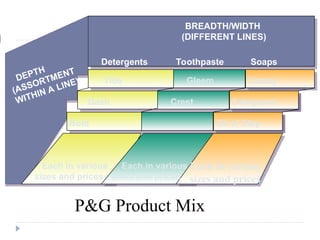
 A product mix has following dimensions:
 Width - number of different product lines
 Length - total number of items within the lines
 Depth - the variety of sizes, colors, and models offered
within each product.
 Consistency –close relationship of product lines.
Product Mix
BREADTH/WIDTH
(DIFFERENT LINES)
Detergents Toothpaste Soaps
Tide
Dash
Bold
DEPTH
(ASSORTMENT
WITHIN A LINE) Gleem
Crest
Camay
Safeguard
Oil of Olay
Each in various
sizes and prices
Each in various
sizes and prices
Each in various
sizes and prices
P&G Product Mix
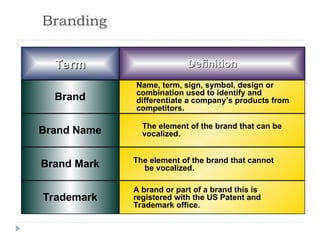
Branding
Definition
Definition
Brand
Brand Name
Brand Mark
Trademark
The element of the brand that can be
vocalized.
Name, term, sign, symbol, design or
combination used to identify and
differentiate a company’s products from
competitors.
The element of the brand that cannot
be vocalized.
A brand or part of a brand this is
registered with the US Patent and
Trademark office.
Term
Term
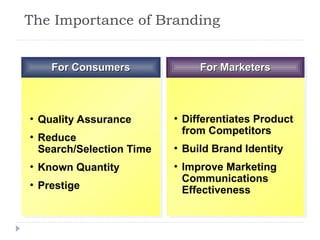
The Importance of Branding
For Consumers
For Consumers For Marketers
For Marketers
• Quality Assurance
• Reduce
Search/Selection Time
• Known Quantity
• Prestige
• Differentiates Product
from Competitors
• Build Brand Identity
• Improve Marketing
Communications
Effectiveness
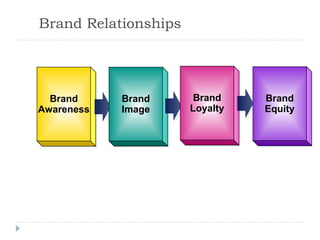
Brand Relationships
Brand
Awareness
Brand
Image
Brand
Loyalty
Brand
Equity
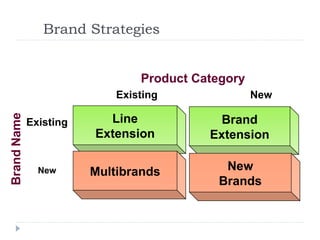
Brand Strategies
Brand
Extension
New
Brand
Name
Product Category
Line
Extension
Existing
Existing
Multibrands
New New
Brands
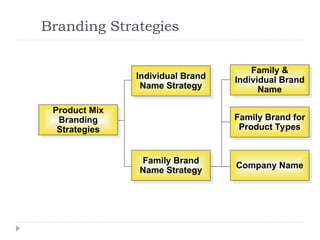
Branding Strategies
Product Mix
Branding
Strategies
Individual Brand
Name Strategy
Family Brand
Name Strategy
Company Name
Family Brand for
Product Types
Family &
Individual Brand
Name
Packaging: The 5th P
All the activities of designing and producing
the container for a product.
Why Package Crucial as a Marketing
Tool
 Self-service
 Consumer affluence
 Company & brand image
 Opportunity for innovation
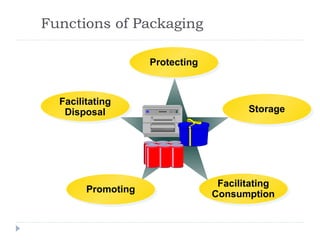
Functions of Packaging
Protecting
Storage
Facilitating
Disposal
Facilitating
Consumption
Promoting
Functions of Labels
 Identifies
 Grades
 Describes
 Promotes
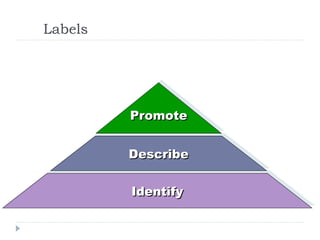
Labels
Identify
Identify
Describe
Describe
Promote
Promote

Setting-Product-Strategy-Marketing-Management.ppt

  • 1.
  • 2.
    THE MEANING OF“PRODUCT”  A product may be a good, service, place, person, or idea.  A product is a set of tangible and intangible attributes, which include packaging, color, price, quality, and brand, plus the services and reputation of the seller.
  • 3.
    Components of the MarketOffering Value-based prices Services mix and quality Product features and quality Attractiveness of the market offering
  • 4.
    Five Product Levels ProductLevels: The Customer Value Hierarchy  Core benefit: It is the fundamental level. It is the service or benefit the customer is really buying.  Basic product: the marketer has to turn the core benefit into a basic product.  Expected product: a set of attributes and conditions buyers normally expect when they purchase this product.  Augmented product: That exceeds the customers expectations.  Potential product:: It encompasses all the possible augmentations and transformations the product or offering might undergo in the future. Here is where companies are searching for new ways to satisfy customers and distinguish their offer.
  • 5.
    Augmented Product In developingcountries brand positioning and competition takes place at this level. Differentiation arises on the basis of product augmentation also leads the marketer to look at the users total consumption system (the way the user perform the tasks of getting and using products and related services) Product Augmentation Strategy: 1. Each augmentation adds cost 2. Augmented benefits soon become expected benefits and necessary point-of-parity, this means that competitors will have to search for other features and benefits. 3. As companies raise the price of their augmented product some competitors offer a “stripped-down” version at a much lower price.
  • 6.
    Five Product Levels Potentialproduct Augmented product Expected product Basic product Core benefit
  • 7.
    Product Classification Schemes Durability  Tangibility  Use (consumer or industrial)
  • 8.
    Durability and Tangibility 1.Nondurable goods: are tangible goods consumed in one or few uses like coke and soap, because these goods are consumed quickly and purchased frequently, the best strategy is to make them available in many locations, charge only a small mark-up and advertise heavily to induce trail and build preference. 2. Durable goods: they are tangible goods that normally survive many uses: refrigerator, machine tools and clothing. Durable goods normally require more personal selling and service, command a high margin and require more seller guarantees. 3. Services: they are intangible, inseparable, variable and perishable products. As a result they normally require more quality control, supplier credibility and adaptability, like haircuts, legal advice and appliance repairs.
  • 9.
    Consumer Goods Classification Thevast array of goods consumers buy can be classified on the basis of shopping habits.  Convenience goods: consumer usually purchases frequently, immediately and with a minimum of effort like tobacco products, soap and newspapers. it can be further divided into staple (goods consumer purchases on a regular basis) Impulse goods (are purchased without any planning and search effort) Emergency goods (are purchased when the need is urgent)  Shopping goods: are goods that the consumer in the process of selection and purchase characteristically compares on such bases as suitability, quality, price and style. Further divided into Homogenous shopping goods (are similar in quality but different enough in price to justify shopping comparisons) Heterogeneous shopping goods (differ in product features and services that may be more important then price. The seller of heterogeneous shopping goods carries a wide assortment to satisfy individual tastes and must have well trained salespeople to inform and advise customers)  Specialty: has unique characteristics or brand identification for which a sufficient number of buyers are willing to make a special purchasing effort. Specialty goods do not involve making comparisons; buyer invest time only to reach dealers carrying the wanted product.  Unsought goods: are those the consumer does not know about or normally think of buying. Unsought goods require advertising and personal selling support.
  • 10.
    Specialty Products Specialty ProductsUnsought Products Unsought Products Shopping Products Shopping Products Buy less frequently > Gather product information > Fewer purchase locations > Compare for: • Suitability & Quality • Price & Style Convenience Products Convenience Products Special purchase efforts > Unique characteristics > Brand identification > Few purchase locations New innovations > Products consumers don’t want to think about. >Require much advertising & personal selling Buy frequently & immediately > Low priced > Many purchase locations > Includes: • Staple goods • Impulse goods • Emergency goods Consumer-Goods Classification
  • 11.
    Industrial Goods Classification Materials and parts: are goods that enter the manufacturer’s product completely. They fall into two parts raw materials and manufactured materials and parts. Raw material can be of farm products and natural products.  Capital items: installations and equipments.  Supplies/business services: operating suppliers, maintenance and repair items, maintenance and repair services and business advisory services.
  • 12.
    Product Differentiation  Productform: the size, shape or physical structure of a product.  Features: they supplement its basic functions  Performance Quality: is the level at which the products primary characteristics operate. most products are established at one of our performance levels: low, average, high or superior.  Conformance Quality: buyers expect that the product to have a high conformance quality which is the degree to which all the produced units are identical and meet the promised specifications.  Durability: a measure of the product’s expected operating life under natural or stressful conditions, is a valued attribute to some products.  Reliability: It is the measure of the probability that a product will not malfunction or fail within a specific time period.  Reparability: it is the measure of the ease of fixing a product when it malfunction or fails.  Style: Describes the product’s look and feel to the buyer.  Design: it is the totality of features that affect how a product looks and functions in terms of consumer requirements.
  • 13.
    Services Differentiation  Orderingease: refers to how easy it is fot the customers to place an order with the company.  Delivery: refers to how well the product or service is delivered to the customer.  Installation: refers to the work done to make a product operational in its planned location.  Customer training: refers to training the customer’s employees to use the vendor’s equipment properly and efficiently.  Customer consulting: refers to data, information systems and advice services that the seller offers to buyers.  Maintenance and repair: describes the service program for helping customers keep purchased products in good working order.
  • 14.
    The Product Hierarchy Need family: the core need that underlies the existence of a product family. example: security  Product family: all the product classes that can satisfy a core need with reasonable effectiveness. Example: savings and income  Product class: a group of products within the product family recognized as having a certain functional coherence. Also known as product category. Example: financial instruments  Product line: a group of products that are closely related because they perform a similar function are sold to the same customer groups, are marketed through the same outlets or channels or fall within given price ranges  Product type: a group of items within a product line that share one of the several possible forms of the product.  Item: a distinct unit within a brand or product line distinguishable by size, price, appearance or some other attribute
  • 15.
    Product Systems andMixes  Product system: it is group of diverse but related items that function in a compatible manner.  Product mix: also called product assortment is a set of all products and items a particular seller offers for sale product mix consist of various product lines. A company’s product mix has a certain width, length, depth and consistency.  Width: the width of the product mix refers to how many different product lines the company carries.  Length: the length of the product mix refers to the total number of items in the mix.  Depth: the depth of a product mix refers to how many variants are offered to each product in the line.  Consistency: the consistency of the product mix refers to how closely related the various product line are in the end use, production requirements, distribution channels or some other way.
  • 16.
     The productmix is the set of all products offered for sale by a company.  A product line is a broad group of products, intended for similar uses and having similar characteristics.  A product mix has following dimensions:  Width - number of different product lines  Length - total number of items within the lines  Depth - the variety of sizes, colors, and models offered within each product.  Consistency –close relationship of product lines. Product Mix
  • 17.
    BREADTH/WIDTH (DIFFERENT LINES) Detergents ToothpasteSoaps Tide Dash Bold DEPTH (ASSORTMENT WITHIN A LINE) Gleem Crest Camay Safeguard Oil of Olay Each in various sizes and prices Each in various sizes and prices Each in various sizes and prices P&G Product Mix
  • 18.
    Branding Definition Definition Brand Brand Name Brand Mark Trademark Theelement of the brand that can be vocalized. Name, term, sign, symbol, design or combination used to identify and differentiate a company’s products from competitors. The element of the brand that cannot be vocalized. A brand or part of a brand this is registered with the US Patent and Trademark office. Term Term
  • 19.
    The Importance ofBranding For Consumers For Consumers For Marketers For Marketers • Quality Assurance • Reduce Search/Selection Time • Known Quantity • Prestige • Differentiates Product from Competitors • Build Brand Identity • Improve Marketing Communications Effectiveness
  • 20.
  • 21.
  • 22.
    Branding Strategies Product Mix Branding Strategies IndividualBrand Name Strategy Family Brand Name Strategy Company Name Family Brand for Product Types Family & Individual Brand Name
  • 23.
    Packaging: The 5thP All the activities of designing and producing the container for a product.
  • 24.
    Why Package Crucialas a Marketing Tool  Self-service  Consumer affluence  Company & brand image  Opportunity for innovation
  • 25.
  • 26.
    Functions of Labels Identifies  Grades  Describes  Promotes
  • 27.