Soil Compaction
Presented By:
Sishir Chaulagain
Roll no: 05
M. Sc. Engineering Geology,
Second Semester
Contents
 Introductory Comments on Compaction of soils
 Compaction Tests: Standard and Modified Compaction Tests (their similarities and
differences)
 Empirical Relation of Compaction Test
Introduction
 Compaction is an instantaneous process which increases soil density or unit weight, achieved by a
decrease in air volume without change in water content. It is performed in partially saturated soils.
 Various factors such as nature and type of soil, water content at the time of compaction, site
conditions such as weathering, along with the compactive effort.
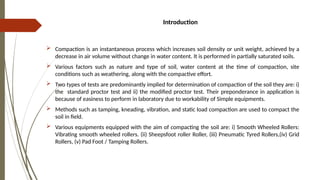
 Two types of tests are predominantly implied for determination of compaction of the soil they are: i)
the standard proctor test and ii) the modified proctor test. Their preponderance in application is
because of easiness to perform in laboratory due to workability of Simple equipments.
 Methods such as tamping, kneading, vibration, and static load compaction are used to compact the
soil in field.
 Various equipments equipped with the aim of compacting the soil are: i) Smooth Wheeled Rollers:
Vibrating smooth wheeled rollers. (ii) Sheepsfoot roller Roller, (iii) Pneumatic Tyred Rollers,(iv) Grid
Rollers, (v) Pad Foot / Tamping Rollers.
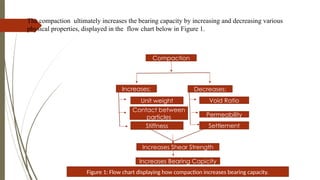
 The compaction ultimately increases the bearing capacity by increasing and decreasing various
physical properties, displayed in the flow chart below in Figure 1.
Compaction
Increases: Decreases:
Unit weight
Contact between
particles
Stiffness
Void Ratio
Permeability
Settlement
Increases Shear Strength
Increases Bearing Capicity
Figure 1: Flow chart displaying how compaction increases bearing capacity.
Compaction Tests: Standard and Modified Compaction Tests (their similarities
and differences)
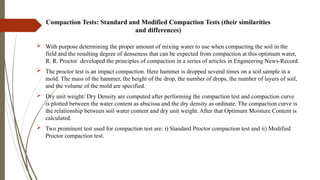
 With purpose determining the proper amount of mixing water to use when compacting the soil in the
field and the resulting degree of denseness that can be expected from compaction at this optimum water,
R. R. Proctor developed the principles of compaction in a series of articles in Engineering News-Record.
 The proctor test is an impact compaction. Here hammer is dropped several times on a soil sample in a
mold. The mass of the hammer, the height of the drop, the number of drops, the number of layers of soil,
and the volume of the mold are specified.
 Dry unit weight/ Dry Density are computed after performing the compaction test and compaction curve
is plotted between the water content as abscissa and the dry density as ordinate. The compaction curve is
the relationship between soil water content and dry unit weight. After that Optimum Moisture Content is
calculated.
 Two prominent test used for compaction test are: i) Standard Proctor compaction test and ii) Modified
Proctor compaction test.
Standard Proctor compaction test
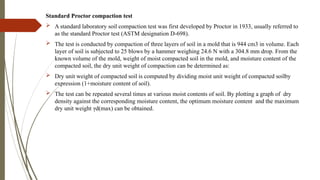
 A standard laboratory soil compaction test was first developed by Proctor in 1933, usually referred to
as the standard Proctor test (ASTM designation D-698).
 The test is conducted by compaction of three layers of soil in a mold that is 944 cm3 in volume. Each
layer of soil is subjected to 25 blows by a hammer weighing 24.6 N with a 304.8 mm drop. From the
known volume of the mold, weight of moist compacted soil in the mold, and moisture content of the
compacted soil, the dry unit weight of compaction can be determined as:
 Dry unit weight of compacted soil is computed by dividing moist unit weight of compacted soilby
expression (1+moisture content of soil).
 The test can be repeated several times at various moist contents of soil. By plotting a graph of dry
density against the corresponding moisture content, the optimum moisture content and the maximum
dry unit weight γd(max) can be obtained.
Modified Proctor compaction test
 With the development of heavier compaction equipment, the standard Proctor test has been modified for better
representation of field conditions. In the modified Proctor test (ASTM designation D-1577), the same mold as
in the standard Proctor test is used. However, the soil is compacted in 5 layers, with a 44.5 N hammer giving
25 blows to each layer. The height of drop of the hammer is 457.2 mm.
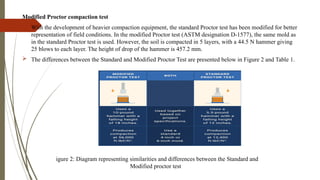
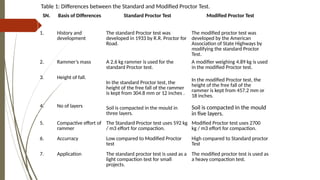
 The differences between the Standard and Modified Proctor Test are presented below in Figure 2 and Table 1.
Figure 2: Diagram representing similarities and differences between the Standard and
Modified proctor test
SN. Basis of Differences Standard Proctor Test Modified Proctor Test
1. History and
development
The standard Proctor test was
developed in 1933 by R.R. Proctor for
Road.
The modified proctor test was
developed by the American
Association of State Highways by
modifying the standard Proctor
Test.
2. Rammer’s mass A 2.6 kg rammer is used for the
standard Proctor test.
A modifier weighing 4.89 kg is used
in the modified Proctor test.
3. Height of fall.
In the standard Proctor test, the
height of the free fall of the rammer
is kept from 304.8 mm or 12 inches .
In the modified Proctor test, the
height of the free fall of the
rammer is kept from 457.2 mm or
18 inches.
4. No of layers Soil is compacted in the mould in
three layers.
Soil is compacted in the mould
in five layers.
5. Compactive effort of
rammer
The Standard Proctor test uses 592 kg
/ m3 effort for compaction.
Modified Proctor test uses 2700
kg / m3 effort for compaction.
6. Accurracy Low compared to Modified Proctor
test
High compared to Standard proctor
Test
7. Application The standard proctor test is used as a
light compaction test for small
projects.
The modified proctor test is used as
a heavy compaction test.
Table 1: Differences between the Standard and Modified Proctor Test.
Empirical Relation of Compaction Tests
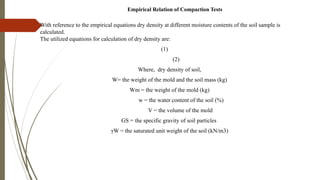
With reference to the empirical equations dry density at different moisture contents of the soil sample is
calculated.
The utilized equations for calculation of dry density are:
(1)
(2)
Where, dry density of soil,
W= the weight of the mold and the soil mass (kg)
Wm = the weight of the mold (kg)
w = the water content of the soil (%)
V = the volume of the mold
GS = the specific gravity of soil particles
γW = the saturated unit weight of the soil (kN/m3)
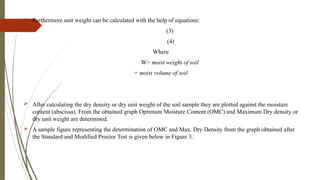
 Furthermore unit weight can be calculated with the help of equations:
(3)
(4)
Where
W= moist weight of soil
= moist volume of soil
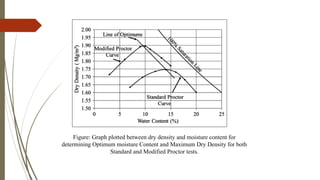
 After calculating the dry density or dry unit weight of the soil sample they are plotted against the moisture
content (abscissa). From the obtained graph Optimum Moisture Content (OMC) and Maximum Dry density or
dry unit weight are determined.
 A sample figure representing the determination of OMC and Max. Dry Density from the graph obtained after
the Standard and Modified Proctor Test is given below in Figure 3.
Figure: Graph plotted between dry density and moisture content for
determining Optimum moisture Content and Maximum Dry Density for both
Standard and Modified Proctor tests.
Thank You

SOIL COMPACTION using the standard and modified proctor test

  • 1.
    Soil Compaction Presented By: SishirChaulagain Roll no: 05 M. Sc. Engineering Geology, Second Semester
  • 2.
    Contents  Introductory Commentson Compaction of soils  Compaction Tests: Standard and Modified Compaction Tests (their similarities and differences)  Empirical Relation of Compaction Test
  • 3.
    Introduction  Compaction isan instantaneous process which increases soil density or unit weight, achieved by a decrease in air volume without change in water content. It is performed in partially saturated soils.  Various factors such as nature and type of soil, water content at the time of compaction, site conditions such as weathering, along with the compactive effort.  Two types of tests are predominantly implied for determination of compaction of the soil they are: i) the standard proctor test and ii) the modified proctor test. Their preponderance in application is because of easiness to perform in laboratory due to workability of Simple equipments.  Methods such as tamping, kneading, vibration, and static load compaction are used to compact the soil in field.  Various equipments equipped with the aim of compacting the soil are: i) Smooth Wheeled Rollers: Vibrating smooth wheeled rollers. (ii) Sheepsfoot roller Roller, (iii) Pneumatic Tyred Rollers,(iv) Grid Rollers, (v) Pad Foot / Tamping Rollers.
  • 4.
     The compactionultimately increases the bearing capacity by increasing and decreasing various physical properties, displayed in the flow chart below in Figure 1. Compaction Increases: Decreases: Unit weight Contact between particles Stiffness Void Ratio Permeability Settlement Increases Shear Strength Increases Bearing Capicity Figure 1: Flow chart displaying how compaction increases bearing capacity.
  • 5.
    Compaction Tests: Standardand Modified Compaction Tests (their similarities and differences)  With purpose determining the proper amount of mixing water to use when compacting the soil in the field and the resulting degree of denseness that can be expected from compaction at this optimum water, R. R. Proctor developed the principles of compaction in a series of articles in Engineering News-Record.  The proctor test is an impact compaction. Here hammer is dropped several times on a soil sample in a mold. The mass of the hammer, the height of the drop, the number of drops, the number of layers of soil, and the volume of the mold are specified.  Dry unit weight/ Dry Density are computed after performing the compaction test and compaction curve is plotted between the water content as abscissa and the dry density as ordinate. The compaction curve is the relationship between soil water content and dry unit weight. After that Optimum Moisture Content is calculated.  Two prominent test used for compaction test are: i) Standard Proctor compaction test and ii) Modified Proctor compaction test.
  • 6.
    Standard Proctor compactiontest  A standard laboratory soil compaction test was first developed by Proctor in 1933, usually referred to as the standard Proctor test (ASTM designation D-698).  The test is conducted by compaction of three layers of soil in a mold that is 944 cm3 in volume. Each layer of soil is subjected to 25 blows by a hammer weighing 24.6 N with a 304.8 mm drop. From the known volume of the mold, weight of moist compacted soil in the mold, and moisture content of the compacted soil, the dry unit weight of compaction can be determined as:  Dry unit weight of compacted soil is computed by dividing moist unit weight of compacted soilby expression (1+moisture content of soil).  The test can be repeated several times at various moist contents of soil. By plotting a graph of dry density against the corresponding moisture content, the optimum moisture content and the maximum dry unit weight γd(max) can be obtained.
  • 7.
    Modified Proctor compactiontest  With the development of heavier compaction equipment, the standard Proctor test has been modified for better representation of field conditions. In the modified Proctor test (ASTM designation D-1577), the same mold as in the standard Proctor test is used. However, the soil is compacted in 5 layers, with a 44.5 N hammer giving 25 blows to each layer. The height of drop of the hammer is 457.2 mm.  The differences between the Standard and Modified Proctor Test are presented below in Figure 2 and Table 1. Figure 2: Diagram representing similarities and differences between the Standard and Modified proctor test
  • 8.
    SN. Basis ofDifferences Standard Proctor Test Modified Proctor Test 1. History and development The standard Proctor test was developed in 1933 by R.R. Proctor for Road. The modified proctor test was developed by the American Association of State Highways by modifying the standard Proctor Test. 2. Rammer’s mass A 2.6 kg rammer is used for the standard Proctor test. A modifier weighing 4.89 kg is used in the modified Proctor test. 3. Height of fall. In the standard Proctor test, the height of the free fall of the rammer is kept from 304.8 mm or 12 inches . In the modified Proctor test, the height of the free fall of the rammer is kept from 457.2 mm or 18 inches. 4. No of layers Soil is compacted in the mould in three layers. Soil is compacted in the mould in five layers. 5. Compactive effort of rammer The Standard Proctor test uses 592 kg / m3 effort for compaction. Modified Proctor test uses 2700 kg / m3 effort for compaction. 6. Accurracy Low compared to Modified Proctor test High compared to Standard proctor Test 7. Application The standard proctor test is used as a light compaction test for small projects. The modified proctor test is used as a heavy compaction test. Table 1: Differences between the Standard and Modified Proctor Test.
  • 9.
    Empirical Relation ofCompaction Tests With reference to the empirical equations dry density at different moisture contents of the soil sample is calculated. The utilized equations for calculation of dry density are: (1) (2) Where, dry density of soil, W= the weight of the mold and the soil mass (kg) Wm = the weight of the mold (kg) w = the water content of the soil (%) V = the volume of the mold GS = the specific gravity of soil particles γW = the saturated unit weight of the soil (kN/m3)
  • 10.
     Furthermore unitweight can be calculated with the help of equations: (3) (4) Where W= moist weight of soil = moist volume of soil  After calculating the dry density or dry unit weight of the soil sample they are plotted against the moisture content (abscissa). From the obtained graph Optimum Moisture Content (OMC) and Maximum Dry density or dry unit weight are determined.  A sample figure representing the determination of OMC and Max. Dry Density from the graph obtained after the Standard and Modified Proctor Test is given below in Figure 3.
  • 11.
    Figure: Graph plottedbetween dry density and moisture content for determining Optimum moisture Content and Maximum Dry Density for both Standard and Modified Proctor tests.
  • 12.