Introduction to Software Engineering 
(CSC291) 
Instructor 
Humaira Afzal 
Lecturer 
humairaafzal@ciitlahore.edu.pk 
1
SDLC 
SDLC, Software Development Life Cycle is a process 
used by software industry to design, develop and test 
high quality software. 
The SDLC aims to produce a high quality software 
that meets or exceeds customer expectations, 
reaches completion within times and cost estimates. 
2
SDLC 
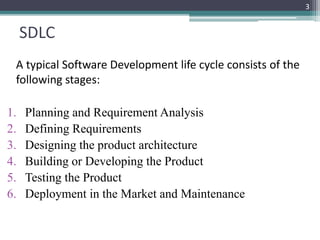
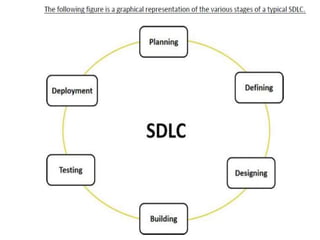
A typical Software Development life cycle consists of the 
following stages: 
1. Planning and Requirement Analysis 
2. Defining Requirements 
3. Designing the product architecture 
4. Building or Developing the Product 
5. Testing the Product 
6. Deployment in the Market and Maintenance 
3
4
5 
Software Process/SDLC Models 
“A software process model is an abstract representation of a software 
(i.e. a roadmap)” 
Following are the most important and popular SDLC models followed in 
the industry: 
• Waterfall Model 
• Iterative Model 
• Spiral Model 
• V-Model 
• Incremental Model 
The other related methodologies are Agile Model, RAD Model – Rapid 
Application Development and Prototyping Models.
Waterfall Model 
• The first published model of the software development 
process. 
• Because of the cascade from one phase to another, this 
model is known as ‘Waterfall Model’. 
• It is also referred to as linear-sequential life cycle model. 
• It is very simple to understand and use. 
• Each phase must be completed before the next phase can 
begin and there is no overlapping in the phases. 
6
Waterfall Model 
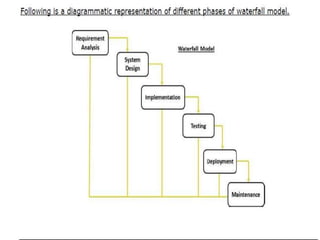
The sequential phases in Waterfall model are: 
Requirement Gathering and analysis: All possible requirements of the 
system to be developed are captured in this phase and documented in a 
requirement specification doc. 
• System’s services 
• Constraints 
• Goals 
System Design: The requirement specifications from first phase are studied 
in this phase and system design is prepared. System Design helps in 
specifying hardware and system requirements and also helps in defining 
overall system architecture. 
7
Waterfall Model 
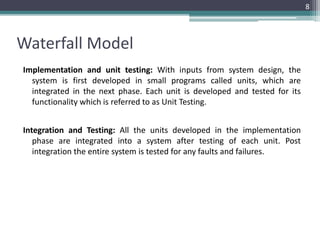
Implementation and unit testing: With inputs from system design, the 
system is first developed in small programs called units, which are 
integrated in the next phase. Each unit is developed and tested for its 
functionality which is referred to as Unit Testing. 
Integration and Testing: All the units developed in the implementation 
phase are integrated into a system after testing of each unit. Post 
integration the entire system is tested for any faults and failures. 
8
Waterfall Model 
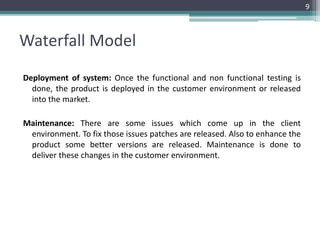
Deployment of system: Once the functional and non functional testing is 
done, the product is deployed in the customer environment or released 
into the market. 
Maintenance: There are some issues which come up in the client 
environment. To fix those issues patches are released. Also to enhance the 
product some better versions are released. Maintenance is done to 
deliver these changes in the customer environment. 
9
Waterfall Model 
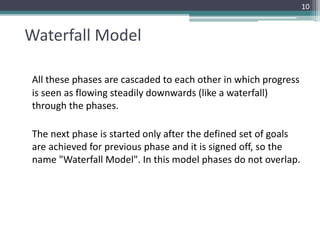
All these phases are cascaded to each other in which progress 
is seen as flowing steadily downwards (like a waterfall) 
through the phases. 
The next phase is started only after the defined set of goals 
are achieved for previous phase and it is signed off, so the 
name "Waterfall Model". In this model phases do not overlap. 
10
11
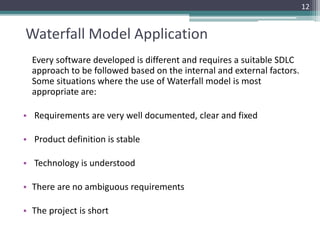
Waterfall Model Application 
Every software developed is different and requires a suitable SDLC 
approach to be followed based on the internal and external factors. 
Some situations where the use of Waterfall model is most 
appropriate are: 
• Requirements are very well documented, clear and fixed 
• Product definition is stable 
• Technology is understood 
• There are no ambiguous requirements 
• The project is short 
12
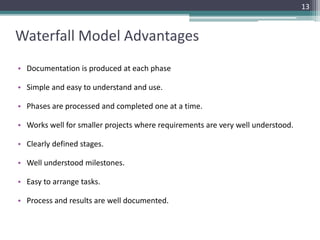
Waterfall Model Advantages 
13 
• Documentation is produced at each phase 
• Simple and easy to understand and use. 
• Phases are processed and completed one at a time. 
• Works well for smaller projects where requirements are very well understood. 
• Clearly defined stages. 
• Well understood milestones. 
• Easy to arrange tasks. 
• Process and results are well documented.
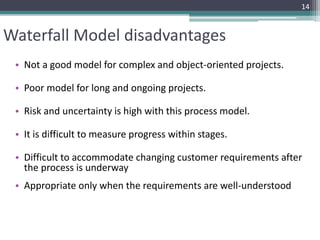
Waterfall Model disadvantages 
• Not a good model for complex and object-oriented projects. 
• Poor model for long and ongoing projects. 
• Risk and uncertainty is high with this process model. 
• It is difficult to measure progress within stages. 
14 
• Difficult to accommodate changing customer requirements after 
the process is underway 
• Appropriate only when the requirements are well-understood
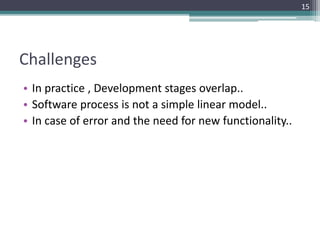
Challenges 
• In practice , Development stages overlap.. 
• Software process is not a simple linear model.. 
• In case of error and the need for new functionality.. 
15

Process Models

  • 1.
    Introduction to SoftwareEngineering (CSC291) Instructor Humaira Afzal Lecturer humairaafzal@ciitlahore.edu.pk 1
  • 2.
    SDLC SDLC, SoftwareDevelopment Life Cycle is a process used by software industry to design, develop and test high quality software. The SDLC aims to produce a high quality software that meets or exceeds customer expectations, reaches completion within times and cost estimates. 2
  • 3.
    SDLC A typicalSoftware Development life cycle consists of the following stages: 1. Planning and Requirement Analysis 2. Defining Requirements 3. Designing the product architecture 4. Building or Developing the Product 5. Testing the Product 6. Deployment in the Market and Maintenance 3
  • 4.
  • 5.
    5 Software Process/SDLCModels “A software process model is an abstract representation of a software (i.e. a roadmap)” Following are the most important and popular SDLC models followed in the industry: • Waterfall Model • Iterative Model • Spiral Model • V-Model • Incremental Model The other related methodologies are Agile Model, RAD Model – Rapid Application Development and Prototyping Models.
  • 6.
    Waterfall Model •The first published model of the software development process. • Because of the cascade from one phase to another, this model is known as ‘Waterfall Model’. • It is also referred to as linear-sequential life cycle model. • It is very simple to understand and use. • Each phase must be completed before the next phase can begin and there is no overlapping in the phases. 6
  • 7.
    Waterfall Model Thesequential phases in Waterfall model are: Requirement Gathering and analysis: All possible requirements of the system to be developed are captured in this phase and documented in a requirement specification doc. • System’s services • Constraints • Goals System Design: The requirement specifications from first phase are studied in this phase and system design is prepared. System Design helps in specifying hardware and system requirements and also helps in defining overall system architecture. 7
  • 8.
    Waterfall Model Implementationand unit testing: With inputs from system design, the system is first developed in small programs called units, which are integrated in the next phase. Each unit is developed and tested for its functionality which is referred to as Unit Testing. Integration and Testing: All the units developed in the implementation phase are integrated into a system after testing of each unit. Post integration the entire system is tested for any faults and failures. 8
  • 9.
    Waterfall Model Deploymentof system: Once the functional and non functional testing is done, the product is deployed in the customer environment or released into the market. Maintenance: There are some issues which come up in the client environment. To fix those issues patches are released. Also to enhance the product some better versions are released. Maintenance is done to deliver these changes in the customer environment. 9
  • 10.
    Waterfall Model Allthese phases are cascaded to each other in which progress is seen as flowing steadily downwards (like a waterfall) through the phases. The next phase is started only after the defined set of goals are achieved for previous phase and it is signed off, so the name "Waterfall Model". In this model phases do not overlap. 10
  • 11.
  • 12.
    Waterfall Model Application Every software developed is different and requires a suitable SDLC approach to be followed based on the internal and external factors. Some situations where the use of Waterfall model is most appropriate are: • Requirements are very well documented, clear and fixed • Product definition is stable • Technology is understood • There are no ambiguous requirements • The project is short 12
  • 13.
    Waterfall Model Advantages 13 • Documentation is produced at each phase • Simple and easy to understand and use. • Phases are processed and completed one at a time. • Works well for smaller projects where requirements are very well understood. • Clearly defined stages. • Well understood milestones. • Easy to arrange tasks. • Process and results are well documented.
  • 14.
    Waterfall Model disadvantages • Not a good model for complex and object-oriented projects. • Poor model for long and ongoing projects. • Risk and uncertainty is high with this process model. • It is difficult to measure progress within stages. 14 • Difficult to accommodate changing customer requirements after the process is underway • Appropriate only when the requirements are well-understood
  • 15.
    Challenges • Inpractice , Development stages overlap.. • Software process is not a simple linear model.. • In case of error and the need for new functionality.. 15