Process and Methodology: Research Information Architecture
Methodology Overview Designing a web site is similar to designing any software or information system. It is hard work and requires a phased approach.
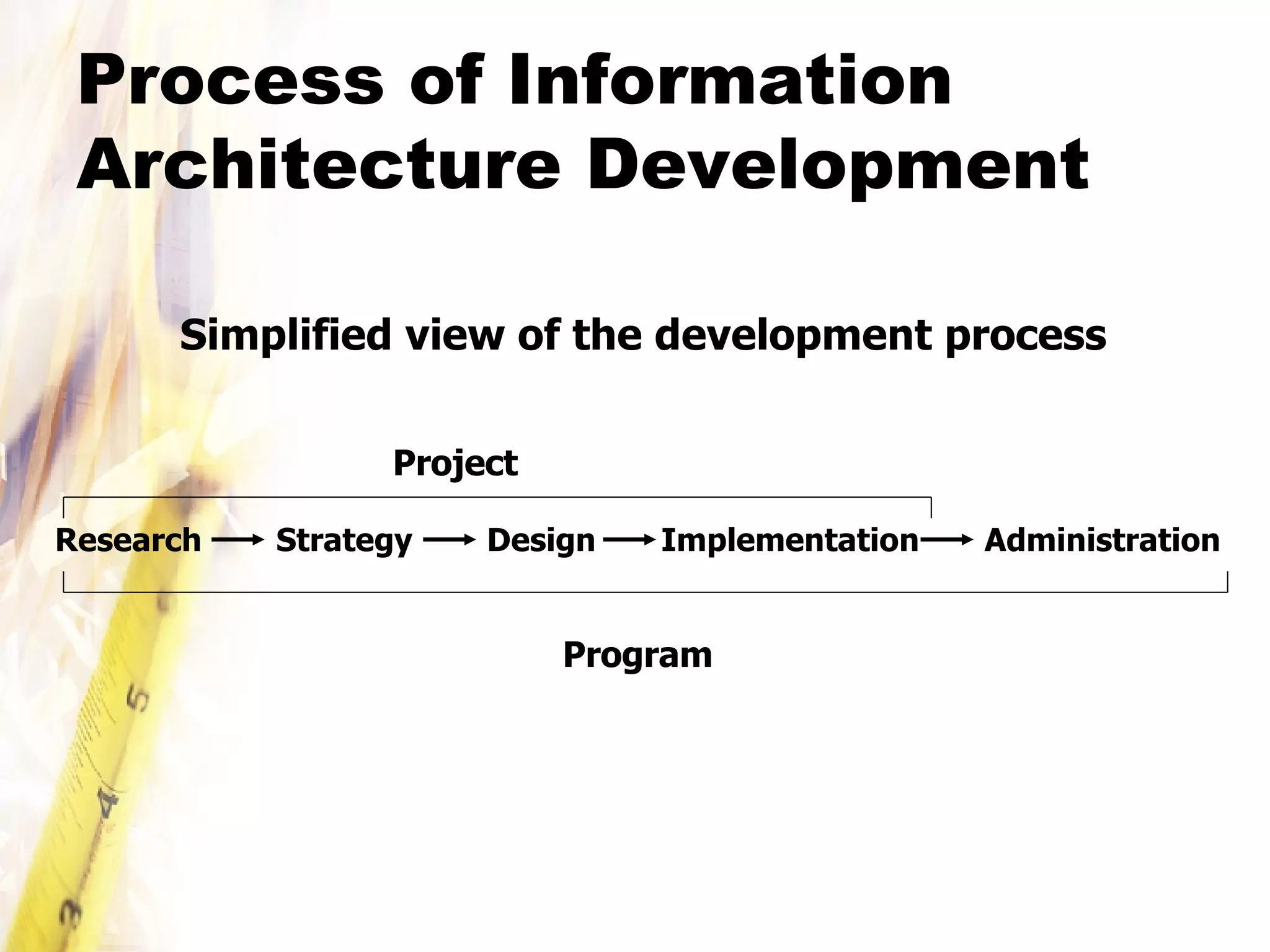
Process of Information Architecture Development   Project Research  Strategy  Design  Implementation  Administration   Program   Simplified view of the development process
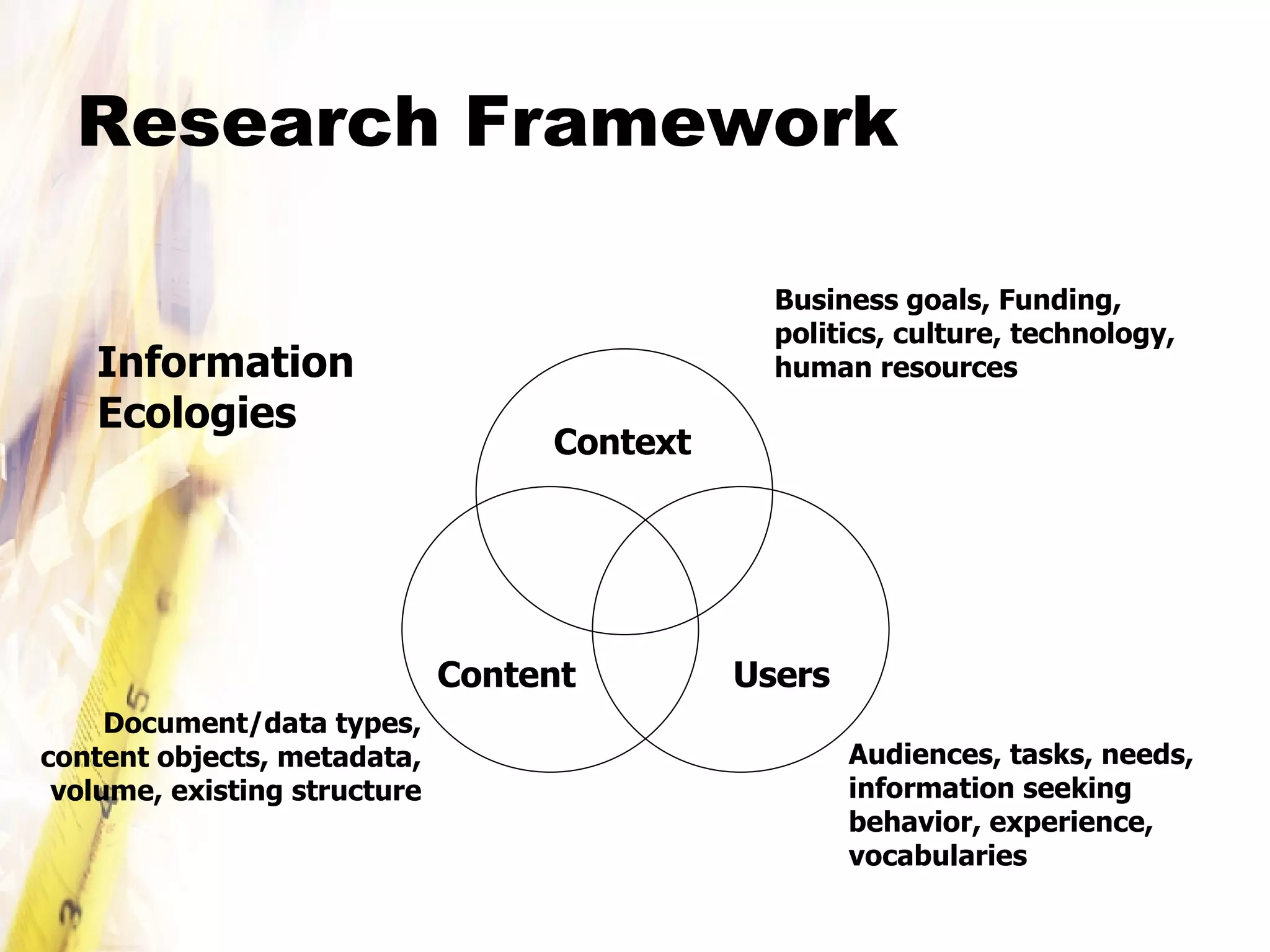
Research Framework Context Content Users Business goals, Funding, politics, culture, technology, human resources Audiences, tasks, needs, information seeking behavior, experience, vocabularies Document/data types, content objects, metadata, volume, existing structure Information Ecologies
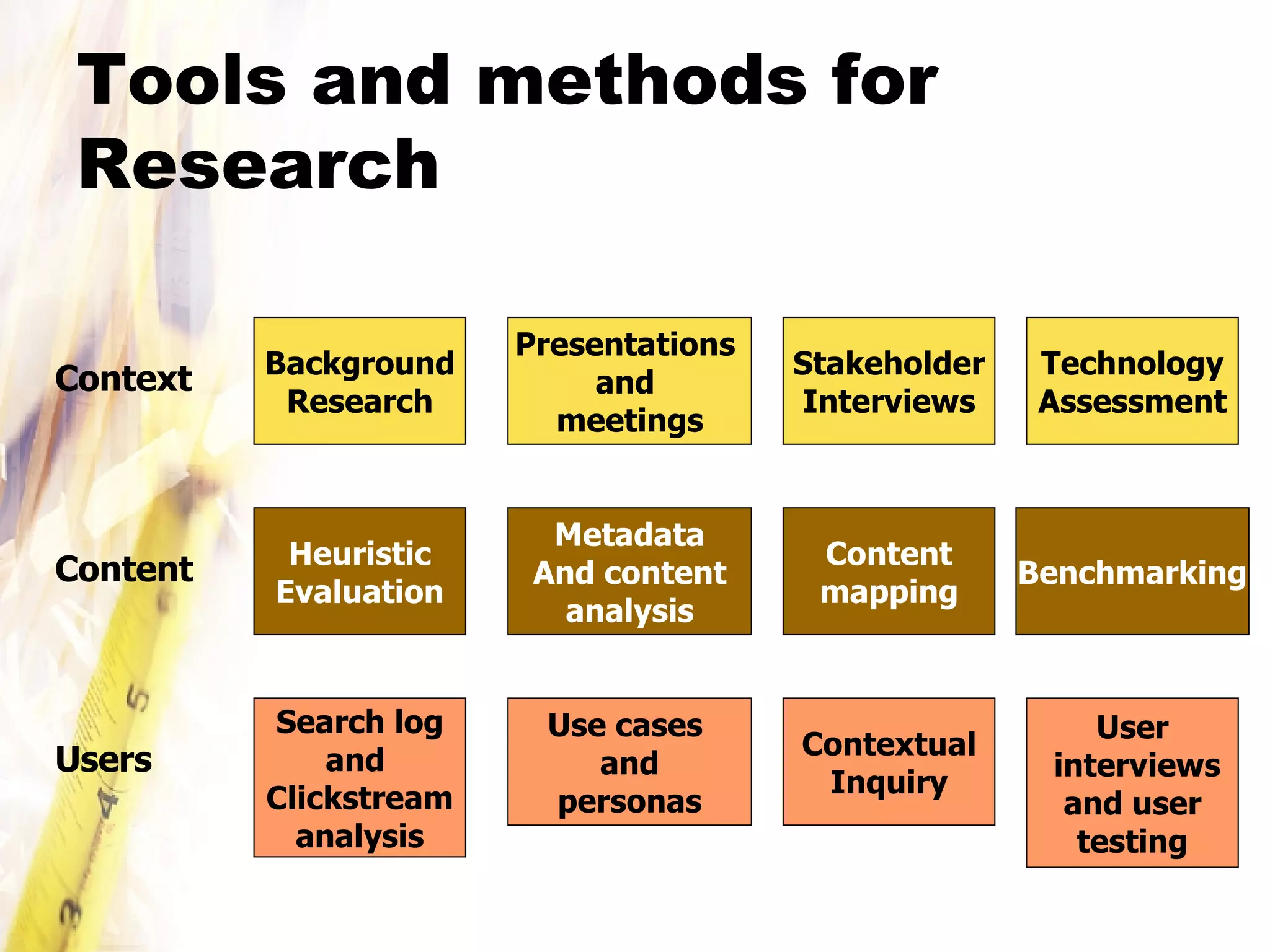
Tools and methods for Research Background Research Presentations  and  meetings Stakeholder Interviews Technology Assessment Context Heuristic Evaluation Metadata And content analysis Content mapping Benchmarking Content Search log and  Clickstream analysis Use cases  and personas Contextual Inquiry User interviews and user testing Users
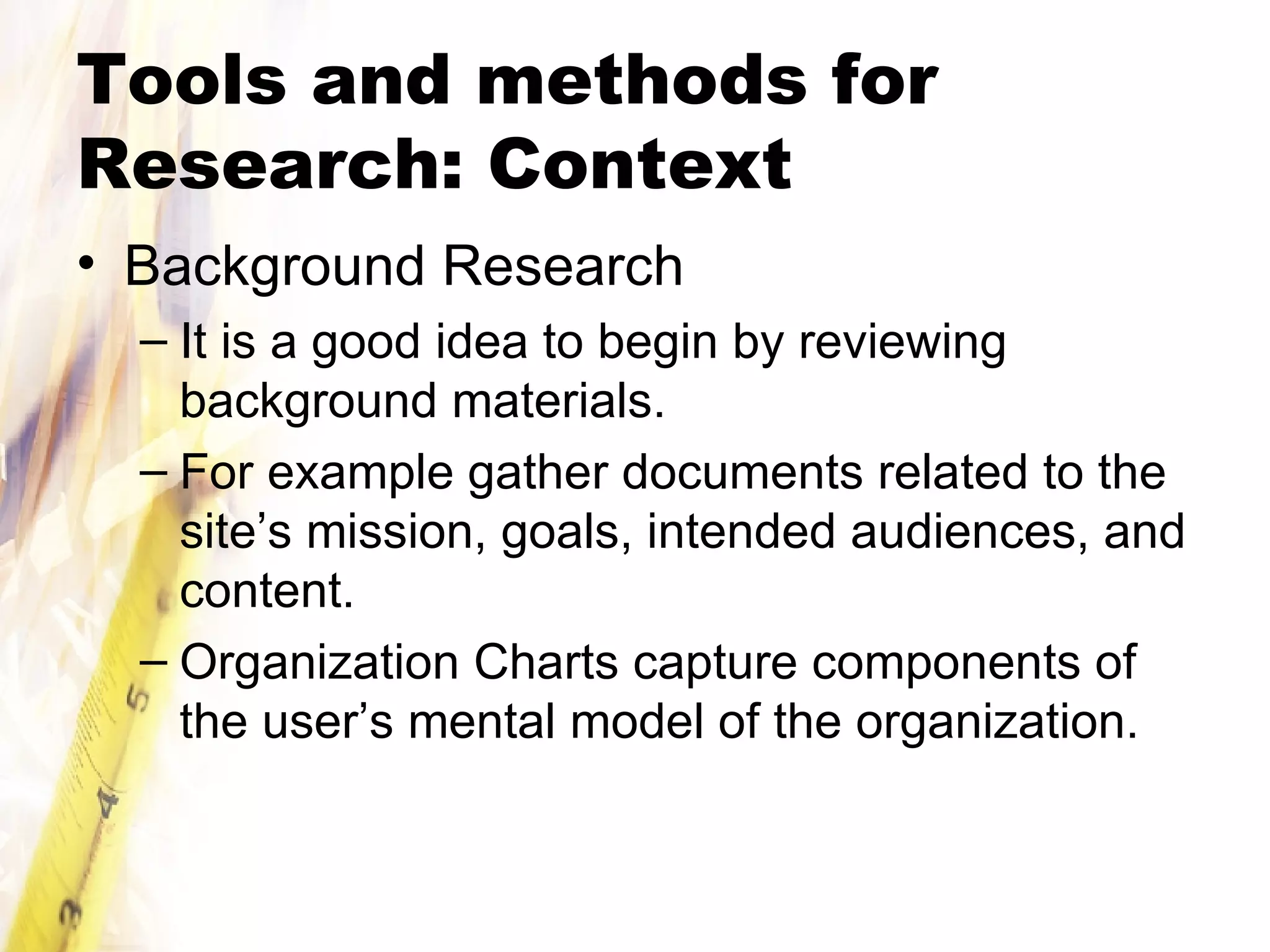
Tools and methods for Research: Context Background Research It is a good idea to begin by reviewing background materials.  For example gather documents related to the site’s mission, goals, intended audiences, and content. Organization Charts capture components of the user’s mental model of the organization.
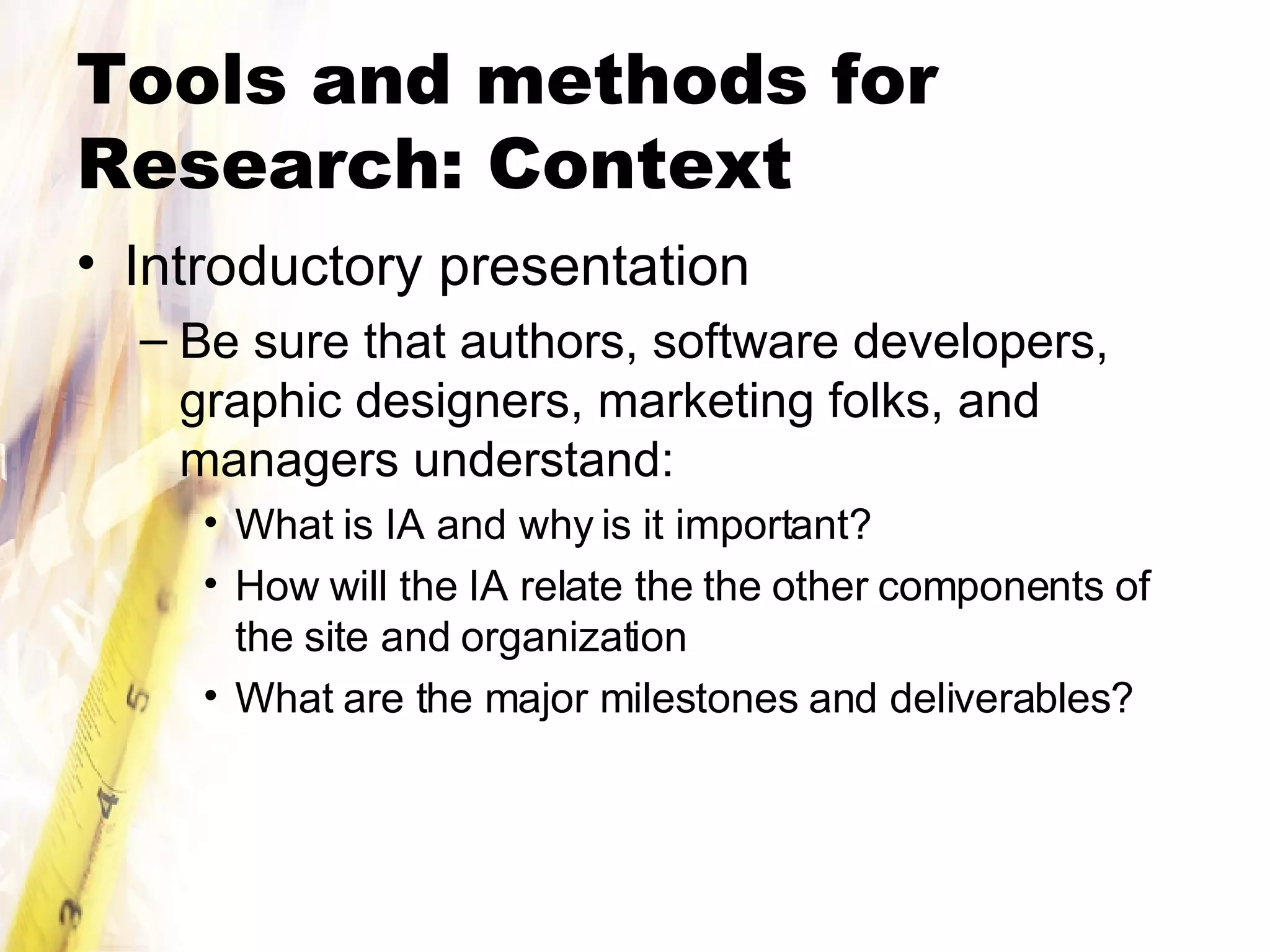
Tools and methods for Research: Context Introductory presentation Be sure that authors, software developers, graphic designers, marketing folks, and managers understand: What is IA and why is it important? How will the IA relate the the other components of the site and organization What are the major milestones and deliverables?
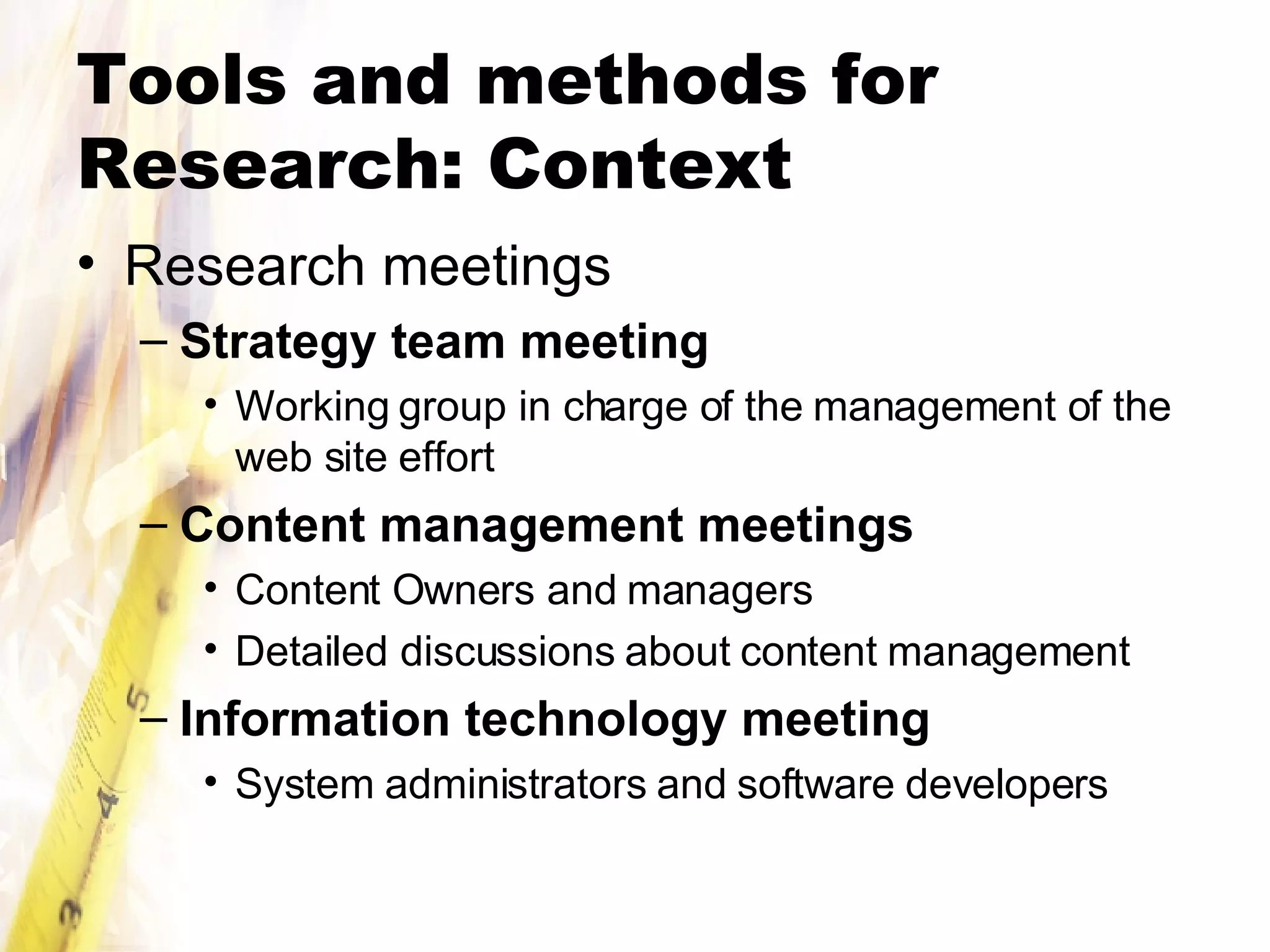
Tools and methods for Research: Context Research meetings Strategy team meeting   Working group in charge of the management of the web site effort Content management meetings Content Owners and managers Detailed discussions about content management Information technology meeting System administrators and software developers
Tools and methods for Research: Context Stakeholder Interviews Interviews with senior executives and managers Open ended questions about the current information environment and their vision for the organization web site.
Tools and methods for Research: Context Technology Assessment Evaluation of IT resources available for the project. This should be done early in the project
Tools and methods for Research: Content Content includes: Documents Data Applications E-services Images Audio and video files
Tools and methods for Research: Content Heuristic Evaluation If you have an existing web site, do an analysis to see what is worth keeping. Some guidelines for heuristic evaluation: Multiple ways to access information Indexes and sitemap The navigation should provide users with sense of context Use language consistently and appropriate for audience Integration of searching and browsing
Tools and methods for Research: Content Content Analysis It is a bottom-up approach to IA It involves careful review of documents and object that actually exists It can be: High level content survey at the beginning of the project Page by page content audit latter in the project
Tools and methods for Research: Content Content Analysis: Gathering content: Use intuition and judgment, balancing the size of your sample against the time constrains of the project. Use the “Noah’s approach” (two samples of each kind)
Tools and methods for Research: Content Dimension to use for sampling: Format  (text, software, audio and video files, archived mail Document Type : capture diverse set of documents. (catalogs, annual reports, technical reports, marketing, etc) Source  (engineering, marketing, customer support, finance, human resources, etc) Subject  (use a broad range of subjects) Existing architecture  (but don’t get overly influenced)
Tools and methods for Research: Content Analyzing content Goals: Get familiar with the subject matter Provide data that is critical for the development of a solid IA.
Tools and methods for Research: Content Analyzing content: For each object note: Structural metadata(Information hierarchy) Descriptive metadata (topic audience format) Administrative metadata (how the object relates to the business context.)
Research Content Mapping Visual representation of the existing information. High-level and conceptual Tool for understanding rather than a deliverable
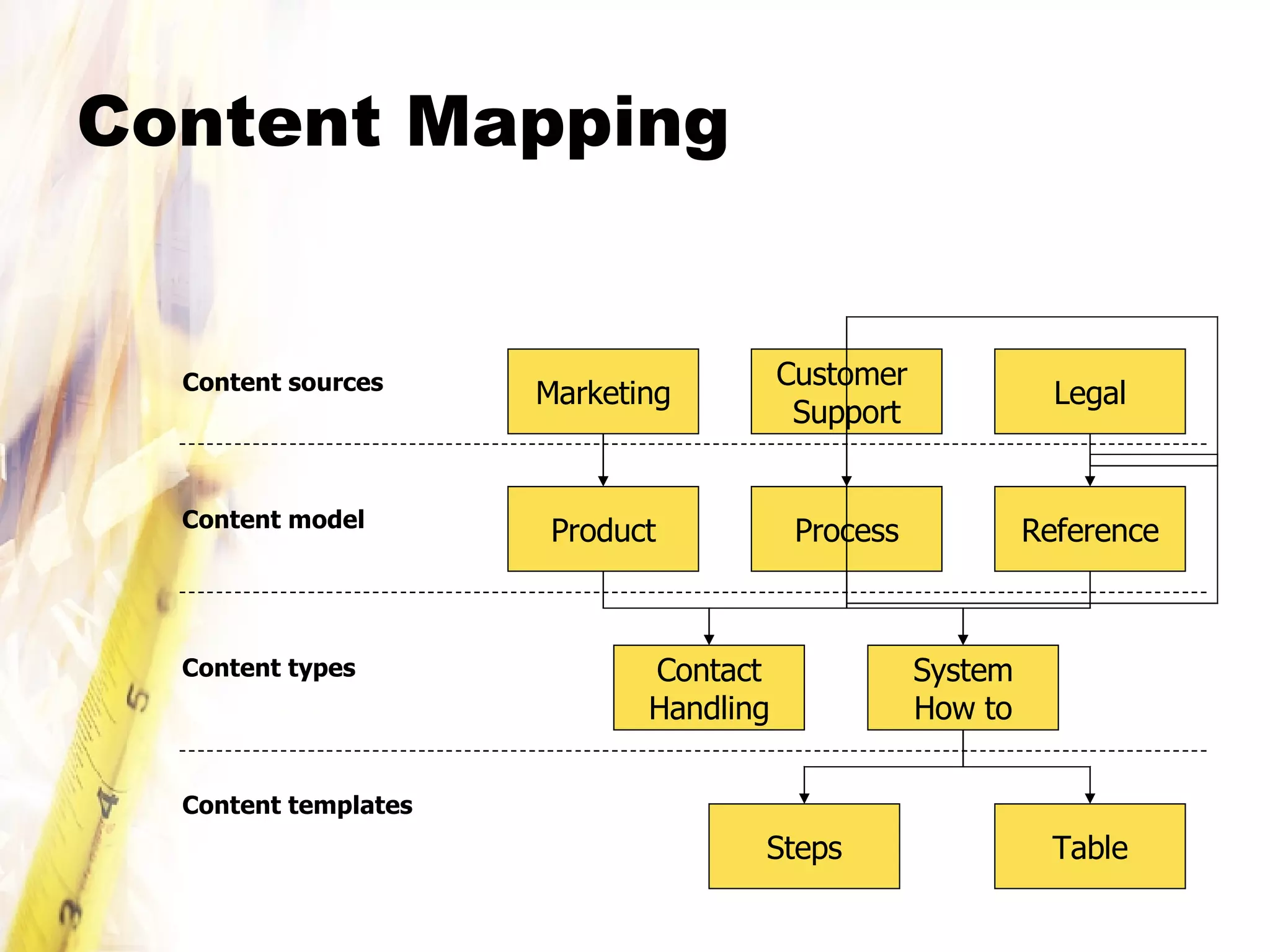
Content Mapping Content sources Content model Content types Content templates Marketing Customer  Support Legal Product Process Reference Contact Handling System How to Steps Table
Benchmarking Systematic identification, evaluation, and comparison of IA features of web sites and intranets. Competitive Benchmarking Before-and-after benchmarking
Users If you have an existing web site: Usage statistics Search log analysis Customer support data
Users Other techniques involve selecting users to conduct qualitative analysis. Define the intended audiences of your site Select one or more methods for gathering information Develop instruments and participants profiles Recruit participants Hard work of gathering the data Data analysis and conclusion
Users Techniques for performing user studies: Surveys Contextual Inquiries Focus Groups User research sessions Interviews Card sorting User testing
Users Surveys Allows to gather information from a large number of people Quick and inexpensive. Results allows quantitative analysis
Users Contextual Inquiry Technique used in ethnographic research Observation of users in their own environment
Users Focus Groups Gather groups of users (or potential users) Ask scripted questions Demonstrate prototype Ask questions about user’s perception Get recommendations for improvement
Users User Research sessions Face-to-face sessions involving one user at a time Expensive and time consuming. Must be combined with other methods such as user testing or card sorting.
Users Interviews Types of questions: Background Information use Intranet use Document publishing Suggestions
Users Card Sorting Label cards with headings from categories, sub-categories and content. Ask the user to sort them into piles that make sense to them and label these piles. Ask them to talk out aloud while they work Take good notes and record labels and contents of their piles.
User Testing Have the user sit in front of the computer to use your site for: Finding information or Completing a task Take good notes Capture what he says and where he goes count clicks and measure his time.
User Testing Include a range of audience types Have experts and novices  Choose the right tasks. For example Easy to impossible Known-item to exhaustive Topic to task Artificial to real Spread tasks across multiple areas of your site
Strategy
Strategy Strategy is the bridge between research and design. It is a high level conceptual framework for structuring and organizing your web site or intranet. You can consider strategies for structuring and organizing information before you start your research
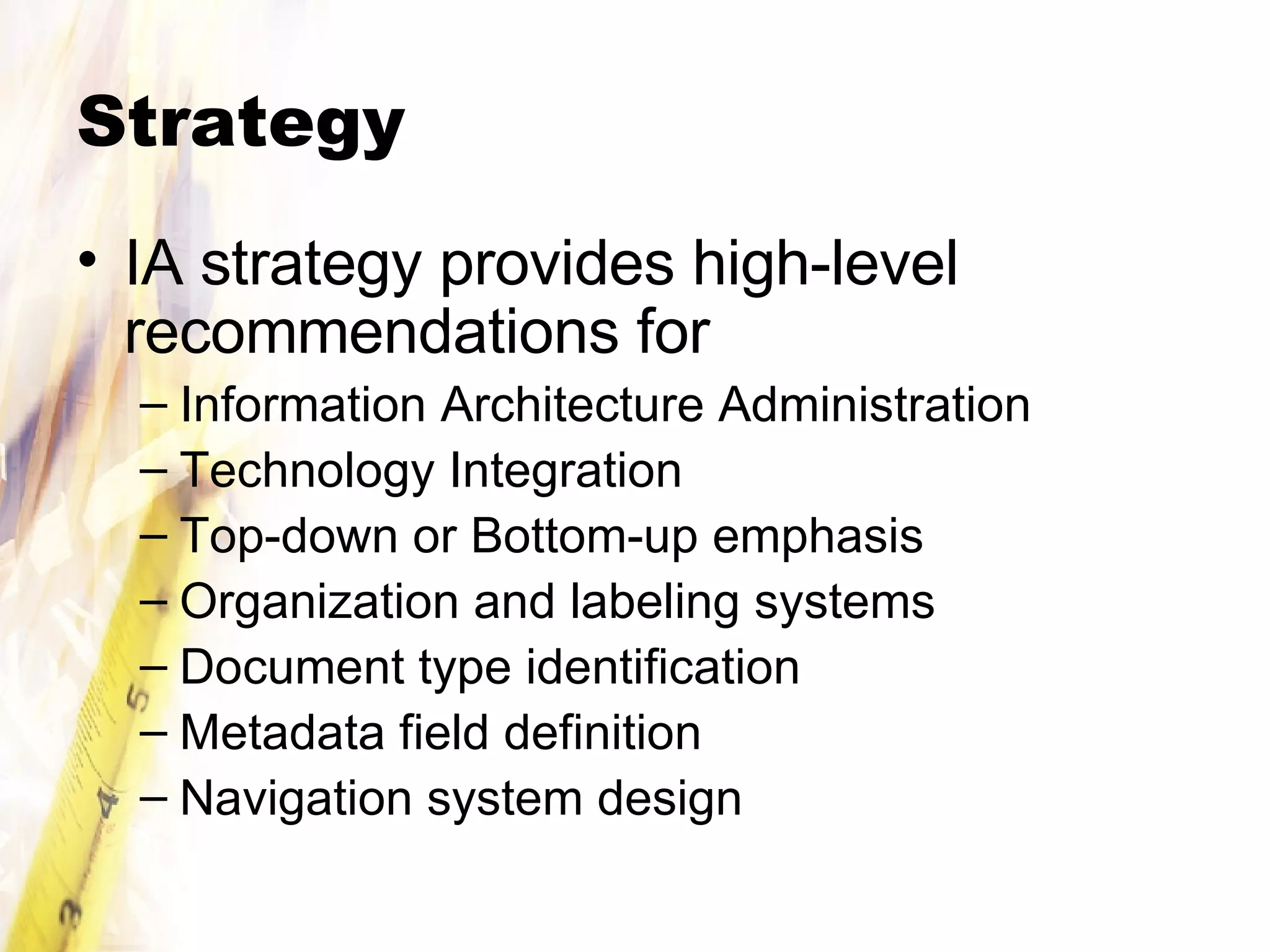
Strategy IA strategy provides high-level recommendations for Information Architecture Administration Technology Integration Top-down or Bottom-up emphasis Organization and labeling systems Document type identification Metadata field definition Navigation system design
Strategy You move from Research to strategy when you start to reach the “saturation point” in Research.  In strategy the emphasis changes from open-ended learning to design and testing. You should use visuals to articulate your ideas.
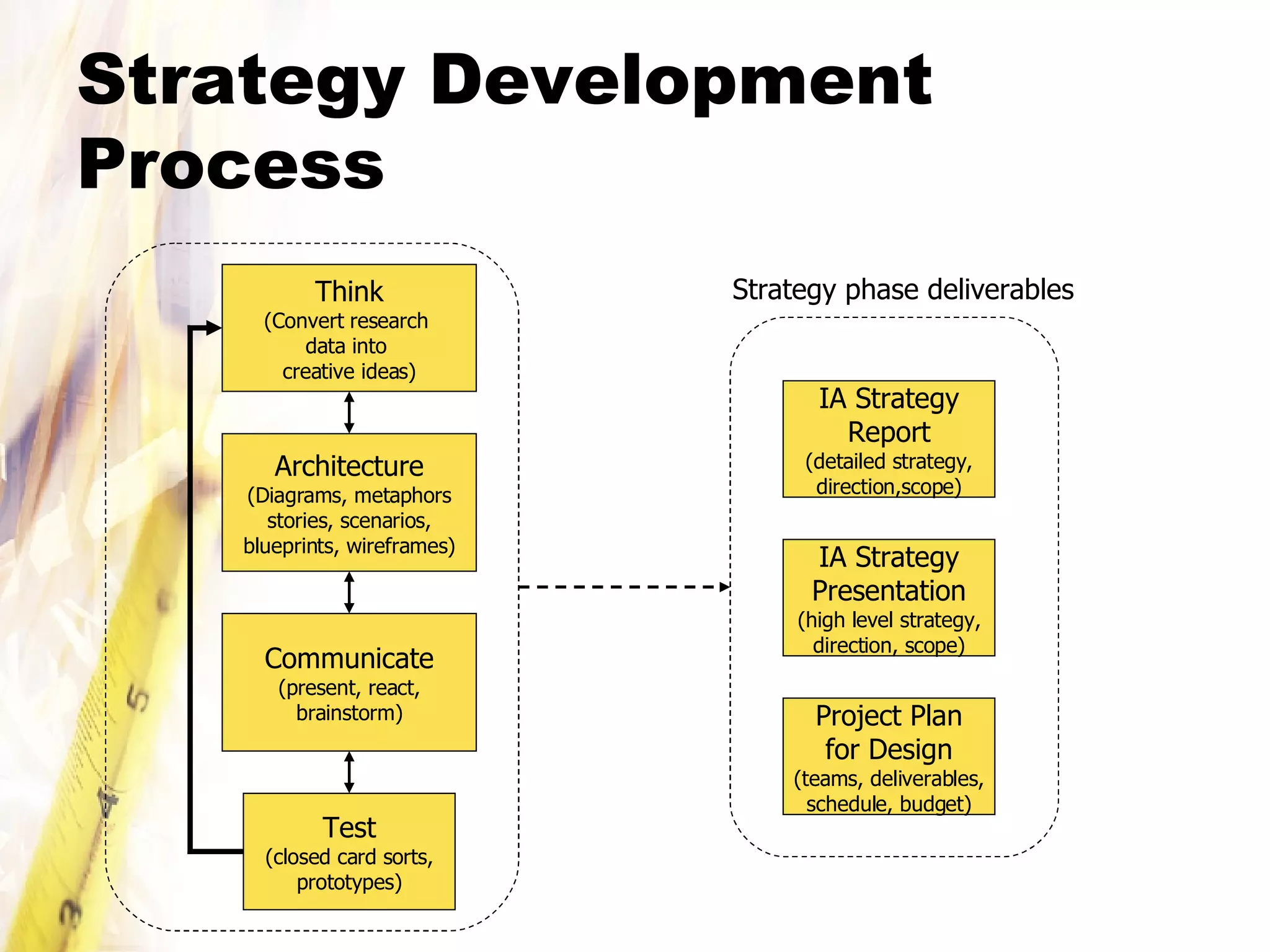
Strategy Development Process Think (Convert research  data into  creative ideas) Architecture (Diagrams, metaphors stories, scenarios, blueprints, wireframes) Communicate (present, react, brainstorm) Test (closed card sorts, prototypes) IA Strategy Report (detailed strategy, direction,scope) IA Strategy Presentation (high level strategy, direction, scope) Project Plan for Design (teams, deliverables, schedule, budget) Strategy phase deliverables
Strategy work products and deliverables Scenarios Narrative pieces that show how people with different needs and behaviors will navigate your site. Usually are easy and fun to write. Case studies and stories
Strategy work products and deliverables Conceptual Diagrams Pictorial representation of the concepts in your Information Architecture. Blueprints  Show relations between your   pages and other content components Wireframes Quick and dirty visuals that show the content and major  links of major pages on the web site.
Strategy Report Executive summary Audiences, mission and vision: Lessons learned Architectural strategies Content management
Project Plan The project plan for the Information Architecture design is the last part of the Information strategy. Objectives: To ensure that information architecture is grounded in reality. Is a bridge between strategy and design.
Presentations It is a good idea to make one or more presentations to the people who needs to understand your recommendations. Select highlights of your recommendations and organize your presentation around them. Metaphor can be a good way to convey your ideas to the audience.

Process And Methodology Research

  • 1.
    Process and Methodology:Research Information Architecture
  • 2.
    Methodology Overview Designinga web site is similar to designing any software or information system. It is hard work and requires a phased approach.
  • 3.
    Process of InformationArchitecture Development Project Research Strategy Design Implementation Administration Program Simplified view of the development process
  • 4.
    Research Framework ContextContent Users Business goals, Funding, politics, culture, technology, human resources Audiences, tasks, needs, information seeking behavior, experience, vocabularies Document/data types, content objects, metadata, volume, existing structure Information Ecologies
  • 5.
    Tools and methodsfor Research Background Research Presentations and meetings Stakeholder Interviews Technology Assessment Context Heuristic Evaluation Metadata And content analysis Content mapping Benchmarking Content Search log and Clickstream analysis Use cases and personas Contextual Inquiry User interviews and user testing Users
  • 6.
    Tools and methodsfor Research: Context Background Research It is a good idea to begin by reviewing background materials. For example gather documents related to the site’s mission, goals, intended audiences, and content. Organization Charts capture components of the user’s mental model of the organization.
  • 7.
    Tools and methodsfor Research: Context Introductory presentation Be sure that authors, software developers, graphic designers, marketing folks, and managers understand: What is IA and why is it important? How will the IA relate the the other components of the site and organization What are the major milestones and deliverables?
  • 8.
    Tools and methodsfor Research: Context Research meetings Strategy team meeting Working group in charge of the management of the web site effort Content management meetings Content Owners and managers Detailed discussions about content management Information technology meeting System administrators and software developers
  • 9.
    Tools and methodsfor Research: Context Stakeholder Interviews Interviews with senior executives and managers Open ended questions about the current information environment and their vision for the organization web site.
  • 10.
    Tools and methodsfor Research: Context Technology Assessment Evaluation of IT resources available for the project. This should be done early in the project
  • 11.
    Tools and methodsfor Research: Content Content includes: Documents Data Applications E-services Images Audio and video files
  • 12.
    Tools and methodsfor Research: Content Heuristic Evaluation If you have an existing web site, do an analysis to see what is worth keeping. Some guidelines for heuristic evaluation: Multiple ways to access information Indexes and sitemap The navigation should provide users with sense of context Use language consistently and appropriate for audience Integration of searching and browsing
  • 13.
    Tools and methodsfor Research: Content Content Analysis It is a bottom-up approach to IA It involves careful review of documents and object that actually exists It can be: High level content survey at the beginning of the project Page by page content audit latter in the project
  • 14.
    Tools and methodsfor Research: Content Content Analysis: Gathering content: Use intuition and judgment, balancing the size of your sample against the time constrains of the project. Use the “Noah’s approach” (two samples of each kind)
  • 15.
    Tools and methodsfor Research: Content Dimension to use for sampling: Format (text, software, audio and video files, archived mail Document Type : capture diverse set of documents. (catalogs, annual reports, technical reports, marketing, etc) Source (engineering, marketing, customer support, finance, human resources, etc) Subject (use a broad range of subjects) Existing architecture (but don’t get overly influenced)
  • 16.
    Tools and methodsfor Research: Content Analyzing content Goals: Get familiar with the subject matter Provide data that is critical for the development of a solid IA.
  • 17.
    Tools and methodsfor Research: Content Analyzing content: For each object note: Structural metadata(Information hierarchy) Descriptive metadata (topic audience format) Administrative metadata (how the object relates to the business context.)
  • 18.
    Research Content MappingVisual representation of the existing information. High-level and conceptual Tool for understanding rather than a deliverable
  • 19.
    Content Mapping Contentsources Content model Content types Content templates Marketing Customer Support Legal Product Process Reference Contact Handling System How to Steps Table
  • 20.
    Benchmarking Systematic identification,evaluation, and comparison of IA features of web sites and intranets. Competitive Benchmarking Before-and-after benchmarking
  • 21.
    Users If youhave an existing web site: Usage statistics Search log analysis Customer support data
  • 22.
    Users Other techniquesinvolve selecting users to conduct qualitative analysis. Define the intended audiences of your site Select one or more methods for gathering information Develop instruments and participants profiles Recruit participants Hard work of gathering the data Data analysis and conclusion
  • 23.
    Users Techniques forperforming user studies: Surveys Contextual Inquiries Focus Groups User research sessions Interviews Card sorting User testing
  • 24.
    Users Surveys Allowsto gather information from a large number of people Quick and inexpensive. Results allows quantitative analysis
  • 25.
    Users Contextual InquiryTechnique used in ethnographic research Observation of users in their own environment
  • 26.
    Users Focus GroupsGather groups of users (or potential users) Ask scripted questions Demonstrate prototype Ask questions about user’s perception Get recommendations for improvement
  • 27.
    Users User Researchsessions Face-to-face sessions involving one user at a time Expensive and time consuming. Must be combined with other methods such as user testing or card sorting.
  • 28.
    Users Interviews Typesof questions: Background Information use Intranet use Document publishing Suggestions
  • 29.
    Users Card SortingLabel cards with headings from categories, sub-categories and content. Ask the user to sort them into piles that make sense to them and label these piles. Ask them to talk out aloud while they work Take good notes and record labels and contents of their piles.
  • 30.
    User Testing Havethe user sit in front of the computer to use your site for: Finding information or Completing a task Take good notes Capture what he says and where he goes count clicks and measure his time.
  • 31.
    User Testing Includea range of audience types Have experts and novices Choose the right tasks. For example Easy to impossible Known-item to exhaustive Topic to task Artificial to real Spread tasks across multiple areas of your site
  • 32.
  • 33.
    Strategy Strategy isthe bridge between research and design. It is a high level conceptual framework for structuring and organizing your web site or intranet. You can consider strategies for structuring and organizing information before you start your research
  • 34.
    Strategy IA strategyprovides high-level recommendations for Information Architecture Administration Technology Integration Top-down or Bottom-up emphasis Organization and labeling systems Document type identification Metadata field definition Navigation system design
  • 35.
    Strategy You movefrom Research to strategy when you start to reach the “saturation point” in Research. In strategy the emphasis changes from open-ended learning to design and testing. You should use visuals to articulate your ideas.
  • 36.
    Strategy Development ProcessThink (Convert research data into creative ideas) Architecture (Diagrams, metaphors stories, scenarios, blueprints, wireframes) Communicate (present, react, brainstorm) Test (closed card sorts, prototypes) IA Strategy Report (detailed strategy, direction,scope) IA Strategy Presentation (high level strategy, direction, scope) Project Plan for Design (teams, deliverables, schedule, budget) Strategy phase deliverables
  • 37.
    Strategy work productsand deliverables Scenarios Narrative pieces that show how people with different needs and behaviors will navigate your site. Usually are easy and fun to write. Case studies and stories
  • 38.
    Strategy work productsand deliverables Conceptual Diagrams Pictorial representation of the concepts in your Information Architecture. Blueprints Show relations between your pages and other content components Wireframes Quick and dirty visuals that show the content and major links of major pages on the web site.
  • 39.
    Strategy Report Executivesummary Audiences, mission and vision: Lessons learned Architectural strategies Content management
  • 40.
    Project Plan Theproject plan for the Information Architecture design is the last part of the Information strategy. Objectives: To ensure that information architecture is grounded in reality. Is a bridge between strategy and design.
  • 41.
    Presentations It isa good idea to make one or more presentations to the people who needs to understand your recommendations. Select highlights of your recommendations and organize your presentation around them. Metaphor can be a good way to convey your ideas to the audience.