Primary funding is provided by
The SPE Foundation through member donations
and a contribution from Offshore Europe
The Society is grateful to those companies that allow their
professionals to serve as lecturers
Additional support provided by American Institute for Mechanical
Engineers (AIME)
Society of Petroleum Engineers
Distinguished Lecturer Program
www.spe.org/dl
1
This program year (2011-2012) marks
the 50th anniversary of the SPE
Distinguished Lecturer program.
Please visit our site to learn more
about this amazing program.
www.spe.org/go/DL50
2
Practical Approach to Solving
Wellbore Instability Problems
Samuel O. Osisanya, Ph.D.; P.E.
Professor
Mewbourne School of Petroleum and Geol. Engineering
The University of Oklahoma
Norman, OK, USA
sosisanya@ou.edu
Society of Petroleum Engineers
Distinguished Lecturer Program
www.spe.org/dl 3
Outline
● Introduction & Objectives
● Causes of Wellbore Instability
● Wellbore Stability (WS)
– Before Drilling; While Drilling; &
After Drilling
● Symptoms, Prevention &
Remedial Actions
● Case Studies
● Summary & Conclusions
4
Introduction
5
Introduction
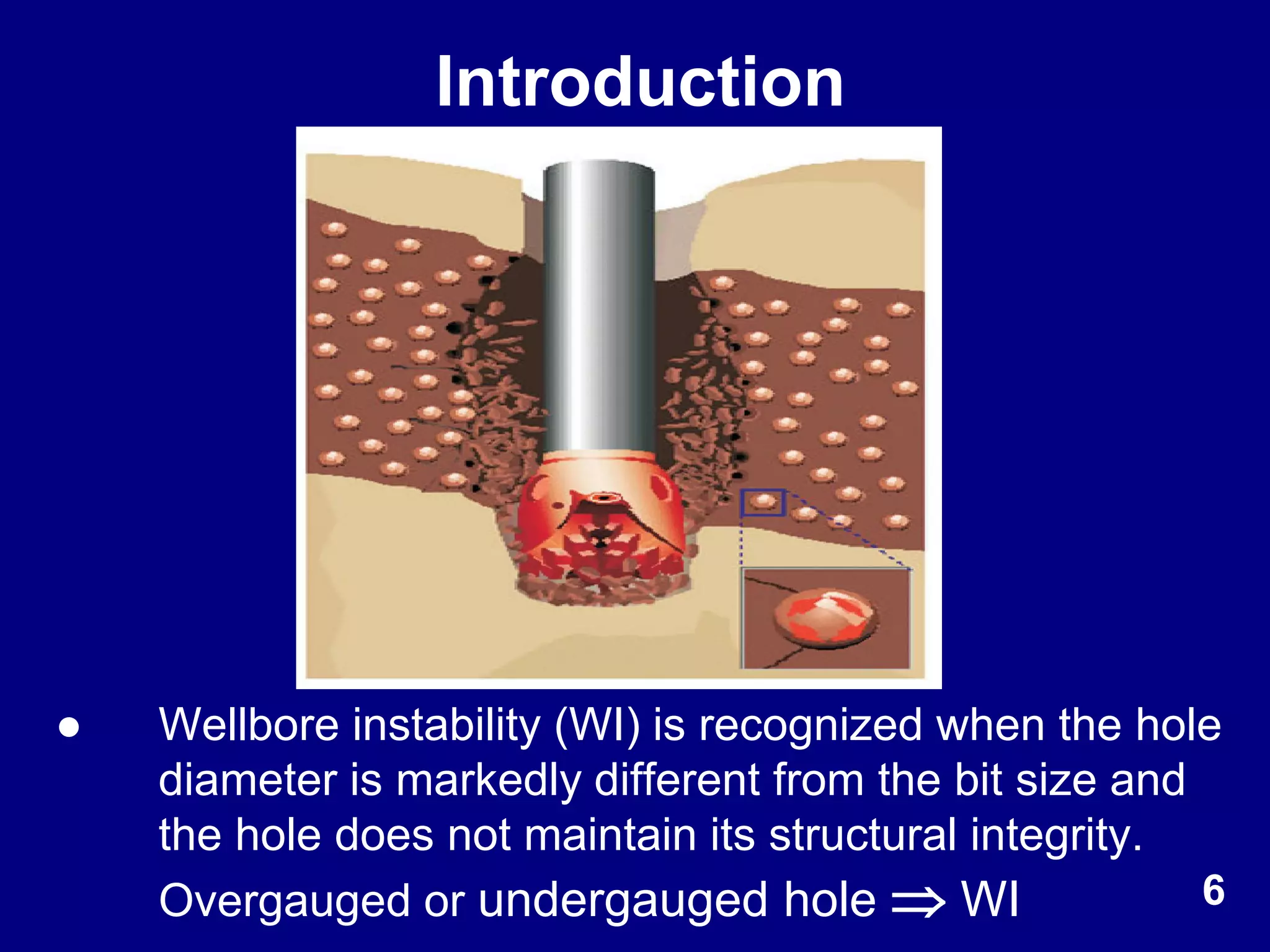
● Wellbore instability (WI) is recognized when the hole
diameter is markedly different from the bit size and
the hole does not maintain its structural integrity.
Overgauged or undergauged hole  WI 6
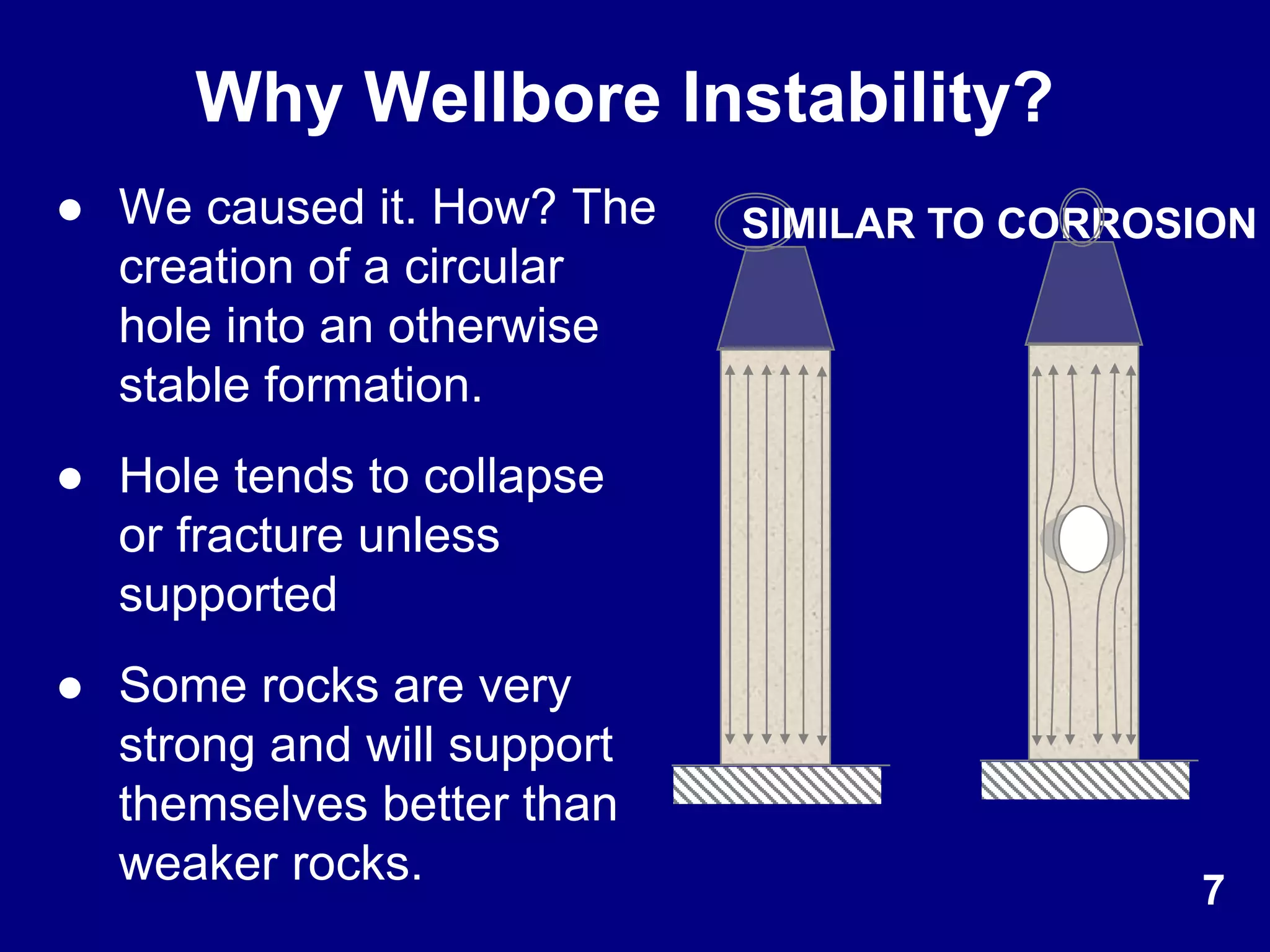
Why Wellbore Instability?
SIMILAR TO CORROSION● We caused it. How? The
creation of a circular
hole into an otherwise
stable formation.
● Hole tends to collapse
or fracture unless
supported
● Some rocks are very
strong and will support
themselves better than
weaker rocks.
7
Introduction (cont’d)
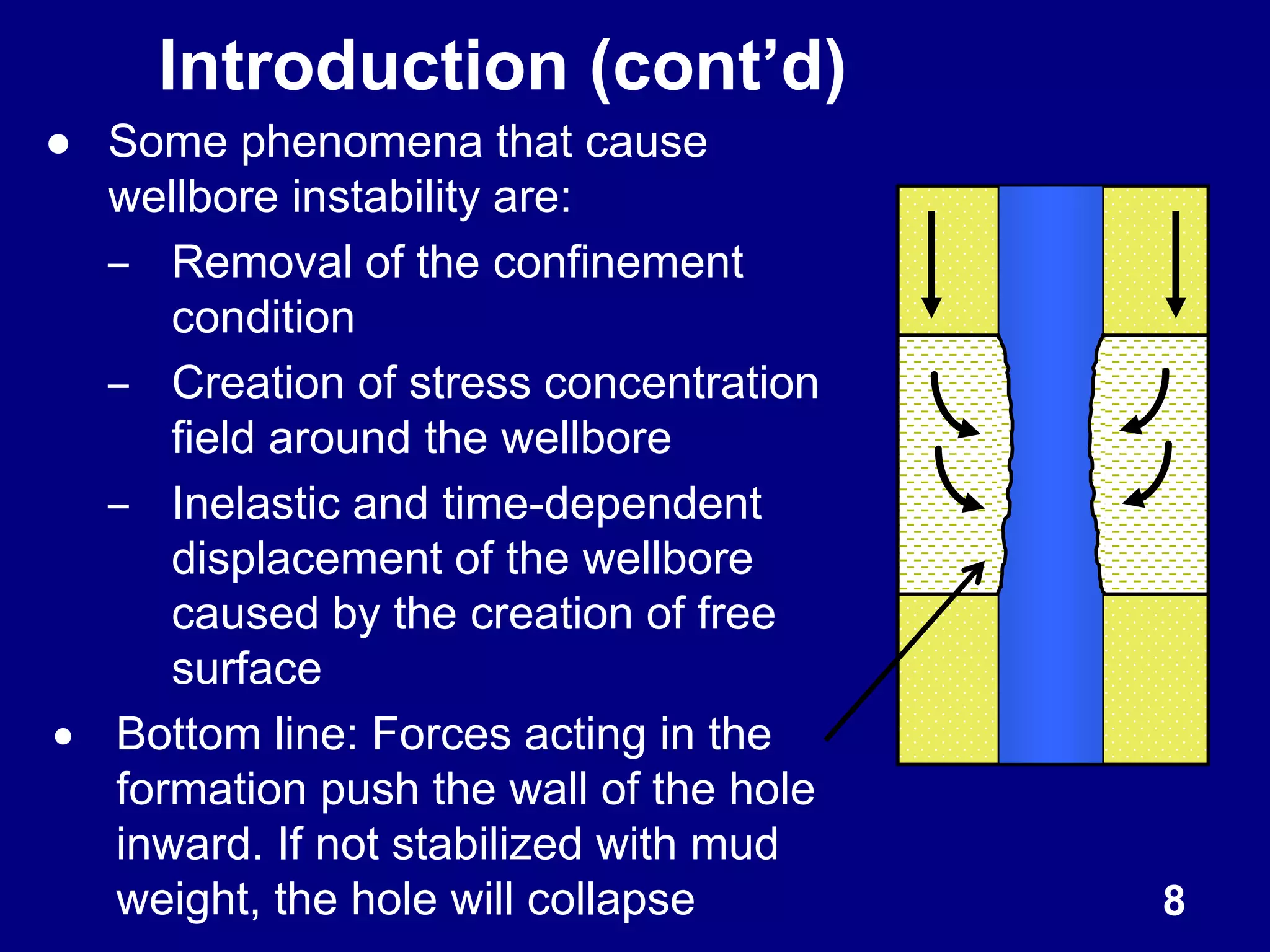
● Some phenomena that cause
wellbore instability are:
– Removal of the confinement
condition
– Creation of stress concentration
field around the wellbore
– Inelastic and time-dependent
displacement of the wellbore
caused by the creation of free
surface
 Bottom line: Forces acting in the
formation push the wall of the hole
inward. If not stabilized with mud
weight, the hole will collapse 8
Consequences of Wellbore Instability
● These are:
– At least reduced drilling performance and/or
stuck BHA & downhole tools  fishing
– Loss of equipment and sidetracking
– Excessive trip time and reaming time
– Poor hole logging; inability to land casing; and
poor cementing conditions/jobs
– At worst it can lead to total collapse and loss of
the hole
● Bottom Line: increase in non-productive
time and increase in total drilling cost. 9
Objectives
1. To describe causes of wellbore
instability problems
2. To describe wellbore stability before,
during, and after drilling wells
3. To describe symptoms of the
problems while drilling
4. To discuss practical, preventive, and
remedial actions for wellbore instability
10
Causes of Wellbore Instability
11
Causes of Wellbore Instability
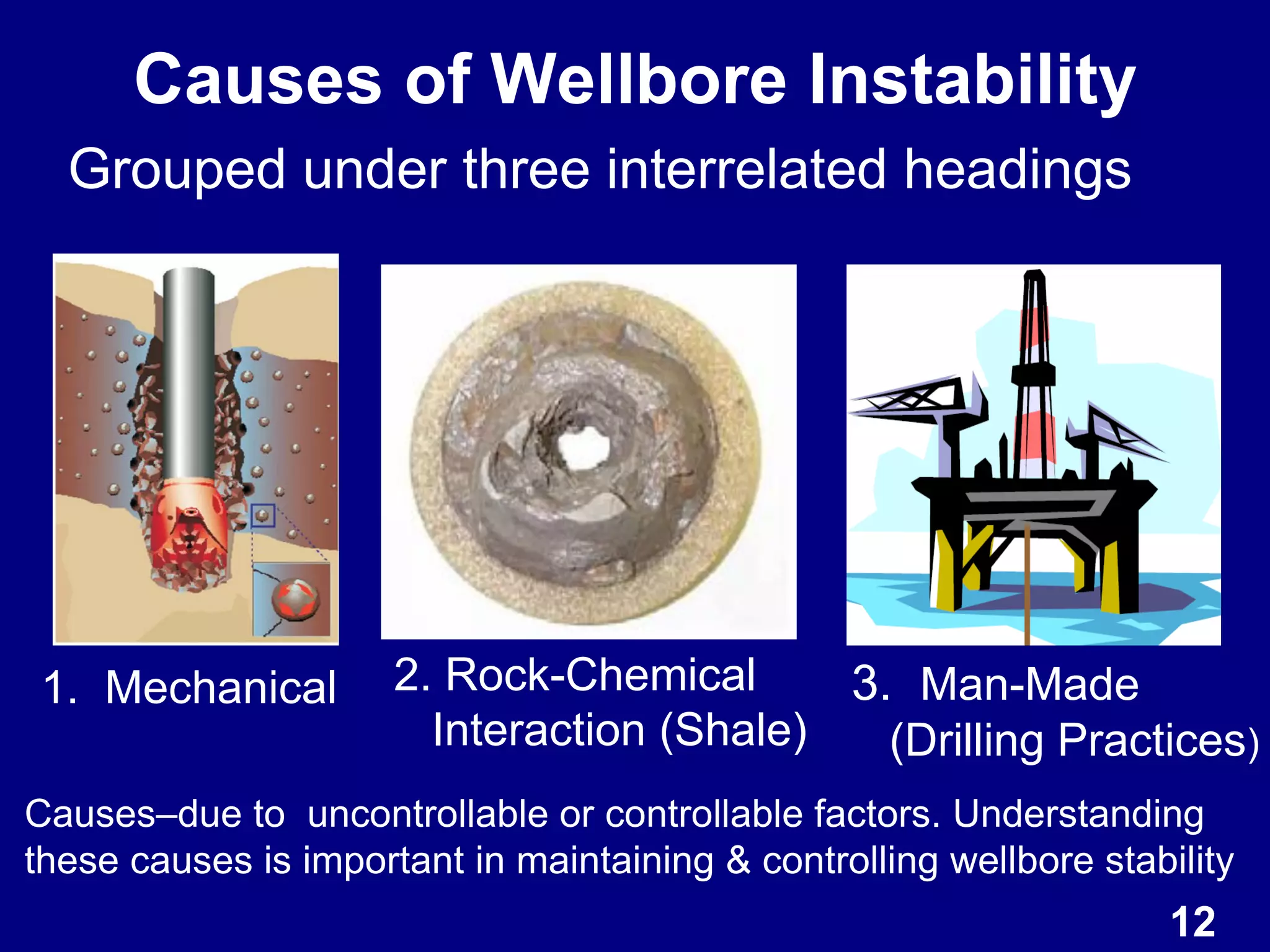
1. Mechanical 2. Rock-Chemical
Interaction (Shale)
3. Man-Made
(Drilling Practices)
Grouped under three interrelated headings
Causes–due to uncontrollable or controllable factors. Understanding
these causes is important in maintaining & controlling wellbore stability
12
1. Mechanical Wellbore Instability
● Key parameters are:
1. Rock Stresses/Rock Types
2. Rock Strength (weaken)
3. Wellbore Geometry (Hole
Inclination & Azimuth)
4. Man-Made Related Stresses
● First two are uncontrollable and the
last two are controllable
13
Mechanical Wellbore Instability
● Mechanical failure occurs when
wellbore stress concentrations
exceed the rock strength
● Wellbore stress concentrations result
from
– Drilling into pre-stressed rock (earth
stresses)
– Excessive wellbore pressures
– Drillstring vibrations
14
Wellbore Stresses After Drilling
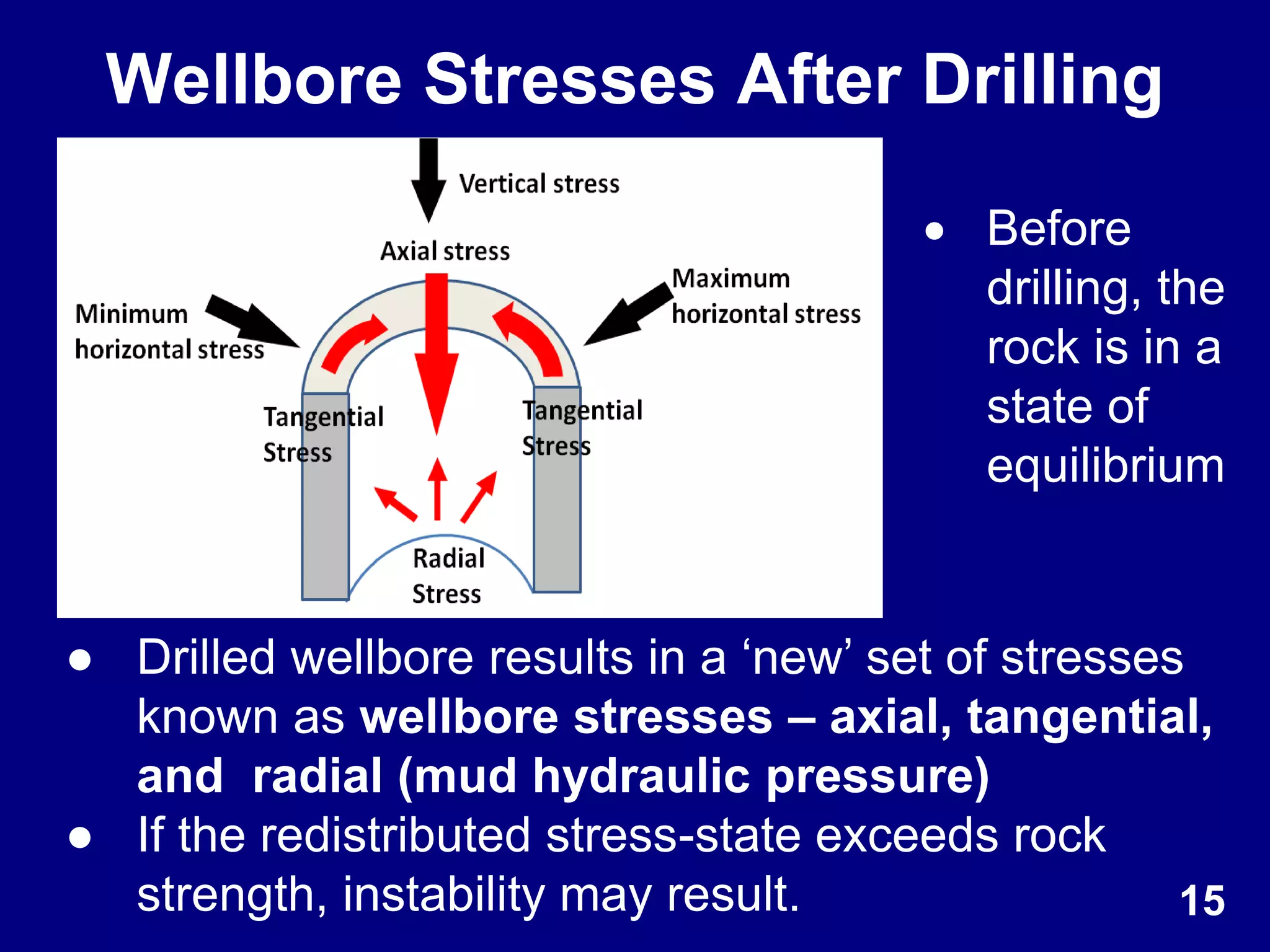
● Drilled wellbore results in a ‘new’ set of stresses
known as wellbore stresses – axial, tangential,
and radial (mud hydraulic pressure)
● If the redistributed stress-state exceeds rock
strength, instability may result. 15
 Before
drilling, the
rock is in a
state of
equilibrium
Mechanical Wellbore Instability -
Borehole Stress Orientation
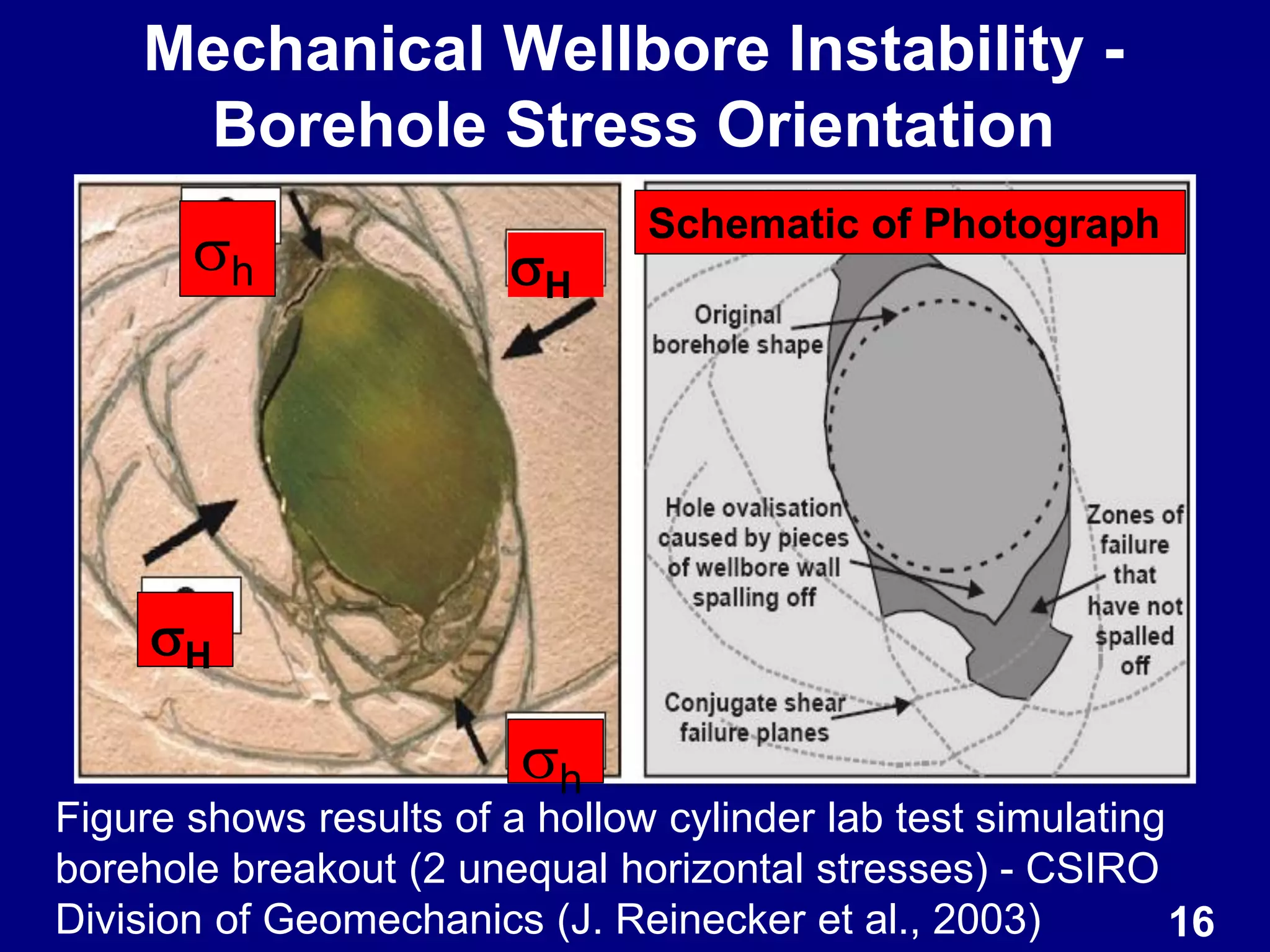
Figure shows results of a hollow cylinder lab test simulating
borehole breakout (2 unequal horizontal stresses) - CSIRO
Division of Geomechanics (J. Reinecker et al., 2003) 16
H
H
h
h
Schematic of Photograph
● Sedimentary rocks in general are shales (75%)
and in particular they are sensitive to their
chemical environment.
● Reaction between the shale and drilling fluid
causes the shale to swell, weaken, and
eventually fall/collapse into the wellbore.
● Solution is to have a drilling fluid system that
balances the mechanical and chemical forces.
● Also use drilling practices that minimize shale or
formation instability.
17
2. Rock-Chemical Interaction (Shale)
Instability
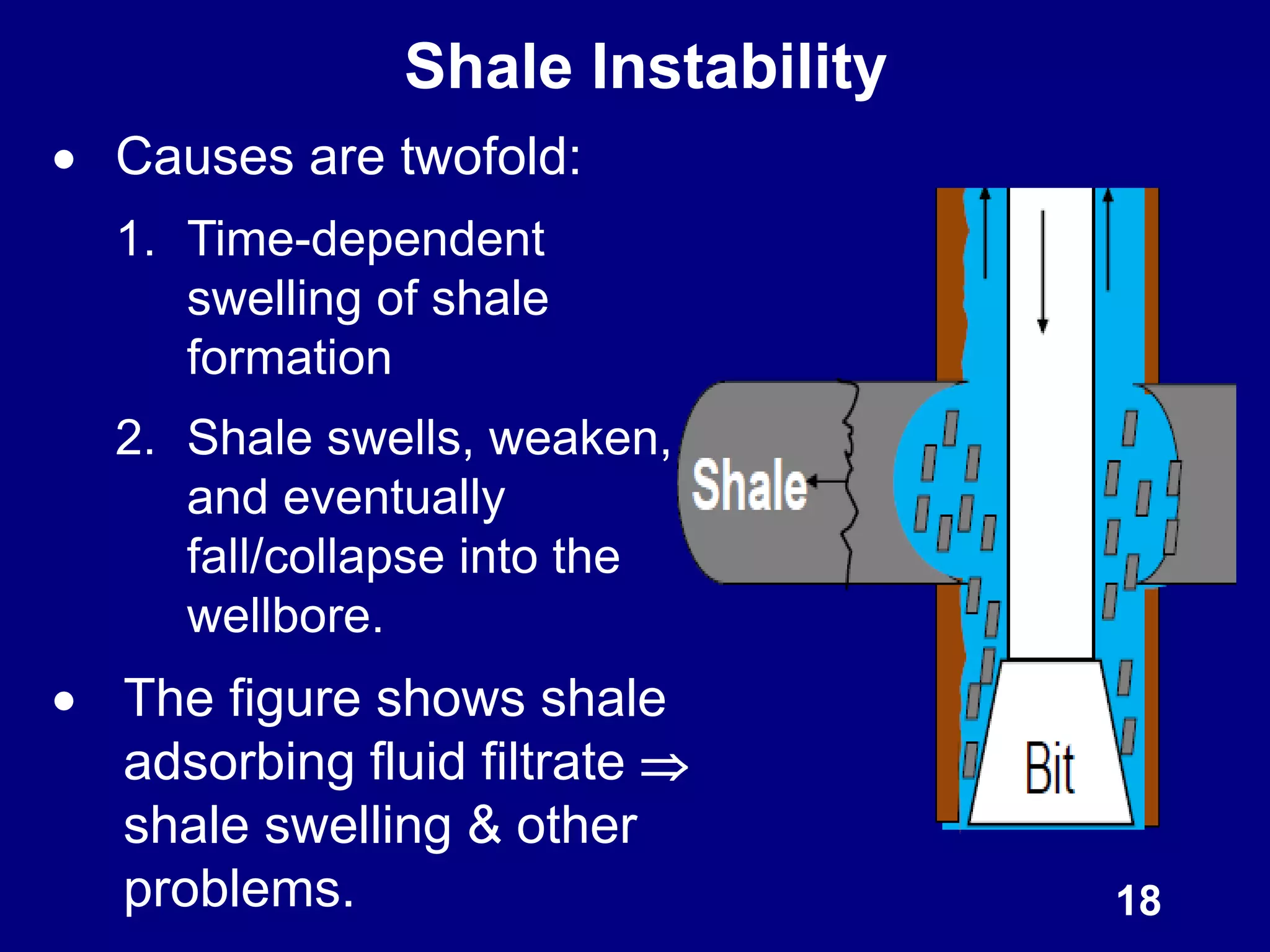
Shale Instability
 Causes are twofold:
1. Time-dependent
swelling of shale
formation
2. Shale swells, weaken,
and eventually
fall/collapse into the
wellbore.
 The figure shows shale
adsorbing fluid filtrate 
shale swelling & other
problems. 18
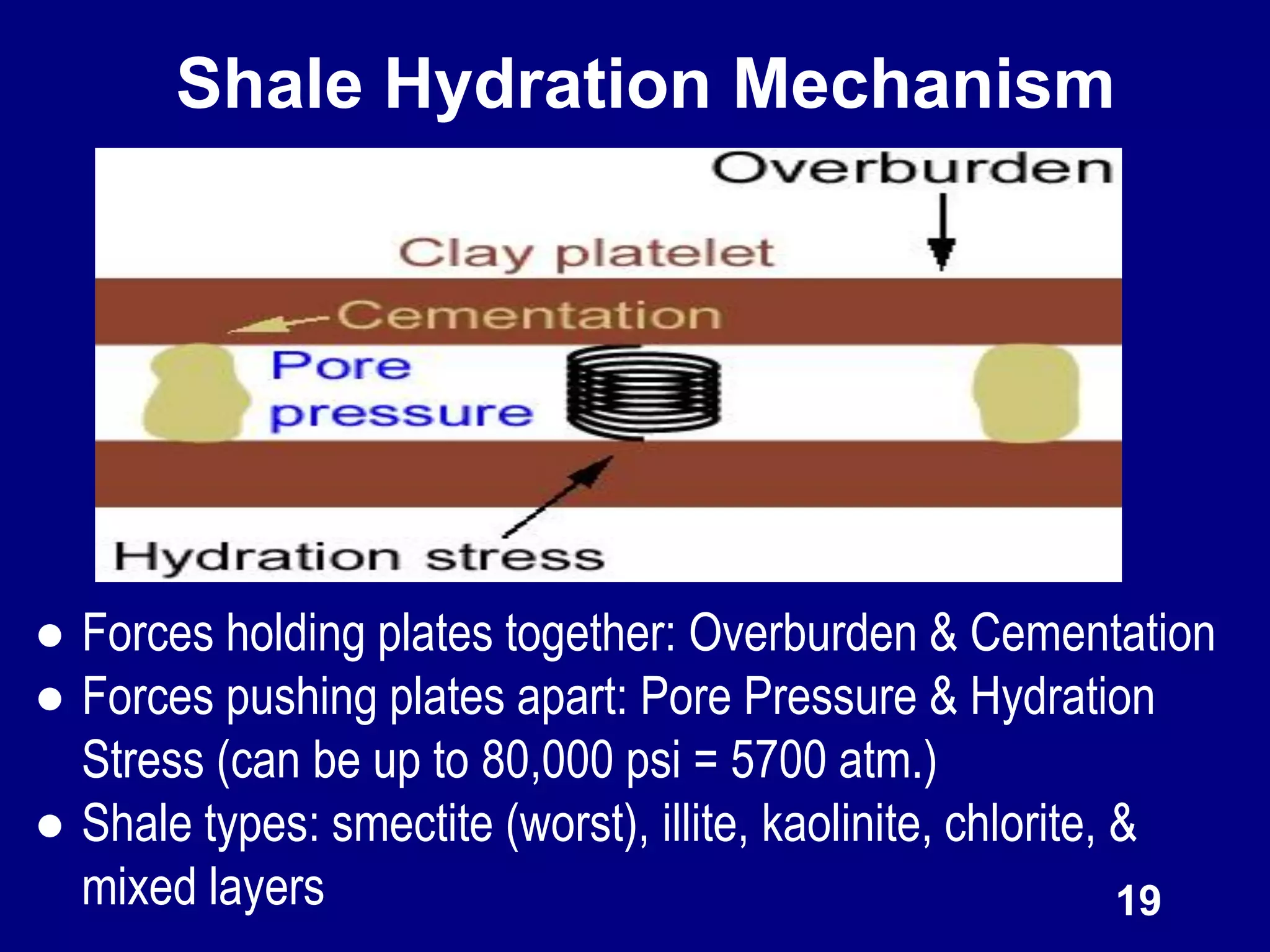
Shale Hydration Mechanism
19
● Forces holding plates together: Overburden & Cementation
● Forces pushing plates apart: Pore Pressure & Hydration
Stress (can be up to 80,000 psi = 5700 atm.)
● Shale types: smectite (worst), illite, kaolinite, chlorite, &
mixed layers
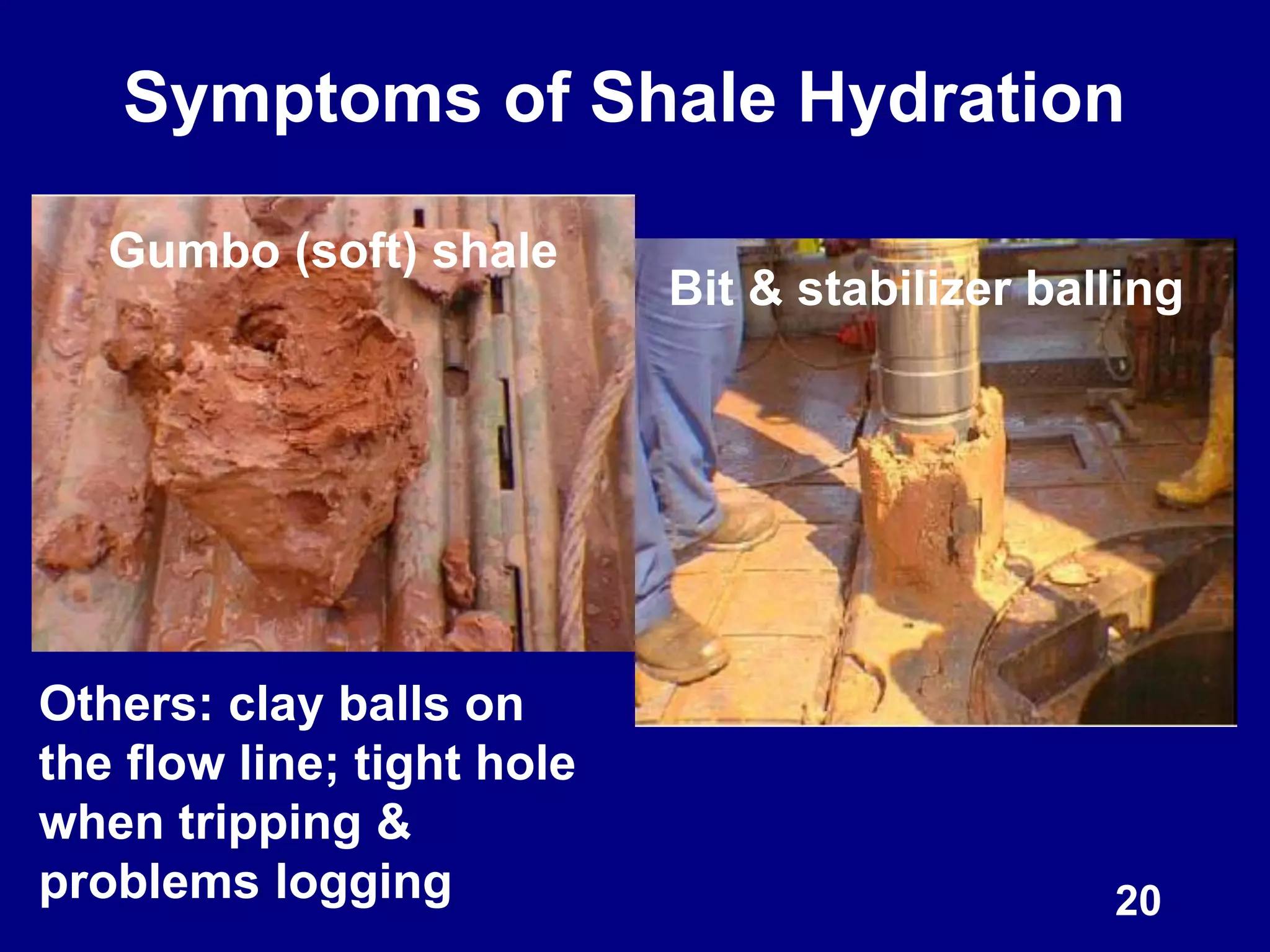
Symptoms of Shale Hydration
Gumbo (soft) shale
20
Bit & stabilizer balling
Others: clay balls on
the flow line; tight hole
when tripping &
problems logging
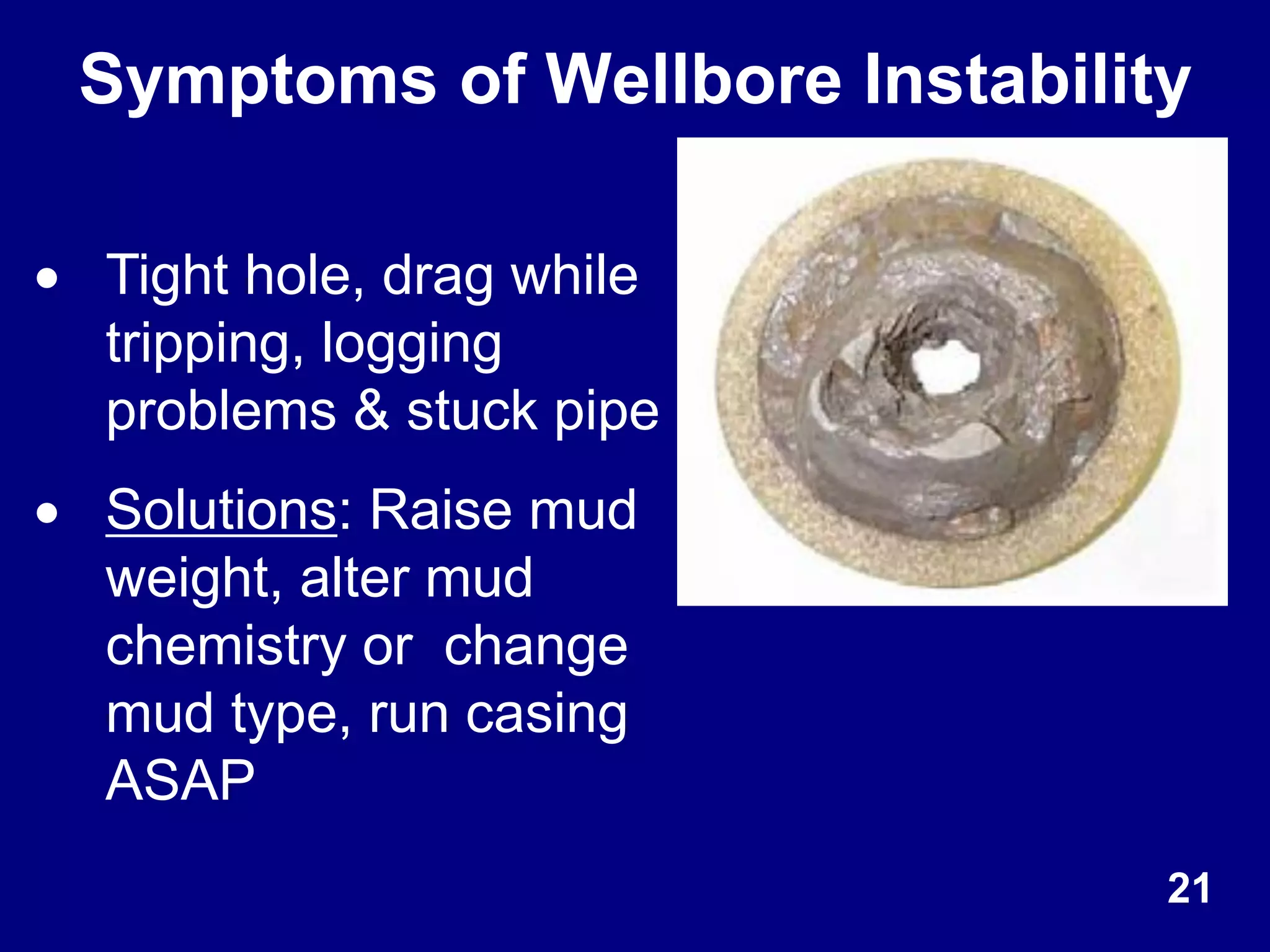
Symptoms of Wellbore Instability
 Tight hole, drag while
tripping, logging
problems & stuck pipe
 Solutions: Raise mud
weight, alter mud
chemistry or change
mud type, run casing
ASAP
21
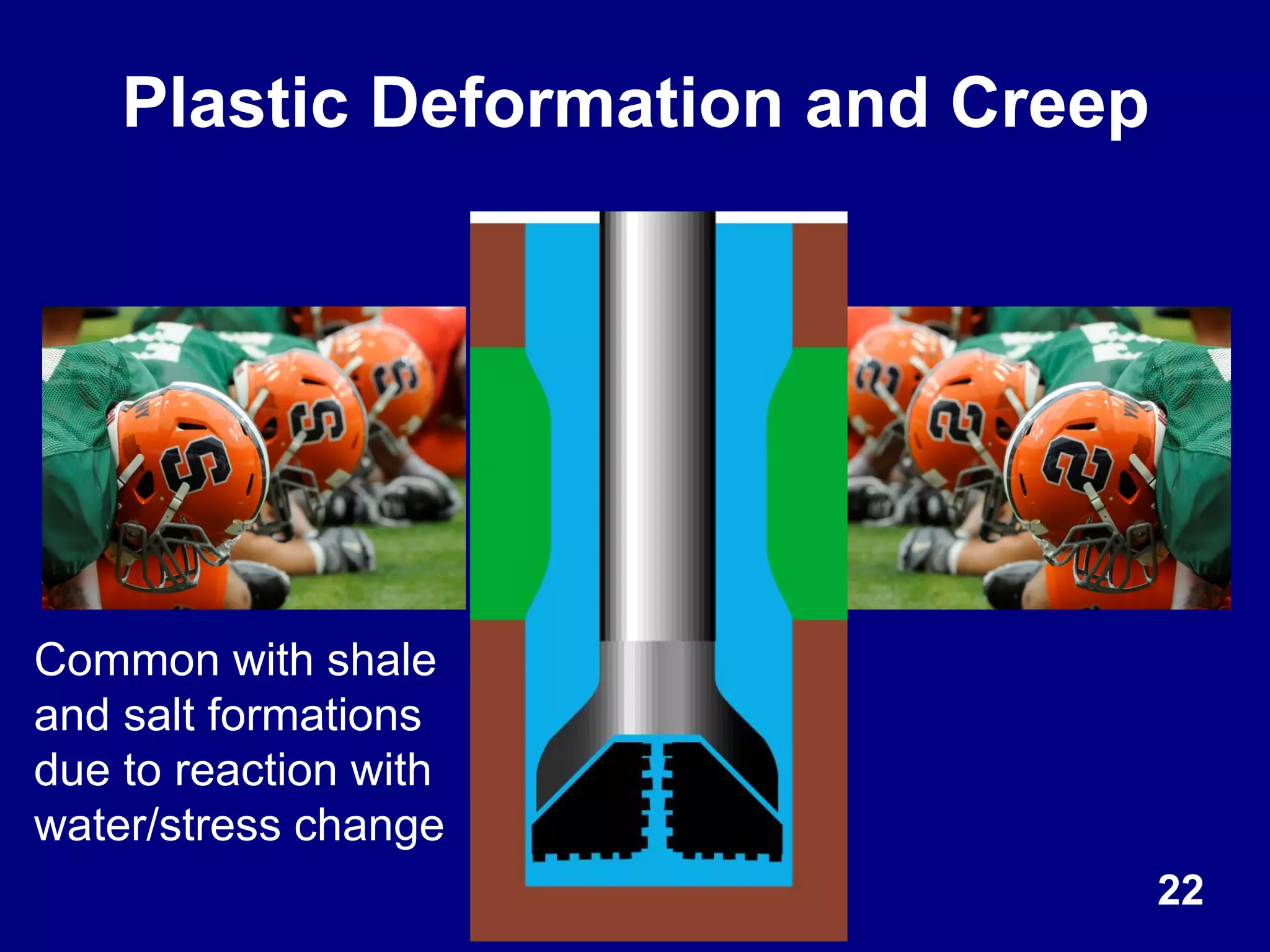
Plastic Deformation and Creep
22
Common with shale
and salt formations
due to reaction with
water/stress change
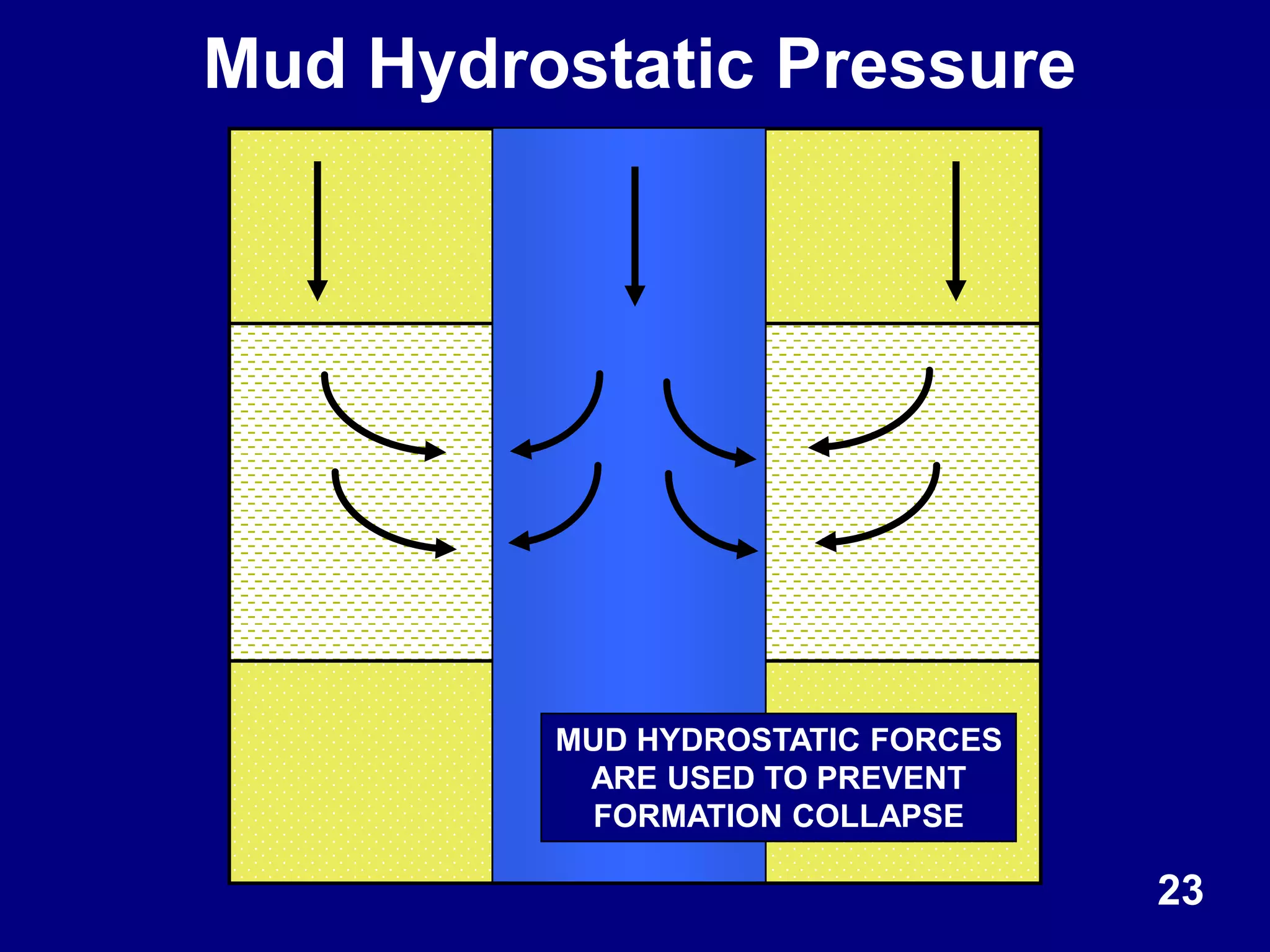
MUD HYDROSTATIC FORCES
ARE USED TO PREVENT
FORMATION COLLAPSE
Mud Hydrostatic Pressure
23
● Lack of adequate well planning
– Selection of wrong inclination &
azimuth
– Selection of wrong drilling fluid system
● Improper (poor) drilling practices
– Excessive wellbore stresses
– Poor hole cleaning
– Excessive drillstring vibrations
3. Man-Made Wellbore Instability
24
Wellbore Stability (WS)
Before Drilling (Planning)
25
Wellbore Stability (WS) Before Drilling
(Planning)
● Involves: geo-mechanics and drilling
fluid selection
– A comprehensive GeoMechanics study is
essential in order to understand causes
of wellbore instability and to improve
drilling design and drilling performance.
• Extremely important for horizontal &
extended reach wells.
– An extensive shale inhibition testing
program is also essential.
26
Wellbore Stability (WS) Before Drilling
(Planning)
● Steps for GeoMechanics study are:
– To acquire, audit & perform quality control
of geomechanical data (e.g. wireline logs)
– To build Mechanical Earth Model (MEM)
– To perform WS analysis of the planned well
including trajectory sensitivity analysis
– To review wellbore instability drilling events
from offset wells
– To forecast wellbore stability 27
Wellbore Stability Before Drilling
(Planning)
● Geo-Mechanical Earth Model
– Integrate all geo-mechanical data
available from a field/basin into one
“database”
– Use model to predict wellbore instability
problems in an upcoming well
– Model outputs – (1) safe mud weight
window and (2) safest inclination &
azimuth to drill. 28
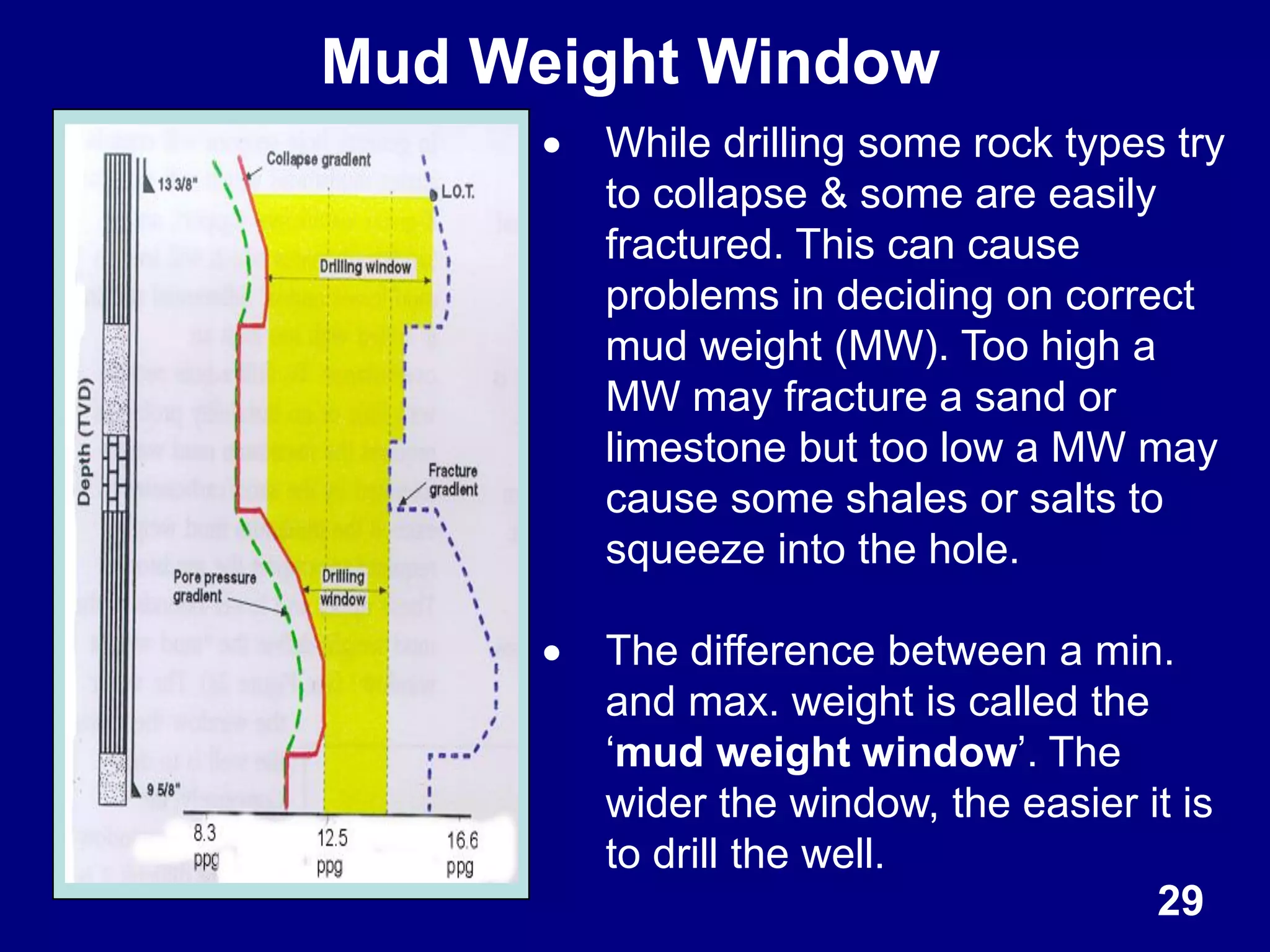
Mud Weight Window
29
 While drilling some rock types try
to collapse & some are easily
fractured. This can cause
problems in deciding on correct
mud weight (MW). Too high a
MW may fracture a sand or
limestone but too low a MW may
cause some shales or salts to
squeeze into the hole.
 The difference between a min.
and max. weight is called the
‘mud weight window’. The
wider the window, the easier it is
to drill the well.
Shale Inhibition Test Methods
● Wellbore Simulators - swelling
stress/strain tests under HTHP (lab)
– to model fluid flow in shale (shale
permeability)
● Cuttings Dispersion - evaluation of
mud type (lab & rig site)
● Cation Exchange Capacity (aka
MBT) – use to determine shale type
30
Wellbore Instability While
Drilling – Improper Drilling
Practices
31
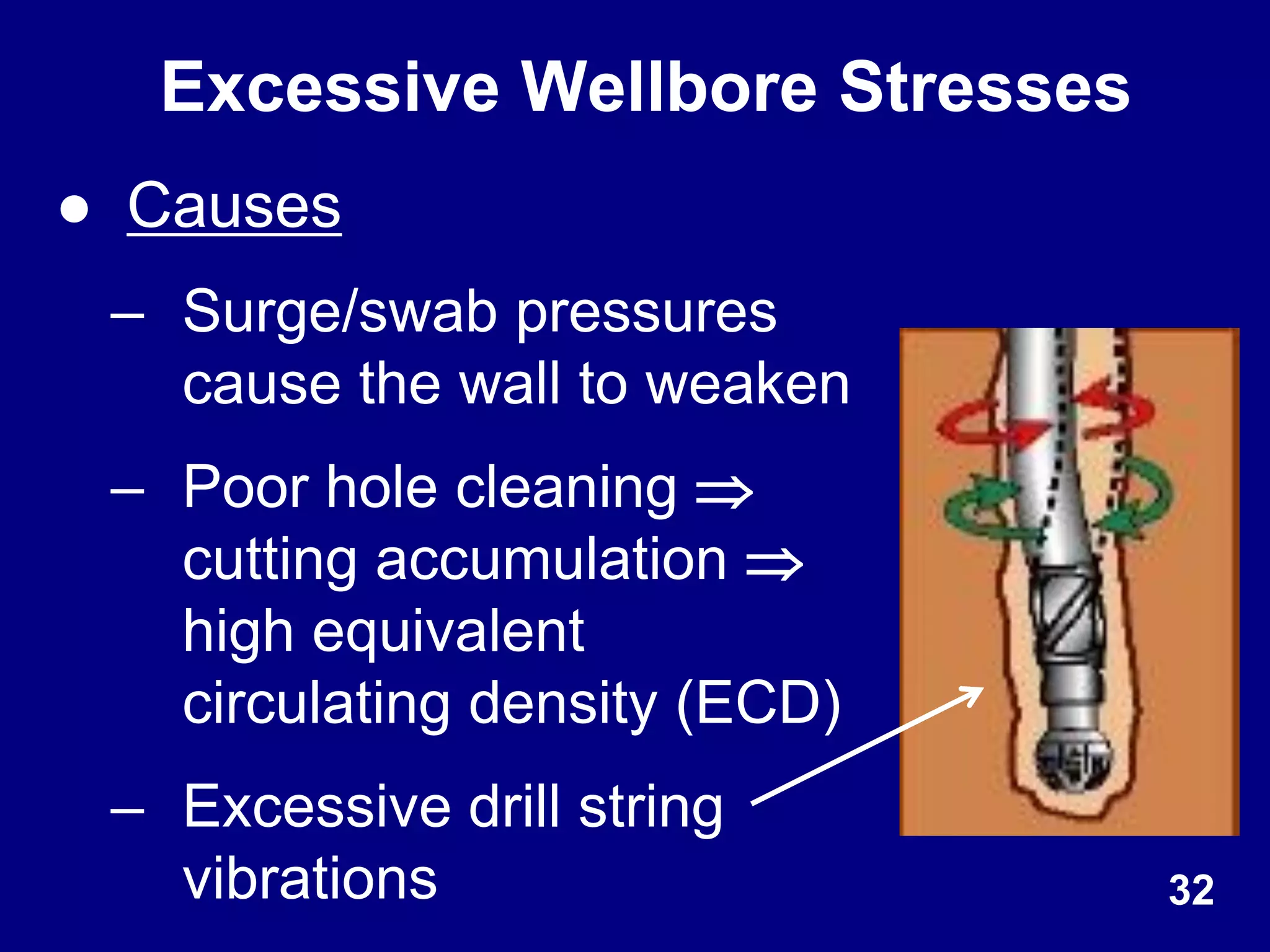
Excessive Wellbore Stresses
● Causes
– Surge/swab pressures
cause the wall to weaken
– Poor hole cleaning 
cutting accumulation 
high equivalent
circulating density (ECD)
– Excessive drill string
vibrations 32
RUNNING IN
PULLING OUT
INCREASED
PRESSURE
DECREASED
PRESSURE
PRESSURE SURGES DUE
TO TRIPPING CAN CREATE
CYCLES OF STRESS THAT
GRADUALLY WEAKEN THE
HOLE WALL
Excessive Wellbore Stresses
33
ALSO ECD SURGES
WHEN SWITHCHING
PUMPS ON AND OFF
WILL CREATE
PRESSURE SURGES
SURGE
SWAB
34
Symptoms of Excessive Stresses
• Large amounts of
blocky cavings on
shale shaker; more
after wiper trip;
borehole failure due
to stress changes in
massive shales
• Hole enlargement
• Erratic directional
control
Symptoms of Wellbore Instability
● Lots of cuttings
on the surface.
● Borehole failure
due to stress
changes in
massive shales
● Solution: One
solution is to
raise mud weight 35
Pore Pressure Penetration
● Causes:
● Poor hole
cleaning
● Localized
elevated pore
pressure
● Symptoms
● Tensile cavings
● More cavings
after trips 36
Instability in Fractured Rocks
37
● Causes:
– Time-dependent mud
penetration into
fractures
– Stress changes 
weaken formation
● Symptoms
– High levels of angular
cavings
– More cavings after
wiper trips
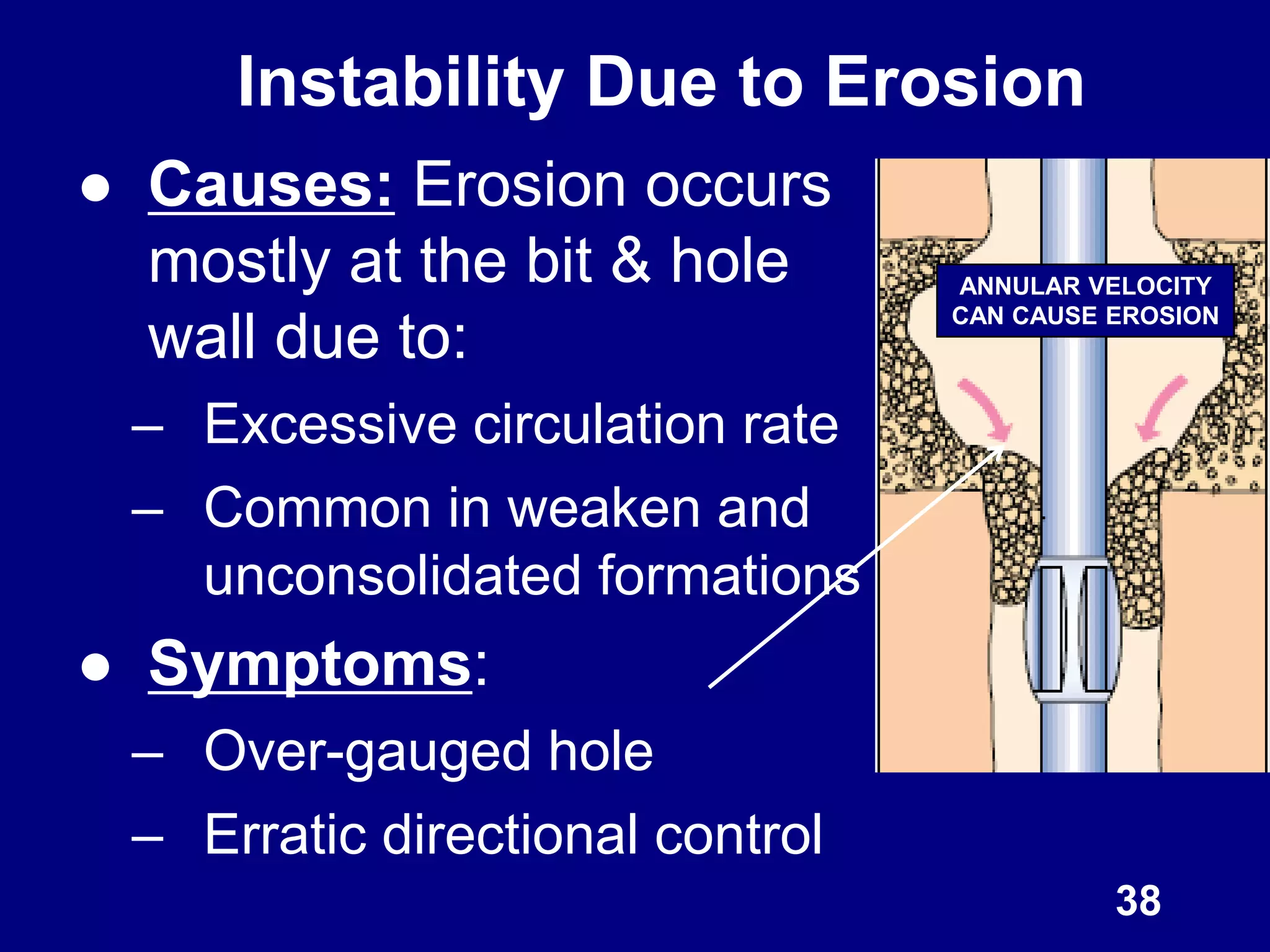
Instability Due to Erosion
● Causes: Erosion occurs
mostly at the bit & hole
wall due to:
– Excessive circulation rate
– Common in weaken and
unconsolidated formations
● Symptoms:
– Over-gauged hole
– Erratic directional control
38
ANNULAR VELOCITY
CAN CAUSE EROSION
Wellbore Stability While Drilling
● Involves real time WS management
(control): This is a 2-fold process:
1. Continuous monitoring – caving
analysis, downhole measurements
(MWD and LWD) and surface
signatures to diagnose onset of a
problem
2. Remedial actions – involve control of
surface parameters such as WOB,
mud weight, flow rate, etc. 39
Wellbore Stability While Drilling
● Caving Analysis: A key parameter
to managing wellbore instability in
real time; provides an early
warning of wellbore instability
– Monitor caving rate
– Perform caving morphology
1. Types of cavings: Tabular,
Angular, or Splintered
40
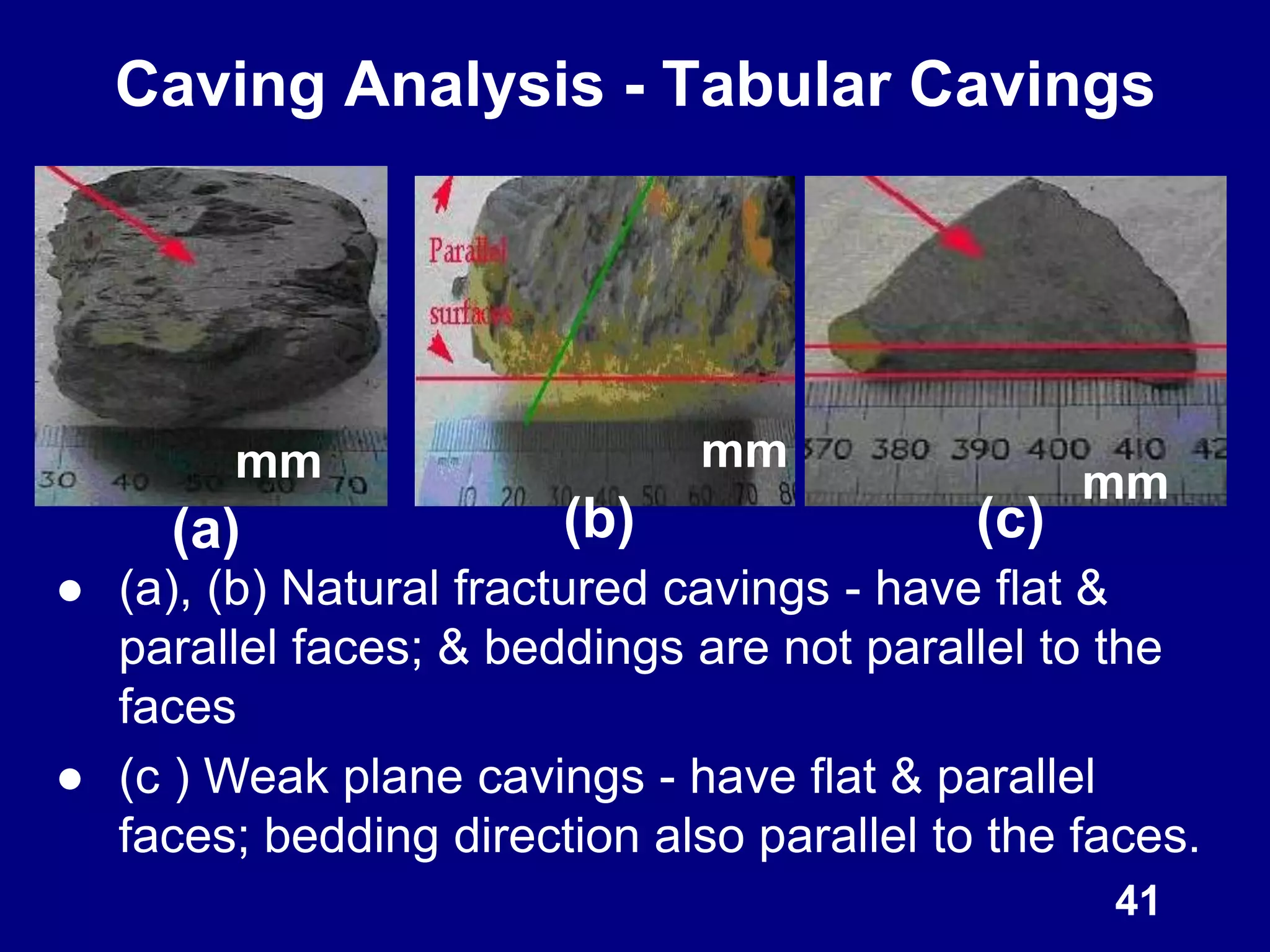
Caving Analysis - Tabular Cavings
● (a), (b) Natural fractured cavings - have flat &
parallel faces; & beddings are not parallel to the
faces
● (c ) Weak plane cavings - have flat & parallel
faces; bedding direction also parallel to the faces.
41
(b)(a) (c)
mm mm
mm
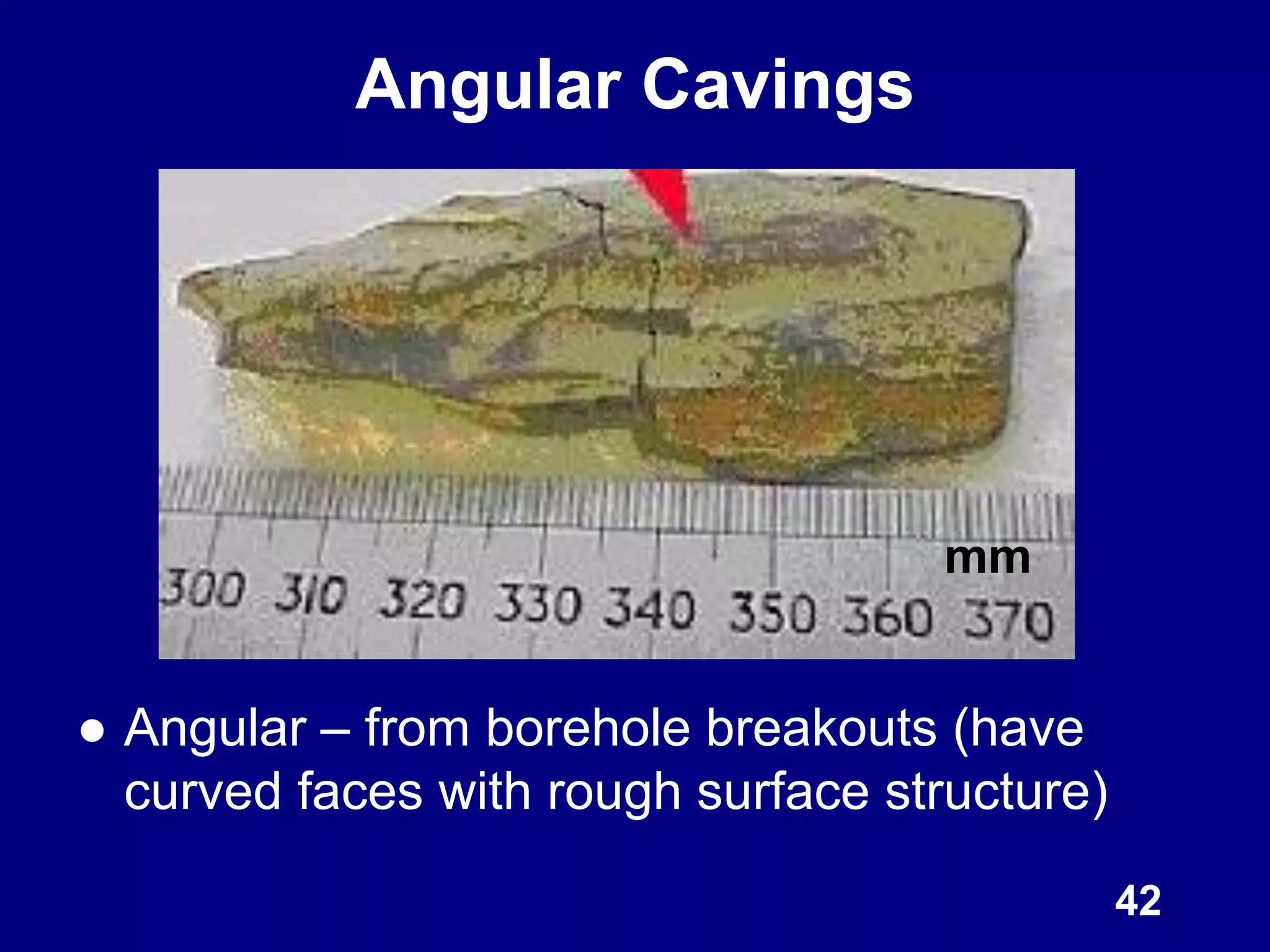
Angular Cavings
● Angular – from borehole breakouts (have
curved faces with rough surface structure)
42
mm
Splintered Caving
●From over-pressured zones (concave
flat, thin, & planar in structures)
43
Downhole & Surface Measurements
● Run tools to monitor annular
pressures (APWD), hole diameter
(caliper log), & downhole vibrations
to diagnose onset of a problem
● Control surface parameters (WOB,
RPM, flow rate, mud weight, &
rheology) to fix a failed or failing
wellbore.
44
Remedial Actions While
Drilling
45
Remedial Actions for Wellbore
Instability
● Depend on type of instability and its
severity
● Involve integration of the three
causes: mechanical, rock-chemical
interaction, & man-made instabilities
– May be problematic in some cases.
Why? Rocks are not identical
46
 ROP and hole cleaning efficiency.
– Continuously monitor cavings (analysis)
– Monitor hole cleaning & reduce ROP if
necessary
– Control surface parameters
 Improve drilling practices: trip wisely (1
stand/minute) & minimize wiper trips
 If everything fail, case the well ASAP
Remedial Actions for Wellbore
Instability
47
Wellbore Stability After
Drilling
48
● This is Post-Drilling Review. Involves
– Acquiring relevant geomechanical
data, analyzing same and updating
Mechanical Earth Model (MEM)
– Reviewing all drilling events leading
to wellbore instability
– Reviewing planned WS action with
actual performance, and analyze
differences
49
Wellbore Stability After Drilling
● Development of New Drilling
Fluid Systems
● Use of Annular Pressure While
Drilling Tools
● Use of Rotary Steerable Systems
● Monitoring of Downhole
Vibrations
50
New Developments for Solving
Wellbore Instability Problems
● Various synthetic water-based mud
are being developed – to match the
performance of oil-based mud
● Addition of coating/plugging materials
– Silicates
– Methyl Glycoside
– Mixed-Metal-Hydroxide (MMH)
51
Development of New Drilling Fluid
Systems
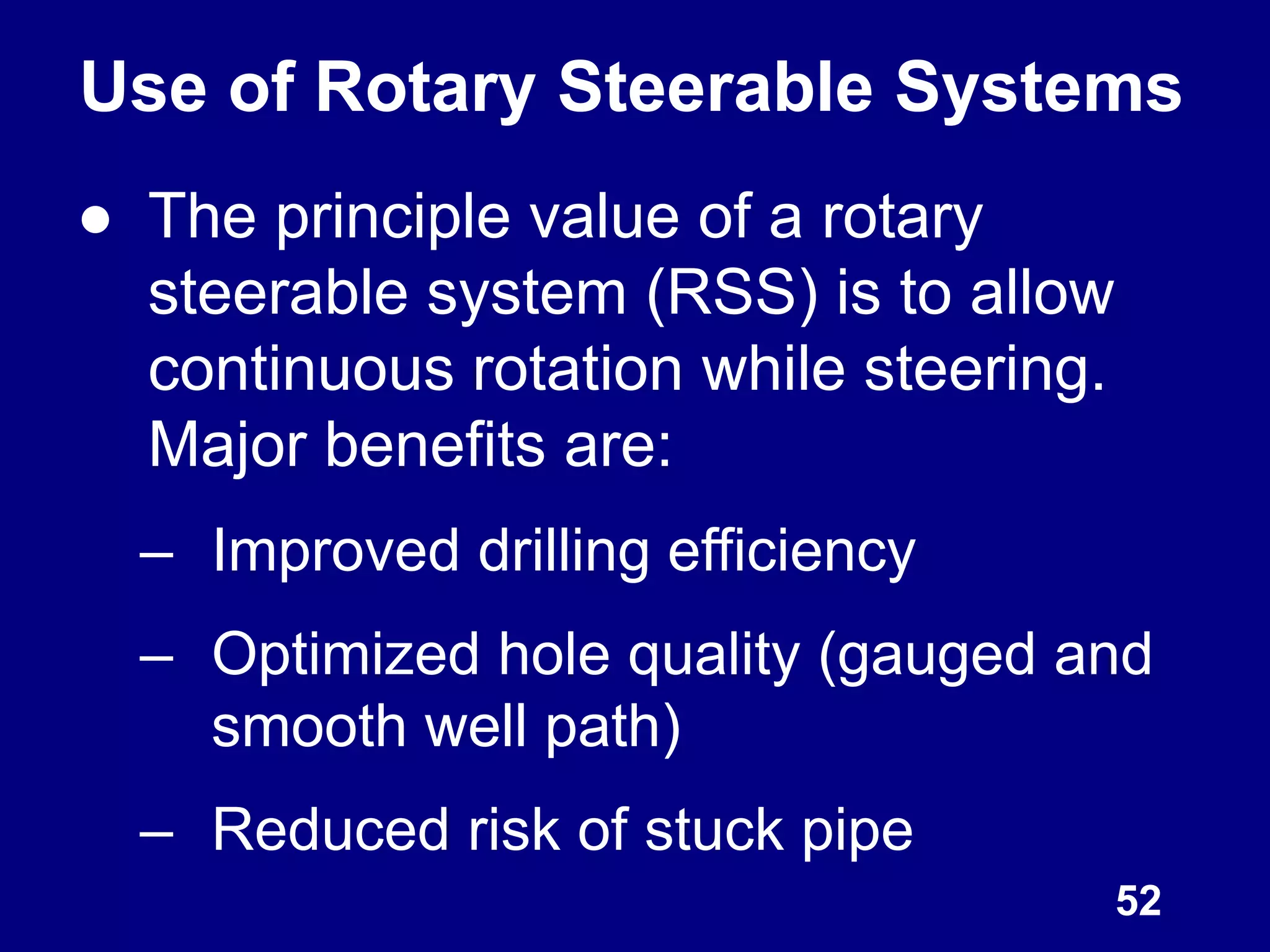
● The principle value of a rotary
steerable system (RSS) is to allow
continuous rotation while steering.
Major benefits are:
– Improved drilling efficiency
– Optimized hole quality (gauged and
smooth well path)
– Reduced risk of stuck pipe
52
Use of Rotary Steerable Systems
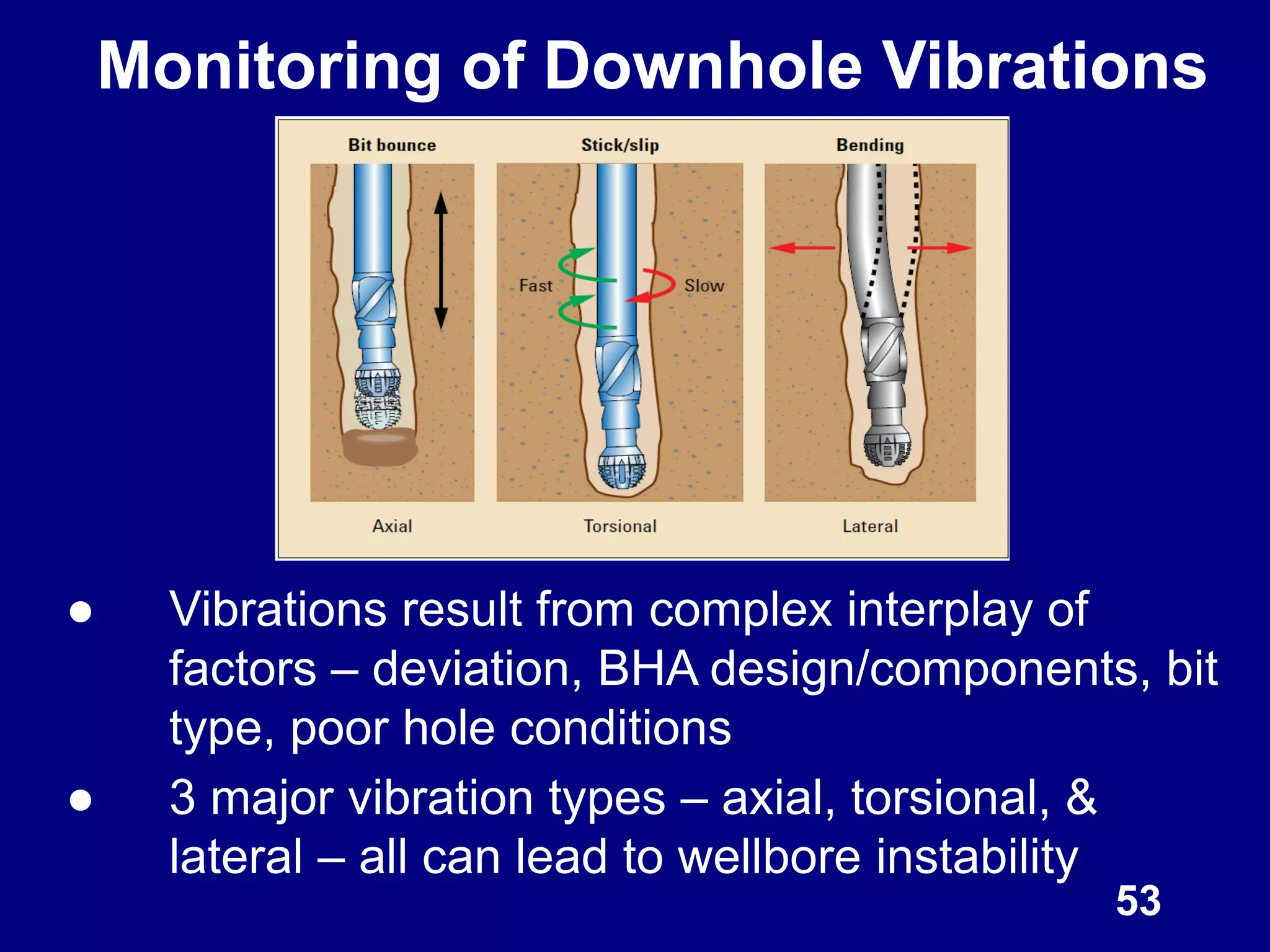
● Vibrations result from complex interplay of
factors – deviation, BHA design/components, bit
type, poor hole conditions
● 3 major vibration types – axial, torsional, &
lateral – all can lead to wellbore instability
53
Monitoring of Downhole Vibrations
54
Monitoring of Downhole Vibrations
Case Studies
55
56
Case Study - 1
● Location: Asabo Field, Nigeria
● Wellbore Instability Related Problems
– Stuck Pipe
– Excessive torque and drag
– Pack-offs
– Inability to log the well
57
Remedial Actions - Case Study 1
● Reduced pressure fluctuations (trip
wisely)
● Controlled mud weight
● Reduced drill string vibrations
● Excellent supervision – monitored
trend changes (torque, drag, fills
during trips, & volume of cuttings)
58
Case Study 2
● Location: Valhall Field , Norway
● Wellbore Instability Related
Problems
– Hole packed-offs
– Stuck pipe
– Tools lost in hole
– Sidetracking
– Inability to land casing
59
Remedial Actions - Case Study 2
● Used Integrated Approach
–Constructed geomechanical earth
model
–Monitored drilling data, acquired
more data, & updated model
–Interpreted observations
–Changed hole inclination and
azimuth
Summary and Conclusions
60
Remember!
Although we can’t control what the
drillers do, we can influence them
and gain credibility with them by
understanding their problems,
speaking their language, and letting
them understand the consequences
of their actions.
61
Summary
● Combined analysis (integrated
approach) of wellbore stresses,
mud chemistry, and excellent
drilling practices is the key to
minimizing wellbore instability
● With adequate planning and
supervision the problems can be
solved if not totally eliminated.
62
63
Summary
 Total prevention of wellbore instability is unrealistic.
 Wellbore wants to collapse
 Three main causes of wellbore instability:
Mechanical; Chemical; Drilling Practices
 Prevent pressure surges/swabs
 Maintain correct mud weight (Increase mud weight at
higher hole angles)
 Minimize time hole is open
 Maintain good mud inhibition
 Warning signs: Torque & drag increase; Ledges; Bit
balling; Soft cuttings; More caving; Increased mud
viscosity and low gravity solids
Conclusions
Before Drilling
1. Mechanical Earth Model must be utilized to
predict wellbore instability problems in an
upcoming well.
2. We must anticipate remedial actions to be used,
which depend on type of instability and its
severity
While Drilling
3. We must employ the best drilling practices (e.g.
reduction of surge/swab pressures and drillstring
vibrations) as well as excellent mud chemistry
64
Conclusions
While Drilling
4. ROP and hole cleaning efficiency form the key
links between wellbore instability and
operations. Hence, we must optimize hole
cleaning and minimize open hole time
5. Must perform continuous caving analysis and
control surface parameters
After Drilling
6. Perform Post-Drilling Review – collect data and
update MEM); detail wellbore instability events
Key words – Planning, Teamwork & Excellent
Drilling Practices/Supervision 65
I would like to thanks to the following:
● SPE Distinguished Lecturer Program
Committee Members for this
opportunity and my many mentors
over the years
● Mewbourne School of Petroleum and
Geological Engineering, The
University of Oklahoma for
permission to take part in this
important event
66

Caving Remedies

  • 1.
    Primary funding isprovided by The SPE Foundation through member donations and a contribution from Offshore Europe The Society is grateful to those companies that allow their professionals to serve as lecturers Additional support provided by American Institute for Mechanical Engineers (AIME) Society of Petroleum Engineers Distinguished Lecturer Program www.spe.org/dl 1
  • 2.
    This program year(2011-2012) marks the 50th anniversary of the SPE Distinguished Lecturer program. Please visit our site to learn more about this amazing program. www.spe.org/go/DL50 2
  • 3.
    Practical Approach toSolving Wellbore Instability Problems Samuel O. Osisanya, Ph.D.; P.E. Professor Mewbourne School of Petroleum and Geol. Engineering The University of Oklahoma Norman, OK, USA sosisanya@ou.edu Society of Petroleum Engineers Distinguished Lecturer Program www.spe.org/dl 3
  • 4.
    Outline ● Introduction &Objectives ● Causes of Wellbore Instability ● Wellbore Stability (WS) – Before Drilling; While Drilling; & After Drilling ● Symptoms, Prevention & Remedial Actions ● Case Studies ● Summary & Conclusions 4
  • 5.
  • 6.
    Introduction ● Wellbore instability(WI) is recognized when the hole diameter is markedly different from the bit size and the hole does not maintain its structural integrity. Overgauged or undergauged hole  WI 6
  • 7.
    Why Wellbore Instability? SIMILARTO CORROSION● We caused it. How? The creation of a circular hole into an otherwise stable formation. ● Hole tends to collapse or fracture unless supported ● Some rocks are very strong and will support themselves better than weaker rocks. 7
  • 8.
    Introduction (cont’d) ● Somephenomena that cause wellbore instability are: – Removal of the confinement condition – Creation of stress concentration field around the wellbore – Inelastic and time-dependent displacement of the wellbore caused by the creation of free surface  Bottom line: Forces acting in the formation push the wall of the hole inward. If not stabilized with mud weight, the hole will collapse 8
  • 9.
    Consequences of WellboreInstability ● These are: – At least reduced drilling performance and/or stuck BHA & downhole tools  fishing – Loss of equipment and sidetracking – Excessive trip time and reaming time – Poor hole logging; inability to land casing; and poor cementing conditions/jobs – At worst it can lead to total collapse and loss of the hole ● Bottom Line: increase in non-productive time and increase in total drilling cost. 9
  • 10.
    Objectives 1. To describecauses of wellbore instability problems 2. To describe wellbore stability before, during, and after drilling wells 3. To describe symptoms of the problems while drilling 4. To discuss practical, preventive, and remedial actions for wellbore instability 10
  • 11.
    Causes of WellboreInstability 11
  • 12.
    Causes of WellboreInstability 1. Mechanical 2. Rock-Chemical Interaction (Shale) 3. Man-Made (Drilling Practices) Grouped under three interrelated headings Causes–due to uncontrollable or controllable factors. Understanding these causes is important in maintaining & controlling wellbore stability 12
  • 13.
    1. Mechanical WellboreInstability ● Key parameters are: 1. Rock Stresses/Rock Types 2. Rock Strength (weaken) 3. Wellbore Geometry (Hole Inclination & Azimuth) 4. Man-Made Related Stresses ● First two are uncontrollable and the last two are controllable 13
  • 14.
    Mechanical Wellbore Instability ●Mechanical failure occurs when wellbore stress concentrations exceed the rock strength ● Wellbore stress concentrations result from – Drilling into pre-stressed rock (earth stresses) – Excessive wellbore pressures – Drillstring vibrations 14
  • 15.
    Wellbore Stresses AfterDrilling ● Drilled wellbore results in a ‘new’ set of stresses known as wellbore stresses – axial, tangential, and radial (mud hydraulic pressure) ● If the redistributed stress-state exceeds rock strength, instability may result. 15  Before drilling, the rock is in a state of equilibrium
  • 16.
    Mechanical Wellbore Instability- Borehole Stress Orientation Figure shows results of a hollow cylinder lab test simulating borehole breakout (2 unequal horizontal stresses) - CSIRO Division of Geomechanics (J. Reinecker et al., 2003) 16 H H h h Schematic of Photograph
  • 17.
    ● Sedimentary rocksin general are shales (75%) and in particular they are sensitive to their chemical environment. ● Reaction between the shale and drilling fluid causes the shale to swell, weaken, and eventually fall/collapse into the wellbore. ● Solution is to have a drilling fluid system that balances the mechanical and chemical forces. ● Also use drilling practices that minimize shale or formation instability. 17 2. Rock-Chemical Interaction (Shale) Instability
  • 18.
    Shale Instability  Causesare twofold: 1. Time-dependent swelling of shale formation 2. Shale swells, weaken, and eventually fall/collapse into the wellbore.  The figure shows shale adsorbing fluid filtrate  shale swelling & other problems. 18
  • 19.
    Shale Hydration Mechanism 19 ●Forces holding plates together: Overburden & Cementation ● Forces pushing plates apart: Pore Pressure & Hydration Stress (can be up to 80,000 psi = 5700 atm.) ● Shale types: smectite (worst), illite, kaolinite, chlorite, & mixed layers
  • 20.
    Symptoms of ShaleHydration Gumbo (soft) shale 20 Bit & stabilizer balling Others: clay balls on the flow line; tight hole when tripping & problems logging
  • 21.
    Symptoms of WellboreInstability  Tight hole, drag while tripping, logging problems & stuck pipe  Solutions: Raise mud weight, alter mud chemistry or change mud type, run casing ASAP 21
  • 22.
    Plastic Deformation andCreep 22 Common with shale and salt formations due to reaction with water/stress change
  • 23.
    MUD HYDROSTATIC FORCES AREUSED TO PREVENT FORMATION COLLAPSE Mud Hydrostatic Pressure 23
  • 24.
    ● Lack ofadequate well planning – Selection of wrong inclination & azimuth – Selection of wrong drilling fluid system ● Improper (poor) drilling practices – Excessive wellbore stresses – Poor hole cleaning – Excessive drillstring vibrations 3. Man-Made Wellbore Instability 24
  • 25.
    Wellbore Stability (WS) BeforeDrilling (Planning) 25
  • 26.
    Wellbore Stability (WS)Before Drilling (Planning) ● Involves: geo-mechanics and drilling fluid selection – A comprehensive GeoMechanics study is essential in order to understand causes of wellbore instability and to improve drilling design and drilling performance. • Extremely important for horizontal & extended reach wells. – An extensive shale inhibition testing program is also essential. 26
  • 27.
    Wellbore Stability (WS)Before Drilling (Planning) ● Steps for GeoMechanics study are: – To acquire, audit & perform quality control of geomechanical data (e.g. wireline logs) – To build Mechanical Earth Model (MEM) – To perform WS analysis of the planned well including trajectory sensitivity analysis – To review wellbore instability drilling events from offset wells – To forecast wellbore stability 27
  • 28.
    Wellbore Stability BeforeDrilling (Planning) ● Geo-Mechanical Earth Model – Integrate all geo-mechanical data available from a field/basin into one “database” – Use model to predict wellbore instability problems in an upcoming well – Model outputs – (1) safe mud weight window and (2) safest inclination & azimuth to drill. 28
  • 29.
    Mud Weight Window 29 While drilling some rock types try to collapse & some are easily fractured. This can cause problems in deciding on correct mud weight (MW). Too high a MW may fracture a sand or limestone but too low a MW may cause some shales or salts to squeeze into the hole.  The difference between a min. and max. weight is called the ‘mud weight window’. The wider the window, the easier it is to drill the well.
  • 30.
    Shale Inhibition TestMethods ● Wellbore Simulators - swelling stress/strain tests under HTHP (lab) – to model fluid flow in shale (shale permeability) ● Cuttings Dispersion - evaluation of mud type (lab & rig site) ● Cation Exchange Capacity (aka MBT) – use to determine shale type 30
  • 31.
    Wellbore Instability While Drilling– Improper Drilling Practices 31
  • 32.
    Excessive Wellbore Stresses ●Causes – Surge/swab pressures cause the wall to weaken – Poor hole cleaning  cutting accumulation  high equivalent circulating density (ECD) – Excessive drill string vibrations 32
  • 33.
    RUNNING IN PULLING OUT INCREASED PRESSURE DECREASED PRESSURE PRESSURESURGES DUE TO TRIPPING CAN CREATE CYCLES OF STRESS THAT GRADUALLY WEAKEN THE HOLE WALL Excessive Wellbore Stresses 33 ALSO ECD SURGES WHEN SWITHCHING PUMPS ON AND OFF WILL CREATE PRESSURE SURGES SURGE SWAB
  • 34.
    34 Symptoms of ExcessiveStresses • Large amounts of blocky cavings on shale shaker; more after wiper trip; borehole failure due to stress changes in massive shales • Hole enlargement • Erratic directional control
  • 35.
    Symptoms of WellboreInstability ● Lots of cuttings on the surface. ● Borehole failure due to stress changes in massive shales ● Solution: One solution is to raise mud weight 35
  • 36.
    Pore Pressure Penetration ●Causes: ● Poor hole cleaning ● Localized elevated pore pressure ● Symptoms ● Tensile cavings ● More cavings after trips 36
  • 37.
    Instability in FracturedRocks 37 ● Causes: – Time-dependent mud penetration into fractures – Stress changes  weaken formation ● Symptoms – High levels of angular cavings – More cavings after wiper trips
  • 38.
    Instability Due toErosion ● Causes: Erosion occurs mostly at the bit & hole wall due to: – Excessive circulation rate – Common in weaken and unconsolidated formations ● Symptoms: – Over-gauged hole – Erratic directional control 38 ANNULAR VELOCITY CAN CAUSE EROSION
  • 39.
    Wellbore Stability WhileDrilling ● Involves real time WS management (control): This is a 2-fold process: 1. Continuous monitoring – caving analysis, downhole measurements (MWD and LWD) and surface signatures to diagnose onset of a problem 2. Remedial actions – involve control of surface parameters such as WOB, mud weight, flow rate, etc. 39
  • 40.
    Wellbore Stability WhileDrilling ● Caving Analysis: A key parameter to managing wellbore instability in real time; provides an early warning of wellbore instability – Monitor caving rate – Perform caving morphology 1. Types of cavings: Tabular, Angular, or Splintered 40
  • 41.
    Caving Analysis -Tabular Cavings ● (a), (b) Natural fractured cavings - have flat & parallel faces; & beddings are not parallel to the faces ● (c ) Weak plane cavings - have flat & parallel faces; bedding direction also parallel to the faces. 41 (b)(a) (c) mm mm mm
  • 42.
    Angular Cavings ● Angular– from borehole breakouts (have curved faces with rough surface structure) 42 mm
  • 43.
    Splintered Caving ●From over-pressuredzones (concave flat, thin, & planar in structures) 43
  • 44.
    Downhole & SurfaceMeasurements ● Run tools to monitor annular pressures (APWD), hole diameter (caliper log), & downhole vibrations to diagnose onset of a problem ● Control surface parameters (WOB, RPM, flow rate, mud weight, & rheology) to fix a failed or failing wellbore. 44
  • 45.
  • 46.
    Remedial Actions forWellbore Instability ● Depend on type of instability and its severity ● Involve integration of the three causes: mechanical, rock-chemical interaction, & man-made instabilities – May be problematic in some cases. Why? Rocks are not identical 46
  • 47.
     ROP andhole cleaning efficiency. – Continuously monitor cavings (analysis) – Monitor hole cleaning & reduce ROP if necessary – Control surface parameters  Improve drilling practices: trip wisely (1 stand/minute) & minimize wiper trips  If everything fail, case the well ASAP Remedial Actions for Wellbore Instability 47
  • 48.
  • 49.
    ● This isPost-Drilling Review. Involves – Acquiring relevant geomechanical data, analyzing same and updating Mechanical Earth Model (MEM) – Reviewing all drilling events leading to wellbore instability – Reviewing planned WS action with actual performance, and analyze differences 49 Wellbore Stability After Drilling
  • 50.
    ● Development ofNew Drilling Fluid Systems ● Use of Annular Pressure While Drilling Tools ● Use of Rotary Steerable Systems ● Monitoring of Downhole Vibrations 50 New Developments for Solving Wellbore Instability Problems
  • 51.
    ● Various syntheticwater-based mud are being developed – to match the performance of oil-based mud ● Addition of coating/plugging materials – Silicates – Methyl Glycoside – Mixed-Metal-Hydroxide (MMH) 51 Development of New Drilling Fluid Systems
  • 52.
    ● The principlevalue of a rotary steerable system (RSS) is to allow continuous rotation while steering. Major benefits are: – Improved drilling efficiency – Optimized hole quality (gauged and smooth well path) – Reduced risk of stuck pipe 52 Use of Rotary Steerable Systems
  • 53.
    ● Vibrations resultfrom complex interplay of factors – deviation, BHA design/components, bit type, poor hole conditions ● 3 major vibration types – axial, torsional, & lateral – all can lead to wellbore instability 53 Monitoring of Downhole Vibrations
  • 54.
  • 55.
  • 56.
    56 Case Study -1 ● Location: Asabo Field, Nigeria ● Wellbore Instability Related Problems – Stuck Pipe – Excessive torque and drag – Pack-offs – Inability to log the well
  • 57.
    57 Remedial Actions -Case Study 1 ● Reduced pressure fluctuations (trip wisely) ● Controlled mud weight ● Reduced drill string vibrations ● Excellent supervision – monitored trend changes (torque, drag, fills during trips, & volume of cuttings)
  • 58.
    58 Case Study 2 ●Location: Valhall Field , Norway ● Wellbore Instability Related Problems – Hole packed-offs – Stuck pipe – Tools lost in hole – Sidetracking – Inability to land casing
  • 59.
    59 Remedial Actions -Case Study 2 ● Used Integrated Approach –Constructed geomechanical earth model –Monitored drilling data, acquired more data, & updated model –Interpreted observations –Changed hole inclination and azimuth
  • 60.
  • 61.
    Remember! Although we can’tcontrol what the drillers do, we can influence them and gain credibility with them by understanding their problems, speaking their language, and letting them understand the consequences of their actions. 61
  • 62.
    Summary ● Combined analysis(integrated approach) of wellbore stresses, mud chemistry, and excellent drilling practices is the key to minimizing wellbore instability ● With adequate planning and supervision the problems can be solved if not totally eliminated. 62
  • 63.
    63 Summary  Total preventionof wellbore instability is unrealistic.  Wellbore wants to collapse  Three main causes of wellbore instability: Mechanical; Chemical; Drilling Practices  Prevent pressure surges/swabs  Maintain correct mud weight (Increase mud weight at higher hole angles)  Minimize time hole is open  Maintain good mud inhibition  Warning signs: Torque & drag increase; Ledges; Bit balling; Soft cuttings; More caving; Increased mud viscosity and low gravity solids
  • 64.
    Conclusions Before Drilling 1. MechanicalEarth Model must be utilized to predict wellbore instability problems in an upcoming well. 2. We must anticipate remedial actions to be used, which depend on type of instability and its severity While Drilling 3. We must employ the best drilling practices (e.g. reduction of surge/swab pressures and drillstring vibrations) as well as excellent mud chemistry 64
  • 65.
    Conclusions While Drilling 4. ROPand hole cleaning efficiency form the key links between wellbore instability and operations. Hence, we must optimize hole cleaning and minimize open hole time 5. Must perform continuous caving analysis and control surface parameters After Drilling 6. Perform Post-Drilling Review – collect data and update MEM); detail wellbore instability events Key words – Planning, Teamwork & Excellent Drilling Practices/Supervision 65
  • 66.
    I would liketo thanks to the following: ● SPE Distinguished Lecturer Program Committee Members for this opportunity and my many mentors over the years ● Mewbourne School of Petroleum and Geological Engineering, The University of Oklahoma for permission to take part in this important event 66