Problem-based Learning   &  R esource-based Learning two complementary approaches ? Drs. W.W.R. te Winkel Dr.  R.M.P.J. Rikers Prof. Dr. H. G. Schmidt
Instructional Design Design-focus ( prescriptive ) on improving Education & Instruction aided by Cognitive Psychological findings on Memory and Learning Integrated Thematic Instruction : From Brain Research to Application Toward the Development of  Flexibly Adaptive Instructional Design Systematically Using Powerful Learning Environments to  Accelerate the Learning of    Disadvantaged Sudents  in Grades 4-8 Landamatics Instructional-Design Theory for  Teaching General Methods of Thinking The Elaboration Theory: Guidance for  Scope and Sequence Decisions Designing a  Student Activating, Constructivistic e-Learning Environment  (PsyWeb)
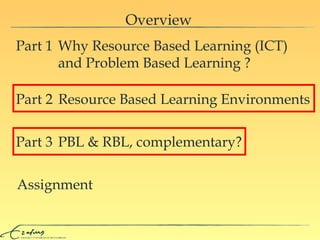
Overview Assignment Why  Resource Based Learning ( I C T )     and Problem Based Learning  ? Part 1 Resource Based Learning Environments Part 2 PBL & RBL, complementary? Part 3
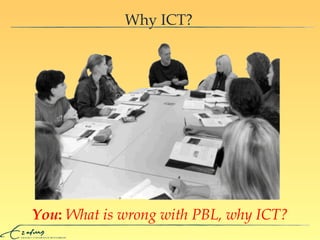
Why ICT? You :   What is wrong with PBL, why ICT?
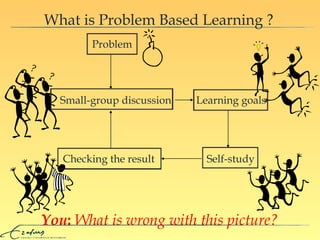
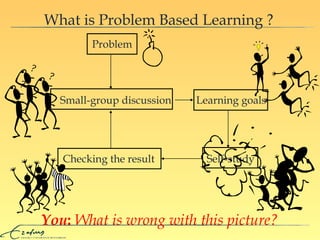
What is Problem Based Learning ? Problem Small-group discussion Learning goals Checking the result Self-study You :   What is wrong with this picture?
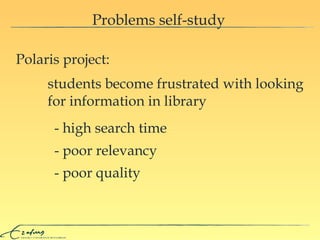
Polaris project:  Problems self-study - high search time - poor relevancy - poor quality students become frustrated with looking for information in library
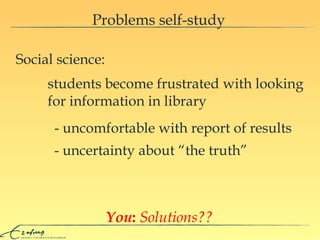
Problems self-study - uncomfortable with report of results - uncertainty about “the truth” Social science:  students become frustrated with looking for information in library You :   Solutions??
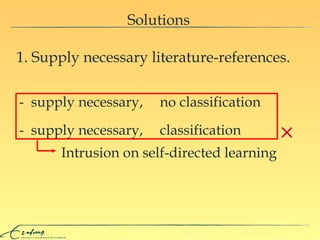
Solutions 1. Supply necessary literature-references. -  supply necessary,  no classification -  supply necessary,  classification Intrusion on self-directed learning
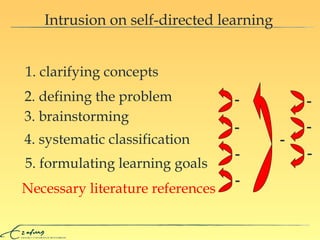
1. clarifying concepts Intrusion on self-directed learning Necessary literature references 2. defining the problem 3. brainstorming 4. systematic classification 5. formulating learning goals - - - - - - - -
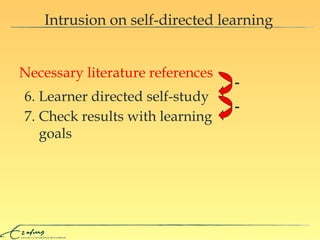
6. Learner directed self-study 7. Check results with learning goals Intrusion on self-directed learning Necessary literature references - -
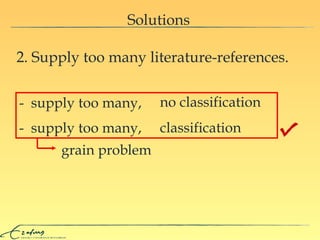
Solutions 2. Supply too many literature-references. -  supply too many,   no classification -  supply too many,  classification grain problem
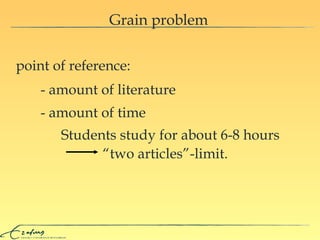
Grain problem point of reference: - amount of literature - amount of time Students study for about 6-8 hours “ two articles”-limit.
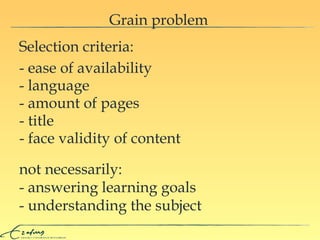
Grain problem Selection criteria:  not necessarily: - answering learning goals - understanding the subject - language - amount of pages - title - face validity of content - ease of availability
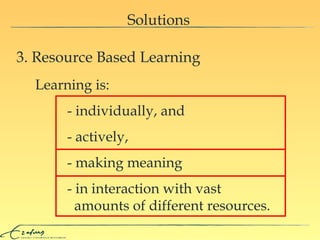
Solutions 3. Resource Based Learning Learning is: - individually, and - actively,  - making meaning - in interaction with vast    amounts of different resources.
Promises of RBL - individual learner has full ownership - better criteria for selecting relevant info - direct availability of vast amounts of info - learning goals are decisive
Threats of RBL RBL without support (i.e., internet):  - “information gaze” - “butterfly defect”  (Salomon, 1998) - less learner directedness  information search  information discovery
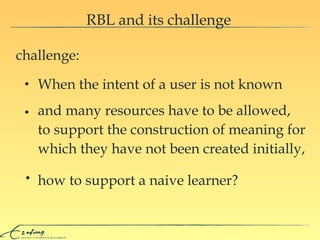
RBL and its challenge challenge: and many resources have to be allowed,  to support the construction of meaning for which they have not been created initially, how to support a naive learner? When the intent of a user is not known You :   how to support a naive learner?
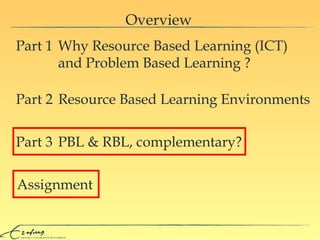
Overview Assignment Why  Resource Based Learning ( I C T )     and Problem Based Learning  ? Part 1 Resource Based Learning Environments Part 2 PBL & RBL, complementary? Part 3
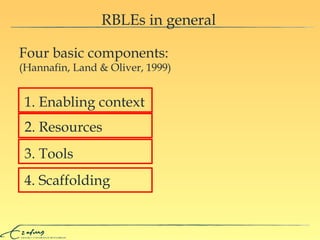
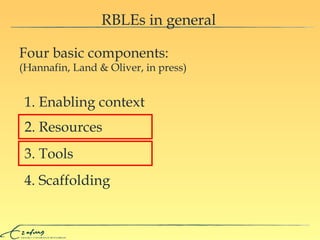
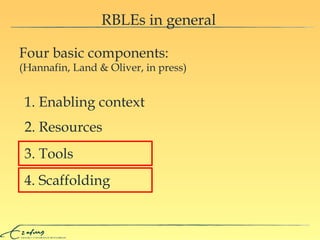
RBLEs in general Four basic components:  (Hannafin, Land & Oliver,  1999 ) 1. Enabling context 2. Resources 3. Tools 4. Scaffolding
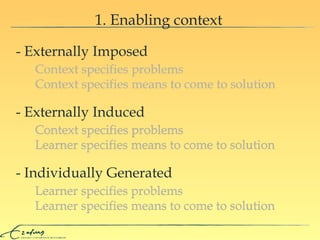
1. Enabling context Context specifies problems Context specifies means to come to solution Learner specifies problems Learner specifies means to come to solution - Externally Imposed - Externally Induced - Individually Generated Context specifies problems Learner specifies means to come to solution Context specifies problems Context specifies means to come to solution Learner specifies problems Learner specifies means to come to solution Context specifies problems Learner specifies means to come to solution
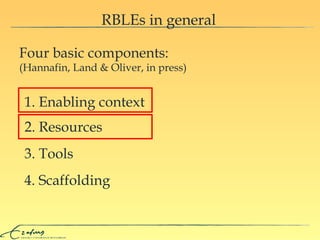
RBLEs in general Four basic components:  (Hannafin, Land & Oliver, in press) 1. Enabling context 2. Resources 3. Tools 4. Scaffolding
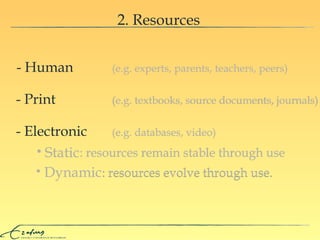
2. Resources (e.g. experts, parents, teachers, peers) Static  : resources remain stable through use Dynamic  : resources evolve through use. (e.g. textbooks, source documents, journals) (e.g. experts, parents, teachers, peers) - Human - Print - Electronic (e.g. databases, video)   (e.g. textbooks, source documents, journals) Dynamic   : resources evolve through use. (e.g. databases, video) Static  : resources remain stable through use
RBLEs in general Four basic components:  (Hannafin, Land & Oliver, in press) 1. Enabling context 2. Resources 3. Tools 4. Scaffolding
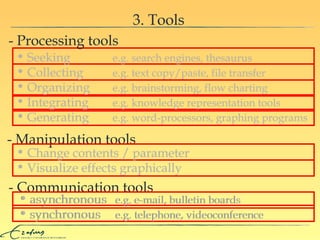
3. Tools Seeking e.g. search engines, thesaurus Collecting e.g. text copy/paste, file transfer Organizing e.g. brainstorming, flow charting Integrating e.g. knowledge representation tools Generating e.g. word-processors, graphing programs asynchronous e.g. e-mail, bulletin boards synchronous e.g. telephone, videoconference Seeking e.g. search engines, thesaurus Collecting e.g. text copy/paste, file transfer Organizing e.g. brainstorming, flow charting Integrating e.g. knowledge representation tools Generating e.g. word-processors, graphing programs Change contents / parameter Visualize effects graphically - Processing tools - Manipulation tools - Communication tools Change contents / parameter Visualize effects graphically asynchronous e.g. e-mail, bulletin boards synchronous e.g. telephone, videoconference
RBLEs in general Four basic components:  (Hannafin, Land & Oliver, in press) 1. Enabling context 2. Resources 3. Tools 4. Scaffolding
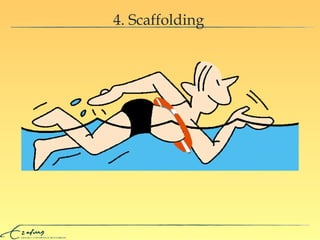
4. Scaffolding
4. Scaffolding
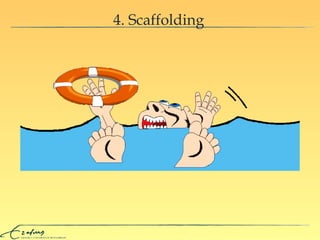
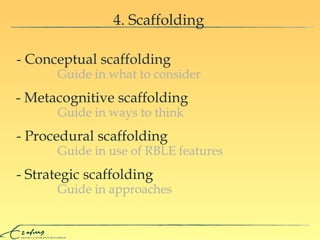
4. Scaffolding Guide in what to consider Guide in approaches - Conceptual scaffolding - Metacognitive scaffolding - Procedural scaffolding - Strategic scaffolding Guide in ways to think Guide in what to consider Guide in use of RBLE features Guide in ways to think Guide in approaches Guide in use of RBLE features
Overview Assignment Why  Resource Based Learning ( I C T )     and Problem Based Learning  ? Part 1 Resource Based Learning Environments Part 2 PBL & RBL, complementary? Part 3
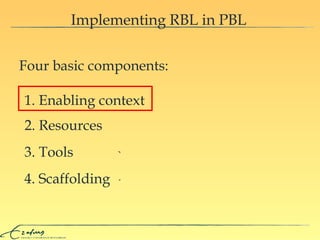
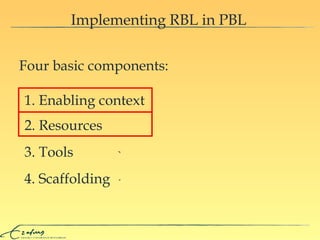
Implementing RBL in PBL Four basic components:  1. Enabling context 2. Resources 3. Tools 4. Scaffolding }
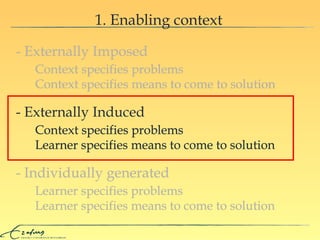
1. Enabling context - Externally Imposed Context specifies problems Context specifies means to come to solution - Externally Induced Context specifies problems Learner specifies means to come to solution - Individually generated Learner specifies problems Learner specifies means to come to solution Context specifies problems Learner specifies means to come to solution Context specifies problems Learner specifies means to come to solution Context specifies problems Context specifies means to come to solution Learner specifies problems Learner specifies means to come to solution - Externally Imposed - Individually generated
Implementing RBL in PBL Four basic components:  1. Enabling context 2. Resources 3. Tools 4. Scaffolding }
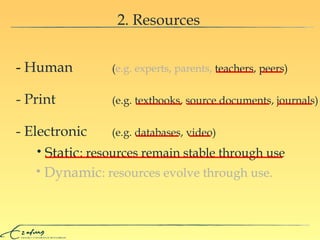
2. Resources - Electronic (e.g. databases, video) - Print (e.g. textbooks, source documents, journals) - Human (e.g. experts, parents, teachers, peers) Static  : resources remain stable through use Dynamic  : resources evolve through use. -  Human ( e.g. experts, parents,  teachers, peers) Dynamic  : resources evolve through use.
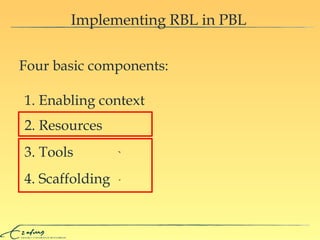
Implementing RBL in PBL Four basic components:  1. Enabling context 2. Resources 3. Tools 4. Scaffolding }
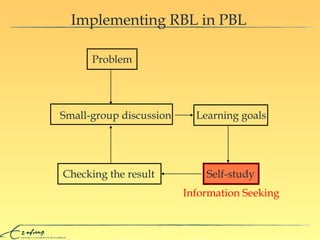
Problem Small-group discussion Learning goals Checking the result Self-study Implementing RBL in PBL Information Seeking
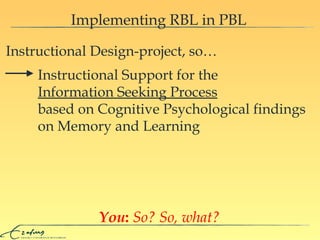
Implementing RBL in PBL Instructional Design-project, so… You :   So? So, what? Instructional Support for the  Information  S eeking  P rocess based on Cognitive Psychological findings on Memory and Learning
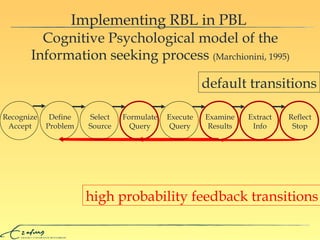
Implementing RBL in PBL high probability feedback transitions Cognitive Psychological model of the Information seeking process  (Marchionini, 1995) default transitions Recognize Accept Define Problem Select Source Formulate Query Execute Query Examine Results Extract Info Reflect Stop
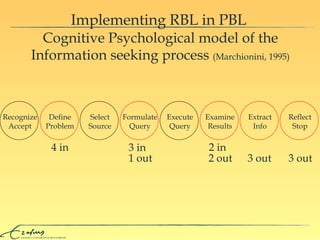
Implementing RBL in PBL Recognize Accept Define Problem Select Source Formulate Query Execute Query Examine Results Extract Info Reflect Stop 4 in 3 in 2 in 2 out 1 out 3 out 3 out Cognitive Psychological model of the Information seeking process  (Marchionini, 1995)
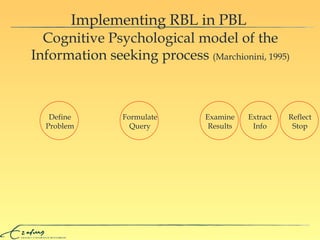
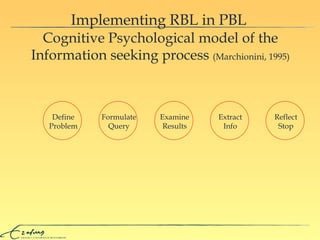
Implementing RBL in PBL Define Problem Formulate Query Examine Results Extract Info Reflect Stop Cognitive Psychological model of the Information seeking process  (Marchionini, 1995)
Implementing RBL in PBL Reflect Stop Cognitive Psychological model of the Information seeking process  (Marchionini, 1995) Define Problem Formulate Query Examine Results Extract Info
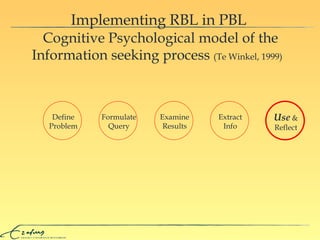
Implementing RBL in PBL Cognitive Psychological model of the Information seeking process  ( Te Winkel , 199 9 )   Define Problem Formulate Query Examine Results Extract Info Use  & Reflect
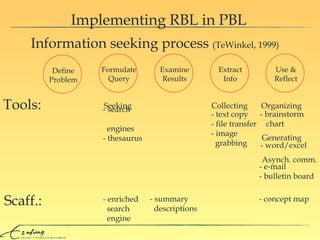
Implementing RBL in PBL Information seeking process  (TeWinkel, 1999) - search  engines - thesaurus - text copy - file transfer - image  grabbing  Seeking Collecting Organizing Tools: Generating - summary  descriptions Scaff.: - brainstorm chart - word/excel Asynch. comm. - e-mail - bulletin board - enriched search  engine - concept map Define Problem Formulate Query Examine Results Extract Info Use & Reflect
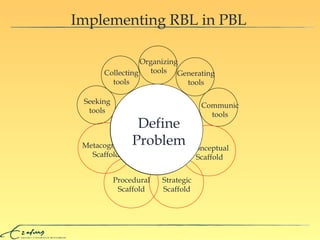
Implementing RBL in PBL Define Problem Collecting tools Organizing tools Seeking tools Generating tools Communic tools Metacognitive Scaffold Procedural Scaffold Strategic Scaffold Conceptual Scaffold Define Problem
RBL and its challenge challenge: and many resources have to be allowed,  to support the construction of meaning for which they have not been created initially, how to support a naive learner? When the intent of a user is not known
Overview Assignment Why  Resource Based Learning ( I C T )     and Problem Based Learning  ? Part 1 Resource Based Learning Environments Part 2 PBL & RBL, complementary? Part 3
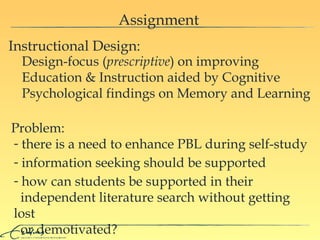
Assignment Instructional Design:  Design-focus ( prescriptive ) on improving Education & Instruction aided by Cognitive Psychological findings on Memory and Learning Problem:  there is a need to enhance PBL during self-study information seeking should be supported how  can  students  be supported in their    independent literature search  without getting lost    or demotivated ?
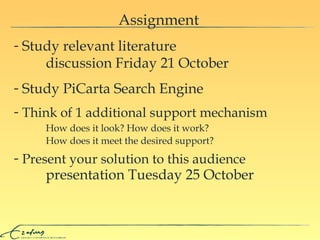
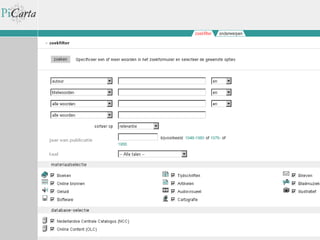
Assignment Study relevant literature  discussion Friday 21 October Study PiCarta Search Engine Think of   1  additional support mechanism Present your solution to this audience presentation Tuesday 25 October H ow does it look ?   H ow does it work ?   H ow does it meet the desired support ?
Questions
Assignment

Problem-based Learning & Resource-based Learning two complementary approaches?

  • 1.
    Problem-based Learning & R esource-based Learning two complementary approaches ? Drs. W.W.R. te Winkel Dr. R.M.P.J. Rikers Prof. Dr. H. G. Schmidt
  • 2.
    Instructional Design Design-focus( prescriptive ) on improving Education & Instruction aided by Cognitive Psychological findings on Memory and Learning Integrated Thematic Instruction : From Brain Research to Application Toward the Development of Flexibly Adaptive Instructional Design Systematically Using Powerful Learning Environments to Accelerate the Learning of Disadvantaged Sudents in Grades 4-8 Landamatics Instructional-Design Theory for Teaching General Methods of Thinking The Elaboration Theory: Guidance for Scope and Sequence Decisions Designing a Student Activating, Constructivistic e-Learning Environment (PsyWeb)
  • 3.
    Overview Assignment Why Resource Based Learning ( I C T ) and Problem Based Learning ? Part 1 Resource Based Learning Environments Part 2 PBL & RBL, complementary? Part 3
  • 4.
    Why ICT? You: What is wrong with PBL, why ICT?
  • 5.
    What is ProblemBased Learning ? Problem Small-group discussion Learning goals Checking the result Self-study You : What is wrong with this picture?
  • 6.
    What is ProblemBased Learning ? Problem Small-group discussion Learning goals Checking the result Self-study You : What is wrong with this picture?
  • 7.
    Polaris project: Problems self-study - high search time - poor relevancy - poor quality students become frustrated with looking for information in library
  • 8.
    Problems self-study -uncomfortable with report of results - uncertainty about “the truth” Social science: students become frustrated with looking for information in library You : Solutions??
  • 9.
    Solutions 1. Supplynecessary literature-references. - supply necessary, no classification - supply necessary, classification Intrusion on self-directed learning
  • 10.
    1. clarifying conceptsIntrusion on self-directed learning Necessary literature references 2. defining the problem 3. brainstorming 4. systematic classification 5. formulating learning goals - - - - - - - -
  • 11.
    6. Learner directedself-study 7. Check results with learning goals Intrusion on self-directed learning Necessary literature references - -
  • 12.
    Solutions 2. Supplytoo many literature-references. - supply too many, no classification - supply too many, classification grain problem
  • 13.
    Grain problem pointof reference: - amount of literature - amount of time Students study for about 6-8 hours “ two articles”-limit.
  • 14.
    Grain problem Selectioncriteria: not necessarily: - answering learning goals - understanding the subject - language - amount of pages - title - face validity of content - ease of availability
  • 15.
    Solutions 3. ResourceBased Learning Learning is: - individually, and - actively, - making meaning - in interaction with vast amounts of different resources.
  • 16.
    Promises of RBL- individual learner has full ownership - better criteria for selecting relevant info - direct availability of vast amounts of info - learning goals are decisive
  • 17.
    Threats of RBLRBL without support (i.e., internet): - “information gaze” - “butterfly defect” (Salomon, 1998) - less learner directedness information search information discovery
  • 18.
    RBL and itschallenge challenge: and many resources have to be allowed, to support the construction of meaning for which they have not been created initially, how to support a naive learner? When the intent of a user is not known You : how to support a naive learner?
  • 19.
    Overview Assignment Why Resource Based Learning ( I C T ) and Problem Based Learning ? Part 1 Resource Based Learning Environments Part 2 PBL & RBL, complementary? Part 3
  • 20.
    RBLEs in generalFour basic components: (Hannafin, Land & Oliver, 1999 ) 1. Enabling context 2. Resources 3. Tools 4. Scaffolding
  • 21.
    1. Enabling contextContext specifies problems Context specifies means to come to solution Learner specifies problems Learner specifies means to come to solution - Externally Imposed - Externally Induced - Individually Generated Context specifies problems Learner specifies means to come to solution Context specifies problems Context specifies means to come to solution Learner specifies problems Learner specifies means to come to solution Context specifies problems Learner specifies means to come to solution
  • 22.
    RBLEs in generalFour basic components: (Hannafin, Land & Oliver, in press) 1. Enabling context 2. Resources 3. Tools 4. Scaffolding
  • 23.
    2. Resources (e.g.experts, parents, teachers, peers) Static : resources remain stable through use Dynamic : resources evolve through use. (e.g. textbooks, source documents, journals) (e.g. experts, parents, teachers, peers) - Human - Print - Electronic (e.g. databases, video) (e.g. textbooks, source documents, journals) Dynamic : resources evolve through use. (e.g. databases, video) Static : resources remain stable through use
  • 24.
    RBLEs in generalFour basic components: (Hannafin, Land & Oliver, in press) 1. Enabling context 2. Resources 3. Tools 4. Scaffolding
  • 25.
    3. Tools Seekinge.g. search engines, thesaurus Collecting e.g. text copy/paste, file transfer Organizing e.g. brainstorming, flow charting Integrating e.g. knowledge representation tools Generating e.g. word-processors, graphing programs asynchronous e.g. e-mail, bulletin boards synchronous e.g. telephone, videoconference Seeking e.g. search engines, thesaurus Collecting e.g. text copy/paste, file transfer Organizing e.g. brainstorming, flow charting Integrating e.g. knowledge representation tools Generating e.g. word-processors, graphing programs Change contents / parameter Visualize effects graphically - Processing tools - Manipulation tools - Communication tools Change contents / parameter Visualize effects graphically asynchronous e.g. e-mail, bulletin boards synchronous e.g. telephone, videoconference
  • 26.
    RBLEs in generalFour basic components: (Hannafin, Land & Oliver, in press) 1. Enabling context 2. Resources 3. Tools 4. Scaffolding
  • 27.
  • 28.
  • 29.
    4. Scaffolding Guidein what to consider Guide in approaches - Conceptual scaffolding - Metacognitive scaffolding - Procedural scaffolding - Strategic scaffolding Guide in ways to think Guide in what to consider Guide in use of RBLE features Guide in ways to think Guide in approaches Guide in use of RBLE features
  • 30.
    Overview Assignment Why Resource Based Learning ( I C T ) and Problem Based Learning ? Part 1 Resource Based Learning Environments Part 2 PBL & RBL, complementary? Part 3
  • 31.
    Implementing RBL inPBL Four basic components: 1. Enabling context 2. Resources 3. Tools 4. Scaffolding }
  • 32.
    1. Enabling context- Externally Imposed Context specifies problems Context specifies means to come to solution - Externally Induced Context specifies problems Learner specifies means to come to solution - Individually generated Learner specifies problems Learner specifies means to come to solution Context specifies problems Learner specifies means to come to solution Context specifies problems Learner specifies means to come to solution Context specifies problems Context specifies means to come to solution Learner specifies problems Learner specifies means to come to solution - Externally Imposed - Individually generated
  • 33.
    Implementing RBL inPBL Four basic components: 1. Enabling context 2. Resources 3. Tools 4. Scaffolding }
  • 34.
    2. Resources -Electronic (e.g. databases, video) - Print (e.g. textbooks, source documents, journals) - Human (e.g. experts, parents, teachers, peers) Static : resources remain stable through use Dynamic : resources evolve through use. - Human ( e.g. experts, parents, teachers, peers) Dynamic : resources evolve through use.
  • 35.
    Implementing RBL inPBL Four basic components: 1. Enabling context 2. Resources 3. Tools 4. Scaffolding }
  • 36.
    Problem Small-group discussionLearning goals Checking the result Self-study Implementing RBL in PBL Information Seeking
  • 37.
    Implementing RBL inPBL Instructional Design-project, so… You : So? So, what? Instructional Support for the Information S eeking P rocess based on Cognitive Psychological findings on Memory and Learning
  • 38.
    Implementing RBL inPBL high probability feedback transitions Cognitive Psychological model of the Information seeking process (Marchionini, 1995) default transitions Recognize Accept Define Problem Select Source Formulate Query Execute Query Examine Results Extract Info Reflect Stop
  • 39.
    Implementing RBL inPBL Recognize Accept Define Problem Select Source Formulate Query Execute Query Examine Results Extract Info Reflect Stop 4 in 3 in 2 in 2 out 1 out 3 out 3 out Cognitive Psychological model of the Information seeking process (Marchionini, 1995)
  • 40.
    Implementing RBL inPBL Define Problem Formulate Query Examine Results Extract Info Reflect Stop Cognitive Psychological model of the Information seeking process (Marchionini, 1995)
  • 41.
    Implementing RBL inPBL Reflect Stop Cognitive Psychological model of the Information seeking process (Marchionini, 1995) Define Problem Formulate Query Examine Results Extract Info
  • 42.
    Implementing RBL inPBL Cognitive Psychological model of the Information seeking process ( Te Winkel , 199 9 ) Define Problem Formulate Query Examine Results Extract Info Use & Reflect
  • 43.
    Implementing RBL inPBL Information seeking process (TeWinkel, 1999) - search engines - thesaurus - text copy - file transfer - image grabbing Seeking Collecting Organizing Tools: Generating - summary descriptions Scaff.: - brainstorm chart - word/excel Asynch. comm. - e-mail - bulletin board - enriched search engine - concept map Define Problem Formulate Query Examine Results Extract Info Use & Reflect
  • 44.
    Implementing RBL inPBL Define Problem Collecting tools Organizing tools Seeking tools Generating tools Communic tools Metacognitive Scaffold Procedural Scaffold Strategic Scaffold Conceptual Scaffold Define Problem
  • 45.
    RBL and itschallenge challenge: and many resources have to be allowed, to support the construction of meaning for which they have not been created initially, how to support a naive learner? When the intent of a user is not known
  • 46.
    Overview Assignment Why Resource Based Learning ( I C T ) and Problem Based Learning ? Part 1 Resource Based Learning Environments Part 2 PBL & RBL, complementary? Part 3
  • 47.
    Assignment Instructional Design: Design-focus ( prescriptive ) on improving Education & Instruction aided by Cognitive Psychological findings on Memory and Learning Problem: there is a need to enhance PBL during self-study information seeking should be supported how can students be supported in their independent literature search without getting lost or demotivated ?
  • 48.
    Assignment Study relevantliterature discussion Friday 21 October Study PiCarta Search Engine Think of 1 additional support mechanism Present your solution to this audience presentation Tuesday 25 October H ow does it look ? H ow does it work ? H ow does it meet the desired support ?
  • 49.
  • 50.