PAARL Parallel Session-Workshops on Library and Web 2011, 
Holy Angel University, Pampanga, 19-20 August 2010 
Ms. Anna Rita L. Alomo 
Head Librarian - General Reference and Information Section 
University of Santo Tomas 
Miguel de Benavides Library
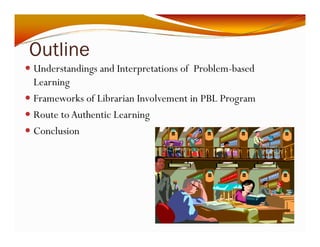
Outline 
y Understandings and Interpretations of Problem-based 
Learning 
y Frameworks of Librarian Involvement in PBL Program 
y Route to Authentic Learning 
y Conclusion
Understandings and Interpretations of 
Problem-based Learning 
Problem-based learning (PBL) is an educational technique 
used to supplement or replace traditional lecture-based courses. 
9It provides the theoretical framework for a learner-centered 
active instructional experience that relies on collaboration, 
critical thinking, and hands-on interaction with resources. 
9An approach to learning through which students have been 
enabled to understand their own situations and frameworks so 
that they are able to perceive how they learn, and how they see 
themselves as future professionals.
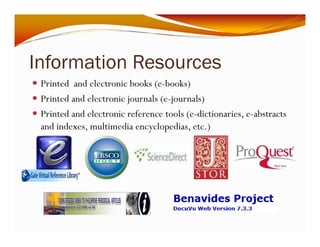
Information Resources 
y Printed and electronic books (e-books) 
y Printed and electronic journals (e-journals) 
y Printed and electronic reference tools (e-dictionaries, e-abstracts 
and indexes, multimedia encyclopedias, etc.)
Framework of Librarian 
Involvement in PBL Program 
1. Assistance at the Reference Desk 
2. Instruction at the Reference Desk 
3. Course-Related Instruction 
4. Resource Management and Utilization 
5. Consultation with Faculty and Students 
6. Group Facilitation
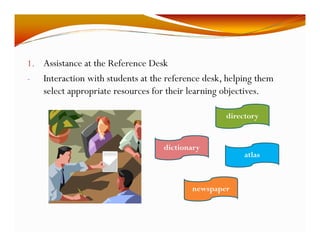
1. Assistance at the Reference Desk 
I t - Interaction with students at the reference desk, helping them 
select appropriate resources for their learning objectives. 
directory 
dictionary 
atlas 
newspaper
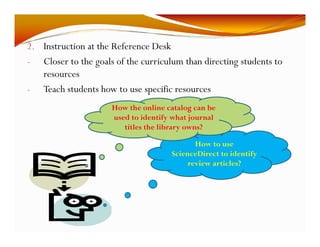
2. Instruction at the Reference Desk 
- Closer to the goals of the curriculum than directing students to 
resources 
- Teach students how to use specific resources 
How the online catalog can be 
used to identify what journal 
titles the library owns? 
How to use 
ScienceDirect to identify 
review articles?
3. Course-Related Instruction 
- Librarians would identify curricular integration 
- Recognizes the importance of information-seeking skills 
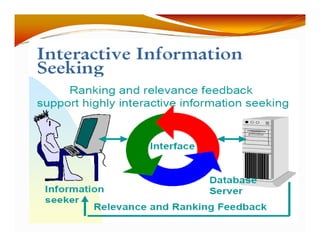
A. Interactive Information Seeking 
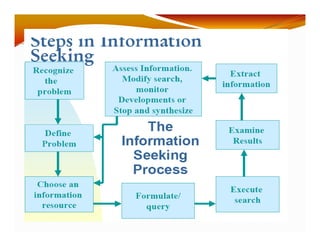
B. Steps in Information Seeking 
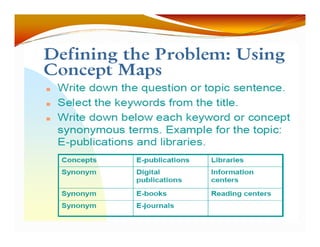
- A concept map presents the relationships among a set of 
connected concepts and ideas. It is a tangible way to display how 
your mind "sees" a particular topic. By constructing a concept 
map, you reflect on what you know and what you don't know. In a 
Concept Map, the concepts, usually represented by single words 
enclosed in a rectangle (box), are connected to other concept 
boxes by arrows.
PBL and Concept Maps-An Analogy: 
In problem-based learning, each student group is like a party 
of explorers entering new territory. As a group they decide what 
neighboring areas they should reconnoiter, the individual members 
scout these areas and return to describe things they discovered that are 
relevant to the party’s interests. It is important in this process that the 
scouts know what they are looking for (have well-defined learning 
issues). In this effort, each member learns different things that get 
integrated and used to make decisions. Not all of the information will 
be transmitted to the others. When the expedition is over and the 
party needs to summarize their explorations, they draw a map that 
captures the important features of the territory. This would 
correspond to a PBL group constructing a concept map. The 
instructor or tutor serves as a native guide in this analogy.
4. Resource Management and Utilization 
- Collection management must be synchronized closely with the 
curriculum 
- Gathering and analyzing information about the resources used 
by students 
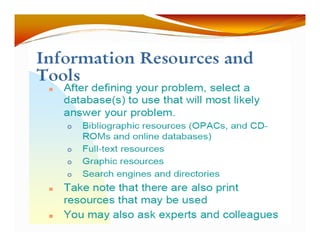
A. Information resources and tools 
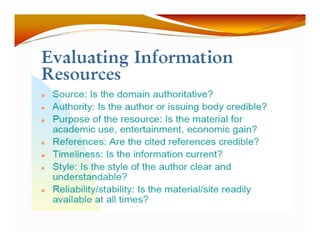
B. Evaluating information resources
5. Consultation with Faculty and Students 
- Components: 
1. Consulting during planning and development of the PBL 
curricula. 
2. Consulting with students and faculty during PBL 
regarding information sources, use, and information-seeking 
strategies.
6. Group Facilitation 
- Indicates the greatest level of curricular integration is librarians 
serving as small-group facilitators (tutors) 
- Librarians can function well as facilitators because of the 
interpersonal and communication skills developed for 
reference interviewing and assisting library users
Route for Authentic Learning 
y What is authentic learning? 
y What makes authentic learning effective? 
y Why is authentic learning important?
What Is Authentic Learning? 
- Authentic learning typically focuses on real-world, complex 
problems and their solutions, using role-playing exercises, 
problem-based activities, case studies, and participation in virtual 
communities of practice. 
- A learning environment is similar to some ‘real world’ application 
or discipline: for example, managing a city, building a house, flying 
an airplane, setting a budget, and or solving a crime. 
- Authentic learning intentionally brings into play multiple 
disciplines, multiple perspectives, ways of working, habits of mind, 
and community.
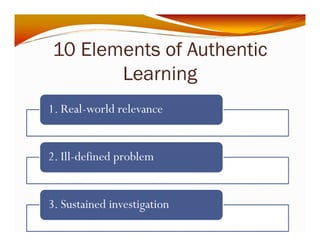
10 Elements of Authentic 
Learning 
1. Real-world relevance 
2. Ill-defined problem 
3. Sustained investigation
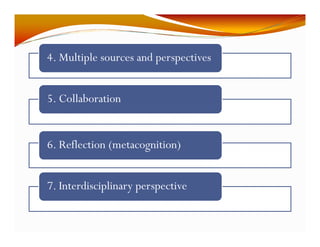
4. Multiple sources and perspectives 
5. Collaboration 
6. Reflection (metacognition) 
7. Interdisciplinary perspective
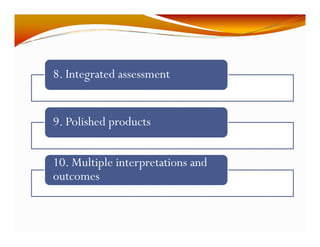
8. Integrated assessment 
9. Polished products 
10. Multiple interpretations and 
outcomes
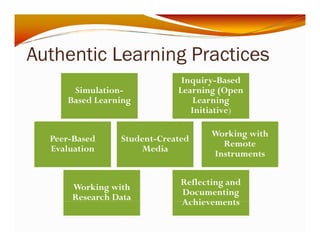
Authentic Learning Practices 
Simulation- 
Based Learning 
Inquiry-Based 
Learning (Open 
Learning 
I i i i ) 
Student Created 
Initiative) 
Peer Based 
Student-Working with 
Media 
Peer-Evaluation 
g 
Remote 
Instruments 
Working with 
Research Data 
Reflecting and 
Documenting 
Achievements
What Makes Authentic Learning 
Effective? 
- Authentic learning aligns with research 
into the way the human mind turns 
information into useful, transferable 
knowledge.
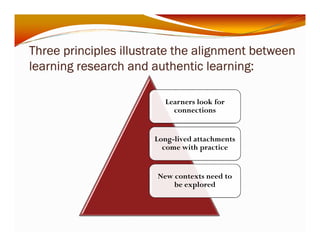
Three principles illustrate the alignment between 
learning research and authentic learning: 
Learners look for 
connections 
Long-lived attachments 
come with practice 
New contexts need to 
be explored
Eight critical factors that researchers say must 
be aligned to ensure a successful learning 
environment : 
goals 
content 
instructional design 
learner tasks 
instructor roles 
student roles 
technological affordances 
assessment
Why Is Authentic Learning 
y g 
Important? 
- Authentic learning exercises expose 
the messiness of real-life decision 
making, where there may not be a 
right or a wrong answer per se, 
although one solution may be better 
or worse than others depending on 
the particular context. 
- The goal is to give learners the 
confidence that comes with being 
recognized as “legitimate peripheral 
participants” in a community of 
practice.
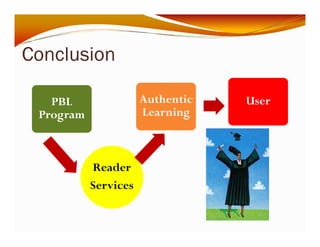
Conclusion 
Authentic 
PBL User 
Program i 
Learning 
Reader 
Services
Conclusion 
The value problem based-learning has been underestimated in 
terms of the ways in which it can: 
"equip students for the world of work 
"improve students’ learning by helping them to learn with 
complexity and through ambiguity, and 
"enable students to see learning as a lifelong cyclical process 
through which to develop increasing understandings of 
themselves and the situations in which they learn effectively.

Libraries as problem based learning environments across reader services [compatibility mode]

  • 1.
    PAARL Parallel Session-Workshopson Library and Web 2011, Holy Angel University, Pampanga, 19-20 August 2010 Ms. Anna Rita L. Alomo Head Librarian - General Reference and Information Section University of Santo Tomas Miguel de Benavides Library
  • 2.
    Outline y Understandingsand Interpretations of Problem-based Learning y Frameworks of Librarian Involvement in PBL Program y Route to Authentic Learning y Conclusion
  • 3.
    Understandings and Interpretationsof Problem-based Learning Problem-based learning (PBL) is an educational technique used to supplement or replace traditional lecture-based courses. 9It provides the theoretical framework for a learner-centered active instructional experience that relies on collaboration, critical thinking, and hands-on interaction with resources. 9An approach to learning through which students have been enabled to understand their own situations and frameworks so that they are able to perceive how they learn, and how they see themselves as future professionals.
  • 4.
    Information Resources yPrinted and electronic books (e-books) y Printed and electronic journals (e-journals) y Printed and electronic reference tools (e-dictionaries, e-abstracts and indexes, multimedia encyclopedias, etc.)
  • 5.
    Framework of Librarian Involvement in PBL Program 1. Assistance at the Reference Desk 2. Instruction at the Reference Desk 3. Course-Related Instruction 4. Resource Management and Utilization 5. Consultation with Faculty and Students 6. Group Facilitation
  • 6.
    1. Assistance atthe Reference Desk I t - Interaction with students at the reference desk, helping them select appropriate resources for their learning objectives. directory dictionary atlas newspaper
  • 7.
    2. Instruction atthe Reference Desk - Closer to the goals of the curriculum than directing students to resources - Teach students how to use specific resources How the online catalog can be used to identify what journal titles the library owns? How to use ScienceDirect to identify review articles?
  • 8.
    3. Course-Related Instruction - Librarians would identify curricular integration - Recognizes the importance of information-seeking skills A. Interactive Information Seeking B. Steps in Information Seeking - A concept map presents the relationships among a set of connected concepts and ideas. It is a tangible way to display how your mind "sees" a particular topic. By constructing a concept map, you reflect on what you know and what you don't know. In a Concept Map, the concepts, usually represented by single words enclosed in a rectangle (box), are connected to other concept boxes by arrows.
  • 11.
    PBL and ConceptMaps-An Analogy: In problem-based learning, each student group is like a party of explorers entering new territory. As a group they decide what neighboring areas they should reconnoiter, the individual members scout these areas and return to describe things they discovered that are relevant to the party’s interests. It is important in this process that the scouts know what they are looking for (have well-defined learning issues). In this effort, each member learns different things that get integrated and used to make decisions. Not all of the information will be transmitted to the others. When the expedition is over and the party needs to summarize their explorations, they draw a map that captures the important features of the territory. This would correspond to a PBL group constructing a concept map. The instructor or tutor serves as a native guide in this analogy.
  • 13.
    4. Resource Managementand Utilization - Collection management must be synchronized closely with the curriculum - Gathering and analyzing information about the resources used by students A. Information resources and tools B. Evaluating information resources
  • 16.
    5. Consultation withFaculty and Students - Components: 1. Consulting during planning and development of the PBL curricula. 2. Consulting with students and faculty during PBL regarding information sources, use, and information-seeking strategies.
  • 17.
    6. Group Facilitation - Indicates the greatest level of curricular integration is librarians serving as small-group facilitators (tutors) - Librarians can function well as facilitators because of the interpersonal and communication skills developed for reference interviewing and assisting library users
  • 19.
    Route for AuthenticLearning y What is authentic learning? y What makes authentic learning effective? y Why is authentic learning important?
  • 20.
    What Is AuthenticLearning? - Authentic learning typically focuses on real-world, complex problems and their solutions, using role-playing exercises, problem-based activities, case studies, and participation in virtual communities of practice. - A learning environment is similar to some ‘real world’ application or discipline: for example, managing a city, building a house, flying an airplane, setting a budget, and or solving a crime. - Authentic learning intentionally brings into play multiple disciplines, multiple perspectives, ways of working, habits of mind, and community.
  • 21.
    10 Elements ofAuthentic Learning 1. Real-world relevance 2. Ill-defined problem 3. Sustained investigation
  • 22.
    4. Multiple sourcesand perspectives 5. Collaboration 6. Reflection (metacognition) 7. Interdisciplinary perspective
  • 23.
    8. Integrated assessment 9. Polished products 10. Multiple interpretations and outcomes
  • 24.
    Authentic Learning Practices Simulation- Based Learning Inquiry-Based Learning (Open Learning I i i i ) Student Created Initiative) Peer Based Student-Working with Media Peer-Evaluation g Remote Instruments Working with Research Data Reflecting and Documenting Achievements
  • 25.
    What Makes AuthenticLearning Effective? - Authentic learning aligns with research into the way the human mind turns information into useful, transferable knowledge.
  • 26.
    Three principles illustratethe alignment between learning research and authentic learning: Learners look for connections Long-lived attachments come with practice New contexts need to be explored
  • 27.
    Eight critical factorsthat researchers say must be aligned to ensure a successful learning environment : goals content instructional design learner tasks instructor roles student roles technological affordances assessment
  • 28.
    Why Is AuthenticLearning y g Important? - Authentic learning exercises expose the messiness of real-life decision making, where there may not be a right or a wrong answer per se, although one solution may be better or worse than others depending on the particular context. - The goal is to give learners the confidence that comes with being recognized as “legitimate peripheral participants” in a community of practice.
  • 29.
    Conclusion Authentic PBLUser Program i Learning Reader Services
  • 30.
    Conclusion The valueproblem based-learning has been underestimated in terms of the ways in which it can: "equip students for the world of work "improve students’ learning by helping them to learn with complexity and through ambiguity, and "enable students to see learning as a lifelong cyclical process through which to develop increasing understandings of themselves and the situations in which they learn effectively.