Developing
Instructional Materials
By
Jett Even
Background
This presentation will address chapter ten including the roles the
instructor plays when giving out knowledge to a specific group.
Instructors usually have their own specific strategies when making sure
the majority of the group understands. The instructor is the motivator,
counselor, evaluator, and decision maker, and the instructor is
responsible for the students' mastery of the objectives.
Now instructors use media and other instructional materials to
help the group understand. This does not necessarily mean the instructor
is removed from the instructional setting. The instructor plans and
performs functional activities that we describe as being components of
an instructional strategy. In this chapter there are concepts, guidelines,
and criteria for developing instructional materials. We don’t really focus
on media production techniques because those techniques encompass
vast skill sets for which excellent resources are available in books and
online text, tutorials and interactive user groups.
Objectives
• Describe the designers role in materials development and
instructional delivery.
• Describe factors that may cause revisions in media selections and
delivery systems for a given instruction.
• Name and describe the components of an instructional package.
• List four categories of criteria for judging the appropriateness of
existing instructional materials
• Name appropriate rough draft materials for various final media.
• Given an instructional strategy, describe the procedures for
developing instructional materials.
• Develop instructional materials based on a given instructional
strategy.

The Designers Role in Material’s
Development and Instructional
Delivery
When designers are developers and instructors, they take on different
teaching responsibilities based on the types of materials prescribed in the
instructional strategy. The role of the instructor in instructional delivery
is passive, but their role as a facilitator is very active.
Students can progress at their own speed through the instruction,
with the instructor providing feedback as needed and additional help for
those who seem to get stuck. Some available materials may be instructor
independent, but when they are not, the instructor must provide learning
components specified in the strategy but not found in the materials.
By providing a learner guide for available materials, instructors
may be able to increase the independence of the materials and free
themselves to provide additional guidance and consultation for students
who need it.
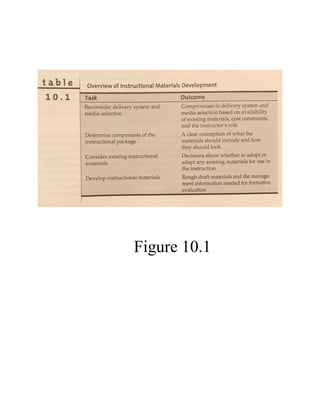
Figure 10.1
The Delivery System and Media
Selections
At this point a delivery system is specified and the instructional
strategy has been developed, including clustering and sequencing,
learning components, student groupings, and tentative media selections.
Availability of existing instructional materials
• Existing materials are an attractive alternative to going through the
development and production process.

• Existing materials could be substituted for planned materials on a
scale ranging from a single motivational sequence.

• After the development is completed, the costs of duplication,
distribution, and maintenance can be just as prohibitive as
unanticipated production costs.

Components of an Instructional
Package
• Instructional materials contain the content whether its written,
mediated, or facilitated by an instructor.

• Instructional materials refers to any pre existing materials being
incorporated, as well as to those materials developed specifically
for the objectives.

• All instructional materials should be accompanied by objective
tests or by product or performance assessments, and may include
both a pretest and post test.

• Often there is an instructor's manual that provides an overview of
the materials and shows how they could be incorporated into an
overall learning sequence for students.

Existing Instructional Materials
• A recent development in selecting existing instructional materials
is the shareable content object reference model(SCORM), which is
a set of e-learning standards for interchangeability of learning
objects. 

• The SCORM concept is promising, but practice in sharable objects
currently lags well behind theory (Bush, Walker, and Sorenson,
2011).

• Goal centered criteria focus on the content of instruction, and your
instructional analysis documents provide a basis for determining
the acceptability of the content in various instructional materials.

• Your learner analysis documentation should provide the foundation
for consideration of the appropriateness of instructional materials
for your target group.

Instructional Materials and
Formative Evaluation
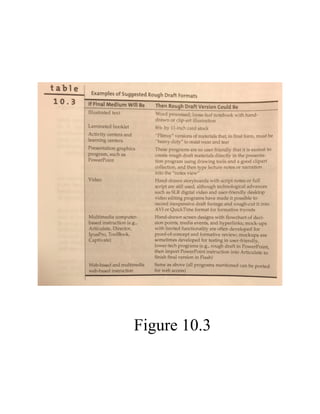
• Rough draft materials: the purpose for doing a rough draft of
materials is to create a quick-low cost version of your design to
have something to guide final production and to take into
formative evaluation.

• Even those in well developed skills in multimedia production
should keep time commitments in mind and remember that the
desired outcome is rough draft materials for formative evaluation.

• Anyone with decent word- processing skills can quickly create
rough drafts of text and either draw by hand or electronically insert
pictures and graphic illustrations.

Rapid Prototyping
1. The first strategy used in rapid prototyping is to go light on the
early analysis steps of an instructional design model, then develop
prototype instructional materials rapidly, and use quick iterative
cycles of formative evaluation and revision to shape the final form
of the materials.

2. The second strategy is concurrent design and development; that is,
much of the front end analysis work is conducted while the first
rough draft materials are being developed.

3. The thinking here is that trainers designing cutting edge
technological products will not know the answers to critical design
questions unless they are also involved in product development with
those technologies.

Materials Development Tools
and Resources
• Production of mediated materials requires a whole set of skills,
both artistic and technical, that can range from simple word
processing to converting materials for web-based delivery.

• Several references at the end of this chapter include instruction on
digital audio and video as well as computer-based and web-based
multimedia.

• The other source is the web itself.

• To find the most current information on a computer application or
authoring tool, just type the brand name into a web index or search
engine.

Steps in the Development of
Instruction
1. Review the instructional strategy for each objective in each lesson.

2. Decide on the components of the package of instructional
materials.
3. Consider how you might adopt or adapt available materials.
4. Review each completed lesson or learning session for clarity and
flow of ideas.
5. You may either develop materials for the instructors manual as you
go along or take notes as you develop and revise the instructional
presentations and activities.

Mediation of Pretest
As prescribed in the objectives and
instructional strategy, the pretest
consists of directions for learners, a
learner response form, and a
streaming video of a simulated
meeting.

Content Presentation and Learning
Guidance
• Instruction is web based and can be assessed by learners in their
homes or wherever they have internet access.

• The web based instruction for these two objectives will be created
using a comic book instructor and a conversational format. 

• This presentation exercise begins to link verbal information actions
to interactive human actions during a meeting.

Learner Participation
• The learner participation component is also formatted for web
based instruction, enabling learners to study independently.

• After completing the exercise, they can scroll down to the
feedback section, which repeats the meeting script with the
behaviors enhancing and stifling marked.

• Learners can then compare their classification of the behaviors
with those made by the designer, marking any discrepancies.

Learner Participation Script
The learner participation script for the web
based material is illustrated, the actual script
would continue until all twelve cooperation-
encouraging and corresponding stifling
behaviors are illustrated. We stop before the
end of the script because the nature of the
student participation is established 

Production and Implementation
Constraints
Media formats and delivery systems that look
expensive are expensive. Cutting production
corner to save money usually does not affect
student learning. It is essential to anticipate such
constraints by due diligence during the learning
context analysis and to maintain an open and
flexible viewpoint when entering the materials
production phase.
Figure 10.3
Summary
In this chapter it was talking about the
different roles that instructors play and the
different strategies they use, so that the
students can understand. The different
materials used in this chapter were the
instructional goal, instructional analysis,
performance objectives, sample test items,
characteristics of the target learners, and
the characteristics of the learning and
performance contexts. In this chapter we
learned that the instructor is the motivator,
counselor, evaluator, and decision maker,
and the instructor is responsible for the
students' mastery of the objectives.
By Jett Even
jeven.44@gmail.com

Chapter 10 - Developing Instructional Materials

  • 1.
  • 2.
    Background This presentation willaddress chapter ten including the roles the instructor plays when giving out knowledge to a specific group. Instructors usually have their own specific strategies when making sure the majority of the group understands. The instructor is the motivator, counselor, evaluator, and decision maker, and the instructor is responsible for the students' mastery of the objectives. Now instructors use media and other instructional materials to help the group understand. This does not necessarily mean the instructor is removed from the instructional setting. The instructor plans and performs functional activities that we describe as being components of an instructional strategy. In this chapter there are concepts, guidelines, and criteria for developing instructional materials. We don’t really focus on media production techniques because those techniques encompass vast skill sets for which excellent resources are available in books and online text, tutorials and interactive user groups.
  • 3.
    Objectives • Describe thedesigners role in materials development and instructional delivery. • Describe factors that may cause revisions in media selections and delivery systems for a given instruction. • Name and describe the components of an instructional package. • List four categories of criteria for judging the appropriateness of existing instructional materials • Name appropriate rough draft materials for various final media. • Given an instructional strategy, describe the procedures for developing instructional materials. • Develop instructional materials based on a given instructional strategy.

  • 4.
    The Designers Rolein Material’s Development and Instructional Delivery When designers are developers and instructors, they take on different teaching responsibilities based on the types of materials prescribed in the instructional strategy. The role of the instructor in instructional delivery is passive, but their role as a facilitator is very active. Students can progress at their own speed through the instruction, with the instructor providing feedback as needed and additional help for those who seem to get stuck. Some available materials may be instructor independent, but when they are not, the instructor must provide learning components specified in the strategy but not found in the materials. By providing a learner guide for available materials, instructors may be able to increase the independence of the materials and free themselves to provide additional guidance and consultation for students who need it.
  • 5.
  • 6.
    The Delivery Systemand Media Selections At this point a delivery system is specified and the instructional strategy has been developed, including clustering and sequencing, learning components, student groupings, and tentative media selections. Availability of existing instructional materials • Existing materials are an attractive alternative to going through the development and production process.
 • Existing materials could be substituted for planned materials on a scale ranging from a single motivational sequence.
 • After the development is completed, the costs of duplication, distribution, and maintenance can be just as prohibitive as unanticipated production costs.

  • 7.
    Components of anInstructional Package • Instructional materials contain the content whether its written, mediated, or facilitated by an instructor.
 • Instructional materials refers to any pre existing materials being incorporated, as well as to those materials developed specifically for the objectives.
 • All instructional materials should be accompanied by objective tests or by product or performance assessments, and may include both a pretest and post test.
 • Often there is an instructor's manual that provides an overview of the materials and shows how they could be incorporated into an overall learning sequence for students.

  • 8.
    Existing Instructional Materials •A recent development in selecting existing instructional materials is the shareable content object reference model(SCORM), which is a set of e-learning standards for interchangeability of learning objects. 
 • The SCORM concept is promising, but practice in sharable objects currently lags well behind theory (Bush, Walker, and Sorenson, 2011).
 • Goal centered criteria focus on the content of instruction, and your instructional analysis documents provide a basis for determining the acceptability of the content in various instructional materials.
 • Your learner analysis documentation should provide the foundation for consideration of the appropriateness of instructional materials for your target group.

  • 9.
    Instructional Materials and FormativeEvaluation • Rough draft materials: the purpose for doing a rough draft of materials is to create a quick-low cost version of your design to have something to guide final production and to take into formative evaluation.
 • Even those in well developed skills in multimedia production should keep time commitments in mind and remember that the desired outcome is rough draft materials for formative evaluation.
 • Anyone with decent word- processing skills can quickly create rough drafts of text and either draw by hand or electronically insert pictures and graphic illustrations.

  • 10.
    Rapid Prototyping 1. Thefirst strategy used in rapid prototyping is to go light on the early analysis steps of an instructional design model, then develop prototype instructional materials rapidly, and use quick iterative cycles of formative evaluation and revision to shape the final form of the materials.
 2. The second strategy is concurrent design and development; that is, much of the front end analysis work is conducted while the first rough draft materials are being developed.
 3. The thinking here is that trainers designing cutting edge technological products will not know the answers to critical design questions unless they are also involved in product development with those technologies.

  • 11.
    Materials Development Tools andResources • Production of mediated materials requires a whole set of skills, both artistic and technical, that can range from simple word processing to converting materials for web-based delivery.
 • Several references at the end of this chapter include instruction on digital audio and video as well as computer-based and web-based multimedia.
 • The other source is the web itself.
 • To find the most current information on a computer application or authoring tool, just type the brand name into a web index or search engine.

  • 12.
    Steps in theDevelopment of Instruction 1. Review the instructional strategy for each objective in each lesson.
 2. Decide on the components of the package of instructional materials. 3. Consider how you might adopt or adapt available materials. 4. Review each completed lesson or learning session for clarity and flow of ideas. 5. You may either develop materials for the instructors manual as you go along or take notes as you develop and revise the instructional presentations and activities.

  • 13.
    Mediation of Pretest Asprescribed in the objectives and instructional strategy, the pretest consists of directions for learners, a learner response form, and a streaming video of a simulated meeting.

  • 14.
    Content Presentation andLearning Guidance • Instruction is web based and can be assessed by learners in their homes or wherever they have internet access.
 • The web based instruction for these two objectives will be created using a comic book instructor and a conversational format. 
 • This presentation exercise begins to link verbal information actions to interactive human actions during a meeting.

  • 15.
    Learner Participation • Thelearner participation component is also formatted for web based instruction, enabling learners to study independently.
 • After completing the exercise, they can scroll down to the feedback section, which repeats the meeting script with the behaviors enhancing and stifling marked.
 • Learners can then compare their classification of the behaviors with those made by the designer, marking any discrepancies.

  • 16.
    Learner Participation Script Thelearner participation script for the web based material is illustrated, the actual script would continue until all twelve cooperation- encouraging and corresponding stifling behaviors are illustrated. We stop before the end of the script because the nature of the student participation is established 

  • 17.
    Production and Implementation Constraints Mediaformats and delivery systems that look expensive are expensive. Cutting production corner to save money usually does not affect student learning. It is essential to anticipate such constraints by due diligence during the learning context analysis and to maintain an open and flexible viewpoint when entering the materials production phase.
  • 18.
  • 19.
    Summary In this chapterit was talking about the different roles that instructors play and the different strategies they use, so that the students can understand. The different materials used in this chapter were the instructional goal, instructional analysis, performance objectives, sample test items, characteristics of the target learners, and the characteristics of the learning and performance contexts. In this chapter we learned that the instructor is the motivator, counselor, evaluator, and decision maker, and the instructor is responsible for the students' mastery of the objectives.
  • 20.