ProblemSolvingSkills
Dr Zahiruddin Othman
GCN505 Nov2018
Definitions
 To accomplish a goal by overcoming the
obstacles
 Thinking directed toward the handling of a
particular situation involving both the
formation of responses and the selection
among possible responses
THINKING
Concepts
Problem
Solving
Decision
Making
Judgment
formation
formation of a new mental representation through the transformation of information by complex
interaction of the mental attributes
FEATURES
of problems
A goal, or
description of
what constitutes
a solution
A description of
objects relevant
to achieving a
solution
A set of
operations or
allowable actions
toward solution
A set of
constraints not
to be violated
Knowledge-Lean
Problems
Knowledge-Rich
Problems
Well-defined
Problems
Ill-defined
Problems
Types of
problems
All the elements are given, and the
task is to rearrange them
Arrangement
Discovery of a pattern relating
elements of a problem to each
other
Inducing Structure
Manipulation of objects or symbols
while following certain rules
Transformation
Problem
solving
 Mechanical solution
 A problem solution achieved by trial and error or by
fixed procedure based on learned rules
 Solution by understanding
 Understanding: a deeper comprehension of the
nature of a problem
 General solution: correctly states the requirement
for success but not enough for further action
 Functional solution: a detailed, practical, and
workable solution
Trial & Error
(Thorndike
1898)
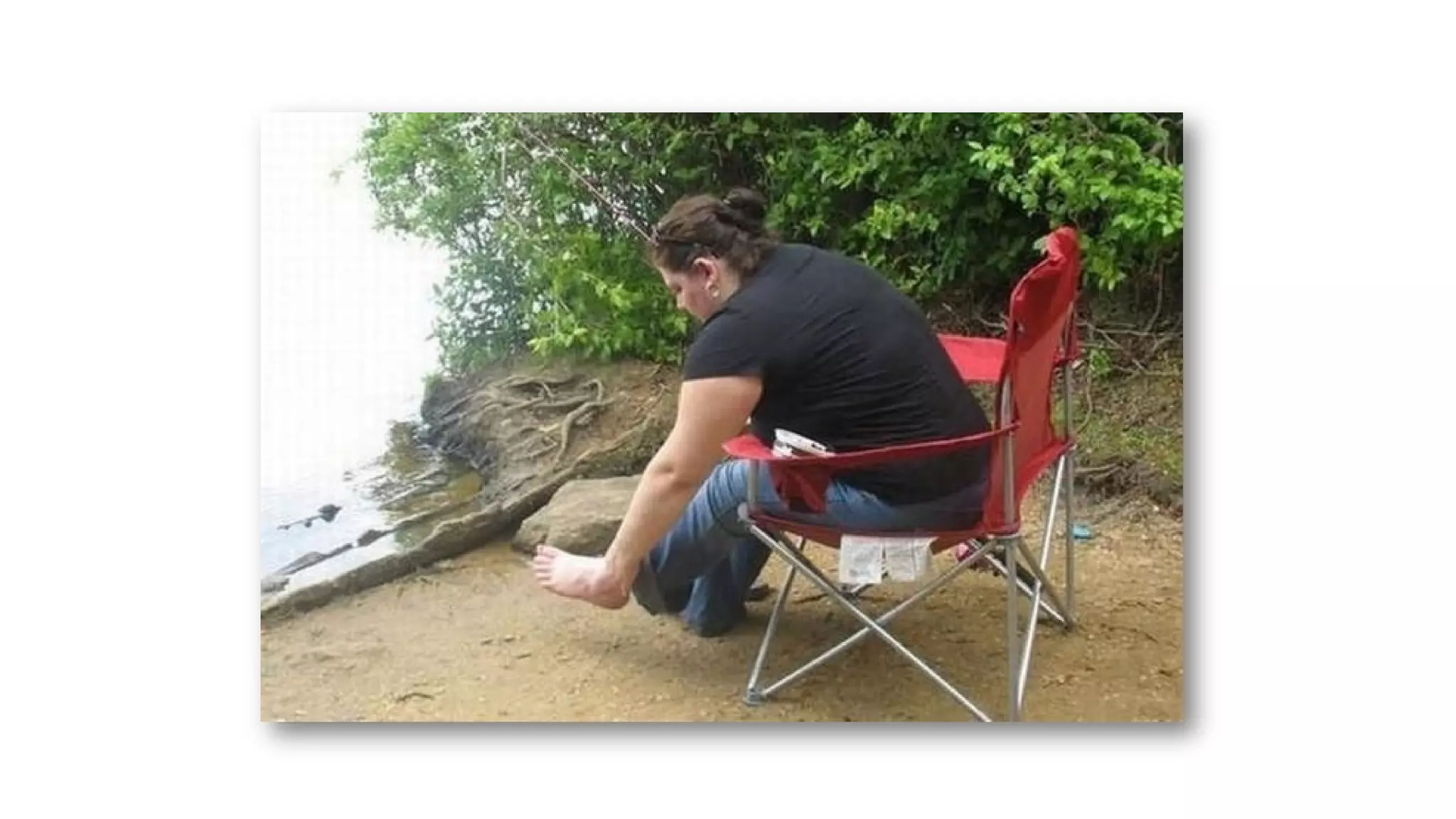
What do
you see?
Problem
Solving
Insightful solution
 Insight: a sudden mental reorganization of a
problem that makes solution obvious
Heuristics
 Any strategy or technique that aids problem
solving, especially by limiting the number of
possible solution to be tried
Nature of
Insight
• The ability to select information relevant to
problem solving while ignoring useless or
distracting information
Selective
encoding
• The ability to connect seemingly unrelated
items of information
Selective
combination
• The ability to relate a present problem to
similar problem solved in the past or prior
experience
Selective
comparison
Problem solving utilizing
restructuring & insight
Productive thinking
Problem solving reusing past
experiences
Reproductive thinking
How would you attach
the candle to the wall?
How would you arrange
the match sticks to form
equilateral triangles?
A cognitive bias that limits a person to use an
object only in the way it is traditionally used
Functional fixedness
A tendency to approach a problem in a
particular way, especially if that way was
successful in the past.
Mental set
Problem
Space
Theory
(Newell &
Simon 1972)
The initial state
All the possible
intermediate states
The goal state
The actions that people take in order to move from one state to
another are known as operators
Acquiring
operators
Heuristic Analogy
Heuristics
• Avoid an action that would take you back to a
previous problem state
Repeat-state
avoidance
• Carry out the operation that moves you closest to
the final goal stateHill-climbing
• Similar to hill-climbing heuristic. Create sub-goal
and select operators.
Means-end
analysis
• Try solving the problem from the start to the end
Working
forward
• The problem-solver start at the end and tries to
work backward from there
Working
backward
• The problem-solver generates a list of alternative
ways of action and then notices in turn whether
each course of action will work
Generate &
test
Maier’s (1931) two-string problem
As hard as
Sebastian tries,
he can’t grab
the second
string. How can
he tie the two
strings
together?
Parking
spot
number
WATER LILY PROBLEM
Water lilies growing
in a pond doubles in
area every 24 hours.
On the first day of
spring, only 1 lily pad
is on the surface of
the pond. 60 days
later, the pond is
entirely covered. On
what day is the pond
half covered?
AMOEBA PROBLEM
There are two jars of
equal capacity. In the first
jar there is one amoeba.
In the second jar there are
two amoebas.
An amoeba can reproduce
itself in 3 minutes. It
takes the amoebas in the
second jar 3 hours to fill
the jar to capacity. How
long does it take the one
amoeba in the first jar to
fill that jar to capacity?
ROPE LADDER PROBLEM
A ship is at anchor. Over
its side hangs a rope
ladder with rungs a foot
apart.
The tide rises at a rate of
8 inches per hour. At the
end of 6 hours, how much
of the rope ladder will
remain above the water,
assuming that 8 feet were
above the water when the
tide began to rise?
Where does the man get his hair cut?
A man needing a haircut
goes into a small town
where everyone in the
town gets their haircut
by one of two barbers.
The man visits the
first—a very clean shop
where the barber has a
terrific haircut.Then he
visits the second—a
very dirty shop where
the barber has a terrible
haircut.
FIVE MARKS PROBLEM
Add five more
marks (lines)
and make ten.
THREECATS
The 1st and 2nd weigh
7kg altogether.
The 2nd and 3rd weigh
8kg altogether
The 1st and 3rd weigh
11kg altogether.
What is the weight of
each cats?
THE NINE DOTS PUZZLE
Link all 9 dots
using 4 straight
lines without
lifting the pen.
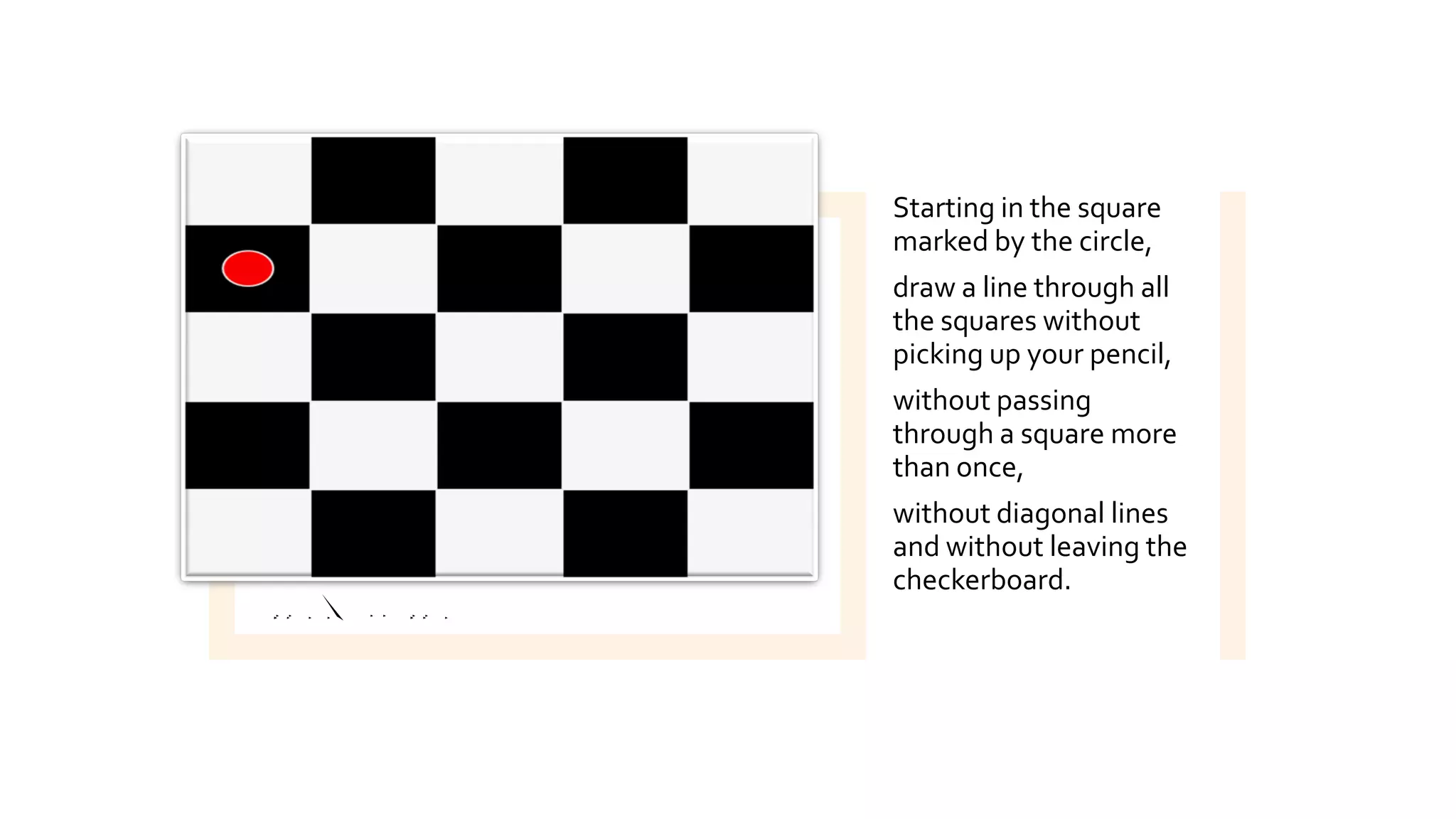
POSSIBLE OR IMPOSSIBLE?
Starting in the square
marked by the circle,
draw a line through all
the squares without
picking up your pencil,
without passing
through a square more
than once,
without diagonal lines
and without leaving the
checkerboard.
Initial and goal states for the Tower of Hanoi problem
Operators that govern theTower of Hanoi problem.
Initial steps in
solving the
Tower of Hanoi
problem,
showing how
the problem can
be broken down
into sub-goals
Conditions: at
least one in
the boat and
at no time can
there be more
orcs than
hobbits on a
river bank.
Means-end
Analysis
The Monk AndThe Mountain
At precisely 7:00 a.m., a monk sets out to climb a tall mountain,
so that he might visit a temple at its peak.The trail he walks is
narrow and winding, but it is the only way to reach the summit.
As he ascends the mountain, the monk walks the path at
varying speeds.Though he stops occasionally to rest and eat, he
never strays from the path, and he never walks backwards.At
exactly 7:00 p.m., the monk reaches the temple at the summit,
where he stays the night.
The following morning at 7:00 a.m. sharp, the monk departs the
temple and begins his journey back to the bottom of the
mountain. He descends by way of the same path, again walking
slowly at times and quickly at others, stopping here and there
to eat and drink and rest, but never deviating from the path and
never going backwards.Twelve hours later, at 7:00 p.m. on the
nose, the monk arrives back at the foot of the mountain.
Is there any point along the path that the monk occupied at
precisely the same time on both days?
7 am
Problem
Solving by
Analogy
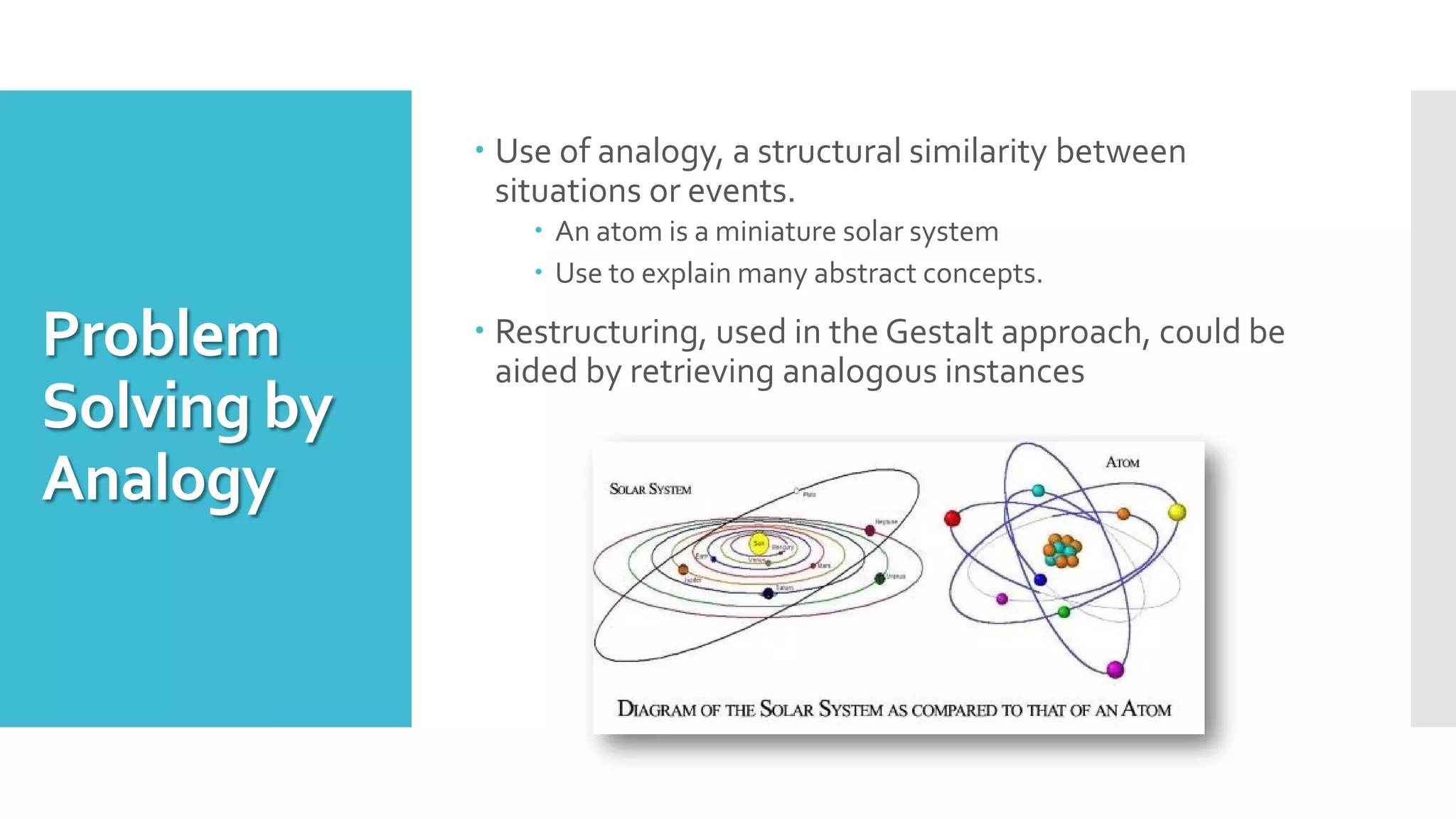
 Use of analogy, a structural similarity between
situations or events.
 An atom is a miniature solar system
 Use to explain many abstract concepts.
 Restructuring, used in the Gestalt approach, could be
aided by retrieving analogous instances
DUNCKER’S (1945) RADIATION PROBLEM
What procedure
might the doctor
employ to destroy
the tumor with
the rays, at the
same time
avoiding
destroying any
healthy tissue?
The normal cells received lower dose of radiation
than the cancer cells, where all the rays meet
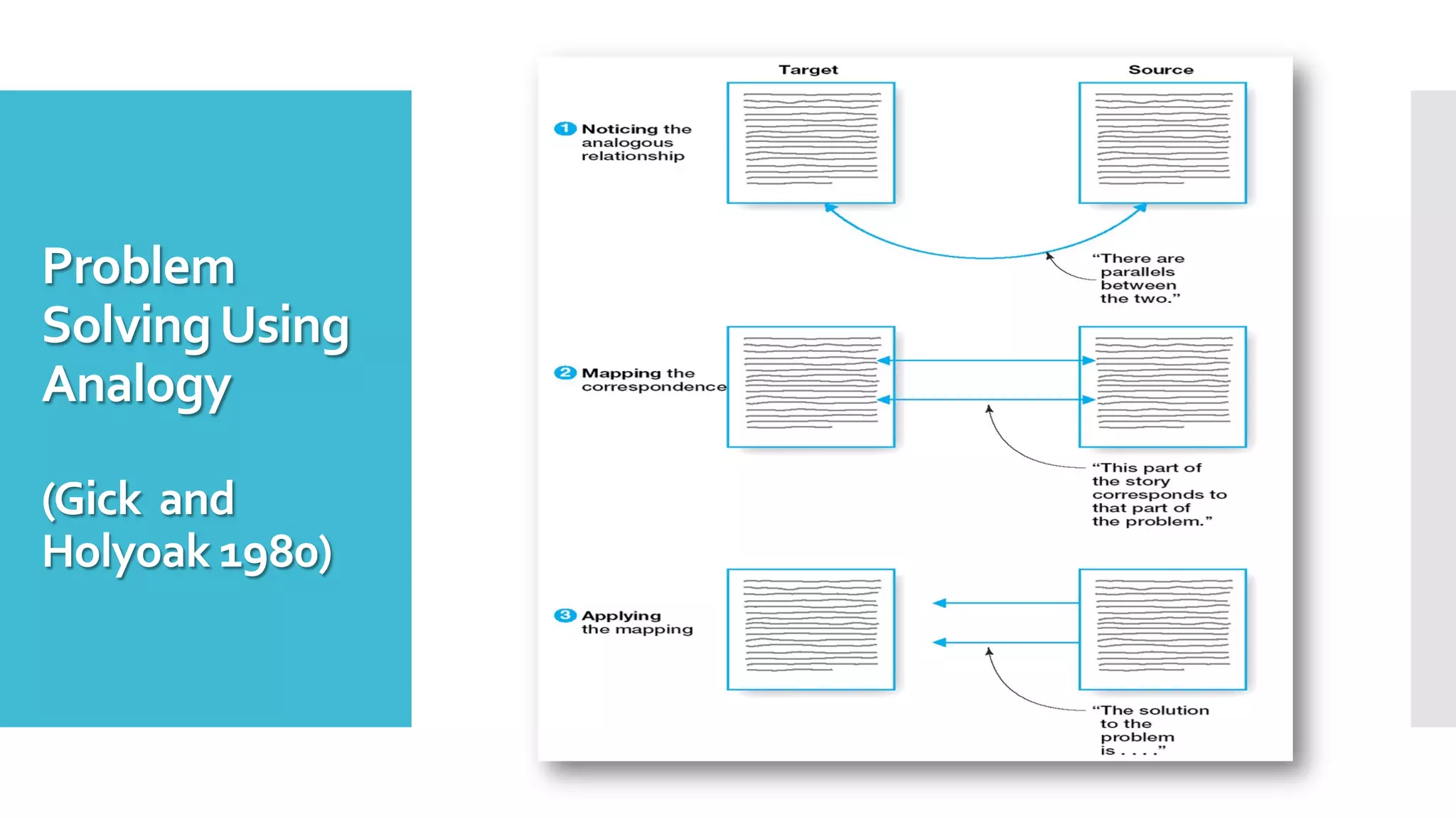
Problem
SolvingUsing
Analogy
(Gick and
Holyoak 1980)
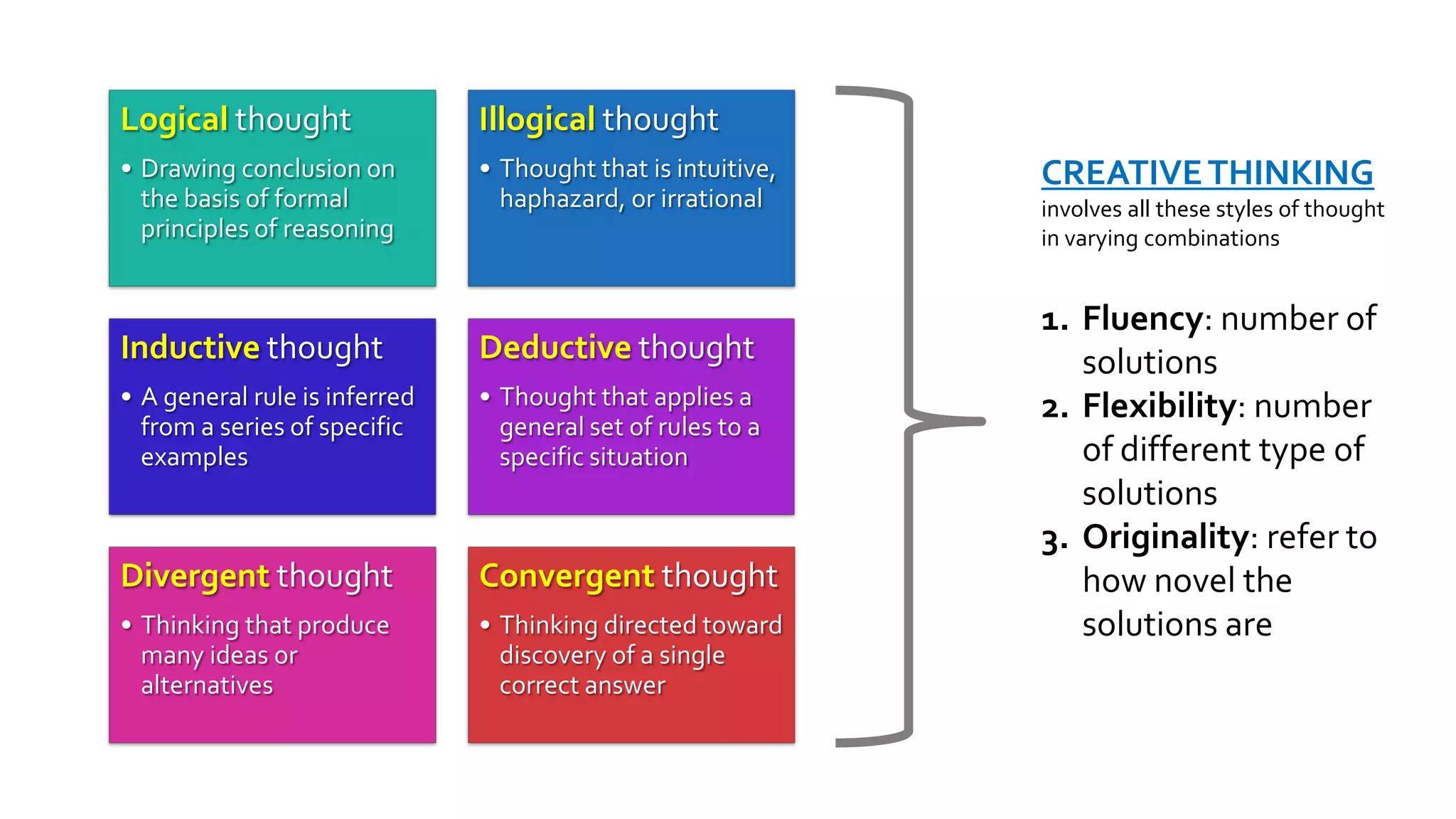
Logical thought
• Drawing conclusion on
the basis of formal
principles of reasoning
Illogical thought
• Thought that is intuitive,
haphazard, or irrational
Inductive thought
• A general rule is inferred
from a series of specific
examples
Deductive thought
• Thought that applies a
general set of rules to a
specific situation
Divergent thought
• Thinking that produce
many ideas or
alternatives
Convergent thought
• Thinking directed toward
discovery of a single
correct answer
CREATIVETHINKING
involves all these styles of thought
in varying combinations
1. Fluency: number of
solutions
2. Flexibility: number
of different type of
solutions
3. Originality: refer to
how novel the
solutions are
• Formulating &
beginning
Preparation
• Problem
solving at
subconscious
level
Incubation
• End of
incubation
period by rapid
insights
Illumination
• Critical
evaluation of
solution
Verification
Why should an
interruption
help?
Posner (1973) suggested three reasons:
 Recovery from fatigue
 Forget inappropriate approaches
 Reorganization
Problem solver
initially works
unsuccessfully
on a problem
Problem solver spend
sometime doing
something
completely different
Problem solver
has sudden
insight; solves
the problem
General traits
• Originality
• Verbal fluency
• Relatively high IQ
• A good imagination
Thinking
abilities
• Uses metaphors in thinking
• Flexible decision maker
• Uses broad categories
• Makes independent judgment
• Can break mental set
• Find order in chaos
Thinking styles
• Challenges assumption, ask “why?”
• Draw new ideas out of existing knowledge
Personality
Characteristics
• Persist in problem solving
• Curious and open to new experience
• Highly interested in work
• Broad range of interest
• Intuitive
• Playful with ideas
Perceptual
memory
Autobiographical
memory
Linguistic &
semantic
Visual
knowledge
Declarative
knowledge
Habits & motor
skills
Central
executive
Working
storage
Verbal
rehearsal
Visuospatial
sketchpad
Sensorybuffers
Actionplanning
Shared memories,
knowledge & skills
Vision
Hearing
Touch
Sensory input
Conscious
event
Top down
voluntary
attention
Bottom up
attentional
capture
Adapted from: Cognition, Brain, and Consciousness. Introduction to Cognitive Neuroscience. Baars & Gage, 2010. page 348
Response output
Premotor cortex:
• Response selection
• Execution of simple action
• Rule matching
Frontopolar cortex:
• Tracking of goals and sub-goals
• Relational integration
• Information-seeking behaviour
Mid-dorsolateral PFC:
• Task switching
• Categorization of sequence
• Complex stimulus-response
contingencies
Posterior lateral PFC:
• Selection of sequence of response
• Categorization of sequence
• Rule learning
Topographical
organization
in lateral
prefrontal
cortex
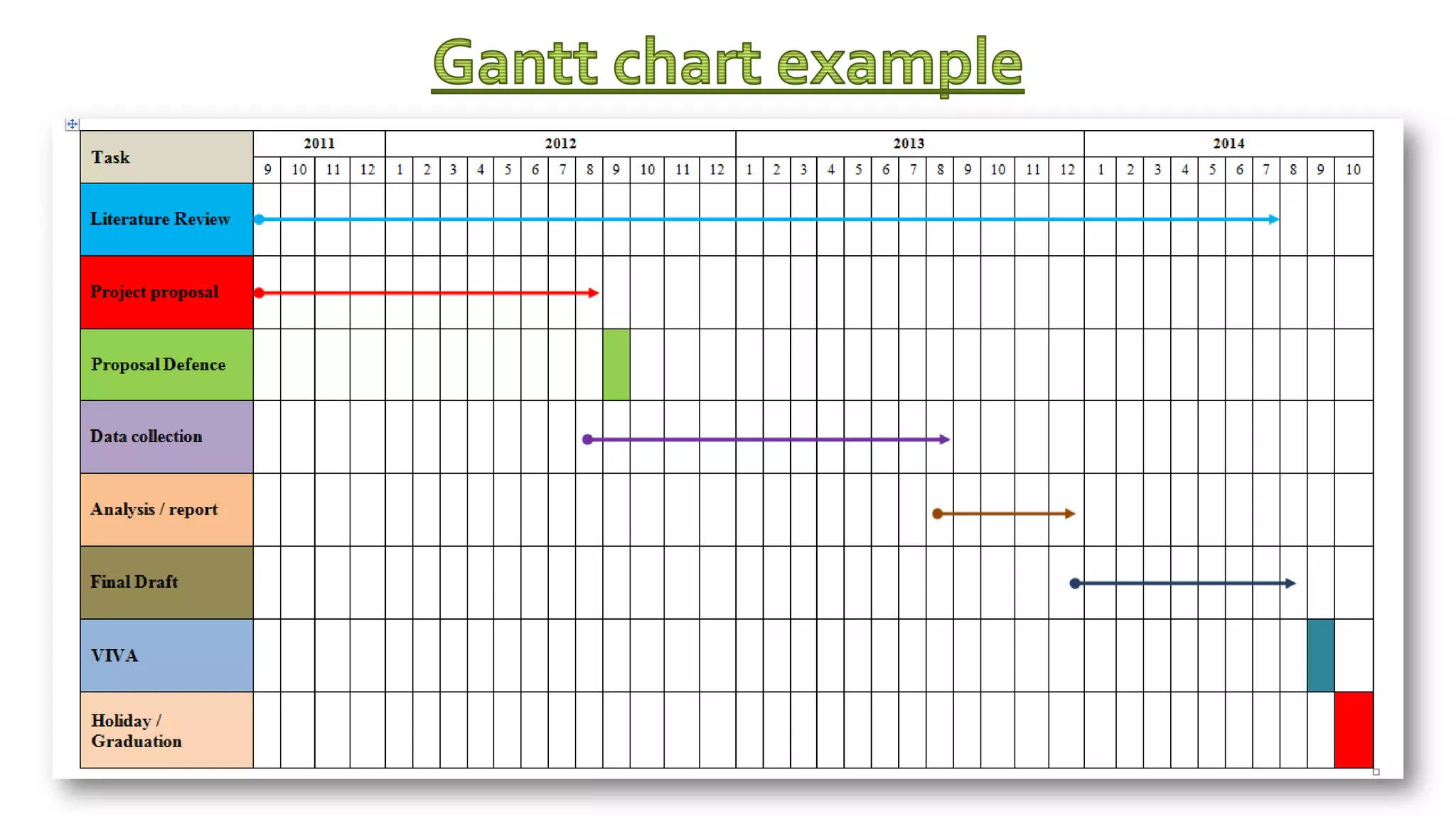
Tools for Problem
Solving
 Purpose
 To show sequential steps in a
process
 When to use
 To develop understanding of
how a process is done
 To study a process
improvement
 To communicate to others
how a process is done
 To document a process
 When planning a project
 Choose the right team and have a leader
 Ensure everyone knows the rules
 Define the problem/topic clearly
 Allow time for individual thought before generating
ideas as a group
 Ensure everyone participates
 Generate as many ideas as possible
 Ban discussion and evaluation during the idea
generation stage
 Record every idea, on a Flipchart
 Allow incubation time before evaluating the ideas
 Keep a relaxed atmosphere
1.Why is there oil on the floor?
• Oil leaks from the cylinder rod when
activated.
2.Why did oil leak?
• TheO-ring was cut.
3.Why was the O-ring cut?
• The rod was flawed.
4.Why was the rod flawed?
• Dirt in the oil abrades the rod.
5.Why did dirt get in the oil?
• There are holes and gaps on the upper
plate of the tank.
Define the Problem
•What do you see
happening?
•What are the
specific symptoms?
Collect Data
•What proof do you
have that the
problem exists?
•How long has the
problem existed?
•What is the impact
of the problem?
Identify Possible
Causal Factors
•What sequence of
events leads to the
problem?
•What conditions
allow the problem
to occur?
Identify the Root
Cause(s)
•Why does the causal
factor exist?
•What is the real
reason the problem
occurred?
Recommend and
Implement Solutions
•What can you do to
prevent the problem
from happening
again?
•How will the
solution be
implemented?
Cause and
Effect
Analysis
Strengths and
Weaknesses
Analysis
STRENGTH
• What are the special
skills?What things go
well?What strengths do
other people perceive?
WEAKNESS
• What area needs
improvement?What is
not going so well? What
weaknesses do other
people perceive?
OPPORTUNITY
• What opportunities are
ahead?What
advantages can be
obtained from
environmental factors?
How can the
competition be
surpassed?
THREAT
• What threats are
realistic?What
environmental factors
are disadvantageous?
How can the
competition/adversary
surpass me?
SUMMARY
PROBLEM
SOLVING
Problem
COMPLEXITY
Knowledge-
lean/rich
Well/ill-defined
Arrangement/
inducing structure/
transformation
OBSTACLE/
BARRIER
Fixation
Solution
MECHANICAL
Trial-and-error
Algorithm
UNDERSTANDING/
INSIGHT
Heuristic
Analogy
Creativity

Problem solving skills

  • 1.
  • 2.
    Definitions  To accomplisha goal by overcoming the obstacles  Thinking directed toward the handling of a particular situation involving both the formation of responses and the selection among possible responses
  • 3.
    THINKING Concepts Problem Solving Decision Making Judgment formation formation of anew mental representation through the transformation of information by complex interaction of the mental attributes
  • 5.
    FEATURES of problems A goal,or description of what constitutes a solution A description of objects relevant to achieving a solution A set of operations or allowable actions toward solution A set of constraints not to be violated
  • 6.
  • 7.
    All the elementsare given, and the task is to rearrange them Arrangement Discovery of a pattern relating elements of a problem to each other Inducing Structure Manipulation of objects or symbols while following certain rules Transformation
  • 8.
    Problem solving  Mechanical solution A problem solution achieved by trial and error or by fixed procedure based on learned rules  Solution by understanding  Understanding: a deeper comprehension of the nature of a problem  General solution: correctly states the requirement for success but not enough for further action  Functional solution: a detailed, practical, and workable solution
  • 9.
  • 11.
  • 14.
    Problem Solving Insightful solution  Insight:a sudden mental reorganization of a problem that makes solution obvious Heuristics  Any strategy or technique that aids problem solving, especially by limiting the number of possible solution to be tried
  • 15.
    Nature of Insight • Theability to select information relevant to problem solving while ignoring useless or distracting information Selective encoding • The ability to connect seemingly unrelated items of information Selective combination • The ability to relate a present problem to similar problem solved in the past or prior experience Selective comparison
  • 16.
    Problem solving utilizing restructuring& insight Productive thinking Problem solving reusing past experiences Reproductive thinking
  • 17.
    How would youattach the candle to the wall? How would you arrange the match sticks to form equilateral triangles?
  • 18.
    A cognitive biasthat limits a person to use an object only in the way it is traditionally used Functional fixedness A tendency to approach a problem in a particular way, especially if that way was successful in the past. Mental set
  • 21.
    Problem Space Theory (Newell & Simon 1972) Theinitial state All the possible intermediate states The goal state The actions that people take in order to move from one state to another are known as operators
  • 22.
  • 23.
    Heuristics • Avoid anaction that would take you back to a previous problem state Repeat-state avoidance • Carry out the operation that moves you closest to the final goal stateHill-climbing • Similar to hill-climbing heuristic. Create sub-goal and select operators. Means-end analysis • Try solving the problem from the start to the end Working forward • The problem-solver start at the end and tries to work backward from there Working backward • The problem-solver generates a list of alternative ways of action and then notices in turn whether each course of action will work Generate & test
  • 24.
    Maier’s (1931) two-stringproblem As hard as Sebastian tries, he can’t grab the second string. How can he tie the two strings together?
  • 25.
  • 26.
    WATER LILY PROBLEM Waterlilies growing in a pond doubles in area every 24 hours. On the first day of spring, only 1 lily pad is on the surface of the pond. 60 days later, the pond is entirely covered. On what day is the pond half covered?
  • 27.
    AMOEBA PROBLEM There aretwo jars of equal capacity. In the first jar there is one amoeba. In the second jar there are two amoebas. An amoeba can reproduce itself in 3 minutes. It takes the amoebas in the second jar 3 hours to fill the jar to capacity. How long does it take the one amoeba in the first jar to fill that jar to capacity?
  • 28.
    ROPE LADDER PROBLEM Aship is at anchor. Over its side hangs a rope ladder with rungs a foot apart. The tide rises at a rate of 8 inches per hour. At the end of 6 hours, how much of the rope ladder will remain above the water, assuming that 8 feet were above the water when the tide began to rise?
  • 29.
    Where does theman get his hair cut? A man needing a haircut goes into a small town where everyone in the town gets their haircut by one of two barbers. The man visits the first—a very clean shop where the barber has a terrific haircut.Then he visits the second—a very dirty shop where the barber has a terrible haircut.
  • 30.
    FIVE MARKS PROBLEM Addfive more marks (lines) and make ten.
  • 31.
    THREECATS The 1st and2nd weigh 7kg altogether. The 2nd and 3rd weigh 8kg altogether The 1st and 3rd weigh 11kg altogether. What is the weight of each cats?
  • 32.
    THE NINE DOTSPUZZLE Link all 9 dots using 4 straight lines without lifting the pen.
  • 35.
    POSSIBLE OR IMPOSSIBLE? Startingin the square marked by the circle, draw a line through all the squares without picking up your pencil, without passing through a square more than once, without diagonal lines and without leaving the checkerboard.
  • 36.
    Initial and goalstates for the Tower of Hanoi problem Operators that govern theTower of Hanoi problem.
  • 37.
    Initial steps in solvingthe Tower of Hanoi problem, showing how the problem can be broken down into sub-goals
  • 38.
    Conditions: at least onein the boat and at no time can there be more orcs than hobbits on a river bank.
  • 39.
  • 40.
    The Monk AndTheMountain At precisely 7:00 a.m., a monk sets out to climb a tall mountain, so that he might visit a temple at its peak.The trail he walks is narrow and winding, but it is the only way to reach the summit. As he ascends the mountain, the monk walks the path at varying speeds.Though he stops occasionally to rest and eat, he never strays from the path, and he never walks backwards.At exactly 7:00 p.m., the monk reaches the temple at the summit, where he stays the night. The following morning at 7:00 a.m. sharp, the monk departs the temple and begins his journey back to the bottom of the mountain. He descends by way of the same path, again walking slowly at times and quickly at others, stopping here and there to eat and drink and rest, but never deviating from the path and never going backwards.Twelve hours later, at 7:00 p.m. on the nose, the monk arrives back at the foot of the mountain. Is there any point along the path that the monk occupied at precisely the same time on both days?
  • 41.
  • 42.
    Problem Solving by Analogy  Useof analogy, a structural similarity between situations or events.  An atom is a miniature solar system  Use to explain many abstract concepts.  Restructuring, used in the Gestalt approach, could be aided by retrieving analogous instances
  • 43.
    DUNCKER’S (1945) RADIATIONPROBLEM What procedure might the doctor employ to destroy the tumor with the rays, at the same time avoiding destroying any healthy tissue?
  • 44.
    The normal cellsreceived lower dose of radiation than the cancer cells, where all the rays meet
  • 45.
  • 46.
    Logical thought • Drawingconclusion on the basis of formal principles of reasoning Illogical thought • Thought that is intuitive, haphazard, or irrational Inductive thought • A general rule is inferred from a series of specific examples Deductive thought • Thought that applies a general set of rules to a specific situation Divergent thought • Thinking that produce many ideas or alternatives Convergent thought • Thinking directed toward discovery of a single correct answer CREATIVETHINKING involves all these styles of thought in varying combinations 1. Fluency: number of solutions 2. Flexibility: number of different type of solutions 3. Originality: refer to how novel the solutions are
  • 47.
    • Formulating & beginning Preparation •Problem solving at subconscious level Incubation • End of incubation period by rapid insights Illumination • Critical evaluation of solution Verification
  • 48.
    Why should an interruption help? Posner(1973) suggested three reasons:  Recovery from fatigue  Forget inappropriate approaches  Reorganization Problem solver initially works unsuccessfully on a problem Problem solver spend sometime doing something completely different Problem solver has sudden insight; solves the problem
  • 49.
    General traits • Originality •Verbal fluency • Relatively high IQ • A good imagination Thinking abilities • Uses metaphors in thinking • Flexible decision maker • Uses broad categories • Makes independent judgment • Can break mental set • Find order in chaos Thinking styles • Challenges assumption, ask “why?” • Draw new ideas out of existing knowledge Personality Characteristics • Persist in problem solving • Curious and open to new experience • Highly interested in work • Broad range of interest • Intuitive • Playful with ideas
  • 50.
    Perceptual memory Autobiographical memory Linguistic & semantic Visual knowledge Declarative knowledge Habits &motor skills Central executive Working storage Verbal rehearsal Visuospatial sketchpad Sensorybuffers Actionplanning Shared memories, knowledge & skills Vision Hearing Touch Sensory input Conscious event Top down voluntary attention Bottom up attentional capture Adapted from: Cognition, Brain, and Consciousness. Introduction to Cognitive Neuroscience. Baars & Gage, 2010. page 348 Response output
  • 51.
    Premotor cortex: • Responseselection • Execution of simple action • Rule matching Frontopolar cortex: • Tracking of goals and sub-goals • Relational integration • Information-seeking behaviour Mid-dorsolateral PFC: • Task switching • Categorization of sequence • Complex stimulus-response contingencies Posterior lateral PFC: • Selection of sequence of response • Categorization of sequence • Rule learning Topographical organization in lateral prefrontal cortex
  • 52.
  • 53.
     Purpose  Toshow sequential steps in a process  When to use  To develop understanding of how a process is done  To study a process improvement  To communicate to others how a process is done  To document a process  When planning a project
  • 55.
     Choose theright team and have a leader  Ensure everyone knows the rules  Define the problem/topic clearly  Allow time for individual thought before generating ideas as a group  Ensure everyone participates  Generate as many ideas as possible  Ban discussion and evaluation during the idea generation stage  Record every idea, on a Flipchart  Allow incubation time before evaluating the ideas  Keep a relaxed atmosphere
  • 56.
    1.Why is thereoil on the floor? • Oil leaks from the cylinder rod when activated. 2.Why did oil leak? • TheO-ring was cut. 3.Why was the O-ring cut? • The rod was flawed. 4.Why was the rod flawed? • Dirt in the oil abrades the rod. 5.Why did dirt get in the oil? • There are holes and gaps on the upper plate of the tank.
  • 57.
    Define the Problem •Whatdo you see happening? •What are the specific symptoms? Collect Data •What proof do you have that the problem exists? •How long has the problem existed? •What is the impact of the problem? Identify Possible Causal Factors •What sequence of events leads to the problem? •What conditions allow the problem to occur? Identify the Root Cause(s) •Why does the causal factor exist? •What is the real reason the problem occurred? Recommend and Implement Solutions •What can you do to prevent the problem from happening again? •How will the solution be implemented?
  • 58.
  • 59.
    Strengths and Weaknesses Analysis STRENGTH • Whatare the special skills?What things go well?What strengths do other people perceive? WEAKNESS • What area needs improvement?What is not going so well? What weaknesses do other people perceive? OPPORTUNITY • What opportunities are ahead?What advantages can be obtained from environmental factors? How can the competition be surpassed? THREAT • What threats are realistic?What environmental factors are disadvantageous? How can the competition/adversary surpass me?
  • 60.