Downloaded 48 times
![V.M.WESTERBERG'S SUPER BRIEF DEVELOPMENTAL THEORIES SERIES.
LEVINSON’S SEASONS OF A [WO]MAN’S LIFE
In his theory there are two key concepts:
1) the Stable Period - This is the time when a person makes crucial choices in life.
2) the Transitional Period - This is the end of a person's stage and the beginning of a new one. Life during
these transitions can be either rocky or smooth, but the quality and significance of one’s life commitments
often change between the beginning and end of a period.
Levinson adapted his “seasons of a man’s life” into “seasons of a woman’s life” in the late 1980’s. Although the
6 stages are the same, there are quantitative differences. A man’s dream focuses almost exclusively on his
career whereas a woman’s focuses on forming a family and on being part of a man’s dream.
[2 STABLE PERIODS: Childhood and adolescence]
1.- T1- Age 20 transition = Early adult transition
(17-22) - leave adolescence, make preliminary choices for adult life [experimenting with studies, work, love]
seeking the dream.
2.- STABLE PERIOD: Early adulthood
Entering the adult world (22-28) - make initial choices in love, occupation, values, lifestyle. Works towards the
dream.
3.- T2- Age 30 transition
(28-33) Binding decisions are made regarding career and family life. Changes occur in life structure, either a
moderate change or, more often, a severe and stressful crisis.
4) STABLE PERIOD: Settling down
(33-40) - Establish a niche in society, progress follows expected timetable in both family and career
accomplishments. The dream must have been reached by now. At this age one is expected to think and behave
like a parent and spouse so they are facing more demanding pressure in roles and expectations.
5) T3- Age 40 transition = Mid-life transition
(40-45) Life structure is questioned. There is a crisis regarding the meaning, direction, and value of one’s life.
Neglected parts of the self (talents, desires, aspirations) seek expression. Men are seen more as parents than
as “brothers” to other men who are somewhat younger than them and this message comes as an irritation at
first. Women are seen as mothers more than potential partners. Also at this time, people become increasingly
aware of death and they are reminded of how short life really is. They become involved in trying to leave a
legacy and this usually forms the core of the second half of his life.
6) 2 STABLE PERIODS: Middle and late adulthood
Entering middle adulthood (45-50) - choices must be made, a new life structure formed. person must commit
to new tasks. He later included the Late adulthood (+50) stage during which time a man spent time reflecting
on past achievements and regrets, and making peace with one's self and others (including God).](https://image.slidesharecdn.com/levinson-140825002731-phpapp02/75/Levinson-developmental-theory-1-2048.jpg)
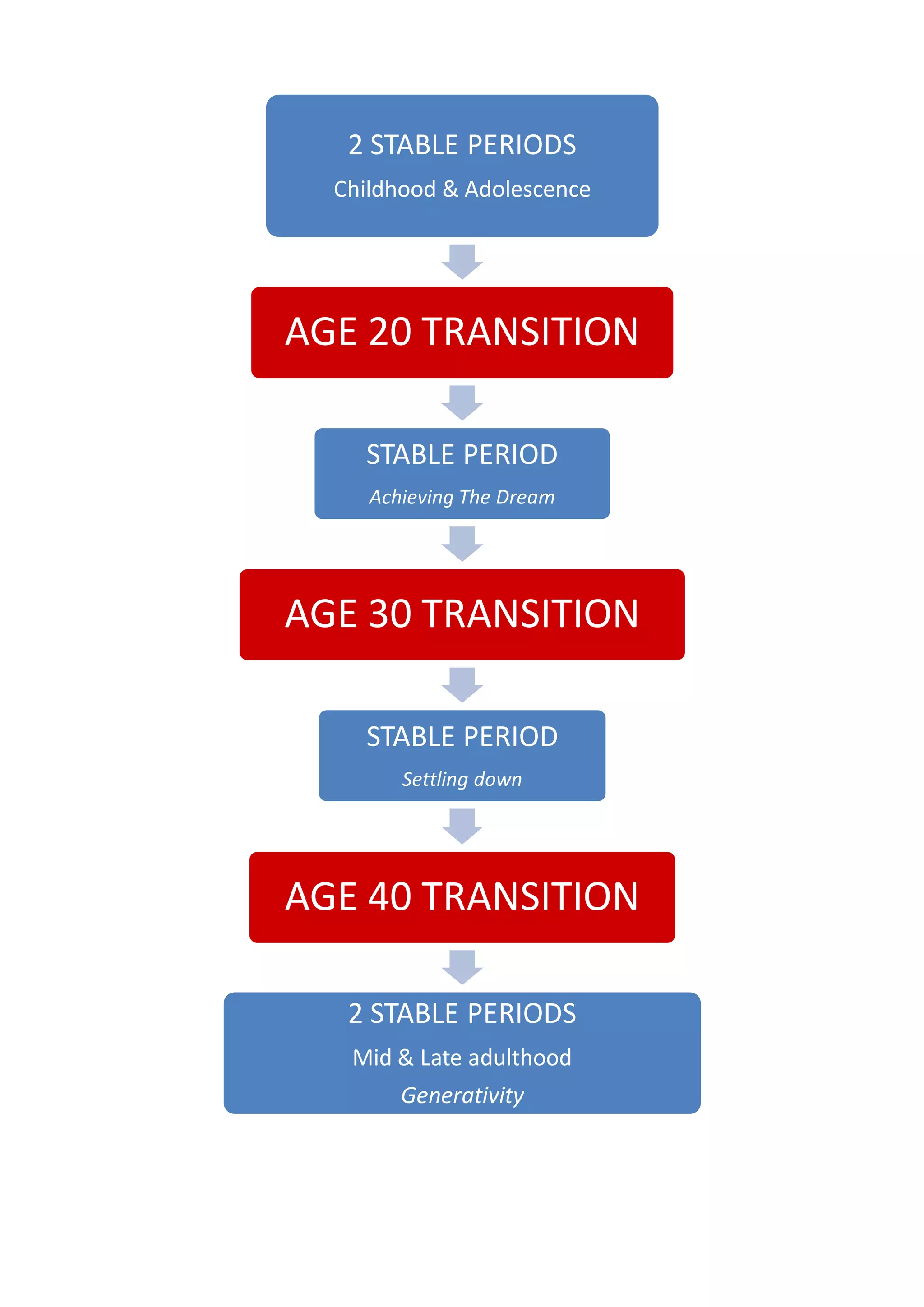

Levinson's theory proposes six life stages from childhood to late adulthood. Each stage is separated by a transition period. The two key concepts are stable periods, when crucial life choices are made, and transitional periods, when one's life commitments often change between stages. A stable period focuses on working towards one's "dream" career and family goals. Transitional periods involve questioning one's path and making adjustments. Levinson later adapted the theory to account for gender differences in dreams and priorities through the stages.


![Raymond cattell [autosaved]](https://cdn.slidesharecdn.com/ss_thumbnails/raymondcattellautosaved-190113045031-thumbnail.jpg?width=640&height=640&fit=bounds)


