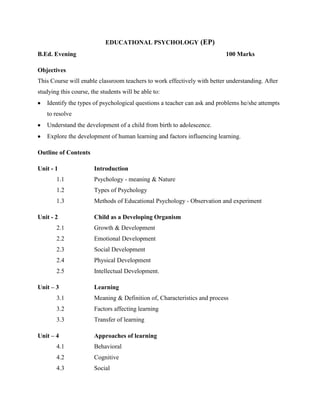
EDUCATIONAL PSYCHOLOGY (EP)
B.Ed. Evening                                                             100 Marks

Objectives
This Course will enable classroom teachers to work effectively with better understanding. After
studying this course, the students will be able to:
   Identify the types of psychological questions a teacher can ask and problems he/she attempts
   to resolve
   Understand the development of a child from birth to adolescence.
   Explore the development of human learning and factors influencing learning.

Outline of Contents

Unit - 1               Introduction
       1.1             Psychology - meaning & Nature
       1.2             Types of Psychology
       1.3             Methods of Educational Psychology - Observation and experiment

Unit - 2               Child as a Developing Organism
       2.1             Growth & Development
       2.2             Emotional Development
       2.3             Social Development
       2.4             Physical Development
       2.5             Intellectual Development.

Unit – 3               Learning
       3.1             Meaning & Definition of, Characteristics and process
       3.2             Factors affecting learning
       3.3             Transfer of learning

Unit – 4               Approaches of learning
       4.1             Behavioral
       4.2             Cognitive
       4.3             Social
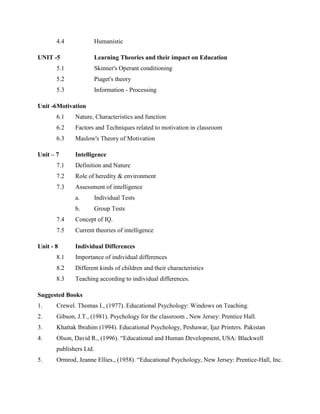
4.4               Humanistic

UNIT -5                  Learning Theories and their impact on Education
       5.1               Skinner's Operant conditioning
       5.2               Piaget's theory
       5.3               Information - Processing

Unit -6Motivation
       6.1    Nature, Characteristics and function
       6.2    Factors and Techniques related to motivation in classroom
       6.3    Maslow's Theory of Motivation

Unit – 7      Intelligence
       7.1    Definition and Nature
       7.2    Role of heredity & environment
       7.3    Assessment of intelligence
              a.         Individual Tests
              b.         Group Tests
       7.4    Concept of IQ.
       7.5    Current theories of intelligence

Unit - 8      Individual Differences
       8.1    Importance of individual differences
       8.2    Different kinds of children and their characteristics
       8.3    Teaching according to individual differences.

Suggested Books
1.     Crewel. Thomas I., (1977). Educational Psychology: Windows on Teaching.
2.     Gibson, J.T., (1981). Psychology for the classroom , New Jersey: Prentice Hall.
3.     Khattak Ibrahim (1994). Educational Psychology, Peshawar, Ijaz Printers. Pakistan
4.     Olson, David R., (1996). “Educational and Human Development, USA: Blackwell
       publishers Ltd.
5.     Ormrod, Jeanne Ellies., (1958). “Educational Psychology, New Jersey: Prentice-Hall, Inc.
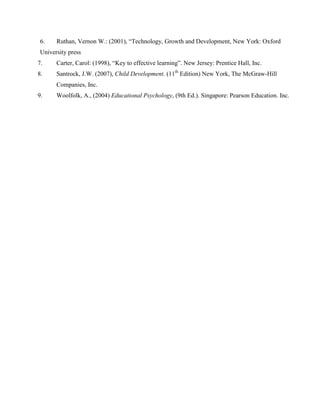
6.    Ruthan, Vernon W.: (2001), “Technology, Growth and Development, New York: Oxford
 University press
7.     Carter, Carol: (1998), “Key to effective learning”. New Jersey: Prentice Hall, Inc.
8.     Santrock, J.W. (2007), Child Development. (11th Edition) New York, The McGraw-Hill
       Companies, Inc.
9.     Woolfolk, A., (2004) Educational Psychology, (9th Ed.). Singapore: Pearson Education. Inc.
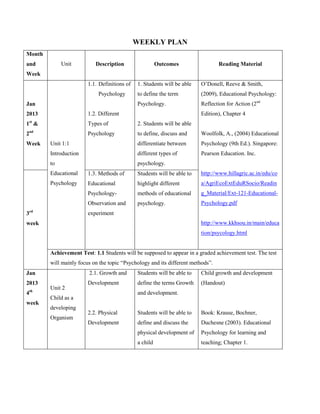
WEEKLY PLAN
Month
and          Unit          Description                  Outcomes                 Reading Material
Week
                        1.1. Definitions of   1. Students will be able   O’Donell, Reeve & Smith,
                            Psychology        to define the term         (2009), Educational Psychology:
Jan                                           Psychology.                Reflection for Action (2nd
2013                    1.2. Different                                   Edition), Chapter 4
 st
1 &                     Types of              2. Students will be able
2nd                     Psychology            to define, discuss and     Woolfolk, A., (2004) Educational
Week    Unit 1:1                              differentiate between      Psychology (9th Ed.). Singapore:
        Introduction                          different types of         Pearson Education. Inc.
        to                                    psychology.
        Educational     1.3. Methods of       Students will be able to   http://www.hillagric.ac.in/edu/co
        Psychology      Educational           highlight different        a/AgriEcoExtEduRSocio/Readin
                        Psychology-           methods of educational     g_Material/Ext-121-Educational-
                        Observation and       psychology.                Psychology.pdf
3rd                     experiment
week                                                                     http://www.kkhsou.in/main/educa
                                                                         tion/psycology.html


        Achievement Test: 1.1 Students will be supposed to appear in a graded achievement test. The test
        will mainly focus on the topic “Psychology and its different methods”.
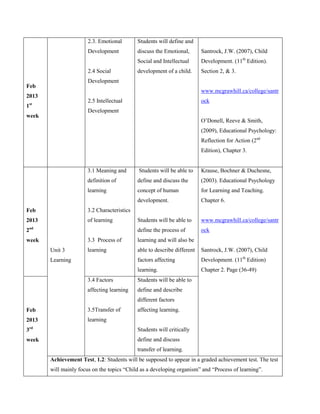
Jan                     2.1. Growth and       Students will be able to   Child growth and development
2013                    Development           define the terms Growth    (Handout)
 th
        Unit 2
4                                             and development.
        Child as a
week
        developing
                        2.2. Physical         Students will be able to   Book: Krause, Bochner,
        Organism
                        Development           define and discuss the     Duchesne (2003). Educational
                                              physical development of    Psychology for learning and
                                              a child                    teaching; Chapter 1.
2.3. Emotional       Students will define and
                       Development          discuss the Emotional,       Santrock, J.W. (2007), Child
                                            Social and Intellectual      Development. (11th Edition).
                       2.4 Social           development of a child.      Section 2, & 3.
                       Development
Feb
                                                                         www.mcgrawhill.ca/college/santr
2013
                       2.5 Intellectual                                  ock
1st
                       Development
week
                                                                         O’Donell, Reeve & Smith,
                                                                         (2009), Educational Psychology:
                                                                         Reflection for Action (2nd
                                                                         Edition), Chapter 3.


                      3.1 Meaning and        Students will be able to    Krause, Bochner & Duchesne,
                      definition of         define and discuss the       (2003). Educational Psychology
                      learning              concept of human             for Learning and Teaching.
                                            development.                 Chapter 6.
Feb                   3.2 Characteristics
2013                  of learning           Students will be able to     www.mcgrawhill.ca/college/santr
 nd
2                                           define the process of        ock
week                  3.3 Process of        learning and will also be
       Unit 3         learning              able to describe different   Santrock, J.W. (2007), Child
       Learning                             factors affecting            Development. (11th Edition)
                                            learning.                    Chapter 2. Page (36-49)
                      3.4 Factors           Students will be able to
                      affecting learning    define and describe
                                            different factors
Feb                   3.5Transfer of        affecting learning.
2013                  learning
3rd                                         Students will critically
week                                        define and discuss
                                            transfer of learning.
       Achievement Test, 1.2: Students will be supposed to appear in a graded achievement test. The test
       will mainly focus on the topics “Child as a developing organism” and “Process of learning”.
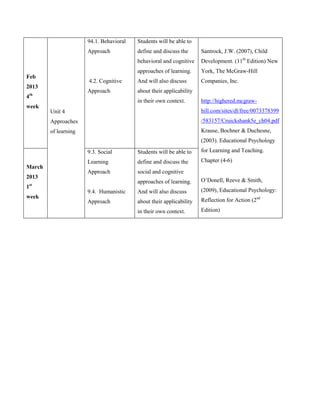
94.1. Behavioral   Students will be able to
                      Approach           define and discuss the      Santrock, J.W. (2007), Child
                                         behavioral and cognitive    Development. (11th Edition) New
                                         approaches of learning.     York, The McGraw-Hill
Feb
                      4.2. Cognitive     And will also discuss       Companies, Inc.
2013
                      Approach           about their applicability
4th
                                         in their own context.       http://highered.mcgraw-
week
        Unit 4                                                       hill.com/sites/dl/free/0073378399
        Approaches                                                   /583157/Cruickshank5e_ch04.pdf
        of learning                                                  Krause, Bochner & Duchesne,
                                                                     (2003). Educational Psychology
                      9.3. Social        Students will be able to    for Learning and Teaching.
                      Learning           define and discuss the      Chapter (4-6)
March
                      Approach           social and cognitive
2013
                                         approaches of learning.     O’Donell, Reeve & Smith,
1st
                      9.4. Humanistic    And will also discuss       (2009), Educational Psychology:
week
                      Approach           about their applicability   Reflection for Action (2nd
                                         in their own context.       Edition)
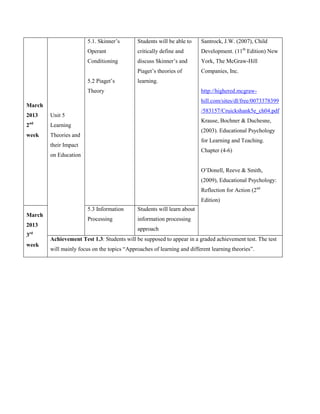
5.1. Skinner’s        Students will be able to    Santrock, J.W. (2007), Child
                        Operant               critically define and       Development. (11th Edition) New
                        Conditioning          discuss Skinner’s and       York, The McGraw-Hill
                                              Piaget’s theories of        Companies, Inc.
                        5.2 Piaget’s          learning.
                        Theory                                            http://highered.mcgraw-
                                                                          hill.com/sites/dl/free/0073378399
March
                                                                          /583157/Cruickshank5e_ch04.pdf
2013    Unit 5
                                                                          Krause, Bochner & Duchesne,
2nd     Learning
                                                                          (2003). Educational Psychology
week    Theories and
                                                                          for Learning and Teaching.
        their Impact
                                                                          Chapter (4-6)
        on Education

                                                                          O’Donell, Reeve & Smith,
                                                                          (2009), Educational Psychology:
                                                                          Reflection for Action (2nd
                                                                          Edition)
                        5.3 Information       Students will learn about
March
                        Processing            information processing
2013
                                              approach
3rd
        Achievement Test 1.3: Students will be supposed to appear in a graded achievement test. The test
week
        will mainly focus on the topics “Approaches of learning and different learning theories”.
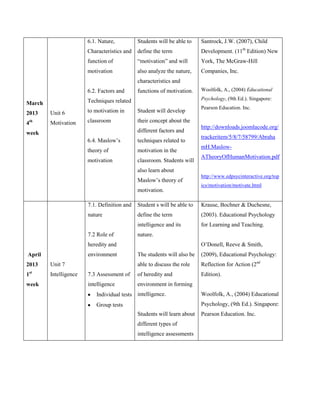
6.1. Nature,          Students will be able to    Santrock, J.W. (2007), Child
                       Characteristics and   define the term             Development. (11th Edition) New
                       function of           “motivation” and will       York, The McGraw-Hill
                       motivation            also analyze the nature,    Companies, Inc.
                                             characteristics and
                       6.2. Factors and      functions of motivation.    Woolfolk, A., (2004) Educational

                       Techniques related                                Psychology, (9th Ed.). Singapore:
March
                                                                         Pearson Education. Inc.
2013    Unit 6         to motivation in      Student will develop

4th     Motivation     classroom             their concept about the
                                                                         http://downloads.joomlacode.org/
week                                         different factors and
                                                                         trackeritem/5/8/7/58799/Abraha
                       6.4. Maslow’s         techniques related to
                                                                         mH.Maslow-
                       theory of             motivation in the
                                                                         ATheoryOfHumanMotivation.pdf
                       motivation            classroom. Students will
                                             also learn about
                                                                         http://www.edpsycinteractive.org/top
                                             Maslow’s theory of
                                                                         ics/motivation/motivate.html
                                             motivation.

                       7.1. Definition and   Student s will be able to   Krause, Bochner & Duchesne,
                       nature                define the term             (2003). Educational Psychology
                                             intelligence and its        for Learning and Teaching.
                       7.2 Role of           nature.
                       heredity and                                      O’Donell, Reeve & Smith,
April                  environment           The students will also be   (2009), Educational Psychology:
2013    Unit 7                               able to discuss the role    Reflection for Action (2nd
1st     Intelligence   7.3 Assessment of     of heredity and             Edition).
week                   intelligence          environment in forming
                          Individual tests intelligence.                 Woolfolk, A., (2004) Educational
                          Group tests                                    Psychology, (9th Ed.). Singapore:
                                             Students will learn about   Pearson Education. Inc.
                                             different types of
                                             intelligence assessments
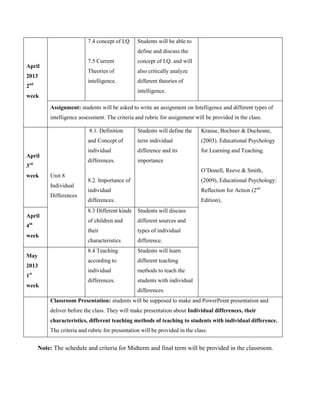
7.4 concept of I.Q    Students will be able to
                                                 define and discuss the
                           7.5 Current           concept of I.Q. and will
April
                           Theories of           also critically analyze
2013
                           intelligence.         different theories of
2nd
                                                 intelligence.
week

          Assignment: students will be asked to write an assignment on Intelligence and different types of
          intelligence assessment. The criteria and rubric for assignment will be provided in the class.

                           8.1. Definition       Students will define the     Krause, Bochner & Duchesne,
                           and Concept of        term individual              (2003). Educational Psychology
                           individual            difference and its           for Learning and Teaching.
April
                           differences.          importance
3rd
                                                                              O’Donell, Reeve & Smith,
week      Unit 8
                           8.2. Importance of                                 (2009), Educational Psychology:
          Individual
                           individual                                         Reflection for Action (2nd
          Differences
                           differences.                                       Edition),
                           8.3 Different kinds   Students will discuss
April
                           of children and       different sources and
4th
                           their                 types of individual
week
                           characteristics       difference.
                           8.4 Teaching          Students will learn
May
                           according to          different teaching
2013
                           individual            methods to teach the
1st
                           differences.          students with individual
week
                                                 differences.
          Classroom Presentation: students will be supposed to make and PowerPoint presentation and
          deliver before the class. They will make presentation about Individual differences, their
          characteristics, different teaching methods of teaching to students with individual difference.
          The criteria and rubric for presentation will be provided in the class.


      Note: The schedule and criteria for Midterm and final term will be provided in the classroom.

Educational psychology b.ed. evening-weekly plan

  • 1.
    EDUCATIONAL PSYCHOLOGY (EP) B.Ed.Evening 100 Marks Objectives This Course will enable classroom teachers to work effectively with better understanding. After studying this course, the students will be able to: Identify the types of psychological questions a teacher can ask and problems he/she attempts to resolve Understand the development of a child from birth to adolescence. Explore the development of human learning and factors influencing learning. Outline of Contents Unit - 1 Introduction 1.1 Psychology - meaning & Nature 1.2 Types of Psychology 1.3 Methods of Educational Psychology - Observation and experiment Unit - 2 Child as a Developing Organism 2.1 Growth & Development 2.2 Emotional Development 2.3 Social Development 2.4 Physical Development 2.5 Intellectual Development. Unit – 3 Learning 3.1 Meaning & Definition of, Characteristics and process 3.2 Factors affecting learning 3.3 Transfer of learning Unit – 4 Approaches of learning 4.1 Behavioral 4.2 Cognitive 4.3 Social
  • 2.
    4.4 Humanistic UNIT -5 Learning Theories and their impact on Education 5.1 Skinner's Operant conditioning 5.2 Piaget's theory 5.3 Information - Processing Unit -6Motivation 6.1 Nature, Characteristics and function 6.2 Factors and Techniques related to motivation in classroom 6.3 Maslow's Theory of Motivation Unit – 7 Intelligence 7.1 Definition and Nature 7.2 Role of heredity & environment 7.3 Assessment of intelligence a. Individual Tests b. Group Tests 7.4 Concept of IQ. 7.5 Current theories of intelligence Unit - 8 Individual Differences 8.1 Importance of individual differences 8.2 Different kinds of children and their characteristics 8.3 Teaching according to individual differences. Suggested Books 1. Crewel. Thomas I., (1977). Educational Psychology: Windows on Teaching. 2. Gibson, J.T., (1981). Psychology for the classroom , New Jersey: Prentice Hall. 3. Khattak Ibrahim (1994). Educational Psychology, Peshawar, Ijaz Printers. Pakistan 4. Olson, David R., (1996). “Educational and Human Development, USA: Blackwell publishers Ltd. 5. Ormrod, Jeanne Ellies., (1958). “Educational Psychology, New Jersey: Prentice-Hall, Inc.
  • 3.
    6. Ruthan, Vernon W.: (2001), “Technology, Growth and Development, New York: Oxford University press 7. Carter, Carol: (1998), “Key to effective learning”. New Jersey: Prentice Hall, Inc. 8. Santrock, J.W. (2007), Child Development. (11th Edition) New York, The McGraw-Hill Companies, Inc. 9. Woolfolk, A., (2004) Educational Psychology, (9th Ed.). Singapore: Pearson Education. Inc.
  • 4.
    WEEKLY PLAN Month and Unit Description Outcomes Reading Material Week 1.1. Definitions of 1. Students will be able O’Donell, Reeve & Smith, Psychology to define the term (2009), Educational Psychology: Jan Psychology. Reflection for Action (2nd 2013 1.2. Different Edition), Chapter 4 st 1 & Types of 2. Students will be able 2nd Psychology to define, discuss and Woolfolk, A., (2004) Educational Week Unit 1:1 differentiate between Psychology (9th Ed.). Singapore: Introduction different types of Pearson Education. Inc. to psychology. Educational 1.3. Methods of Students will be able to http://www.hillagric.ac.in/edu/co Psychology Educational highlight different a/AgriEcoExtEduRSocio/Readin Psychology- methods of educational g_Material/Ext-121-Educational- Observation and psychology. Psychology.pdf 3rd experiment week http://www.kkhsou.in/main/educa tion/psycology.html Achievement Test: 1.1 Students will be supposed to appear in a graded achievement test. The test will mainly focus on the topic “Psychology and its different methods”. Jan 2.1. Growth and Students will be able to Child growth and development 2013 Development define the terms Growth (Handout) th Unit 2 4 and development. Child as a week developing 2.2. Physical Students will be able to Book: Krause, Bochner, Organism Development define and discuss the Duchesne (2003). Educational physical development of Psychology for learning and a child teaching; Chapter 1.
  • 5.
    2.3. Emotional Students will define and Development discuss the Emotional, Santrock, J.W. (2007), Child Social and Intellectual Development. (11th Edition). 2.4 Social development of a child. Section 2, & 3. Development Feb www.mcgrawhill.ca/college/santr 2013 2.5 Intellectual ock 1st Development week O’Donell, Reeve & Smith, (2009), Educational Psychology: Reflection for Action (2nd Edition), Chapter 3. 3.1 Meaning and Students will be able to Krause, Bochner & Duchesne, definition of define and discuss the (2003). Educational Psychology learning concept of human for Learning and Teaching. development. Chapter 6. Feb 3.2 Characteristics 2013 of learning Students will be able to www.mcgrawhill.ca/college/santr nd 2 define the process of ock week 3.3 Process of learning and will also be Unit 3 learning able to describe different Santrock, J.W. (2007), Child Learning factors affecting Development. (11th Edition) learning. Chapter 2. Page (36-49) 3.4 Factors Students will be able to affecting learning define and describe different factors Feb 3.5Transfer of affecting learning. 2013 learning 3rd Students will critically week define and discuss transfer of learning. Achievement Test, 1.2: Students will be supposed to appear in a graded achievement test. The test will mainly focus on the topics “Child as a developing organism” and “Process of learning”.
  • 6.
    94.1. Behavioral Students will be able to Approach define and discuss the Santrock, J.W. (2007), Child behavioral and cognitive Development. (11th Edition) New approaches of learning. York, The McGraw-Hill Feb 4.2. Cognitive And will also discuss Companies, Inc. 2013 Approach about their applicability 4th in their own context. http://highered.mcgraw- week Unit 4 hill.com/sites/dl/free/0073378399 Approaches /583157/Cruickshank5e_ch04.pdf of learning Krause, Bochner & Duchesne, (2003). Educational Psychology 9.3. Social Students will be able to for Learning and Teaching. Learning define and discuss the Chapter (4-6) March Approach social and cognitive 2013 approaches of learning. O’Donell, Reeve & Smith, 1st 9.4. Humanistic And will also discuss (2009), Educational Psychology: week Approach about their applicability Reflection for Action (2nd in their own context. Edition)
  • 7.
    5.1. Skinner’s Students will be able to Santrock, J.W. (2007), Child Operant critically define and Development. (11th Edition) New Conditioning discuss Skinner’s and York, The McGraw-Hill Piaget’s theories of Companies, Inc. 5.2 Piaget’s learning. Theory http://highered.mcgraw- hill.com/sites/dl/free/0073378399 March /583157/Cruickshank5e_ch04.pdf 2013 Unit 5 Krause, Bochner & Duchesne, 2nd Learning (2003). Educational Psychology week Theories and for Learning and Teaching. their Impact Chapter (4-6) on Education O’Donell, Reeve & Smith, (2009), Educational Psychology: Reflection for Action (2nd Edition) 5.3 Information Students will learn about March Processing information processing 2013 approach 3rd Achievement Test 1.3: Students will be supposed to appear in a graded achievement test. The test week will mainly focus on the topics “Approaches of learning and different learning theories”.
  • 8.
    6.1. Nature, Students will be able to Santrock, J.W. (2007), Child Characteristics and define the term Development. (11th Edition) New function of “motivation” and will York, The McGraw-Hill motivation also analyze the nature, Companies, Inc. characteristics and 6.2. Factors and functions of motivation. Woolfolk, A., (2004) Educational Techniques related Psychology, (9th Ed.). Singapore: March Pearson Education. Inc. 2013 Unit 6 to motivation in Student will develop 4th Motivation classroom their concept about the http://downloads.joomlacode.org/ week different factors and trackeritem/5/8/7/58799/Abraha 6.4. Maslow’s techniques related to mH.Maslow- theory of motivation in the ATheoryOfHumanMotivation.pdf motivation classroom. Students will also learn about http://www.edpsycinteractive.org/top Maslow’s theory of ics/motivation/motivate.html motivation. 7.1. Definition and Student s will be able to Krause, Bochner & Duchesne, nature define the term (2003). Educational Psychology intelligence and its for Learning and Teaching. 7.2 Role of nature. heredity and O’Donell, Reeve & Smith, April environment The students will also be (2009), Educational Psychology: 2013 Unit 7 able to discuss the role Reflection for Action (2nd 1st Intelligence 7.3 Assessment of of heredity and Edition). week intelligence environment in forming Individual tests intelligence. Woolfolk, A., (2004) Educational Group tests Psychology, (9th Ed.). Singapore: Students will learn about Pearson Education. Inc. different types of intelligence assessments
  • 9.
    7.4 concept ofI.Q Students will be able to define and discuss the 7.5 Current concept of I.Q. and will April Theories of also critically analyze 2013 intelligence. different theories of 2nd intelligence. week Assignment: students will be asked to write an assignment on Intelligence and different types of intelligence assessment. The criteria and rubric for assignment will be provided in the class. 8.1. Definition Students will define the Krause, Bochner & Duchesne, and Concept of term individual (2003). Educational Psychology individual difference and its for Learning and Teaching. April differences. importance 3rd O’Donell, Reeve & Smith, week Unit 8 8.2. Importance of (2009), Educational Psychology: Individual individual Reflection for Action (2nd Differences differences. Edition), 8.3 Different kinds Students will discuss April of children and different sources and 4th their types of individual week characteristics difference. 8.4 Teaching Students will learn May according to different teaching 2013 individual methods to teach the 1st differences. students with individual week differences. Classroom Presentation: students will be supposed to make and PowerPoint presentation and deliver before the class. They will make presentation about Individual differences, their characteristics, different teaching methods of teaching to students with individual difference. The criteria and rubric for presentation will be provided in the class. Note: The schedule and criteria for Midterm and final term will be provided in the classroom.