NURSING RESEARCH
DEEPA
Review:
Problem solving and
scientific method.
Research –definition, characteristics, purposes, types of
research, Basic research terms, Scope of nursing research,
Overview of Research process, Significance of research in
nursing, Historical Evolution of nursing research.
 Future trends in nursing research.
 Problems and challenges in nursing research, health and
social research.
 Priorities for nursing research.
 Evidence based practice.
 Ethics in research

UNIT I Introduction to Research
 Looking for new knowledge, doing something
new ??
 Looking for facts
 Measuring phenomenon, health states,
including health and disease
 Developing new – materials, products including
drugs, processes, designs….
 New models of delivery of health services
What is research??
 Organised investigation of a problem
 French word - re- cerche “ to search again”
 A careful investigation or inquiry
MEANING- RESEARCH
• John Graunt – “Natural and Political
Observations Made upon the Bills of
Mortality” (1662) ‐ he was a trader of
tailoring items ‐ but became father
of demography and epidemiology.
• Your need
• Interest
• Questioning bent of mind
• Know techniques and how to apply them
• Patience and perseverance
• Objectivity and open mind
• Writing skills
Research is not difficult –anyone can do it
 A systematic and objective analysis and
recording of controlled observation that may
lead to the development of generalisation of
principles, theories, resulting in prediction and
possible ultimate control of events
 J. W. BEST
Definition
 It is a careful inquiry or examination seeking
facts or principles , a diligent investigation
to ascertain something
 CLIFFORD WOODY
Definition
 It is an attempt to gain solutions to problems;
more precisely it is the collection of data in a
rigorously controlled situation for the
purpose of prediction or explanation
 TREECE AND TREECE
Definition
• Discovery – finding what existed
• Inventions – new produce development that did
not exist in nature
• Innovation – new ways to solve old problems
• Development – after invention to useful
products and services
• Testing new and old products/drugs and
services
• Evaluation of programs – wider outcomes and
impacts, including unintended outcomes.
Research terms
Observations, Research and Science relationship
• Observations and thinking are basis for scientific development
• Archimedes’s observations on water displaced in the bath tub –
volume, density… principles of floating bodies ‐ 250 BC.
• Renaissance (14‐17th centuries) was spearheaded by systematic
observations of natural processes ‐> new thinking, writing, and
correlating observations and theory
• Galileo's observations on pendulum’s movement ‐
>measurement of time, Telescope ‐> planetary bodies….
• Newton's observation on apple falling ‐> gravitation
• Before that Indian scientists observed, developed theories and
written down… but forgotten…Arya Bhatt, Panini, ……
• Observations, thinking, documentations, experimentation further
development of theory, application to practice….. Basis of science
History of research :
It is the
systematic
inquiry designe
d to
develop
trustwor
thy
evidenc
e
about issues
of
importance
to the
nursing
profession,
including
nursin
g
practic
e,
educat
ion,
adminis
tration,
and
informa
tics.
POLI
T
AND
BECK,
2021
NURSING RESEARCH
 It is a systematic approach to the solution or
alleviation of problems characterised by
sequential execution of the following
observation through action processes
PROBLEM SOLVING
 Inductive
 Deductive
 Analytic
 Synthetic
Approaches of problem solving
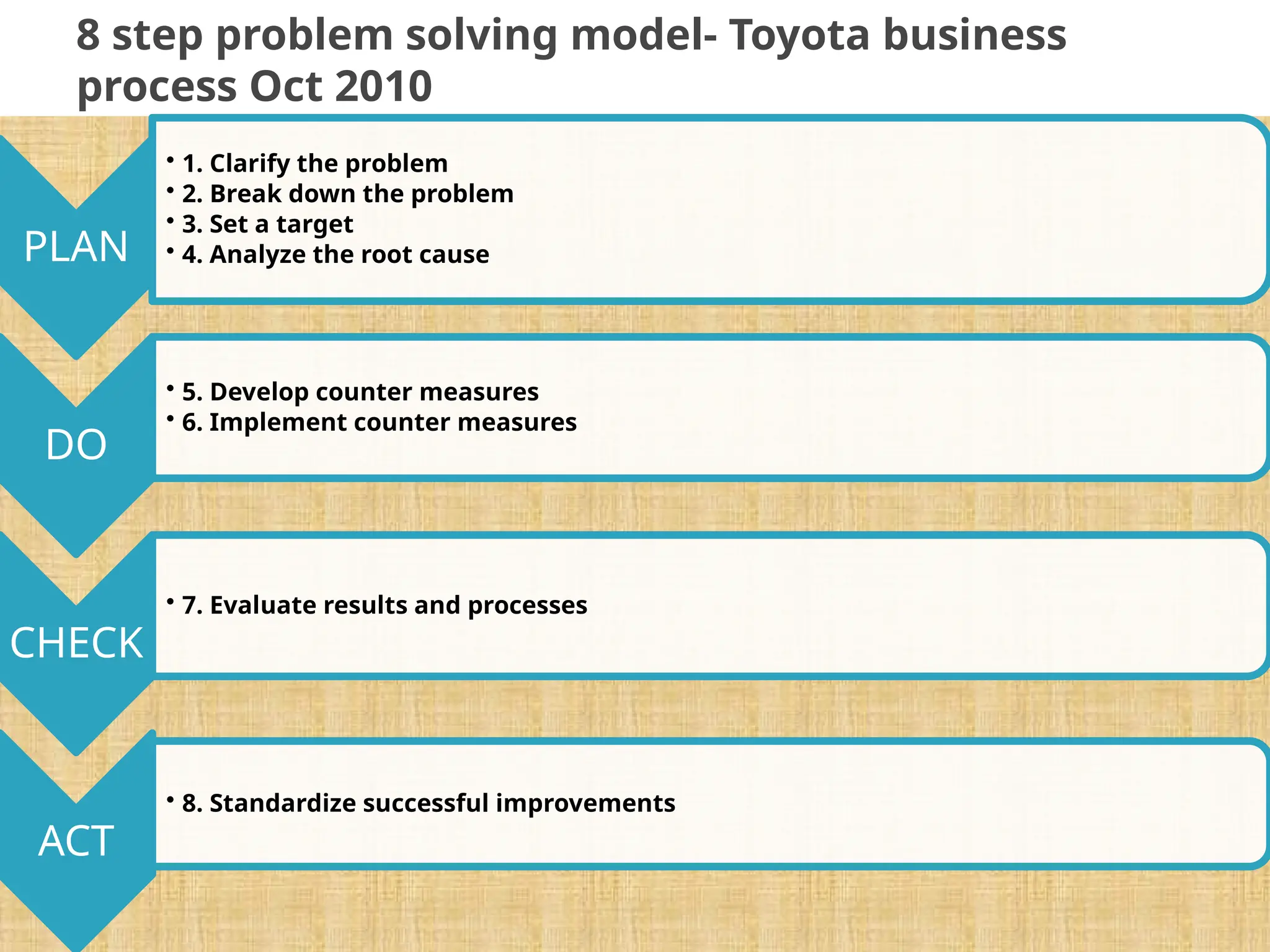
PLAN
• 1. Clarify the problem
• 2. Break down the problem
• 3. Set a target
• 4. Analyze the root cause
DO
• 5. Develop counter measures
• 6. Implement counter measures
CHECK
• 7. Evaluate results and processes
ACT
• 8. Standardize successful improvements
8 step problem solving model- Toyota business
process Oct 2010
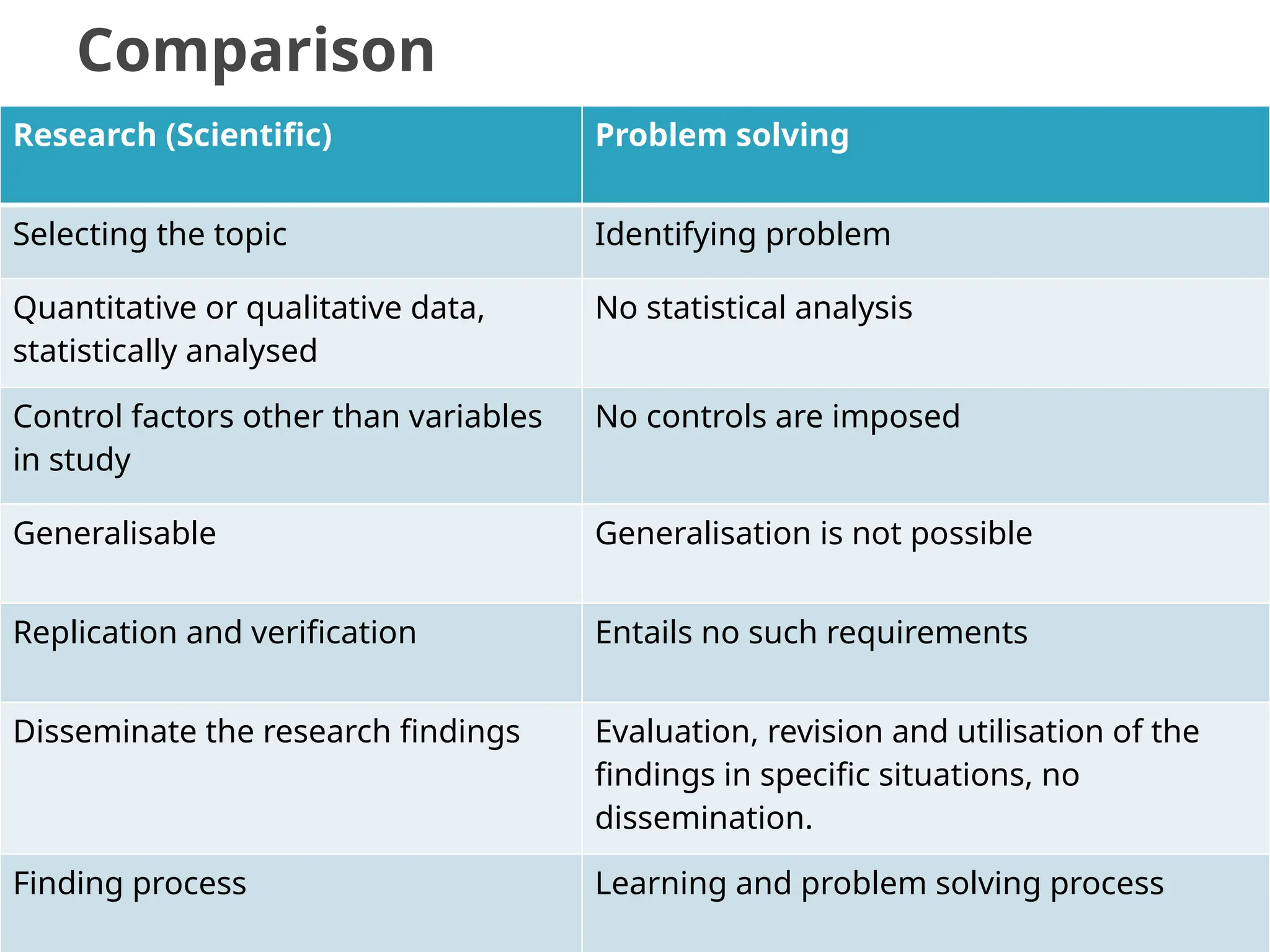
Research (Scientific) Problem solving
Selecting the topic Identifying problem
Quantitative or qualitative data,
statistically analysed
No statistical analysis
Control factors other than variables
in study
No controls are imposed
Generalisable Generalisation is not possible
Replication and verification Entails no such requirements
Disseminate the research findings Evaluation, revision and utilisation of the
findings in specific situations, no
dissemination.
Finding process Learning and problem solving process
Comparison
Specific problem-
recognize, select
& state
Defining
Collecting relevant
information
Formulation of
hypothesis / solutions
Evaluation of
hypothesis
Verifying validity
Choosing alternatives
if unsuccessful or till
successful
Steps
Generation of knowledge
Problem solving
Demands accurate observation and description
Originality
Empirical
Logical
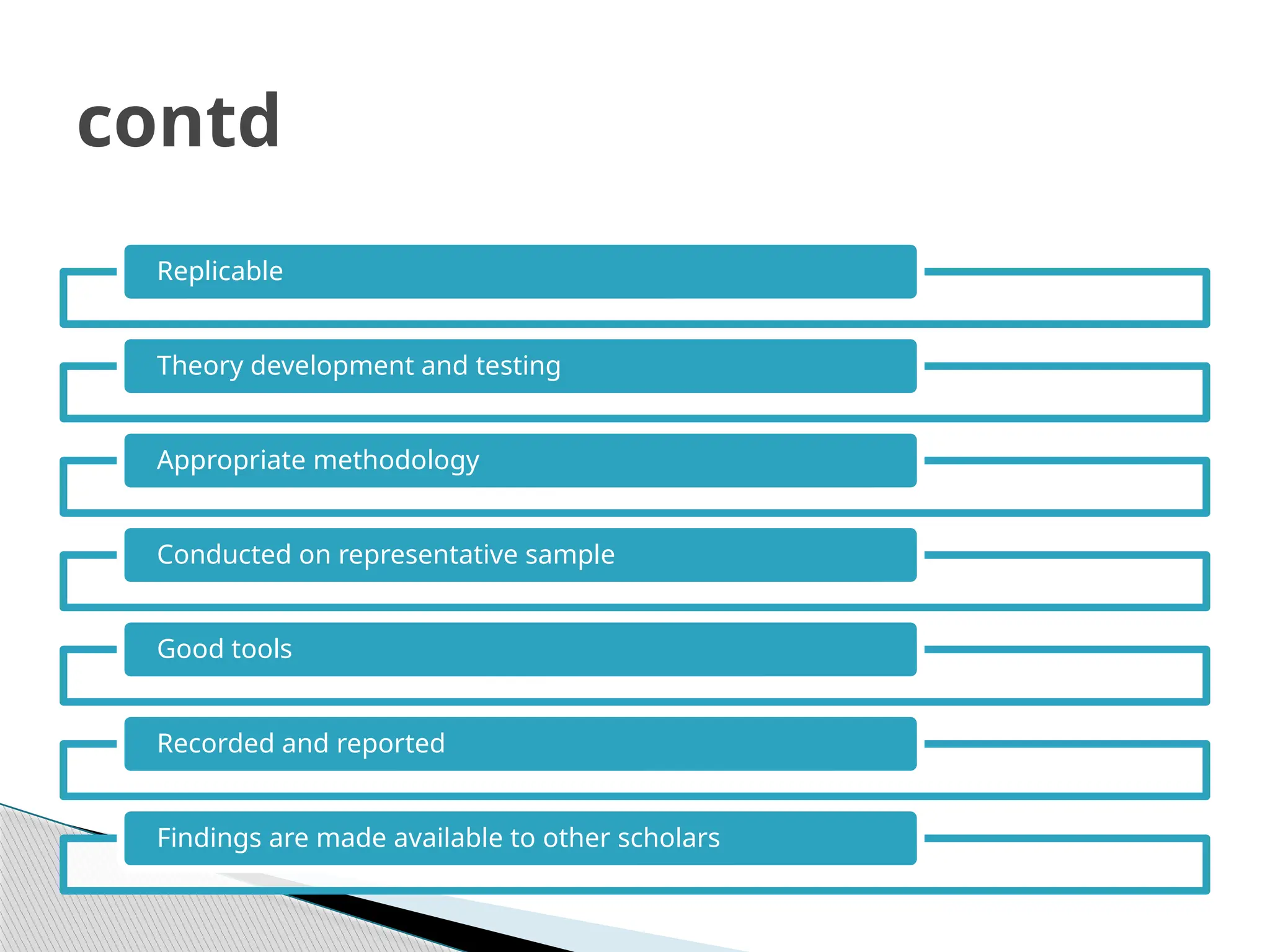
Characteristics of good research
Replicable
Theory development and testing
Appropriate methodology
Conducted on representative sample
Good tools
Recorded and reported
Findings are made available to other scholars
contd
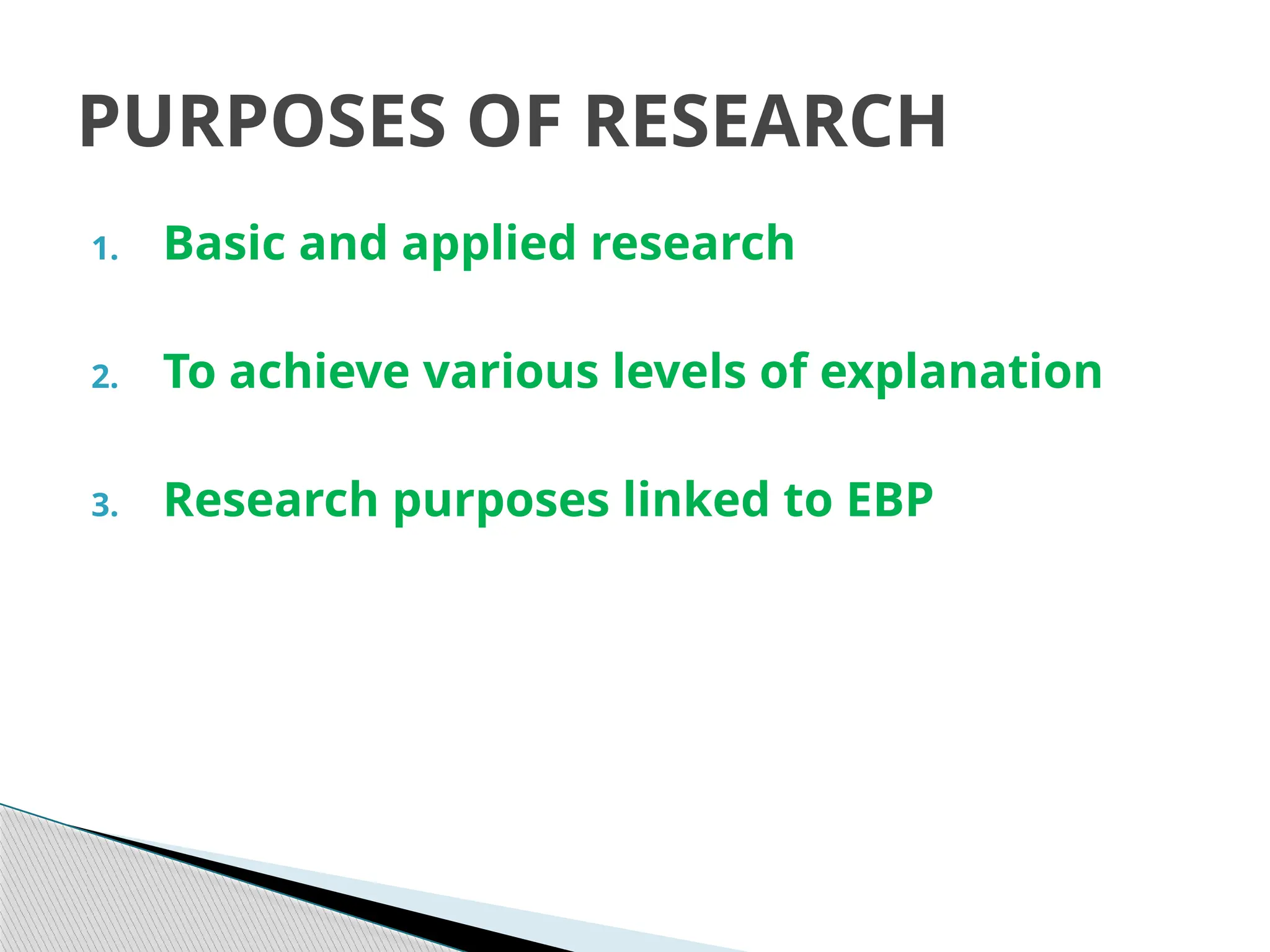
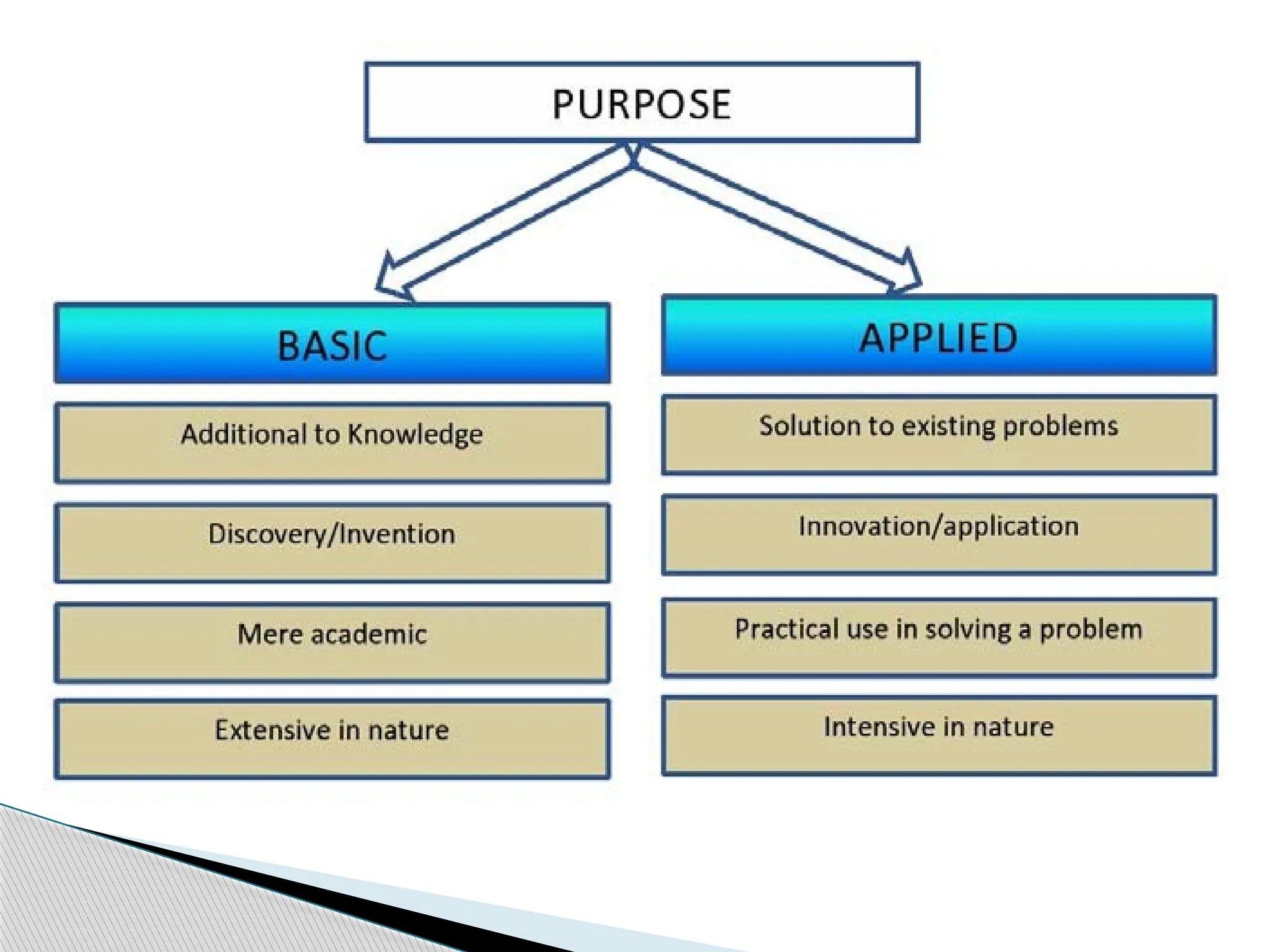
1. Basic and applied research
2. To achieve various levels of explanation
3. Research purposes linked to EBP
PURPOSES OF RESEARCH
 Description
 Exploration
 Explanation
 Prediction and control
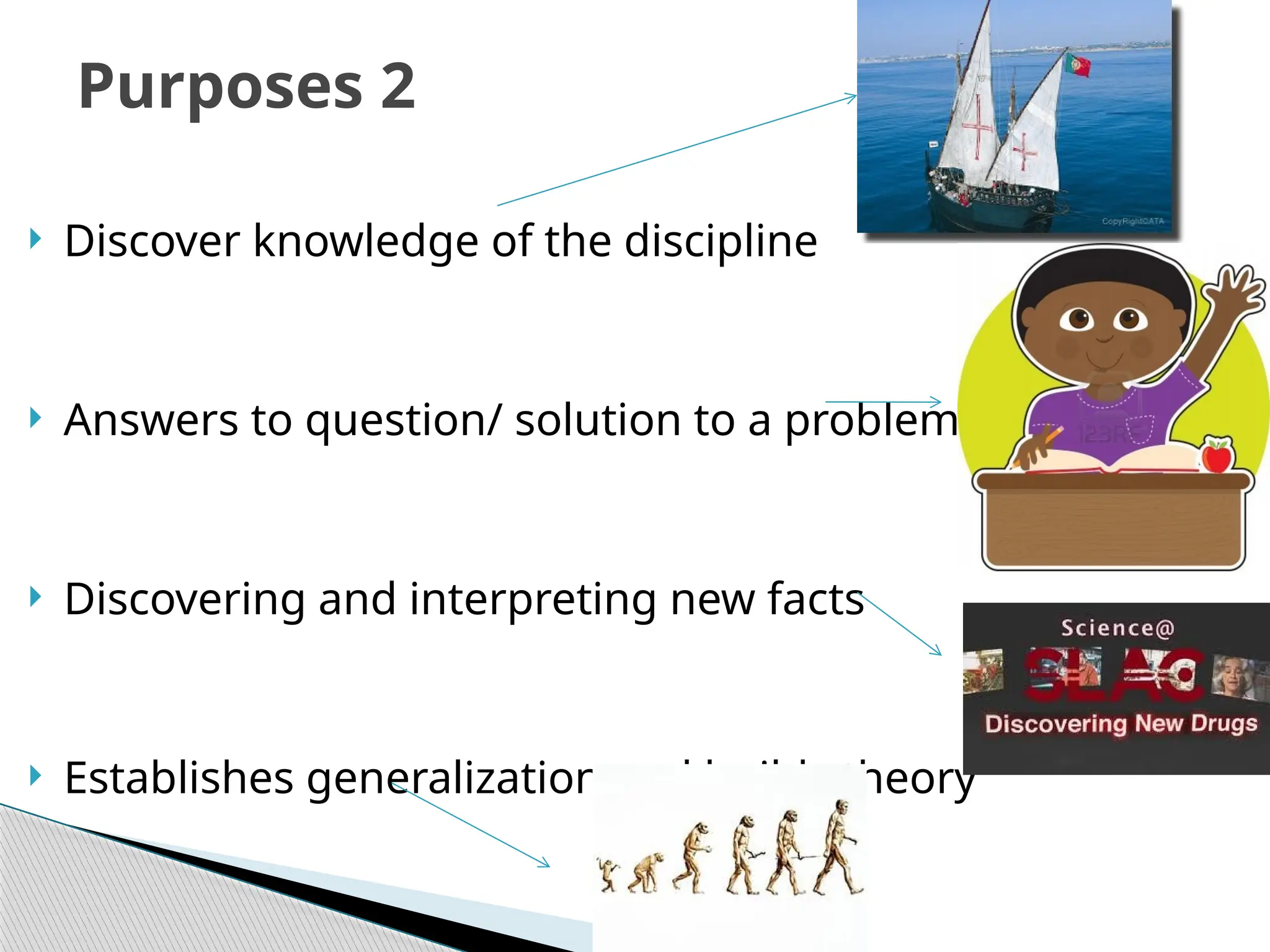
Purposes 1
 Discover knowledge of the discipline
 Answers to question/ solution to a problem
 Discovering and interpreting new facts
 Establishes generalization and builds theory
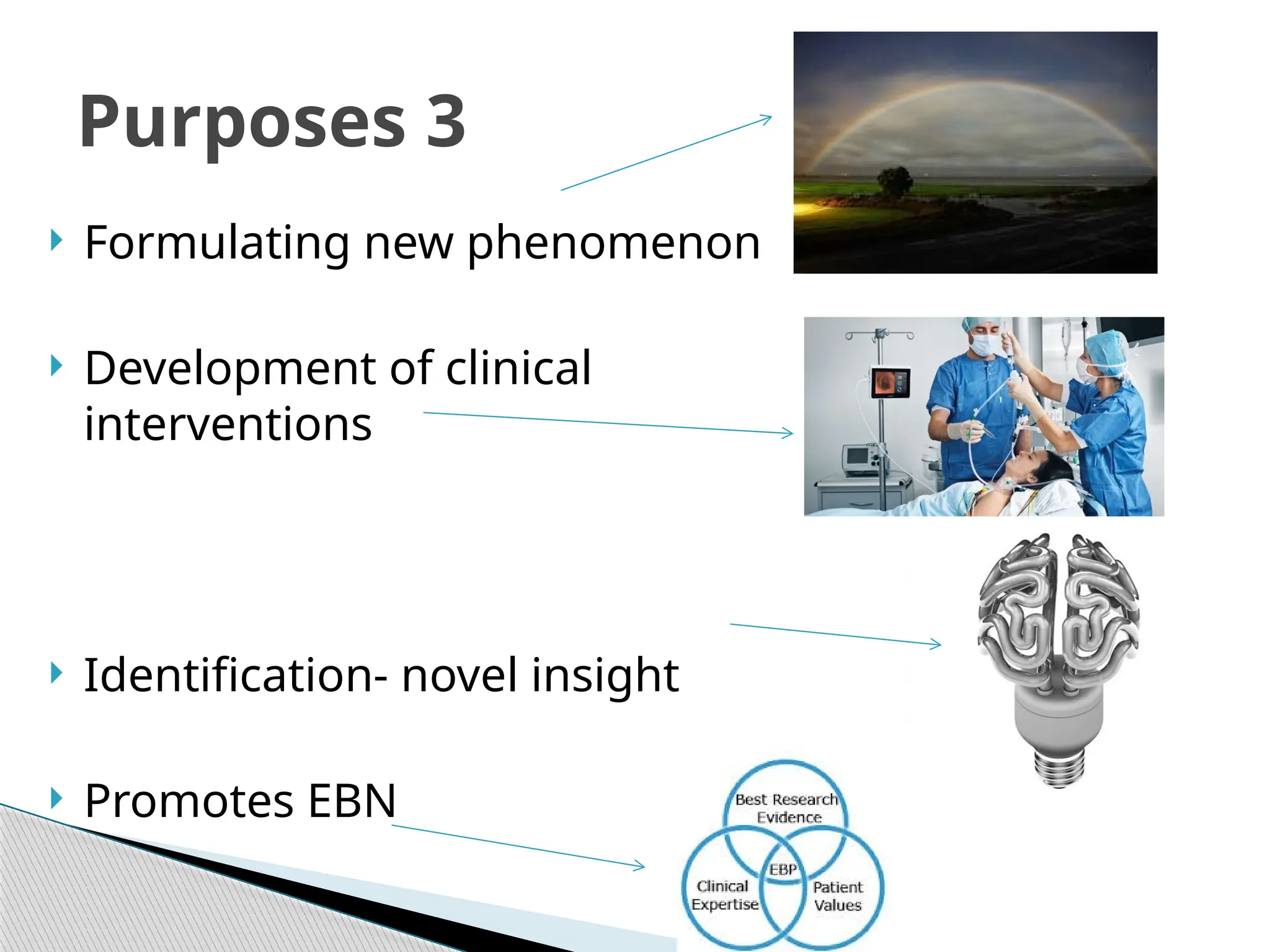
Purposes 2
 Formulating new phenomenon
 Development of clinical
interventions
 Identification- novel insight
 Promotes EBN
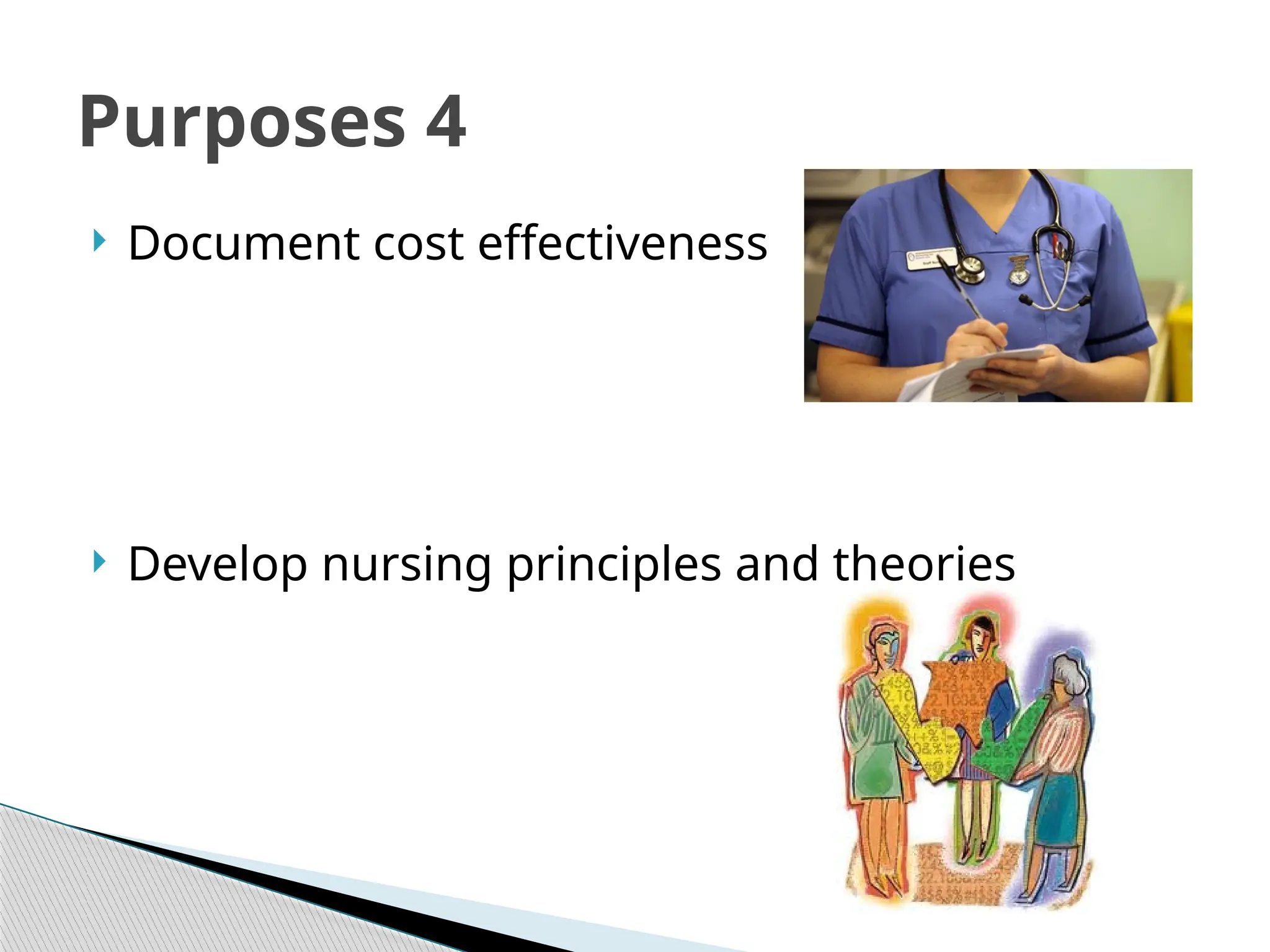
Purposes 3
 Document cost effectiveness
 Develop nursing principles and theories
Purposes 4
 Treatment, Therapy or intervention
 Diagnosis and assessment
 Prognosis
 Prevention of harm
 Etiology or causation
 Meaning and processes
Linked to EBP
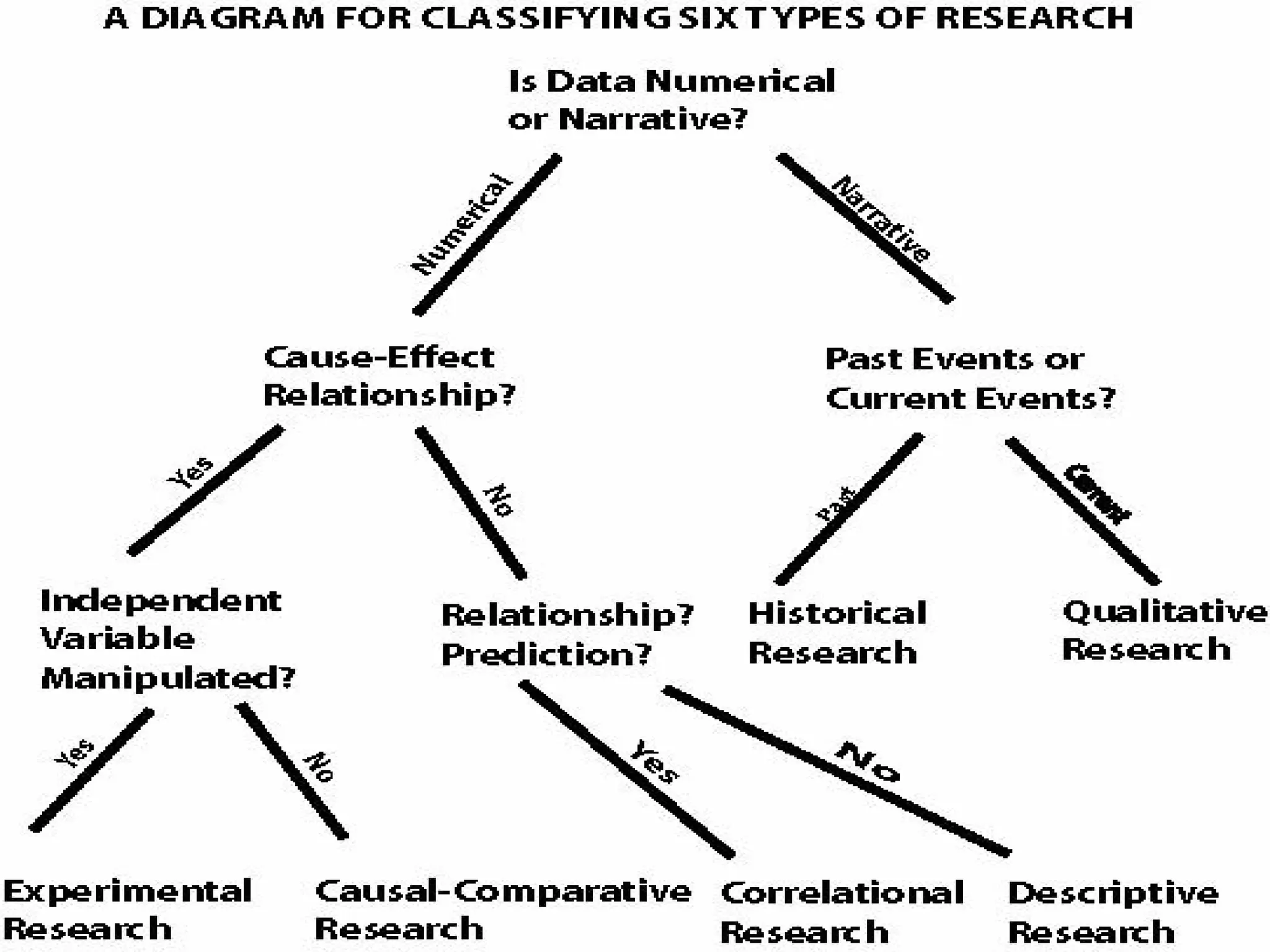
Types of research
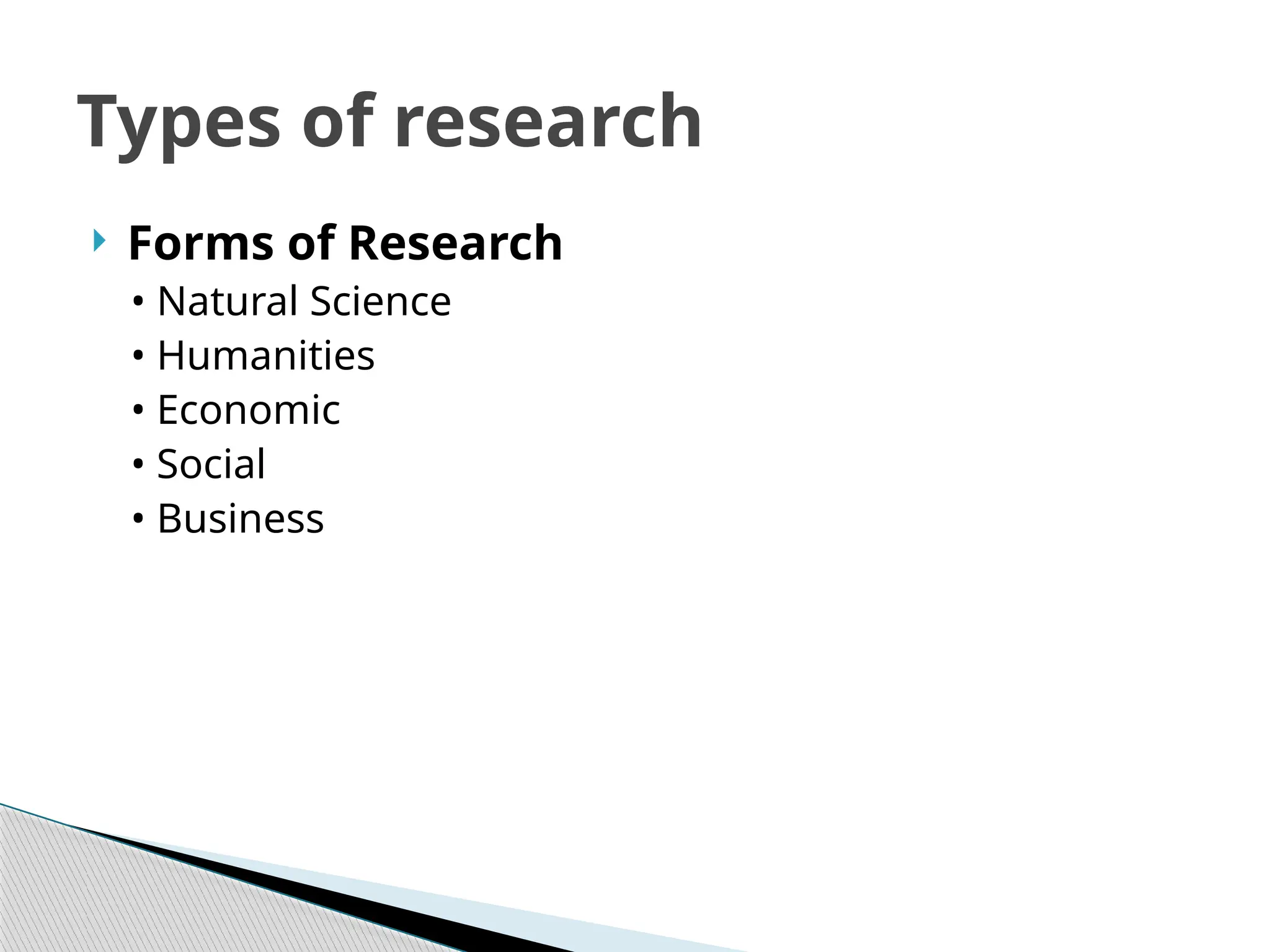
 Forms of Research
• Natural Science
• Humanities
• Economic
• Social
• Business
Types of research
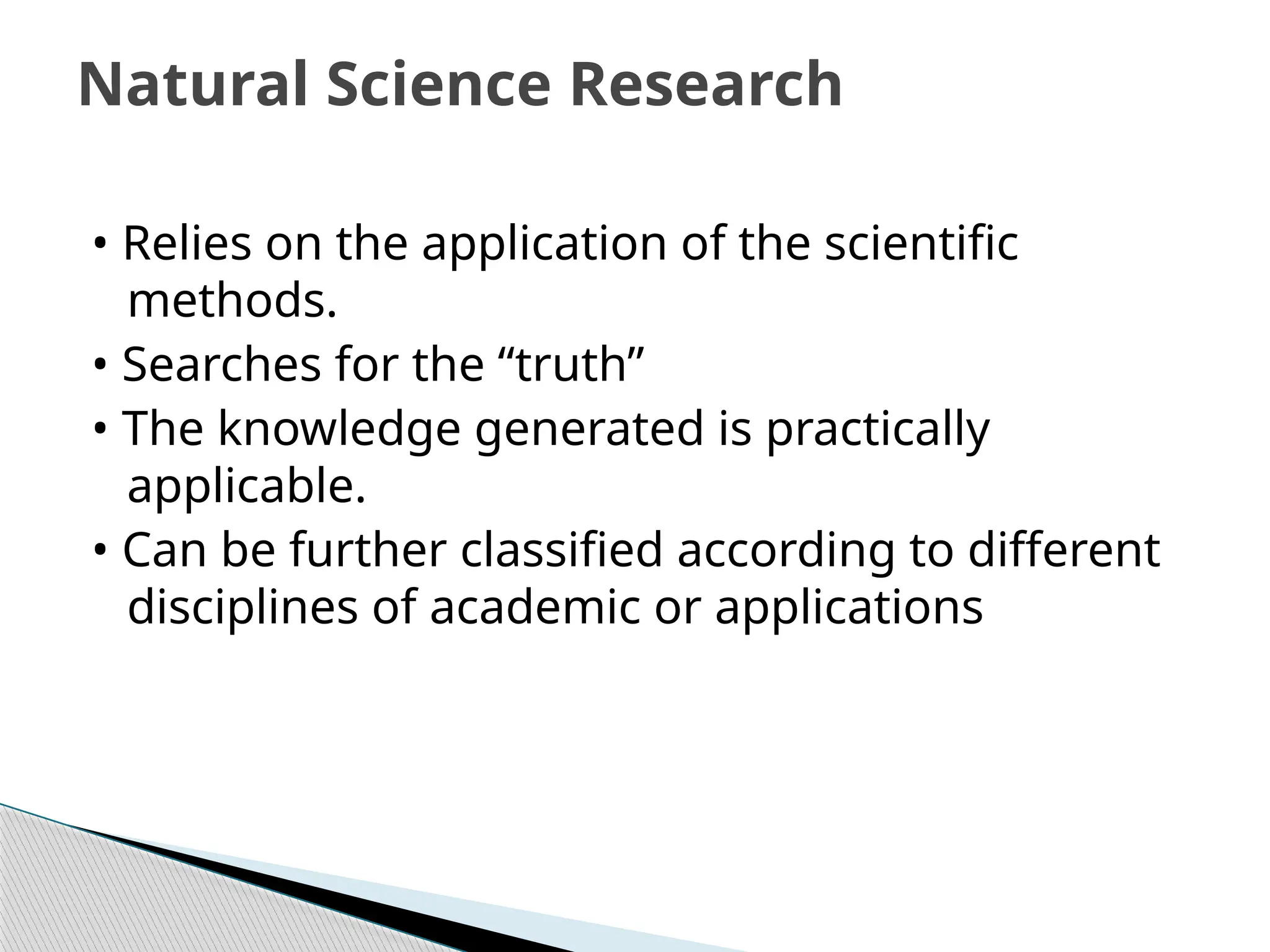
• Relies on the application of the scientific
methods.
• Searches for the “truth”
• The knowledge generated is practically
applicable.
• Can be further classified according to different
disciplines of academic or applications
Natural Science Research
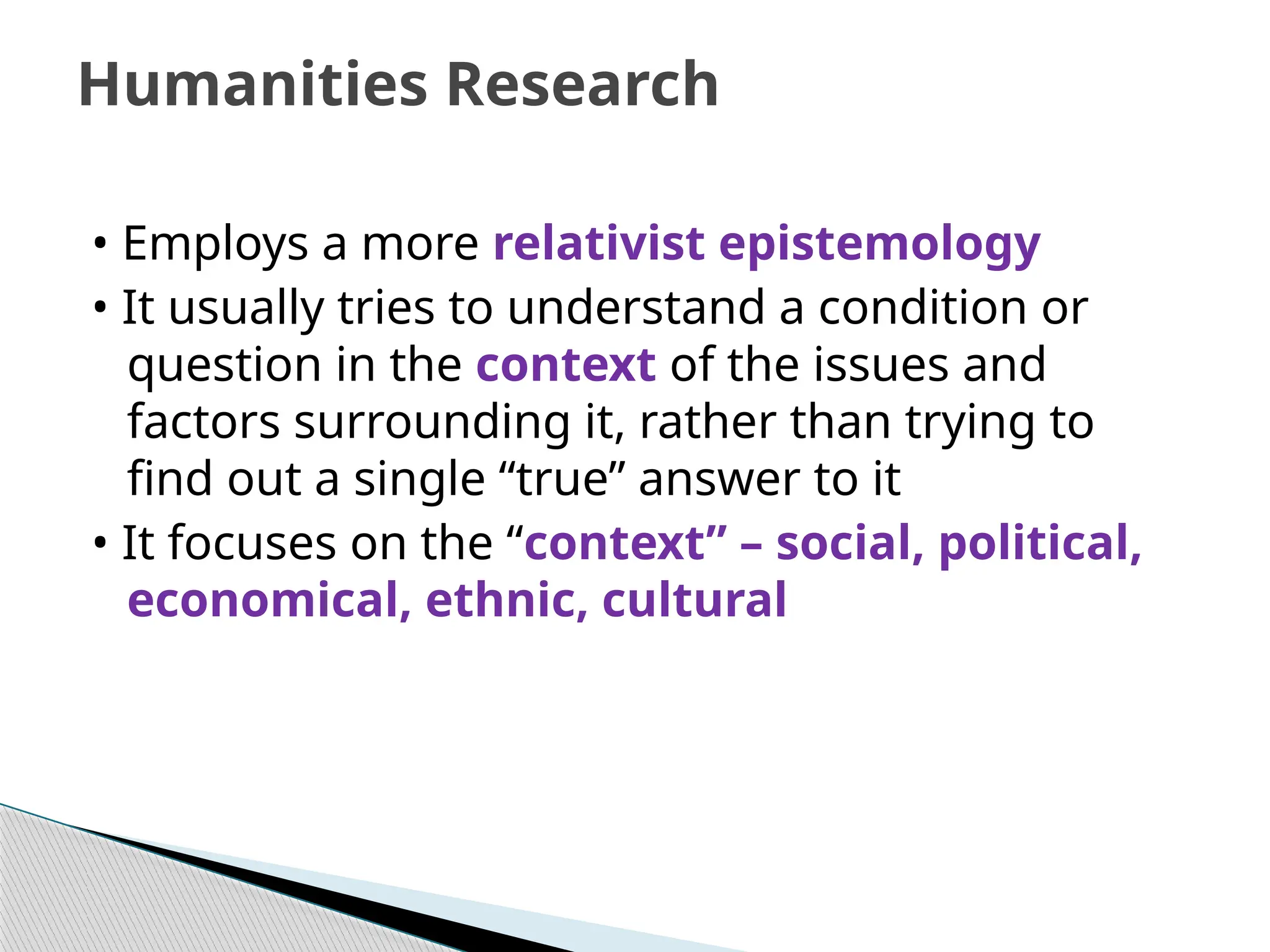
• Employs a more relativist epistemology
• It usually tries to understand a condition or
question in the context of the issues and
factors surrounding it, rather than trying to
find out a single “true” answer to it
• It focuses on the “context” – social, political,
economical, ethnic, cultural
Humanities Research
 Basic vs. Applied
 Type of applied research
 Cyclical in nature
Action research
• A special category of applied or action research
• Aims at maximizing the profit & minimizing the
cost or expenses
• Applying advanced analytical methods to help
make better decisions.
Operations Research
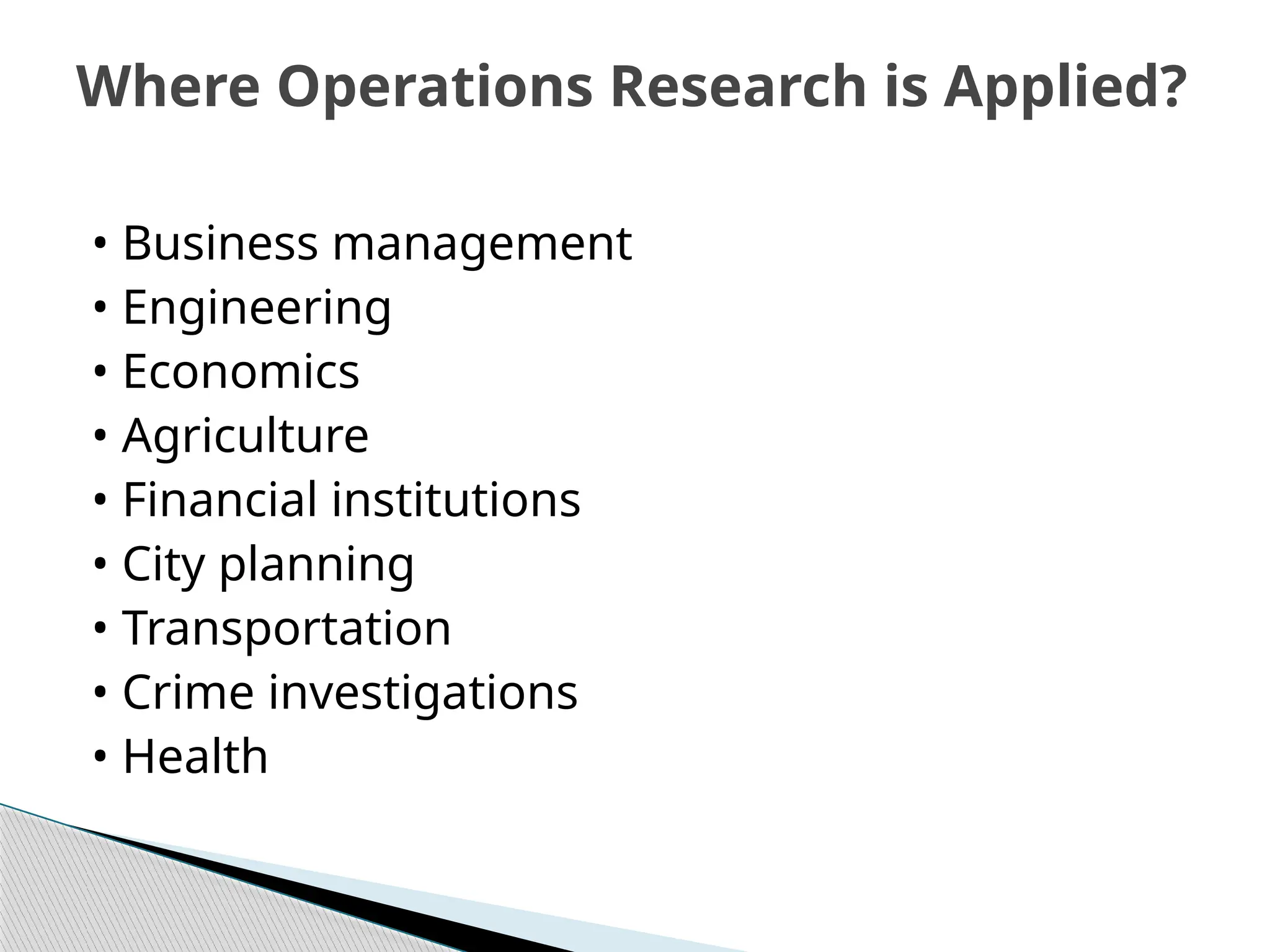
• Business management
• Engineering
• Economics
• Agriculture
• Financial institutions
• City planning
• Transportation
• Crime investigations
• Health
Where Operations Research is Applied?
• How many beds in a hospital/speciality
• How to minimize waiting time in OPD?
• How to reduce interval between two operations
• How best to deliver some medicine to the
target community
• How to optimize the supply for vaccine in an
immunization program
Application of Operations Research in Health
• Primary – Collecting the data from primary
sources like patients, users, practitioners,
environment etc
• Secondary – Collecting the data from
secondary sources like hospital records,
government records, meteorological records,
Survey reports etc
Primary vs. Secondary
 Research confined to the laboratories‐ Most of
the biochemical, pharmacological, Genetic
studies – Many are at cellular level.
 Research conducted in the community, field
program operations etc – Most of the public
health researches are in field.
 Clinical Trials – may be a combination of both.
Laboratory vs. Field
• Descriptive Research is a fact finding investigation
which is aimed at describing the characteristics of
individual, situation or a group (or) describing the
state of affairs as it exists at present.
• Analytical Research is primarily concerned with
testing hypothesis and specifying and
interpreting relationships, by analyzing the facts
or information already available.
• Experimental Research is considered by some
people as a distinct group of analytical research
Descriptive vs. Analytical
Quantitative Research
• Deals with numbers and try to quantify and
measure a particular phenomena.
• Often uses statistical methods aimed at
establishing significance.
• Aims to find the “true cause”.
• Tries to answer questions “how many” or “how
much”.
Quantitative vs. Qualitative
Research
• Primarily does not deal with numbers but the
nature of data.
• Follows an “interpretivist” approach instead of a
statistical one.
• Aims to understand a phenomenon in its
proper “context”.
• Tries to answer questions like “what”, “why” and
“how”.
Qualitative Research
Diagnostic Research – It is also called clinical
research which aims at identifying the causes of
a problem, frequency with which it occurs and
the possible solutions for it.
Exploratory Research – It is the preliminary
study of an unfamiliar problem, about which
the researcher has little or no knowledge. It is
aimed to gain familiarity with the problem, to
generate new ideas or to make a precise
formulation of the problem. Hence it is also
known as formulative research.
Some Other Nomenclatures..
Experimental Research – It is designed to
assess the effect of one particular variable on
a phenomenon by keeping the other variables
constant or controlled.
Historical Research – It is the study of past
records and other information sources, with a
view to find the origin and development of a
phenomenon and to discover the trends in the
past, in order to understand the present and to
anticipate the future
• Clinical trials are a set of procedures in medical
research and drug development that are
conducted to allow safety and efficacy data to
be collected for health interventions (e.g.,
drugs, diagnostics, devices, therapy protocols)
• These are usually conducted in 4 phases ‐ I to IV
on human subjects (preceded by animal
experiments and basic research in laboratories)
Clinical Trials
We can classify research in many ways but these
are not watertight compartments
• Such classifications are more for broad
conceptualisation
• In practice, many a times there are a lots of
overlapping
 Conceptual and Empirical research
 Any other types of research?
 Applications in Nursing?
Home work
 Nursing service
 Nursing education
 Nursing administration
 Nursing informatics
Scope of NR
 Influences current and future practices
 Adequately trained nurses can conduct quality
clinical research
 Leads to EBN practice
 Provide description, explanation, prediction
and control of nursing situations in nursing
practice
 Identifies cost effective practices
 Problem solving
Significance / Importance
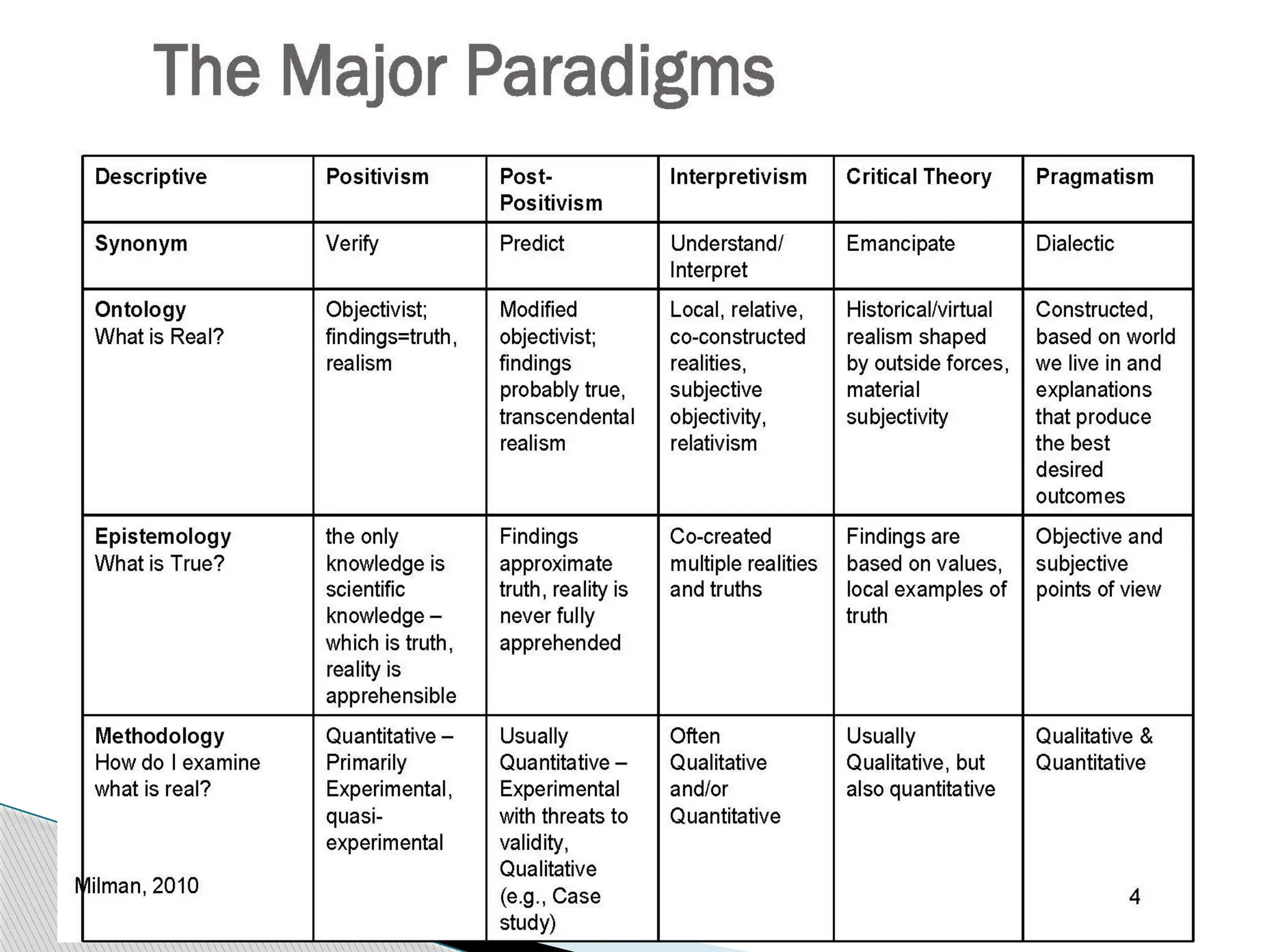
 WORLD VIEW/ GENERAL PERSPECTIVE OF THE
COMPLEXITIES OF REAL WORLD
 BASIC PHILOSOPHICAL QUESTIONS
◦ Ontologic –what is the nature of reality?
◦ Epistemologic- what is the relationship with the
inquirer and that being studied?
◦ Axiologic- what is the role of values in inquiry?
◦ Methodologic – how should the inquirer obtain
knowledge?
Paradigms in research
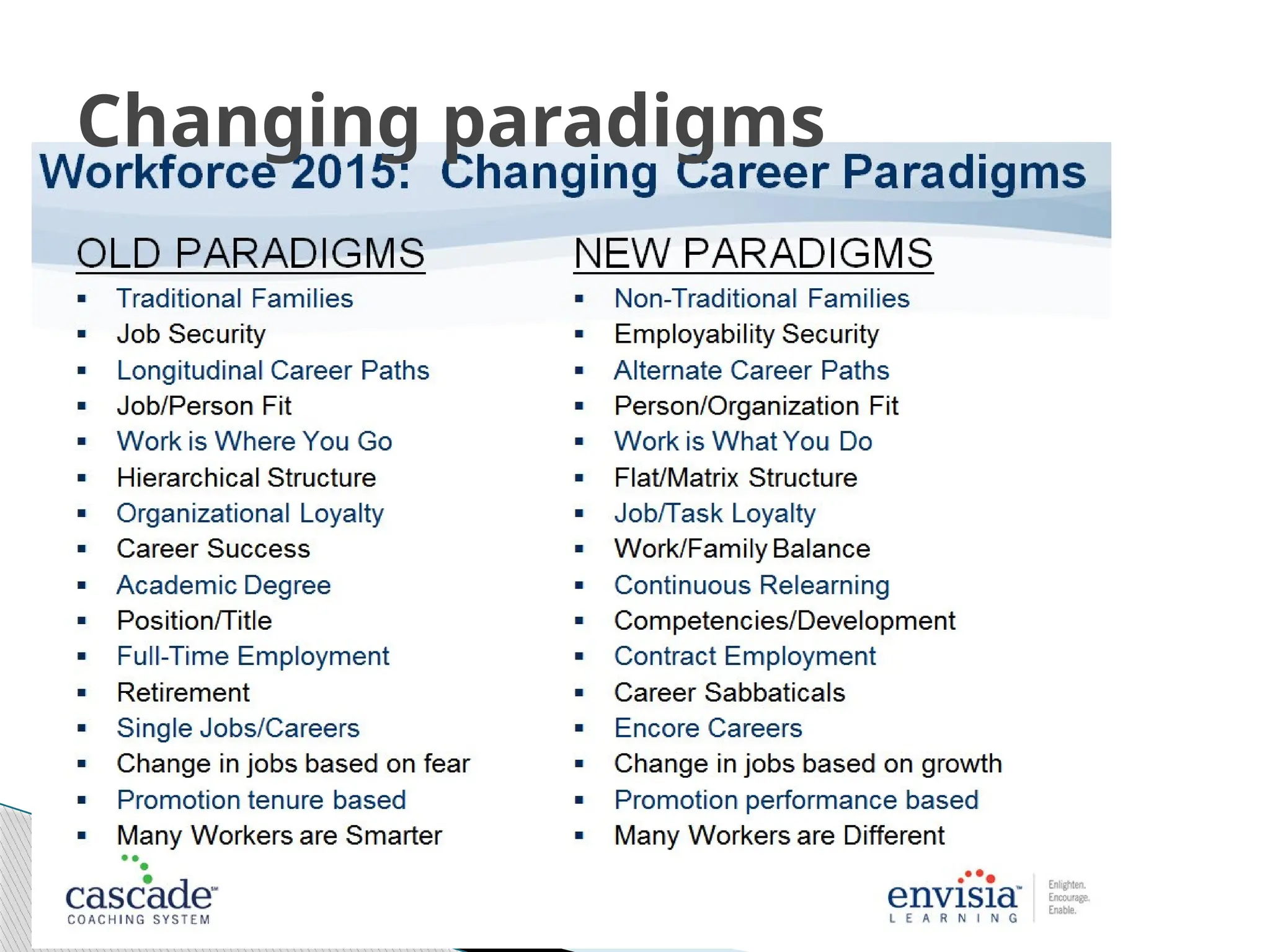
Changing paradigms
 Intellectual pluralism
MULTIPLE PARADIGMS
A beautiful thing
about learning is
that nobody can
take it away from
you
LEARNING
Future trends
• Heightened focus on EBP
• Development of stronger evidence base
• Emphasis on SR
• Expanded local research in health care
settings
EBP
Future trends
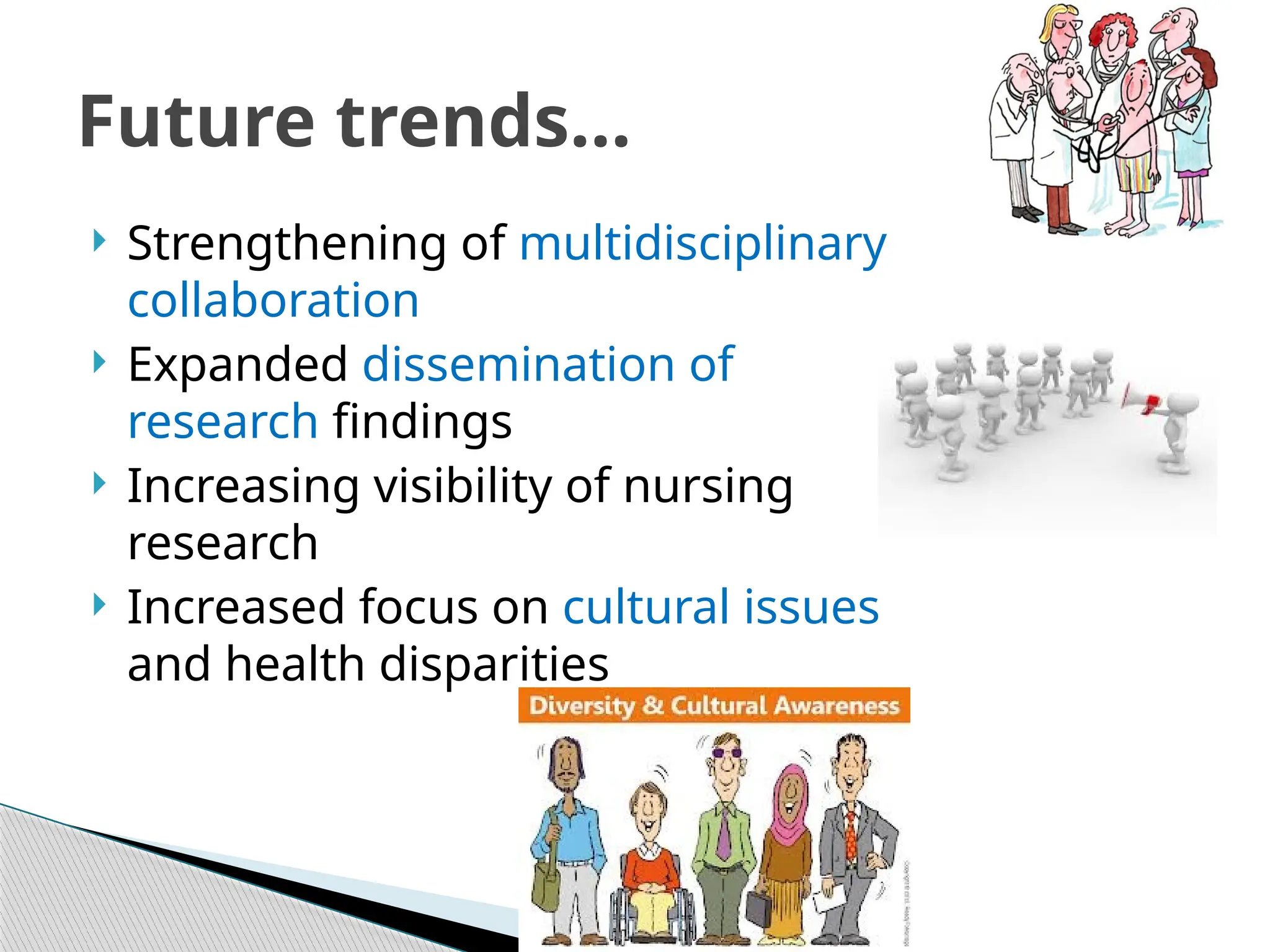
 Strengthening of multidisciplinary
collaboration
 Expanded dissemination of
research findings
 Increasing visibility of nursing
research
 Increased focus on cultural issues
and health disparities
Future trends…
 Inadequate knowledge
 Lack of qualified guide
 Difficulty in controlling external variables
 Lack of time
 Lack of standardized tools
 Reliability of disciplined research
 Studying many variables
 Ethical problems
 Lack of support from administrative set up
 Financial constraints
Problems and challenges
 Health promotion and disease prevention
 Promotion of health of vulnerable and
marginalized communities
 Patient safety and quality of health care
 Development of EBP and translational research
 Promotion of health of older people
 Patient centered care and care co ordination
 Palliation and end of life care
 Care implications of genetic testing and
therapeutics
Priorities for nursing research
 Capacity development of nurse researchers
 Nurses working environment
 STTI 2005
contd
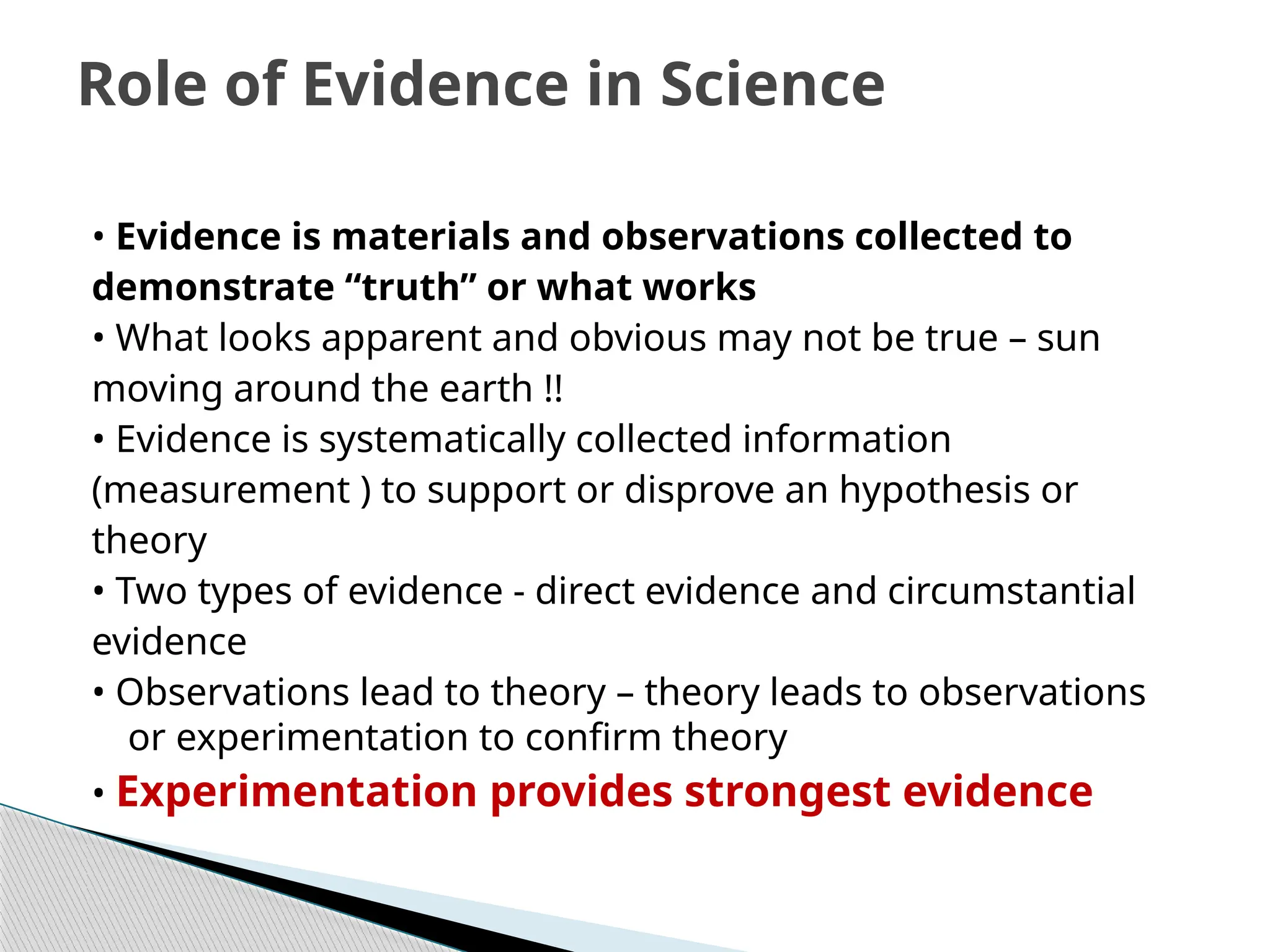
• Evidence is materials and observations collected to
demonstrate “truth” or what works
• What looks apparent and obvious may not be true – sun
moving around the earth !!
• Evidence is systematically collected information
(measurement ) to support or disprove an hypothesis or
theory
• Two types of evidence ‐ direct evidence and circumstantial
evidence
• Observations lead to theory – theory leads to observations
or experimentation to confirm theory
• Experimentation provides strongest evidence
Role of Evidence in Science
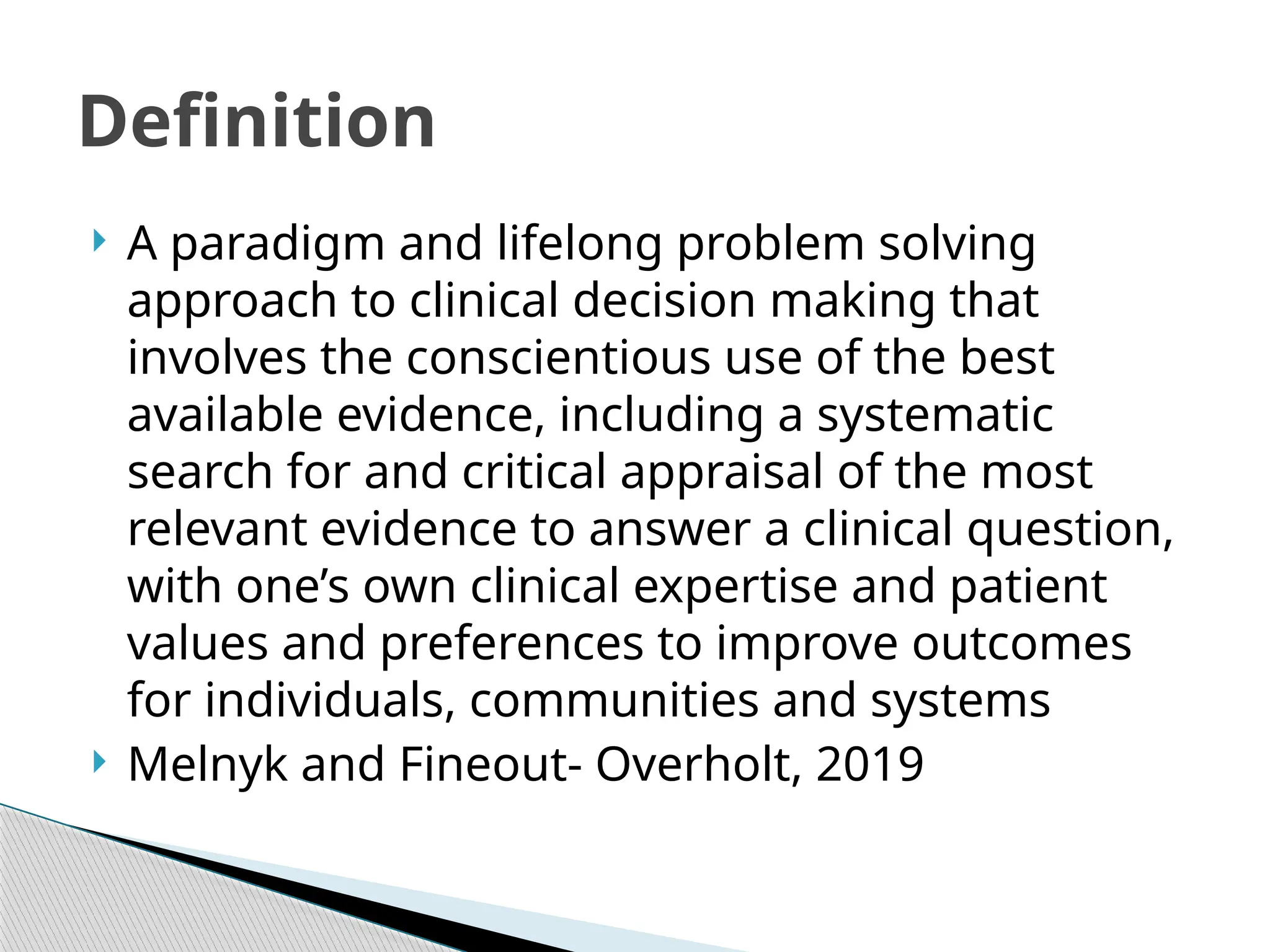
 A paradigm and lifelong problem solving
approach to clinical decision making that
involves the conscientious use of the best
available evidence, including a systematic
search for and critical appraisal of the most
relevant evidence to answer a clinical question,
with one’s own clinical expertise and patient
values and preferences to improve outcomes
for individuals, communities and systems
 Melnyk and Fineout- Overholt, 2019
Definition
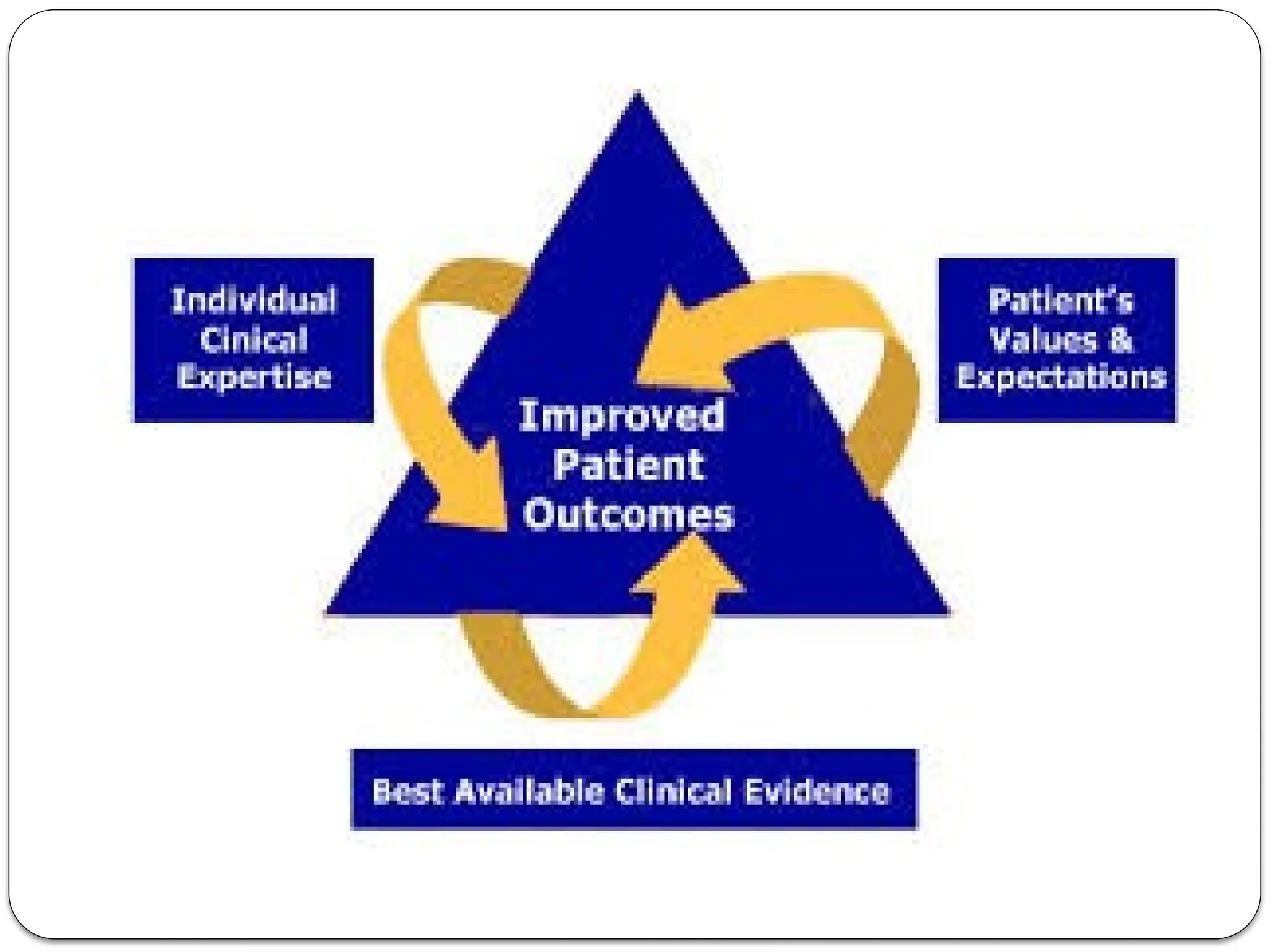
Improved
patient
outcomes
Patient
preferences and
circumstances
Best
available
clinical
evidence
Awareness of
clinical setting &
resource
constraints
Individual
clinical
expertise
EBP
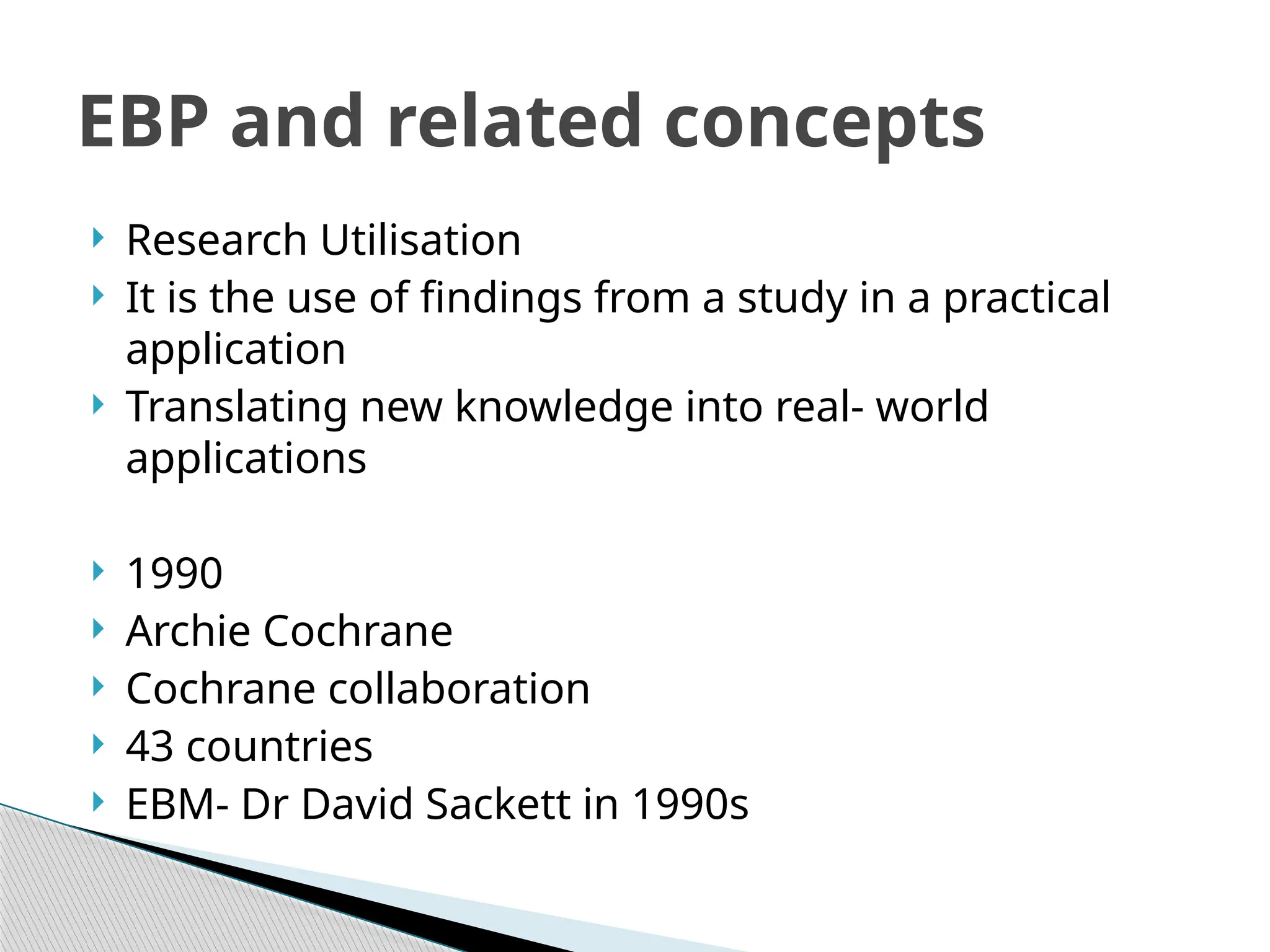
 Research Utilisation
 It is the use of findings from a study in a practical
application
 Translating new knowledge into real- world
applications
 1990
 Archie Cochrane
 Cochrane collaboration
 43 countries
 EBM- Dr David Sackett in 1990s
EBP and related concepts
 EBP or Evidence- Informed Practice
 Based means patient preferences are not taken
into account
??
 Canadian Institutes of Health research
 Exchange, synthesis and ethically sound
application of knowledge- within a complex
system of interactions among researchers and
users- to accelerate the capture of the benefits
of research for Canadians through improved
health, more effective services and products
and a strengthened health care system
Knowledge Translation
 WHO
 The synthesis exchange and application of
knowledge by relevant stakeholders to
accelerate the benefits of global and local
innovation in strengthening health systems
and improving people’s health
 Involves the study of interventions,
implementation processes and contextual
factors that affect the uptake of new evidence
in health care practice
 Doctor of Nursing Practice degree
Translational research
 Sources
◦ Tradition and authority
◦ Clinical experience, trial and error and intuition
◦ Logical reasoning
◦ Assembled information
◦ Disciplined research
EBP
 6 S hierarchy of evidence sources
 DiCenso and colleagues 2009
 A guide for evidence retrieval
 Work top downward
 Ease in terms of searching, not in terms of
quality
Resources for evidence based
practice in Nursing
 “Evidence‐based medicine (EBM) or evidence‐
based practice (EBP) aims to apply the best
available evidence gained from the scientific
method to clinical decision making.
 It seeks to assess the strength of the evidence of
risks and benefits of treatments and diagnostic
tests. This helps clinicians understand whether or
not a treatment will do more good than harm.”
WikiP
Evidence Based Medicine, practice and PH Policies
and Programs
 How evidence grows: No evidence, to some
evidence, substantial evidence, review of
evidence, meta‐analysis, overall recommendation.
 Authority based policies and programs – vs.
evidence based policies and programs.
 Systematic evaluation of evidence is new science –
but clinical trials are not new – first trial was done
by James Lind 1747 on 12 sailors on board a ship
to see effect of limes and oranges on Scurvy
(bleeding gums)
Evidence Based Medicine, practice and PH Policies and
Programs
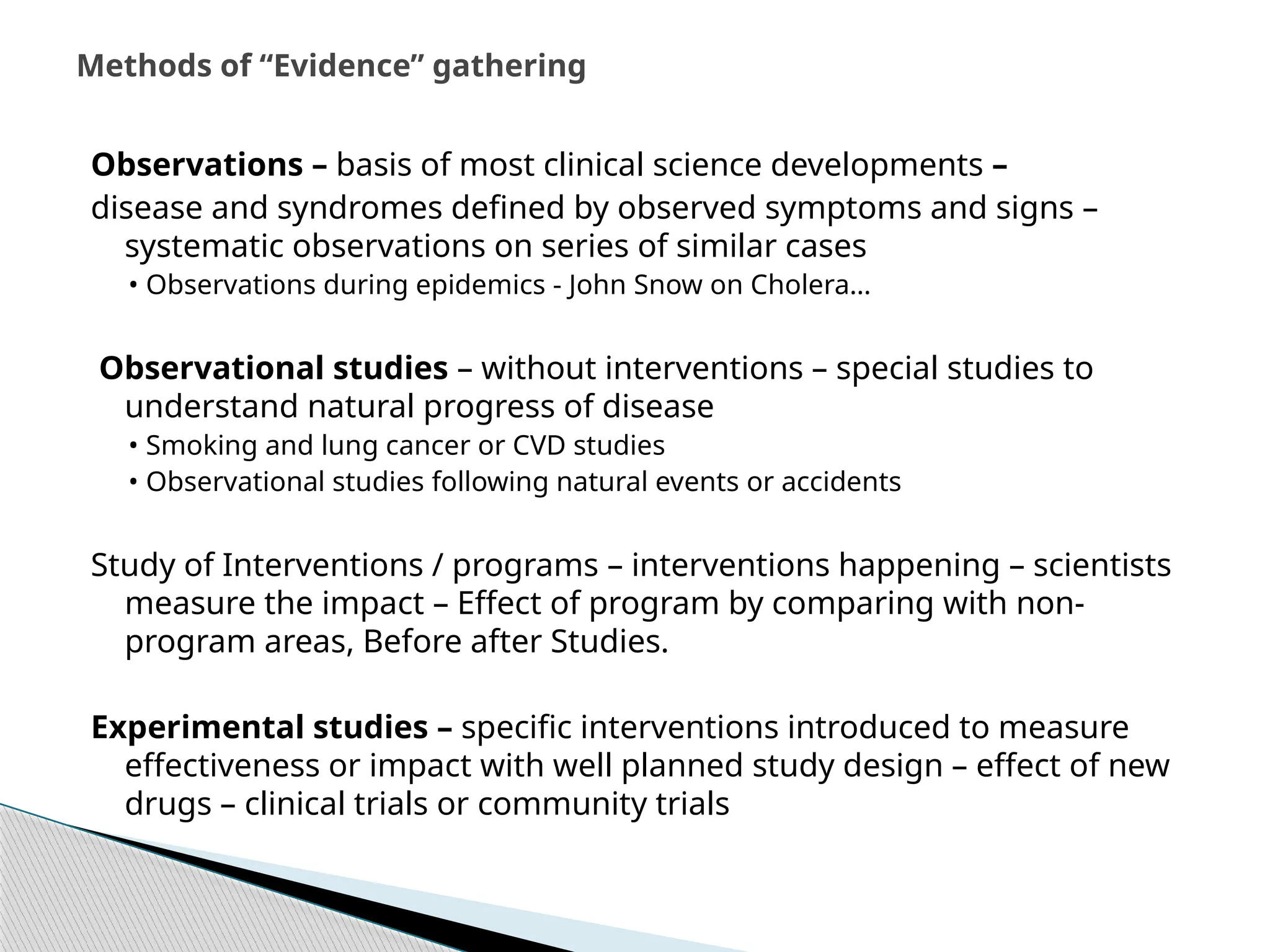
Observations – basis of most clinical science developments –
disease and syndromes defined by observed symptoms and signs –
systematic observations on series of similar cases
• Observations during epidemics ‐ John Snow on Cholera…
Observational studies – without interventions – special studies to
understand natural progress of disease
• Smoking and lung cancer or CVD studies
• Observational studies following natural events or accidents
Study of Interventions / programs – interventions happening – scientists
measure the impact – Effect of program by comparing with non‐
program areas, Before after Studies.
Experimental studies – specific interventions introduced to measure
effectiveness or impact with well planned study design – effect of new
drugs – clinical trials or community trials
Methods of “Evidence” gathering
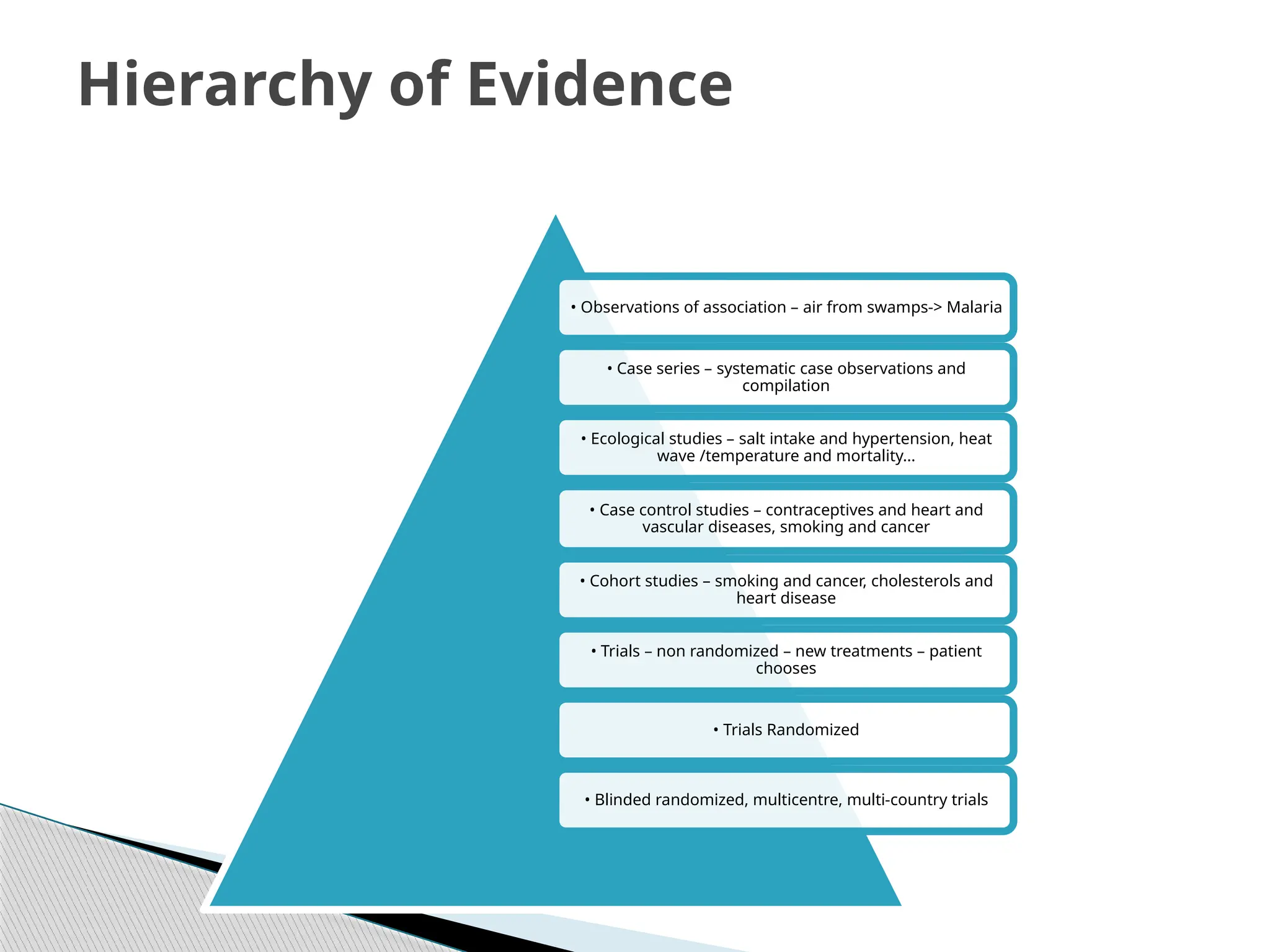
• Observations of association – air from swamps‐> Malaria
• Case series – systematic case observations and
compilation
• Ecological studies – salt intake and hypertension, heat
wave /temperature and mortality…
• Case control studies – contraceptives and heart and
vascular diseases, smoking and cancer
• Cohort studies – smoking and cancer, cholesterols and
heart disease
• Trials – non randomized – new treatments – patient
chooses
• Trials Randomized
• Blinded randomized, multicentre, multi‐country trials
Hierarchy of Evidence
Polit and Beck levels/ hierarchy of
evidence of interventions
Hierarchy/levels of evidence
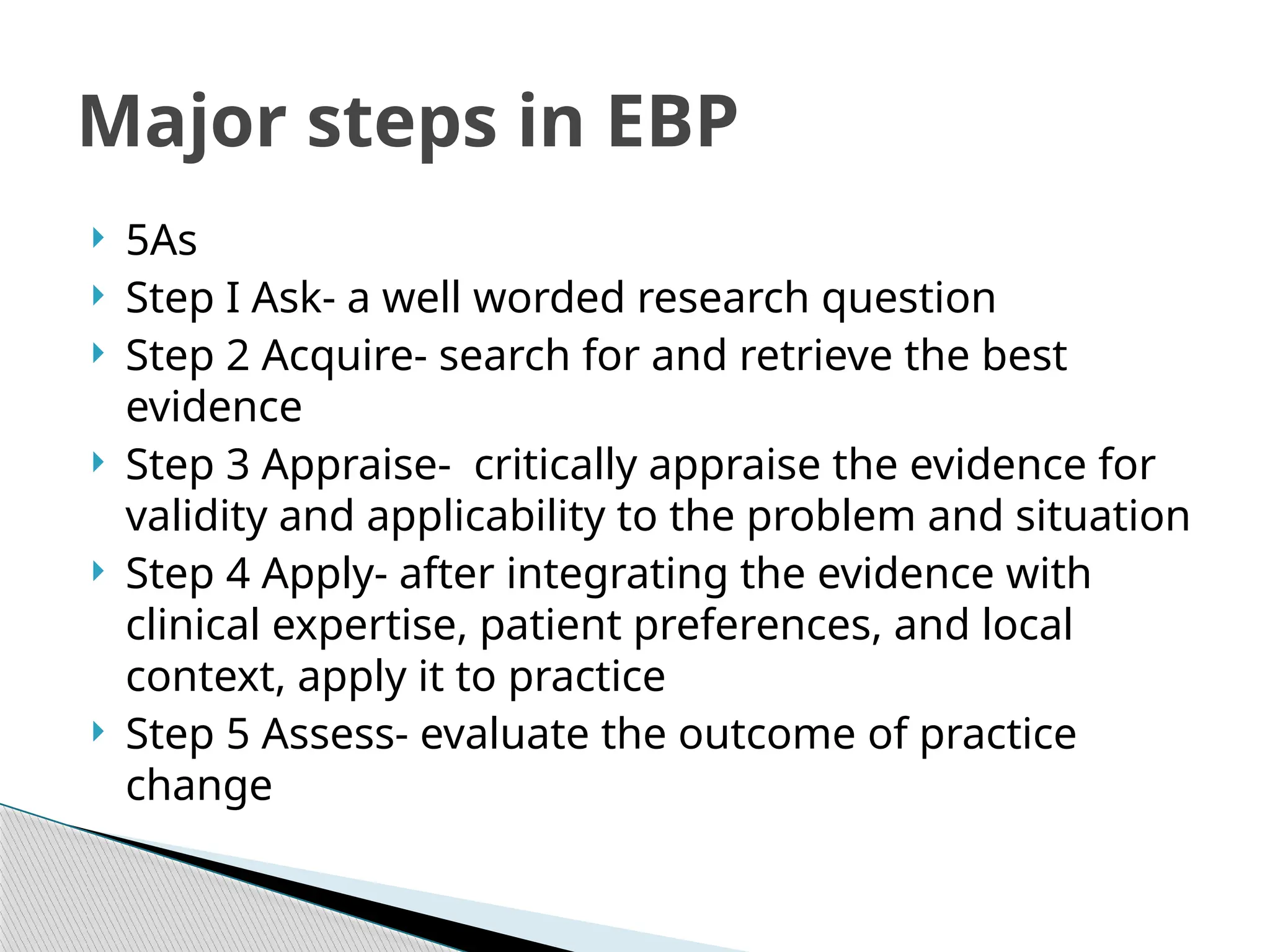
 5As
 Step I Ask- a well worded research question
 Step 2 Acquire- search for and retrieve the best
evidence
 Step 3 Appraise- critically appraise the evidence for
validity and applicability to the problem and situation
 Step 4 Apply- after integrating the evidence with
clinical expertise, patient preferences, and local
context, apply it to practice
 Step 5 Assess- evaluate the outcome of practice
change
Major steps in EBP
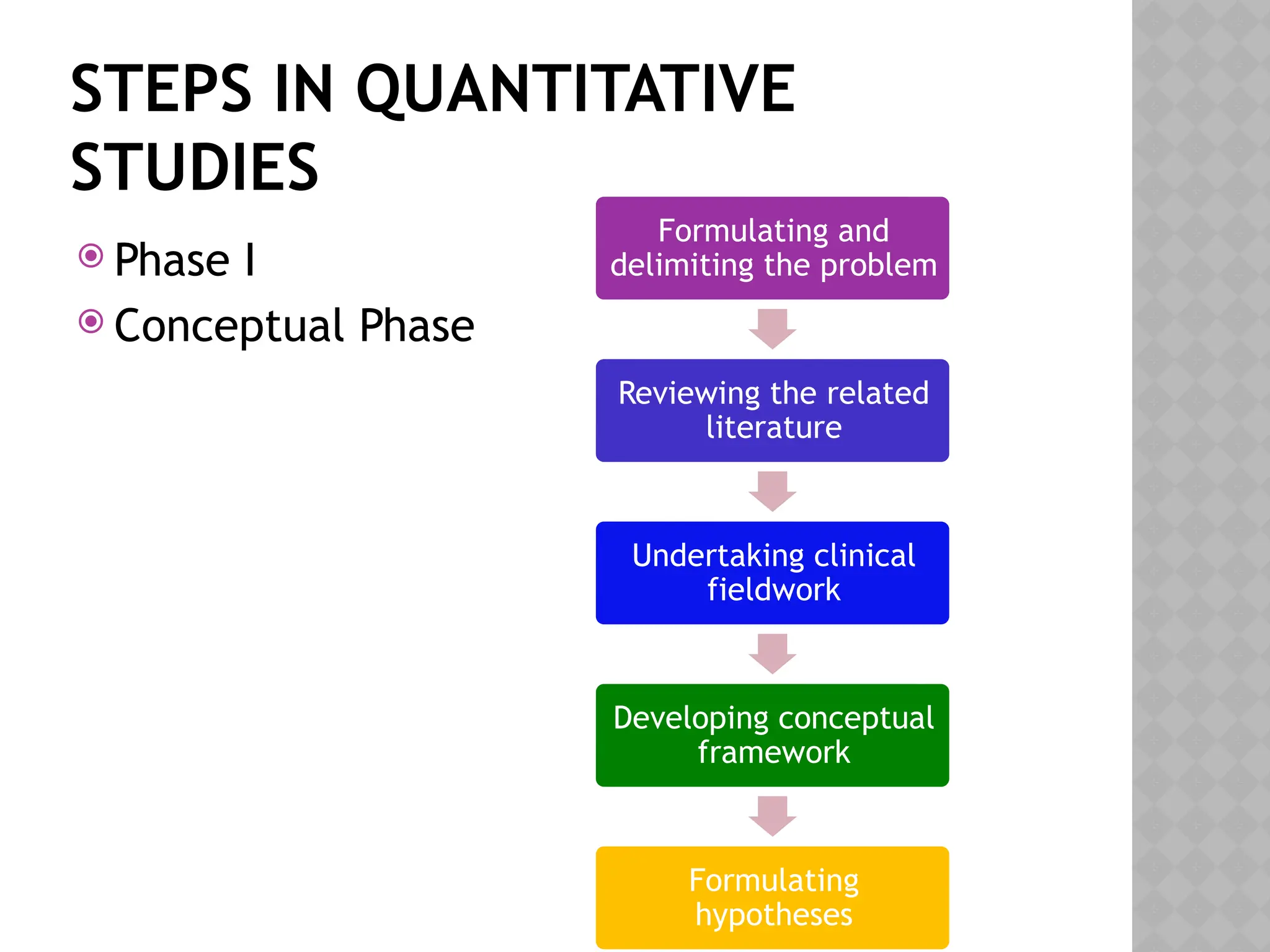
STEPS IN QUANTITATIVE
STUDIES
 Phase I
 Conceptual Phase
Formulating and
delimiting the problem
Reviewing the related
literature
Undertaking clinical
fieldwork
Developing conceptual
framework
Formulating
hypotheses
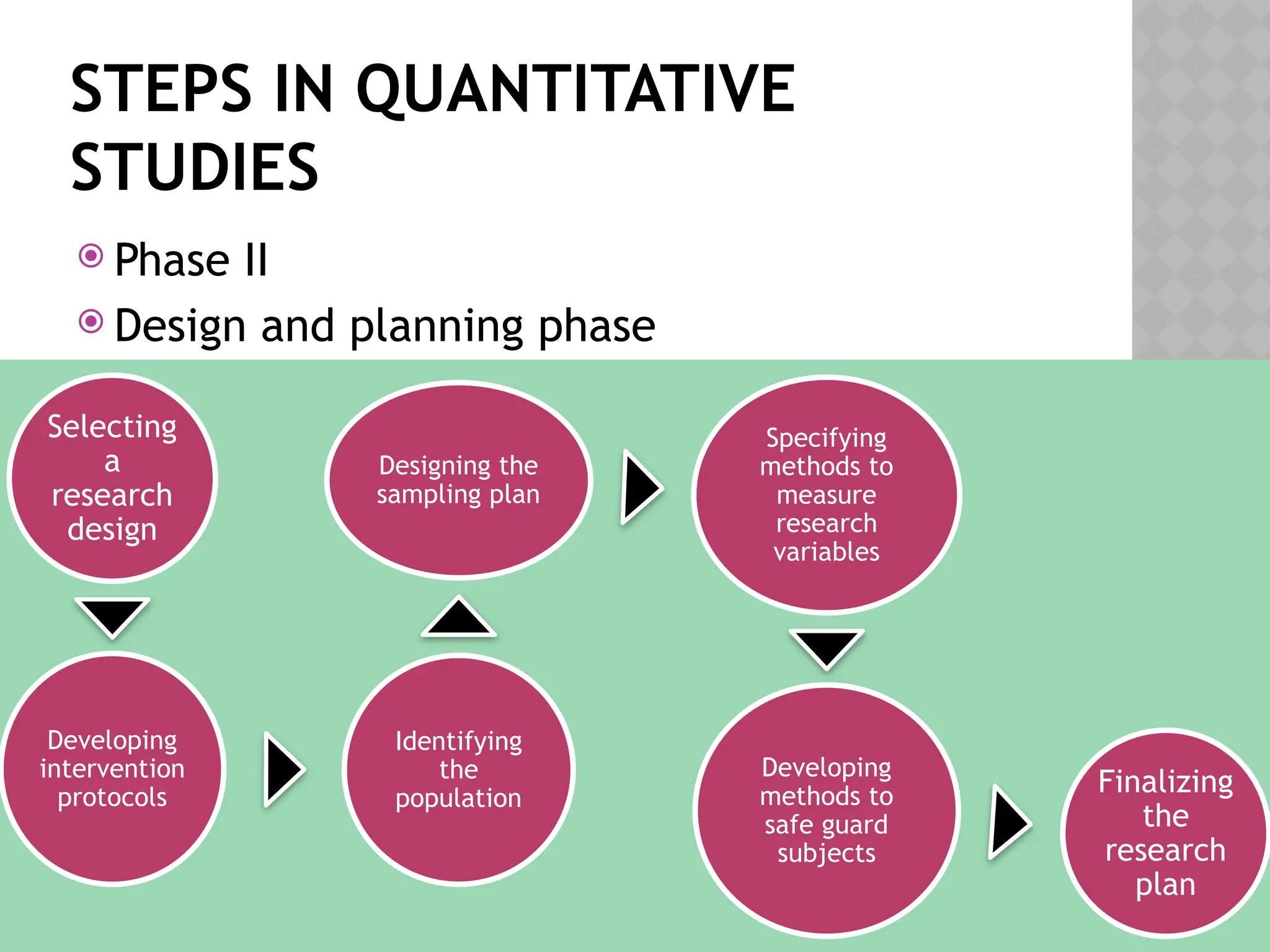
STEPS IN QUANTITATIVE
STUDIES
 Phase II
 Design and planning phase
Selecting
a
research
design
Developing
intervention
protocols
Identifying
the
population
Designing the
sampling plan
Specifying
methods to
measure
research
variables
Developing
methods to
safe guard
subjects
Finalizing
the
research
plan
STEPS IN QUANTITATIVE
STUDIES
 Phase III
 Empirical phase
Collecting the
data
Preparing the
data for
analysis
STEPS IN QUANTITATIVE
STUDIES
 Phase IV
 Analytic phase
Analyzing the data
Interpreting the
results
STEPS IN QUANTITATIVE
STUDIES
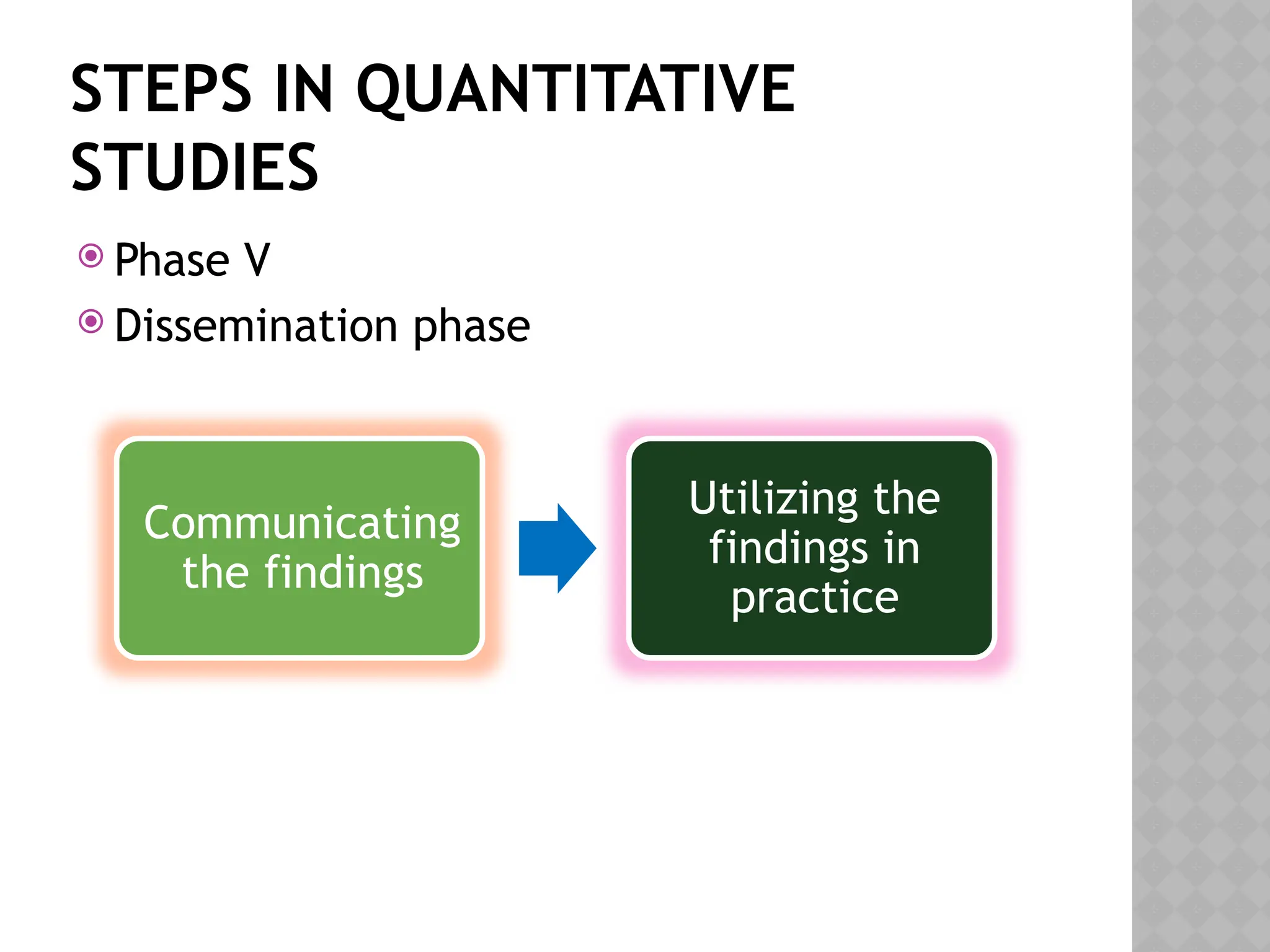
 Phase V
 Dissemination phase
Communicating
the findings
Utilizing the
findings in
practice
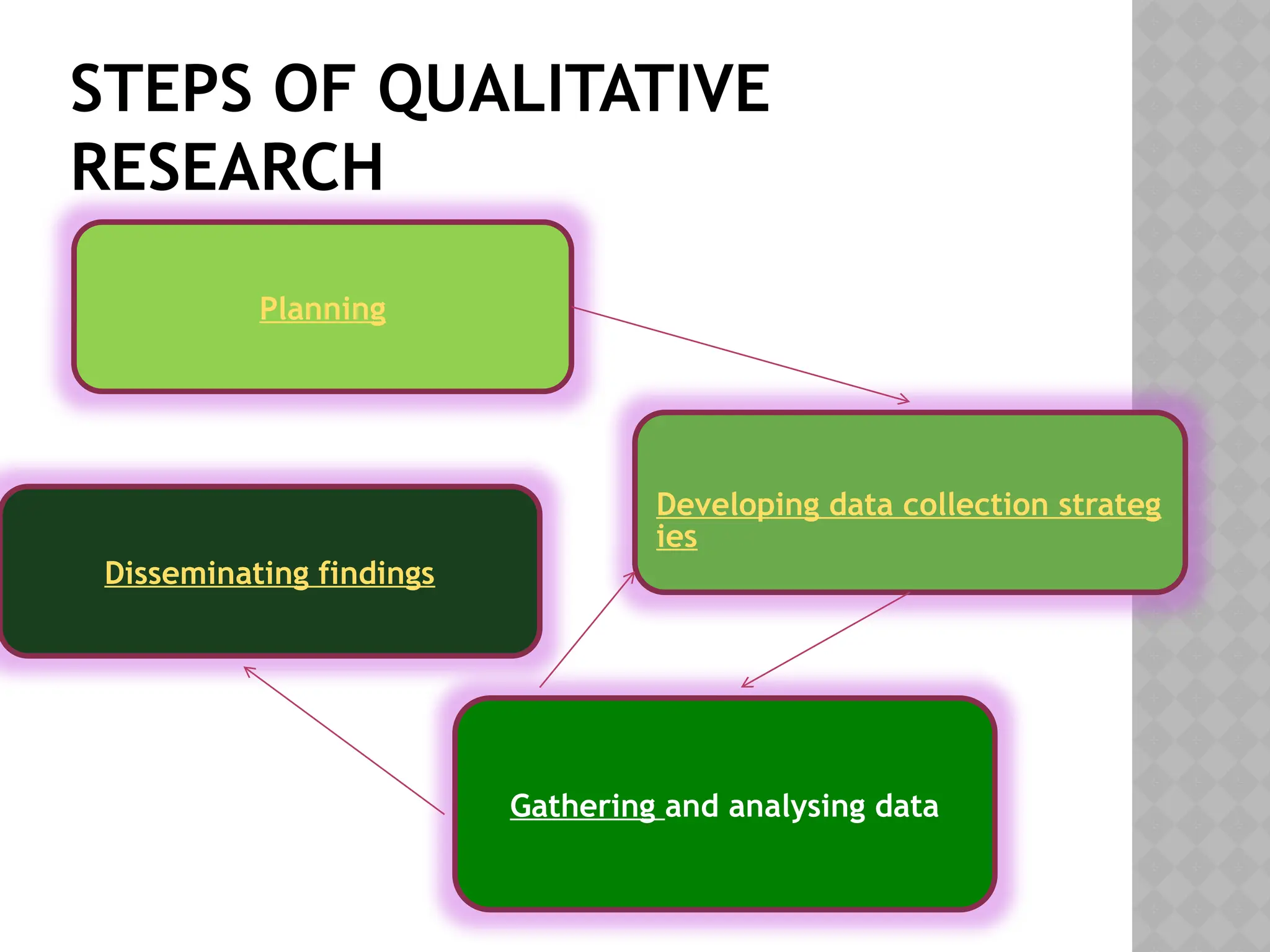
STEPS OF QUALITATIVE
RESEARCH
Planning
Developing data collection strateg
ies
Gathering and analysing data
Disseminating findings
ETHICS IN RESEARCH
 Every study involving human subjects raises a
unique set of ethical issues. A practical way to
address these issues is to work from the
regulations of federal agencies that fund
research and guidelines of the Indian Nursing
Council
ETHICS IN RESEARCH
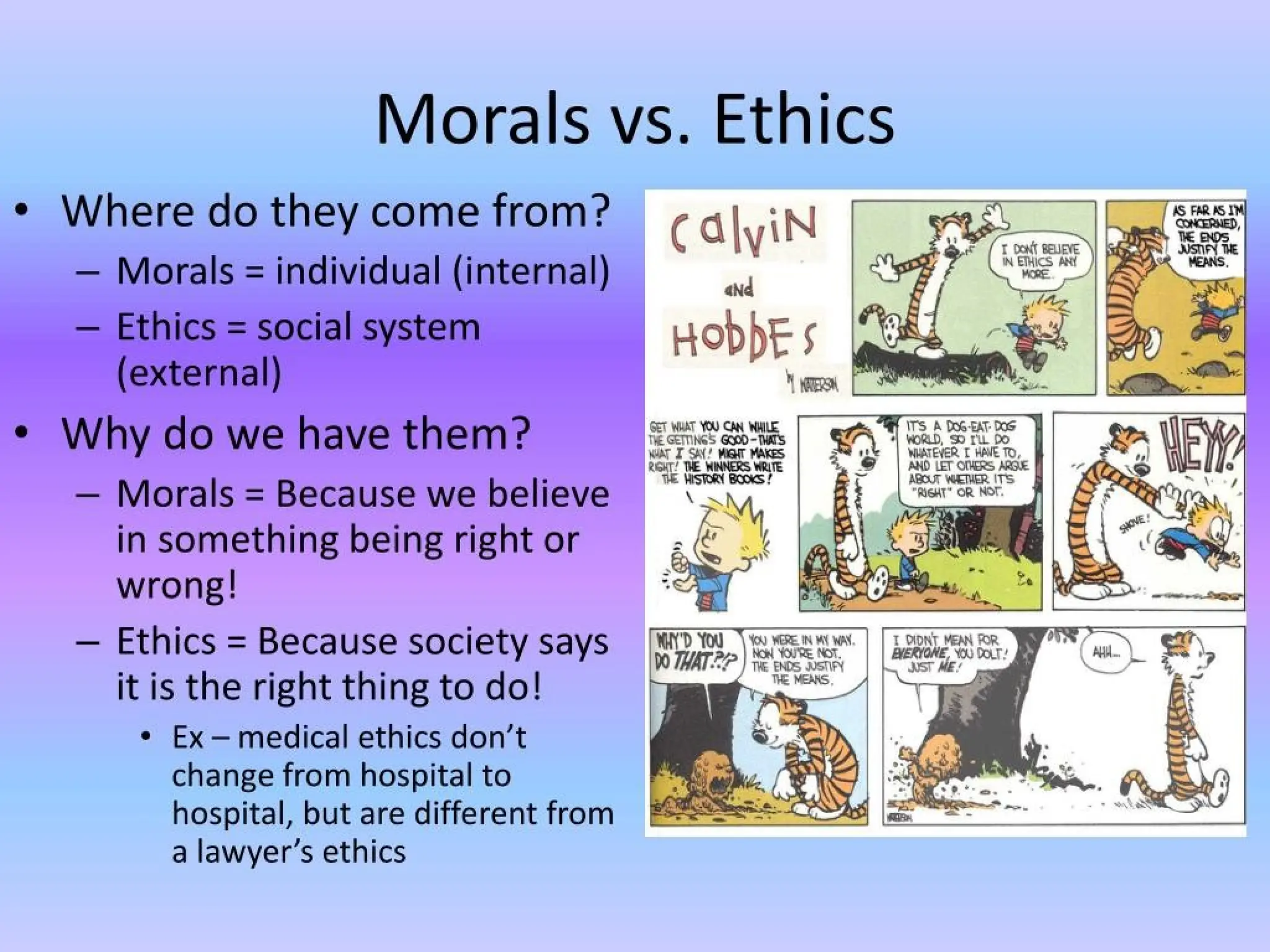
 Moral principles that govern a person's behaviour
or the conducting of an activity.
 The branch of knowledge that deals with moral
principles
Ethics
Introduction
How long does it take for body parts to
freeze when people are kept naked
outdoors in subfreezing temperatures?
What signs and symptoms are seen
when people are kept in tanks of ice
water for 3 hours? These questions
were asked by so-called researchers in
Germany in the early 1940s.
Introduction
During 1942 and 1943, prisoners’
wounds were deliberately infected with
bacteria. Infection was aggravated by
the forcing of wood shavings and
ground glass into the wounds.
Contd..
Introduction
Sulfanilamide was then given to these
prisoners to determine the effectiveness
of this drug. Some subjects died and
others suffered serious injury. Many
nurses participated in these unethical
experiments.
(Bonifazi 2004)
Introduction
Between June and September 1944,
photographs and body measurements
were taken of 112 Jewish prisoners.
Then they were killed, and their
skeletons were defleshed.
Contd..
Introduction
One purpose of this study was to
determine if photographs from live
human being could be used to predict
skeletal size. The skeleton collection
was to be displayed at the Reich
University of Strasbourg.
(Nuremberg Military Tribunals, 1949)
Introduction
 Infecting women prisoners with
syphilis, having them impregnated by
male prisoners, then dissecting the
live babies and mothers.
 Draining the blood from prisoners’
veins and substituting horse blood.
Contd..
Introduction
 Exploding gas gangrene bombs next
to prisoners tied to stakes.
 Vivisecting prisoners to compile data
on the human endurance of pain.
(Scientific Atrocities, 1996, Japan)
Introduction
Of the 600 black male subjects, 399 had
syphilis, and 201 did not have the
disease. Those subjects with active
cases were given no treatment. All
subjects were given free medical
exams, free meals, and burial
expenses.
Contd…
Introduction
Even after penicillin was accepted as the
treatment of choice for syphilis in 1945,
subjects were still given no treatment.
This unethical study became common
knowledge 40 years after it was begun. On
May 16, 1997, president Bill Clinton made
a public apology on behalf of the nation.
(CDC 2006)
Introduction
It is common knowledge that smallpox
is no threat to the world. Few people
remember, or even know, that Edward
Jenner deliberately exposed an 8 year
old child to cowpox to try out his new
vaccine for smallpox.
(Hayter, 1979)
Introduction
In July 1963, doctors at the Jewish
Chronic Disease Hospital in Brooklyn,
New York, injected live cancer cells into
22 elderly patients. The study was
designed to measure patients’ ability to
reject foreign cells. The patients were
told that they were being given skin
tests.
(Katz, 1972)
Introduction
In 2005, it was revealed that
government-funded researchers tested
experimental AIDS drugs on hundreds
of foster children.
(Solomon, 2005)
Core concept
Ethics is the science that deals with
rightness and wrongness of actions.
Bioethics is the term applied to these
principles when they refer to concepts
within the scope of medicine, nursing,
and allied health .
(Aiken, 2004)
Core concept
Moral behavior is defined as conduct that results
from serious critical thinking about how individuals
ought to treat others. Moral behavior reflects the way
a person interprets basic respect for other persons,
such as the respect for autonomy, freedom, justice,
honesty, and confidentiality.
(Pappas, 2003)
Core concept
Values are ideals or concepts that give
meaning to the individual ’s life.
(Aiken, 2004)
Core concept
A right is defined as “ a valid, legally
recognized claim or entitlement,
encompassing both freedom from
government interference or
discriminatory treatment and an
entitlement to a benefit of service”.
(Levy and Rubenstein 1996)
 Nuremberg code: 1947
 Helsinki Declaration: 1975
 Belmont Report: 1979
 CIOMS Council for International Organisations
of Medical Sciences : 1982
 ICMR (Indian Council of Medical Research)
Guidelines: 1980, revised 2000
Evolution of Ethical Guidelines
Development of ethical codes
The development of appropriate
ethical guidelines are complex as it
concerns with human behaviour.
Ethical principles changes with time
and newer knowledge. Because of
public outcry against the atrocities
committed in Germany in 1940s, the
Nuremberg code was developed in
1947.
The Nuremberg code
 Researcher must inform subjects
about the study
 Research must be for the good of
society
 Research must be based on animal
experiments, if possible
contd…
 Researcher must try to avoid injury
to research subjects
 Researcher must be qualified to
conduct research
 Subjects or the researcher can
stop the study if problems occur.
Based on the preliminary efforts of the Council
for International Organisations of Medical
Sciences (CIOMS) in 1964 at Helsinki, the World
Medical Association formulated general
principles and specific guidelines on use of
human subjects in medical research, known as
the Helsinki Declaration
Helsinki declaration
 National Commission for the Protection of Human
Subjects of Biomedical and Behavioral Research.
 The Belmont Report summarizes ethical principles
and guidelines for research involving human subjects.
 Three core principles
◦ respect for persons
◦ Beneficence
◦ justice.
 Three primary areas of application
◦ informed consent
◦ assessment of risks and benefits
◦ selection of subjects.
Belmont report 1978-9
Respect for person
Beneficence
Justice
Belmont principles
 The right to self determination
 The right to full disclosure
 Requires investigators to treat subjects
as autonomous individuals and obtain
their informed consent
 Research subjects must be regarded not
as passive sources of data, but as
individuals whose welfare and rights
must be respected.
Respect for human dignity
 The right to freedom from harm and
discomfort
 The right to protection from exploitation
 requires investigators to design protocols
that will provide valid and generalisable
knowledge
 ensure that the benefits of the research are
proportionate to the risks assumed by the
subjects.
 wellbeing of the subjects must be
protected.
Beneficence
LEVELS OF DISCOMFORT AND
HARM
 Level 1: No anticipated effects: no
positive or negative effects for the subjects
LEVELS OF DISCOMFORT AND
HARM
 Level 2: Temporary discomfort considered
minimal risk studies
 discomfort is simulate to that which the subject would
experience in his/her daily life and cease with
termination of the study
LEVELS OF DISCOMFORT AND
HARM
 Level 3: Unusual levels of temporary
discomfort during the study and after the
study has terminated
 Level 4: Risk of permanent damage,
potential for subject to suffer permanent
damage
LEVELS OF DISCOMFORT AND
HARM
 Level 5: Certain permanent damage; no
experiment should be conducted where
there is an a priori reason to believe that
death or disabling injury will occur...
 The right to fair treatment
 The right to privacy
 requires that the benefits and burden of
research be distributed fairly .
 Research participants assume some risk
in order to benefit the society as a whole.
 Therefore no single group, especially not
disadvantaged, vulnerable or minority
groups should be asked to bear a
disproportionate share of risk.
Justice
 Beneficence ‐ a practitioner/researcher should act
in the best interest of the patient/participant
 Non‐maleficence ‐ "first, do no harm”
 Autonomy ‐ the participant has the right to refuse
the intervention or opt out from the research study
 Justice ‐ concerns the distribution of scarce health
resources and the decision of who gets what
treatment
 Dignity ‐ the patient/participant (and the person
treating the patient) have the right to dignity.
 Truthfulness and honesty ‐ the concept of informed
consent has increased in importance since the
historical events of the Nuremberg trials and
Tuskegee Syphilis Study
Six Principles of Medical Ethics
 While planning the study
 Through out the course of the study
 Poor research design and poor dissemination-
unethical
Building ethics into the design of
the study
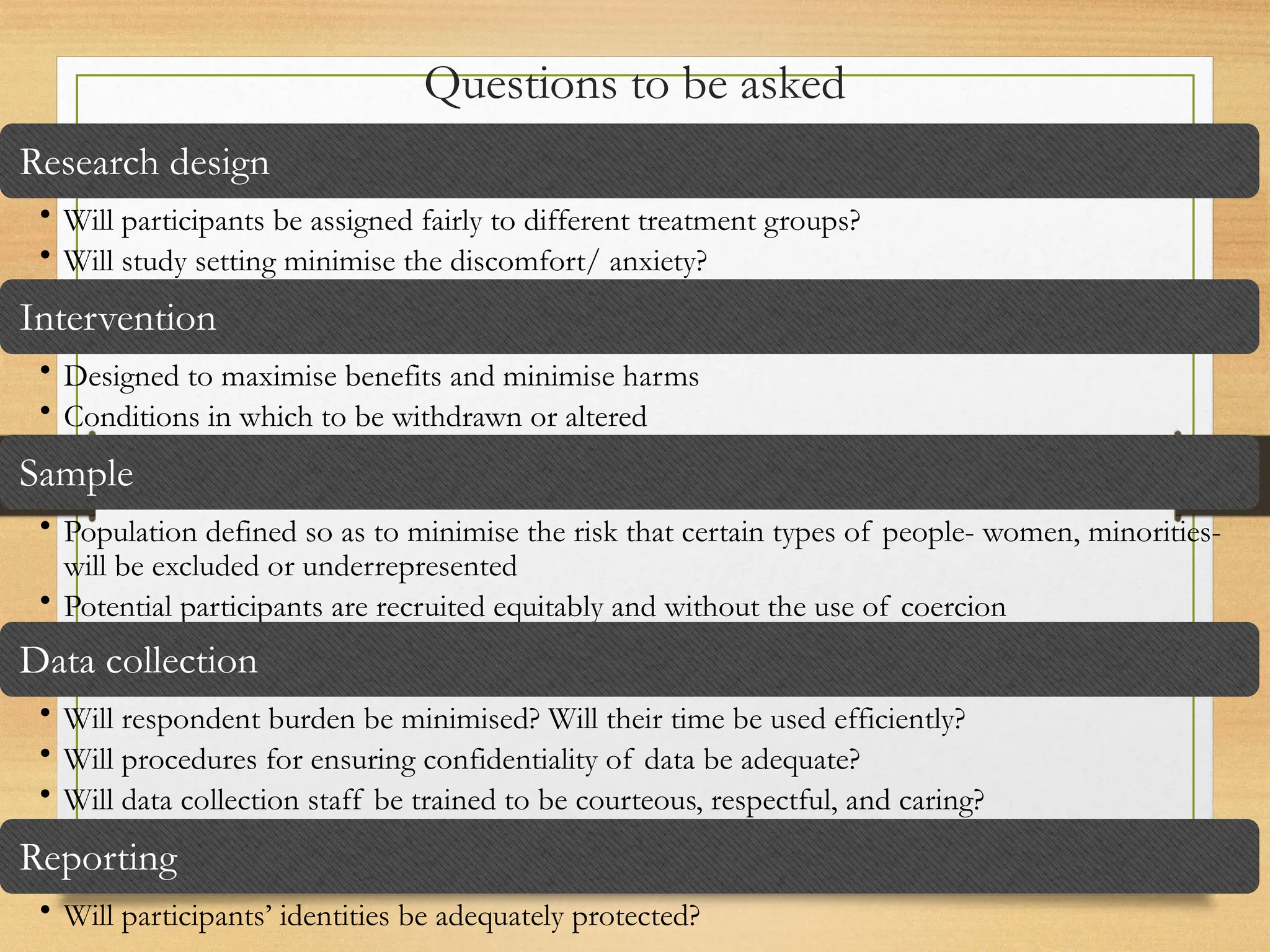
Questions to be asked
Research design
• Will participants be assigned fairly to different treatment groups?
• Will study setting minimise the discomfort/ anxiety?
Intervention
• Designed to maximise benefits and minimise harms
• Conditions in which to be withdrawn or altered
Sample
• Population defined so as to minimise the risk that certain types of people- women, minorities-
will be excluded or underrepresented
• Potential participants are recruited equitably and without the use of coercion
Data collection
• Will respondent burden be minimised? Will their time be used efficiently?
• Will procedures for ensuring confidentiality of data be adequate?
• Will data collection staff be trained to be courteous, respectful, and caring?
Reporting
• Will participants’ identities be adequately protected?
Other ethical issues
• In using animals in research- IC not relevant
• Nine principles(USA) including
• Alternatives
• Pain and distress
• Researcher qualifications
• Use of appropriate anaesthesia
• Conditions of euthanizing animals
contd
• Research misconduct
• Fabrication, falsification, or plagiarism in proposing,
performing or reviewing research, or in reporting the
results
• Protection of the public trust
• Office of Research Integrity in USA
contd
• Fabrication- making up data or study results
• Falsification- manipulating research materials,
equipment or processes, also involves changing or
omitting data or distorting results
• Plagiarism- involves the appropriation of someone’s
ideas, results, or words without giving due credit,
including information obtained as a reviewer of
research proposals or manuscripts
Other misconducts
• Improprieties of authorship
• Poor data management
• Conflicts of interest
• Inappropriate financial arrangements
• Failure to comply with governmental regulations
• Unauthorised use of confidential information
Areas of scientific
dishonesty

Plagiarism
 Fabrication & falsification
 Non publication of data
 Faulty data gathering procedure
 Poor data storage and retention
 Misleading authorship
 Sneaky publication practices
 Abstract of a SR in the field of Non
communicable disease
 Research priorities by ICN,INC, KUHS
 Mention instances that you have noticed which
violated the principles of ethics.
 Describe the process of informed CONSENT
Notes
Guidelines of DHHS
 Risks to subjects are minimised and
proportionate to the anticipated benefits and
knowledge.
 Data are monitored to ensure safety of subjects
 Selection of subjects is equitable
 Informed consent is obtained, if appropriate
 Confidentiality is adequately protected
ETHICAL GUIDELINES FOR
BIOMEDICAL RESEARCH ON
HUMAN PARTICIPANTS- ICMR
REPORT
READ…..
Researchers need to be aware of the
Health Insurance Portability and
Accountability Act (HIPAA, 2003).
This act protects an individual’s
health information. This ensures
participant taking part voluntarily
and is aware of what is about to
happen.
Participants must be given all
necessary information that might
affect their willingness to
participate. The investigators must
disclose information that will be
relevant to the subject’s decision
whether or not to participate.
contd..
Necessary information
 Informed consent
◦ The nature of research project
◦ Procedures of the study
◦ The potential risks & benefits of the
study
 Assurances that participation is
voluntary
 Protection of confidentiality
 Questions about the study
Guidelines for Nurses
 Advocacy
 Privacy
 Confidentiality
 Debriefing
 Anonymity
 An independent review board comprises
medical/scientific and non‐medical /nonscientific
members
 9‐15 members
 Review every research proposal on human subjects
IT IS MANDATORY THAT ALL PROPOSALS ON
BIOMEDICAL RESEARCH INVOLVING HUMAN
SUBJECTS SHOULD BE CLEARED BY AN
APPROPRIATELY CONSTITUTED INSTITUTIONAL
ETHICS COMMITTEE
IEC / HREC/ IRB
 How essential is the research?
 Informed consent‐ voluntariness
 Non exploitation of vulnerable population
 Privacy and confidentiality ( HIV/AIDS)
 Minimal risks and dangers for subjects
 Reasonable risk ‐ benefit ratio
 Professional competence of
investigator/researcher
Review Procedure
 Accountability and transparency
 Institutional arrangements/adequate clinical
monitoring to ensure safety
 Emergency care provision
 Totality of responsibility
 Compliance of GCP (Good Clinical Practice)
 Informed consent document‐ contents
CONTD
 Safeguarding the participants
 IC means that participants have adequate
information about the research, comprehend
that information and can consent to or decline
participation voluntarily
Informed consent
 Involves communicating the following
 Participant status
 Research and treatment- difference should be
known
 Which treatment is routine and which is
specifically done for research
 Data they provide will be used for research
purposes.
Content of IC
 Study goals
 Should be stated in lay rather than technical terms
 How the data will be used should be described
 Type of data
 What type of data will be collected. Eg: self-reports,
lab tests
 Procedures
 Given a description of the data collection
procedures and procedures to be used for any
innovative treatment
 Nature of commitment
 To be told the expected time commitment at
each point of contact and the number of
contacts within a given time frame
 Sponsorship
 Or funding, if it is a part of the academic
requirement that should be mentioned
 Participant selection
 How they are selected for recruitment and how
many people will be participating
 Potential risks
 Foreseeable risks- physical, psychological,
social or economic- or discomforts
 Efforts to minimise the risks
 Possibility of unforeseeable risks should be
discussed if appropriate
 If injury occurs, what treatment will be given
will be described
 Potential benefits
 Specific benefits and benefits of others
 Alternatives
 Should be told about the alternative treatments
that are available which might be
advantageous to them
 Compensation
 Stipends or reimbursements or if the treatment
is free, it should be discussed
 Confidentiality pledge
 Should be assured that their privacy will be
protected. If anonymity can be guaranteed this
should be stated
 Voluntary consent
 Should indicate the participation is strictly
voluntary and failure to volunteer will not result
in any penalty or loss of benefits
 Right to withdraw and withhold information
 Should be told that after consenting, they have
the right to withdraw from the study or
withhold any information. Researchers have to
describe the circumstances under which they
would terminate the study
 Contact information
 Whom to contact in the event of questions,
comments or complaints
 Process consent
 It is an ongoing, transactional process
 The researcher continually renegotiates the
consent, allowing participants to play a
collaborative role in making decisions about
ongoing participation
In qualitative study
 Presented orally or in writing
 Speak with the prospective participants even when
we are giving the written notices
 Information should be communicated and
understood
 Simple terms and avoid technical terms
 Teacher role
 General population level should be that of 7th
or 8th
grade student
 Non natives and who have cognitive impairments-
comprehension is especially important
Comprehension of IC
 Consent form
 No intervention and anonymity- written informed
consent does not apply- HIPAA
 Should contain all the information
 Participant or their legally authorized
representative- ample time to review before signing
 Signed by the researcher
 Witness – full info orally and short form is for
signature
 Copy to both parties
Documentation
 Implied consent- if it is a self administered
questionnaire- they return it
 Information sheet is provided, no signature
needed
Critiquing the Ethical Aspects
i) Was the study approved by an
Institutional Review Board (IRB)?
ii) Was informed consent obtained
from the subjects?
iii) Is there information about
provisions for anonymity or
confidentiality?
contd…
iv) Were vulnerable subjects used?
v) Does it appear that subjects
might have been coerced into
acting as subjects?
vi) Is it evident that the benefits of
participation in the study
outweighed the risks involved?
vii) Were subjects provided the
opportunity to ask questions
about the study and told how to
contact the researcher if other
questions arose?
viii) Were subjects told how they
could get the results of the study?
Conclusion
Conducting research ethically
requires protection of human rights
of subjects. Human rights that
require protection in research
include - self determination, privacy,
anonymity & confidentiality and fair
treatment. Research need to be
conducted with ethical guidelines.
 Evidence Based Nursing and prepare notes..
READ
 Burns and Grove 5 th edition 2005
 Polit and Beck 8th
edition 2012
 Wood and Haber 6th
edition 2006
 Schmidt and Brown 2009
References
Thank you students……
Unit II
LITERATURE REVIEW
INTRODUCTION
 Scientific knowledge grows day by day
 Multiplication of research information
 Studies are undertaken with the context of an
existing base of knowledge
 Researcher’s work to be built on the work of
others (Kaplan,1964)
LITERATURE
 Consists of all written sources relevant to
the selected topic
 Availability of research information
continues to escalate
 Computerized data bases
LITERATURE REVIEW
Definitions
 An organized written presentation of what has
been published on a topic by the scholars – Burns
& Grove (2005)
 An account of what has been published by
accredited scholars and researchers – Taylor(2011)
LITERATURE REVIEW
 Is not a list of published studies
 Presents identified themes & trends
 Critically analyses the available literature on the
topic
 Evaluates the studies based on the focus of your
study
Relevant Literature Review
 Sources that are important in providing in-
depth knowledge needed to make changes
in nursing practice or to study a selected
problem
Literature Review
 Increase in number of nursing journals
 Availability of computerized data bases
 Review process has become more
enlightening & challenging
 Establishes the context
 Identifies the knowledge gap
 Helps in generating RQ and hypothesis
 Guides research methodology
 Guides in sample size estimation
 Avoids duplication
 Sources for citations and references
 Informs practical implications
Importance
PURPOSES OF LITERATURE REVIEW
 Discovers knowledge
 Conveys to the reader what is currently known
regarding the topic of interest
 Determines gaps , consistencies and
inconsistencies
 Discovers unanswered questions
 Describes the strengths & weaknesses of designs,
instruments used in studies
PURPOSES - contd
 Determines the need to replicate a study
 For development of new/refined interventions
 Identifies relevant framework designs &
methods
 Identifies the source of funding & the experts in
the field
 Assists in interpreting study findings
LITERATURE REVIEW IN QUANTITATIVE
RESEARCH
 Major review is done at the beginning of the
research process & limited review during the
generalization of research report
LITERATURE REVIEW IN QUALITATIVE
RESEARCH
 Purpose & timing depend on the type of study
 Phenomenological research – after the data
collection & analysis
 Grounded theory research – minimal relevant
review in the beginning of the study
 Ethnographical research – done early in research
process to give background for the study
 Historical research – an initial review to select the
research problem & to develop research questions
SCOPE OF LITERATURE REVIEW
 Broad – to become knowledgeable about the
research problem
 Narrow – to predominantly relevant sources
AREAS TO BE EVALUATED FOR SCOPE
 Types of sources & information available
 Approximate depth and breadth of review
 Time frame for conducting review
TYPES OF LITERATURE
 Theoretical literature
 Empirical literature
Theoretical literature
 It consists of concept analysis, models, theories &
conceptual frameworks that support a selected
research problem and purpose
 It reflects the current understanding of the research
problem
 Theoretical literature can be found in the serials,
periodicals & monographs
Empirical literature
 Comprises of relevant studies in journals & books as
well as unpublished theses
 Empirical literature reviewed depends on the study
problem & the type of research conducted
SOURCES OF REVIEW
 Primary sources
 Secondary sources
Primary source
 A primary source is written by a person who is
responsible for originating or generating the ideas
published
 Research publications written by the person or people
who conducted the research/ theorists who developed
the theory
Secondary source
 Secondary source –Research reports prepared by
someone other than the original researcher
 Problems
- Interpretation is influenced by the author’s perception
& may be biased
- Possibility of errors
- Fails to provide the details of study
Forms
 A review embedded in Research Report
 A review in a Research proposal
 A review in a thesis or dissertation
DEPTH AND BREADTH OF REVIEW
 Depth – number & quality of sources referred
on a topic
 Breadth – number of different topics
examined
FACTORS AFFECTING DEPTH & BREADTH OF REVIEW
 Researcher’s background
- new investigator & experienced investigator
 Complexity of research project
- numerous variables & complex methodologies
 Availability of sources
- articles, journals & books
TIME FRAME FOR LITERATURE REVIEW
• Depends on the type of problem, sources available & goals
of the scholar
• No set length of time for review
• Narrower the focus of study – lesser time is needed
• Set a time frame for literature review
MAJOR STAGES IN LITERATURE
REVIEW PROCESS
 Searching the literature
 Reading the literature
 Writing the literature
I.SEARCHING THE LITERATURE
“A systematic and explicit approach to the
identification, retrieval and bibliographical
management of independent studies for the
purpose of locating information on a topic,
synthesizing conclusions, identifying areas for
future studies and developing guidelines for
clinical practice”
- Auston, Cahn & Selden (1992)
Purposes of searching the literature
 Develop a search strategy to retrieve as
much relevant literature as possible
 Develop a strategy based on time &
finances available
Strategies to obtain relevant literature
 Develop a search strategy
 Select data bases to search
 Select key words
 Systematically record references
 Use reference management software
 Locate relevant literature
 Perform complex searches
 Select search fields
 Select electronic journals
 Search the internet
 Finding every relevant sources
Search strategy - Approaches
Cooper (1998)
 Bibliographic databases
 Ancestory approach – use the citations from
relevant studies & track down earlier research
 Decendancy approach – search forward to find
recent studies
 Grey literature – refers to studies with limited
distribution (conference papers, unpublished
reports, dissertations)
Develop a search strategy
 Written search strategy saves time. It helps to
- avoid going back along paths you have already
searched
- retrace your steps
- search new paths
 Initial search should be wide & later narrow the
focus of search
 Get consultation for literature search approach
Select databases to search
 A bibliographical database is a compilation of citations
relevant to a specific discipline or from a variety of
disciplines
 Three distinct types
- Indexes & abstracts
- Full text reprint services
- Link citations
 Data bases
- Printed form
- Electronic data base
Electronic Databases for Nurse
Researchers
 CINAHL (Cumulative Index to Nursing and Allied Health
Literature)
 MEDLINE (Medical Literature Online)
 ISI (Institute for Scientific Information Web of Knowledge)
 British Nursing Index
 Cochrane Database of Systematic Reviews
 HaPI (Health and Psychological Instruments Database)
 Nursing and Allied Health Source (ProQuest)
 Dissertation Abstracts Online
CINAHL Database
 Contains citations of nursing literature published after 1955
 Referred as “Red Books” by nursing scholars
 Covers English language, Nursing and Allied Health
journals, books, book chapters, dissertations & selected
conference proceedings
 Electronic version contains database from 1982 to the
present (more than one million records)
 Accessed online http://www.cinahl.com or by CD-ROM
MEDLINE Database
 Developed by US National Library of Medicine
(NLM) – Free access
 Covers about 5000 Medical, Nursing and Health
journals
 15 million records from mid 1960’s
 From 1999, Abstracts of Cochrane collaboration
became available
 Is an online database with free access through
PubMed web
www.ncbi.nlm.gov/entrez/query.fcgi
ISI Web of Knowledge
 Maintains multidisciplinary resources called the
web of knowledge
 Offers integrated searching
 Covers most fields of social & applied sciences
including medicine and nursing
Other Databases
 Cancer Lit
 Cochrane database of systematic review
 Dissertations abstract online
 Psych Info
 Ovid
 Science direct
Select key words
 Key words are the major concepts or variables
that must be included in your search
 To determine the key words, identify concepts,
variables, population, interventions,
measurement methods or relevant outcomes
 Subject headings and phrases can be used
 Think of alternative terms (synonyms)
 Note down the key words in the written search
plan
Select keywords - contd
 Truncating words allow to locate more citations
related to the term
 Do not truncate terms to less than four letters –
will give unwanted references
 Pay attention to variant spellings
 Frequently cited author’s name can be used to
perform search
 Use a journal title in case of well known journal in
that particular topic/field
Search recordings
 Name of databases used
 Exclusion & inclusion criteria used
 Date of performing search
 Exact search strategy used
 Key words used
 Combining strategies used
 Number of articles found
 Percentage of relevant articles
 Websites visited & links pursued
 Authors contacted for further information
 Develop a table of record and save it in the computer
Systematically record references
 As per the format used in the reference list
 APA (American Psychological Association,2001),
Vancouver
 Cross check the sources cited two or three times
to prevent errors
 Use reference management software
Use Reference Management Software
 To track the references you have obtained
 To store information on all search fields
 As you read insert comments
 It also organizes the references into the reference style you
intend to use
 Eg ProCite and EndNote
Locate relevant literature
 Initiate search using key words identified
 Citations are listed with the most recent ones first
 Proceed to next key word
 Plan for complex search
Performing complex searches
 Combines two or more concepts or synonyms in
one search
 Three most common ways
- Boolean operators
- Locational operators
- positional operators
 Truncation symbols - !, +, $,*,? AND #
Operators
 Permit grouping of ideas, selection of places to
search,& to show relationship within a data base
record
 Examine “Help Screen” to see whether the
operators are available and how they are used
Boolean operators
 3 words – AND, OR and NOT
 Often capitalized
 Used with the identified concepts
 OR is commonly used
Locational operators
 Identify terms in specific areas
 Article name, journal & author name
 Subject headings, abstracts, cited references,
publication type, instruments used
Positional operators
 To look for requested terms
 Highly dependent on data base search software
 Common ones are – NEAR, WITH & ADJ (adjacent)
Example
Search topic Hits
Pain 49,60,000
Pain AND Child* AND Nur 1,14,000
Limit to English 5634
Limit to entries with abstracts 2342
Limit to nursing journals 1232
Limit to 2013-2023 567
Limiting search
 Limits
- vary with the data base
- limit the years of search
- limit within particular years & get
the hits
- depends on the time limit
- full text articles are better
 Helps to avoid irrelevant & non useful material
Searching electronic journals
 Have more current information
 Need to subscribe to online journals
 Can access full text article
 Articles are reviewed & published within 3 months
 List of current electronic nursing journals are
available at
www.4nursingjournals.com
Searching internet/ worldwide web
 Unlikely to find relevant studies but may get
information relevant to background &
significance
 Advantage – information are current
 Disadvantage – accuracy is questionable & no
screening process
 Important to check the source
 Identify the best search engine
Recording mechanisms
 Literature review protocol
 Literature review matrices
- Methodologic matrix
- Results matrix
- Evaluation matrix
TYPES OF REVIEW MATRIX
 Methodologic Matrix –How have researchers studied this research
question?
 Results Matrix –What have researchers found?
 Evaluation Matrix – How much confidence we have in the evidence?
METHODOLOGIC MATRIX
 Authors
 Publication year
 Country
 Dependent variables
 Independent variables
 Study designs
 Sample size
 Sampling method
 Data collection method
RESULT MATRIX
 Authors
 Publication year
 Dependent variables
- pain perception
- use of analgesics
- Effect of nursing
intervention
 Others – association & relationships
EVALUATION MATRIX
 Authors
 Publication years
 Major strengths
 Major weaknesses
 Quality score
II READING AND CRITIQUING SOURCES
 Skimming resources
 Comprehending resources
 Analyzing resources
 Synthesizing resources
Skimming resources
 Quickly reviewing a source to gain a broad
overview of its content
 Read title, author’s name, abstract or introduction
& the major headings
 Finally review the conclusion or summary
 Helps to make a preliminary judgement about the
value of the source
 Helps to determine whether it is primary or
secondary source
Comprehending Sources
 Requires complete reading of an article
carefully
 Highlight the content you consider
important
 Relevant categories are identified for
sorting & organizing sources
 These categories serve as a guide for
writing the literature review
Analyzing Sources
 Can determine the value of a source for a
particular study
 Analysis takes place in two ways
- Critique individual studies
- Making comparisons among
studies
Synthesizing Sources
 Basis for developing review of literature section
 Involves clarifying the meaning obtained from the
source as a whole
 Can cluster & interrelate ideas from several
sources
 Avoid using direct quote, instead paraphrase
(expressing the ideas clearly in your own words)
 The meanings obtained from all sources are then
combined or clustered to the proposed study
III WRITING LITERATURE REVIEW
 Sorting sources
 Developing the written review
 Checking references
Sorting sources
 Is challenging
 Relevant sources
 Organizing the review – meaningful
 Structure in such a way that the presentation is
logical, demonstrates meaningful thematic
integration & leads to a conclusion about the
state of evidence on the topic
Developing the written review
Major sections
 Introduction
 Discussion of theoretical literature
 Discussion of empirical literature
 Summary
 Definition of the topic of review
 Context
 Purpose / objectives
 Scope
 Structure
Introduction
 Include emerging themes, solutions, gaps, point out
recent trends, Divergent perspectives
 Give structure or narrative thread
◦ Chronological; by themes; by sector / domains / sub-groups;
by development of ideas or along a process; by themes)
 Use sub-headings organized in proper layers
 Signposting
 Adduce evidence - citation
 Quotes
 Paraphrase
 Style – detached narration, a dialogue with the
literature,
 Use tables to compare two or more perspectives,
methods, profile of participants
The Body
 Summarize major and most convincing
contributions of significant studies
 Evaluate the current state of the evidence in
the field
 Point out gaps
 Point out issues pertinent to future study
 Provide insight into the relationship between
the central topic review and a larger area of
study
Conclusion
Checking references
 Check for accuracy & completeness
 Errors should be avoided
 Spelling of author’s name
 Check all citations within the text & each citation
in the reference list
 Year of citation
Characteristics of a Quality Review
 Must be comprehensive & thorough incorporating
up to date references
 Systematic
 Reproducible
 Absence of bias
 “sum of its parts”
ROLE OF A RESEARCHER
 To point out what is known already,
how dependable the studies are, what
are the gaps that exists in the body of
research and the contribution the
present study would make
CONCLUSION
 Is a critical step in the research process
 Is challenging
REFERENCES
 Burns, N., & Grove, K. S. (2005). The practice of
nursing research: Conduct, critique and utilization
(5th ed.). Missouri: Elsevier Publication.
 Munshall, P. L. (2001). Nursing Research: A
qualitative perspective. Sudbury, MA: Jones &
Bartlett
 Polit, F. D., & Beck, T. C. (2011). Nursing research
generating and assessing evidence fir nursing
practice (8th ed.). New Delhi: Wolters Kluwer
(India) Pvt. Ltd.
REFERENCES
 Taylor, T. (2011). The literature review: A few tips on
conducting it. Retrieved June 6, 2011 from
http://wwwwriting utoronto ca/advice/specific –
types-of-listing/literature-review.
 UNC Education Department. (2011). Literature
reviews. Retrieved June 14, 2011 from
http://wwwunc
edu/depts/wcweb/handouts/literature_review
html.
 Online search engines, databases, reviews, and index
Cochrane Review (http://www.cochrane.org/reviews/)
 PubMed; Medline, Medline Central
http://www.ncbi.nlm.nih.gov/pmc/
 Medlars (http://indmed.nic.in/; http://medind.nic.in/
 JSTOR (http://www.jstor.org/)
 ProQuest (www.proquest.com/)
 Current Contents
(http://thomsonreuters.com/products_services/science/s
cience_products/a-z/current_contents_connect/
 Social Science Citation Index
(http://thomsonreuters.com/products_services/science/s
cience_products/a-z/social_sciences_citation_index/)
 Popline (http://www.popline.org/)
 Google Scholar
Thank you students….

Nursing research unit 1 of MSc N syllabus KUHS.pptx

  • 1.
  • 2.
    Review: Problem solving and scientificmethod. Research –definition, characteristics, purposes, types of research, Basic research terms, Scope of nursing research, Overview of Research process, Significance of research in nursing, Historical Evolution of nursing research.  Future trends in nursing research.  Problems and challenges in nursing research, health and social research.  Priorities for nursing research.  Evidence based practice.  Ethics in research  UNIT I Introduction to Research
  • 3.
     Looking fornew knowledge, doing something new ??  Looking for facts  Measuring phenomenon, health states, including health and disease  Developing new – materials, products including drugs, processes, designs….  New models of delivery of health services What is research??
  • 4.
     Organised investigationof a problem  French word - re- cerche “ to search again”  A careful investigation or inquiry MEANING- RESEARCH
  • 5.
    • John Graunt– “Natural and Political Observations Made upon the Bills of Mortality” (1662) ‐ he was a trader of tailoring items ‐ but became father of demography and epidemiology. • Your need • Interest • Questioning bent of mind • Know techniques and how to apply them • Patience and perseverance • Objectivity and open mind • Writing skills Research is not difficult –anyone can do it
  • 6.
     A systematicand objective analysis and recording of controlled observation that may lead to the development of generalisation of principles, theories, resulting in prediction and possible ultimate control of events  J. W. BEST Definition
  • 7.
     It isa careful inquiry or examination seeking facts or principles , a diligent investigation to ascertain something  CLIFFORD WOODY Definition
  • 8.
     It isan attempt to gain solutions to problems; more precisely it is the collection of data in a rigorously controlled situation for the purpose of prediction or explanation  TREECE AND TREECE Definition
  • 9.
    • Discovery –finding what existed • Inventions – new produce development that did not exist in nature • Innovation – new ways to solve old problems • Development – after invention to useful products and services • Testing new and old products/drugs and services • Evaluation of programs – wider outcomes and impacts, including unintended outcomes. Research terms
  • 10.
    Observations, Research andScience relationship • Observations and thinking are basis for scientific development • Archimedes’s observations on water displaced in the bath tub – volume, density… principles of floating bodies ‐ 250 BC. • Renaissance (14‐17th centuries) was spearheaded by systematic observations of natural processes ‐> new thinking, writing, and correlating observations and theory • Galileo's observations on pendulum’s movement ‐ >measurement of time, Telescope ‐> planetary bodies…. • Newton's observation on apple falling ‐> gravitation • Before that Indian scientists observed, developed theories and written down… but forgotten…Arya Bhatt, Panini, …… • Observations, thinking, documentations, experimentation further development of theory, application to practice….. Basis of science History of research :
  • 11.
    It is the systematic inquirydesigne d to develop trustwor thy evidenc e about issues of importance to the nursing profession, including nursin g practic e, educat ion, adminis tration, and informa tics. POLI T AND BECK, 2021 NURSING RESEARCH
  • 12.
     It isa systematic approach to the solution or alleviation of problems characterised by sequential execution of the following observation through action processes PROBLEM SOLVING
  • 13.
     Inductive  Deductive Analytic  Synthetic Approaches of problem solving
  • 14.
    PLAN • 1. Clarifythe problem • 2. Break down the problem • 3. Set a target • 4. Analyze the root cause DO • 5. Develop counter measures • 6. Implement counter measures CHECK • 7. Evaluate results and processes ACT • 8. Standardize successful improvements 8 step problem solving model- Toyota business process Oct 2010
  • 15.
    Research (Scientific) Problemsolving Selecting the topic Identifying problem Quantitative or qualitative data, statistically analysed No statistical analysis Control factors other than variables in study No controls are imposed Generalisable Generalisation is not possible Replication and verification Entails no such requirements Disseminate the research findings Evaluation, revision and utilisation of the findings in specific situations, no dissemination. Finding process Learning and problem solving process Comparison
  • 16.
    Specific problem- recognize, select &state Defining Collecting relevant information Formulation of hypothesis / solutions Evaluation of hypothesis Verifying validity Choosing alternatives if unsuccessful or till successful Steps
  • 17.
    Generation of knowledge Problemsolving Demands accurate observation and description Originality Empirical Logical Characteristics of good research
  • 18.
    Replicable Theory development andtesting Appropriate methodology Conducted on representative sample Good tools Recorded and reported Findings are made available to other scholars contd
  • 19.
    1. Basic andapplied research 2. To achieve various levels of explanation 3. Research purposes linked to EBP PURPOSES OF RESEARCH
  • 22.
     Description  Exploration Explanation  Prediction and control Purposes 1
  • 23.
     Discover knowledgeof the discipline  Answers to question/ solution to a problem  Discovering and interpreting new facts  Establishes generalization and builds theory Purposes 2
  • 24.
     Formulating newphenomenon  Development of clinical interventions  Identification- novel insight  Promotes EBN Purposes 3
  • 25.
     Document costeffectiveness  Develop nursing principles and theories Purposes 4
  • 26.
     Treatment, Therapyor intervention  Diagnosis and assessment  Prognosis  Prevention of harm  Etiology or causation  Meaning and processes Linked to EBP
  • 27.
  • 29.
     Forms ofResearch • Natural Science • Humanities • Economic • Social • Business Types of research
  • 30.
    • Relies onthe application of the scientific methods. • Searches for the “truth” • The knowledge generated is practically applicable. • Can be further classified according to different disciplines of academic or applications Natural Science Research
  • 31.
    • Employs amore relativist epistemology • It usually tries to understand a condition or question in the context of the issues and factors surrounding it, rather than trying to find out a single “true” answer to it • It focuses on the “context” – social, political, economical, ethnic, cultural Humanities Research
  • 32.
  • 34.
     Type ofapplied research  Cyclical in nature Action research
  • 35.
    • A specialcategory of applied or action research • Aims at maximizing the profit & minimizing the cost or expenses • Applying advanced analytical methods to help make better decisions. Operations Research
  • 36.
    • Business management •Engineering • Economics • Agriculture • Financial institutions • City planning • Transportation • Crime investigations • Health Where Operations Research is Applied?
  • 37.
    • How manybeds in a hospital/speciality • How to minimize waiting time in OPD? • How to reduce interval between two operations • How best to deliver some medicine to the target community • How to optimize the supply for vaccine in an immunization program Application of Operations Research in Health
  • 38.
    • Primary –Collecting the data from primary sources like patients, users, practitioners, environment etc • Secondary – Collecting the data from secondary sources like hospital records, government records, meteorological records, Survey reports etc Primary vs. Secondary
  • 39.
     Research confinedto the laboratories‐ Most of the biochemical, pharmacological, Genetic studies – Many are at cellular level.  Research conducted in the community, field program operations etc – Most of the public health researches are in field.  Clinical Trials – may be a combination of both. Laboratory vs. Field
  • 40.
    • Descriptive Researchis a fact finding investigation which is aimed at describing the characteristics of individual, situation or a group (or) describing the state of affairs as it exists at present. • Analytical Research is primarily concerned with testing hypothesis and specifying and interpreting relationships, by analyzing the facts or information already available. • Experimental Research is considered by some people as a distinct group of analytical research Descriptive vs. Analytical
  • 41.
    Quantitative Research • Dealswith numbers and try to quantify and measure a particular phenomena. • Often uses statistical methods aimed at establishing significance. • Aims to find the “true cause”. • Tries to answer questions “how many” or “how much”. Quantitative vs. Qualitative Research
  • 42.
    • Primarily doesnot deal with numbers but the nature of data. • Follows an “interpretivist” approach instead of a statistical one. • Aims to understand a phenomenon in its proper “context”. • Tries to answer questions like “what”, “why” and “how”. Qualitative Research
  • 43.
    Diagnostic Research –It is also called clinical research which aims at identifying the causes of a problem, frequency with which it occurs and the possible solutions for it. Exploratory Research – It is the preliminary study of an unfamiliar problem, about which the researcher has little or no knowledge. It is aimed to gain familiarity with the problem, to generate new ideas or to make a precise formulation of the problem. Hence it is also known as formulative research. Some Other Nomenclatures..
  • 44.
    Experimental Research –It is designed to assess the effect of one particular variable on a phenomenon by keeping the other variables constant or controlled. Historical Research – It is the study of past records and other information sources, with a view to find the origin and development of a phenomenon and to discover the trends in the past, in order to understand the present and to anticipate the future
  • 45.
    • Clinical trialsare a set of procedures in medical research and drug development that are conducted to allow safety and efficacy data to be collected for health interventions (e.g., drugs, diagnostics, devices, therapy protocols) • These are usually conducted in 4 phases ‐ I to IV on human subjects (preceded by animal experiments and basic research in laboratories) Clinical Trials
  • 46.
    We can classifyresearch in many ways but these are not watertight compartments • Such classifications are more for broad conceptualisation • In practice, many a times there are a lots of overlapping
  • 47.
     Conceptual andEmpirical research
  • 48.
     Any othertypes of research?  Applications in Nursing? Home work
  • 49.
     Nursing service Nursing education  Nursing administration  Nursing informatics Scope of NR
  • 50.
     Influences currentand future practices  Adequately trained nurses can conduct quality clinical research  Leads to EBN practice  Provide description, explanation, prediction and control of nursing situations in nursing practice  Identifies cost effective practices  Problem solving Significance / Importance
  • 51.
     WORLD VIEW/GENERAL PERSPECTIVE OF THE COMPLEXITIES OF REAL WORLD  BASIC PHILOSOPHICAL QUESTIONS ◦ Ontologic –what is the nature of reality? ◦ Epistemologic- what is the relationship with the inquirer and that being studied? ◦ Axiologic- what is the role of values in inquiry? ◦ Methodologic – how should the inquirer obtain knowledge? Paradigms in research
  • 52.
  • 54.
  • 55.
    A beautiful thing aboutlearning is that nobody can take it away from you LEARNING
  • 57.
    Future trends • Heightenedfocus on EBP • Development of stronger evidence base • Emphasis on SR • Expanded local research in health care settings
  • 58.
  • 60.
  • 61.
     Strengthening ofmultidisciplinary collaboration  Expanded dissemination of research findings  Increasing visibility of nursing research  Increased focus on cultural issues and health disparities Future trends…
  • 62.
     Inadequate knowledge Lack of qualified guide  Difficulty in controlling external variables  Lack of time  Lack of standardized tools  Reliability of disciplined research  Studying many variables  Ethical problems  Lack of support from administrative set up  Financial constraints Problems and challenges
  • 63.
     Health promotionand disease prevention  Promotion of health of vulnerable and marginalized communities  Patient safety and quality of health care  Development of EBP and translational research  Promotion of health of older people  Patient centered care and care co ordination  Palliation and end of life care  Care implications of genetic testing and therapeutics Priorities for nursing research
  • 64.
     Capacity developmentof nurse researchers  Nurses working environment  STTI 2005 contd
  • 65.
    • Evidence ismaterials and observations collected to demonstrate “truth” or what works • What looks apparent and obvious may not be true – sun moving around the earth !! • Evidence is systematically collected information (measurement ) to support or disprove an hypothesis or theory • Two types of evidence ‐ direct evidence and circumstantial evidence • Observations lead to theory – theory leads to observations or experimentation to confirm theory • Experimentation provides strongest evidence Role of Evidence in Science
  • 66.
     A paradigmand lifelong problem solving approach to clinical decision making that involves the conscientious use of the best available evidence, including a systematic search for and critical appraisal of the most relevant evidence to answer a clinical question, with one’s own clinical expertise and patient values and preferences to improve outcomes for individuals, communities and systems  Melnyk and Fineout- Overholt, 2019 Definition
  • 67.
  • 68.
     Research Utilisation It is the use of findings from a study in a practical application  Translating new knowledge into real- world applications  1990  Archie Cochrane  Cochrane collaboration  43 countries  EBM- Dr David Sackett in 1990s EBP and related concepts
  • 69.
     EBP orEvidence- Informed Practice  Based means patient preferences are not taken into account ??
  • 70.
     Canadian Institutesof Health research  Exchange, synthesis and ethically sound application of knowledge- within a complex system of interactions among researchers and users- to accelerate the capture of the benefits of research for Canadians through improved health, more effective services and products and a strengthened health care system Knowledge Translation
  • 71.
     WHO  Thesynthesis exchange and application of knowledge by relevant stakeholders to accelerate the benefits of global and local innovation in strengthening health systems and improving people’s health
  • 72.
     Involves thestudy of interventions, implementation processes and contextual factors that affect the uptake of new evidence in health care practice  Doctor of Nursing Practice degree Translational research
  • 73.
     Sources ◦ Traditionand authority ◦ Clinical experience, trial and error and intuition ◦ Logical reasoning ◦ Assembled information ◦ Disciplined research EBP
  • 74.
     6 Shierarchy of evidence sources  DiCenso and colleagues 2009  A guide for evidence retrieval  Work top downward  Ease in terms of searching, not in terms of quality Resources for evidence based practice in Nursing
  • 76.
     “Evidence‐based medicine(EBM) or evidence‐ based practice (EBP) aims to apply the best available evidence gained from the scientific method to clinical decision making.  It seeks to assess the strength of the evidence of risks and benefits of treatments and diagnostic tests. This helps clinicians understand whether or not a treatment will do more good than harm.” WikiP Evidence Based Medicine, practice and PH Policies and Programs
  • 77.
     How evidencegrows: No evidence, to some evidence, substantial evidence, review of evidence, meta‐analysis, overall recommendation.  Authority based policies and programs – vs. evidence based policies and programs.  Systematic evaluation of evidence is new science – but clinical trials are not new – first trial was done by James Lind 1747 on 12 sailors on board a ship to see effect of limes and oranges on Scurvy (bleeding gums) Evidence Based Medicine, practice and PH Policies and Programs
  • 78.
    Observations – basisof most clinical science developments – disease and syndromes defined by observed symptoms and signs – systematic observations on series of similar cases • Observations during epidemics ‐ John Snow on Cholera… Observational studies – without interventions – special studies to understand natural progress of disease • Smoking and lung cancer or CVD studies • Observational studies following natural events or accidents Study of Interventions / programs – interventions happening – scientists measure the impact – Effect of program by comparing with non‐ program areas, Before after Studies. Experimental studies – specific interventions introduced to measure effectiveness or impact with well planned study design – effect of new drugs – clinical trials or community trials Methods of “Evidence” gathering
  • 79.
    • Observations ofassociation – air from swamps‐> Malaria • Case series – systematic case observations and compilation • Ecological studies – salt intake and hypertension, heat wave /temperature and mortality… • Case control studies – contraceptives and heart and vascular diseases, smoking and cancer • Cohort studies – smoking and cancer, cholesterols and heart disease • Trials – non randomized – new treatments – patient chooses • Trials Randomized • Blinded randomized, multicentre, multi‐country trials Hierarchy of Evidence
  • 80.
    Polit and Becklevels/ hierarchy of evidence of interventions
  • 81.
  • 84.
     5As  StepI Ask- a well worded research question  Step 2 Acquire- search for and retrieve the best evidence  Step 3 Appraise- critically appraise the evidence for validity and applicability to the problem and situation  Step 4 Apply- after integrating the evidence with clinical expertise, patient preferences, and local context, apply it to practice  Step 5 Assess- evaluate the outcome of practice change Major steps in EBP
  • 86.
    STEPS IN QUANTITATIVE STUDIES Phase I  Conceptual Phase Formulating and delimiting the problem Reviewing the related literature Undertaking clinical fieldwork Developing conceptual framework Formulating hypotheses
  • 87.
    STEPS IN QUANTITATIVE STUDIES Phase II  Design and planning phase Selecting a research design Developing intervention protocols Identifying the population Designing the sampling plan Specifying methods to measure research variables Developing methods to safe guard subjects Finalizing the research plan
  • 88.
    STEPS IN QUANTITATIVE STUDIES Phase III  Empirical phase Collecting the data Preparing the data for analysis
  • 89.
    STEPS IN QUANTITATIVE STUDIES Phase IV  Analytic phase Analyzing the data Interpreting the results
  • 90.
    STEPS IN QUANTITATIVE STUDIES Phase V  Dissemination phase Communicating the findings Utilizing the findings in practice
  • 91.
    STEPS OF QUALITATIVE RESEARCH Planning Developingdata collection strateg ies Gathering and analysing data Disseminating findings
  • 92.
  • 93.
     Every studyinvolving human subjects raises a unique set of ethical issues. A practical way to address these issues is to work from the regulations of federal agencies that fund research and guidelines of the Indian Nursing Council ETHICS IN RESEARCH
  • 94.
     Moral principlesthat govern a person's behaviour or the conducting of an activity.  The branch of knowledge that deals with moral principles Ethics
  • 96.
    Introduction How long doesit take for body parts to freeze when people are kept naked outdoors in subfreezing temperatures? What signs and symptoms are seen when people are kept in tanks of ice water for 3 hours? These questions were asked by so-called researchers in Germany in the early 1940s.
  • 97.
    Introduction During 1942 and1943, prisoners’ wounds were deliberately infected with bacteria. Infection was aggravated by the forcing of wood shavings and ground glass into the wounds. Contd..
  • 98.
    Introduction Sulfanilamide was thengiven to these prisoners to determine the effectiveness of this drug. Some subjects died and others suffered serious injury. Many nurses participated in these unethical experiments. (Bonifazi 2004)
  • 99.
    Introduction Between June andSeptember 1944, photographs and body measurements were taken of 112 Jewish prisoners. Then they were killed, and their skeletons were defleshed. Contd..
  • 100.
    Introduction One purpose ofthis study was to determine if photographs from live human being could be used to predict skeletal size. The skeleton collection was to be displayed at the Reich University of Strasbourg. (Nuremberg Military Tribunals, 1949)
  • 101.
    Introduction  Infecting womenprisoners with syphilis, having them impregnated by male prisoners, then dissecting the live babies and mothers.  Draining the blood from prisoners’ veins and substituting horse blood. Contd..
  • 102.
    Introduction  Exploding gasgangrene bombs next to prisoners tied to stakes.  Vivisecting prisoners to compile data on the human endurance of pain. (Scientific Atrocities, 1996, Japan)
  • 103.
    Introduction Of the 600black male subjects, 399 had syphilis, and 201 did not have the disease. Those subjects with active cases were given no treatment. All subjects were given free medical exams, free meals, and burial expenses. Contd…
  • 104.
    Introduction Even after penicillinwas accepted as the treatment of choice for syphilis in 1945, subjects were still given no treatment. This unethical study became common knowledge 40 years after it was begun. On May 16, 1997, president Bill Clinton made a public apology on behalf of the nation. (CDC 2006)
  • 105.
    Introduction It is commonknowledge that smallpox is no threat to the world. Few people remember, or even know, that Edward Jenner deliberately exposed an 8 year old child to cowpox to try out his new vaccine for smallpox. (Hayter, 1979)
  • 106.
    Introduction In July 1963,doctors at the Jewish Chronic Disease Hospital in Brooklyn, New York, injected live cancer cells into 22 elderly patients. The study was designed to measure patients’ ability to reject foreign cells. The patients were told that they were being given skin tests. (Katz, 1972)
  • 107.
    Introduction In 2005, itwas revealed that government-funded researchers tested experimental AIDS drugs on hundreds of foster children. (Solomon, 2005)
  • 108.
    Core concept Ethics isthe science that deals with rightness and wrongness of actions. Bioethics is the term applied to these principles when they refer to concepts within the scope of medicine, nursing, and allied health . (Aiken, 2004)
  • 109.
    Core concept Moral behavioris defined as conduct that results from serious critical thinking about how individuals ought to treat others. Moral behavior reflects the way a person interprets basic respect for other persons, such as the respect for autonomy, freedom, justice, honesty, and confidentiality. (Pappas, 2003)
  • 110.
    Core concept Values areideals or concepts that give meaning to the individual ’s life. (Aiken, 2004)
  • 111.
    Core concept A rightis defined as “ a valid, legally recognized claim or entitlement, encompassing both freedom from government interference or discriminatory treatment and an entitlement to a benefit of service”. (Levy and Rubenstein 1996)
  • 112.
     Nuremberg code:1947  Helsinki Declaration: 1975  Belmont Report: 1979  CIOMS Council for International Organisations of Medical Sciences : 1982  ICMR (Indian Council of Medical Research) Guidelines: 1980, revised 2000 Evolution of Ethical Guidelines
  • 113.
    Development of ethicalcodes The development of appropriate ethical guidelines are complex as it concerns with human behaviour. Ethical principles changes with time and newer knowledge. Because of public outcry against the atrocities committed in Germany in 1940s, the Nuremberg code was developed in 1947.
  • 114.
    The Nuremberg code Researcher must inform subjects about the study  Research must be for the good of society  Research must be based on animal experiments, if possible contd…
  • 115.
     Researcher musttry to avoid injury to research subjects  Researcher must be qualified to conduct research  Subjects or the researcher can stop the study if problems occur.
  • 116.
    Based on thepreliminary efforts of the Council for International Organisations of Medical Sciences (CIOMS) in 1964 at Helsinki, the World Medical Association formulated general principles and specific guidelines on use of human subjects in medical research, known as the Helsinki Declaration Helsinki declaration
  • 117.
     National Commissionfor the Protection of Human Subjects of Biomedical and Behavioral Research.  The Belmont Report summarizes ethical principles and guidelines for research involving human subjects.  Three core principles ◦ respect for persons ◦ Beneficence ◦ justice.  Three primary areas of application ◦ informed consent ◦ assessment of risks and benefits ◦ selection of subjects. Belmont report 1978-9
  • 118.
  • 119.
     The rightto self determination  The right to full disclosure  Requires investigators to treat subjects as autonomous individuals and obtain their informed consent  Research subjects must be regarded not as passive sources of data, but as individuals whose welfare and rights must be respected. Respect for human dignity
  • 120.
     The rightto freedom from harm and discomfort  The right to protection from exploitation  requires investigators to design protocols that will provide valid and generalisable knowledge  ensure that the benefits of the research are proportionate to the risks assumed by the subjects.  wellbeing of the subjects must be protected. Beneficence
  • 121.
    LEVELS OF DISCOMFORTAND HARM  Level 1: No anticipated effects: no positive or negative effects for the subjects
  • 122.
    LEVELS OF DISCOMFORTAND HARM  Level 2: Temporary discomfort considered minimal risk studies  discomfort is simulate to that which the subject would experience in his/her daily life and cease with termination of the study
  • 123.
    LEVELS OF DISCOMFORTAND HARM  Level 3: Unusual levels of temporary discomfort during the study and after the study has terminated  Level 4: Risk of permanent damage, potential for subject to suffer permanent damage
  • 124.
    LEVELS OF DISCOMFORTAND HARM  Level 5: Certain permanent damage; no experiment should be conducted where there is an a priori reason to believe that death or disabling injury will occur...
  • 125.
     The rightto fair treatment  The right to privacy  requires that the benefits and burden of research be distributed fairly .  Research participants assume some risk in order to benefit the society as a whole.  Therefore no single group, especially not disadvantaged, vulnerable or minority groups should be asked to bear a disproportionate share of risk. Justice
  • 126.
     Beneficence ‐a practitioner/researcher should act in the best interest of the patient/participant  Non‐maleficence ‐ "first, do no harm”  Autonomy ‐ the participant has the right to refuse the intervention or opt out from the research study  Justice ‐ concerns the distribution of scarce health resources and the decision of who gets what treatment  Dignity ‐ the patient/participant (and the person treating the patient) have the right to dignity.  Truthfulness and honesty ‐ the concept of informed consent has increased in importance since the historical events of the Nuremberg trials and Tuskegee Syphilis Study Six Principles of Medical Ethics
  • 127.
     While planningthe study  Through out the course of the study  Poor research design and poor dissemination- unethical Building ethics into the design of the study
  • 128.
    Questions to beasked Research design • Will participants be assigned fairly to different treatment groups? • Will study setting minimise the discomfort/ anxiety? Intervention • Designed to maximise benefits and minimise harms • Conditions in which to be withdrawn or altered Sample • Population defined so as to minimise the risk that certain types of people- women, minorities- will be excluded or underrepresented • Potential participants are recruited equitably and without the use of coercion Data collection • Will respondent burden be minimised? Will their time be used efficiently? • Will procedures for ensuring confidentiality of data be adequate? • Will data collection staff be trained to be courteous, respectful, and caring? Reporting • Will participants’ identities be adequately protected?
  • 129.
    Other ethical issues •In using animals in research- IC not relevant • Nine principles(USA) including • Alternatives • Pain and distress • Researcher qualifications • Use of appropriate anaesthesia • Conditions of euthanizing animals
  • 130.
    contd • Research misconduct •Fabrication, falsification, or plagiarism in proposing, performing or reviewing research, or in reporting the results • Protection of the public trust • Office of Research Integrity in USA
  • 131.
    contd • Fabrication- makingup data or study results • Falsification- manipulating research materials, equipment or processes, also involves changing or omitting data or distorting results • Plagiarism- involves the appropriation of someone’s ideas, results, or words without giving due credit, including information obtained as a reviewer of research proposals or manuscripts
  • 132.
    Other misconducts • Improprietiesof authorship • Poor data management • Conflicts of interest • Inappropriate financial arrangements • Failure to comply with governmental regulations • Unauthorised use of confidential information
  • 133.
    Areas of scientific dishonesty  Plagiarism Fabrication & falsification  Non publication of data  Faulty data gathering procedure  Poor data storage and retention  Misleading authorship  Sneaky publication practices
  • 134.
     Abstract ofa SR in the field of Non communicable disease  Research priorities by ICN,INC, KUHS  Mention instances that you have noticed which violated the principles of ethics.  Describe the process of informed CONSENT Notes
  • 135.
    Guidelines of DHHS Risks to subjects are minimised and proportionate to the anticipated benefits and knowledge.  Data are monitored to ensure safety of subjects  Selection of subjects is equitable  Informed consent is obtained, if appropriate  Confidentiality is adequately protected
  • 137.
    ETHICAL GUIDELINES FOR BIOMEDICALRESEARCH ON HUMAN PARTICIPANTS- ICMR REPORT READ…..
  • 138.
    Researchers need tobe aware of the Health Insurance Portability and Accountability Act (HIPAA, 2003). This act protects an individual’s health information. This ensures participant taking part voluntarily and is aware of what is about to happen.
  • 139.
    Participants must begiven all necessary information that might affect their willingness to participate. The investigators must disclose information that will be relevant to the subject’s decision whether or not to participate. contd..
  • 140.
    Necessary information  Informedconsent ◦ The nature of research project ◦ Procedures of the study ◦ The potential risks & benefits of the study  Assurances that participation is voluntary  Protection of confidentiality  Questions about the study
  • 141.
    Guidelines for Nurses Advocacy  Privacy  Confidentiality  Debriefing  Anonymity
  • 142.
     An independentreview board comprises medical/scientific and non‐medical /nonscientific members  9‐15 members  Review every research proposal on human subjects IT IS MANDATORY THAT ALL PROPOSALS ON BIOMEDICAL RESEARCH INVOLVING HUMAN SUBJECTS SHOULD BE CLEARED BY AN APPROPRIATELY CONSTITUTED INSTITUTIONAL ETHICS COMMITTEE IEC / HREC/ IRB
  • 143.
     How essentialis the research?  Informed consent‐ voluntariness  Non exploitation of vulnerable population  Privacy and confidentiality ( HIV/AIDS)  Minimal risks and dangers for subjects  Reasonable risk ‐ benefit ratio  Professional competence of investigator/researcher Review Procedure
  • 144.
     Accountability andtransparency  Institutional arrangements/adequate clinical monitoring to ensure safety  Emergency care provision  Totality of responsibility  Compliance of GCP (Good Clinical Practice)  Informed consent document‐ contents CONTD
  • 145.
     Safeguarding theparticipants  IC means that participants have adequate information about the research, comprehend that information and can consent to or decline participation voluntarily Informed consent
  • 146.
     Involves communicatingthe following  Participant status  Research and treatment- difference should be known  Which treatment is routine and which is specifically done for research  Data they provide will be used for research purposes. Content of IC
  • 147.
     Study goals Should be stated in lay rather than technical terms  How the data will be used should be described  Type of data  What type of data will be collected. Eg: self-reports, lab tests  Procedures  Given a description of the data collection procedures and procedures to be used for any innovative treatment
  • 148.
     Nature ofcommitment  To be told the expected time commitment at each point of contact and the number of contacts within a given time frame  Sponsorship  Or funding, if it is a part of the academic requirement that should be mentioned  Participant selection  How they are selected for recruitment and how many people will be participating
  • 149.
     Potential risks Foreseeable risks- physical, psychological, social or economic- or discomforts  Efforts to minimise the risks  Possibility of unforeseeable risks should be discussed if appropriate  If injury occurs, what treatment will be given will be described
  • 150.
     Potential benefits Specific benefits and benefits of others  Alternatives  Should be told about the alternative treatments that are available which might be advantageous to them  Compensation  Stipends or reimbursements or if the treatment is free, it should be discussed
  • 151.
     Confidentiality pledge Should be assured that their privacy will be protected. If anonymity can be guaranteed this should be stated  Voluntary consent  Should indicate the participation is strictly voluntary and failure to volunteer will not result in any penalty or loss of benefits
  • 152.
     Right towithdraw and withhold information  Should be told that after consenting, they have the right to withdraw from the study or withhold any information. Researchers have to describe the circumstances under which they would terminate the study  Contact information  Whom to contact in the event of questions, comments or complaints
  • 153.
     Process consent It is an ongoing, transactional process  The researcher continually renegotiates the consent, allowing participants to play a collaborative role in making decisions about ongoing participation In qualitative study
  • 154.
     Presented orallyor in writing  Speak with the prospective participants even when we are giving the written notices  Information should be communicated and understood  Simple terms and avoid technical terms  Teacher role  General population level should be that of 7th or 8th grade student  Non natives and who have cognitive impairments- comprehension is especially important Comprehension of IC
  • 155.
     Consent form No intervention and anonymity- written informed consent does not apply- HIPAA  Should contain all the information  Participant or their legally authorized representative- ample time to review before signing  Signed by the researcher  Witness – full info orally and short form is for signature  Copy to both parties Documentation
  • 156.
     Implied consent-if it is a self administered questionnaire- they return it  Information sheet is provided, no signature needed
  • 157.
    Critiquing the EthicalAspects i) Was the study approved by an Institutional Review Board (IRB)? ii) Was informed consent obtained from the subjects? iii) Is there information about provisions for anonymity or confidentiality? contd…
  • 158.
    iv) Were vulnerablesubjects used? v) Does it appear that subjects might have been coerced into acting as subjects? vi) Is it evident that the benefits of participation in the study outweighed the risks involved?
  • 159.
    vii) Were subjectsprovided the opportunity to ask questions about the study and told how to contact the researcher if other questions arose? viii) Were subjects told how they could get the results of the study?
  • 160.
    Conclusion Conducting research ethically requiresprotection of human rights of subjects. Human rights that require protection in research include - self determination, privacy, anonymity & confidentiality and fair treatment. Research need to be conducted with ethical guidelines.
  • 161.
     Evidence BasedNursing and prepare notes.. READ
  • 162.
     Burns andGrove 5 th edition 2005  Polit and Beck 8th edition 2012  Wood and Haber 6th edition 2006  Schmidt and Brown 2009 References
  • 163.
  • 164.
  • 165.
    INTRODUCTION  Scientific knowledgegrows day by day  Multiplication of research information  Studies are undertaken with the context of an existing base of knowledge  Researcher’s work to be built on the work of others (Kaplan,1964)
  • 166.
    LITERATURE  Consists ofall written sources relevant to the selected topic  Availability of research information continues to escalate  Computerized data bases
  • 167.
    LITERATURE REVIEW Definitions  Anorganized written presentation of what has been published on a topic by the scholars – Burns & Grove (2005)  An account of what has been published by accredited scholars and researchers – Taylor(2011)
  • 168.
    LITERATURE REVIEW  Isnot a list of published studies  Presents identified themes & trends  Critically analyses the available literature on the topic  Evaluates the studies based on the focus of your study
  • 169.
    Relevant Literature Review Sources that are important in providing in- depth knowledge needed to make changes in nursing practice or to study a selected problem
  • 170.
    Literature Review  Increasein number of nursing journals  Availability of computerized data bases  Review process has become more enlightening & challenging
  • 171.
     Establishes thecontext  Identifies the knowledge gap  Helps in generating RQ and hypothesis  Guides research methodology  Guides in sample size estimation  Avoids duplication  Sources for citations and references  Informs practical implications Importance
  • 172.
    PURPOSES OF LITERATUREREVIEW  Discovers knowledge  Conveys to the reader what is currently known regarding the topic of interest  Determines gaps , consistencies and inconsistencies  Discovers unanswered questions  Describes the strengths & weaknesses of designs, instruments used in studies
  • 173.
    PURPOSES - contd Determines the need to replicate a study  For development of new/refined interventions  Identifies relevant framework designs & methods  Identifies the source of funding & the experts in the field  Assists in interpreting study findings
  • 174.
    LITERATURE REVIEW INQUANTITATIVE RESEARCH  Major review is done at the beginning of the research process & limited review during the generalization of research report
  • 175.
    LITERATURE REVIEW INQUALITATIVE RESEARCH  Purpose & timing depend on the type of study  Phenomenological research – after the data collection & analysis  Grounded theory research – minimal relevant review in the beginning of the study  Ethnographical research – done early in research process to give background for the study  Historical research – an initial review to select the research problem & to develop research questions
  • 176.
    SCOPE OF LITERATUREREVIEW  Broad – to become knowledgeable about the research problem  Narrow – to predominantly relevant sources
  • 177.
    AREAS TO BEEVALUATED FOR SCOPE  Types of sources & information available  Approximate depth and breadth of review  Time frame for conducting review
  • 178.
    TYPES OF LITERATURE Theoretical literature  Empirical literature
  • 179.
    Theoretical literature  Itconsists of concept analysis, models, theories & conceptual frameworks that support a selected research problem and purpose  It reflects the current understanding of the research problem  Theoretical literature can be found in the serials, periodicals & monographs
  • 180.
    Empirical literature  Comprisesof relevant studies in journals & books as well as unpublished theses  Empirical literature reviewed depends on the study problem & the type of research conducted
  • 181.
    SOURCES OF REVIEW Primary sources  Secondary sources
  • 182.
    Primary source  Aprimary source is written by a person who is responsible for originating or generating the ideas published  Research publications written by the person or people who conducted the research/ theorists who developed the theory
  • 183.
    Secondary source  Secondarysource –Research reports prepared by someone other than the original researcher  Problems - Interpretation is influenced by the author’s perception & may be biased - Possibility of errors - Fails to provide the details of study
  • 184.
    Forms  A reviewembedded in Research Report  A review in a Research proposal  A review in a thesis or dissertation
  • 185.
    DEPTH AND BREADTHOF REVIEW  Depth – number & quality of sources referred on a topic  Breadth – number of different topics examined
  • 186.
    FACTORS AFFECTING DEPTH& BREADTH OF REVIEW  Researcher’s background - new investigator & experienced investigator  Complexity of research project - numerous variables & complex methodologies  Availability of sources - articles, journals & books
  • 187.
    TIME FRAME FORLITERATURE REVIEW • Depends on the type of problem, sources available & goals of the scholar • No set length of time for review • Narrower the focus of study – lesser time is needed • Set a time frame for literature review
  • 188.
    MAJOR STAGES INLITERATURE REVIEW PROCESS  Searching the literature  Reading the literature  Writing the literature
  • 189.
    I.SEARCHING THE LITERATURE “Asystematic and explicit approach to the identification, retrieval and bibliographical management of independent studies for the purpose of locating information on a topic, synthesizing conclusions, identifying areas for future studies and developing guidelines for clinical practice” - Auston, Cahn & Selden (1992)
  • 190.
    Purposes of searchingthe literature  Develop a search strategy to retrieve as much relevant literature as possible  Develop a strategy based on time & finances available
  • 191.
    Strategies to obtainrelevant literature  Develop a search strategy  Select data bases to search  Select key words  Systematically record references  Use reference management software  Locate relevant literature  Perform complex searches  Select search fields  Select electronic journals  Search the internet  Finding every relevant sources
  • 192.
    Search strategy -Approaches Cooper (1998)  Bibliographic databases  Ancestory approach – use the citations from relevant studies & track down earlier research  Decendancy approach – search forward to find recent studies  Grey literature – refers to studies with limited distribution (conference papers, unpublished reports, dissertations)
  • 193.
    Develop a searchstrategy  Written search strategy saves time. It helps to - avoid going back along paths you have already searched - retrace your steps - search new paths  Initial search should be wide & later narrow the focus of search  Get consultation for literature search approach
  • 194.
    Select databases tosearch  A bibliographical database is a compilation of citations relevant to a specific discipline or from a variety of disciplines  Three distinct types - Indexes & abstracts - Full text reprint services - Link citations  Data bases - Printed form - Electronic data base
  • 195.
    Electronic Databases forNurse Researchers  CINAHL (Cumulative Index to Nursing and Allied Health Literature)  MEDLINE (Medical Literature Online)  ISI (Institute for Scientific Information Web of Knowledge)  British Nursing Index  Cochrane Database of Systematic Reviews  HaPI (Health and Psychological Instruments Database)  Nursing and Allied Health Source (ProQuest)  Dissertation Abstracts Online
  • 196.
    CINAHL Database  Containscitations of nursing literature published after 1955  Referred as “Red Books” by nursing scholars  Covers English language, Nursing and Allied Health journals, books, book chapters, dissertations & selected conference proceedings  Electronic version contains database from 1982 to the present (more than one million records)  Accessed online http://www.cinahl.com or by CD-ROM
  • 197.
    MEDLINE Database  Developedby US National Library of Medicine (NLM) – Free access  Covers about 5000 Medical, Nursing and Health journals  15 million records from mid 1960’s  From 1999, Abstracts of Cochrane collaboration became available  Is an online database with free access through PubMed web www.ncbi.nlm.gov/entrez/query.fcgi
  • 198.
    ISI Web ofKnowledge  Maintains multidisciplinary resources called the web of knowledge  Offers integrated searching  Covers most fields of social & applied sciences including medicine and nursing
  • 199.
    Other Databases  CancerLit  Cochrane database of systematic review  Dissertations abstract online  Psych Info  Ovid  Science direct
  • 200.
    Select key words Key words are the major concepts or variables that must be included in your search  To determine the key words, identify concepts, variables, population, interventions, measurement methods or relevant outcomes  Subject headings and phrases can be used  Think of alternative terms (synonyms)  Note down the key words in the written search plan
  • 201.
    Select keywords -contd  Truncating words allow to locate more citations related to the term  Do not truncate terms to less than four letters – will give unwanted references  Pay attention to variant spellings  Frequently cited author’s name can be used to perform search  Use a journal title in case of well known journal in that particular topic/field
  • 202.
    Search recordings  Nameof databases used  Exclusion & inclusion criteria used  Date of performing search  Exact search strategy used  Key words used  Combining strategies used  Number of articles found  Percentage of relevant articles  Websites visited & links pursued  Authors contacted for further information  Develop a table of record and save it in the computer
  • 203.
    Systematically record references As per the format used in the reference list  APA (American Psychological Association,2001), Vancouver  Cross check the sources cited two or three times to prevent errors  Use reference management software
  • 204.
    Use Reference ManagementSoftware  To track the references you have obtained  To store information on all search fields  As you read insert comments  It also organizes the references into the reference style you intend to use  Eg ProCite and EndNote
  • 205.
    Locate relevant literature Initiate search using key words identified  Citations are listed with the most recent ones first  Proceed to next key word  Plan for complex search
  • 206.
    Performing complex searches Combines two or more concepts or synonyms in one search  Three most common ways - Boolean operators - Locational operators - positional operators  Truncation symbols - !, +, $,*,? AND #
  • 207.
    Operators  Permit groupingof ideas, selection of places to search,& to show relationship within a data base record  Examine “Help Screen” to see whether the operators are available and how they are used
  • 208.
    Boolean operators  3words – AND, OR and NOT  Often capitalized  Used with the identified concepts  OR is commonly used
  • 209.
    Locational operators  Identifyterms in specific areas  Article name, journal & author name  Subject headings, abstracts, cited references, publication type, instruments used
  • 210.
    Positional operators  Tolook for requested terms  Highly dependent on data base search software  Common ones are – NEAR, WITH & ADJ (adjacent)
  • 211.
    Example Search topic Hits Pain49,60,000 Pain AND Child* AND Nur 1,14,000 Limit to English 5634 Limit to entries with abstracts 2342 Limit to nursing journals 1232 Limit to 2013-2023 567
  • 212.
    Limiting search  Limits -vary with the data base - limit the years of search - limit within particular years & get the hits - depends on the time limit - full text articles are better  Helps to avoid irrelevant & non useful material
  • 213.
    Searching electronic journals Have more current information  Need to subscribe to online journals  Can access full text article  Articles are reviewed & published within 3 months  List of current electronic nursing journals are available at www.4nursingjournals.com
  • 214.
    Searching internet/ worldwideweb  Unlikely to find relevant studies but may get information relevant to background & significance  Advantage – information are current  Disadvantage – accuracy is questionable & no screening process  Important to check the source  Identify the best search engine
  • 215.
    Recording mechanisms  Literaturereview protocol  Literature review matrices - Methodologic matrix - Results matrix - Evaluation matrix
  • 216.
    TYPES OF REVIEWMATRIX  Methodologic Matrix –How have researchers studied this research question?  Results Matrix –What have researchers found?  Evaluation Matrix – How much confidence we have in the evidence?
  • 217.
    METHODOLOGIC MATRIX  Authors Publication year  Country  Dependent variables  Independent variables  Study designs  Sample size  Sampling method  Data collection method
  • 218.
    RESULT MATRIX  Authors Publication year  Dependent variables - pain perception - use of analgesics - Effect of nursing intervention  Others – association & relationships
  • 219.
    EVALUATION MATRIX  Authors Publication years  Major strengths  Major weaknesses  Quality score
  • 220.
    II READING ANDCRITIQUING SOURCES  Skimming resources  Comprehending resources  Analyzing resources  Synthesizing resources
  • 221.
    Skimming resources  Quicklyreviewing a source to gain a broad overview of its content  Read title, author’s name, abstract or introduction & the major headings  Finally review the conclusion or summary  Helps to make a preliminary judgement about the value of the source  Helps to determine whether it is primary or secondary source
  • 222.
    Comprehending Sources  Requirescomplete reading of an article carefully  Highlight the content you consider important  Relevant categories are identified for sorting & organizing sources  These categories serve as a guide for writing the literature review
  • 223.
    Analyzing Sources  Candetermine the value of a source for a particular study  Analysis takes place in two ways - Critique individual studies - Making comparisons among studies
  • 224.
    Synthesizing Sources  Basisfor developing review of literature section  Involves clarifying the meaning obtained from the source as a whole  Can cluster & interrelate ideas from several sources  Avoid using direct quote, instead paraphrase (expressing the ideas clearly in your own words)  The meanings obtained from all sources are then combined or clustered to the proposed study
  • 225.
    III WRITING LITERATUREREVIEW  Sorting sources  Developing the written review  Checking references
  • 226.
    Sorting sources  Ischallenging  Relevant sources  Organizing the review – meaningful  Structure in such a way that the presentation is logical, demonstrates meaningful thematic integration & leads to a conclusion about the state of evidence on the topic
  • 227.
    Developing the writtenreview Major sections  Introduction  Discussion of theoretical literature  Discussion of empirical literature  Summary
  • 228.
     Definition ofthe topic of review  Context  Purpose / objectives  Scope  Structure Introduction
  • 229.
     Include emergingthemes, solutions, gaps, point out recent trends, Divergent perspectives  Give structure or narrative thread ◦ Chronological; by themes; by sector / domains / sub-groups; by development of ideas or along a process; by themes)  Use sub-headings organized in proper layers  Signposting  Adduce evidence - citation  Quotes  Paraphrase  Style – detached narration, a dialogue with the literature,  Use tables to compare two or more perspectives, methods, profile of participants The Body
  • 230.
     Summarize majorand most convincing contributions of significant studies  Evaluate the current state of the evidence in the field  Point out gaps  Point out issues pertinent to future study  Provide insight into the relationship between the central topic review and a larger area of study Conclusion
  • 231.
    Checking references  Checkfor accuracy & completeness  Errors should be avoided  Spelling of author’s name  Check all citations within the text & each citation in the reference list  Year of citation
  • 232.
    Characteristics of aQuality Review  Must be comprehensive & thorough incorporating up to date references  Systematic  Reproducible  Absence of bias  “sum of its parts”
  • 233.
    ROLE OF ARESEARCHER  To point out what is known already, how dependable the studies are, what are the gaps that exists in the body of research and the contribution the present study would make
  • 234.
    CONCLUSION  Is acritical step in the research process  Is challenging
  • 235.
    REFERENCES  Burns, N.,& Grove, K. S. (2005). The practice of nursing research: Conduct, critique and utilization (5th ed.). Missouri: Elsevier Publication.  Munshall, P. L. (2001). Nursing Research: A qualitative perspective. Sudbury, MA: Jones & Bartlett  Polit, F. D., & Beck, T. C. (2011). Nursing research generating and assessing evidence fir nursing practice (8th ed.). New Delhi: Wolters Kluwer (India) Pvt. Ltd.
  • 236.
    REFERENCES  Taylor, T.(2011). The literature review: A few tips on conducting it. Retrieved June 6, 2011 from http://wwwwriting utoronto ca/advice/specific – types-of-listing/literature-review.  UNC Education Department. (2011). Literature reviews. Retrieved June 14, 2011 from http://wwwunc edu/depts/wcweb/handouts/literature_review html.
  • 237.
     Online searchengines, databases, reviews, and index Cochrane Review (http://www.cochrane.org/reviews/)  PubMed; Medline, Medline Central http://www.ncbi.nlm.nih.gov/pmc/  Medlars (http://indmed.nic.in/; http://medind.nic.in/  JSTOR (http://www.jstor.org/)  ProQuest (www.proquest.com/)  Current Contents (http://thomsonreuters.com/products_services/science/s cience_products/a-z/current_contents_connect/  Social Science Citation Index (http://thomsonreuters.com/products_services/science/s cience_products/a-z/social_sciences_citation_index/)  Popline (http://www.popline.org/)  Google Scholar
  • 242.

Editor's Notes

  • #11 ANA. BURNS AND GROVE,ICN
  • #22 Describe the prevalence and characteristics of childhood sexual abuse among married women Explain (theories) exercise on the basis of self efficacy and outcome expectations Predict- identify predictors of succesful weaning from Mech vent Control- study to test effectiveness of nurse led smoking cessation programmes- controlling (improving) patient outcomes
  • #26 Effectiveness of relaxation breathing exercise on labour pain among primi Apgar Long term prognostic indicators of high risk infants Measures to improve women’s knowledge reagrding breast cancer and to promote preventive actions like BSE Why young adolescents do not use safety measures while driving- lower perceived risk, use of drugs and alcohol, non availability of safety equipments
  • #30 Causa nd effect. Obesity- oil or fat. Is that the truth. Then we can say that if u consume that less- can stop obesity. Practical application.Nutrition epidemiology
  • #31 And not a truth finding and cause and effect. Different dimension. Apart from the fact that they are taking more oil, fat…Obesity- what type of diet, physical activity, social condition, economic condition---- results in obesity
  • #64 INC, NINR, ICN etc
  • #112 SBMR
  • #117 The three fundamental ethical principles for using any human subjects for research are ( as found on http://www.hhs.gov/ohrp/humansubjects/guidance/belmont.html): Respect for persons: protecting the autonomy of all people and treating them with courtesy and respect and allowing for informed consent. Researchers must be truthful and conduct no deception; Beneficence: The philosophy of "Do no harm" while maximizing benefits for the research project and minimizing risks to the research subjects; and Justice: ensuring reasonable, non-exploitative, and well-considered procedures are administered fairly — the fair distribution of costs and benefits to potential research participants — and equally. These principles remain the basis for the HHS human subject protection regulations.
  • #118 Belmont principlesThe three Belmont Principles — respect for persons, justice , and beneficence — were supposedly derived from the works of leading secular moral philosophers of the 18th, 19th and 20th centuries, chiefly Kant, John Stuart Mill, and John Rawls, a highly influential Harvard University philosopher whose 1971 book, A Theory of Justice, was a blueprint for certain radically egalitarian legal and social theories of the 1970's, such as affirmative action and wealth redistribution. 
  • #135 US Department of health and human services
  • #139 The President's Commission for the Study of Ethical Problems in Medicine and Biomedical and Behavioral Research, created by Congress in 1978, has cited the three principles in presumably definitive reports on such wide–ranging medical–moral issues as the definition of death; informed consent; genetic screening and counseling; regional and class differences in the availability of health care; the use of life–sustaining treatment; privacy and confidentiality; genetic engineering; compensation for injured subjects; whistle–blowing in research; and guidelines for the institutional review boards set up by universities for research on human subjects. 
  • #232 gh