METHODS OF ACQUIRING
KNOWLEDGE IN NURSING
NAVDEEP KAUR
INTRODUCTION
• The present era of complex health problems makes interdisciplinary research
an essential characteristic of nursing research, because multiple perspectives
are required for the complex study of health and illness experiences of society.
• The expansion of new knowledge is required for growing profession like
nursing.
• A well-developed and reliable body of knowledge is a foundation for any
profession. This most sought-after knowledge can be acquired from highly
structured as well as loosely arranged processes or methods.
NAVDEEP KAUR
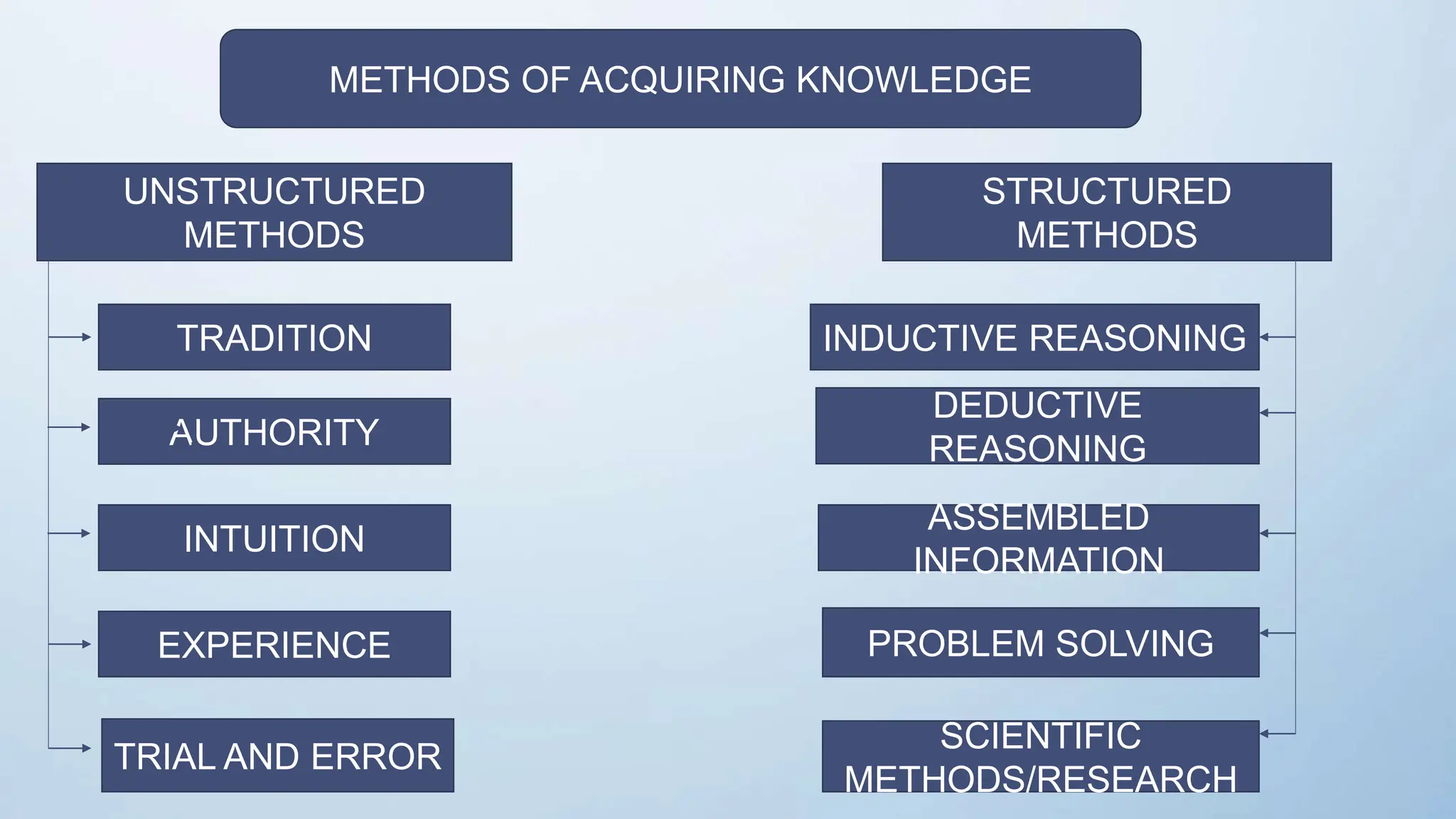
METHODS OF ACQUIRING KNOWLEDGE
UNSTRUCTURED
METHODS
STRUCTURED
METHODS
AUTHORITY
INTUITION
EXPERIENCE
TRIAL AND ERROR
SCIENTIFIC
METHODS/RESEARCH
INDUCTIVE REASONING
PROBLEM SOLVING
ASSEMBLED
INFORMATION
DEDUCTIVE
REASONING
TRADITION
1. Tradition:
The bulk of knowledge has been accumulated over centuries and
passed down from one generation to another through various
media. Traditional nursing knowledge is learnt mainly from
books, journals, by word of mouth, and by observing the practices
of others. Much traditional practices takes the form of rituals.
FOR EXAMPLE, it may be a tradition in some hospitals, talcum
powder is dusted over the bodies, after patients are washed,
performed consistently with little thought to the rationale behind
it. Traditions are not only important in passing down the
knowledge, but also in giving groups in society a sense of identity,
belonging and pride.
UNSTRUCTURED METHODS
2. Authority
• In our complex society, there are authorities(people with
specialized expertise in every field). We are constantly faced with
making decisions about matters with which we have had no direct
experience; therefore, it seems natural to place trust in the
judgement of people who are authoritative on an issue by virtue of
specialized training or experience. Those people are believed to be
a sound source of knowledge and understanding. However,
authority as source of knowledge do has many shortcomings.
NAVDEEP KAUR
It is considered as an important source of knowledge in
nursing profession since past. However, the knowledge
obtained from intuition, if through empathetic feeling,
without rational reasoning. Thus, it is also known as
information obtained through sixth sense without conscious
thinking but in this rationalizing the information may not be
obtained. In intuition, nurses know that there is something
wrong but cannot explain what it is and why it is.
3. Intuition
Nurses and midwives base their practices in
great part on their own experience and to a
lesser extent on the experience of others.
Experience is a useful way of gaining
knowledge. There is a wealth of untapped
knowledge embedded in the practice and
know-how of expert nurses and clinicians.
Experiences, therefore are an important
source of knowledge but relying solely on it
and overhanging its importance can be
detrimental to nursing practices.
4. Experience
5. Trial and error
It is the most common approach of gaining
knowledge. In this approach, alternatives are
tried successively until a solution to a problem
is found. In day-to-day life, everybody uses
this technique to solve many problems,
including professional ones. FOR EXAMPLE,
a new nurse is not aware of the different keys
used to change the head end of patient’s bed
up and down; she tries different alternatives
before achieving her task successfully.
NAVDEEP KAUR
1. LOGICAL REASONING:
Reasoning is the mental processing of ideas to solve problems.
Logical reasoning as a method of knowing, combines experience,
intellectual faculties and formal system of thought. Two
intellectual mechanisms used in reasoning are inductive and
deductive reasoning.
INDUCTIVE REASONING: It is the process of developing
generalization from specific observations. FOR EXAMPLE, a
nurse may observe the anxious behavior of (specific) hospitalized
children and conclude that (in general) children’s separation from
parents is stressful.
DEDUCTIVE REASONING: It is the process of developing
specific prediction from general principles. FOR EXAMPLE, if
we assume that separation anxiety occurs in hospitalized children
(in general), then we might predict that (specific) children
admitted in a hospital whose parents do not room-in will manifest
symptoms of stress.
STRUCTURED METHODS
2. ASSEMBLED INFORMATION
In making clinical decision, health care
professionals also rely n information that
has been assembled for a variety of
purposes. The regularly assembled data in
hospital such as patient census and in
community such as population census
serves as a good source of much needed
information for nurses and other
healthcare professionals.
NAVDEEP
• In problem solving, nurses try to understand a problem and
search for possible solutions. In this approach, possible
solutions are carefully evaluated and one of them is chosen for
implementation.
The nurse does not discard the other solutions, but holds them
in reserve; in the event when the first solution is not effective,
then other alternatives can be used.
3. PROBLEM SOLVIG
PROBLEM
DEFINITION
PROBLEM
ANALYSIS
GENERATING
POSSIBLE
SOLUTIONS
ANALYZING THE
SELECTING THE
BEST SOLUTION
IMPLEMENTING THE
SOLUTION
EVALUATION AND
REVISION
PROBLEM
SOLVING
PROCESS
NAVDEEP KAUR
(I) PROBLEM DEFINITION
The normal process for solving a problem initially
involves defining the problem that is to be solved. In
this first stage, there is a need to write down what
exactly the problem entails, which helps to identify the
real problem that is under study and needs an
immediate solution. This is the most important step of
the process as without this, next steps can not be
executed.
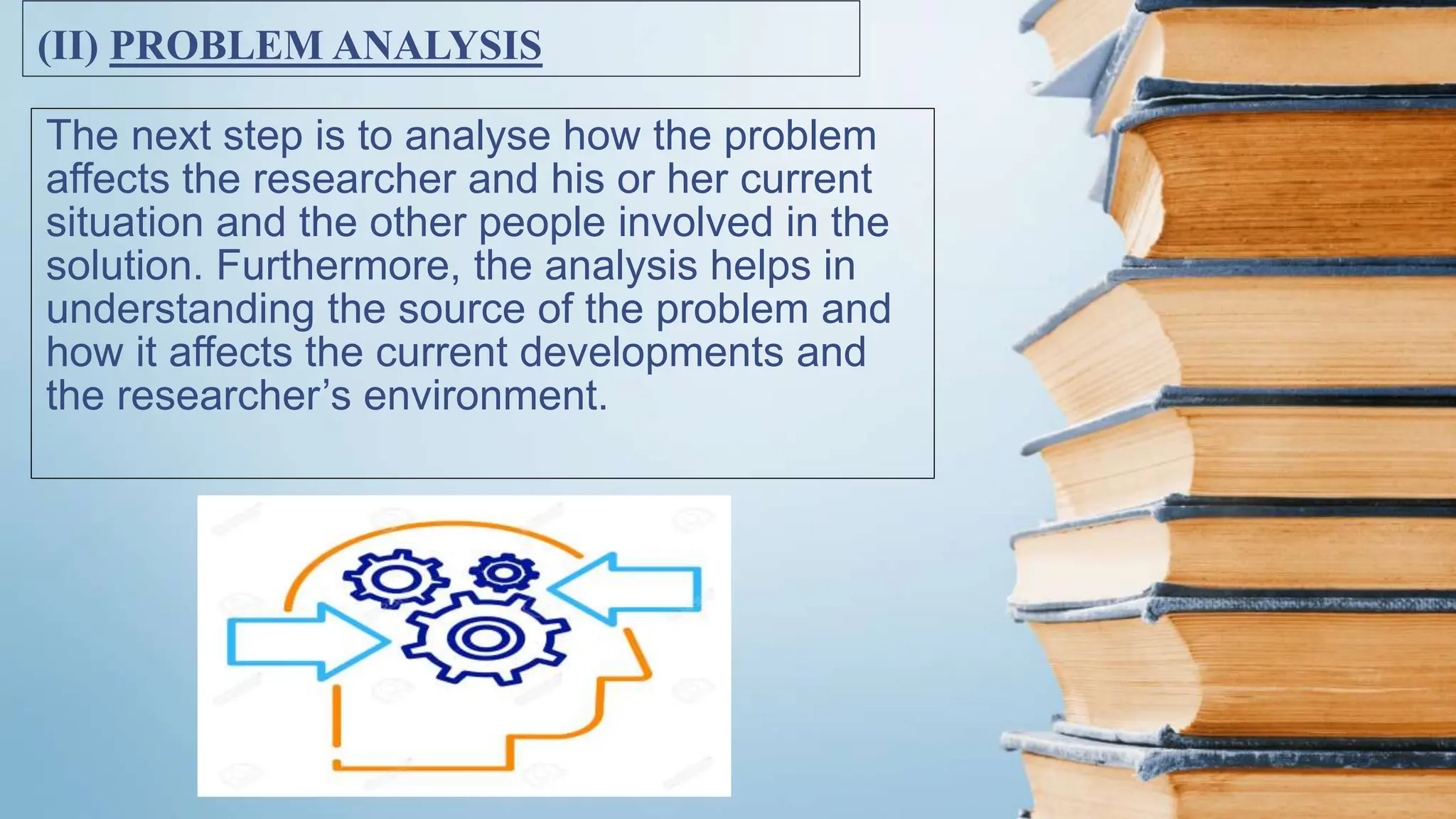
The next step is to analyse how the problem
affects the researcher and his or her current
situation and the other people involved in the
solution. Furthermore, the analysis helps in
understanding the source of the problem and
how it affects the current developments and
the researcher’s environment.
(II) PROBLEM ANALYSIS
(III) GENERATING POSSIBLE
SOLUTIONS
• When the real problem is
discovered, its contributing factors
should be investigated.
• At this stage, focus must be on
identifying and generating all
possible solutions for a problem.
• No idea should be discarded.
• Each idea should be treated as a
new idea
NAVDEEP KAUR
In this step, all the positive and negative aspects of
each solution are analysed to chose for the suitable
solution.
(IV) ANALYSING THE SOLUTIONS
(V) SELECTING THE BEST SOLUTION
In this, an attempt is made to compare the available
solutions and then the best solution out of all is
selected based on careful judgement.
NAVDEEP KAUR
It is the final step to solve the problem by
implementing the selected solution.
(VI) IMPLEMENTING THE SOLUTION
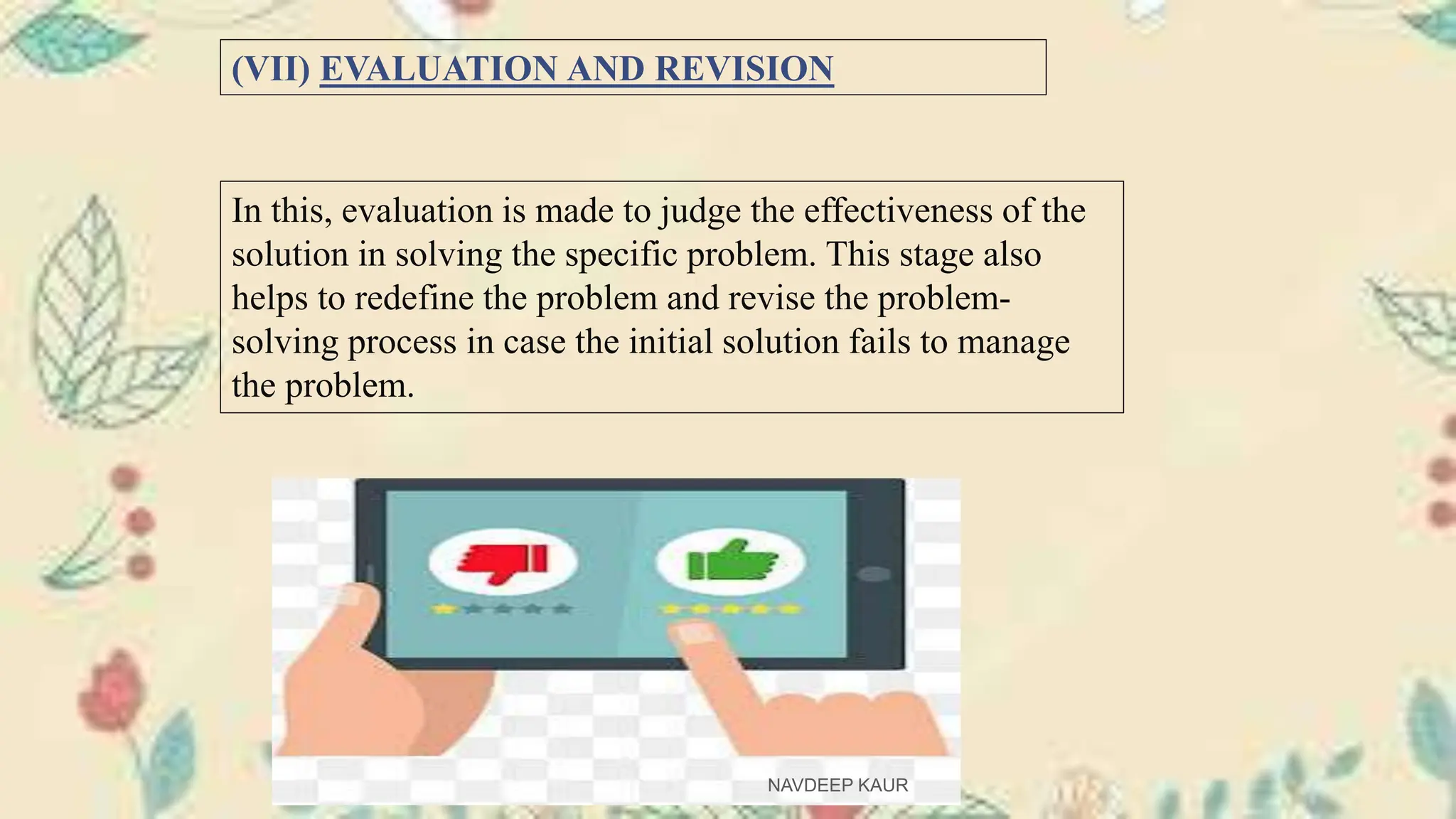
(VII) EVALUATION AND REVISION
In this, evaluation is made to judge the effectiveness of the
solution in solving the specific problem. This stage also
helps to redefine the problem and revise the problem-
solving process in case the initial solution fails to manage
the problem.
NAVDEEP KAUR
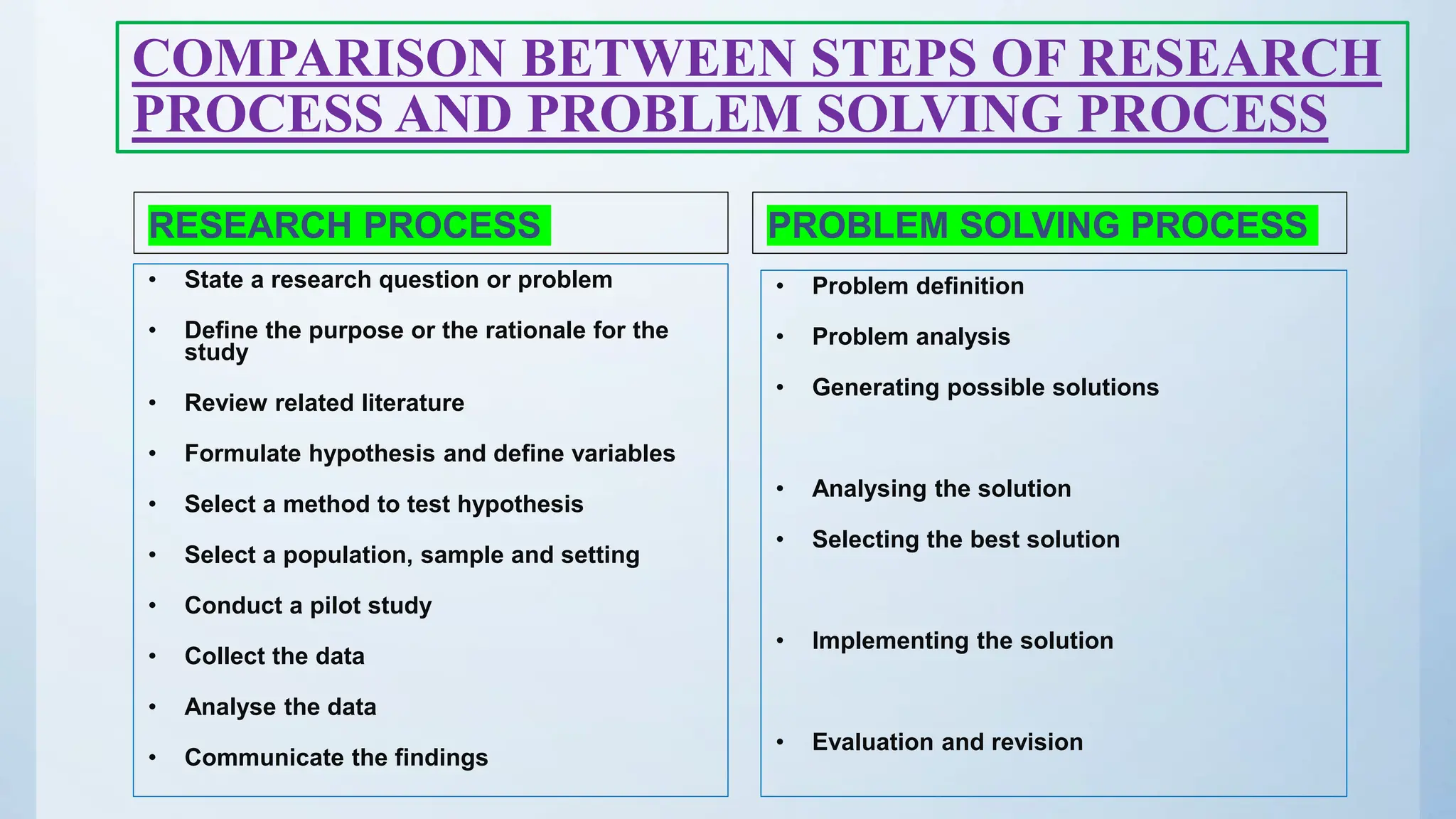
COMPARISON BETWEEN STEPS OF RESEARCH
PROCESS AND PROBLEM SOLVING PROCESS
RESEARCH PROCESS
• State a research question or problem
• Define the purpose or the rationale for the
study
• Review related literature
• Formulate hypothesis and define variables
• Select a method to test hypothesis
• Select a population, sample and setting
• Conduct a pilot study
• Collect the data
• Analyse the data
• Communicate the findings
PROBLEM SOLVING PROCESS
• Problem definition
• Problem analysis
• Generating possible solutions
• Analysing the solution
• Selecting the best solution
• Implementing the solution
• Evaluation and revision
4. SCIENTIFIC METHODS
These are defined as controlled, systematic
investigations that are rooted in objective reality and
that aim to develop general knowledge about natural
phenomena.
NAVDEEP KAUR
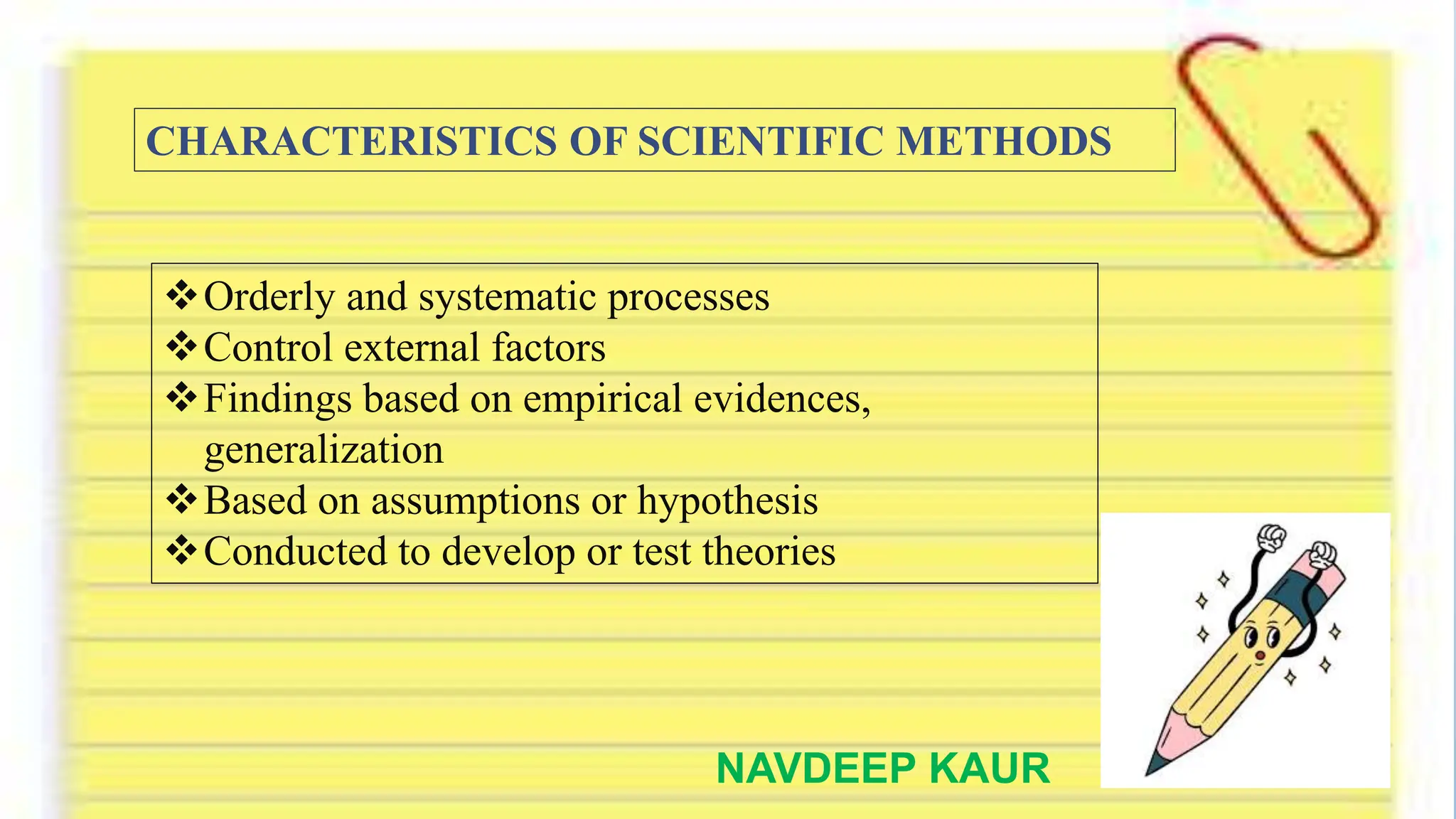
CHARACTERISTICS OF SCIENTIFIC METHODS
Orderly and systematic processes
Control external factors
Findings based on empirical evidences,
generalization
Based on assumptions or hypothesis
Conducted to develop or test theories
NAVDEEP KAUR
PURPOSES OF SCIENTIFIC METHODS
 Description
 Exploration
 Explanation
 Prediction
 Control
 Prescription
 Identification of relationship of the facts
NAVDEEP KAUR
STEPS OF SCIENTIFIC METHODS
 Selecting the topic and identifying the problem
 Defining the objectives of the study
 Literature review
 Defining concepts and variables
 Stating hypothesis about expected observations or
phenomena to be studied
 Identifying assumptions and implications
 Determining ethical implications of the proposed
study
 Describing the research design and methods for
data collection
 Defining study population and sample
 Planning the data analysis and discussion
 Collecting data from subjects
 Analysing and interpreting data
 Communicating findings of the study
* Moral or ethical problem
*Human Complexity
*Measurement problems
*External variable control problems
LIMITATIONS OF SCIENTIFIC METHODS
NAVDEEP KAUR
NAVDEEP KAUR AND
SAPNA THAKUR
SAPNA THAKUR
NAVDEEP KAUR

METHODS OF ACQUIRING KNOWLEDGE IN NURSING.pptx by navdeep kaur

  • 1.
    METHODS OF ACQUIRING KNOWLEDGEIN NURSING NAVDEEP KAUR
  • 2.
    INTRODUCTION • The presentera of complex health problems makes interdisciplinary research an essential characteristic of nursing research, because multiple perspectives are required for the complex study of health and illness experiences of society. • The expansion of new knowledge is required for growing profession like nursing. • A well-developed and reliable body of knowledge is a foundation for any profession. This most sought-after knowledge can be acquired from highly structured as well as loosely arranged processes or methods. NAVDEEP KAUR
  • 3.
    METHODS OF ACQUIRINGKNOWLEDGE UNSTRUCTURED METHODS STRUCTURED METHODS AUTHORITY INTUITION EXPERIENCE TRIAL AND ERROR SCIENTIFIC METHODS/RESEARCH INDUCTIVE REASONING PROBLEM SOLVING ASSEMBLED INFORMATION DEDUCTIVE REASONING TRADITION
  • 4.
    1. Tradition: The bulkof knowledge has been accumulated over centuries and passed down from one generation to another through various media. Traditional nursing knowledge is learnt mainly from books, journals, by word of mouth, and by observing the practices of others. Much traditional practices takes the form of rituals. FOR EXAMPLE, it may be a tradition in some hospitals, talcum powder is dusted over the bodies, after patients are washed, performed consistently with little thought to the rationale behind it. Traditions are not only important in passing down the knowledge, but also in giving groups in society a sense of identity, belonging and pride. UNSTRUCTURED METHODS
  • 5.
    2. Authority • Inour complex society, there are authorities(people with specialized expertise in every field). We are constantly faced with making decisions about matters with which we have had no direct experience; therefore, it seems natural to place trust in the judgement of people who are authoritative on an issue by virtue of specialized training or experience. Those people are believed to be a sound source of knowledge and understanding. However, authority as source of knowledge do has many shortcomings. NAVDEEP KAUR
  • 6.
    It is consideredas an important source of knowledge in nursing profession since past. However, the knowledge obtained from intuition, if through empathetic feeling, without rational reasoning. Thus, it is also known as information obtained through sixth sense without conscious thinking but in this rationalizing the information may not be obtained. In intuition, nurses know that there is something wrong but cannot explain what it is and why it is. 3. Intuition
  • 7.
    Nurses and midwivesbase their practices in great part on their own experience and to a lesser extent on the experience of others. Experience is a useful way of gaining knowledge. There is a wealth of untapped knowledge embedded in the practice and know-how of expert nurses and clinicians. Experiences, therefore are an important source of knowledge but relying solely on it and overhanging its importance can be detrimental to nursing practices. 4. Experience
  • 8.
    5. Trial anderror It is the most common approach of gaining knowledge. In this approach, alternatives are tried successively until a solution to a problem is found. In day-to-day life, everybody uses this technique to solve many problems, including professional ones. FOR EXAMPLE, a new nurse is not aware of the different keys used to change the head end of patient’s bed up and down; she tries different alternatives before achieving her task successfully. NAVDEEP KAUR
  • 9.
    1. LOGICAL REASONING: Reasoningis the mental processing of ideas to solve problems. Logical reasoning as a method of knowing, combines experience, intellectual faculties and formal system of thought. Two intellectual mechanisms used in reasoning are inductive and deductive reasoning. INDUCTIVE REASONING: It is the process of developing generalization from specific observations. FOR EXAMPLE, a nurse may observe the anxious behavior of (specific) hospitalized children and conclude that (in general) children’s separation from parents is stressful. DEDUCTIVE REASONING: It is the process of developing specific prediction from general principles. FOR EXAMPLE, if we assume that separation anxiety occurs in hospitalized children (in general), then we might predict that (specific) children admitted in a hospital whose parents do not room-in will manifest symptoms of stress. STRUCTURED METHODS
  • 10.
    2. ASSEMBLED INFORMATION Inmaking clinical decision, health care professionals also rely n information that has been assembled for a variety of purposes. The regularly assembled data in hospital such as patient census and in community such as population census serves as a good source of much needed information for nurses and other healthcare professionals. NAVDEEP
  • 11.
    • In problemsolving, nurses try to understand a problem and search for possible solutions. In this approach, possible solutions are carefully evaluated and one of them is chosen for implementation. The nurse does not discard the other solutions, but holds them in reserve; in the event when the first solution is not effective, then other alternatives can be used. 3. PROBLEM SOLVIG
  • 12.
    PROBLEM DEFINITION PROBLEM ANALYSIS GENERATING POSSIBLE SOLUTIONS ANALYZING THE SELECTING THE BESTSOLUTION IMPLEMENTING THE SOLUTION EVALUATION AND REVISION PROBLEM SOLVING PROCESS NAVDEEP KAUR
  • 13.
    (I) PROBLEM DEFINITION Thenormal process for solving a problem initially involves defining the problem that is to be solved. In this first stage, there is a need to write down what exactly the problem entails, which helps to identify the real problem that is under study and needs an immediate solution. This is the most important step of the process as without this, next steps can not be executed.
  • 14.
    The next stepis to analyse how the problem affects the researcher and his or her current situation and the other people involved in the solution. Furthermore, the analysis helps in understanding the source of the problem and how it affects the current developments and the researcher’s environment. (II) PROBLEM ANALYSIS
  • 15.
    (III) GENERATING POSSIBLE SOLUTIONS •When the real problem is discovered, its contributing factors should be investigated. • At this stage, focus must be on identifying and generating all possible solutions for a problem. • No idea should be discarded. • Each idea should be treated as a new idea NAVDEEP KAUR
  • 16.
    In this step,all the positive and negative aspects of each solution are analysed to chose for the suitable solution. (IV) ANALYSING THE SOLUTIONS
  • 17.
    (V) SELECTING THEBEST SOLUTION In this, an attempt is made to compare the available solutions and then the best solution out of all is selected based on careful judgement. NAVDEEP KAUR
  • 18.
    It is thefinal step to solve the problem by implementing the selected solution. (VI) IMPLEMENTING THE SOLUTION
  • 19.
    (VII) EVALUATION ANDREVISION In this, evaluation is made to judge the effectiveness of the solution in solving the specific problem. This stage also helps to redefine the problem and revise the problem- solving process in case the initial solution fails to manage the problem. NAVDEEP KAUR
  • 20.
    COMPARISON BETWEEN STEPSOF RESEARCH PROCESS AND PROBLEM SOLVING PROCESS RESEARCH PROCESS • State a research question or problem • Define the purpose or the rationale for the study • Review related literature • Formulate hypothesis and define variables • Select a method to test hypothesis • Select a population, sample and setting • Conduct a pilot study • Collect the data • Analyse the data • Communicate the findings PROBLEM SOLVING PROCESS • Problem definition • Problem analysis • Generating possible solutions • Analysing the solution • Selecting the best solution • Implementing the solution • Evaluation and revision
  • 21.
    4. SCIENTIFIC METHODS Theseare defined as controlled, systematic investigations that are rooted in objective reality and that aim to develop general knowledge about natural phenomena. NAVDEEP KAUR
  • 22.
    CHARACTERISTICS OF SCIENTIFICMETHODS Orderly and systematic processes Control external factors Findings based on empirical evidences, generalization Based on assumptions or hypothesis Conducted to develop or test theories NAVDEEP KAUR
  • 23.
    PURPOSES OF SCIENTIFICMETHODS  Description  Exploration  Explanation  Prediction  Control  Prescription  Identification of relationship of the facts NAVDEEP KAUR
  • 24.
    STEPS OF SCIENTIFICMETHODS  Selecting the topic and identifying the problem  Defining the objectives of the study  Literature review  Defining concepts and variables  Stating hypothesis about expected observations or phenomena to be studied  Identifying assumptions and implications  Determining ethical implications of the proposed study  Describing the research design and methods for data collection  Defining study population and sample  Planning the data analysis and discussion  Collecting data from subjects  Analysing and interpreting data  Communicating findings of the study
  • 25.
    * Moral orethical problem *Human Complexity *Measurement problems *External variable control problems LIMITATIONS OF SCIENTIFIC METHODS NAVDEEP KAUR
  • 26.
  • 27.