Problem Solving & Decision Making
Arnab Ghosh
04-Apr-20
Problem Solving & Decision Making
Page 1 of 10
Table of Contents
What is a problem ?......................................................................................................................................2
What is a Goal ? ............................................................................................................................................2
What is a Barrier ?.........................................................................................................................................2
What is problem solving ?.............................................................................................................................3
Triple Constraint Principle ............................................................................................................................3
What does it involve? ...................................................................................................................................4
Stages of Problem Solving.............................................................................................................................5
Stage 1 : Identifying the Problem .................................................................................................................6
Stage 2 : Structuring the Problem.................................................................................................................6
Stage 3 : Possible Solutions...........................................................................................................................6
Stage 4 : Making a Decision ..........................................................................................................................7
Timing of Decision Making............................................................................................................................7
Stage 5 : Implementation..............................................................................................................................7
Problem solving methods ...........................................................................................................................7
Root Cause Analysis (RCA) ............................................................................................................................7
Fishbone (Ishikawa) Diagram........................................................................................................................8
GROW Model ................................................................................................................................................9
Stage 6 : Monitoring/Seeking Feedback .....................................................................................................10
To Conclude ................................................................................................................................................10
Problem Solving & Decision Making
Page 2 of 10
What is a problem ?
Problem can be defined as : “ A perceived gap between the desired state and actual state”. (Expectation
versus Reality).
Some more examples
You have to complete the project within next 10 days.For achieving this target, you need atleast 60
manpower,whereas the available manpower is only 45. So the gap of 15 manpower is the problem here.
You are on the way to the railway station, to catch up a train leaving at 05.30 PM. It is already 5 PM &
you are struck in the traffic. It is likely to take 35 minutes to reach the station. You are short of 5 minutes
to catch the train. Here the gap of 5 minutes is your problem.
All problems have two features in common:Goals and Barriers
What is a Goal ?
• Goals can be anything that you wish to achieve, (or) where you want to be.
• Goals may not be strictly measurable or tangible..
Example : If you are hungry, then your goal is to eat something.
What is a Barrier ?
Barriers are the obstacles that prevent the achievement ofgoals in problem solving. If there are no
barriers in the way of achieving a goal, then there would be no problem.
Following previous example;
• If you feel hungry, then your goal is to eat.
• A barrier to this may be that you have no food available.
• You may take a trip to the supermarket and buy some food,removing the barrier and thus
solve the problem.
Problem Solving & Decision Making
Page 3 of 10
What is problem solving ?
A systematic approach to defining the problem and creating a vast number of possible solutions without
judging these solutions.
Problem Solving is ….
“….the art of finding the ways to get from where you are now to where you want to be (assuming you
do not already know how).
The ‘Problem’, therefore, is a the gap between the present situation and a more desirable one.”
Nolan
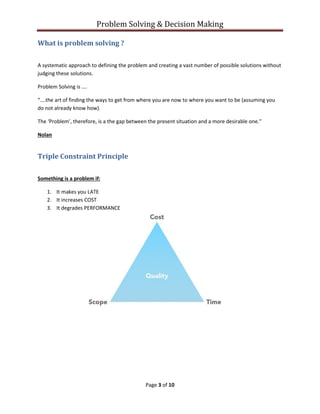
Triple Constraint Principle
Something is a problem if:
1. It makes you LATE
2. It increases COST
3. It degrades PERFORMANCE
Problem Solving & Decision Making
Page 4 of 10
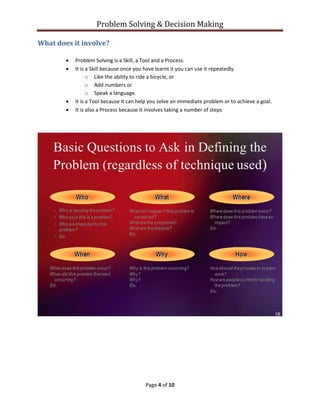
What does it involve?
• Problem Solving is a Skill, a Tool and a Process.
• It is a Skill because once you have learnt it you can use it repeatedly.
o Like the ability to ride a bicycle, or
o Add numbers or
o Speak a language.
• It is a Tool because it can help you solve an immediate problem or to achieve a goal.
• It is also a Process because it involves taking a number of steps
Problem Solving & Decision Making
Page 5 of 10
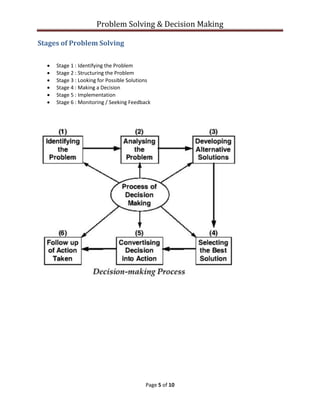
Stages of Problem Solving
• Stage 1 : Identifying the Problem
• Stage 2 : Structuring the Problem
• Stage 3 : Looking for Possible Solutions
• Stage 4 : Making a Decision
• Stage 5 : Implementation
• Stage 6 : Monitoring / Seeking Feedback
Problem Solving & Decision Making
Page 6 of 10
Stage 1 : Identifying the Problem
• Looking at the problem in terms of goals and barriers can offer an effective way of defining
many problems.
• Besides it helps in splitting bigger problems into smaller ones or manageable sub-problems.
• Sometimes it will become apparent that what seems to be a single problem, is more of a series
of sub-problems.
Stage 2 : Structuring the Problem
• Structuring the problem is all about gaining more information about the problem and increasing
its understanding.
• This means, observe the nature of the problem, collect more details and getting a clear picture
of the problem.
Stage 3 : Possible Solutions
Questioning Assumptions:
Decisions runs into difficulties when it is based on the wrong assumptions.So listing out all assumptions
is a good starting point.
Brainstorming:
It is the common technique used for generating a large number of ideas quickly.While it can be done
individually, it is more often practiced in groups.
Divergent Thinking:
It is the process of recalling possible solutions based on the past experiences, or inventing new
solutions.
Convergent thinking:
It is the subsequent process of narrowing down the possibilities to 'converge' on the most appropriate
form of action.
Problem Solving & Decision Making
Page 7 of 10
Stage 4 : Making a Decision
This is the most complex part of the problem solving process.
Following the previous steps, it is now time to look at each potential solution and carefully analyse it.
Some solutions may not be practically possible, due to other problems. (Like :- time constraints,
financial,resources, materials, or other issues).
It is important at this stage to also consider what might happen if nothing was done to solve the
problem. Sometimes trying to solve a problem may lead to many more problems and as such it requires
creative thinking and innovative ideas.
Timing of Decision Making
1. Delay is a tactic of slowing down a decision-making process in order to maintain the status quo.
2. Decision making dilemmas can arise, because errors may result either from deciding too soon or
from delaying decisions too long.
3. Delay in decision making can result in lost opportunities and sometimes can be deadly too.
Stage 5 : Implementation
1. This stage involves accepting and carrying out the chosen course of action.
2. Implementation means acting on the chosen solution to the problem.
3. During implementation stage, more problems may arise especially if identification or structuring
of the original problem was not carried out fully.
Problem solving methods
Root Cause Analysis (RCA) –
In science and engineering, root cause analysis (RCA) is a method of problem solving used for
identifying the root causes of faults or problems.
It is widely used in IT operations, telecommunications, industrial process control, accident
analysis (e.g., in aviation, rail transport, or nuclear plants), medicine (for medical diagnosis),
healthcare industry (e.g., for epidemiology), etc.
Problem Solving & Decision Making
Page 8 of 10
RCA can be decomposed into four steps:
• Identify and describe the Problem clearly.
• Establish a timeline from the normal situation up to the time the problem occurred.
• Distinguish between the root cause and other causal factors (e.g., using event
correlation).
• Establish a causal graph between the root cause and the problem.
RCA generally serves as input to a remediation process whereby corrective actions are taken to prevent
the problem from reoccurring
Fishbone (Ishikawa) Diagram
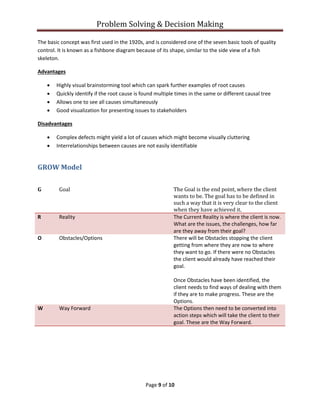
Ishikawa diagrams (also called fishbone diagrams, herringbone diagrams, cause-and-effect diagrams, or
Fishikawa) are causal diagrams created by Kaoru Ishikawa that show the causes of a specific event.
Common uses of the Ishikawa diagram are product design and quality defect prevention to identify
potential factors causing an overall effect. Each cause or reason for imperfection is a source of variation.
Causes are usually grouped into major categories to identify and classify these sources of variation.
The defect is shown as the fish's head, facing to the right, with the causes extending to the left as
fishbones; the ribs branch off the backbone for major causes, with sub-branches for root-causes, to as
many levels as required.
Ishikawa diagrams were popularized in the 1960s by Kaoru Ishikawa,who pioneered quality
management processes in the Kawasaki shipyards, and in the process became one of the founding
fathers of modern management.
Problem Solving & Decision Making
Page 9 of 10
The basic concept was first used in the 1920s, and is considered one of the seven basic tools of quality
control. It is known as a fishbone diagram because of its shape, similar to the side view of a fish
skeleton.
Advantages
• Highly visual brainstorming tool which can spark further examples of root causes
• Quickly identify if the root cause is found multiple times in the same or different causal tree
• Allows one to see all causes simultaneously
• Good visualization for presenting issues to stakeholders
Disadvantages
• Complex defects might yield a lot of causes which might become visually cluttering
• Interrelationships between causes are not easily identifiable
GROW Model
G Goal The Goal is the end point, where the client
wants to be. The goal has to be defined in
such a way that it is very clear to the client
when they have achieved it.
R Reality The Current Reality is where the client is now.
What are the issues, the challenges, how far
are they away from their goal?
O Obstacles/Options There will be Obstacles stopping the client
getting from where they are now to where
they want to go. If there were no Obstacles
the client would already have reached their
goal.
Once Obstacles have been identified, the
client needs to find ways of dealing with them
if they are to make progress. These are the
Options.
W Way Forward The Options then need to be converted into
action steps which will take the client to their
goal. These are the Way Forward.
Problem Solving & Decision Making
Page 10 of 10
Stage 6 : Monitoring/Seeking Feedback
1. The final stage of problem solving is concerned with checking that the process was successful.
2. This can be achieved by monitoring and gaining feedback from people affected by any changes
that occurred.
3. It is good practice to keep a record of outcomes and any additional problems that occurred.
To Conclude
1. Problem Solving & Decision Making are two important management functions.
2. In this competitive world, organization can exist, when the correct and appropriate decisions are
made in time.
3. Avoiding decisions often seems easier because almost any decision involves some conflicts or
dissatisfaction.
4. Yet, making your own decisions and accepting the consequences are the only way to stay in
control of time, success, and your life.

Problem solving & decision making

  • 1.
    Problem Solving &Decision Making Arnab Ghosh 04-Apr-20
  • 2.
    Problem Solving &Decision Making Page 1 of 10 Table of Contents What is a problem ?......................................................................................................................................2 What is a Goal ? ............................................................................................................................................2 What is a Barrier ?.........................................................................................................................................2 What is problem solving ?.............................................................................................................................3 Triple Constraint Principle ............................................................................................................................3 What does it involve? ...................................................................................................................................4 Stages of Problem Solving.............................................................................................................................5 Stage 1 : Identifying the Problem .................................................................................................................6 Stage 2 : Structuring the Problem.................................................................................................................6 Stage 3 : Possible Solutions...........................................................................................................................6 Stage 4 : Making a Decision ..........................................................................................................................7 Timing of Decision Making............................................................................................................................7 Stage 5 : Implementation..............................................................................................................................7 Problem solving methods ...........................................................................................................................7 Root Cause Analysis (RCA) ............................................................................................................................7 Fishbone (Ishikawa) Diagram........................................................................................................................8 GROW Model ................................................................................................................................................9 Stage 6 : Monitoring/Seeking Feedback .....................................................................................................10 To Conclude ................................................................................................................................................10
  • 3.
    Problem Solving &Decision Making Page 2 of 10 What is a problem ? Problem can be defined as : “ A perceived gap between the desired state and actual state”. (Expectation versus Reality). Some more examples You have to complete the project within next 10 days.For achieving this target, you need atleast 60 manpower,whereas the available manpower is only 45. So the gap of 15 manpower is the problem here. You are on the way to the railway station, to catch up a train leaving at 05.30 PM. It is already 5 PM & you are struck in the traffic. It is likely to take 35 minutes to reach the station. You are short of 5 minutes to catch the train. Here the gap of 5 minutes is your problem. All problems have two features in common:Goals and Barriers What is a Goal ? • Goals can be anything that you wish to achieve, (or) where you want to be. • Goals may not be strictly measurable or tangible.. Example : If you are hungry, then your goal is to eat something. What is a Barrier ? Barriers are the obstacles that prevent the achievement ofgoals in problem solving. If there are no barriers in the way of achieving a goal, then there would be no problem. Following previous example; • If you feel hungry, then your goal is to eat. • A barrier to this may be that you have no food available. • You may take a trip to the supermarket and buy some food,removing the barrier and thus solve the problem.
  • 4.
    Problem Solving &Decision Making Page 3 of 10 What is problem solving ? A systematic approach to defining the problem and creating a vast number of possible solutions without judging these solutions. Problem Solving is …. “….the art of finding the ways to get from where you are now to where you want to be (assuming you do not already know how). The ‘Problem’, therefore, is a the gap between the present situation and a more desirable one.” Nolan Triple Constraint Principle Something is a problem if: 1. It makes you LATE 2. It increases COST 3. It degrades PERFORMANCE
  • 5.
    Problem Solving &Decision Making Page 4 of 10 What does it involve? • Problem Solving is a Skill, a Tool and a Process. • It is a Skill because once you have learnt it you can use it repeatedly. o Like the ability to ride a bicycle, or o Add numbers or o Speak a language. • It is a Tool because it can help you solve an immediate problem or to achieve a goal. • It is also a Process because it involves taking a number of steps
  • 6.
    Problem Solving &Decision Making Page 5 of 10 Stages of Problem Solving • Stage 1 : Identifying the Problem • Stage 2 : Structuring the Problem • Stage 3 : Looking for Possible Solutions • Stage 4 : Making a Decision • Stage 5 : Implementation • Stage 6 : Monitoring / Seeking Feedback
  • 7.
    Problem Solving &Decision Making Page 6 of 10 Stage 1 : Identifying the Problem • Looking at the problem in terms of goals and barriers can offer an effective way of defining many problems. • Besides it helps in splitting bigger problems into smaller ones or manageable sub-problems. • Sometimes it will become apparent that what seems to be a single problem, is more of a series of sub-problems. Stage 2 : Structuring the Problem • Structuring the problem is all about gaining more information about the problem and increasing its understanding. • This means, observe the nature of the problem, collect more details and getting a clear picture of the problem. Stage 3 : Possible Solutions Questioning Assumptions: Decisions runs into difficulties when it is based on the wrong assumptions.So listing out all assumptions is a good starting point. Brainstorming: It is the common technique used for generating a large number of ideas quickly.While it can be done individually, it is more often practiced in groups. Divergent Thinking: It is the process of recalling possible solutions based on the past experiences, or inventing new solutions. Convergent thinking: It is the subsequent process of narrowing down the possibilities to 'converge' on the most appropriate form of action.
  • 8.
    Problem Solving &Decision Making Page 7 of 10 Stage 4 : Making a Decision This is the most complex part of the problem solving process. Following the previous steps, it is now time to look at each potential solution and carefully analyse it. Some solutions may not be practically possible, due to other problems. (Like :- time constraints, financial,resources, materials, or other issues). It is important at this stage to also consider what might happen if nothing was done to solve the problem. Sometimes trying to solve a problem may lead to many more problems and as such it requires creative thinking and innovative ideas. Timing of Decision Making 1. Delay is a tactic of slowing down a decision-making process in order to maintain the status quo. 2. Decision making dilemmas can arise, because errors may result either from deciding too soon or from delaying decisions too long. 3. Delay in decision making can result in lost opportunities and sometimes can be deadly too. Stage 5 : Implementation 1. This stage involves accepting and carrying out the chosen course of action. 2. Implementation means acting on the chosen solution to the problem. 3. During implementation stage, more problems may arise especially if identification or structuring of the original problem was not carried out fully. Problem solving methods Root Cause Analysis (RCA) – In science and engineering, root cause analysis (RCA) is a method of problem solving used for identifying the root causes of faults or problems. It is widely used in IT operations, telecommunications, industrial process control, accident analysis (e.g., in aviation, rail transport, or nuclear plants), medicine (for medical diagnosis), healthcare industry (e.g., for epidemiology), etc.
  • 9.
    Problem Solving &Decision Making Page 8 of 10 RCA can be decomposed into four steps: • Identify and describe the Problem clearly. • Establish a timeline from the normal situation up to the time the problem occurred. • Distinguish between the root cause and other causal factors (e.g., using event correlation). • Establish a causal graph between the root cause and the problem. RCA generally serves as input to a remediation process whereby corrective actions are taken to prevent the problem from reoccurring Fishbone (Ishikawa) Diagram Ishikawa diagrams (also called fishbone diagrams, herringbone diagrams, cause-and-effect diagrams, or Fishikawa) are causal diagrams created by Kaoru Ishikawa that show the causes of a specific event. Common uses of the Ishikawa diagram are product design and quality defect prevention to identify potential factors causing an overall effect. Each cause or reason for imperfection is a source of variation. Causes are usually grouped into major categories to identify and classify these sources of variation. The defect is shown as the fish's head, facing to the right, with the causes extending to the left as fishbones; the ribs branch off the backbone for major causes, with sub-branches for root-causes, to as many levels as required. Ishikawa diagrams were popularized in the 1960s by Kaoru Ishikawa,who pioneered quality management processes in the Kawasaki shipyards, and in the process became one of the founding fathers of modern management.
  • 10.
    Problem Solving &Decision Making Page 9 of 10 The basic concept was first used in the 1920s, and is considered one of the seven basic tools of quality control. It is known as a fishbone diagram because of its shape, similar to the side view of a fish skeleton. Advantages • Highly visual brainstorming tool which can spark further examples of root causes • Quickly identify if the root cause is found multiple times in the same or different causal tree • Allows one to see all causes simultaneously • Good visualization for presenting issues to stakeholders Disadvantages • Complex defects might yield a lot of causes which might become visually cluttering • Interrelationships between causes are not easily identifiable GROW Model G Goal The Goal is the end point, where the client wants to be. The goal has to be defined in such a way that it is very clear to the client when they have achieved it. R Reality The Current Reality is where the client is now. What are the issues, the challenges, how far are they away from their goal? O Obstacles/Options There will be Obstacles stopping the client getting from where they are now to where they want to go. If there were no Obstacles the client would already have reached their goal. Once Obstacles have been identified, the client needs to find ways of dealing with them if they are to make progress. These are the Options. W Way Forward The Options then need to be converted into action steps which will take the client to their goal. These are the Way Forward.
  • 11.
    Problem Solving &Decision Making Page 10 of 10 Stage 6 : Monitoring/Seeking Feedback 1. The final stage of problem solving is concerned with checking that the process was successful. 2. This can be achieved by monitoring and gaining feedback from people affected by any changes that occurred. 3. It is good practice to keep a record of outcomes and any additional problems that occurred. To Conclude 1. Problem Solving & Decision Making are two important management functions. 2. In this competitive world, organization can exist, when the correct and appropriate decisions are made in time. 3. Avoiding decisions often seems easier because almost any decision involves some conflicts or dissatisfaction. 4. Yet, making your own decisions and accepting the consequences are the only way to stay in control of time, success, and your life.