


7 TOOLS FOR
A POSITIVE
MINDSET
UNLEASH YOUR POTENTIAL
MINDSET
A set of beliefs or a way of thinking
that determines one’s behavior,
outlook and mental attitude.*
If you refer to someone's mindset,
you mean their general attitudes
and the way they typically think
about things.**
*Shane Cradock **Collins Dictionary
1.PERFORMANCE LOOP
2.NEG ESCAPE GAME
3.PARADIGM SHIFT
4.SOAR
5.PERMA
6.GRATITUDE
7.APPRECIATIVE INQUIRY
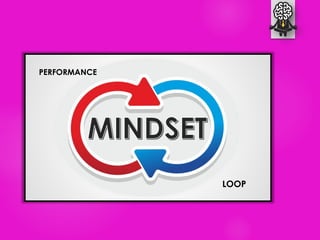
PERFORMANCE
LOOP
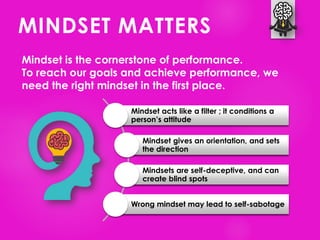
MINDSET MATTERS
Mindset is the cornerstone of performance.
To reach our goals and achieve performance, we
need the right mindset in the first place.
Mindset acts like a filter ; it conditions a
person’s attitude
Mindset gives an orientation, and sets
the direction
Mindsets are self-deceptive, and can
create blind spots
Wrong mindset may lead to self-sabotage
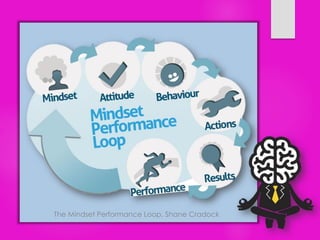
The Mindset Performance Loop, Shane Cradock
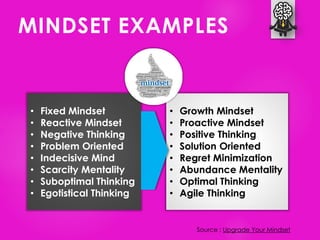
MINDSET EXAMPLES
Source : Upgrade Your Mindset
• Fixed Mindset
• Reactive Mindset
• Negative Thinking
• Problem Oriented
• Indecisive Mind
• Scarcity Mentality
• Suboptimal Thinking
• Egotistical Thinking
• Growth Mindset
• Proactive Mindset
• Positive Thinking
• Solution Oriented
• Regret Minimization
• Abundance Mentality
• Optimal Thinking
• Agile Thinking
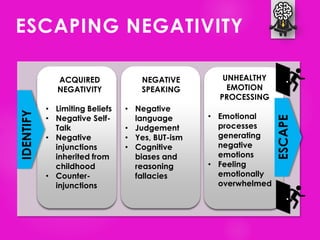
THE NEG
ESCAPE
ACQUIRED
NEGATIVITY
• Limiting Beliefs
• Negative Self-
Talk
• Negative
injunctions
inherited from
childhood
• Counter-
injunctions
NEGATIVE
SPEAKING
• Negative
language
• Judgement
• Yes, BUT-ism
• Cognitive
biases and
reasoning
fallacies
UNHEALTHY
EMOTION
PROCESSING
• Emotional
processes
generating
negative
emotions
• Feeling
emotionally
overwhelmed
IDENTIFYESCAPING NEGATIVITY
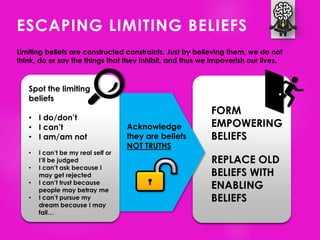
FORM
EMPOWERING
BELIEFS
REPLACE OLD
BELIEFS WITH
ENABLING
BELIEFS
Limiting beliefs are constructed constraints. Just by believing them, we do not
think, do or say the things that they inhibit, and thus we impoverish our lives.
ESCAPING LIMITING BELIEFS
Spot the limiting
beliefs
• I do/don’t
• I can’t
• I am/am not
• I can’t be my real self or
I’ll be judged
• I can’t ask because I
may get rejected
• I can’t trust because
people may betray me
• I can’t pursue my
dream because I may
fail…
Acknowledge
they are beliefs
NOT TRUTHS
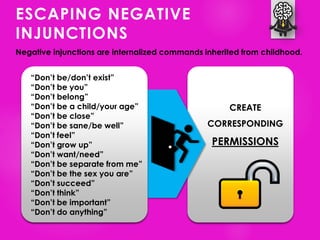
CREATE
CORRESPONDING
PERMISSIONS
ESCAPING NEGATIVE
INJUNCTIONS
Negative injunctions are internalized commands inherited from childhood.
“Don’t be/don’t exist”
“Don’t be you”
“Don’t belong”
“Don’t be a child/your age”
“Don’t be close”
“Don’t be sane/be well”
“Don’t feel”
“Don’t grow up”
“Don’t want/need”
“Don’t be separate from me”
“Don’t be the sex you are”
“Don’t succeed”
“Don’t think”
“Don’t be important”
“Don’t do anything”
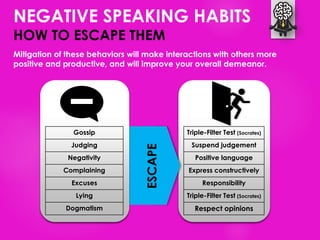
ESCAPE
NEGATIVE SPEAKING HABITS
HOW TO ESCAPE THEM
Mitigation of these behaviors will make interactions with others more
positive and productive, and will improve your overall demeanor.
–Gossip Triple-Filter Test (Socrates)
Judging Suspend judgement
Negativity Positive language
Complaining Express constructively
Excuses Responsibility
Lying Triple-Filter Test (Socrates)
Dogmatism Respect opinions
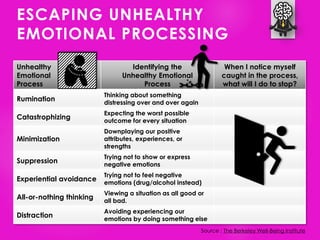
Unhealthy
Emotional
Process
Identifying the
Unhealthy Emotional
Process
When I notice myself
caught in the process,
what will I do to stop?
Rumination
Thinking about something
distressing over and over again
Catastrophizing
Expecting the worst possible
outcome for every situation
Minimization
Downplaying our positive
attributes, experiences, or
strengths
Suppression
Trying not to show or express
negative emotions
Experiential avoidance
Trying not to feel negative
emotions (drug/alcohol instead)
All-or-nothing thinking
Viewing a situation as all good or
all bad.
Distraction
Avoiding experiencing our
emotions by doing something else
ESCAPING UNHEALTHY
EMOTIONAL PROCESSING
Source : The Berkeley Well-Being Institute
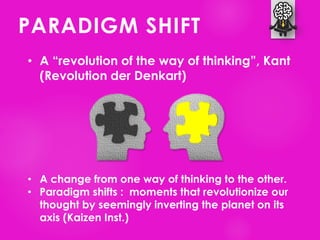
PARADIGM SHIFT
• A “revolution of the way of thinking”, Kant
(Revolution der Denkart)
• A change from one way of thinking to the other.
• Paradigm shifts : moments that revolutionize our
thought by seemingly inverting the planet on its
axis (Kaizen Inst.)
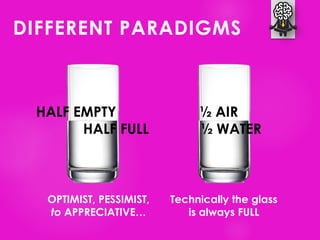
HALF EMPTY
HALF FULL
½ AIR
½ WATER
Technically the glass
is always FULL
OPTIMIST, PESSIMIST,
to APPRECIATIVE…
DIFFERENT PARADIGMS
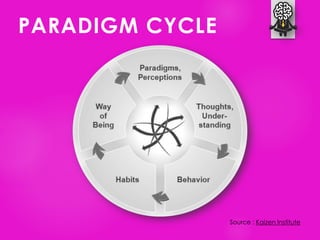
Source : Kaizen Institute
PARADIGM CYCLE
PARADIGM SHIFT
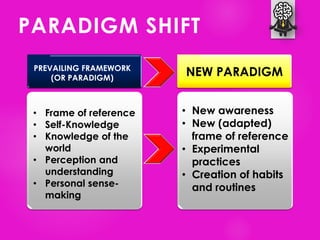
PREVAILING FRAMEWORK
(OR PARADIGM)
• Frame of reference
• Self-Knowledge
• Knowledge of the
world
• Perception and
understanding
• Personal sense-
making
• New awareness
• New (adapted)
frame of reference
• Experimental
practices
• Creation of habits
and routines
NEW PARADIGM
Source : Drawpack
DYNAMICS OF PARADIGM
CHANGE
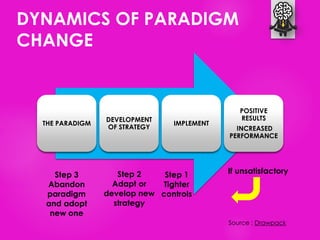
THE PARADIGM
DEVELOPMENT
OF STRATEGY
IMPLEMENT
POSITIVE
RESULTS
INCREASED
PERFORMANCE
If unsatisfactoryStep 1
Tighter
controls
Step 2
Adapt or
develop new
strategy
Step 3
Abandon
paradigm
and adopt
new one
POSITIVE PARADIGM
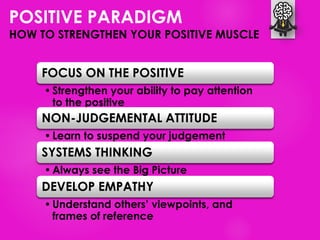
HOW TO STRENGTHEN YOUR POSITIVE MUSCLE
FOCUS ON THE POSITIVE
•Strengthen your ability to pay attention
to the positive
NON-JUDGEMENTAL ATTITUDE
•Learn to suspend your judgement
SYSTEMS THINKING
•Always see the Big Picture
DEVELOP EMPATHY
•Understand others’ viewpoints, and
frames of reference
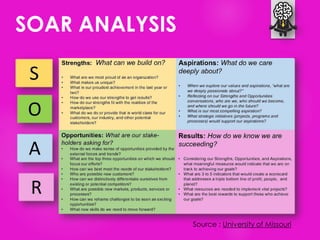
SOAR FRAMEWORK
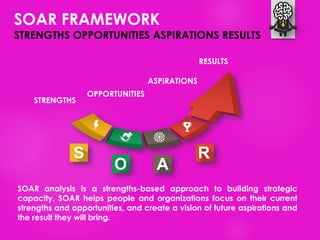
STRENGTHS OPPORTUNITIES ASPIRATIONS RESULTS
SOAR analysis is a strengths-based approach to building strategic
capacity. SOAR helps people and organizations focus on their current
strengths and opportunities, and create a vision of future aspirations and
the result they will bring.
STRENGTHS
OPPORTUNITIES
ASPIRATIONS
RESULTS
Source : University of Missouri
SOAR ANALYSIS
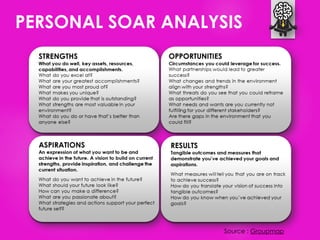
Source : Groupmap
PERSONAL SOAR ANALYSIS
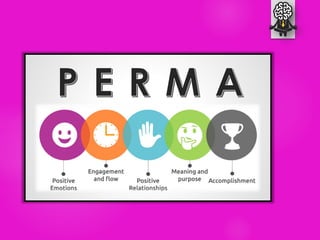
PERMA
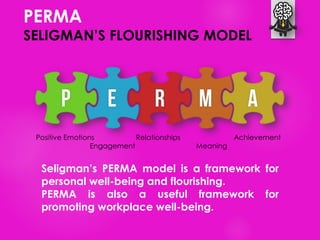
SELIGMAN’S FLOURISHING MODEL
Seligman’s PERMA model is a framework for
personal well-being and flourishing.
PERMA is also a useful framework for
promoting workplace well-being.
Positive Emotions Relationships Achievement
Engagement Meaning
PERMA
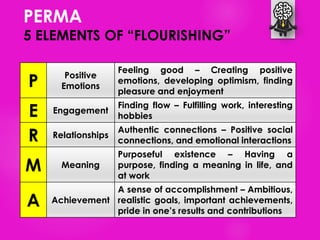
5 ELEMENTS OF “FLOURISHING”
P Positive
Emotions
Feeling good – Creating positive
emotions, developing optimism, finding
pleasure and enjoyment
E Engagement
Finding flow – Fulfilling work, interesting
hobbies
R Relationships
Authentic connections – Positive social
connections, and emotional interactions
M Meaning
Purposeful existence – Having a
purpose, finding a meaning in life, and
at work
A Achievement
A sense of accomplishment – Ambitious,
realistic goals, important achievements,
pride in one’s results and contributions
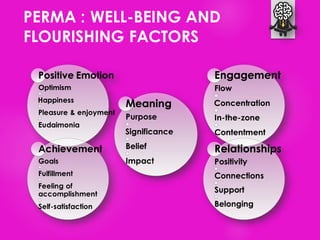
PERMA : WELL-BEING AND
FLOURISHING FACTORS
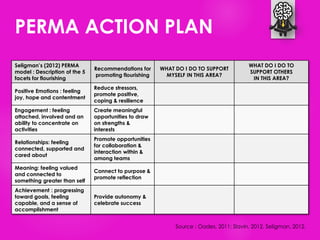
PERMA ACTION PLAN
Seligman’s (2012) PERMA
model : Description of the 5
facets for flourishing
Recommendations for
promoting flourishing
WHAT DO I DO TO SUPPORT
MYSELF IN THIS AREA?
WHAT DO I DO TO
SUPPORT OTHERS
IN THIS AREA?
Positive Emotions : feeling
joy, hope and contentment
Reduce stressors,
promote positive,
coping & resilience
Engagement : feeling
attached, involved and an
ability to concentrate on
activities
Create meaningful
opportunities to draw
on strengths &
interests
Relationships: feeling
connected, supported and
cared about
Promote opportunities
for collaboration &
interaction within &
among teams
Meaning: feeling valued
and connected to
something greater than self
Connect to purpose &
promote reflection
Achievement : progressing
toward goals, feeling
capable, and a sense of
accomplishment
Provide autonomy &
celebrate success
Source : Oades, 2011; Slavin, 2012, Seligman, 2012.
THE
GRATITUDE
JOURNAL
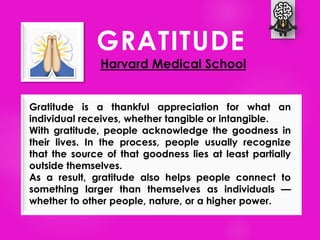
GRATITUDE
Harvard Medical School
Gratitude is a thankful appreciation for what an
individual receives, whether tangible or intangible.
With gratitude, people acknowledge the goodness in
their lives. In the process, people usually recognize
that the source of that goodness lies at least partially
outside themselves.
As a result, gratitude also helps people connect to
something larger than themselves as individuals —
whether to other people, nature, or a higher power.
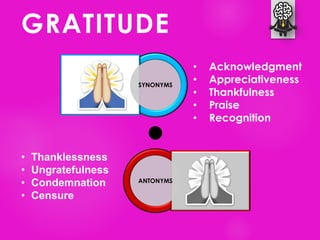
SYNONYMS
ANTONYMS
GRATITUDE
• Acknowledgment
• Appreciativeness
• Thankfulness
• Praise
• Recognition
• Thanklessness
• Ungratefulness
• Condemnation
• Censure
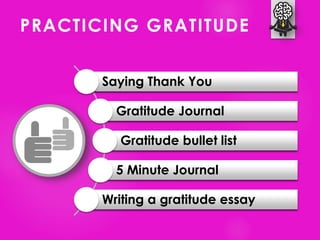
PRACTICING GRATITUDE
Saying Thank You
Gratitude Journal
Gratitude bullet list
5 Minute Journal
Writing a gratitude essay
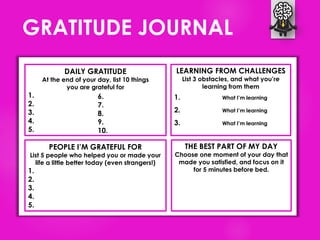
GRATITUDE JOURNAL
DAILY GRATITUDE
At the end of your day, list 10 things
you are grateful for
1.
2.
3.
4.
5.
6.
7.
8.
9.
10.
LEARNING FROM CHALLENGES
List 3 obstacles, and what you’re
learning from them
1. What I’m learning
2. What I’m learning
3. What I’m learning
PEOPLE I’M GRATEFUL FOR
List 5 people who helped you or made your
life a little better today (even strangers!)
1.
2.
3.
4.
5.
THE BEST PART OF MY DAY
Choose one moment of your day that
made you satisfied, and focus on it
for 5 minutes before bed.
Source: AI Commons
APPRECIATIVE INQUIRY
A STRENGTH-BASED APPROACH
Appreciative Inquiry (AI)
is about the search for the best in people, their
organizations, and the strengths-filled, opportunity-
rich world around them. AI is not so much a shift in
the methods and models of organizational
change, but AI is a fundamental shift in the overall
perspective taken throughout the entire change
process to ‘see’ the wholeness of the human
system and to “inquire” into that system’s strengths,
possibilities, and successes.
Stavros, Godwin, Cooperrider (2015)
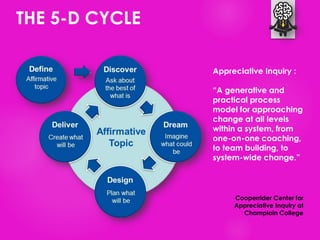
Appreciative Inquiry :
“A generative and
practical process
model for approaching
change at all levels
within a system, from
one-on-one coaching,
to team building, to
system-wide change.”
Cooperrider Center for
Appreciative Inquiry at
Champlain College
THE 5-D CYCLE
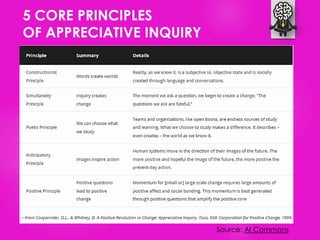
5 CORE PRINCIPLES
OF APPRECIATIVE INQUIRY
Source: AI Commons
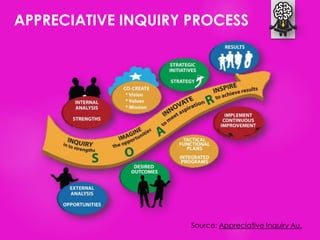
Source: Appreciative Inquiry Au.
APPRECIATIVE INQUIRY PROCESS
• Positive Psychology Theory (University of Pennsylvania)
• The PERMA Model (Positive Psychology Program)
• What is Gratitude and What Is Its Role in Positive
Psychology? (Positive Psychology Program)
• 7 Scientifically Proven Benefits Of Gratitude (Forbes)
• Appreciative Inquiry (Managing For Impact)
• Cooperrider Center for Appreciative Inquiry at
Champlain College, Case Western Reserve University’s
Weatherhead School of Management (AI Commons)
• Transactional Analysis, Eric Berne
• Berkeley Well-Being Institute

7 Tools For a Positive Mindset

  • 1.
    7 TOOLS FOR APOSITIVE MINDSET UNLEASH YOUR POTENTIAL
  • 2.
    MINDSET A set ofbeliefs or a way of thinking that determines one’s behavior, outlook and mental attitude.* If you refer to someone's mindset, you mean their general attitudes and the way they typically think about things.** *Shane Cradock **Collins Dictionary
  • 3.
    1.PERFORMANCE LOOP 2.NEG ESCAPEGAME 3.PARADIGM SHIFT 4.SOAR 5.PERMA 6.GRATITUDE 7.APPRECIATIVE INQUIRY
  • 4.
  • 5.
    MINDSET MATTERS Mindset isthe cornerstone of performance. To reach our goals and achieve performance, we need the right mindset in the first place. Mindset acts like a filter ; it conditions a person’s attitude Mindset gives an orientation, and sets the direction Mindsets are self-deceptive, and can create blind spots Wrong mindset may lead to self-sabotage
  • 6.
    The Mindset PerformanceLoop, Shane Cradock
  • 7.
    MINDSET EXAMPLES Source :Upgrade Your Mindset • Fixed Mindset • Reactive Mindset • Negative Thinking • Problem Oriented • Indecisive Mind • Scarcity Mentality • Suboptimal Thinking • Egotistical Thinking • Growth Mindset • Proactive Mindset • Positive Thinking • Solution Oriented • Regret Minimization • Abundance Mentality • Optimal Thinking • Agile Thinking
  • 8.
  • 9.
    ESCAPE ACQUIRED NEGATIVITY • Limiting Beliefs •Negative Self- Talk • Negative injunctions inherited from childhood • Counter- injunctions NEGATIVE SPEAKING • Negative language • Judgement • Yes, BUT-ism • Cognitive biases and reasoning fallacies UNHEALTHY EMOTION PROCESSING • Emotional processes generating negative emotions • Feeling emotionally overwhelmed IDENTIFYESCAPING NEGATIVITY
  • 10.
    FORM EMPOWERING BELIEFS REPLACE OLD BELIEFS WITH ENABLING BELIEFS Limitingbeliefs are constructed constraints. Just by believing them, we do not think, do or say the things that they inhibit, and thus we impoverish our lives. ESCAPING LIMITING BELIEFS Spot the limiting beliefs • I do/don’t • I can’t • I am/am not • I can’t be my real self or I’ll be judged • I can’t ask because I may get rejected • I can’t trust because people may betray me • I can’t pursue my dream because I may fail… Acknowledge they are beliefs NOT TRUTHS
  • 11.
    CREATE CORRESPONDING PERMISSIONS ESCAPING NEGATIVE INJUNCTIONS Negative injunctionsare internalized commands inherited from childhood. “Don’t be/don’t exist” “Don’t be you” “Don’t belong” “Don’t be a child/your age” “Don’t be close” “Don’t be sane/be well” “Don’t feel” “Don’t grow up” “Don’t want/need” “Don’t be separate from me” “Don’t be the sex you are” “Don’t succeed” “Don’t think” “Don’t be important” “Don’t do anything”
  • 12.
    ESCAPE NEGATIVE SPEAKING HABITS HOWTO ESCAPE THEM Mitigation of these behaviors will make interactions with others more positive and productive, and will improve your overall demeanor. –Gossip Triple-Filter Test (Socrates) Judging Suspend judgement Negativity Positive language Complaining Express constructively Excuses Responsibility Lying Triple-Filter Test (Socrates) Dogmatism Respect opinions
  • 13.
    Unhealthy Emotional Process Identifying the Unhealthy Emotional Process WhenI notice myself caught in the process, what will I do to stop? Rumination Thinking about something distressing over and over again Catastrophizing Expecting the worst possible outcome for every situation Minimization Downplaying our positive attributes, experiences, or strengths Suppression Trying not to show or express negative emotions Experiential avoidance Trying not to feel negative emotions (drug/alcohol instead) All-or-nothing thinking Viewing a situation as all good or all bad. Distraction Avoiding experiencing our emotions by doing something else ESCAPING UNHEALTHY EMOTIONAL PROCESSING Source : The Berkeley Well-Being Institute
  • 15.
    PARADIGM SHIFT • A“revolution of the way of thinking”, Kant (Revolution der Denkart) • A change from one way of thinking to the other. • Paradigm shifts : moments that revolutionize our thought by seemingly inverting the planet on its axis (Kaizen Inst.)
  • 16.
    HALF EMPTY HALF FULL ½AIR ½ WATER Technically the glass is always FULL OPTIMIST, PESSIMIST, to APPRECIATIVE… DIFFERENT PARADIGMS
  • 17.
    Source : KaizenInstitute PARADIGM CYCLE
  • 18.
    PARADIGM SHIFT PREVAILING FRAMEWORK (ORPARADIGM) • Frame of reference • Self-Knowledge • Knowledge of the world • Perception and understanding • Personal sense- making • New awareness • New (adapted) frame of reference • Experimental practices • Creation of habits and routines NEW PARADIGM
  • 19.
    Source : Drawpack DYNAMICSOF PARADIGM CHANGE THE PARADIGM DEVELOPMENT OF STRATEGY IMPLEMENT POSITIVE RESULTS INCREASED PERFORMANCE If unsatisfactoryStep 1 Tighter controls Step 2 Adapt or develop new strategy Step 3 Abandon paradigm and adopt new one
  • 20.
    POSITIVE PARADIGM HOW TOSTRENGTHEN YOUR POSITIVE MUSCLE FOCUS ON THE POSITIVE •Strengthen your ability to pay attention to the positive NON-JUDGEMENTAL ATTITUDE •Learn to suspend your judgement SYSTEMS THINKING •Always see the Big Picture DEVELOP EMPATHY •Understand others’ viewpoints, and frames of reference
  • 22.
    SOAR FRAMEWORK STRENGTHS OPPORTUNITIESASPIRATIONS RESULTS SOAR analysis is a strengths-based approach to building strategic capacity. SOAR helps people and organizations focus on their current strengths and opportunities, and create a vision of future aspirations and the result they will bring. STRENGTHS OPPORTUNITIES ASPIRATIONS RESULTS
  • 23.
    Source : Universityof Missouri SOAR ANALYSIS
  • 24.
  • 26.
    PERMA SELIGMAN’S FLOURISHING MODEL Seligman’sPERMA model is a framework for personal well-being and flourishing. PERMA is also a useful framework for promoting workplace well-being. Positive Emotions Relationships Achievement Engagement Meaning
  • 27.
    PERMA 5 ELEMENTS OF“FLOURISHING” P Positive Emotions Feeling good – Creating positive emotions, developing optimism, finding pleasure and enjoyment E Engagement Finding flow – Fulfilling work, interesting hobbies R Relationships Authentic connections – Positive social connections, and emotional interactions M Meaning Purposeful existence – Having a purpose, finding a meaning in life, and at work A Achievement A sense of accomplishment – Ambitious, realistic goals, important achievements, pride in one’s results and contributions
  • 28.
    PERMA : WELL-BEINGAND FLOURISHING FACTORS
  • 29.
    PERMA ACTION PLAN Seligman’s(2012) PERMA model : Description of the 5 facets for flourishing Recommendations for promoting flourishing WHAT DO I DO TO SUPPORT MYSELF IN THIS AREA? WHAT DO I DO TO SUPPORT OTHERS IN THIS AREA? Positive Emotions : feeling joy, hope and contentment Reduce stressors, promote positive, coping & resilience Engagement : feeling attached, involved and an ability to concentrate on activities Create meaningful opportunities to draw on strengths & interests Relationships: feeling connected, supported and cared about Promote opportunities for collaboration & interaction within & among teams Meaning: feeling valued and connected to something greater than self Connect to purpose & promote reflection Achievement : progressing toward goals, feeling capable, and a sense of accomplishment Provide autonomy & celebrate success Source : Oades, 2011; Slavin, 2012, Seligman, 2012.
  • 30.
  • 31.
    GRATITUDE Harvard Medical School Gratitudeis a thankful appreciation for what an individual receives, whether tangible or intangible. With gratitude, people acknowledge the goodness in their lives. In the process, people usually recognize that the source of that goodness lies at least partially outside themselves. As a result, gratitude also helps people connect to something larger than themselves as individuals — whether to other people, nature, or a higher power.
  • 32.
    SYNONYMS ANTONYMS GRATITUDE • Acknowledgment • Appreciativeness •Thankfulness • Praise • Recognition • Thanklessness • Ungratefulness • Condemnation • Censure
  • 33.
    PRACTICING GRATITUDE Saying ThankYou Gratitude Journal Gratitude bullet list 5 Minute Journal Writing a gratitude essay
  • 34.
    GRATITUDE JOURNAL DAILY GRATITUDE Atthe end of your day, list 10 things you are grateful for 1. 2. 3. 4. 5. 6. 7. 8. 9. 10. LEARNING FROM CHALLENGES List 3 obstacles, and what you’re learning from them 1. What I’m learning 2. What I’m learning 3. What I’m learning PEOPLE I’M GRATEFUL FOR List 5 people who helped you or made your life a little better today (even strangers!) 1. 2. 3. 4. 5. THE BEST PART OF MY DAY Choose one moment of your day that made you satisfied, and focus on it for 5 minutes before bed.
  • 36.
    Source: AI Commons APPRECIATIVEINQUIRY A STRENGTH-BASED APPROACH Appreciative Inquiry (AI) is about the search for the best in people, their organizations, and the strengths-filled, opportunity- rich world around them. AI is not so much a shift in the methods and models of organizational change, but AI is a fundamental shift in the overall perspective taken throughout the entire change process to ‘see’ the wholeness of the human system and to “inquire” into that system’s strengths, possibilities, and successes. Stavros, Godwin, Cooperrider (2015)
  • 37.
    Appreciative Inquiry : “Agenerative and practical process model for approaching change at all levels within a system, from one-on-one coaching, to team building, to system-wide change.” Cooperrider Center for Appreciative Inquiry at Champlain College THE 5-D CYCLE
  • 38.
    5 CORE PRINCIPLES OFAPPRECIATIVE INQUIRY Source: AI Commons
  • 39.
    Source: Appreciative InquiryAu. APPRECIATIVE INQUIRY PROCESS
  • 40.
    • Positive PsychologyTheory (University of Pennsylvania) • The PERMA Model (Positive Psychology Program) • What is Gratitude and What Is Its Role in Positive Psychology? (Positive Psychology Program) • 7 Scientifically Proven Benefits Of Gratitude (Forbes) • Appreciative Inquiry (Managing For Impact) • Cooperrider Center for Appreciative Inquiry at Champlain College, Case Western Reserve University’s Weatherhead School of Management (AI Commons) • Transactional Analysis, Eric Berne • Berkeley Well-Being Institute