Cognitive
Psychology
Problem Solving,
reasoning and Decision
making
SUBMITTED TO: Ar. RAJNI TANEJA
SUBMITTED BY : SHWETA CHOUDHARY
M.ARCH ( ARCHITECTURE PEDAGOGY)
2ND SEMESTER
Cognitive psychology
• Cognitive psychology is a branch of psychology that focuses on the study of
mental processes such as perception, memory, attention, language,
problem-solving, reasoning, and decision-making.
• It seeks to understand how people acquire, process, store, and use
information.
• Cognitive psychologists investigate various aspects of human cognition,
including how individuals perceive the world around them, how they learn
new information, how they remember and retrieve information from memory,
and how they solve problems and make decisions.
Introduction
Problem solving, reasoning, and
decision making are crucial aspects
of cognitive psychology, which is
the branch of psychology that
focuses on mental processes such
as perception, memory, attention,
language, problem-solving,
reasoning, and decision-making.
Problem Solving and Decision Making
• Problem solving is described as a directed thinking process
focused on addressing a specific issue.
• Problem-solving involves focused thinking, utilizing both
internal (mind) and external (support) resources.
• Example: Scoring well in an exam involves studying hard
and seeking help from teachers, friends, and parents.
• It involves three elements: the problem itself, the goal,
and the steps to reach that goal.
• Problem solving is an integral part of daily life, requiring
both internal (mental) and external (support from others)
resources to arrive at an appropriate decision6
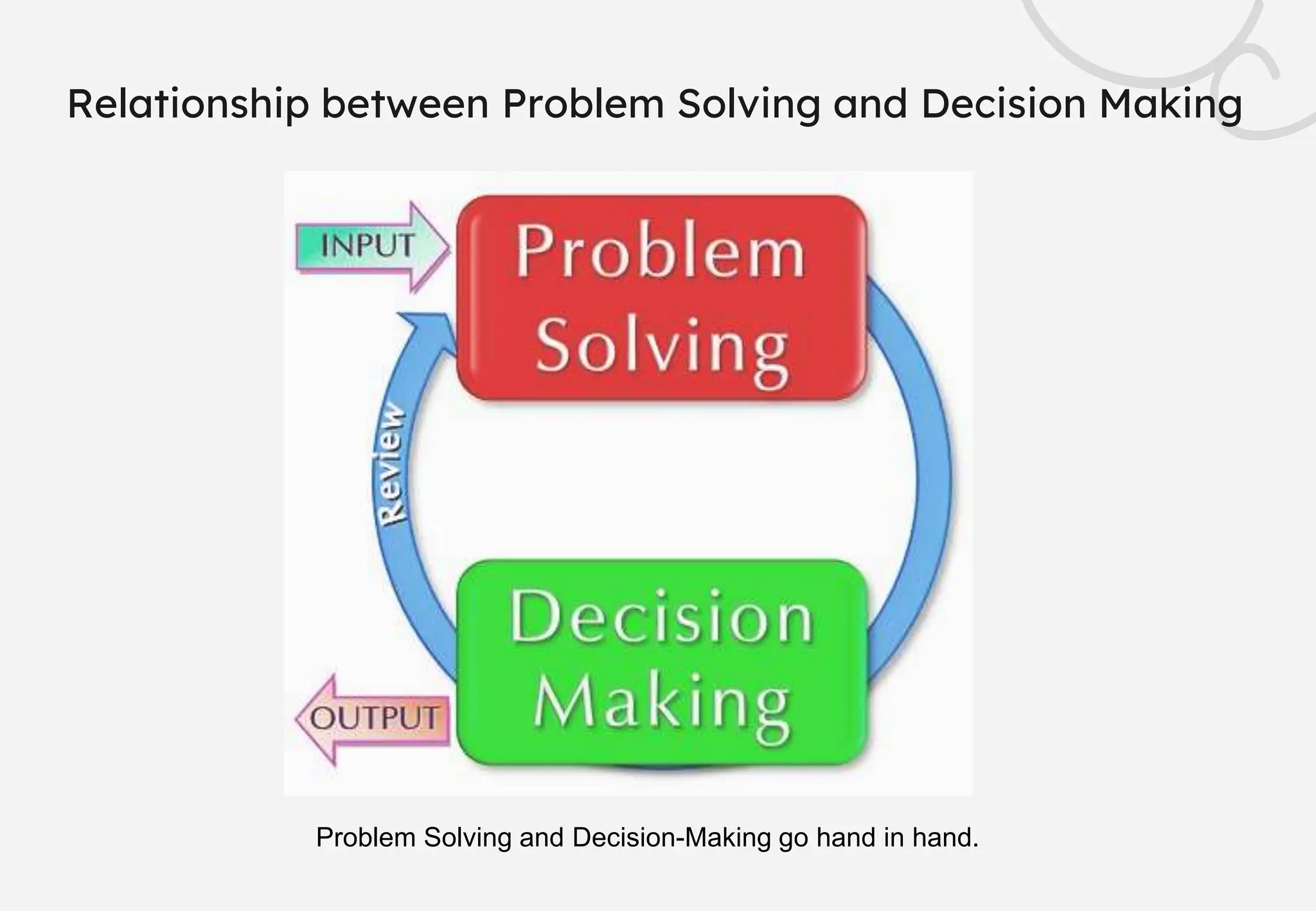
Relationship between Problem Solving and Decision Making
Problem Solving and Decision-Making go hand in hand.
Process of Decision Making
Defining the
problem
Problem
Analysis
Generating
possible
Solutions
Analyzing
solutions
Selecting the
best solutions
Planning the
next course of
action
Problem Solving
Problem Solving
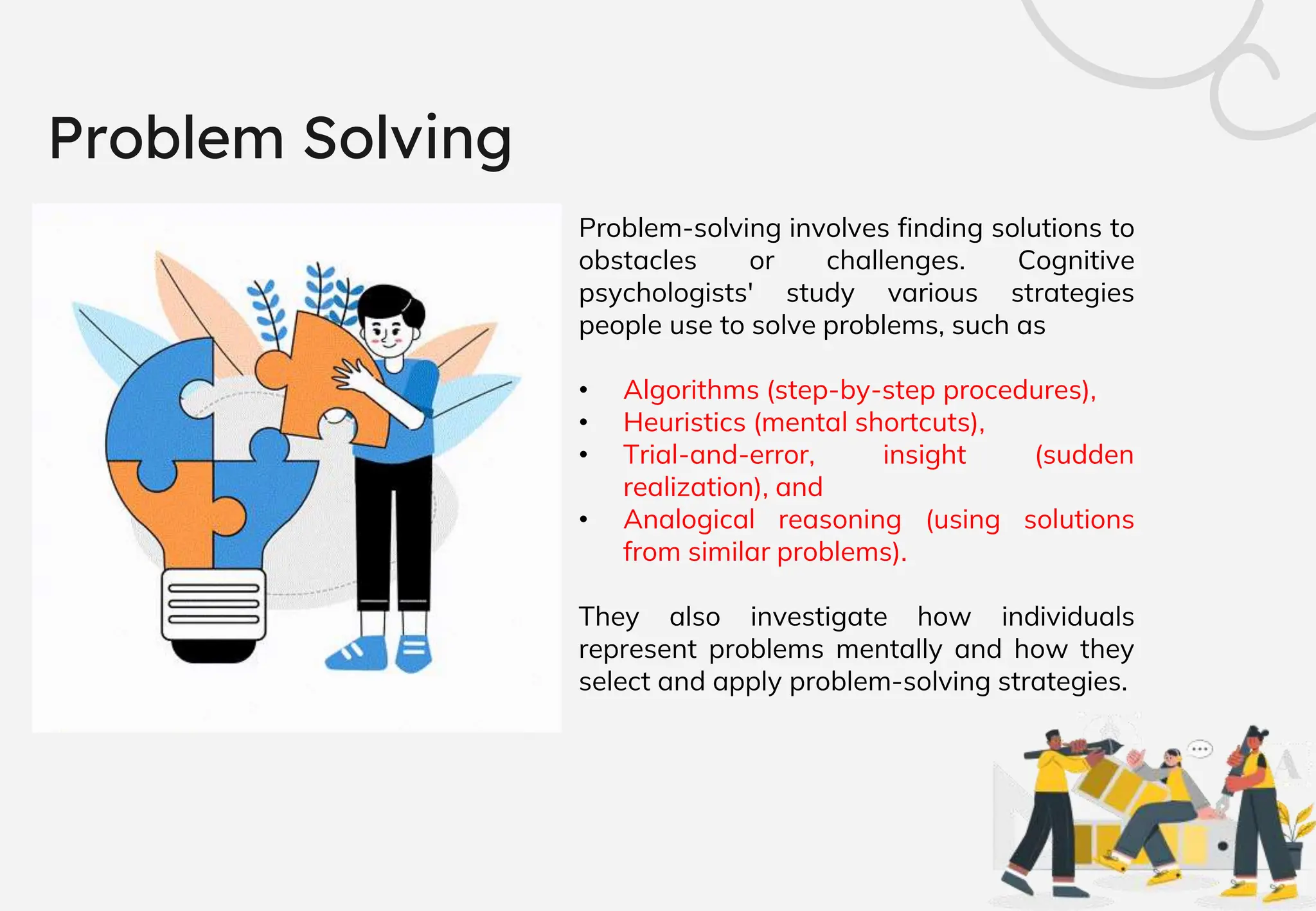
Problem-solving involves finding solutions to
obstacles or challenges. Cognitive
psychologists' study various strategies
people use to solve problems, such as
• Algorithms (step-by-step procedures),
• Heuristics (mental shortcuts),
• Trial-and-error, insight (sudden
realization), and
• Analogical reasoning (using solutions
from similar problems).
They also investigate how individuals
represent problems mentally and how they
select and apply problem-solving strategies.
Barriers to Problem Solving
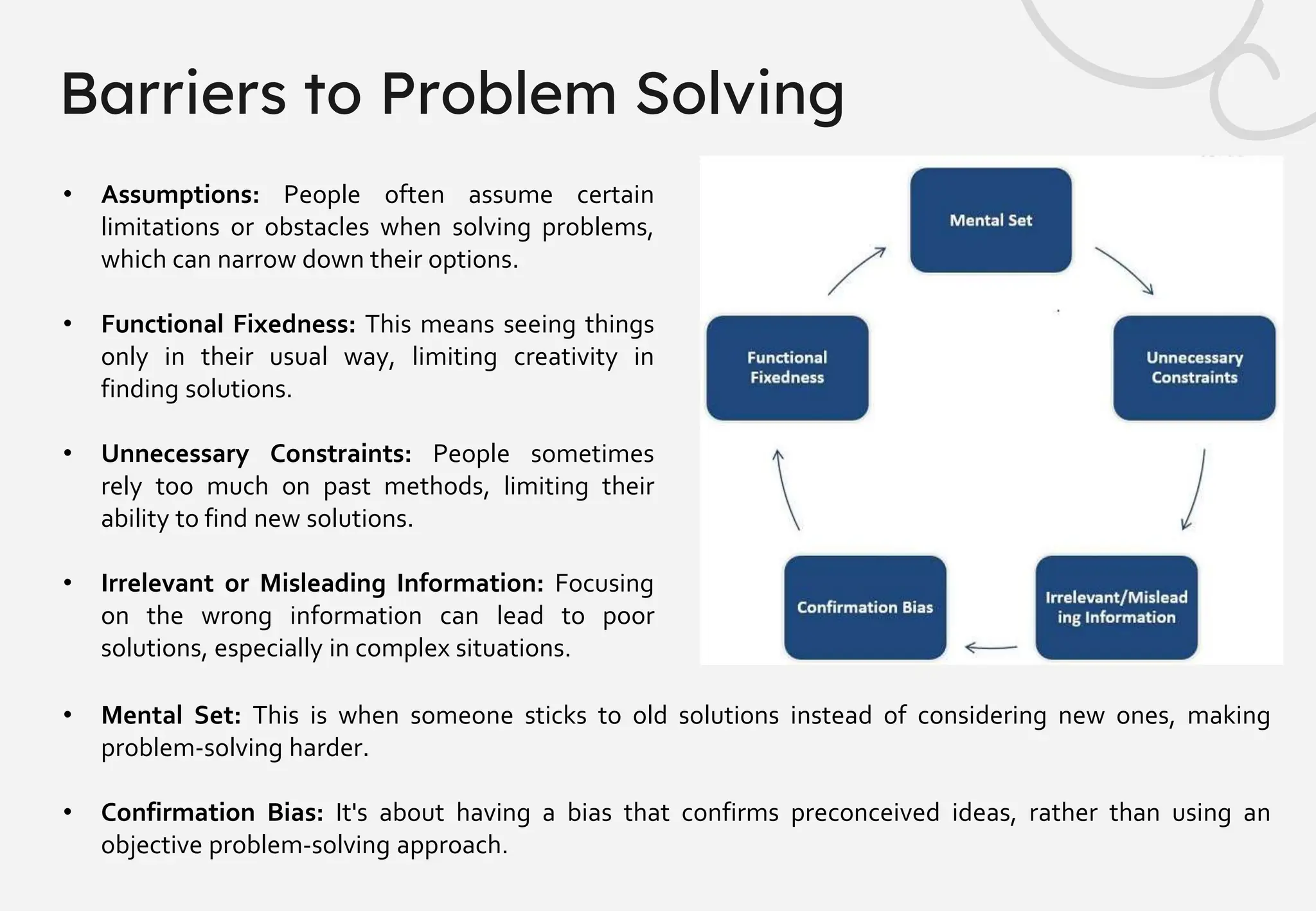
• Assumptions: People often assume certain
limitations or obstacles when solving problems,
which can narrow down their options.
• Functional Fixedness: This means seeing things
only in their usual way, limiting creativity in
finding solutions.
• Unnecessary Constraints: People sometimes
rely too much on past methods, limiting their
ability to find new solutions.
• Irrelevant or Misleading Information: Focusing
on the wrong information can lead to poor
solutions, especially in complex situations.
• Mental Set: This is when someone sticks to old solutions instead of considering new ones, making
problem-solving harder.
• Confirmation Bias: It's about having a bias that confirms preconceived ideas, rather than using an
objective problem-solving approach.
Seven Steps for Effective Problem Solving in the
Workplace
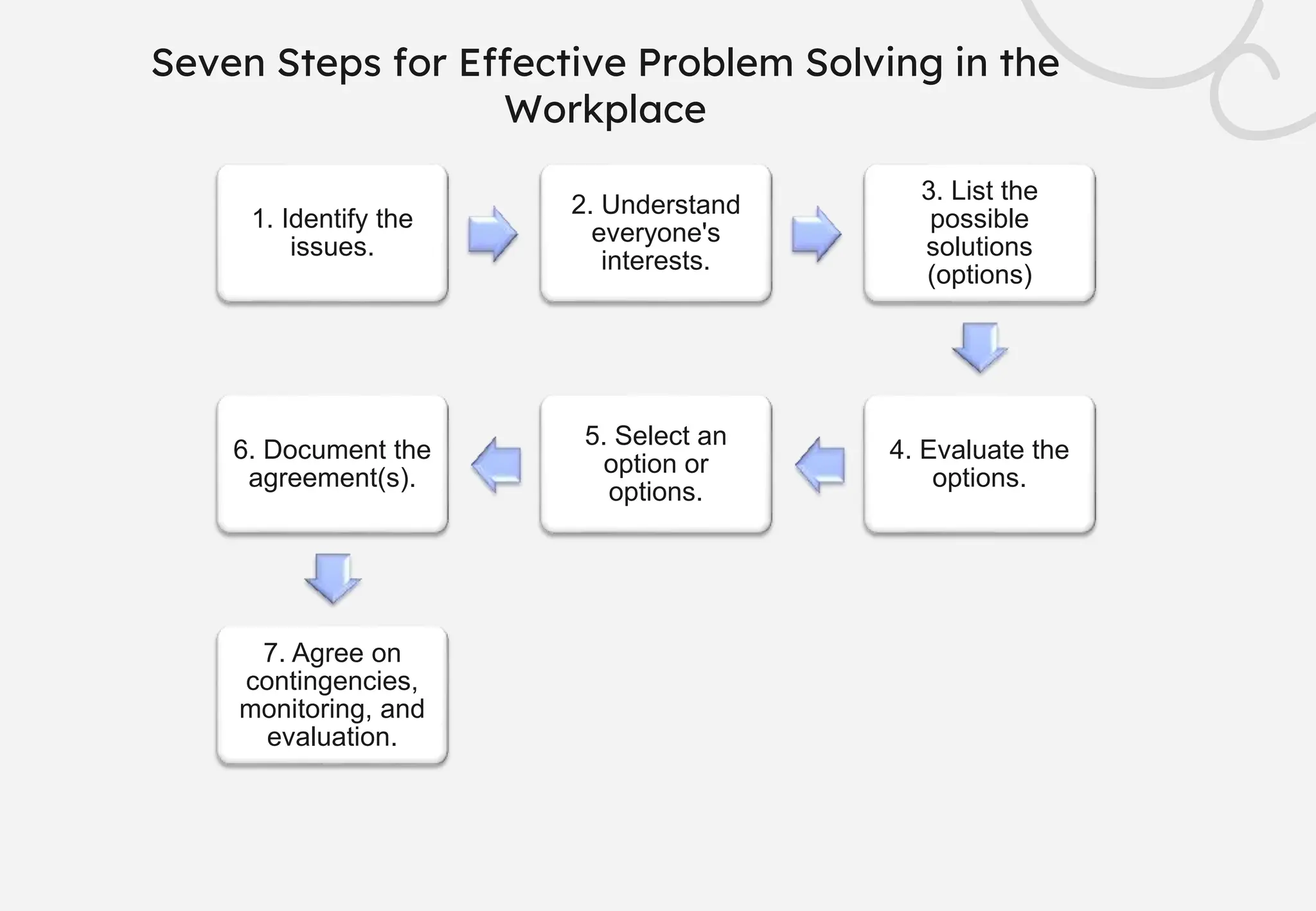
1. Identify the
issues.
2. Understand
everyone's
interests.
3. List the
possible
solutions
(options)
4. Evaluate the
options.
5. Select an
option or
options.
6. Document the
agreement(s).
7. Agree on
contingencies,
monitoring, and
evaluation.
Steps & Approaches of Problem Solving
Problem-solving typically involves several steps, including identifying the
problem, generating possible solutions, evaluating those solutions, and
implementing the best one. Different approaches to problem-solving include:
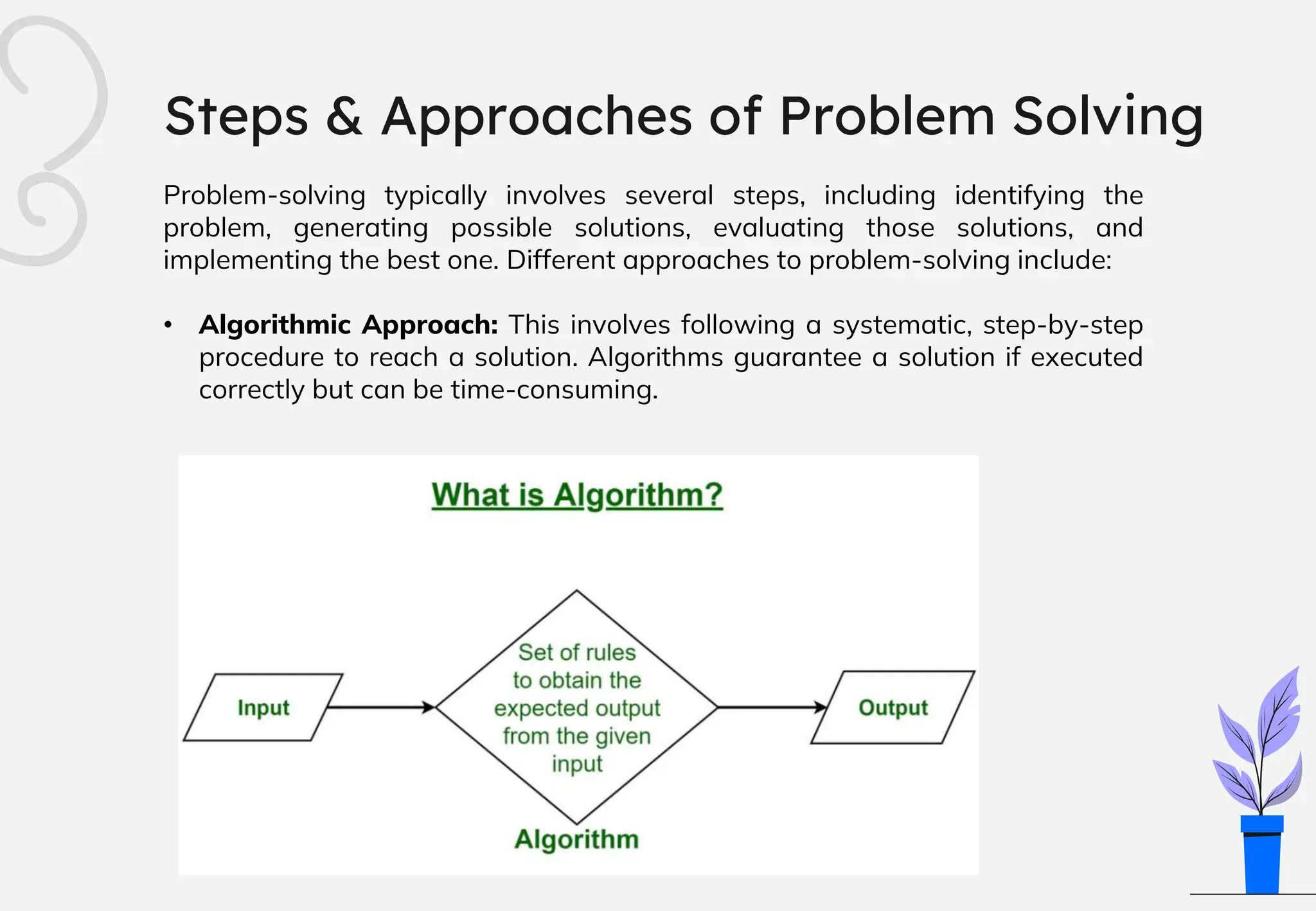
• Algorithmic Approach: This involves following a systematic, step-by-step
procedure to reach a solution. Algorithms guarantee a solution if executed
correctly but can be time-consuming.
Steps & Approaches Problem Solving
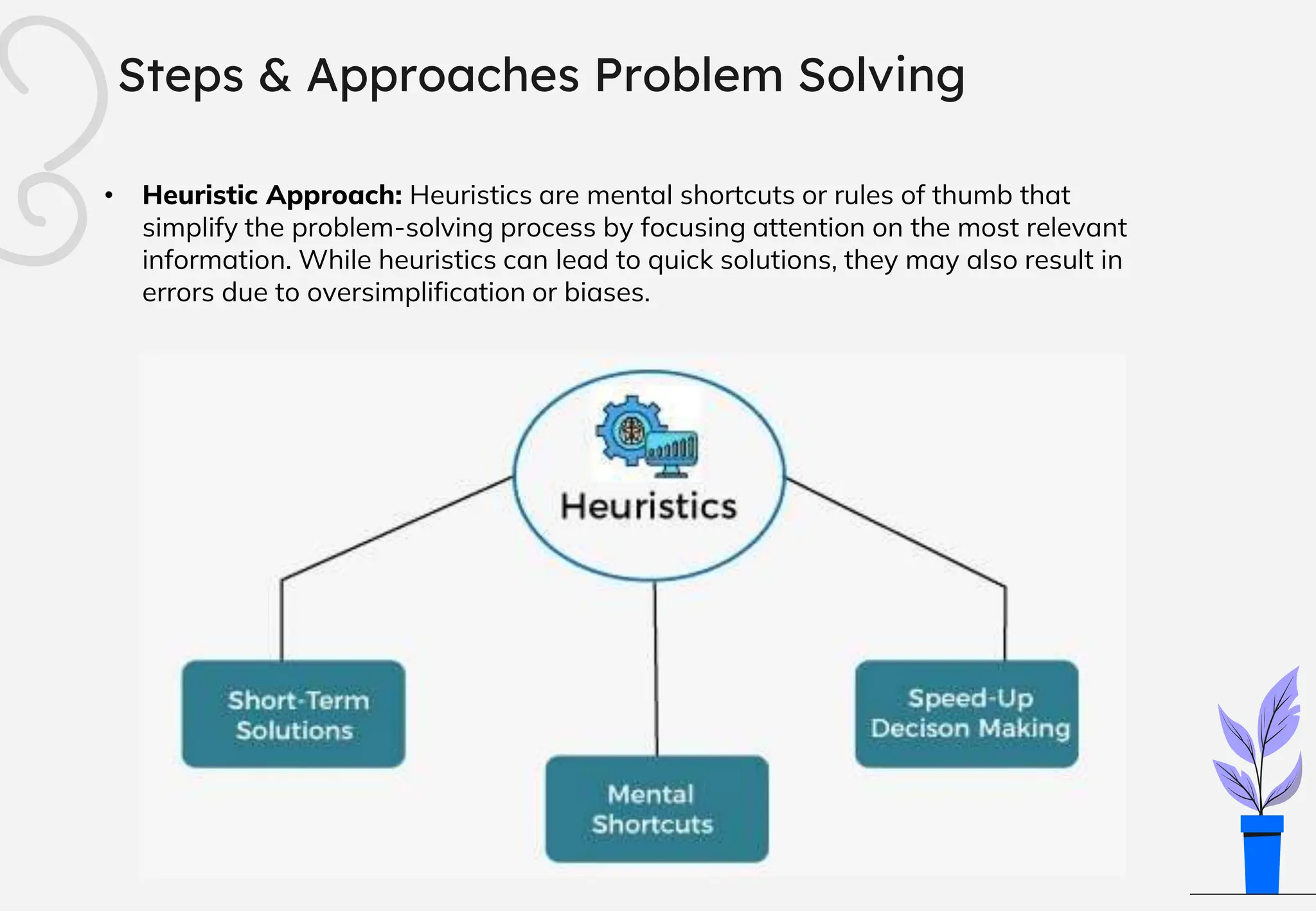
• Heuristic Approach: Heuristics are mental shortcuts or rules of thumb that
simplify the problem-solving process by focusing attention on the most relevant
information. While heuristics can lead to quick solutions, they may also result in
errors due to oversimplification or biases.
Steps & Approaches of Problem Solving
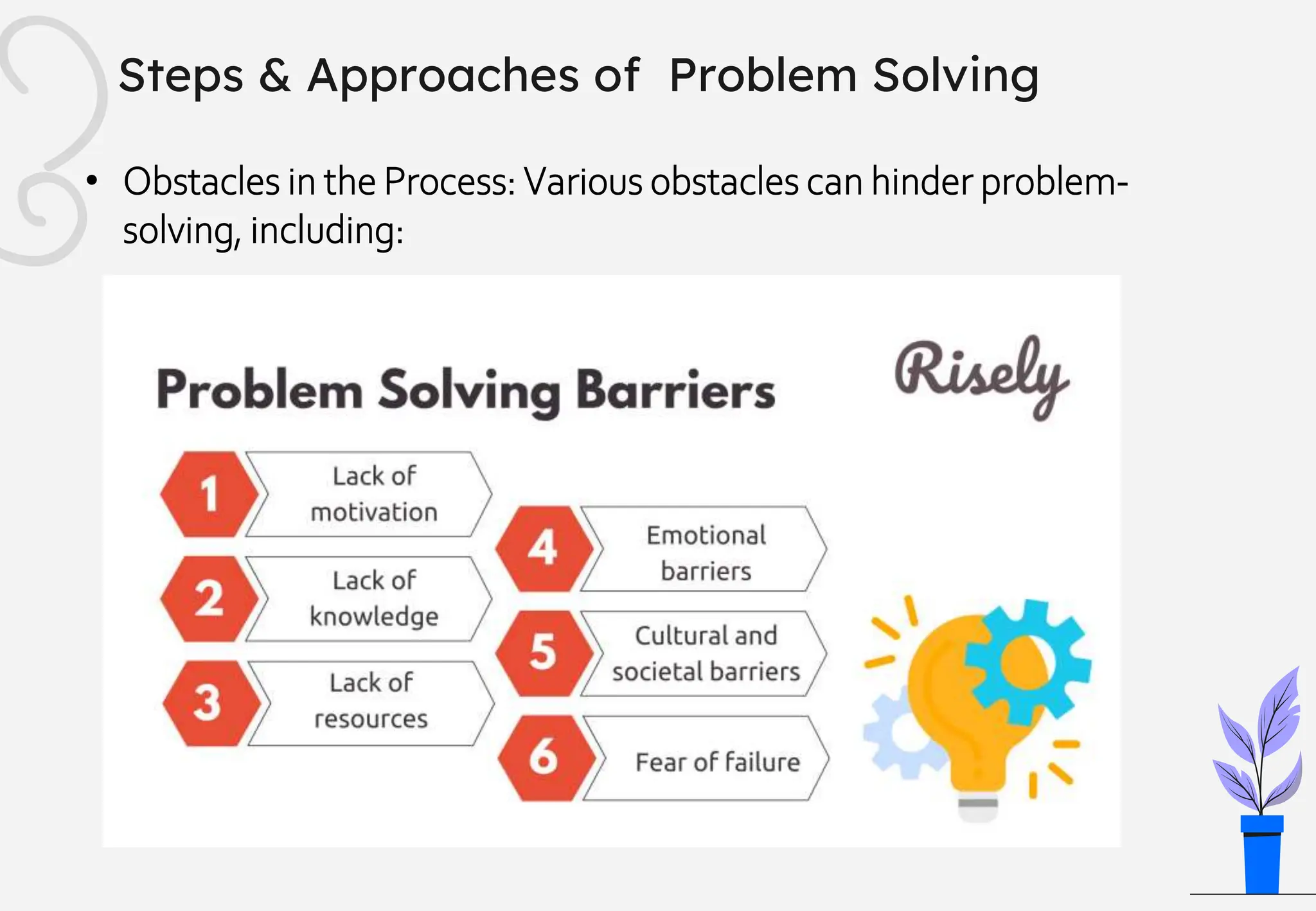
• Obstacles in the Process: Various obstacles can hinder problem-
solving, including:
Steps & Approaches of Problem Solving
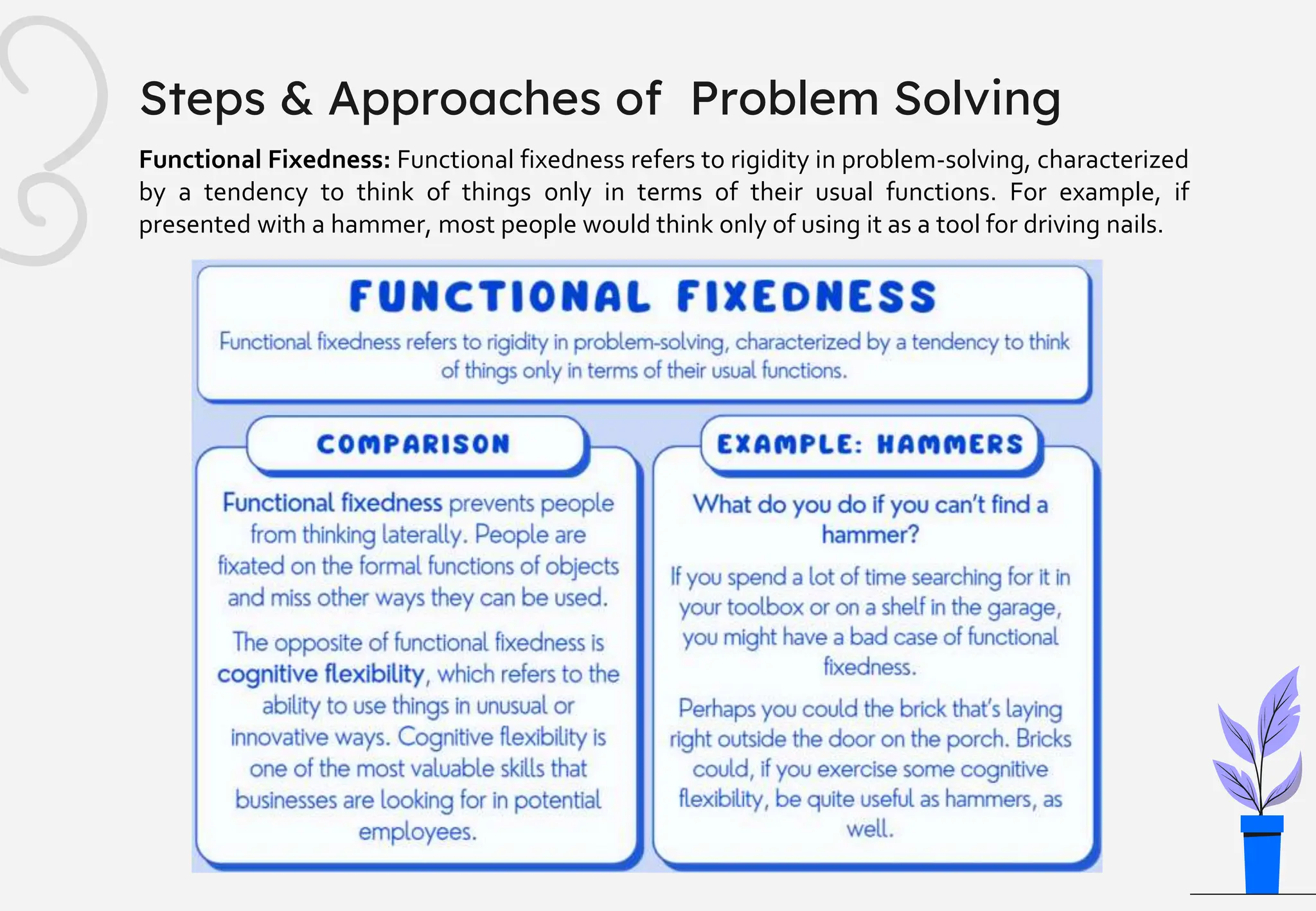
Functional Fixedness: Functional fixedness refers to rigidity in problem-solving, characterized
by a tendency to think of things only in terms of their usual functions. For example, if
presented with a hammer, most people would think only of using it as a tool for driving nails.
Duncker’s Candle Problem
Duncker’s Candle Problem Shows Us the Risk
of Functional Fixedness
The candle problem or candle task, also known as Duncker's candle
problem, is a cognitive performance test, measuring the influence of
functional fixedness on a participant's problem solving capabilities.
Duncker’s Candle Problem is like a puzzle. You have a candle, some
thumbtacks, and matches. The challenge is to put the candle on the wall
and light it without wax dripping on the floor. It's not easy because
people usually think about the objects only in their usual ways. But if you
get creative, you might find a solution, like using the thumbtack box as a
shelf for the candle. This problem tests how well we can think differently
and solve problems in new ways.
Steps & Approaches of Problem Solving
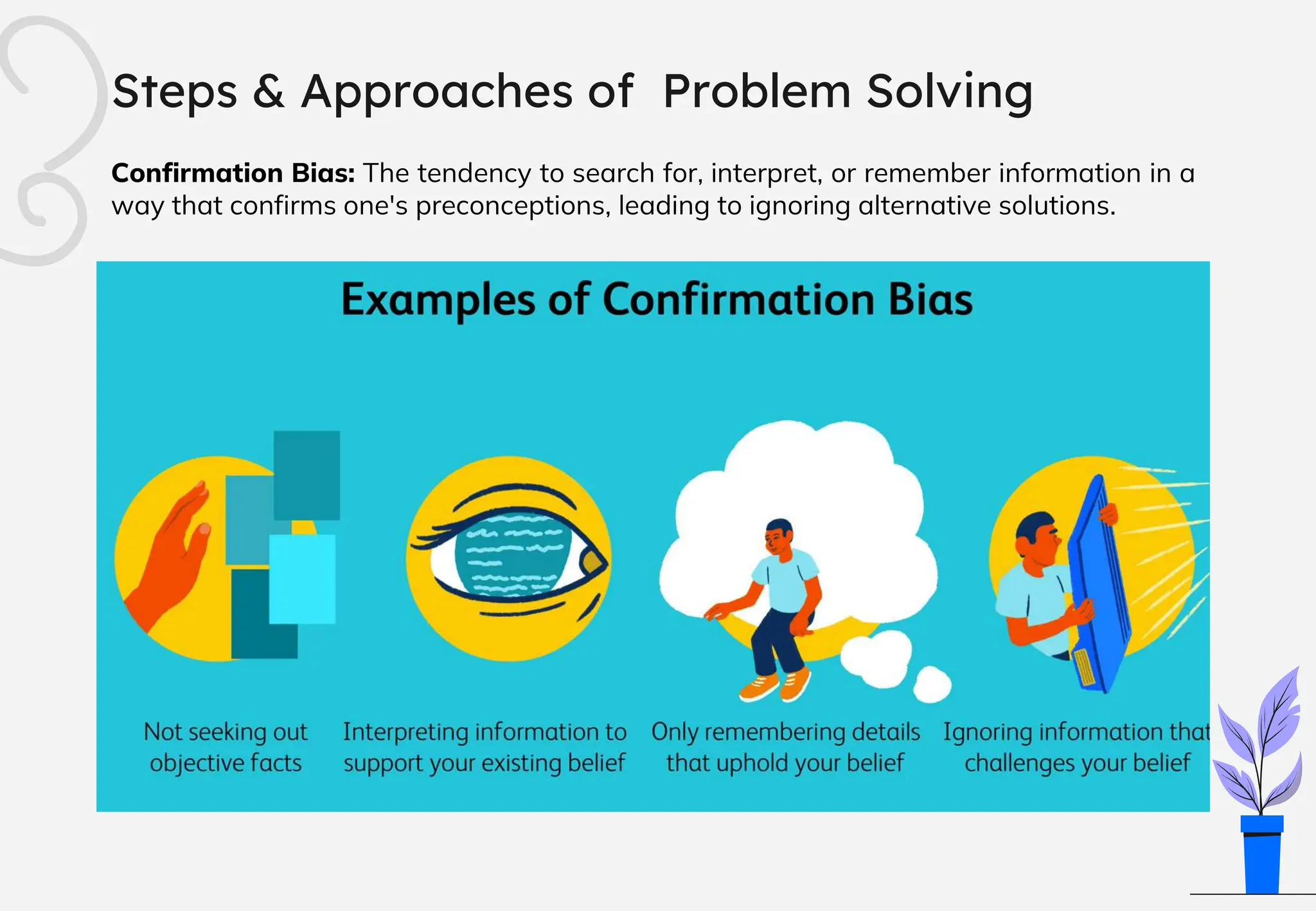
Confirmation Bias: The tendency to search for, interpret, or remember information in a
way that confirms one's preconceptions, leading to ignoring alternative solutions.
Steps & Approaches of Problem Solving
• Mental Set: The tendency to approach
problems using strategies that have
worked in the past, even if they are not
optimal for the current problem.
• Scaffolding in Learning and Problem
Solving : Scaffolding refers to the
support provided by teachers, peers, or
external tools to help learners gradually
develop their problem-solving skills or
understanding of a concept.
Steps & Approaches of Problem Solving
• Learning: In learning, scaffolding involves breaking down complex tasks
into smaller, manageable steps and providing guidance and support as
learners progress. This support can include prompts, hints, modeling, or
structured activities.
• Problem Solving: In problem-solving, scaffolding may involve providing
cues, hints, or guidance to help individuals overcome obstacles and develop
effective problem-solving strategies. As individuals gain proficiency,
scaffolding can be gradually reduced to promote independent problem-
solving.
• Logic & Reasoning Logic: Logic refers to the principles of valid reasoning
and inference. It involves constructing arguments based on premises and
drawing conclusions that follow logically from those premises.
Reasoning
Reasoning encompasses the cognitive processes involved in drawing
conclusions, making inferences, or evaluating arguments.
• It includes deductive reasoning (drawing specific conclusions from
general principles),
• Inductive reasoning (inferring general principles from specific
observations), and
• Abductive reasoning (forming hypotheses to explain observations).
• Logical Fallacies: These are errors in reasoning that undermine the
validity of arguments. Examples include ad hominem attacks, false
dichotomies, and appeals to authority.
• Obstacles to Logical Reasoning: Individuals may encounter obstacles
such as cognitive biases, emotional influences, or lack of relevant
information when engaging in logical reasoning.
• Understanding these concepts and their interplay is essential for
effectively addressing problems, making informed decisions, and
reasoning logically in various domains.
Reasoning
Reasoning refers to the mental processes
used to draw conclusions, make
inferences, and evaluate arguments or
propositions. Cognitive psychologists
examine
• Deductive reasoning (drawing
conclusions from general principles),
• Inductive reasoning (that involves
making generalizations based on
specific observations or evidence)
• Abductive reasoning (forming
hypotheses to explain observations).
They also investigate logical fallacies,
biases, and errors in reasoning that
may influence decision-making.
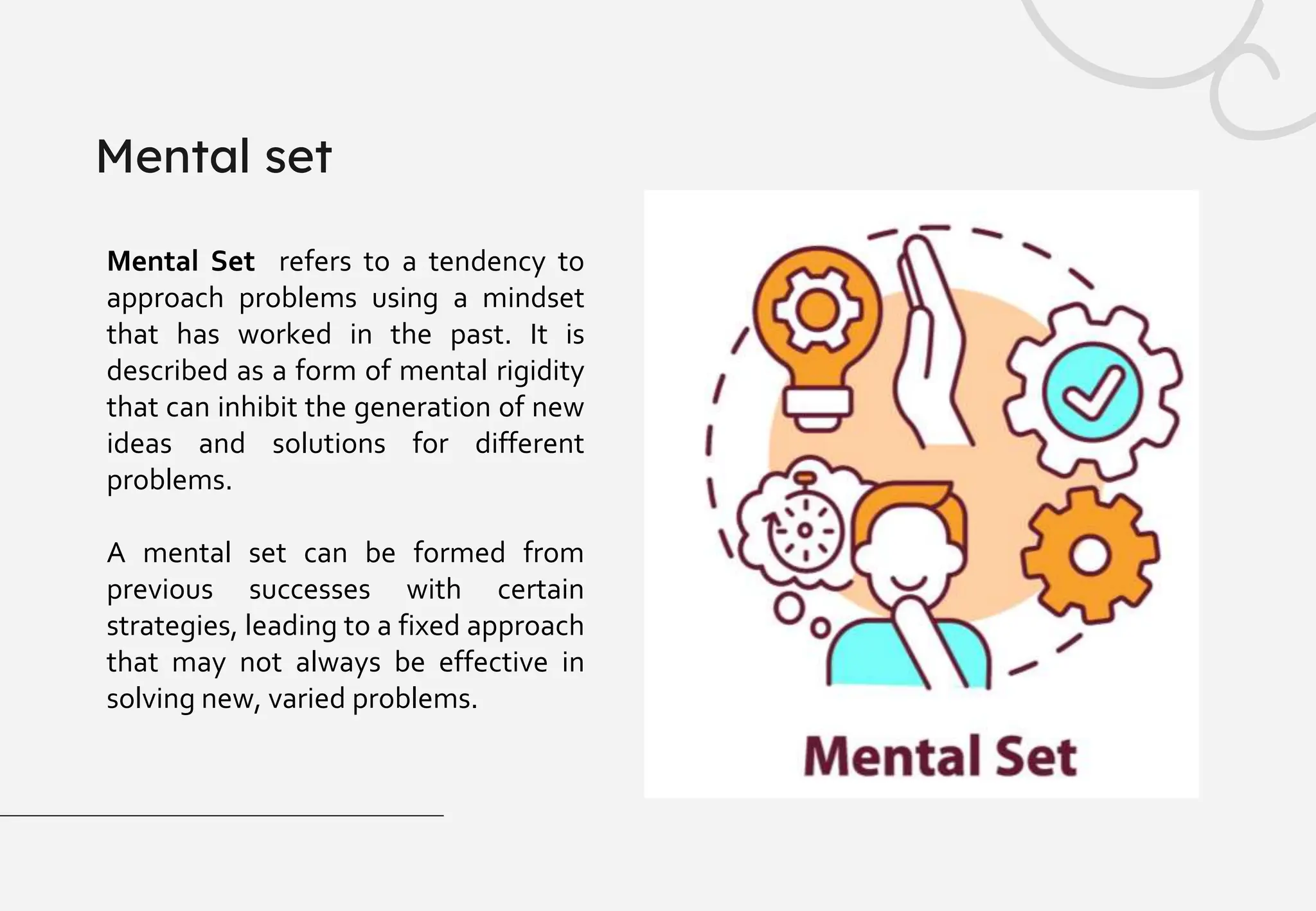
Mental set
Mental Set refers to a tendency to
approach problems using a mindset
that has worked in the past. It is
described as a form of mental rigidity
that can inhibit the generation of new
ideas and solutions for different
problems.
A mental set can be formed from
previous successes with certain
strategies, leading to a fixed approach
that may not always be effective in
solving new, varied problems.
Decision Making
Decision-making means picking one option from several choices.
Cognitive psychologists look at how people make decisions.
• They look at how we collect and think about information.
• They explore how we consider different choices and their
possible outcomes.
• Factors like biases, emotions, and social influences affect
decision-making.
• Methods used include experiments, computer models, brain
scans, and observations.
• Understanding decision-making helps in education, business,
healthcare, and other areas.
Decision Making
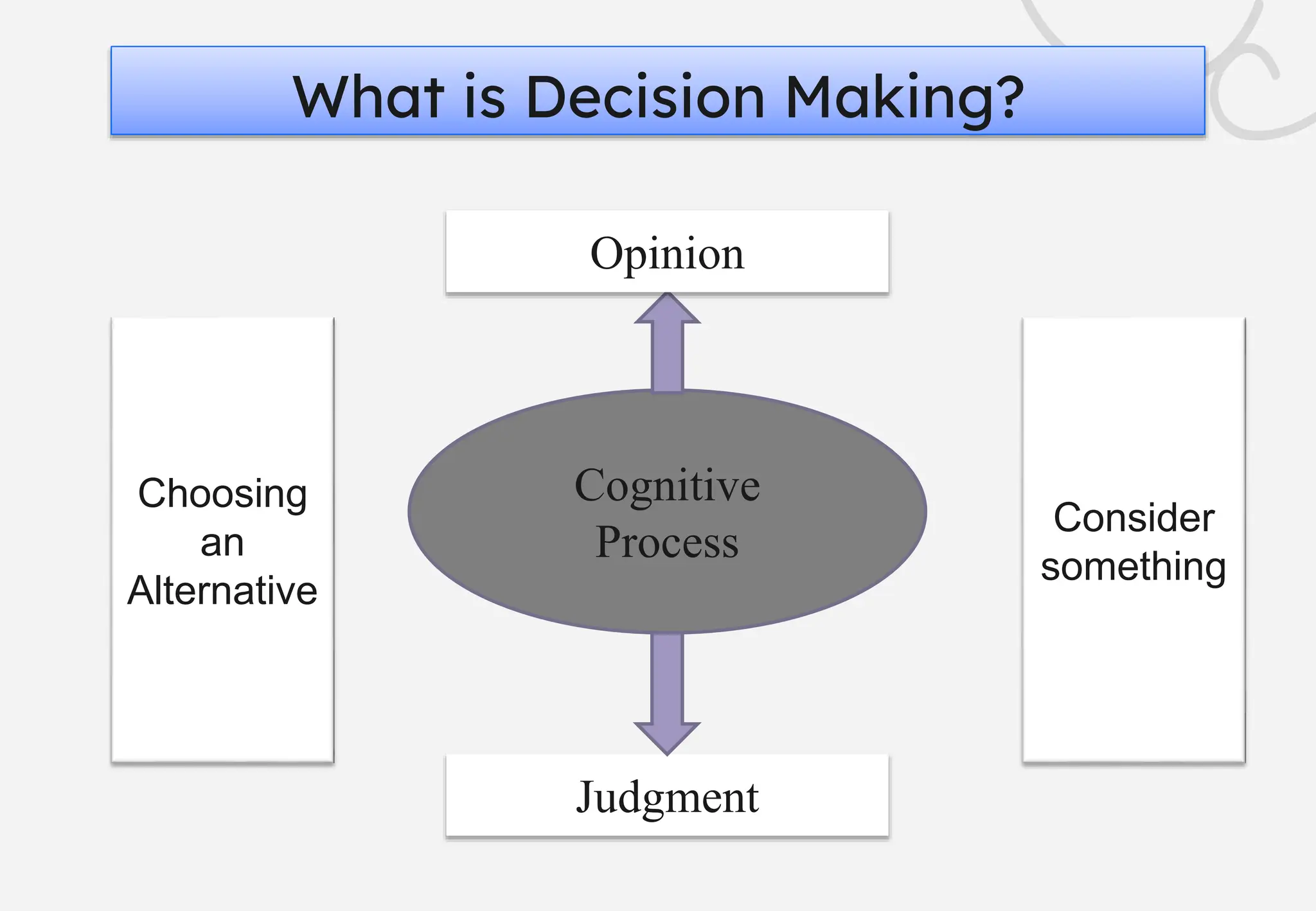
An act of making up your mind about something
A position or opinion or judgment reached after consideration.
What is Decision Making?
Cognitive
Process
Opinion
Judgment
Choosing
an
Alternative
Consider
something
The elements of decision-making can be broken down into several key components:
1. Identification of the Problem: Recognizing and defining the issue or situation that requires a
decision to be made. This involves understanding what needs to be addressed or resolved.
2. Gathering Information: Collecting relevant data, facts, and insights related to the problem at
hand. This step involves researching, observing, or consulting with others to acquire necessary
information.
3. Generating Alternatives: Brainstorming and creating various possible courses of action to address
the problem. This step requires creativity and open-mindedness to explore different options.
4. Evaluating Alternatives: Assessing the pros and cons of each alternative based on criteria such as
feasibility, effectiveness, risks, and consequences. This involves analyzing the potential outcomes
and considering their implications.
5. Making a Decision: Choosing the best alternative among the options considered. This step
involves weighing the advantages and disadvantages of each alternative and selecting the one
that aligns with the decision-maker's goals and values.
6. Implementing the Decision: Putting the chosen alternative into action. This step involves
planning and executing the necessary steps to implement the decision effectively.
7. Monitoring and Evaluating: Assessing the outcomes of the decision to determine its success and
effectiveness. This involves tracking progress, gathering feedback, and making adjustments as
needed.
The elements of decision-making can be broken down into several
key components
Thank You

Cognitive Psychology presentation 1.pptx

  • 1.
    Cognitive Psychology Problem Solving, reasoning andDecision making SUBMITTED TO: Ar. RAJNI TANEJA SUBMITTED BY : SHWETA CHOUDHARY M.ARCH ( ARCHITECTURE PEDAGOGY) 2ND SEMESTER
  • 2.
    Cognitive psychology • Cognitivepsychology is a branch of psychology that focuses on the study of mental processes such as perception, memory, attention, language, problem-solving, reasoning, and decision-making. • It seeks to understand how people acquire, process, store, and use information. • Cognitive psychologists investigate various aspects of human cognition, including how individuals perceive the world around them, how they learn new information, how they remember and retrieve information from memory, and how they solve problems and make decisions.
  • 3.
    Introduction Problem solving, reasoning,and decision making are crucial aspects of cognitive psychology, which is the branch of psychology that focuses on mental processes such as perception, memory, attention, language, problem-solving, reasoning, and decision-making.
  • 4.
    Problem Solving andDecision Making • Problem solving is described as a directed thinking process focused on addressing a specific issue. • Problem-solving involves focused thinking, utilizing both internal (mind) and external (support) resources. • Example: Scoring well in an exam involves studying hard and seeking help from teachers, friends, and parents. • It involves three elements: the problem itself, the goal, and the steps to reach that goal. • Problem solving is an integral part of daily life, requiring both internal (mental) and external (support from others) resources to arrive at an appropriate decision6
  • 5.
    Relationship between ProblemSolving and Decision Making Problem Solving and Decision-Making go hand in hand.
  • 6.
    Process of DecisionMaking Defining the problem Problem Analysis Generating possible Solutions Analyzing solutions Selecting the best solutions Planning the next course of action
  • 8.
  • 9.
    Problem Solving Problem-solving involvesfinding solutions to obstacles or challenges. Cognitive psychologists' study various strategies people use to solve problems, such as • Algorithms (step-by-step procedures), • Heuristics (mental shortcuts), • Trial-and-error, insight (sudden realization), and • Analogical reasoning (using solutions from similar problems). They also investigate how individuals represent problems mentally and how they select and apply problem-solving strategies.
  • 10.
    Barriers to ProblemSolving • Assumptions: People often assume certain limitations or obstacles when solving problems, which can narrow down their options. • Functional Fixedness: This means seeing things only in their usual way, limiting creativity in finding solutions. • Unnecessary Constraints: People sometimes rely too much on past methods, limiting their ability to find new solutions. • Irrelevant or Misleading Information: Focusing on the wrong information can lead to poor solutions, especially in complex situations. • Mental Set: This is when someone sticks to old solutions instead of considering new ones, making problem-solving harder. • Confirmation Bias: It's about having a bias that confirms preconceived ideas, rather than using an objective problem-solving approach.
  • 11.
    Seven Steps forEffective Problem Solving in the Workplace 1. Identify the issues. 2. Understand everyone's interests. 3. List the possible solutions (options) 4. Evaluate the options. 5. Select an option or options. 6. Document the agreement(s). 7. Agree on contingencies, monitoring, and evaluation.
  • 12.
    Steps & Approachesof Problem Solving Problem-solving typically involves several steps, including identifying the problem, generating possible solutions, evaluating those solutions, and implementing the best one. Different approaches to problem-solving include: • Algorithmic Approach: This involves following a systematic, step-by-step procedure to reach a solution. Algorithms guarantee a solution if executed correctly but can be time-consuming.
  • 13.
    Steps & ApproachesProblem Solving • Heuristic Approach: Heuristics are mental shortcuts or rules of thumb that simplify the problem-solving process by focusing attention on the most relevant information. While heuristics can lead to quick solutions, they may also result in errors due to oversimplification or biases.
  • 14.
    Steps & Approachesof Problem Solving • Obstacles in the Process: Various obstacles can hinder problem- solving, including:
  • 15.
    Steps & Approachesof Problem Solving Functional Fixedness: Functional fixedness refers to rigidity in problem-solving, characterized by a tendency to think of things only in terms of their usual functions. For example, if presented with a hammer, most people would think only of using it as a tool for driving nails.
  • 16.
    Duncker’s Candle Problem Duncker’sCandle Problem Shows Us the Risk of Functional Fixedness The candle problem or candle task, also known as Duncker's candle problem, is a cognitive performance test, measuring the influence of functional fixedness on a participant's problem solving capabilities. Duncker’s Candle Problem is like a puzzle. You have a candle, some thumbtacks, and matches. The challenge is to put the candle on the wall and light it without wax dripping on the floor. It's not easy because people usually think about the objects only in their usual ways. But if you get creative, you might find a solution, like using the thumbtack box as a shelf for the candle. This problem tests how well we can think differently and solve problems in new ways.
  • 17.
    Steps & Approachesof Problem Solving Confirmation Bias: The tendency to search for, interpret, or remember information in a way that confirms one's preconceptions, leading to ignoring alternative solutions.
  • 18.
    Steps & Approachesof Problem Solving • Mental Set: The tendency to approach problems using strategies that have worked in the past, even if they are not optimal for the current problem. • Scaffolding in Learning and Problem Solving : Scaffolding refers to the support provided by teachers, peers, or external tools to help learners gradually develop their problem-solving skills or understanding of a concept.
  • 19.
    Steps & Approachesof Problem Solving • Learning: In learning, scaffolding involves breaking down complex tasks into smaller, manageable steps and providing guidance and support as learners progress. This support can include prompts, hints, modeling, or structured activities. • Problem Solving: In problem-solving, scaffolding may involve providing cues, hints, or guidance to help individuals overcome obstacles and develop effective problem-solving strategies. As individuals gain proficiency, scaffolding can be gradually reduced to promote independent problem- solving. • Logic & Reasoning Logic: Logic refers to the principles of valid reasoning and inference. It involves constructing arguments based on premises and drawing conclusions that follow logically from those premises.
  • 20.
    Reasoning Reasoning encompasses thecognitive processes involved in drawing conclusions, making inferences, or evaluating arguments. • It includes deductive reasoning (drawing specific conclusions from general principles), • Inductive reasoning (inferring general principles from specific observations), and • Abductive reasoning (forming hypotheses to explain observations). • Logical Fallacies: These are errors in reasoning that undermine the validity of arguments. Examples include ad hominem attacks, false dichotomies, and appeals to authority. • Obstacles to Logical Reasoning: Individuals may encounter obstacles such as cognitive biases, emotional influences, or lack of relevant information when engaging in logical reasoning. • Understanding these concepts and their interplay is essential for effectively addressing problems, making informed decisions, and reasoning logically in various domains.
  • 21.
    Reasoning Reasoning refers tothe mental processes used to draw conclusions, make inferences, and evaluate arguments or propositions. Cognitive psychologists examine • Deductive reasoning (drawing conclusions from general principles), • Inductive reasoning (that involves making generalizations based on specific observations or evidence) • Abductive reasoning (forming hypotheses to explain observations). They also investigate logical fallacies, biases, and errors in reasoning that may influence decision-making.
  • 23.
    Mental set Mental Setrefers to a tendency to approach problems using a mindset that has worked in the past. It is described as a form of mental rigidity that can inhibit the generation of new ideas and solutions for different problems. A mental set can be formed from previous successes with certain strategies, leading to a fixed approach that may not always be effective in solving new, varied problems.
  • 24.
    Decision Making Decision-making meanspicking one option from several choices. Cognitive psychologists look at how people make decisions. • They look at how we collect and think about information. • They explore how we consider different choices and their possible outcomes. • Factors like biases, emotions, and social influences affect decision-making. • Methods used include experiments, computer models, brain scans, and observations. • Understanding decision-making helps in education, business, healthcare, and other areas. Decision Making An act of making up your mind about something A position or opinion or judgment reached after consideration.
  • 25.
    What is DecisionMaking? Cognitive Process Opinion Judgment Choosing an Alternative Consider something
  • 26.
    The elements ofdecision-making can be broken down into several key components:
  • 27.
    1. Identification ofthe Problem: Recognizing and defining the issue or situation that requires a decision to be made. This involves understanding what needs to be addressed or resolved. 2. Gathering Information: Collecting relevant data, facts, and insights related to the problem at hand. This step involves researching, observing, or consulting with others to acquire necessary information. 3. Generating Alternatives: Brainstorming and creating various possible courses of action to address the problem. This step requires creativity and open-mindedness to explore different options. 4. Evaluating Alternatives: Assessing the pros and cons of each alternative based on criteria such as feasibility, effectiveness, risks, and consequences. This involves analyzing the potential outcomes and considering their implications. 5. Making a Decision: Choosing the best alternative among the options considered. This step involves weighing the advantages and disadvantages of each alternative and selecting the one that aligns with the decision-maker's goals and values. 6. Implementing the Decision: Putting the chosen alternative into action. This step involves planning and executing the necessary steps to implement the decision effectively. 7. Monitoring and Evaluating: Assessing the outcomes of the decision to determine its success and effectiveness. This involves tracking progress, gathering feedback, and making adjustments as needed. The elements of decision-making can be broken down into several key components
  • 28.