M R . A B HI N A V B HA T T
PROBLEM BASED
LEARNING
HISTORY:
 Problem based learning (PBL) was pioneered in the
medical school program at McMaster University in
Hamilton, Ontario, Canada in the late 1960s by
Howard Barrows and his colleagues. The PBL
curriculum was developed in order to stimulate the
learners, assist the learners in seeing the relevance of
learning to future roles, maintain a higher level of
motivation towards learning,
cont…
and to show the learners the importance of
responsible, professional attitudes. PBL was adopted
by the medical school programs & other health
sciences, math, law, education, economic, business,
social studies & engineering.
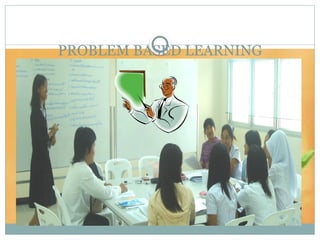
PROBLEM BASED LEARNING
DEFINITION :
PBL is a method in which students work
collaboratively to solve real- world problems. A
students- centered approach, PBL encourages critical
thinking as students investigate issues, gather
material, analyzes & evaluate information & develop
solutions to problems.
REAL LIFE SITUATION
COMPETENT
MAKING DECISIONS
PROBLEM
SUBJECT BASED LEARNING
• CLASS ROOM
• REAL LIFE
INCOMPETENT
CONFUSION
PROBLEM
PURPOSES:
1) To gain an understanding of principle that
underlines phenomenon.
2) Help to aim at problem analyzing skills training in
particular professional situation.
3) To exercise that students learn to take decision
independently.
4) Help to activate prior knowledge & to integrate that
knowledge.
CHARACTERISTIC OF PBL:
 Student- centered & experiential
 Inductive
 Problems are complex & ambiguous & requires
meta- cognition
 Collaborative & interdependent.
PRINCIPLES:
 Understanding comes from our interaction with the
environment.
 Cognitive conflict stimulates learning.
 Knowledge evolves through social negotiation and
evaluation of the viability of individual
understanding
MEMBERS:
1) The group leaders
2) The scribe
3) The group members
4) Tutor
5) The chair man
ROLE OF THE MEMBERS:
A) Role of the group leader
 Keep discussion goal oriented
 Guiding the PBL steps
 Clarifying discussion
 Stimulation participation
 Guiding documentation
 Argument mediator
 Motivator
 Equal participation
 Complete record
 Time gate keeper
CONT…
B) Role of the scribe:
 Records points
 Helps group to order their thoughts
 Participates in discussion
 Records resources used by the group
 Making clean and short notes
 Summarizing information
 External memory
 Not to be selective
CONT…
C) Role of the tutor:
 Encourages group members to participate
 Assist chair with group dynamics and keeping to time
 Plays a key role in PBL
 Is the back bone of PBL
 Makes learning student centered
 Facilitates learning instead of dispensing knowledge
 Guides never directs
 Committed to the groups learning
CONT…
 Active listening
 Must keep the process alive and on the track by non
directive stimuli.
 Should be able to handle small group dynamics
 To allow the group to take over, manage and
encourage students to attain a deeper level of
understanding.
 Ability to asses students ability and problems
 To ensure all students are involved.
CONT…
D) Role of chair man:
 Heads the group through the process
 Encourage all group through the process
 Maintain group keeps to task in hand
 Ensure group keeps to task in hand
 Ensure scribe can keep up & is making an accurate
record
CONT…
E) Role of the group members:
 Follow the steps of the process in sequences
 Participates in discussion
 Listens to & respect contribution of others
 Shares information with others
 Asks open questions
 Research all the learning objectives
 Active participation
 Answering questions
 Make decisions
STEPS:
Problem based learning consists of 2 sessions.
Session I:
The group selects a group leaders and a scribes. Both
group leaders & the scribes rotate among members
during the study block. This session is known as the
brain storming session.
The group leader co-ordinates the session activities.
The session has 7 jumps.
CONT…
7 steps of PBL:
a. Clarity
b. Defining
c. Analyzing
d. Shift & sort
e. Identify learning objectives
f. Go & learn
g. Come back & talk
CONT…
Session II (presentation):
Regroup, synthesize new information & agree on
whether item identified & can be explained to the
satisfaction of all members. If not, return to 5, review
what has been learned during study of the problem.
Begin new problem when group is satisfied with
solutions for previous problem.
CONT…
 Evaluation:
Students will be evaluated on the basis of their
performance & placed in one of the following
categories:
E- Excellent
D- Distinction
P- Pass
F- Fail
A- Absent
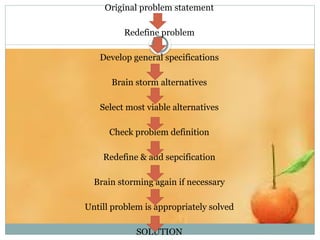
Original problem statement
Redefine problem
Develop general specifications
Brain storm alternatives
Select most viable alternatives
Check problem definition
Redefine & add sepcification
Brain storming again if necessary
Untill problem is appropriately solved
SOLUTION
ADVANTAGES:
 Higher comprehension
 Critical and creative thinking
 Self directed learning
 Project management
 Problem solving skills
 Interpersonal skills & team work
 Self motivated attitude
 Good mastery of content
 Develop analytical thoughts
CRITICAL AND CREATIVE THINKING..
CONT…
 Increased clinical skills
 Bridges the gap between theory & practice
 Fosters concretively in learning
 Able to adapt to rapid changes in the world
 Continue to be useful in the professional life
DISADVANTAGES:
 Transition is difficult for students and faculty
 Increased time to teach content
-increased prep time
 Finding problems- writing problems
 Faculty lack of skills as facilitators
LIMITATIONS:
 Designing a good problem is difficult & require time.
 Valid assessment of the program may not be always
available.
 Tutors role is to guide the student to meet the
objectives set for the students learning.
 PBL sessions are time consuming
 As far as academic achievement is concern
traditional method serves better & it is impossible to
cover whole syllabus by means of PBL.
 It is difficult to generate appropriate problems.
CONT…
 Changing role of the student that is previously
students were accustomed with traditional method
of teaching & sudden change to PBL leads the
students to "simple wonder around something". This
usually happens in first year students who often
express difficulty with self directed learning.
JOURNAL:
 Albanese, Mitchell, Norman, Schmidt,
Vernon & Black (1993) conducted a study on
case- method in the teaching of medical ethics using
PBL which clearly indicates that learners prefer this
method to the conventional, lecture based method. It
had a significant increase in the development of
moral reasoning & decision making about value issue
in medical students.
CONT…
Problem based learning -Five easy steps (according to Queen's
University)
1.Read the problem
2.Brainstorm
3.Identify/ discussion/ assign
4.Individual reading- research- preparation
5.Return review case so far
 Report and discuss
 Assess progress- continue page/ next
 Self- evaluation- how did things go?
 Any suggestions for next time?
 Next problem
CONT…
The first group session
- Be sure you have the necessary information
- Seating arrangements
- Tutor introduction
- Student information
-Review the objectives of PBL and the evaluation
process.
- Choose a "secretary"
- Starting the case
- By the end of the session
CONT…
Before the end of the session, the students in the group need
to clarity their plans for their own learning between session
by:
 First: Identifying all of the significant issues arising from the
hypothesis.
 Second: Settling on a "do- able" list of learning tasks for the
next session, deciding which issues everyone will tackle and
which will be divided up.
 Third: Decided what specific questions individuals will try to
answer.
 Fourth: Deciding on the "enquiry strategy"- how they will
address these learning issues.
CONT…
Question tutors may ask during PBL
 Appropriate question is one of the most important means of
facilitating learning
 Question may elicit a students reasoning process
 The tutor encourages students to make connections
 Tutors emphasize open- ended questions
 Questions can direct
 Tutors should emphasize mechanisms & causes of patients
problems.
 Tutors should periodically ask students to explain & define
medical terminology used.
CONT…
 Tutors should ask higher order questions.
 Some other helpful questions are:
 Why is the mechanism action of this drug?
 What is the evidence that treatment makes any
difference?
 How do you decide which lab tests to do?
THANK YOU

Problem Base learning in the nursing.pptx

  • 1.
    M R .A B HI N A V B HA T T PROBLEM BASED LEARNING
  • 2.
    HISTORY:  Problem basedlearning (PBL) was pioneered in the medical school program at McMaster University in Hamilton, Ontario, Canada in the late 1960s by Howard Barrows and his colleagues. The PBL curriculum was developed in order to stimulate the learners, assist the learners in seeing the relevance of learning to future roles, maintain a higher level of motivation towards learning,
  • 3.
    cont… and to showthe learners the importance of responsible, professional attitudes. PBL was adopted by the medical school programs & other health sciences, math, law, education, economic, business, social studies & engineering.
  • 4.
  • 5.
    DEFINITION : PBL isa method in which students work collaboratively to solve real- world problems. A students- centered approach, PBL encourages critical thinking as students investigate issues, gather material, analyzes & evaluate information & develop solutions to problems.
  • 6.
  • 7.
    SUBJECT BASED LEARNING •CLASS ROOM • REAL LIFE INCOMPETENT CONFUSION PROBLEM
  • 8.
    PURPOSES: 1) To gainan understanding of principle that underlines phenomenon. 2) Help to aim at problem analyzing skills training in particular professional situation. 3) To exercise that students learn to take decision independently. 4) Help to activate prior knowledge & to integrate that knowledge.
  • 9.
    CHARACTERISTIC OF PBL: Student- centered & experiential  Inductive  Problems are complex & ambiguous & requires meta- cognition  Collaborative & interdependent.
  • 10.
    PRINCIPLES:  Understanding comesfrom our interaction with the environment.  Cognitive conflict stimulates learning.  Knowledge evolves through social negotiation and evaluation of the viability of individual understanding
  • 11.
    MEMBERS: 1) The groupleaders 2) The scribe 3) The group members 4) Tutor 5) The chair man
  • 12.
    ROLE OF THEMEMBERS: A) Role of the group leader  Keep discussion goal oriented  Guiding the PBL steps  Clarifying discussion  Stimulation participation  Guiding documentation  Argument mediator  Motivator  Equal participation  Complete record  Time gate keeper
  • 13.
    CONT… B) Role ofthe scribe:  Records points  Helps group to order their thoughts  Participates in discussion  Records resources used by the group  Making clean and short notes  Summarizing information  External memory  Not to be selective
  • 14.
    CONT… C) Role ofthe tutor:  Encourages group members to participate  Assist chair with group dynamics and keeping to time  Plays a key role in PBL  Is the back bone of PBL  Makes learning student centered  Facilitates learning instead of dispensing knowledge  Guides never directs  Committed to the groups learning
  • 15.
    CONT…  Active listening Must keep the process alive and on the track by non directive stimuli.  Should be able to handle small group dynamics  To allow the group to take over, manage and encourage students to attain a deeper level of understanding.  Ability to asses students ability and problems  To ensure all students are involved.
  • 16.
    CONT… D) Role ofchair man:  Heads the group through the process  Encourage all group through the process  Maintain group keeps to task in hand  Ensure group keeps to task in hand  Ensure scribe can keep up & is making an accurate record
  • 17.
    CONT… E) Role ofthe group members:  Follow the steps of the process in sequences  Participates in discussion  Listens to & respect contribution of others  Shares information with others  Asks open questions  Research all the learning objectives  Active participation  Answering questions  Make decisions
  • 18.
    STEPS: Problem based learningconsists of 2 sessions. Session I: The group selects a group leaders and a scribes. Both group leaders & the scribes rotate among members during the study block. This session is known as the brain storming session. The group leader co-ordinates the session activities. The session has 7 jumps.
  • 19.
    CONT… 7 steps ofPBL: a. Clarity b. Defining c. Analyzing d. Shift & sort e. Identify learning objectives f. Go & learn g. Come back & talk
  • 20.
    CONT… Session II (presentation): Regroup,synthesize new information & agree on whether item identified & can be explained to the satisfaction of all members. If not, return to 5, review what has been learned during study of the problem. Begin new problem when group is satisfied with solutions for previous problem.
  • 21.
    CONT…  Evaluation: Students willbe evaluated on the basis of their performance & placed in one of the following categories: E- Excellent D- Distinction P- Pass F- Fail A- Absent
  • 22.
    Original problem statement Redefineproblem Develop general specifications Brain storm alternatives Select most viable alternatives Check problem definition Redefine & add sepcification Brain storming again if necessary Untill problem is appropriately solved SOLUTION
  • 23.
    ADVANTAGES:  Higher comprehension Critical and creative thinking  Self directed learning  Project management  Problem solving skills  Interpersonal skills & team work  Self motivated attitude  Good mastery of content  Develop analytical thoughts
  • 24.
  • 25.
    CONT…  Increased clinicalskills  Bridges the gap between theory & practice  Fosters concretively in learning  Able to adapt to rapid changes in the world  Continue to be useful in the professional life
  • 26.
    DISADVANTAGES:  Transition isdifficult for students and faculty  Increased time to teach content -increased prep time  Finding problems- writing problems  Faculty lack of skills as facilitators
  • 27.
    LIMITATIONS:  Designing agood problem is difficult & require time.  Valid assessment of the program may not be always available.  Tutors role is to guide the student to meet the objectives set for the students learning.  PBL sessions are time consuming  As far as academic achievement is concern traditional method serves better & it is impossible to cover whole syllabus by means of PBL.  It is difficult to generate appropriate problems.
  • 28.
    CONT…  Changing roleof the student that is previously students were accustomed with traditional method of teaching & sudden change to PBL leads the students to "simple wonder around something". This usually happens in first year students who often express difficulty with self directed learning.
  • 29.
    JOURNAL:  Albanese, Mitchell,Norman, Schmidt, Vernon & Black (1993) conducted a study on case- method in the teaching of medical ethics using PBL which clearly indicates that learners prefer this method to the conventional, lecture based method. It had a significant increase in the development of moral reasoning & decision making about value issue in medical students.
  • 30.
    CONT… Problem based learning-Five easy steps (according to Queen's University) 1.Read the problem 2.Brainstorm 3.Identify/ discussion/ assign 4.Individual reading- research- preparation 5.Return review case so far  Report and discuss  Assess progress- continue page/ next  Self- evaluation- how did things go?  Any suggestions for next time?  Next problem
  • 31.
    CONT… The first groupsession - Be sure you have the necessary information - Seating arrangements - Tutor introduction - Student information -Review the objectives of PBL and the evaluation process. - Choose a "secretary" - Starting the case - By the end of the session
  • 32.
    CONT… Before the endof the session, the students in the group need to clarity their plans for their own learning between session by:  First: Identifying all of the significant issues arising from the hypothesis.  Second: Settling on a "do- able" list of learning tasks for the next session, deciding which issues everyone will tackle and which will be divided up.  Third: Decided what specific questions individuals will try to answer.  Fourth: Deciding on the "enquiry strategy"- how they will address these learning issues.
  • 33.
    CONT… Question tutors mayask during PBL  Appropriate question is one of the most important means of facilitating learning  Question may elicit a students reasoning process  The tutor encourages students to make connections  Tutors emphasize open- ended questions  Questions can direct  Tutors should emphasize mechanisms & causes of patients problems.  Tutors should periodically ask students to explain & define medical terminology used.
  • 34.
    CONT…  Tutors shouldask higher order questions.  Some other helpful questions are:  Why is the mechanism action of this drug?  What is the evidence that treatment makes any difference?  How do you decide which lab tests to do?
  • 35.