Problem and Situation
      Analysis
 Public Sector Improvement Facility
          Project Resources
Why conduct a problem/situation analysis?
Define clearly:
Who it is for:
• Project management staff and partners?
• People who will be affected by the initiative?
• Donors?
How the results will be used:
• As a basis for project planning?
• By project managers, staff, partners and stakeholders
  affected by the initiative?
• As a funding proposal?
• As a baseline analysis for impact evaluation?
PSIF Project Resources   Problem and Situation Analysis   2
Purpose of the Problem Analysis

• Understand how different problems affect different
  stakeholders and their priorities in addressing them
• Analyse the situation in which the agency will be
  working
• Identify a suitable area or sector to work in
• Understand the complexities of a problem, its causes
  and how it is already being handled
• Analyse the constraints and opportunities for
  development work

PSIF Project Resources   Problem and Situation Analysis   3
Formulate the Problem

• Brainstorm suggestions to identify a focal
  problem i.e. the central point of the overall
  problem
• Record suggestions and present to group e.g. on
  butchers paper or post-it notes
• Discuss each suggestion and agree on a single
  focal problem to be addressed


PSIF Project Resources   Problem and Situation Analysis   4
Identify Cause & Effect: The Problem Tree


PSIF Project Resources   Problem and Situation Analysis   5
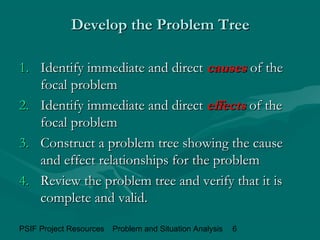
Develop the Problem Tree

1. Identify immediate and direct causes of the
   focal problem
2. Identify immediate and direct effects of the
   focal problem
3. Construct a problem tree showing the cause
   and effect relationships for the problem
4. Review the problem tree and verify that it is
   complete and valid.

PSIF Project Resources   Problem and Situation Analysis   6
Case Study Part 1: Samoa Immigration
       Problem Tree Analysis


PSIF Project Resources   Problem and Situation Analysis   7
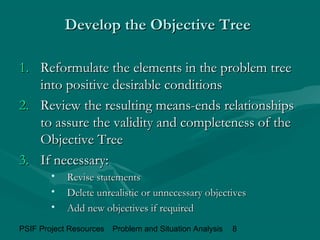
Develop the Objective Tree

1. Reformulate the elements in the problem tree
   into positive desirable conditions
2. Review the resulting means-ends relationships
   to assure the validity and completeness of the
   Objective Tree
3. If necessary:
        •   Revise statements
        •   Delete unrealistic or unnecessary objectives
        •   Add new objectives if required
PSIF Project Resources   Problem and Situation Analysis   8
Case Study Part 2: Samoa Immigration
         Objective Tree Analysis


PSIF Project Resources   Problem and Situation Analysis   9
Identify Cause & Effect:
     The Fishbone (Ishikawa) Diagram


PSIF Project Resources   Problem and Situation Analysis   10
Constructing the Fishbone Diagram
•   Prepare the basic fishbone framework
•   List the problem or issue to be addressed
•   Label each “leg” of the diagram:
    – Manpower, Machines, Methods, Materials
• Alternative labels may include:
    –   Place, Procedure, People, Policies; or
    –   Surroundings, Suppliers, Systems, Skills
• Brainstorm the factors affecting the problem in each leg
• Keep asking “Why is this happening” until participants
  agree there is sufficient detail
• Analyse the results to find the most likely causes
PSIF Project Resources   Problem and Situation Analysis   11
Case Study Part 3: Samoa Immigration
           Fishbone Diagram


PSIF Project Resources   Problem and Situation Analysis   12
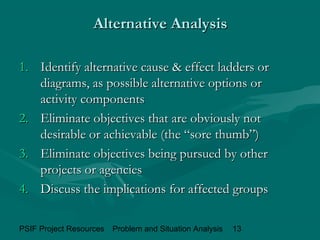
Alternative Analysis

1. Identify alternative cause & effect ladders or
   diagrams, as possible alternative options or
   activity components
2. Eliminate objectives that are obviously not
   desirable or achievable (the “sore thumb”)
3. Eliminate objectives being pursued by other
   projects or agencies
4. Discuss the implications for affected groups

PSIF Project Resources   Problem and Situation Analysis   13
Develop a Conceptual Model
A conceptual model explains how:
• The project will achieve the desired results in
   theory
• The strategy will make the desired change
• Clarify the relationship between the strategy,
   the expected results and the goal (or outcome)
   of the project


PSIF Project Resources   Problem and Situation Analysis   14
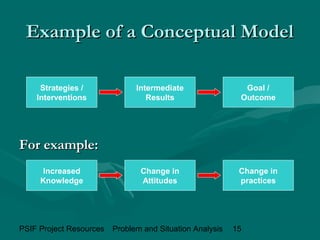
Example of a Conceptual Model

     Strategies /              Intermediate                 Goal /
    Interventions                 Results                  Outcome


For example:
     Increased                  Change in                  Change in
     Knowledge                  Attitudes                  practices


PSIF Project Resources   Problem and Situation Analysis   15
Developing the Conceptual Model
Step 1     Identify the goal (or outcome) of the
  project:

• What are the specific problems affecting the
  stakeholder population or client group?
• Which of these problems can we change?


PSIF Project Resources   Problem and Situation Analysis   16
Developing the Conceptual Model
Step 2     Identify the intermediate results of the
  project:

• What changes must occur in the human
  resources, equipment, work methods or
  materials (see the 4Ms in the Fishbone Diagram)
  to reduce the problem?


PSIF Project Resources   Problem and Situation Analysis   17
Developing the Conceptual Model
Step 3     Identify the interventions of the
  project:

• What activities can be undertaken that will
  achieve the changes identified in Step 2?
• Why will these activities accomplish these
  changes?


PSIF Project Resources   Problem and Situation Analysis   18
Evaluating the project feasibility
A Project can be evaluated on:
• Technical feasibility- appropriateness, use of
  resources, market suitability, etc.
• Financial (cost/benefit) feasibility- set-up/
  recurrent costs, financial sustainability;
• Social implications- distribution of benefits,
  gender issues, socio-cultural constraints, local
  involvement;
• Environmental issues- impact, environmental
  costs vs. benefits.
PSIF Project Resources   Problem and Situation Analysis   19
Selecting the Project Strategy

1. Make an assessment of the project against the
   PSIF Eligibility Criteria
2. Select one of the alternatives as the preferred
   strategy
3. Prepare the Project Identification Brief (PIB)


PSIF Project Resources   Problem and Situation Analysis   20

Problem and situation analysis

  • 1.
    Problem and Situation Analysis Public Sector Improvement Facility Project Resources
  • 2.
    Why conduct aproblem/situation analysis? Define clearly: Who it is for: • Project management staff and partners? • People who will be affected by the initiative? • Donors? How the results will be used: • As a basis for project planning? • By project managers, staff, partners and stakeholders affected by the initiative? • As a funding proposal? • As a baseline analysis for impact evaluation? PSIF Project Resources Problem and Situation Analysis 2
  • 3.
    Purpose of theProblem Analysis • Understand how different problems affect different stakeholders and their priorities in addressing them • Analyse the situation in which the agency will be working • Identify a suitable area or sector to work in • Understand the complexities of a problem, its causes and how it is already being handled • Analyse the constraints and opportunities for development work PSIF Project Resources Problem and Situation Analysis 3
  • 4.
    Formulate the Problem •Brainstorm suggestions to identify a focal problem i.e. the central point of the overall problem • Record suggestions and present to group e.g. on butchers paper or post-it notes • Discuss each suggestion and agree on a single focal problem to be addressed PSIF Project Resources Problem and Situation Analysis 4
  • 5.
    Identify Cause &Effect: The Problem Tree PSIF Project Resources Problem and Situation Analysis 5
  • 6.
    Develop the ProblemTree 1. Identify immediate and direct causes of the focal problem 2. Identify immediate and direct effects of the focal problem 3. Construct a problem tree showing the cause and effect relationships for the problem 4. Review the problem tree and verify that it is complete and valid. PSIF Project Resources Problem and Situation Analysis 6
  • 7.
    Case Study Part1: Samoa Immigration Problem Tree Analysis PSIF Project Resources Problem and Situation Analysis 7
  • 8.
    Develop the ObjectiveTree 1. Reformulate the elements in the problem tree into positive desirable conditions 2. Review the resulting means-ends relationships to assure the validity and completeness of the Objective Tree 3. If necessary: • Revise statements • Delete unrealistic or unnecessary objectives • Add new objectives if required PSIF Project Resources Problem and Situation Analysis 8
  • 9.
    Case Study Part2: Samoa Immigration Objective Tree Analysis PSIF Project Resources Problem and Situation Analysis 9
  • 10.
    Identify Cause &Effect: The Fishbone (Ishikawa) Diagram PSIF Project Resources Problem and Situation Analysis 10
  • 11.
    Constructing the FishboneDiagram • Prepare the basic fishbone framework • List the problem or issue to be addressed • Label each “leg” of the diagram: – Manpower, Machines, Methods, Materials • Alternative labels may include: – Place, Procedure, People, Policies; or – Surroundings, Suppliers, Systems, Skills • Brainstorm the factors affecting the problem in each leg • Keep asking “Why is this happening” until participants agree there is sufficient detail • Analyse the results to find the most likely causes PSIF Project Resources Problem and Situation Analysis 11
  • 12.
    Case Study Part3: Samoa Immigration Fishbone Diagram PSIF Project Resources Problem and Situation Analysis 12
  • 13.
    Alternative Analysis 1. Identifyalternative cause & effect ladders or diagrams, as possible alternative options or activity components 2. Eliminate objectives that are obviously not desirable or achievable (the “sore thumb”) 3. Eliminate objectives being pursued by other projects or agencies 4. Discuss the implications for affected groups PSIF Project Resources Problem and Situation Analysis 13
  • 14.
    Develop a ConceptualModel A conceptual model explains how: • The project will achieve the desired results in theory • The strategy will make the desired change • Clarify the relationship between the strategy, the expected results and the goal (or outcome) of the project PSIF Project Resources Problem and Situation Analysis 14
  • 15.
    Example of aConceptual Model Strategies / Intermediate Goal / Interventions Results Outcome For example: Increased Change in Change in Knowledge Attitudes practices PSIF Project Resources Problem and Situation Analysis 15
  • 16.
    Developing the ConceptualModel Step 1 Identify the goal (or outcome) of the project: • What are the specific problems affecting the stakeholder population or client group? • Which of these problems can we change? PSIF Project Resources Problem and Situation Analysis 16
  • 17.
    Developing the ConceptualModel Step 2 Identify the intermediate results of the project: • What changes must occur in the human resources, equipment, work methods or materials (see the 4Ms in the Fishbone Diagram) to reduce the problem? PSIF Project Resources Problem and Situation Analysis 17
  • 18.
    Developing the ConceptualModel Step 3 Identify the interventions of the project: • What activities can be undertaken that will achieve the changes identified in Step 2? • Why will these activities accomplish these changes? PSIF Project Resources Problem and Situation Analysis 18
  • 19.
    Evaluating the projectfeasibility A Project can be evaluated on: • Technical feasibility- appropriateness, use of resources, market suitability, etc. • Financial (cost/benefit) feasibility- set-up/ recurrent costs, financial sustainability; • Social implications- distribution of benefits, gender issues, socio-cultural constraints, local involvement; • Environmental issues- impact, environmental costs vs. benefits. PSIF Project Resources Problem and Situation Analysis 19
  • 20.
    Selecting the ProjectStrategy 1. Make an assessment of the project against the PSIF Eligibility Criteria 2. Select one of the alternatives as the preferred strategy 3. Prepare the Project Identification Brief (PIB) PSIF Project Resources Problem and Situation Analysis 20