Situation Analysis
If we talk about ‘’ Situation Analysis ’’ we
also talk about ‘’market audits’’. Basically
‘’Situation analysis’’ is same meaning with
‘’market audits’’
Basically, an audit is the means by
which a company can understand how
it relates to the environment in which it
operates. It is the means by which a
company can identify its own strengths
and weaknesses as they relate to
external opportunities and threats. It is
thus a way of helping management to
select a position in that environment
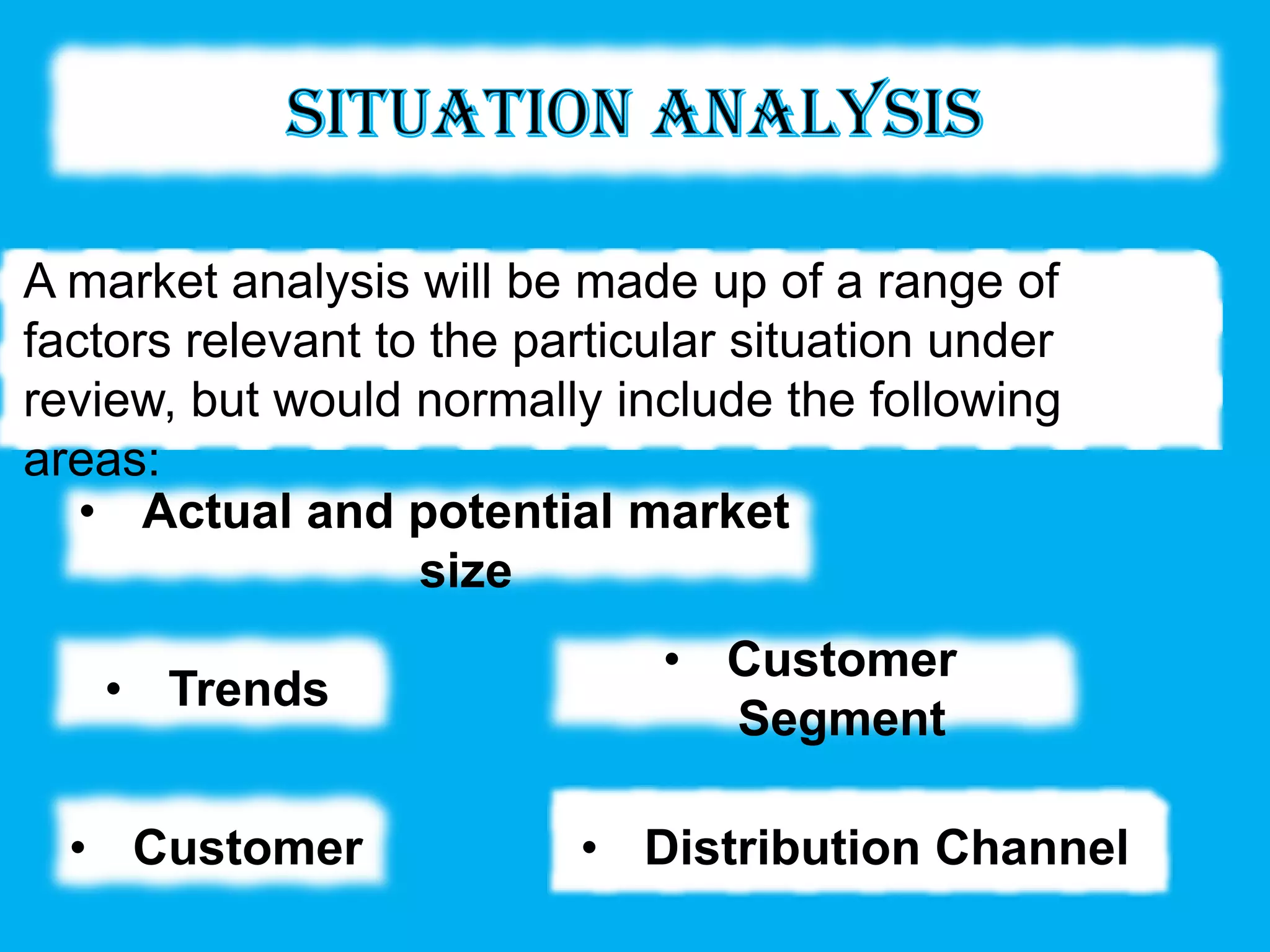
A market analysis will be made up of a range of
factors relevant to the particular situation under
review, but would normally include the following
areas:
• Actual and potential market
size
• Trends
• Customer
• Customer
Segment
• Distribution Channel
S W O T
STRENG
TH
WEAKNESSE
S
OPPORTUNITIE
S
THREATS
“An analysis that identifies the strengths and
weaknesses and the opportunities and threats in
relation to an organisation” – Elliot Rundle-Thiele
Waller “Marketing Second Edition”
“is a tool that is commonly used during the
auditing process. SWOT draws together t1he
key strengths, weakness, opportunities and
threats from the audits” – Graeme Drummond,
John Ensor, Ruth Ashford “Strategic Marketing
Planning and Control”
WHAT IS ‘’S W O T ?’’
Attributes of the organization that
hinder it in trying to achieve its
objectives
Elements of S W O T
STRENGTH
Attributes of organization that help it
achieve its objectives
WEAKNESS
ES
Elements of S W O T
OPPORTUNI
TY
Factors that are potentially helpful to
achieving the organisation’s
objectives.
THREATS
Factors that are potentially harmful to
the organizations efforts to achieve its
objectives
EXAMPLE
S
T
E
E
P
L
E
Social and Culture
Technology
Economic and market
conditions
Education, training, and
employment
Political
Legal
Environmental Protection
P – E – S – T – L
POLITICAL The influence of politics on marketing
decision
ECONOMIC Those factors that affect how much people
and organizations can spend and how they
choose to spend it
SOCIAL
CULTURAL
The social and cultural factors that affect
people’s attitudes, beliefs, behaviours,
preferences, customs and lifestyle
TECHNOLOGICA
L
Vital for competitive advantage
LEGAL Laws : Legislation enacted by elected
officials
POLITICAL/LEGAL ISSUES
Taxation policy
Monopoly controls
Environmental protection
measures
Employment law
Environmental legislation
Foreign trade agreements
Stability of the
government system
ECONOMIC FACTORS
Interest rates
Inflation rates
Money supply
Business cycles
Unemployement
GNP trends
P – E – S - T
P – E – S - T
COMPETITOR
ANALYSIS
Strategic Groups
Strategic groups are made up of organizations
within the same industry that are pursuing
equivalent strategies, targeting groups of
customers that have similar profiles.
EXAMPLE
APPLE
V
S SAMSUNG
FERRA
RI
V
S
LAMBORGHI
NI
Range of attributes to identify strategic
groups
• Size of the company
• Assets and skills
• Scope of the operation
• Breadth of the product range
• Choice of distribution channel
• Relative product quality
• Brand image
Competitor’s objectives
Three important factors :
• Whether the competitor’s current performance
is likely to be fulfilling their objectives.
• How likely the competitor is to commit further
investment to the business.
• The likely future direction of the competitor’s
strategy.
Competitor’s current and past strategies
Three area that should be explored :
• Identification of the current markets, or
market segments, within which the
competitor currently operates.
• Identification of the way the competitor has
chosen to compete in those markets.
• Comparison between the current strategy
and past strategies can be instructive.
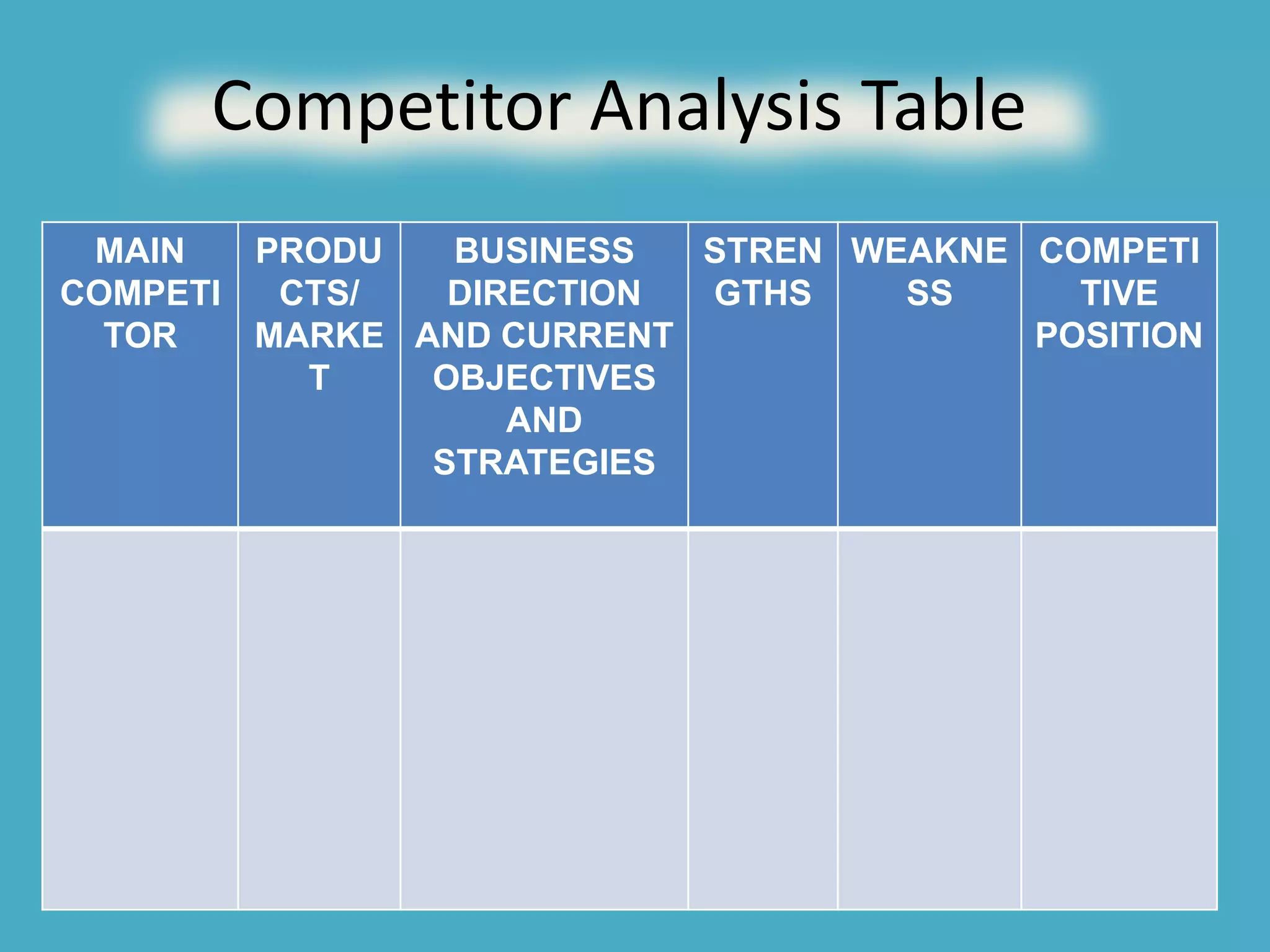
Competitor Analysis Table
MAIN
COMPETI
TOR
PRODU
CTS/
MARKE
T
BUSINESS
DIRECTION
AND CURRENT
OBJECTIVES
AND
STRATEGIES
STREN
GTHS
WEAKNE
SS
COMPETI
TIVE
POSITION
Guide to Competitive Position
Classification
• Leadership : Has major influence
• Strong : Has a wide choices of strategies
• Favourable : Exploits specific competitive
strength, often in a product
market nice.
• Tenable : Performance justifies continuation
in business
• Weak : Currently unsatisfactory
performance
Competitor’s
capabilities
A number of areas need to be
examined:
• Management capabilities
• Marketing capabilities
• Innovation capabilities
• Production capabilities
• Financial capabilities
• Certain Retaliation : The competitor is guaranteed
to react in an aggressive manner to any challenge.
• Failure to react : Competitors can be lulled into a
false sense of security in an industry that, over a
long period of time, has seen very little change.
• Specific reactions : Some competitors may react,
but only to competitive moves in certain areas.
• Inconsistent reactions : These companies’
reactions are simply not predictable.
Competitor’s future strategies and
reactions
Problems in Identifying
Competitors
• Overlooking smaller competitors by placing
too much emphasis on large visible
competitors.
• Focusing on established competitors and
ignoring potential new entrants.
• Concentrating on current domestic
competitors and disregarding international
competitors who could possibly enter the
Name of Group :
Dani Vanadi Junius
2012160512
Dina almadania
2012160822
Devina ayusanti
2012160276
Febrian nindyo
2012161236
Felicia rosmarie
2012160052
Tricia cornelia
2012160268

Marketing Situation Analysis

  • 1.
  • 2.
    If we talkabout ‘’ Situation Analysis ’’ we also talk about ‘’market audits’’. Basically ‘’Situation analysis’’ is same meaning with ‘’market audits’’
  • 3.
    Basically, an auditis the means by which a company can understand how it relates to the environment in which it operates. It is the means by which a company can identify its own strengths and weaknesses as they relate to external opportunities and threats. It is thus a way of helping management to select a position in that environment
  • 4.
    A market analysiswill be made up of a range of factors relevant to the particular situation under review, but would normally include the following areas: • Actual and potential market size • Trends • Customer • Customer Segment • Distribution Channel
  • 5.
    S W OT STRENG TH WEAKNESSE S OPPORTUNITIE S THREATS
  • 6.
    “An analysis thatidentifies the strengths and weaknesses and the opportunities and threats in relation to an organisation” – Elliot Rundle-Thiele Waller “Marketing Second Edition” “is a tool that is commonly used during the auditing process. SWOT draws together t1he key strengths, weakness, opportunities and threats from the audits” – Graeme Drummond, John Ensor, Ruth Ashford “Strategic Marketing Planning and Control” WHAT IS ‘’S W O T ?’’
  • 7.
    Attributes of theorganization that hinder it in trying to achieve its objectives Elements of S W O T STRENGTH Attributes of organization that help it achieve its objectives WEAKNESS ES
  • 8.
    Elements of SW O T OPPORTUNI TY Factors that are potentially helpful to achieving the organisation’s objectives. THREATS Factors that are potentially harmful to the organizations efforts to achieve its objectives
  • 9.
  • 10.
    S T E E P L E Social and Culture Technology Economicand market conditions Education, training, and employment Political Legal Environmental Protection
  • 11.
    P – E– S – T – L POLITICAL The influence of politics on marketing decision ECONOMIC Those factors that affect how much people and organizations can spend and how they choose to spend it SOCIAL CULTURAL The social and cultural factors that affect people’s attitudes, beliefs, behaviours, preferences, customs and lifestyle TECHNOLOGICA L Vital for competitive advantage LEGAL Laws : Legislation enacted by elected officials
  • 12.
    POLITICAL/LEGAL ISSUES Taxation policy Monopolycontrols Environmental protection measures Employment law Environmental legislation Foreign trade agreements Stability of the government system ECONOMIC FACTORS Interest rates Inflation rates Money supply Business cycles Unemployement GNP trends P – E – S - T
  • 13.
    P – E– S - T
  • 14.
  • 15.
    Strategic Groups Strategic groupsare made up of organizations within the same industry that are pursuing equivalent strategies, targeting groups of customers that have similar profiles.
  • 16.
  • 17.
    Range of attributesto identify strategic groups • Size of the company • Assets and skills • Scope of the operation • Breadth of the product range • Choice of distribution channel • Relative product quality • Brand image
  • 18.
    Competitor’s objectives Three importantfactors : • Whether the competitor’s current performance is likely to be fulfilling their objectives. • How likely the competitor is to commit further investment to the business. • The likely future direction of the competitor’s strategy.
  • 19.
    Competitor’s current andpast strategies Three area that should be explored : • Identification of the current markets, or market segments, within which the competitor currently operates. • Identification of the way the competitor has chosen to compete in those markets. • Comparison between the current strategy and past strategies can be instructive.
  • 20.
    Competitor Analysis Table MAIN COMPETI TOR PRODU CTS/ MARKE T BUSINESS DIRECTION ANDCURRENT OBJECTIVES AND STRATEGIES STREN GTHS WEAKNE SS COMPETI TIVE POSITION
  • 21.
    Guide to CompetitivePosition Classification • Leadership : Has major influence • Strong : Has a wide choices of strategies • Favourable : Exploits specific competitive strength, often in a product market nice. • Tenable : Performance justifies continuation in business • Weak : Currently unsatisfactory performance
  • 22.
  • 23.
    A number ofareas need to be examined: • Management capabilities • Marketing capabilities • Innovation capabilities • Production capabilities • Financial capabilities
  • 24.
    • Certain Retaliation: The competitor is guaranteed to react in an aggressive manner to any challenge. • Failure to react : Competitors can be lulled into a false sense of security in an industry that, over a long period of time, has seen very little change. • Specific reactions : Some competitors may react, but only to competitive moves in certain areas. • Inconsistent reactions : These companies’ reactions are simply not predictable. Competitor’s future strategies and reactions
  • 25.
    Problems in Identifying Competitors •Overlooking smaller competitors by placing too much emphasis on large visible competitors. • Focusing on established competitors and ignoring potential new entrants. • Concentrating on current domestic competitors and disregarding international competitors who could possibly enter the
  • 26.
    Name of Group: Dani Vanadi Junius 2012160512 Dina almadania 2012160822 Devina ayusanti 2012160276 Febrian nindyo 2012161236 Felicia rosmarie 2012160052 Tricia cornelia 2012160268