Situational Analysis
By: Dr. Abhishek Tiwari
Situational Analysis
American Marketing Association
“ The systematic collection and
study of past and present data to
identify trends, forces &
conditions with the potential to
influence the performance of the
business & the choice of
appropriate strategies”
Invented by Population council
Researchers in
Kenya 1989
Situation Analysis in Healthcare ?
Describes & analyses the situation regarding the health
status & health services of area e g : a Village ,District or
State
Assess the extent to which health services address
health needs
what’s happening by identifying factors facilitating or
preventing progress of Health
 also prioritises problems and needs so the plans and
strategies can address them
District Health Plan and Report
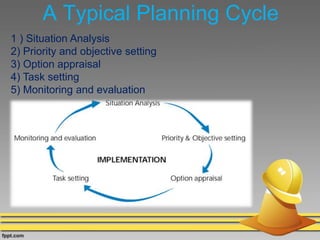
A Typical Planning Cycle
1 ) Situation Analysis
2) Priority and objective setting
3) Option appraisal
4) Task setting
5) Monitoring and evaluation
Importance
First step of a Planning cycle
Effective management tool
Considers both + / - potential
outcomes
Forecasts changes internal & external
Refreshes strategy & tactics of your
marketing
Compiles Analyses & Evaluates Influences
Importance
Applied to corporate,
Govt. Hospital ,clinics
Identifies gaps in Healthcare System
monitoring , evaluation tool of Health
Services
contributes to district
health information system
District Health Plan &
District Health Report
“Understanding where you are today is
fundamental to achieve your future goals”
HOW TO CONDUCT
Step 1: Determine a framework
Step 2: Identify what information
is already available
Step 3: Identify what information
is still required
Step 4: Collect the required
information
Step 5: Compile and write the report
Step 6:Distribute & disseminate the report
Framework-example
1.Assessment of the health district
Geography / Demography/Socio-economic profile
2.Health Status and Problem
3.Progress to Implement District Health System
4.The Management of Support Systems
Finance/transport/drug ,vaccine supply & distribution
Communication/Health information/HR
5.Public Health Sector
Facilities {Hospitals/Clinics/CHC} Referral system
6.Other Care Providers :Private/ Ayush /NGO
7.Assessment of Key Programmes
8. Other Sectors which Impact on Health
9. Summary of Key Health Problems and Conclusion
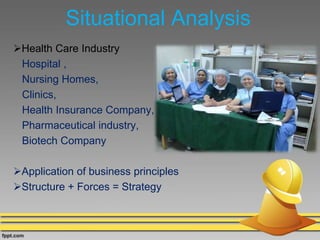
Situational Analysis
Health Care Industry
Hospital ,
Nursing Homes,
Clinics,
Health Insurance Company,
Pharmaceutical industry,
Biotech Company
Application of business principles
Structure + Forces = Strategy
5 C Analysis
Situational analysis can be conducted by three methods
1. The 5Cs Analysis
2. Porter five forces analysis
3. SWOT analysis
The 5 C Analysis
 Earlier “ 3 C Analysis ”
 Extension to 5 C adds Environmental analysis
 Market based sectors of Health care
1. Company :
 Objectives , strategy & capabilities mission &
Goals , current position
5 C Analysis
2. Competitors :
 Position ,Goal ,mission ,strategy & resources
 Capability in industry & potential threats
 Identify type Direct / Indirect/ new entrants
Get prepared to compete
3. Customers : Understand needs
(size ,potential ,demand) Advertising & Motivation
5 C Analysis
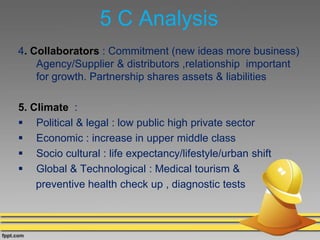
4. Collaborators : Commitment (new ideas more business)
Agency/Supplier & distributors ,relationship important
for growth. Partnership shares assets & liabilities
5. Climate :
 Political & legal : low public high private sector
 Economic : increase in upper middle class
 Socio cultural : life expectancy/lifestyle/urban shift
 Global & Technological : Medical tourism &
preventive health check up , diagnostic tests
Situational Analysis
•
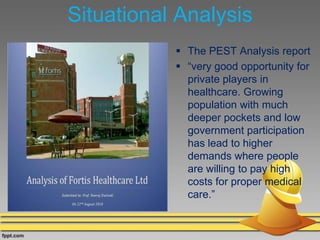
 The PEST Analysis report
 “very good opportunity for
private players in
healthcare. Growing
population with much
deeper pockets and low
government participation
has lead to higher
demands where people
are willing to pay high
costs for proper medical
care.”
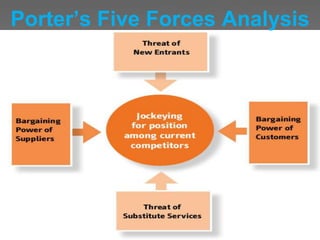
Porter’s Five Forces Analysis
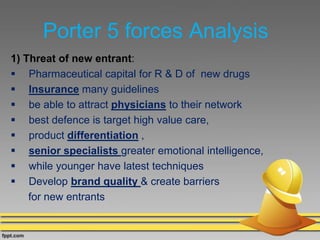
Porter 5 forces Analysis
1) Threat of new entrant:
 Pharmaceutical capital for R & D of new drugs
 Insurance many guidelines
 be able to attract physicians to their network
 best defence is target high value care,
 product differentiation ,
 senior specialists greater emotional intelligence,
 while younger have latest techniques
 Develop brand quality & create barriers
for new entrants
Porter 5 forces Analysis
2) Bargaining power of buyers/patients:
 Very limited power , exceeding demand
 Sick will take treatment in any economy
Medical tourism reduces dependency on local patients
3) Bargaining Power of Suppliers:
New drugs and the latest medications
Hospital need pharmaceutical companies and
they need the hospitals
Shortage of specialist , large power
Porter 5 forces Analysis
4) Pressure from Substitutes:
Drug industry affected by substitutes , if patents lapses
Insurance companies : not really affect
Alternative medicine which treat primary care
problems . Filling of vacant post by untrained staff
5) Competitive Rivalry:
More for Drug & Insurance sector
less amongst hospitals
Porter 5 forces Analysis
Drug R & D ,one gets patent
More : competitors are of equal size & power , same
geographical area & poor differentiation
Summary : Report ,strategy to maximise the strengths
eg targeting value in health care , Focus on
Preventive methods than control to reduce the
cost and improve quality
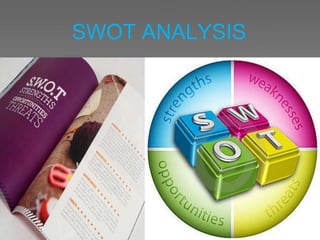
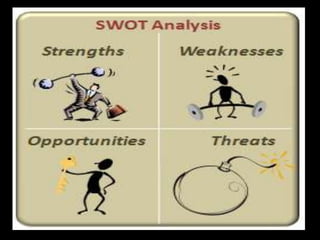
SWOT ANALYSIS
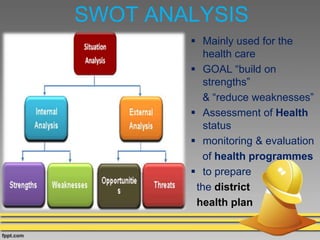
SWOT ANALYSIS
 Mainly used for the
health care
 GOAL “build on
strengths”
& “reduce weaknesses”
 Assessment of Health
status
 monitoring & evaluation
of health programmes
 to prepare
the district
health plan
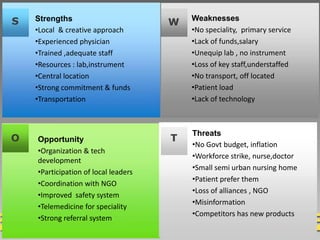
Opportunity
•Organization & tech
development
•Participation of local leaders
•Coordination with NGO
•Improved safety system
•Telemedicine for speciality
•Revised measure , indicators
Weaknesses
•No speciality, primary service
•Lack of funds
•Unequip lab , no instrument
•Loss of key staff,understaffed
•No transport, off located
•Patient load: lifestyle
•Lack of technology
Strengths
•Local & creative approach
•Experienced physician
•Trained ,adequate staff
•Resources : lab,instrument
•Central location
•Strong commitment & funds
•Transportation
Threats
•No Govt budget, inflation
•Workforce strike, nurse,doctor
•Small semi urban nursing home
•Patient prefer them
•Loss of alliances , NGO
•Misinformation
•Competitors has new products
S W
TO
Weaknesses
•No speciality, primary service
•Lack of funds,salary
•Unequip lab , no instrument
•Loss of key staff,understaffed
•No transport, off located
•Patient load
•Lack of technology
Opportunity
•Organization & tech
development
•Participation of local leaders
•Coordination with NGO
•Improved safety system
•Telemedicine for speciality
•Strong referral system
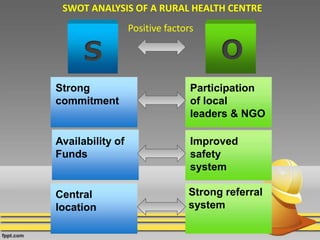
S O
Strong
commitment
Availability of
Funds
Central
location
Participation
of local
leaders & NGO
Improved
safety
system
Strong referral
system
Positive factors
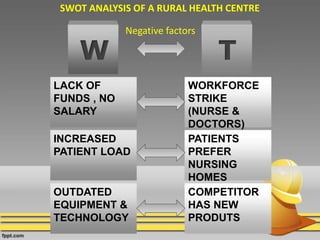
SWOT ANALYSIS OF A RURAL HEALTH CENTRE
W T
LACK OF
FUNDS , NO
SALARY
INCREASED
PATIENT LOAD
.
OUTDATED
EQUIPMENT &
TECHNOLOGY
WORKFORCE
STRIKE
(NURSE &
DOCTORS)
.
PATIENTS
PREFER
NURSING
HOMES
.
COMPETITOR
HAS NEW
PRODUTS
Negative factors
SWOT ANALYSIS OF A RURAL HEALTH CENTRE
Summary
Important areas of progress and development in
the district over the previous year.
The most important and urgent health problems of
the district.
An indication of how these priority problems will be
addressed.
Finally there should be an honest assessment of the
strengths and weaknesses of the
district that lay out the challenges for the future.
Situational Analysis
References
1) A Guide for Health Districts in South Africa
2) NRHM district health report , 2010 Aurangabad
3) Survey by Tim Size at RWHC with eleven “rural health expert
respondents”
4) ZYNX Health solutions
5) EPMG emergency physician medical group
6) Targeting value in health care ..by . Corey scurlock
7) www.healthcaresuccess.com
8) Analysis of Fortis hospitals 2010
Situational analysis in health care industry

Situational analysis in health care industry

  • 1.
  • 2.
    Situational Analysis American MarketingAssociation “ The systematic collection and study of past and present data to identify trends, forces & conditions with the potential to influence the performance of the business & the choice of appropriate strategies” Invented by Population council Researchers in Kenya 1989
  • 3.
    Situation Analysis inHealthcare ? Describes & analyses the situation regarding the health status & health services of area e g : a Village ,District or State Assess the extent to which health services address health needs what’s happening by identifying factors facilitating or preventing progress of Health  also prioritises problems and needs so the plans and strategies can address them District Health Plan and Report
  • 4.
    A Typical PlanningCycle 1 ) Situation Analysis 2) Priority and objective setting 3) Option appraisal 4) Task setting 5) Monitoring and evaluation
  • 5.
    Importance First step ofa Planning cycle Effective management tool Considers both + / - potential outcomes Forecasts changes internal & external Refreshes strategy & tactics of your marketing Compiles Analyses & Evaluates Influences
  • 6.
    Importance Applied to corporate, Govt.Hospital ,clinics Identifies gaps in Healthcare System monitoring , evaluation tool of Health Services contributes to district health information system District Health Plan & District Health Report “Understanding where you are today is fundamental to achieve your future goals”
  • 7.
    HOW TO CONDUCT Step1: Determine a framework Step 2: Identify what information is already available Step 3: Identify what information is still required Step 4: Collect the required information Step 5: Compile and write the report Step 6:Distribute & disseminate the report
  • 8.
    Framework-example 1.Assessment of thehealth district Geography / Demography/Socio-economic profile 2.Health Status and Problem 3.Progress to Implement District Health System 4.The Management of Support Systems Finance/transport/drug ,vaccine supply & distribution Communication/Health information/HR 5.Public Health Sector Facilities {Hospitals/Clinics/CHC} Referral system 6.Other Care Providers :Private/ Ayush /NGO 7.Assessment of Key Programmes 8. Other Sectors which Impact on Health 9. Summary of Key Health Problems and Conclusion
  • 9.
    Situational Analysis Health CareIndustry Hospital , Nursing Homes, Clinics, Health Insurance Company, Pharmaceutical industry, Biotech Company Application of business principles Structure + Forces = Strategy
  • 10.
    5 C Analysis Situationalanalysis can be conducted by three methods 1. The 5Cs Analysis 2. Porter five forces analysis 3. SWOT analysis The 5 C Analysis  Earlier “ 3 C Analysis ”  Extension to 5 C adds Environmental analysis  Market based sectors of Health care 1. Company :  Objectives , strategy & capabilities mission & Goals , current position
  • 11.
    5 C Analysis 2.Competitors :  Position ,Goal ,mission ,strategy & resources  Capability in industry & potential threats  Identify type Direct / Indirect/ new entrants Get prepared to compete 3. Customers : Understand needs (size ,potential ,demand) Advertising & Motivation
  • 12.
    5 C Analysis 4.Collaborators : Commitment (new ideas more business) Agency/Supplier & distributors ,relationship important for growth. Partnership shares assets & liabilities 5. Climate :  Political & legal : low public high private sector  Economic : increase in upper middle class  Socio cultural : life expectancy/lifestyle/urban shift  Global & Technological : Medical tourism & preventive health check up , diagnostic tests
  • 13.
    Situational Analysis •  ThePEST Analysis report  “very good opportunity for private players in healthcare. Growing population with much deeper pockets and low government participation has lead to higher demands where people are willing to pay high costs for proper medical care.”
  • 14.
  • 15.
    Porter 5 forcesAnalysis 1) Threat of new entrant:  Pharmaceutical capital for R & D of new drugs  Insurance many guidelines  be able to attract physicians to their network  best defence is target high value care,  product differentiation ,  senior specialists greater emotional intelligence,  while younger have latest techniques  Develop brand quality & create barriers for new entrants
  • 16.
    Porter 5 forcesAnalysis 2) Bargaining power of buyers/patients:  Very limited power , exceeding demand  Sick will take treatment in any economy Medical tourism reduces dependency on local patients 3) Bargaining Power of Suppliers: New drugs and the latest medications Hospital need pharmaceutical companies and they need the hospitals Shortage of specialist , large power
  • 17.
    Porter 5 forcesAnalysis 4) Pressure from Substitutes: Drug industry affected by substitutes , if patents lapses Insurance companies : not really affect Alternative medicine which treat primary care problems . Filling of vacant post by untrained staff 5) Competitive Rivalry: More for Drug & Insurance sector less amongst hospitals
  • 18.
    Porter 5 forcesAnalysis Drug R & D ,one gets patent More : competitors are of equal size & power , same geographical area & poor differentiation Summary : Report ,strategy to maximise the strengths eg targeting value in health care , Focus on Preventive methods than control to reduce the cost and improve quality
  • 19.
  • 20.
    SWOT ANALYSIS  Mainlyused for the health care  GOAL “build on strengths” & “reduce weaknesses”  Assessment of Health status  monitoring & evaluation of health programmes  to prepare the district health plan
  • 22.
    Opportunity •Organization & tech development •Participationof local leaders •Coordination with NGO •Improved safety system •Telemedicine for speciality •Revised measure , indicators Weaknesses •No speciality, primary service •Lack of funds •Unequip lab , no instrument •Loss of key staff,understaffed •No transport, off located •Patient load: lifestyle •Lack of technology Strengths •Local & creative approach •Experienced physician •Trained ,adequate staff •Resources : lab,instrument •Central location •Strong commitment & funds •Transportation Threats •No Govt budget, inflation •Workforce strike, nurse,doctor •Small semi urban nursing home •Patient prefer them •Loss of alliances , NGO •Misinformation •Competitors has new products S W TO Weaknesses •No speciality, primary service •Lack of funds,salary •Unequip lab , no instrument •Loss of key staff,understaffed •No transport, off located •Patient load •Lack of technology Opportunity •Organization & tech development •Participation of local leaders •Coordination with NGO •Improved safety system •Telemedicine for speciality •Strong referral system
  • 23.
    S O Strong commitment Availability of Funds Central location Participation oflocal leaders & NGO Improved safety system Strong referral system Positive factors SWOT ANALYSIS OF A RURAL HEALTH CENTRE
  • 24.
    W T LACK OF FUNDS, NO SALARY INCREASED PATIENT LOAD . OUTDATED EQUIPMENT & TECHNOLOGY WORKFORCE STRIKE (NURSE & DOCTORS) . PATIENTS PREFER NURSING HOMES . COMPETITOR HAS NEW PRODUTS Negative factors SWOT ANALYSIS OF A RURAL HEALTH CENTRE
  • 25.
    Summary Important areas ofprogress and development in the district over the previous year. The most important and urgent health problems of the district. An indication of how these priority problems will be addressed. Finally there should be an honest assessment of the strengths and weaknesses of the district that lay out the challenges for the future.
  • 26.
    Situational Analysis References 1) AGuide for Health Districts in South Africa 2) NRHM district health report , 2010 Aurangabad 3) Survey by Tim Size at RWHC with eleven “rural health expert respondents” 4) ZYNX Health solutions 5) EPMG emergency physician medical group 6) Targeting value in health care ..by . Corey scurlock 7) www.healthcaresuccess.com 8) Analysis of Fortis hospitals 2010

Editor's Notes

  • #11 Political and regulatory
  • #12 Political and regulatory